eztio

DNOOO blank theme is active for local preview.

Disposable vs Reusable Medical Masks: Which Cuts Total Cost for High-Volume Clinical Use

The question sounds like a sustainability debate. It isn't. At 100,000+ pieces per year, this is a procurement math problem — and the math has a clear answer for most regulated clinical environments.

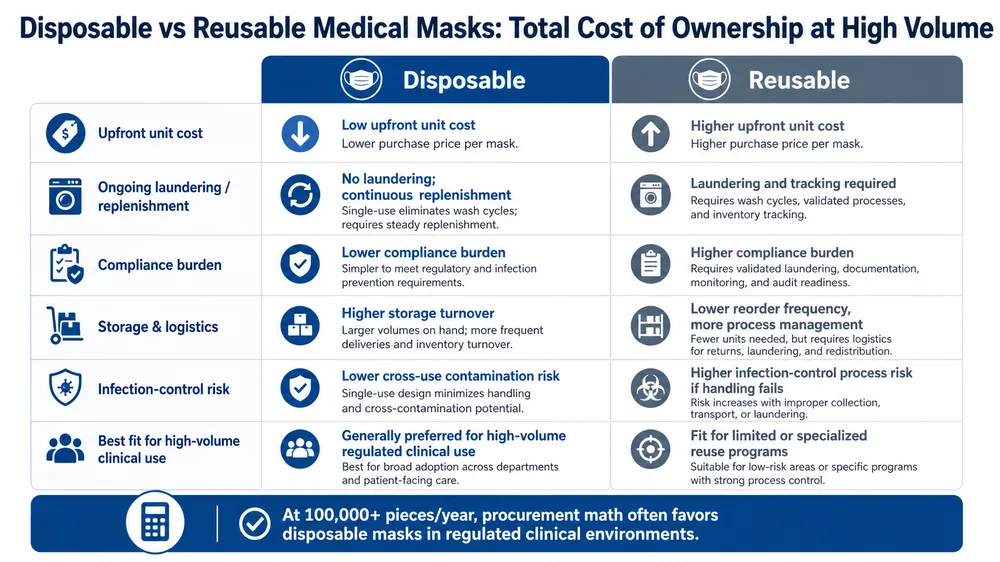
Reusable masks carry a lower per-unit purchase price. That's the number that gets quoted in budget meetings. What doesn't get quoted is the laundering cost per cycle, the compliance documentation burden, the infection-control liability exposure, and the supply chain overhead of managing a reusable program at scale. When you add those up, the economics flip — and they flip hard in high-volume clinical settings.

Quick verdict: For regulated clinical use at volume, disposable medical masks deliver lower total cost of ownership, lower compliance risk, and more predictable supply chain management than reusable alternatives. Reusables have a legitimate role in specific low-volume, non-clinical, or sustainability-mandate scenarios — but they are not the cost-efficient choice for hospital-grade procurement at scale.

The rest of this article shows you exactly why, with the numbers and the regulatory context to back it up.

Side-by-side cost comparison chart of disposable vs reusable medical masks showing total cost of ownership at high volume

What "Disposable" and "Reusable" Actually Mean in Regulatory Terms

Before the cost comparison, the definitions matter — because "reusable medical mask" means different things in different regulatory contexts, and that ambiguity is where procurement decisions go wrong.

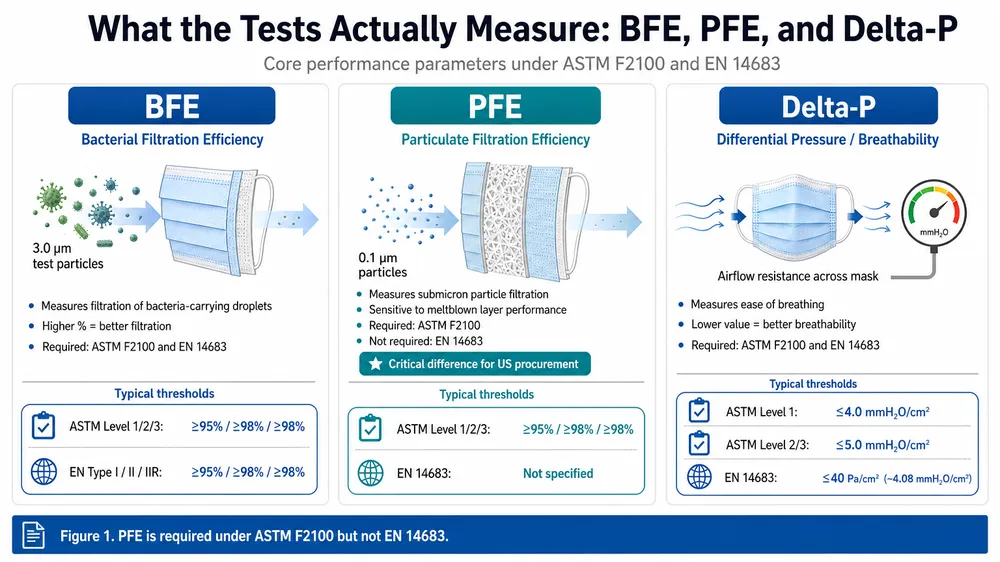
A disposable medical mask is a single-use device designed to be worn once and discarded. Under ASTM F2100 (the US standard) and EN 14683 (the EU standard), disposable surgical and medical masks are tested as manufactured — the BFE, PFE, and Delta-P values on the test report reflect the mask's performance in its original, unused state. The regulatory assumption is single use. There is no provision in either standard for performance after laundering or repeated wear.

A reusable mask in clinical contexts typically refers to fabric or multi-layer cloth masks, or purpose-built respirators with replaceable filter cartridges. Some reusable masks carry their own certifications — certain elastomeric half-masks with replaceable filters are NIOSH-approved, for example. But the category of "reusable surgical mask" that meets ASTM F2100 or EN 14683 as a reusable device is essentially nonexistent in mainstream clinical procurement. The standards don't contemplate it.

This distinction matters for your procurement documentation. When a hospital or institutional buyer specifies "ASTM F2100 Level 2" or "EN 14683 Type IIR," they are specifying a disposable device. Substituting a reusable mask — even a high-quality one — doesn't satisfy that specification, and it creates a compliance gap that surfaces during procurement audits.

(We've seen this play out with buyers who tried to introduce reusable masks into a hospital supply program during a shortage period. The infection control committee rejected them not because of performance concerns, but because the documentation didn't match the procurement spec. The masks sat in a warehouse.)

TCO Breakdown: The Numbers That Change the Decision

The unit price comparison is the wrong starting point. Here's the full cost picture at 100,000 pieces per year.

Cost Dimension Disposable (per use) Reusable (per use, amortized)
Unit purchase cost $0.08–$0.25 (bulk, certified) $2–$8 per mask, amortized over claimed wash cycles
Laundering / replenishment None $0.50–$1.50 per wash cycle (industrial laundry)
Compliance documentation Included with certified shipment Requires separate validation per wash protocol
Storage footprint High (bulk cartons) Lower per-unit, but requires clean storage + rotation tracking
Infection-control liability Defined by single-use protocol Dependent on laundering compliance — variable
Supply chain management Replenishment order cycle Laundering logistics, loss/damage tracking, rotation management
Regulatory audit exposure Low (certified, documented) Higher (wash protocol validation required)

The laundering cost is the number most buyers underestimate. Industrial laundering for medical-grade textiles — the kind that meets healthcare infection-control standards — runs $0.50 to $1.50 per cycle depending on facility and volume. A reusable mask rated for 30 wash cycles accumulates $15–$45 in laundering cost over its life, on top of the $2–$8 purchase price. At 100,000 uses per year, that laundering overhead alone can exceed the entire annual cost of a disposable program.

The compliance documentation burden is the second hidden cost. Disposable masks from a certified manufacturer ship with test reports, certificates of conformity, and FDA/CE documentation already in the package. Your import process and procurement audit are covered. A reusable mask program requires you to validate the laundering protocol, document wash cycle compliance, and demonstrate that the masks still meet performance specs after repeated washing — none of which comes pre-packaged from a fabric supplier.

Bar chart showing cost per use breakdown for disposable vs reusable medical masks including laundering and compliance overhead

Why ASTM F2100 and EN 14683 Favor Single-Use in Hospital Procurement

The regulatory landscape isn't neutral on this question. Both major standards frameworks — ASTM F2100 in the US and EN 14683 in the EU — are built around single-use device assumptions, and that shapes how hospital procurement specs are written.

ASTM F2100 defines three performance levels for surgical masks:

  • Level 1: BFE ≥95%, PFE ≥95%, Delta-P <4.0 mmH₂O/cm²
  • Level 2: BFE ≥98%, PFE ≥98%, Delta-P <5.0 mmH₂O/cm²
  • Level 3: BFE ≥98%, PFE ≥98%, Delta-P <5.0 mmH₂O/cm², plus higher fluid resistance

These performance values are tested on the mask as manufactured. There is no ASTM F2100 test protocol for post-laundering performance. When a hospital procurement spec says "ASTM F2100 Level 2," it is implicitly specifying a disposable device — because that's the only device category the standard covers.

EN 14683 follows the same logic. Type I, Type II, and Type IIR classifications are based on BFE testing of the mask as manufactured. Type IIR adds splash resistance. None of these classifications contemplate reuse.

The practical consequence: if your buyer is a hospital, a clinic, or any institution that references these standards in their procurement documentation, you are selling them disposable masks. The standard doesn't give reusables a path to compliance in this context.

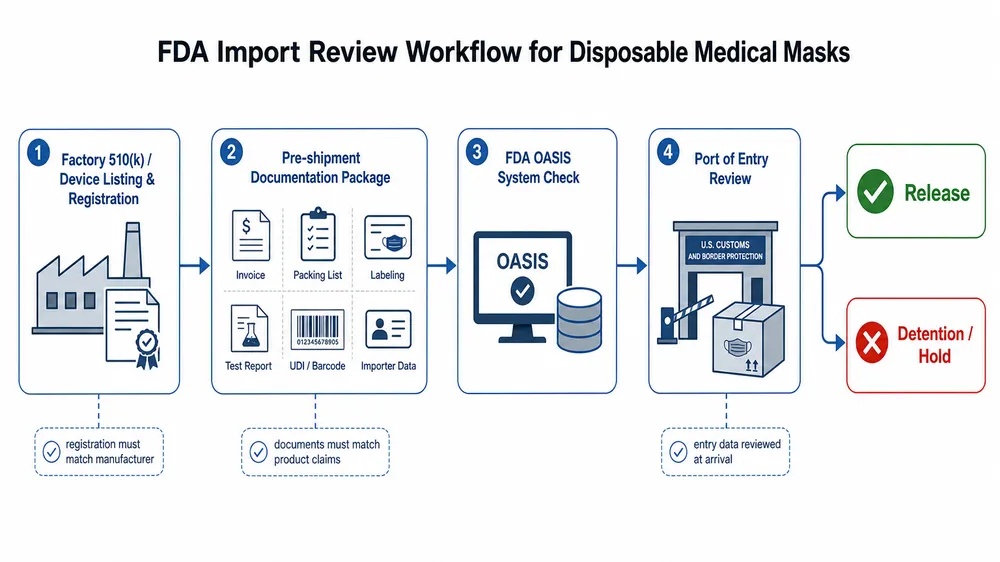
FDA 510(k) registration adds another layer. Our Disposable Medical Masks carry FDA 510(k) clearance, which means the device has been reviewed and cleared for its intended single-use application. A reusable mask program doesn't have an equivalent clearance pathway for the same use case — the device category simply doesn't exist in the 510(k) database in the same form.

(The EU MDR situation is worth noting separately. Since the Medical Device Regulation replaced the old MDD in 2021, the technical file requirements for CE-marked medical masks have become significantly more demanding. Buyers importing into the EU for the first time often don't realize how much documentation their importer of record needs. We've walked multiple European customers through this — it's manageable, but it requires preparation before the order, not after.)

Supply Chain Reliability: Replenishment Cycles vs Laundering Logistics

This is the operational dimension that gets the least attention in cost comparisons, and it's where reusable programs consistently underperform at scale.

A disposable mask program has a simple supply chain: you order, we manufacture and ship, you receive and distribute. Replenishment is a procurement cycle. The masks arrive certified, packaged, and ready for use. Your inventory management is straightforward — carton counts, par levels, reorder triggers.

A reusable mask program introduces a parallel logistics operation: collection, transport to laundry, washing, drying, inspection, repackaging, redistribution. Each step is a failure point. Masks get lost in the laundry cycle (typical loss rates in institutional programs run 5–15% per year). Masks get damaged and need replacement. Wash cycle compliance needs to be tracked and documented. The laundry facility needs to meet healthcare infection-control standards — not every commercial laundry does.

At 100,000 uses per year, the laundering logistics operation is not trivial. You need a contracted laundry partner, a tracking system, a replacement budget for losses, and a compliance documentation process. That infrastructure has a cost — in staff time, in contracted services, in management overhead — that rarely appears in the initial cost comparison.

We supply buyers who have tried both models. The ones who switched from reusable to disposable programs consistently report that the operational simplification was as valuable as the cost reduction. One distributor supplying a network of outpatient clinics told us their reusable program required a part-time coordinator just to manage the laundering logistics. That salary didn't appear in the original cost model.

Buyer Decision Matrix: Which Scenario Favors Which Option

Not every use case points to disposable. Here's where each option makes commercial sense.

Disposable wins when:

  • Regulated clinical settings — hospitals, surgical centers, outpatient clinics, diagnostic labs. ASTM F2100 or EN 14683 compliance is required, and the procurement spec references these standards explicitly. Disposable is the only compliant option.
  • High-volume procurement — 50,000+ pieces per year. At this scale, the laundering overhead of a reusable program exceeds the unit cost savings, and supply chain simplicity has real operational value.
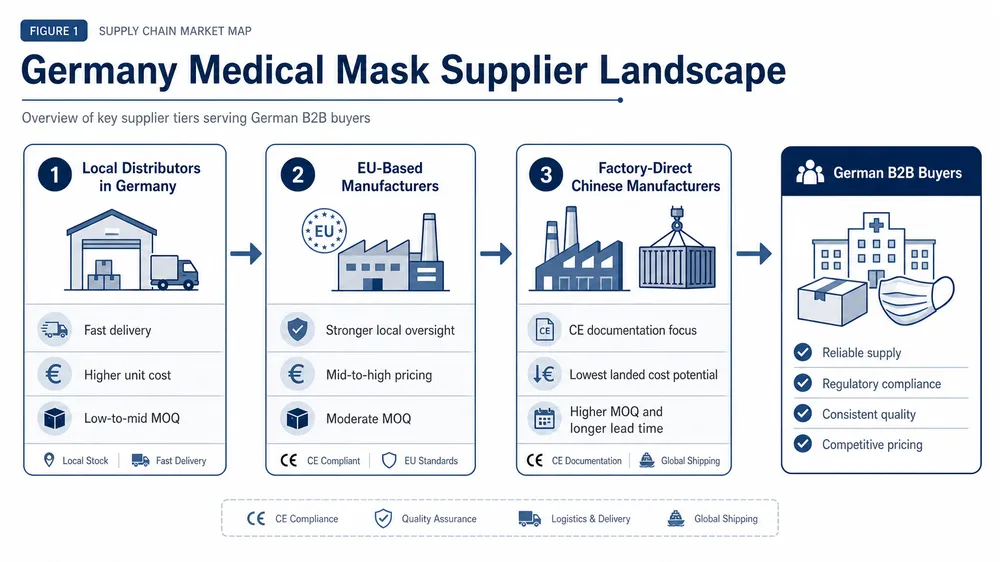
  • Private-label and distribution programs — distributors building their own mask brands need certified, documented products that clear customs without buyer-side compliance work. Disposable, certified masks are the only practical option for this channel.
  • Infection-sensitive environments — ICUs, isolation wards, oncology units, any setting where cross-contamination risk is elevated. Single-use protocol eliminates the laundering compliance variable entirely.
  • Markets with active regulatory enforcement — US (FDA), EU (MDR), Australia (TGA). Customs clearance and procurement audit requirements favor certified disposable devices.

Reusable has a role when:

  • Non-clinical, low-volume settings — community health workers, administrative staff, non-patient-facing roles where ASTM/EN compliance is not required and volume is low enough that laundering logistics are manageable.
  • Sustainability mandate environments — some institutional buyers face ESG reporting requirements or sustainability commitments that favor reusable products. In these cases, the compliance and cost trade-offs are accepted as part of the mandate.
  • Emergency or supply-constrained situations — when certified disposable supply is disrupted, reusable masks provide a fallback. This is a contingency use case, not a primary procurement strategy.

The honest summary: reusable masks are a legitimate product category. They are not the right answer for high-volume regulated clinical procurement, and the cost comparison at scale doesn't support them as the lower-cost option once you account for the full TCO.

Decision matrix showing which clinical and procurement scenarios favor disposable vs reusable medical masks

The Meltblown Variable: Why Disposable Spec Consistency Matters More Than It Looks

There's a technical dimension to this comparison that most buyers don't think about until they've had a filtration failure.

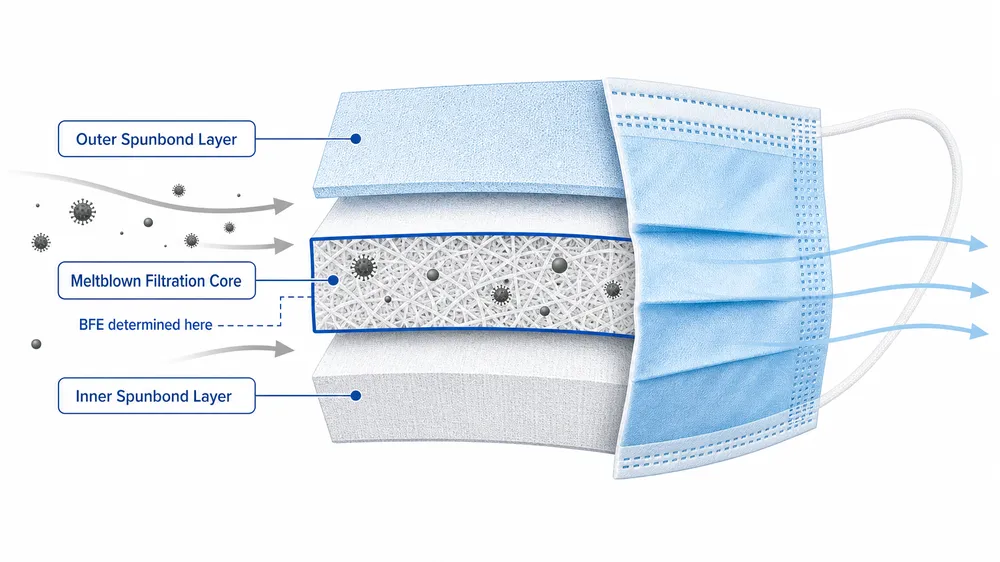
The performance of a disposable medical mask — the BFE and PFE numbers on the test report — is determined almost entirely by the meltblown nonwoven layer. Meltblown fabric is the middle layer in a 3-ply or 4-ply mask. It's produced by extruding polymer through fine nozzles at high velocity, creating a web of ultrafine fibers that trap particles and bacteria. The fiber diameter, basis weight, and electrostatic charge level determine filtration efficiency. Change any of those variables and the BFE changes.

Most mask factories buy meltblown fabric from outside suppliers. That means their filtration performance is only as consistent as their fabric supplier's production. During normal market conditions, this is manageable. During supply disruptions — and we've seen several significant ones since 2020 — factories without their own meltblown capacity either stop shipping or substitute fabric from alternative suppliers, sometimes without updating their test documentation.

We produce our own meltblown fabric. The fiber diameter, basis weight, and electrostatic treatment are set to our spec, not a supplier's. When you order a mask rated at ≥98% BFE from us, we're not relying on a third-party roll to deliver that number — we made the material to that spec, and we batch-test it before it goes into production. Our in-house QC lab runs BFE, PFE, and Delta-P on every production batch, so a spec deviation gets caught before it becomes a shipment problem.

This matters for the disposable vs reusable comparison because it's a disposable-specific advantage that reusables cannot replicate. A reusable fabric mask has no equivalent of a BFE test report that's backed by controlled meltblown production. The filtration performance of a woven or knit fabric mask degrades with washing, and there's no standardized test protocol to track that degradation over time. The spec consistency that makes disposables reliable in clinical settings is a function of controlled manufacturing — and it's only available in the disposable category.

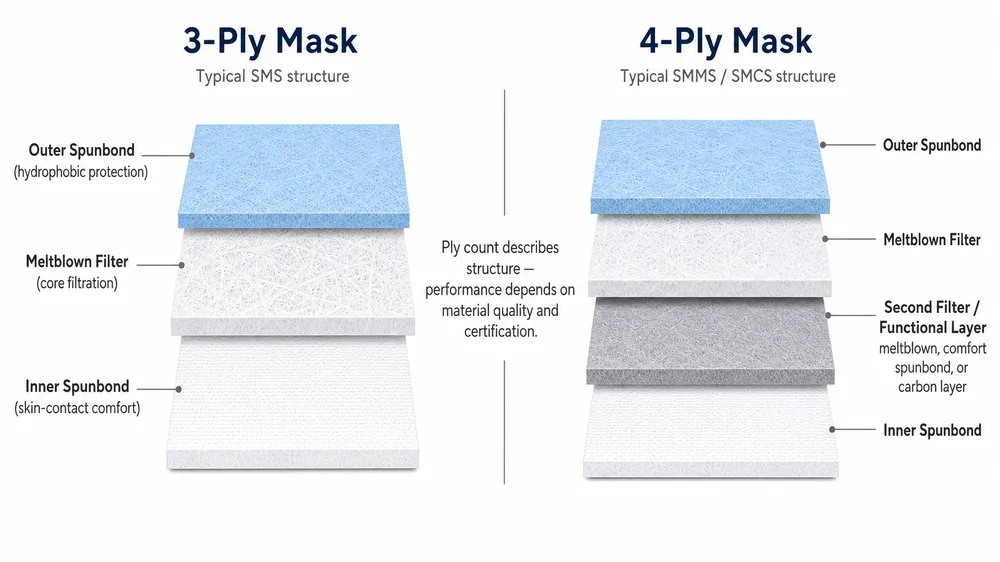
Our 3-ply disposable medical mask and 4-ply disposable medical mask lines both run on this same meltblown production foundation. The 4-ply configuration adds an additional spunbond layer for enhanced fluid resistance — relevant for surgical and high-exposure clinical settings where ASTM F2100 Level 2 or Level 3 performance is specified.

Sourcing Checklist: What to Verify Before Placing a Bulk Disposable Order

If the TCO analysis points you toward disposable, here's what to verify before committing to a supplier. These are the gaps that create problems at customs or during procurement audits.

Certification documentation:

  • FDA 510(k) registration number (verifiable in the FDA database — don't accept a certificate alone)
  • CE marking under EU MDR, with the notified body number and technical file reference
  • ISO 13485:2016 certification (medical device quality management — not just ISO 9001)
  • Third-party test reports for BFE, PFE, and Delta-P from an accredited lab

Filtration layer control:

  • Ask whether the factory produces its own meltblown fabric or sources it externally
  • If sourced externally, ask for the fabric supplier's name and their own test documentation
  • Request batch-level BFE test reports, not just a single certification-run report

Manufacturing environment:

  • Cleanroom classification for mask production (ISO 8 / Class 100,000 is the standard for medical-grade output)
  • Ask whether the factory has passed a third-party facility audit (SGS, Bureau Veritas, or equivalent)

Order and documentation:

  • Confirm the certificate of conformity and test reports will ship with the goods
  • Confirm the mask grade (ASTM Level 1, 2, or 3; EN 14683 Type I, II, or IIR) matches your procurement spec
  • Confirm MOQ and lead time in writing before sample approval

(One thing we see regularly: buyers approve samples from a factory's best production run, then receive bulk orders made from a different meltblown batch. The way to prevent this is to request batch-specific BFE test reports with each shipment, not just a one-time certification document. We provide these as standard — it's part of our outgoing inspection process.)

Our facility runs in a Class 100,000 (ISO 8) cleanroom, holds ISO 13485:2016 and ISO 9001:2015 certifications, and carries FDA 510(k) registration and CE (EU MDR) marking. The 50,000-piece MOQ on standard SKUs is designed to support trial programs before full clinical rollout — you don't need to commit to a million-piece order to validate the product against your procurement spec.

For buyers building private-label programs, we handle OEM packaging in-house. Your brand on our certified product, with the full compliance documentation stack already in place. The customs clearance and procurement audit work is done before the masks leave our facility.

If your volume, grade requirements, and destination market are clear, send them through to get a factory-direct quote — we'll come back with certified product specs, pricing, and the documentation checklist your import process needs.

FAQ: Disposable vs Reusable Medical Masks

Does a reusable mask meet ASTM F2100 or EN 14683 for hospital procurement?

No. Both ASTM F2100 and EN 14683 test masks as manufactured, single-use devices. There is no performance classification under either standard for reusable masks. If your procurement spec references ASTM F2100 Level 1–3 or EN 14683 Type I–IIR, you are specifying a disposable device. A reusable mask — regardless of quality — does not satisfy that specification and will not pass a procurement audit that references these standards.

At what volume does disposable become cheaper than reusable on a per-use basis?

The crossover point depends on your laundering cost and loss rate, but in most institutional settings it occurs well below 50,000 uses per year. At industrial laundry rates of $0.50–$1.50 per cycle, a reusable mask rated for 30 wash cycles accumulates $15–$45 in laundering cost alone — before accounting for losses, replacement costs, and compliance overhead. A certified disposable mask in bulk procurement typically runs $0.08–$0.25 per use, all-in. The math favors disposable at almost any clinical volume.

What BFE level do I need for surgical and clinical use?

For general clinical use and standard surgical procedures, ASTM F2100 Level 2 (BFE ≥98%, PFE ≥98%) is the most common specification. Level 3 adds higher fluid resistance and is specified for procedures with elevated splash risk. EN 14683 Type IIR is the EU equivalent for splash-resistant surgical masks. If your buyer's procurement spec doesn't specify a level, ask — the difference between Level 1 and Level 2 is meaningful in regulated clinical settings, and supplying the wrong grade creates a compliance gap.

Can I run a private-label disposable mask program without managing my own compliance documentation?

Yes, if you source from a factory that already holds the relevant certifications. Our FDA 510(k) registration and CE (EU MDR) marking cover the product as manufactured — your private-label program inherits that compliance foundation. You'll need to ensure your labeling meets the destination market's requirements (FDA labeling rules for the US, MDR labeling requirements for the EU), but the underlying product certification is already in place. We walk buyers through the labeling requirements as part of the OEM setup process.

What's the minimum order for a trial program before full clinical rollout?

Our standard MOQ is 50,000 pieces for standard SKUs. That's sized to support a meaningful trial — enough volume to run a pilot program across a facility or a small distribution network, validate the product against your procurement spec, and generate the usage data you need before committing to a larger order.

Inside the 4 Ply Disposable Medical Mask: Layer Structure, Meltblown Placement, and BFE Targets

Most spec sheets list "4 ply" as a feature. Few explain what those four layers actually do, where the filtration work happens, or why two meltblown layers produce a meaningfully different BFE outcome than one. That gap matters when you're evaluating supplier claims, writing procurement specs, or trying to understand why two masks with identical layer counts can test at ≥95% and ≥98% BFE respectively.

This article walks through the physical layer stack of a 4 ply disposable medical mask, explains the role each layer plays, and connects meltblown placement logic to the BFE numbers you'll see on test reports. We also cover what in-house versus outsourced meltblown production means for batch consistency — a sourcing variable that rarely appears on spec sheets but shows up clearly in QC data over time.

Cross-section diagram of a 4 ply disposable medical mask showing outer spunbond, dual meltblown filtration layers, and inner spunbond
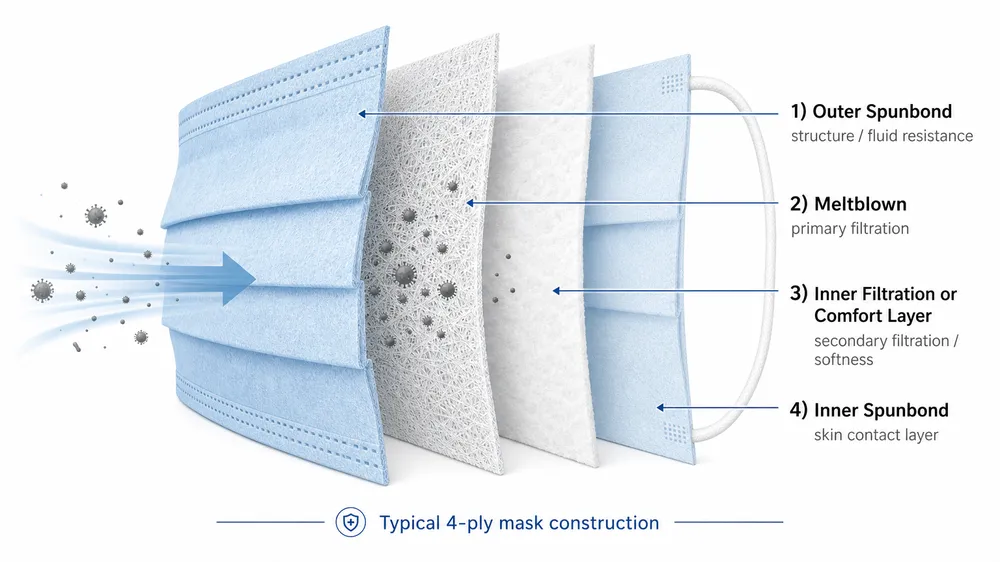
Figure 1. Layer order in a standard 4 ply disposable medical mask: outer spunbond (fluid barrier and structural shell), first meltblown (primary filtration), second meltblown (secondary filtration), inner spunbond (skin-contact comfort layer). The dual meltblown core is what separates this construction from a standard 3 ply mask.

The four-layer stack: what each layer actually does

A 4 ply disposable medical mask runs outer spunbond → meltblown → meltblown → inner spunbond. That sequence is not arbitrary. Each layer has a specific job, and the order determines how well the mask performs under the fluid and particulate challenges defined by EN 14683 and ASTM F2100.

Outer spunbond (Layer 1)

The outer layer is polypropylene spunbond nonwoven, typically 25–30 gsm. Its job is structural and protective: it holds the mask's shape, provides the first line of resistance against fluid splash, and protects the filtration layers underneath from direct contamination. In masks tested to EN 14683 Type IIR or ASTM F2100 Level 2/3, the outer spunbond contributes to the splash resistance (SRS) result — the 120 mmHg synthetic blood penetration test. It does not filter particles. That work belongs entirely to the meltblown layers.

First meltblown layer (Layer 2) — primary filtration

This is where most of the filtration work happens. Meltblown polypropylene is produced by extruding molten PP through fine nozzles under high-velocity hot air, creating a web of fibers typically 1–5 microns in diameter. The resulting fabric has a high surface area and, critically, carries an electrostatic charge applied during production. That charge is what captures sub-micron particles — bacteria, aerosols, and fine particulates — through electrostatic attraction rather than purely mechanical interception.

Basis weight for the first meltblown layer in a 4 ply mask typically runs 20–30 gsm. Fiber diameter and charge density are the two variables that most directly determine filtration efficiency. A meltblown layer with consistent 2-micron fiber diameter and stable charge will test reliably at ≥95% BFE. One with variable fiber diameter or degraded charge — common in lower-grade or improperly stored meltblown fabric — will not.

(We run our meltblown line at a controlled fiber diameter target of 2–3 microns. When we receive meltblown from outside suppliers during peak demand periods, the first thing we check is charge retention — it degrades faster than most buyers realize, especially in humid storage conditions.)

Second meltblown layer (Layer 3) — filtration redundancy and BFE ceiling

The second meltblown layer is what separates a 4 ply construction from a 3 ply mask in filtration terms. It adds a second electrostatic filtration barrier, catching particles that passed through or around the first layer. The combined effect of two meltblown layers — each independently charged and each contributing its own fiber matrix — is what allows a well-constructed 4 ply mask to reach ≥98% BFE, compared to the ≥95% ceiling typical of a single-meltblown 3 ply mask.

The second layer also provides redundancy. If the first meltblown layer has a localized basis weight variation or a charge inconsistency in a specific zone, the second layer compensates. This is why dual-meltblown construction is specified for higher-risk clinical environments and why EN 14683 Type IIR and ASTM F2100 Level 3 both require higher BFE thresholds that a single meltblown layer struggles to meet consistently across a full production batch.

Inner spunbond (Layer 4)

The inner layer is also polypropylene spunbond, typically 20–25 gsm, but softer in texture than the outer layer. Its function is comfort and moisture management at the skin-contact surface. It does not contribute to filtration. What it does affect is wearability over extended shifts — a factor that matters to hospital procurement teams specifying masks for clinical staff who wear them for hours at a time.

Why meltblown placement determines your BFE ceiling

BFE (Bacterial Filtration Efficiency) is measured by passing a standardized aerosol of Staphylococcus aureus through the mask at a controlled flow rate and counting what gets through. The result is a percentage of particles captured. The meltblown layer is the only layer in the stack that meaningfully contributes to this number.

Three variables in the meltblown layer control BFE outcome:

Variable Effect on BFE What goes wrong when it's off
Fiber diameter Smaller fibers = higher surface area = better capture Coarser fibers reduce filtration efficiency, especially for sub-micron particles
Basis weight (gsm) Higher gsm = denser fiber matrix = more capture opportunities Too low gsm creates gaps; too high increases breathing resistance (Delta-P)
Electrostatic charge Charge captures particles that mechanical interception misses Charge degrades with humidity, age, or improper storage — BFE drops without visible change to the fabric

A single meltblown layer optimized for all three variables can reach ≥95% BFE. Reaching ≥98% consistently across a full production batch requires either a very high-spec single layer (which increases Delta-P and makes the mask harder to breathe through) or a dual-layer configuration that distributes the filtration load across two layers while keeping each layer's basis weight — and therefore breathing resistance — at a manageable level.

This is the engineering reason dual meltblown exists. It's not a marketing layer count. It's a way to hit a higher BFE ceiling without pushing Delta-P above the limits set by EN 14683 (≤40 Pa/cm²) and ASTM F2100 (≤5.0 mmH₂O/cm² for Level 2, ≤5.0 mmH₂O/cm² for Level 3).

Bar chart comparing BFE performance of single meltblown 3 ply mask versus dual meltblown 4 ply mask against EN 14683 and ASTM F2100 thresholds
Figure 2. Typical BFE ranges by meltblown configuration. Single meltblown (3 ply) reliably reaches ≥95% BFE, meeting EN 14683 Type II and ASTM F2100 Level 1. Dual meltblown (4 ply) reaches ≥98% BFE, meeting EN 14683 Type IIR and ASTM F2100 Level 2/3 thresholds. Delta-P remains within standard limits in both configurations when basis weight is properly balanced.

BFE target ranges and the standards that govern them

When a supplier quotes a BFE number, it should always be tied to a specific test standard and a specific test method. The two standards most relevant to Disposable Medical Masks in international trade are EN 14683 (EU) and ASTM F2100 (US).

EN 14683 grade mapping:

Grade BFE Requirement Splash Resistance Typical Construction
Type I ≥95% Not required 3 ply single meltblown
Type II ≥98% Not required 4 ply dual meltblown
Type IIR ≥98% ≥120 mmHg 4 ply dual meltblown + treated outer layer

ASTM F2100 grade mapping:

Level BFE Requirement PFE Requirement Delta-P Limit Typical Construction
Level 1 ≥95% ≥95% ≤4.0 mmH₂O/cm² 3 ply single meltblown
Level 2 ≥98% ≥98% ≤5.0 mmH₂O/cm² 4 ply dual meltblown
Level 3 ≥98% ≥98% ≤5.0 mmH₂O/cm² 4 ply dual meltblown (high-fluid-resistance outer)

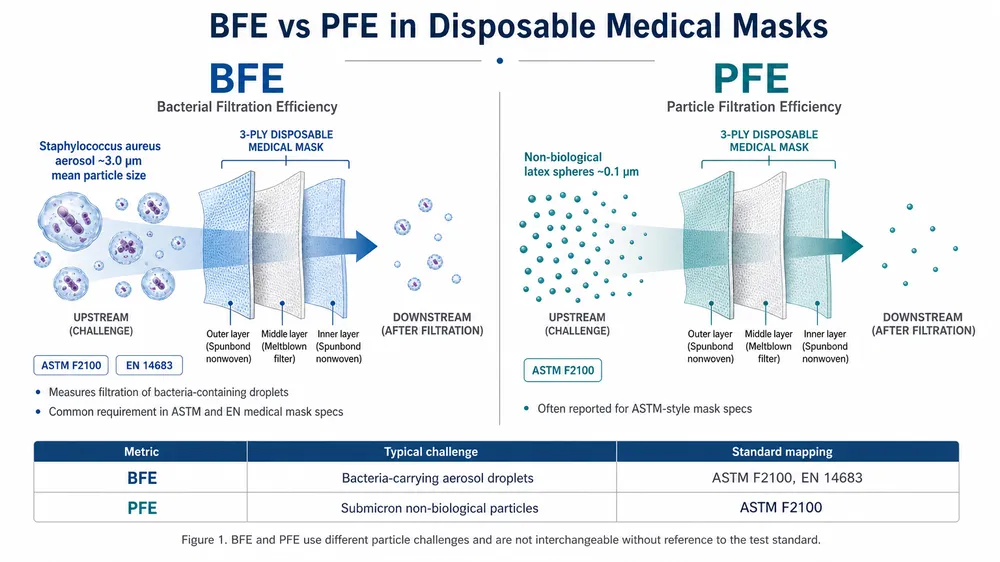
A few things worth noting in these tables. First, PFE (Particulate Filtration Efficiency) is a separate test from BFE — it uses latex microspheres at 0.1 micron rather than bacteria, and it's a harder test to pass. A mask can hit ≥98% BFE and still fall short on PFE if the meltblown charge is inconsistent. Second, Delta-P (differential pressure, or breathing resistance) is the constraint that limits how much meltblown you can stack. You cannot simply add more meltblown layers to chase a higher BFE number without eventually pushing Delta-P above the standard limit.

For buyers sourcing into US hospital or institutional channels, ASTM F2100 Level 2 is the most common specification. For EU hospital tenders, EN 14683 Type IIR is the standard entry requirement. Both require the dual meltblown construction described above.

In-house vs outsourced meltblown: the sourcing variable that doesn't appear on spec sheets

Here is the question most buyers don't ask: where does the meltblown fabric come from?

A factory that buys meltblown from a third-party supplier has no direct control over fiber diameter, basis weight consistency, or electrostatic charge at the time of production. They receive rolls of fabric, run incoming inspection (if they have the equipment), and proceed to production. If the meltblown batch has degraded charge or inconsistent basis weight, the BFE result on that production run will be lower than the certification sample — and the buyer may not find out until their own QC or, worse, until a downstream audit.

We produce meltblown in-house. That means we control fiber diameter at the extrusion stage, set basis weight to our own spec, and apply electrostatic charge under controlled conditions. When we run a production batch of 4 Ply Disposable Medical Masks, the meltblown going into that batch was produced in the same facility, under the same QC system, within a defined time window before use. Charge retention is not a variable we manage by hoping the supplier stored the rolls correctly.

This matters for batch-to-batch consistency. A factory sourcing meltblown externally might produce a certification sample that tests at ≥98% BFE, then ship production batches where the meltblown came from a different supplier lot with different charge characteristics. The mask looks identical. The test report from the certification sample still says ≥98%. But the actual production batch may test lower.

The way to verify this is to ask for batch-specific test reports, not just certification documents. A supplier with in-house testing capability should be able to provide BFE, PFE, and Delta-P results tied to specific production lot numbers — not just a single certificate issued against a sample submitted months earlier.

How to read a 4 ply mask test report

When you receive a test report for a 4 ply disposable medical mask, these are the values that matter and what acceptable ranges look like:

Parameter Test Method Acceptable Range (4 ply, dual meltblown) What a low result indicates
BFE EN 14683 Annex B / ASTM F2101 ≥98% Meltblown charge degradation, low basis weight, or fiber diameter inconsistency
PFE ASTM F2299 ≥98% (for Level 2/3) Sub-micron particle capture failure — often charge-related
Delta-P EN 14683 Annex C / ASTM F2100 ≤40 Pa/cm² (EN) / ≤5.0 mmH₂O/cm² (ASTM) High result means breathing resistance is too high; low result may indicate insufficient meltblown density
Splash resistance (SRS) EN 14683 Annex D ≥120 mmHg (Type IIR only) Outer layer treatment failure or insufficient fabric weight
Flammability 16 CFR Part 1610 / EN 14683 Class 1 (ASTM) / Pass (EN) Fabric treatment or material substitution issue

A few things to check beyond the numbers themselves. Look at the test date relative to the production date — a test report issued 18 months before your order was placed is not evidence of current production quality. Look at whether the report was issued by an accredited third-party lab (SGS, Intertek, Bureau Veritas, Nelson Labs) or by the factory's own internal lab. Both have value, but they serve different purposes: third-party reports are what survive procurement audits; internal batch reports are what tell you whether the production run you're actually buying matches the certification sample.

(We run BFE, PFE, and Delta-P on every production batch in our in-house QC lab, and we can provide third-party SGS reports for certification purposes. The two documents together give you a complete picture — the certification establishes the baseline, the batch reports confirm the production run matched it.)

Annotated guide showing key parameters to check on a disposable medical mask BFE test report including test date, lot number, BFE percentage, PFE percentage, and Delta-P value
Figure 3. Key fields to verify on a 4 ply disposable medical mask test report. BFE and PFE values should be tied to a specific production lot, not just a certification sample. Test date, issuing lab accreditation, and Delta-P value are the three most commonly overlooked fields in procurement review.

The sourcing trap: what "4 ply" on a spec sheet doesn't tell you

"4 ply" describes layer count. It does not describe layer quality, meltblown grade, basis weight, or electrostatic charge. Two masks can both be labeled 4 ply and test at 95% and 98% BFE respectively — the difference is entirely in the meltblown specification.

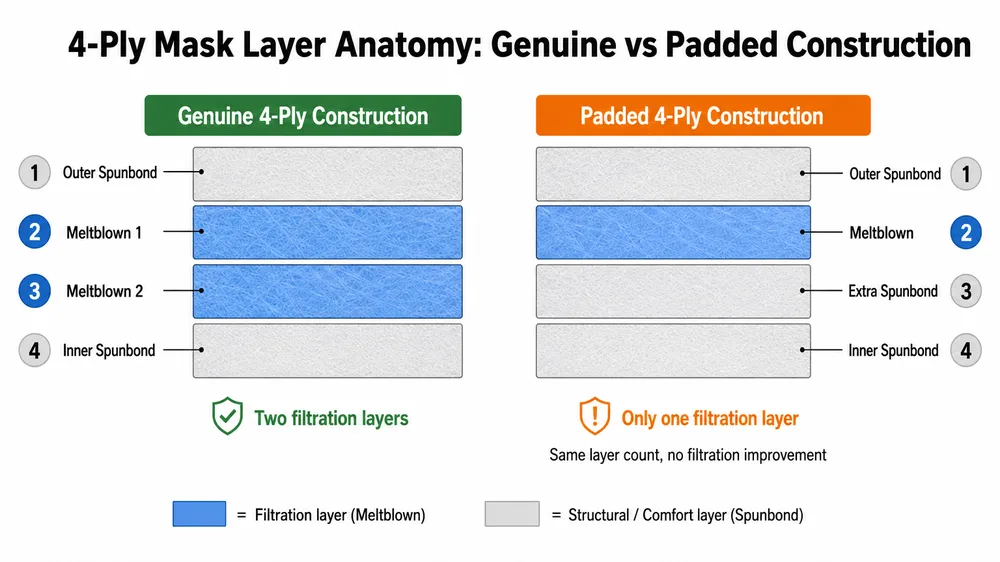
The most common sourcing mistake we see is buyers treating layer count as a proxy for filtration performance. A 4 ply mask with a single meltblown layer and a non-woven comfort layer added to reach the count is not the same as a 4 ply mask with dual meltblown. Both are technically "4 ply." Only one has the filtration architecture to reach ≥98% BFE.

When evaluating a 4 ply mask supplier, ask these questions before committing to a volume order:

  • What is the layer composition? Specifically: how many of the four layers are meltblown, and what is the basis weight of each meltblown layer?
  • Is the meltblown produced in-house or sourced externally? If external, who is the supplier and what is the incoming inspection protocol?
  • Can you provide batch-specific BFE and PFE test results? Not just the certification document — actual production batch reports with lot numbers.
  • What standard and grade does the mask meet? EN 14683 Type II vs Type IIR, or ASTM F2100 Level 1 vs Level 2/3 — these are not interchangeable.
  • What is the Delta-P value on the test report? A mask with very high BFE but also very high Delta-P may have been over-specified on meltblown weight in a way that makes it uncomfortable to wear for extended periods.

These questions are not difficult for a legitimate manufacturer to answer. A supplier who deflects or provides only generic certification documents without batch-level data is telling you something about their QC infrastructure.

4 ply vs 3 ply: when the upgrade is worth specifying

Not every application requires a 4 ply dual meltblown mask. The upgrade is worth specifying when:

  • Your buyer or end-user requires EN 14683 Type IIR or ASTM F2100 Level 2/3 compliance — both require ≥98% BFE, which a standard 3 ply single meltblown mask cannot reliably deliver
  • The masks are destined for hospital, surgical, or high-fluid-exposure environments where splash resistance and higher filtration are both required
  • Your downstream customer is a healthcare institution or government tender that will conduct its own incoming QC — in which case the batch-level test documentation matters as much as the spec itself
  • You are building a private-label healthcare brand where the product needs to hold up under distributor or retailer compliance review

For general-purpose medical mask distribution into markets where EN 14683 Type I or ASTM F2100 Level 1 is the standard requirement, a well-made 3 ply single meltblown mask is sufficient and will cost less. The 4 ply construction adds material cost — primarily the second meltblown layer — and that cost should be justified by the specification requirement, not added as a marketing claim.

(We produce both configurations. The honest answer is that most of our North American hospital buyers specify Level 2, and most of our general distribution buyers in Southeast Asia and Africa specify Type I or Type II. The right spec depends on your market, not on which number sounds better.)

Sourcing checklist before placing a volume order

Before committing to a 4 ply disposable medical mask supplier, verify the following:

Documentation

  • [ ] Third-party BFE test report from an accredited lab (SGS, Intertek, Nelson Labs, Bureau Veritas)
  • [ ] Batch-specific test reports with production lot numbers, not just certification samples
  • [ ] EN 14683 or ASTM F2100 certificate specifying the exact grade (Type IIR, Level 2, etc.)
  • [ ] ISO 13485:2016 certificate (quality management system for medical devices)
  • [ ] FDA 510(k) registration number (required for US market entry)
  • [ ] CE certificate under EU MDR (required for EU market entry)

Technical verification

  • [ ] Confirmed layer composition: outer spunbond / meltblown / meltblown / inner spunbond
  • [ ] Meltblown basis weight per layer (ask for the spec sheet, not just the marketing sheet)
  • [ ] Meltblown source: in-house production or third-party supplier
  • [ ] Delta-P value on the test report (confirm it's within standard limits)
  • [ ] PFE result alongside BFE (both should be ≥98% for Level 2/3 or Type IIR)

Production and supply chain

  • [ ] Cleanroom manufacturing environment (ISO 8 / Class 100,000 minimum for medical masks)
  • [ ] MOQ and lead time for your target volume
  • [ ] Sample availability before volume commitment
  • [ ] Packaging and labeling compliance for your destination market

Our 4 Ply Disposable Medical Mask is produced in a Class 100,000 (ISO 8) cleanroom, with in-house meltblown production and batch-level BFE/PFE/Delta-P testing. ISO 13485:2016, CE under EU MDR, and FDA 510(k) registration are current and available for review.

Frequently asked questions

What are the four layers in a 4 ply disposable medical mask?

The standard construction is: outer spunbond (fluid resistance and structural shell), first meltblown (primary filtration), second meltblown (secondary filtration), inner spunbond (skin-contact comfort layer). The two meltblown layers form the filtration core. The spunbond layers provide structural integrity, fluid resistance, and wearability. Some manufacturers substitute a non-woven comfort layer for the second meltblown to reach a four-layer count without the dual filtration architecture — always confirm the layer composition before specifying.

Why does a 4 ply mask achieve higher BFE than a 3 ply mask?

The difference is the second meltblown layer. A single meltblown layer, well-made, can reach ≥95% BFE. Adding a second meltblown layer creates a second independent electrostatic filtration barrier, which captures particles that passed through or around the first layer. The combined effect allows the mask to reach ≥98% BFE while keeping Delta-P within standard limits — something a single very-dense meltblown layer would struggle to do without exceeding breathing resistance thresholds.

What BFE standard applies to a 4 ply medical mask for US hospital procurement?

ASTM F2100 Level 2 is the most common specification for US hospital and institutional procurement. It requires ≥98% BFE, ≥98% PFE, and Delta-P ≤5.0 mmH₂O/cm². A 4 ply dual meltblown mask from a compliant manufacturer should meet all three. For EU hospital tenders, EN 14683 Type IIR is the equivalent requirement, adding a splash resistance test at ≥120 mmHg.

How do I know if a supplier's meltblown is in-house or outsourced?

Ask directly, and ask for documentation. A factory with in-house meltblown production can show you the production equipment, provide meltblown spec sheets with their own lot numbers, and explain their charge application process. A factory sourcing externally will reference a third-party supplier. Neither is automatically disqualifying, but in-house production gives you a shorter, more verifiable supply chain for the most critical component in the mask. Ask for batch-specific BFE reports tied to production lot numbers — this is the practical test of whether the meltblown going into your order matches the certification sample.

What is an acceptable Delta-P value for a 4 ply medical mask?

Under EN 14683, the limit is ≤40 Pa/cm². Under ASTM F2100, the limit is ≤5.0 mmH₂O/cm² for Level 2 and Level 3. A mask testing at the very low end of Delta-P (well below the limit) may have insufficient meltblown density for reliable high-BFE performance. A mask testing near the upper limit may be uncomfortable for extended wear. For a well-balanced 4 ply dual meltblown mask, you'd typically expect Delta-P in the range of 25–35 Pa/cm² (EN) or 3.0–4.5 mmH₂O/cm² (ASTM) — high enough to indicate adequate meltblown density, low enough to remain comfortable.

Can I request batch-specific test reports rather than just the product certification?

Yes, and you should. A product certification establishes that a sample submitted to a lab at a specific point in time met the standard. A batch-specific test report confirms that the production run you're actually buying matched that performance. Suppliers with in-house QC labs can provide both. If a supplier can only provide the certification document and not batch-level data, that's a gap worth noting in your supplier evaluation.

If you're specifying a 4 ply dual meltblown mask for a volume order and want to verify the construction against your target standard, send us an RFQ with your BFE grade requirement, destination market, and order volume. We'll respond with a spec sheet, current batch test reports, and sample availability.

3 Ply Disposable Medical Mask Specification Breakdown: What Each Layer Does and Why It Matters

Most sourcing problems with 3-ply masks don't start at the factory. They start when a buyer commits to a supplier without understanding which layer drives which test result — and then discovers the problem at customs, or worse, during a hospital procurement audit.

A 3 ply disposable medical mask specification isn't a single number. It's a set of interdependent material and performance parameters, and each one traces back to a specific physical layer. Get the meltblown wrong and your BFE fails. Get the outer spunbond wrong and your fluid resistance rating collapses. Get the ear-loop spec wrong and your product fails a tensile test that most buyers never think to ask about.

This breakdown maps each layer to its function, its material spec, and the test parameter it controls — so you can read a supplier's spec sheet with the same eye we use when we're qualifying our own raw materials.

Cross-section diagram of a 3 ply disposable medical mask showing outer spunbond, middle meltblown, and inner spunbond layers with labeled basis weights

The SMS Construction: Why Three Layers, Not One

The standard 3-ply disposable medical mask uses an SMS structure — spunbond, meltblown, spunbond. Each layer is a different nonwoven fabric with a different fiber structure, a different basis weight range, and a different job.

The outer spunbond layer faces the environment. The middle meltblown layer does the filtration. The inner spunbond layer sits against the wearer's face. None of these layers is interchangeable, and none of them can compensate for a deficiency in another.

We've seen masks come through our incoming inspection that used a single-layer meltblown construction with a thin spunbond laminate on each side — technically three layers, but not SMS in any meaningful sense. The meltblown was too thin to hold electrostatic charge consistently, and the BFE results were all over the place. The construction looked right on paper. The performance didn't hold.

The table below maps each layer to its material, typical basis weight, primary function, and the test parameter it directly affects.

Layer Material Typical Basis Weight Primary Function Test Parameter Affected
Outer (Layer 1) Spunbond PP 20–25 gsm Fluid barrier, structural integrity Fluid resistance (mmHg)
Middle (Layer 2) Meltblown PP 20–40 gsm Particulate and bacterial filtration BFE (%), PFE (%), Delta-P (Pa/cm²)
Inner (Layer 3) Spunbond PP or soft nonwoven 18–25 gsm Skin contact, moisture management Comfort; indirect effect on Delta-P

The basis weight ranges above are typical for medical-grade product. You'll see cheaper masks using meltblown as light as 15 gsm — that's a cost reduction, not a spec variation. Below roughly 20 gsm, maintaining consistent electrostatic charge across the full roll becomes difficult, and BFE performance starts to drift between batches.

Outer Layer: Fluid Resistance and Structural Integrity

The outer layer is spunbond polypropylene, typically 20–25 gsm. Its job is to resist fluid penetration — blood, respiratory droplets, splash — and to give the mask its structural shape.

The fluid resistance rating on a mask spec sheet (expressed in mmHg) comes from this layer. ASTM F2100 Level 1 requires ≥80 mmHg; Level 2 and Level 3 require ≥120 mmHg and ≥160 mmHg respectively. EN 14683 Type IIR requires ≥120 mmHg splash resistance. A mask that meets Level 1 fluid resistance is not suitable for surgical environments where blood splash is a risk — that's a Level 2 or Level 3 application.

The outer spunbond also affects how the mask holds its shape during wear. A fabric that's too light (below 18 gsm) tends to collapse against the face under normal breathing, which increases Delta-P and makes the mask feel suffocating. We run our outer layer at 20–22 gsm for standard surgical masks — enough structural integrity without adding unnecessary weight to the finished product.

One thing worth checking on any spec sheet: whether the outer layer fabric has been treated for hydrophobicity. Untreated spunbond PP has some natural water resistance, but medical-grade outer layers should carry a hydrophobic finish to meet the fluid resistance thresholds reliably. If a supplier's spec sheet doesn't mention the surface treatment, ask.

Middle Layer: The Filtration Layer That Determines Your BFE and PFE

The meltblown layer is where the actual filtration happens, and it's the layer that most buyers understand least — which is exactly where sourcing risk concentrates.

Meltblown polypropylene is produced by extruding molten PP through fine nozzles under high-velocity hot air, creating a web of extremely fine fibers (typically 1–5 microns in diameter, compared to 15–35 microns for spunbond). The fiber web is then electrostatically charged. That charge is what makes the filtration work: particles are captured not just by mechanical interception but by electrostatic attraction, which is why a 20–25 gsm meltblown layer can achieve ≥95% BFE even though the physical fiber density alone wouldn't block particles that small.

The two variables that determine filtration performance are basis weight and electrostatic charge level. Both need to be controlled consistently across every roll, every batch, every production run.

This is where in-house meltblown production changes the equation. We produce our own meltblown fabric at our Gaomi facility. We set the fiber diameter, the basis weight, and the charge parameters ourselves — and we batch-test every roll before it enters the mask production line. When you order a 3 Ply Disposable Medical Mask from us rated at ≥95% BFE, that number comes from material we made and tested, not from a certificate of conformity from a fabric supplier we're trusting to be consistent.

Factories that buy meltblown from outside suppliers are dependent on that supplier's process consistency. During normal market conditions, that's manageable. During supply disruptions — and we've seen several since 2020 — it's where spec drift happens. A supplier switches to a different meltblown source, the basis weight shifts by 3–5 gsm, the charge retention changes, and the BFE drops from 98% to 91%. The mask looks identical. The test result doesn't.

Chart showing the relationship between meltblown nonwoven basis weight and BFE filtration efficiency in 3 ply disposable medical masks

Inner Layer: Skin Contact and Breathability

The inner layer is spunbond PP or a soft nonwoven blend, typically 18–25 gsm. It doesn't do filtration. Its job is skin contact comfort and moisture management — and it has an indirect effect on Delta-P.

A rough or stiff inner layer increases the perceived resistance to breathing, even if the actual Delta-P measurement is within spec. For hospital and clinical use, where masks are worn for extended shifts, this matters commercially: products that cause discomfort get removed or worn incorrectly, which is a liability issue for the distributor supplying them.

We use a soft-finish spunbond for our inner layer — slightly lower basis weight than the outer layer, with a smoother fiber surface. It's a small material cost difference, but it's the kind of detail that shows up in reorder rates from hospital accounts. (We've had buyers switch to us specifically because their previous supplier's inner layer was causing skin irritation complaints from nursing staff. The filtration spec was fine. The inner layer wasn't.)

The inner layer also affects how the mask sits against the face, which influences the seal quality around the edges. A layer that's too stiff creates gaps at the nose and chin — gaps that bypass the filtration layer entirely. This is a fit issue, not a material spec issue per se, but the inner layer material choice is part of what determines it.

Key Performance Parameters: What the Numbers Mean and Where They Come From

A complete 3 ply disposable medical mask specification includes four performance parameters. Each one maps to a specific test method and a specific layer.

Parameter What It Measures Test Method Which Layer Drives It
BFE (Bacterial Filtration Efficiency) % of bacteria-sized particles (3 µm) filtered ASTM F2101 / EN 14683 Annex B Meltblown (middle layer)
PFE (Particulate Filtration Efficiency) % of sub-micron particles (0.1 µm) filtered ASTM F2299 Meltblown (middle layer)
Delta-P (Differential Pressure) Breathing resistance (Pa/cm²) ASTM F2101 / EN 14683 Annex C All three layers combined
Fluid Resistance Resistance to fluid penetration (mmHg) ASTM F1862 / EN 14683 Annex D Outer spunbond (layer 1)

BFE and PFE are both filtration efficiency measurements, but they test different particle sizes. BFE uses a 3-micron aerosol (roughly the size of bacteria-carrying droplets). PFE uses 0.1-micron latex spheres — closer to the size of viral particles. A mask can have high BFE and lower PFE if the meltblown charge isn't optimized for sub-micron capture. For surgical mask applications, BFE is the primary regulatory threshold. For applications where sub-micron filtration matters, check the PFE number specifically.

Delta-P is the pressure differential across the mask at a fixed airflow rate. Lower is better — it means less breathing resistance. ASTM F2100 sets a maximum of 5.0 mm H₂O/cm² for all three levels. EN 14683 sets a maximum of 40 Pa/cm² for Type I and Type II, and 60 Pa/cm² for Type IIR. A mask that passes BFE but fails Delta-P is not compliant — and this is a failure mode we see more often than buyers expect, usually caused by a meltblown layer that's too dense or an inner layer that's too thick.

For a deeper look at how these tests are actually run and what the results mean for your sourcing decisions, see how BFE and PFE testing works on disposable masks.

ASTM F2100 vs EN 14683: Threshold Comparison for US and EU Markets

If you're sourcing for both the US and EU markets, you're working with two different standards frameworks. They test similar parameters but use different thresholds and different classification systems.

Parameter ASTM F2100 Level 1 ASTM F2100 Level 2 ASTM F2100 Level 3 EN 14683 Type I EN 14683 Type IIR
BFE ≥95% ≥98% ≥98% ≥95% ≥98%
PFE (0.1 µm) ≥95% ≥98% ≥98% Not specified Not specified
Delta-P (mm H₂O/cm²) ≤5.0 ≤5.0 ≤5.0 ≤40 Pa/cm² ≤60 Pa/cm²
Fluid Resistance ≥80 mmHg ≥120 mmHg ≥160 mmHg Not required ≥120 mmHg
Flammability Class 1 Class 1 Class 1 Not specified Not specified

A few things worth noting in this table:

EN 14683 does not specify PFE. If your EU buyer asks for PFE data, that's a supplementary requirement — common in hospital procurement specs — not a standard EN 14683 threshold. You can still provide it, but it won't appear on the CE technical file as a mandatory parameter.

EN 14683 Type I has no fluid resistance requirement. Type IIR does (≥120 mmHg). If you're selling into surgical environments in Europe, Type IIR is the relevant classification. Type I is for non-surgical medical use.

ASTM F2100 Level 1 is the minimum for US surgical mask clearance. Most hospital procurement specs in the US require Level 2 or Level 3 for procedural and surgical applications. If your buyer is supplying US hospitals, confirm which level their procurement spec requires before you finalize the order.

Our FDA 510(k) registration and CE (EU MDR) certification cover both frameworks, so the documentation is already in place for either market. The spec we ship to you is the spec that clears customs — we don't produce to a different internal standard and then submit third-party tests separately.

Side-by-side comparison table of ASTM F2100 Level 1/2/3 and EN 14683 Type I/IIR threshold values for BFE, PFE, Delta-P, and fluid resistance

Nose Wire and Ear-Loop Specs: The Components That Fail in the Field

Filtration specs get most of the attention. Nose wire and ear-loop specs cause most of the field complaints.

Nose wire is typically a single or double aluminum wire, 0.45–0.55 mm diameter, embedded in the top edge of the mask by ultrasonic welding. The spec parameters that matter are wire gauge, corrosion resistance, and weld integrity. A nose wire that corrodes in humid storage conditions will stain the mask fabric and trigger rejection at incoming inspection. A nose wire that's welded too close to the edge will tear out under normal adjustment — a failure mode that generates returns and warranty claims.

We run our nose wire at 0.5 mm single-core aluminum with a PE coating. The PE coating prevents corrosion and gives the wire enough surface friction to hold its shape after the wearer adjusts it. We test nose wire pull-out force as part of incoming inspection — the wire should require meaningful force to remove, not slide out with finger pressure.

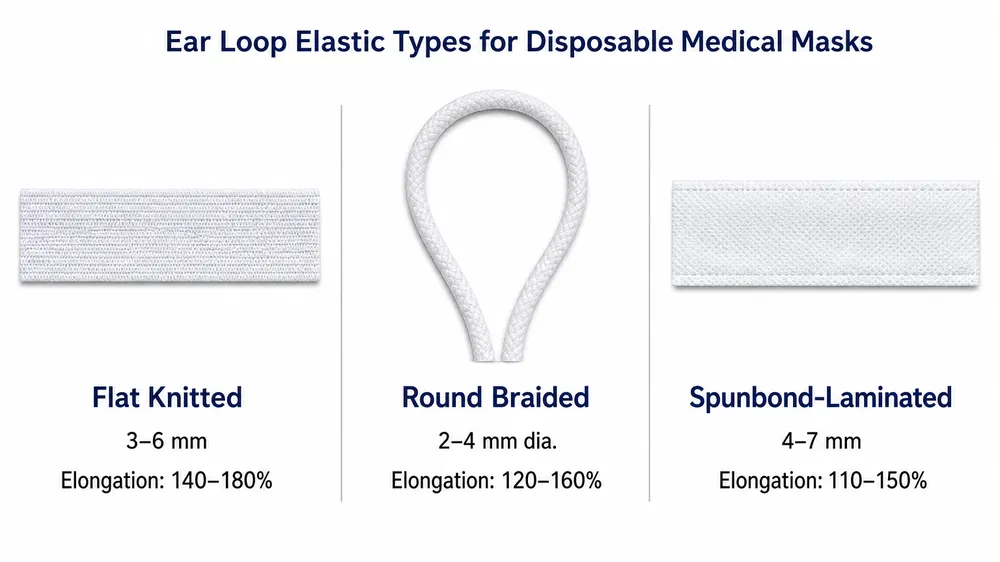
Ear loops are typically flat elastic, 3–4 mm wide, attached by ultrasonic welding. The critical spec is tensile strength — specifically, the force required to break the ear-loop attachment point. ASTM F2100 doesn't specify a minimum ear-loop tensile strength, but hospital procurement specs commonly require ≥10 N at the weld point. We test to ≥15 N as our internal standard, which gives margin above the typical procurement threshold.

Ear-loop material matters too. Cheap elastic loses tension after 2–3 hours of wear, which means the mask starts to sag and the seal degrades. We use a spandex-core flat elastic that maintains tension through a full 8-hour shift. It costs slightly more than standard polyester elastic, but it's the difference between a mask that works for a full clinical shift and one that needs to be replaced at lunch.

(One thing we check at incoming inspection that most buyers never ask about: ear-loop color consistency. If you're running a private-label program with white masks and white ear loops, a batch of slightly off-white elastic is a cosmetic rejection that your end customer will notice. We match ear-loop color to the mask body on every order.)

What a Complete Spec Sheet Should Include for Import and Procurement Audits

A spec sheet that passes a hospital procurement audit or an FDA import review contains more than BFE and PFE numbers. Here's what a complete 3 ply disposable medical mask specification document should include:

Product identification

  • Product name and model number
  • Applicable standard (ASTM F2100 Level X or EN 14683 Type X)
  • Intended use statement

Material specification

  • Outer layer: material type, basis weight (gsm), surface treatment
  • Middle layer: material type, basis weight (gsm), electrostatic charge method
  • Inner layer: material type, basis weight (gsm)
  • Nose wire: material, gauge, coating
  • Ear loop: material, width, attachment method

Performance test results (with test report reference numbers)

  • BFE (%) — test method and result
  • PFE (%) — test method and result (if required)
  • Delta-P (Pa/cm² or mm H₂O/cm²) — test method and result
  • Fluid resistance (mmHg) — test method and result (if applicable)
  • Flammability class (if ASTM F2100)

Regulatory documentation

  • ISO 13485 certificate number and scope
  • CE certificate number (for EU market)
  • FDA 510(k) number (for US market)
  • Third-party test lab name and accreditation

Traceability

  • Batch/lot number system
  • Production date range
  • Shelf life and storage conditions

If a supplier's spec sheet is missing the material specification section — particularly the meltblown basis weight and the third-party test lab reference — that's a gap worth asking about before you place an order. A spec sheet that only lists performance results without identifying the materials that produce them gives you no way to verify consistency across batches.

Our spec sheets include all of the above. The test reports that travel with each shipment reference the specific production batch, the in-house test results, and the third-party lab verification. That documentation is what your customs broker and your buyer's compliance team will ask for.

How to Verify Spec Claims Before You Commit

Reading a spec sheet is the first step. Verifying it is the second — and most buyers skip it.

Request the third-party test report, not just the certificate. A certificate of conformity says the product meets a standard. The test report shows the actual measured values. BFE of 98.7% is more useful than "meets ASTM F2100 Level 2" because it tells you how much margin exists above the threshold. A product that tests at 98.1% and a product that tests at 99.4% both "meet Level 2," but they're not the same product.

Check the test lab accreditation. The test report should come from an ISO 17025-accredited laboratory. For US market products, Nelson Labs and SGS are commonly recognized. For EU market products, look for a notified body-accredited lab. An in-house test report without third-party verification is not sufficient for import documentation.

Ask about batch-to-batch consistency, not just the certification sample. Certification testing is typically done on a single production sample. What you need to know is whether the factory tests every production batch — or only the batch that went to the certification lab. Under ISO 13485, every batch should be tested before shipment. If a supplier can't tell you their batch testing protocol, that's a sourcing risk.

Request a sample before committing to volume. This sounds obvious, but a surprising number of buyers skip it on repeat orders from the same supplier, assuming the spec hasn't changed. We recommend requesting a sample from any new production run if the order is going into a regulated procurement channel. The sample costs almost nothing. A non-compliant shipment costs significantly more.

We test every production batch in our in-house QC lab — BFE, PFE, and Delta-P — before the batch moves to outgoing inspection. Third-party test reports are submitted for certification documentation. The in-house testing is what catches problems before they become your problem.

For buyers comparing 3-ply and 4-ply configurations, the layer structure and spec implications are different enough to warrant a separate look — see our breakdown of 3 ply vs 4 ply disposable medical mask differences.

Frequently Asked Questions

What is the difference between BFE and PFE in a 3 ply mask spec?

BFE (Bacterial Filtration Efficiency) measures how well the mask filters bacteria-sized particles at 3 microns, using a standardized aerosol challenge. PFE (Particulate Filtration Efficiency) tests sub-micron particles at 0.1 microns — closer to the size of viral aerosols. Both are driven by the meltblown middle layer. ASTM F2100 requires both; EN 14683 only specifies BFE. If your buyer's procurement spec asks for PFE data on an EN 14683 product, that's a supplementary requirement you need to confirm with your supplier separately.

Can a 3 ply mask meet both ASTM F2100 and EN 14683 simultaneously?

Yes, with the right spec. A mask built to ASTM F2100 Level 2 (≥98% BFE, ≥120 mmHg fluid resistance, ≤5.0 mm H₂O/cm² Delta-P) will generally satisfy EN 14683 Type IIR thresholds as well, since the ASTM Level 2 fluid resistance requirement (≥120 mmHg) matches the Type IIR requirement. The main gap is flammability — ASTM F2100 requires Class 1 flammability testing, which EN 14683 does not specify. A dual-market product needs both test reports in the documentation package.

Why does meltblown basis weight matter for spec consistency across batches?

Meltblown filtration performance depends on both fiber density (basis weight) and electrostatic charge. If the basis weight varies between rolls — say, from 22 gsm to 18 gsm — the charge retention changes, and BFE can drop by several percentage points even if the production process looks identical. This is why in-house meltblown production matters: the factory controls the variable that determines filtration performance, rather than accepting whatever the fabric supplier ships. Batch-to-batch BFE variation of more than 1–2% on a well-controlled production line is a signal worth investigating.

What should I ask a supplier if their spec sheet only shows BFE and PFE numbers?

Ask for the third-party test report (not just the certificate), the meltblown basis weight and material source, the batch testing protocol under their QMS, and the specific ASTM or EN standard level the product is certified to. A spec sheet that lists performance numbers without identifying the materials and test methods behind them gives you no way to verify consistency. If the supplier can't provide the test report with the lab accreditation number, that's a documentation gap that will surface during import review or procurement audit.

What is the minimum ear-loop tensile strength for hospital procurement?

ASTM F2100 doesn't specify a minimum ear-loop tensile strength, but hospital and institutional procurement specs commonly require ≥10 N at the weld point. Our internal standard is ≥15 N, tested at incoming inspection on every ear-loop lot. If you're supplying into a hospital tender, ask your buyer's procurement team for their specific tensile requirement — it varies by institution and country.

If you're ready to evaluate a specific spec configuration — ASTM F2100 Level 1, 2, or 3, or EN 14683 Type I or IIR — send your target standard, required BFE grade, order volume, and any packaging requirements to Request Quote. We'll respond with a spec sheet, third-party test report references, and sample availability.

For the full product range and standard SKU configurations, see our Disposable Medical Masks category page.