eztio

DNOOO blank theme is active for local preview.

Top 10 Surgical Medical Mask Suppliers in Germany: Factory-Direct Import Shortlist

Germany runs one of the most compliance-demanding medical procurement environments in the EU. EN 14683 is the baseline, EU MDR documentation is non-negotiable for anything entering a hospital supply chain, and buyers who got burned by undocumented mask imports during 2020–2021 are now significantly more rigorous about what they accept. That's the context this list is built for.

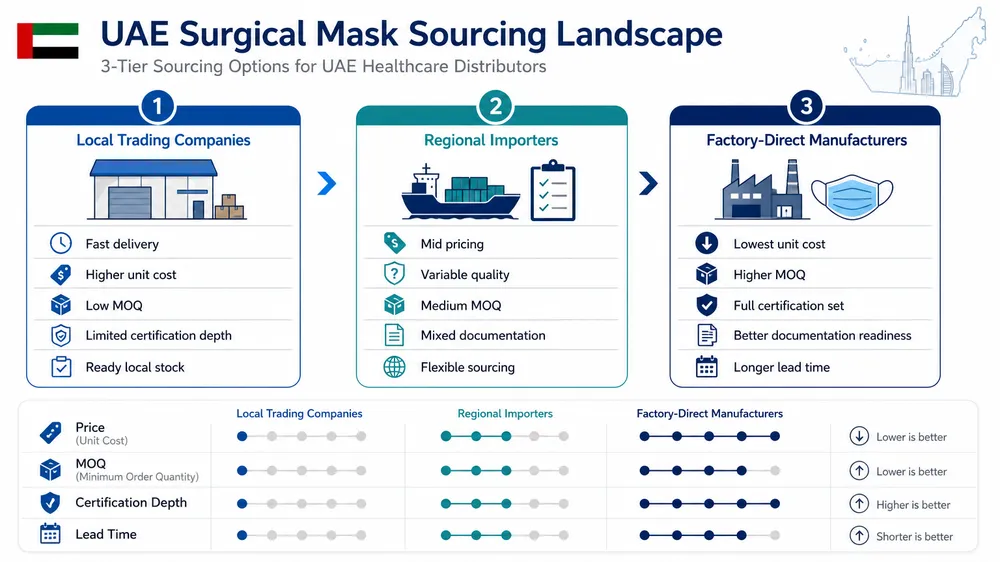
This isn't a ranked popularity contest. It's a sourcing landscape map — domestic distributors, EU-based manufacturers, and one factory-direct alternative — with honest notes on what each supplier model is actually good for and where the trade-offs land. The goal is to help you shortlist faster and ask better questions before you commit to a supplier relationship.

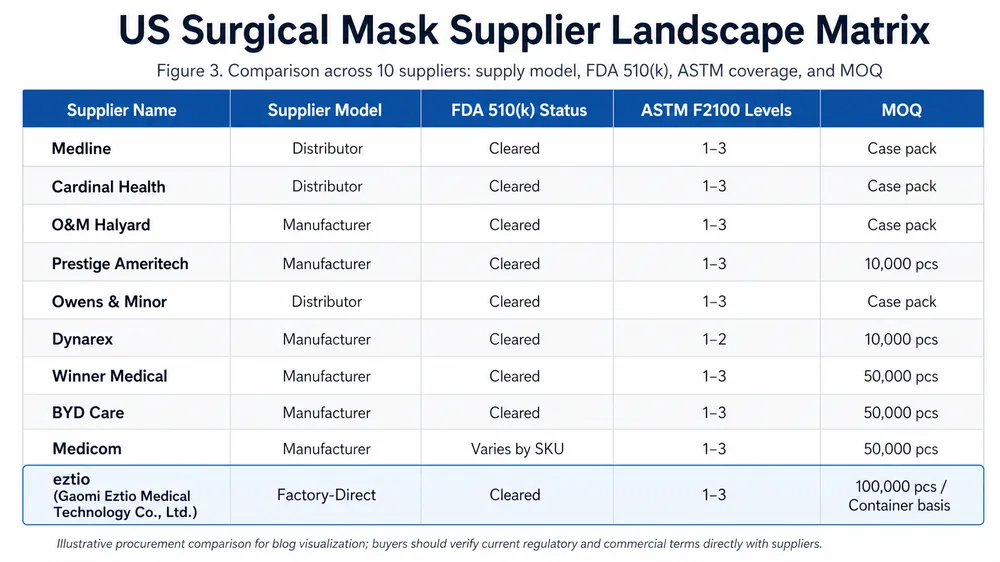
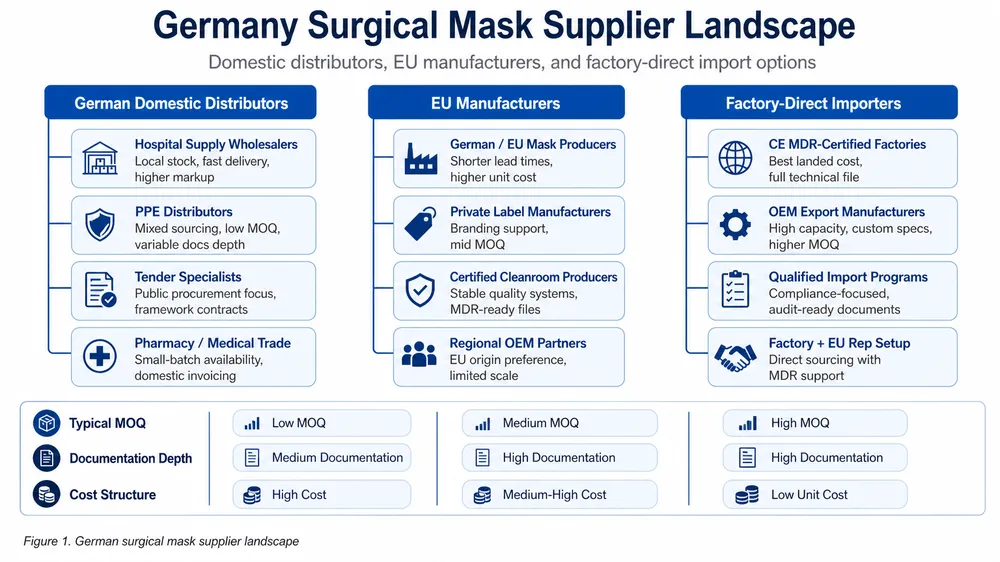
Supplier landscape map showing German domestic distributors, EU manufacturers, and factory-direct options for surgical medical masks

What German Buyers Actually Need from a Surgical Mask Supplier

Before the list, the evaluation framework. German procurement teams — whether buying for hospital networks, pharmacy chains, or institutional resale — are working against a specific compliance checklist. If a supplier can't satisfy these criteria, the conversation ends before pricing even comes up.

EN 14683 Type II or Type IIR compliance is the floor. Type II requires ≥98% BFE; Type IIR adds splash resistance (≥120 mmHg fluid resistance). Most clinical settings in Germany specify Type IIR. If you're supplying pharmacy retail or non-clinical institutional buyers, Type II may be sufficient — but verify the end-use before you commit to a spec.

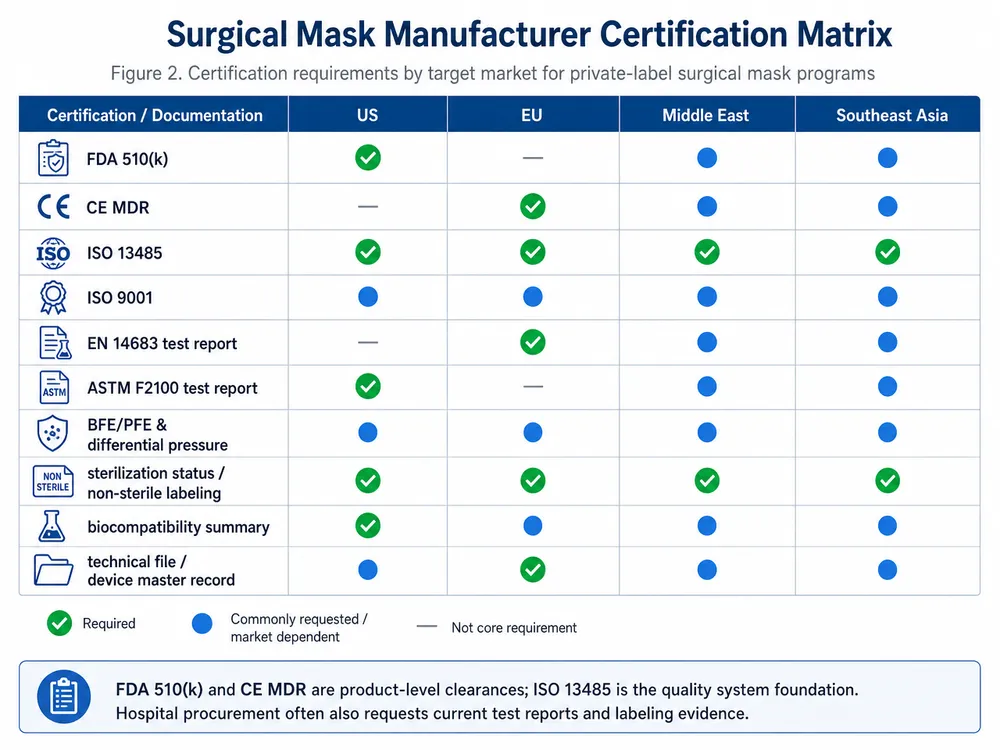
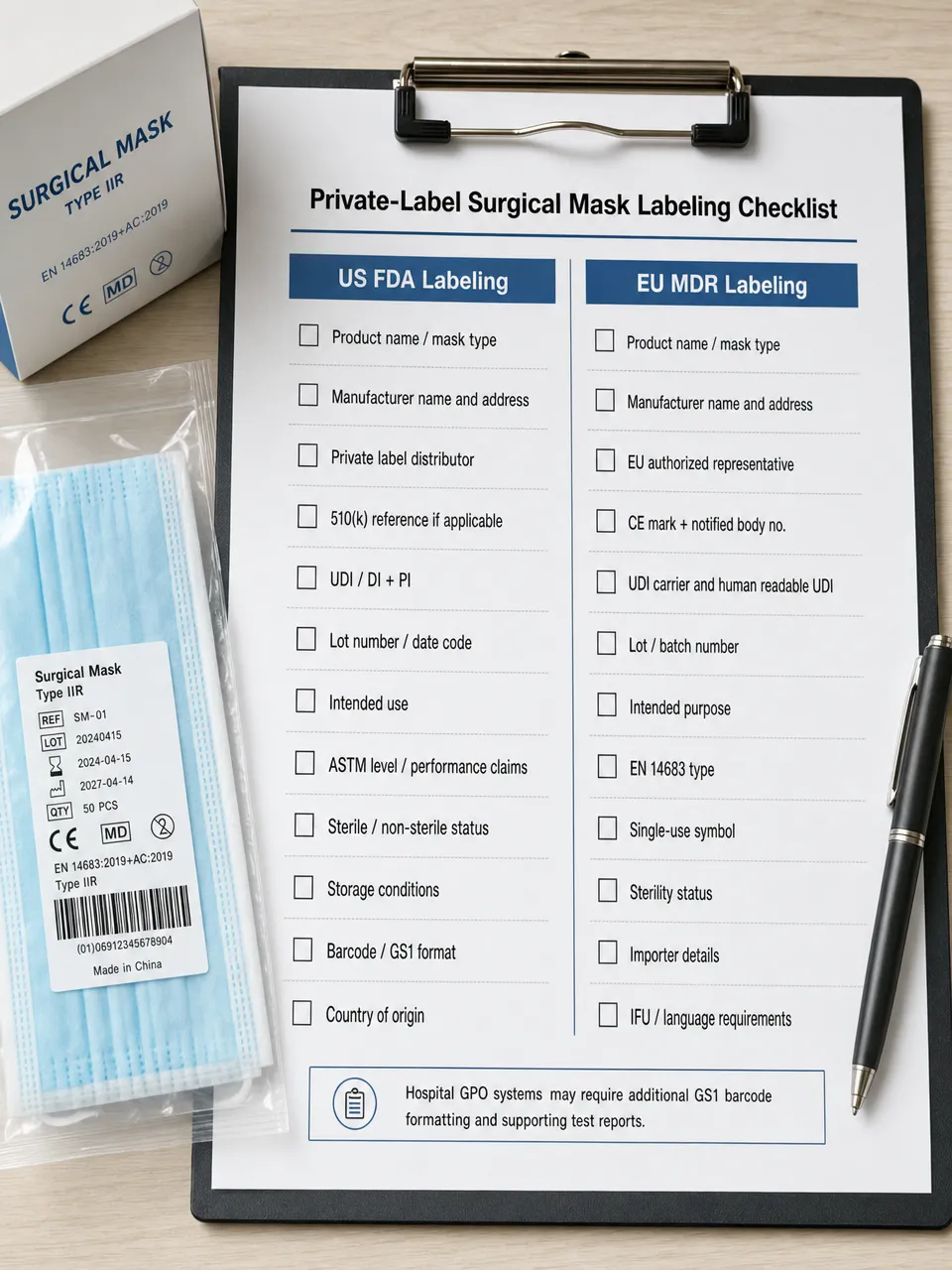
CE marking under EU MDR (Regulation 2017/745) is mandatory for surgical masks sold as medical devices in Germany. This is not the same as the old MDD CE mark. Post-2021, surgical masks require a valid EU MDR Declaration of Conformity, a technical file maintained by the manufacturer, and a registered EU Authorized Representative if the manufacturer is outside the EU. Suppliers who can only produce an MDD-era CE certificate are not compliant for current German market entry.

ISO 13485:2016 is the quality management standard behind the MDR technical file. It's not legally required as a standalone certification, but any serious manufacturer maintaining MDR compliance will have it — and any German hospital procurement audit will ask for it. Treat its absence as a yellow flag.

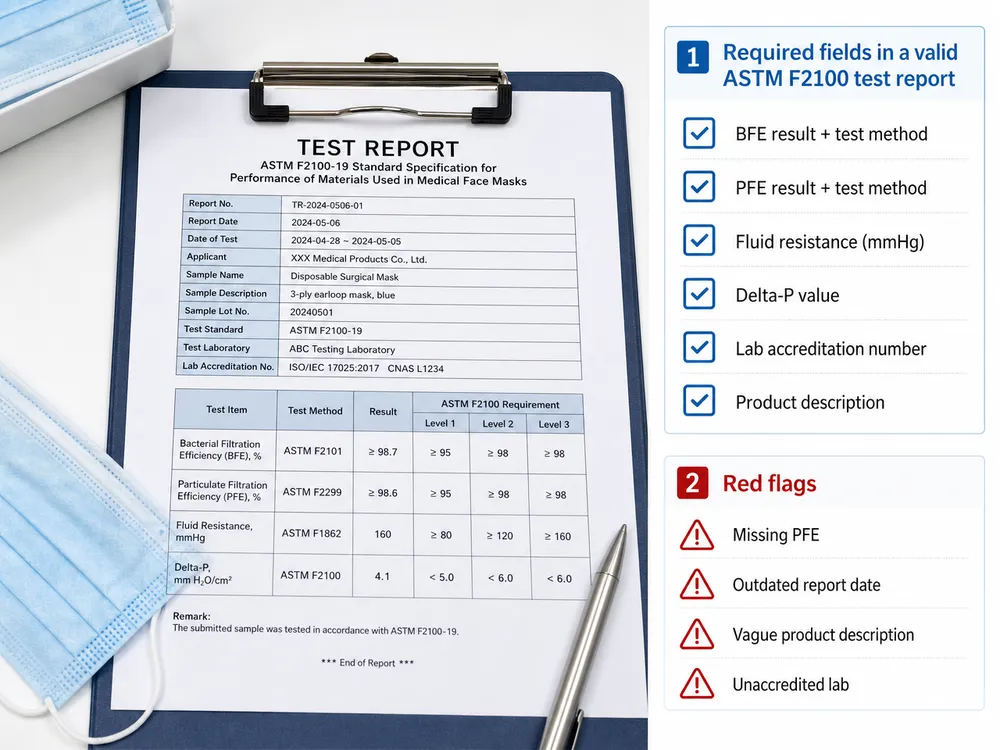
BFE test reports from an accredited laboratory — not just a certificate, but the actual test report showing the test method (EN 14683 Annex B), the test organism (Staphylococcus aureus), the particle size, and the result. We've seen suppliers provide certificates that reference tests they can't produce the underlying data for. Ask for the full report.

Delta-P (breathability) and fluid resistance test data round out the performance picture. Delta-P above 40 Pa/cm² on a Type IIR mask is a comfort problem for extended clinical wear — worth checking if your buyers are supplying surgical teams rather than general ward staff.

(One thing we've learned from working with German distributors: the documentation review often takes longer than the product evaluation. Build that into your timeline.)

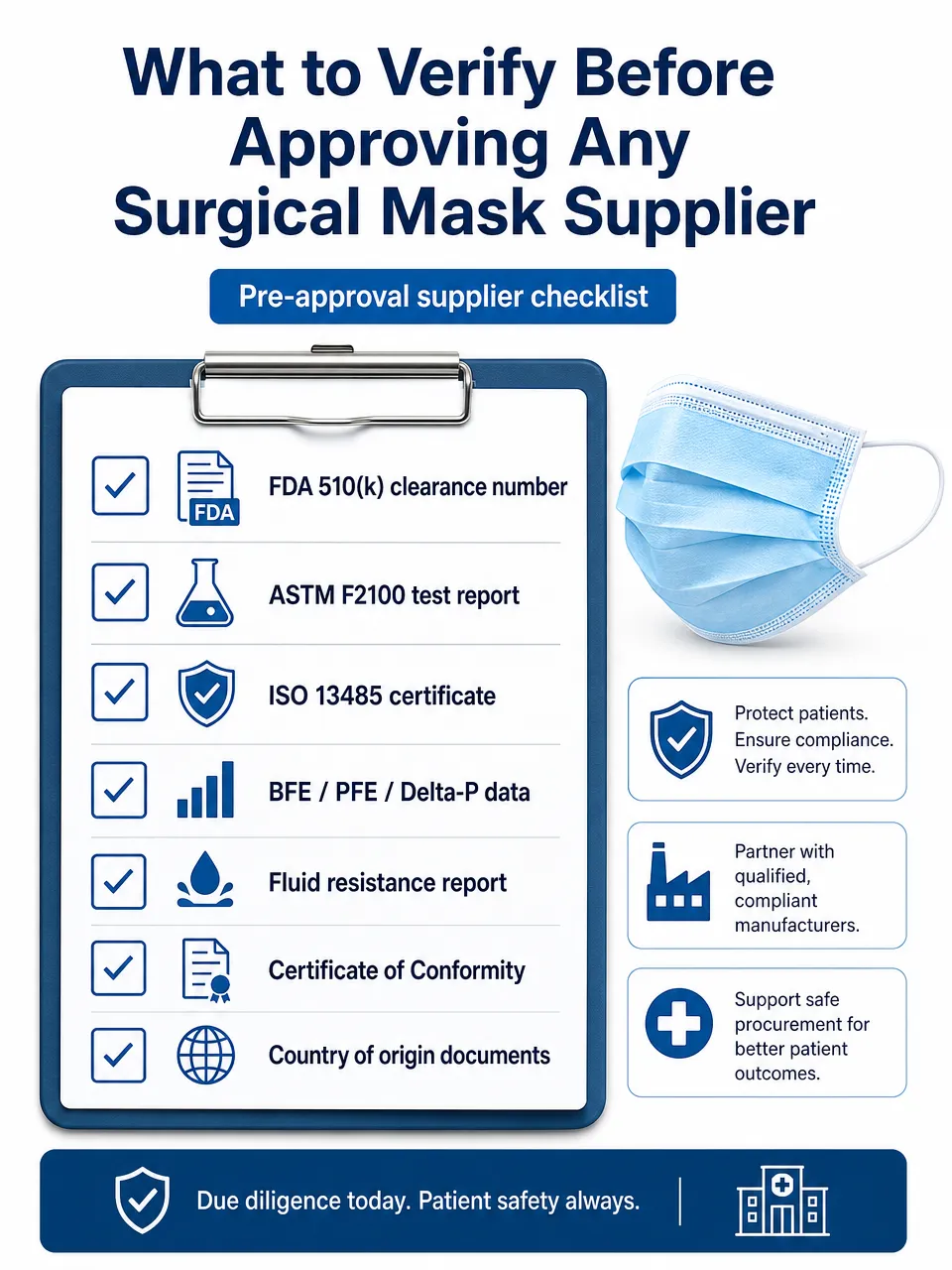
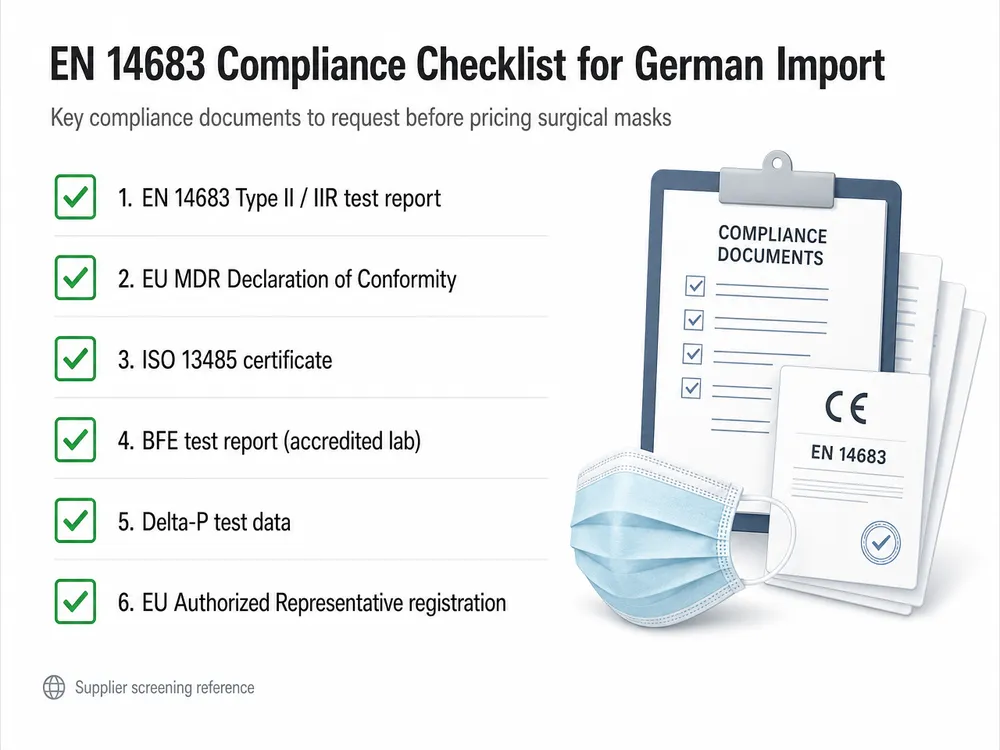
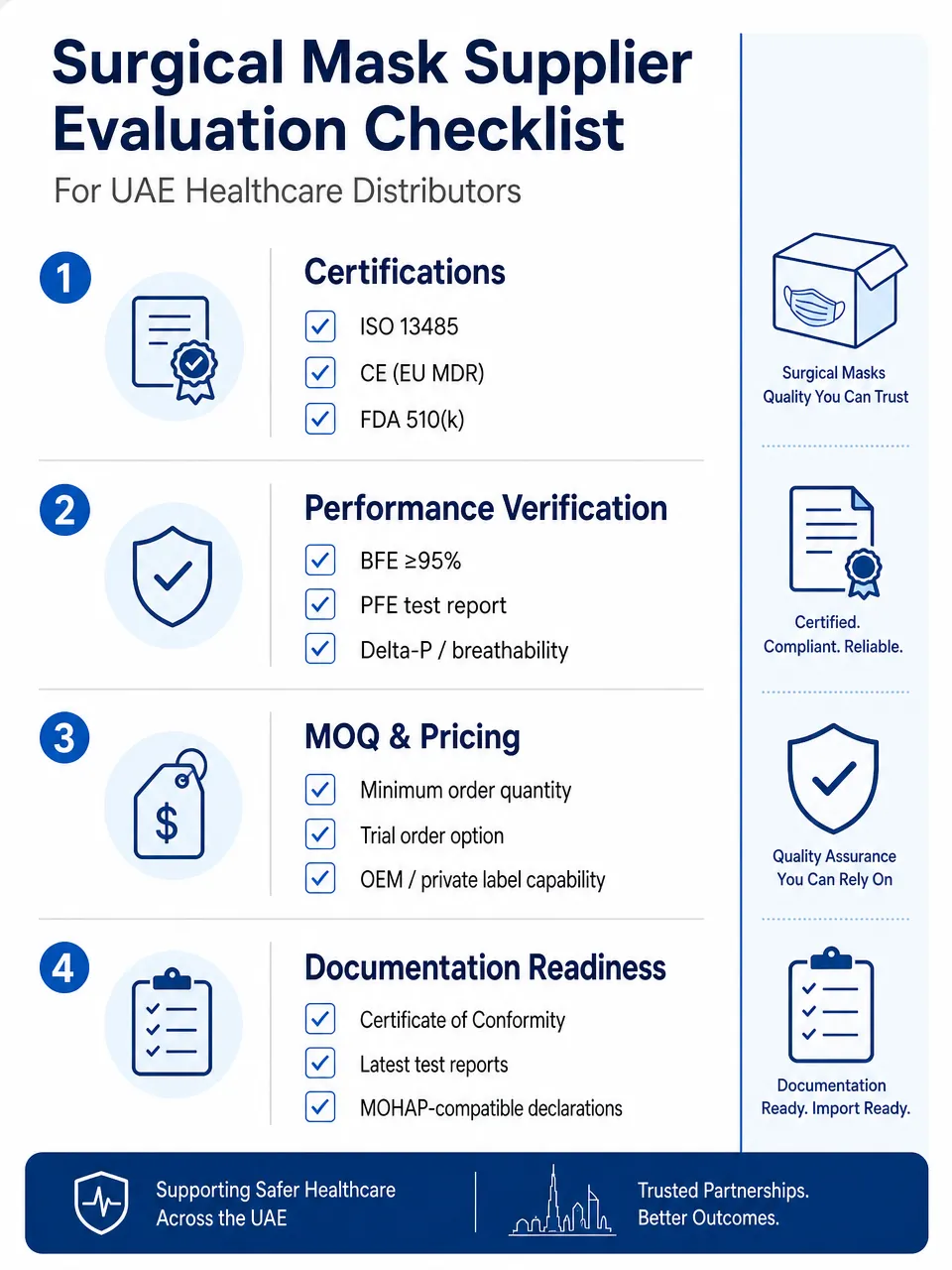
EN 14683 compliance checklist for surgical mask import into Germany showing required certifications and test documents

The 10 Suppliers: German Market Landscape

1. Paul Hartmann AG

Website: hartmann.info | Type: German manufacturer and distributor

Hartmann is the anchor name in German hospital supply. Their Foliodress surgical mask line covers Type I, Type II, and Type IIR configurations and is stocked through their direct sales network and major medical distributors across Germany. For hospital procurement teams buying on framework contracts, Hartmann is often the default — the documentation is in order, the supply chain is domestic, and the account management is German-speaking.

The trade-off is cost and flexibility. Hartmann operates at scale for institutional buyers, which means their pricing reflects a full-service distribution model. MOQ for direct supply is typically aligned to hospital contract volumes. If you're a smaller distributor or a private-label buyer, you're likely buying through a sub-distributor, which adds another margin layer.

2. Mölnlycke Health Care

Website: molnlycke.com | Type: Swedish EU manufacturer, strong German distribution

Mölnlycke's Barrier surgical mask range is well-established in German OR settings. Their products carry EN 14683 Type IIR compliance and are positioned at the premium end of the clinical market — the brand is associated with surgical draping and gowning systems, so the mask sits in a broader OR supply relationship. German hospital procurement teams buying Mölnlycke gowns often extend that relationship to masks.

For buyers outside the hospital OR segment, Mölnlycke is less relevant. Their distribution model is built around surgical suite procurement, not general medical supply or pharmacy channels.

3. Lohmann & Rauscher (L&R)

Website: lohmann-rauscher.com | Type: German/Austrian manufacturer and distributor

L&R is a significant player in German wound care and surgical supply. Their Sentinex surgical mask line covers standard clinical configurations with EN 14683 compliance. L&R has direct sales infrastructure in Germany and a strong presence in hospital and outpatient clinic supply chains.

Their strength is breadth — they supply a wide range of medical consumables, so buyers consolidating orders across product categories find L&R convenient. The mask range itself is solid but not differentiated on filtration performance; it's a reliable commodity product from a trusted German supplier.

4. Meditrade GmbH

Website: meditrade.de | Type: German medical disposables distributor

Meditrade is a German-based distributor of disposable medical products with surgical masks in their portfolio. They serve pharmacy chains, medical practices, and institutional buyers across Germany. Their product range includes both branded and private-label configurations.

As a distributor rather than a manufacturer, Meditrade's documentation depth depends on their upstream suppliers. Worth asking specifically about the manufacturer of record on their surgical mask SKUs and whether the CE MDR technical file is accessible — this is a standard question for any distributor-sourced product.

5. Dräger

Website: draeger.com | Type: German medical device manufacturer

Dräger is primarily known for anaesthesia, ventilation, and monitoring equipment, but their respiratory protection portfolio includes surgical and procedure masks. Their products carry the full German regulatory pedigree — CE MDR, ISO 13485, and the documentation infrastructure that comes with a major medical device manufacturer.

For buyers specifically in the respiratory protection or clinical procedure segment, Dräger is a credible option. For general surgical mask procurement at volume, their pricing and minimum order structure reflects a premium medical device positioning that may not be cost-competitive against dedicated mask manufacturers.

6. Uvex Safety Group

Website: uvex-safety.com | Type: German PPE and safety equipment manufacturer

Uvex manufactures a range of respiratory protection products including surgical-grade masks. Their German manufacturing heritage and PPE compliance infrastructure make them a natural fit for industrial healthcare and occupational health buyers. EN 14683 compliance is covered in their medical mask range.

The caveat: Uvex's core business is occupational safety, not clinical medical supply. Their surgical mask range is real and compliant, but the depth of clinical documentation and the breadth of SKU options is narrower than dedicated medical mask manufacturers. Suitable for occupational health procurement; less suited for hospital supply chain buyers who need deep clinical documentation.

7. Abena Group

Website: abena.de | Type: Danish manufacturer, strong German distribution

Abena is a Danish healthcare product manufacturer with established German distribution. Their disposable medical product range includes surgical masks with EN 14683 compliance. They supply nursing homes, outpatient clinics, and pharmacy chains across Germany through their German subsidiary.

Abena's positioning is mid-market — reliable compliance documentation, reasonable pricing, and a distribution model that works for buyers who need regular replenishment without large-volume commitments. Not a factory-direct option, but a credible EU-based supplier for buyers who prefer European sourcing.

8. Kimberly-Clark Professional

Website: kimberly-clark.com | Type: US multinational, EU distribution including Germany

Kimberly-Clark's Halyard surgical mask range is distributed across the EU including Germany. Their products carry EN 14683 compliance and the documentation infrastructure of a major multinational medical device company. For buyers already in a Kimberly-Clark supply relationship for other medical consumables, extending to surgical masks is straightforward.

The practical limitation for German buyers is that Kimberly-Clark operates through distribution partners in Germany rather than direct factory supply. Pricing reflects the multinational brand premium plus distribution margin. For high-volume buyers, the landed cost per unit is rarely competitive against factory-direct alternatives.

9. Noba Verbandmittel Danz GmbH & Co. KG

Website: noba.de | Type: German medical supply distributor

Noba is a German medical supply distributor serving pharmacies, medical practices, and care facilities. Their product range includes surgical masks sourced from multiple manufacturers. As a distributor, Noba provides the convenience of domestic stock, German-language account management, and consolidated ordering across product categories.

For buyers who need small quantities, fast replenishment, or consolidated invoicing across multiple product types, Noba and similar German distributors serve a real function. The trade-off is unit cost — distributor margin is built into every SKU, and the manufacturer of record on the mask may not be immediately transparent.

10. eztio — Factory-Direct CE MDR Certified Manufacturer

Website: eztio.com | Type: Chinese factory-direct manufacturer, CE (EU MDR) + ISO 13485 certified

eztio is a different kind of entry on this list — not a German distributor or EU-based manufacturer, but a factory-direct option that clears the compliance bar for German market entry. We manufacture Surgical Medical Masks at our 12,000 m² facility in Gaomi, Shandong, with 6 fully automated production lines and 120 million pieces annual capacity.

The compliance stack is the starting point: CE under EU MDR, ISO 13485:2016, ISO 9001:2015, FDA 510(k) registration, and SGS. For German import, the CE MDR registration and ISO 13485 certificate are the documents your importer of record needs, and we maintain both with current surveillance audit records. Our EU Authorized Representative is in place, so the MDR importer pathway is already structured.

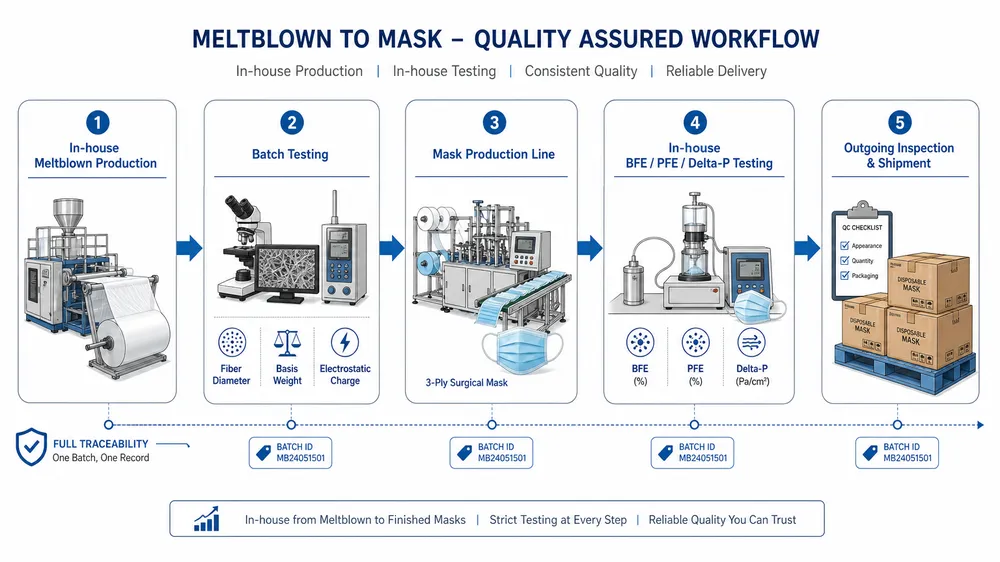
The differentiator that matters most for buyers evaluating filtration performance is in-house meltblown production. We manufacture the meltblown nonwoven layer — the filtration core — ourselves. That means when we quote a disposable surgical medical mask at ≥98% BFE (EN 14683 Type IIR), we're not relying on a fabric supplier's batch consistency. We set the fiber diameter, basis weight, and electrostatic charge level in our own production run, and we test every batch in our in-house BFE/PFE/Delta-P lab before it goes to outgoing inspection. (Most trading companies and even some manufacturers can't tell you who made their meltblown fabric or what the batch-to-batch BFE variance looks like. We can, because we made it.)

Our 3-ply medical mask line runs in a Class 100,000 (ISO 8) cleanroom with continuous particle monitoring — the facility standard that hospital procurement audits look for. MOQ starts at 50,000 pieces for standard SKUs, which is sized for market-entry orders and trial programs without forcing a volume commitment that doesn't match your current demand. OEM and private-label packaging is handled in-house.

For German buyers, the full export documentation package travels with every shipment: EN 14683 test reports from accredited third-party labs, Certificate of Conformity, EU MDR Declaration of Conformity, and any additional declarations your customs broker or compliance team needs. We've shipped to multiple European buyers post-2021 and understand what the MDR importer documentation review actually requires.

In-house meltblown nonwoven fabric production line at eztio factory in Gaomi China for surgical mask filtration layer

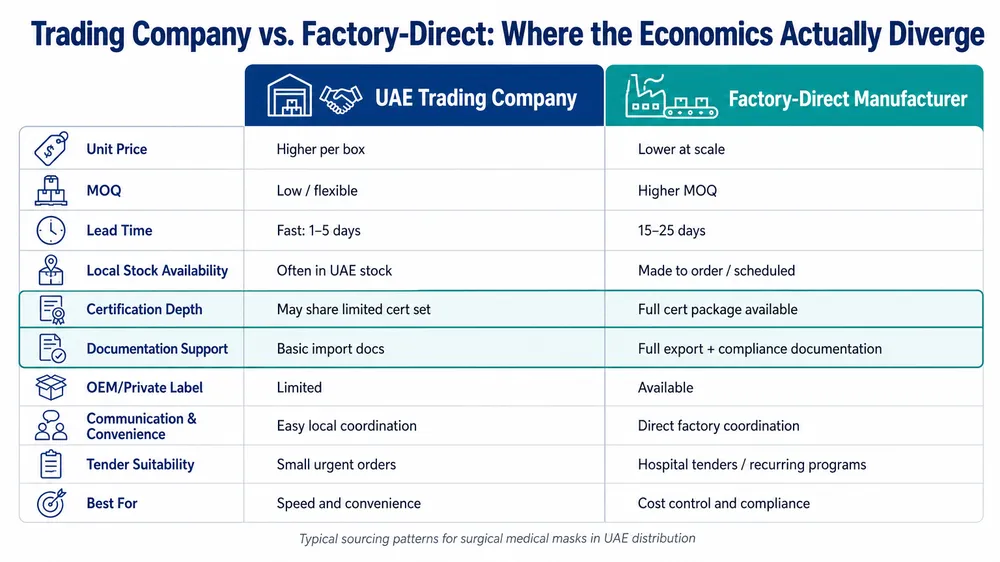
German Distributor vs. Factory-Direct: Where the Cost Difference Actually Lives

The pricing gap between a German distributor and a factory-direct manufacturer is real, but it's not uniform — it depends on order volume, documentation requirements, and how you're using the product downstream.

Here's how the cost structure typically breaks down on a 500,000-piece order of EN 14683 Type IIR surgical masks into Germany:

Cost Component German Distributor Factory-Direct (eztio)
Unit product cost Higher (includes distributor margin) Lower (factory gate price)
Freight to Germany Included or domestic Sea freight + customs (est. €0.008–0.012/pc at volume)
Import duty (EU) N/A (EU-sourced) ~6.3% on CIF value
MDR documentation Included Provided by factory
Lead time Days to weeks (from stock) 15–25 days production + transit
MOQ flexibility Often low (from stock) 50,000 pieces minimum
Landed cost per unit Higher at volume Lower at volume

The distributor model wins on speed and minimum quantity. If you need 10,000 masks by next week, a German distributor is the right answer. If you're placing a 500,000-piece order for a quarterly supply program, the factory-direct landed cost — even after freight and duty — is typically 25–40% lower than distributor pricing on the same EN 14683 Type IIR specification.

The documentation equation has shifted since EU MDR came into full effect. Pre-2021, some buyers assumed factory-direct sourcing meant documentation risk. The reality now is that a CE MDR-registered factory with a maintained technical file and an EU Authorized Representative in place carries the same regulatory standing as a European distributor sourcing from the same factory. The question is whether the factory can produce the documentation — not where the factory is located.

How to Verify a Supplier's CE MDR Status Before You Order

This is where a lot of buyers lose time. A CE mark on a product label is not the same as a valid EU MDR registration. Here's the verification sequence:

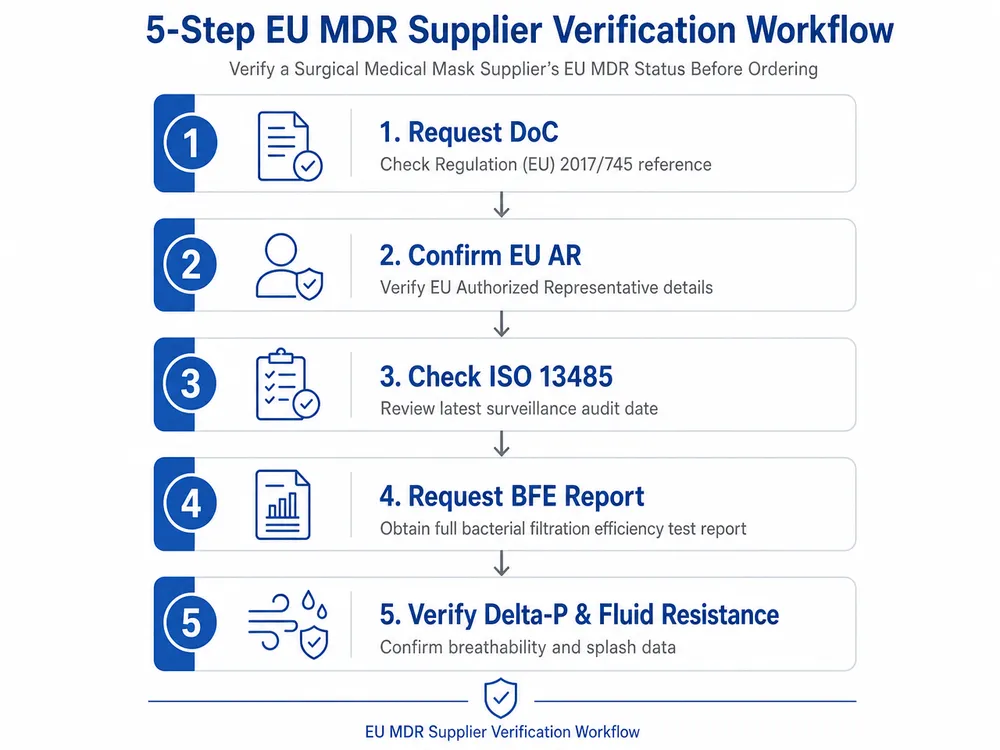
Step 1 — Request the EU MDR Declaration of Conformity (DoC). The DoC must reference Regulation (EU) 2017/745, not the old MDD (93/42/EEC). If the DoC references MDD, the product is not MDR-compliant for current German market entry.

Step 2 — Confirm the EU Authorized Representative. For manufacturers outside the EU, the MDR requires a registered EU Authorized Representative (Article 11). The DoC must name this representative. Verify the representative is real and currently active — this is a searchable registration.

Step 3 — Request the ISO 13485 certificate with current surveillance audit date. ISO 13485 certificates have a 3-year validity with annual surveillance audits. A certificate issued in 2020 with no surveillance audit record is a yellow flag.

Step 4 — Request the BFE test report, not just the certificate. The test report should show: test method (EN 14683 Annex B), test organism (Staphylococcus aureus at 28.3 L/min), particle size (3.0 ± 0.3 μm), and the actual BFE result (≥98% for Type II/IIR). A certificate that says "≥98% BFE" without the underlying test data is not sufficient for a German hospital procurement audit.

Step 5 — Check Delta-P and fluid resistance for Type IIR. Type IIR requires ≤40 Pa/cm² Delta-P and ≥120 mmHg fluid resistance. Both should appear in the test report. If a supplier is quoting Type IIR but can only produce a Type II test report, that's a compliance gap.

(We've had buyers come to us after a failed procurement audit because their previous supplier's documentation didn't hold up to this level of review. The documentation review is not bureaucratic box-ticking — it's the mechanism that protects your import license and your customer relationships.)

Step-by-step workflow diagram for verifying EU MDR compliance of a surgical mask supplier before placing an import order

When Local Supply Is the Right Answer

Factory-direct sourcing makes economic sense at repeat volume. It doesn't make sense in every situation, and a credible sourcing guide should say so.

Buy from a German distributor when:

  • You need delivery within days, not weeks
  • Your order is below 50,000 pieces
  • You're responding to an emergency or unplanned demand spike
  • Your buyer requires a German or EU-based supplier of record for contractual reasons
  • You're testing a new product category and need small quantities to validate demand

Consider factory-direct when:

  • You're placing orders of 100,000 pieces or more on a recurring basis
  • You're building a private-label surgical mask program and need OEM packaging
  • Your current distributor pricing is compressing your margin on resale
  • You need a specific EN 14683 configuration (Type II vs. Type IIR, ear-loop vs. tie-on) that isn't stocked locally
  • You want direct access to the manufacturer's QC documentation for your own compliance records

The honest version of this trade-off: local distributors provide convenience at a cost. That cost is manageable when your volumes are low or your urgency is high. At sustained volume — quarterly orders of 500,000 pieces or more — the distributor margin layer becomes a structural cost that factory-direct sourcing eliminates.

Sourcing Route Decision Guide

Scenario Recommended Route
Emergency restock, <50k pieces, needed within 1 week German distributor (Hartmann, L&R, Meditrade, Noba)
Quarterly supply program, 200k–1M pieces, Type IIR Factory-direct (verify CE MDR + ISO 13485 + BFE test reports)
Private-label surgical mask program, OEM packaging Factory-direct manufacturer with in-house packaging capability
Hospital framework contract, German supplier of record required German manufacturer or EU-based manufacturer (Hartmann, L&R, Mölnlycke)
Market entry, 50k–100k pieces, testing new SKU Factory-direct with 50k MOQ, request samples first
Compliance-sensitive procurement, full MDR documentation required Factory-direct with maintained MDR technical file and EU Authorized Representative

Frequently Asked Questions

What EN 14683 type do most German hospitals specify for surgical masks?

Type IIR is the standard specification for surgical and procedural use in German clinical settings. Type IIR adds splash resistance (≥120 mmHg fluid resistance) to the ≥98% BFE requirement of Type II. General ward and non-surgical clinical environments sometimes accept Type II, but if you're supplying OR or procedure room settings, specify Type IIR and verify the fluid resistance test data.

What's the difference between an MDD CE mark and an EU MDR CE mark on a surgical mask?

The EU Medical Device Regulation (2017/745) replaced the Medical Device Directive (93/42/EEC) with a transition deadline of May 2021. Surgical masks sold as medical devices in Germany after that date must carry CE marking under MDR, not MDD. The Declaration of Conformity must reference Regulation (EU) 2017/745. An MDD-era CE mark is no longer valid for new market placements — if a supplier's DoC references 93/42/EEC, the product is not compliant for current German import.

What import duty applies to surgical masks imported into Germany from China?

Surgical masks (HS code 6307.90 or 9020.00 depending on classification) imported into Germany from China are subject to EU customs duty, typically in the range of 6.3–12% on CIF value depending on the specific HS classification. Your customs broker will confirm the applicable rate for your specific product. Factor this into your landed cost calculation alongside sea freight, insurance, and local delivery.

How do I verify that a Chinese mask manufacturer has a valid EU Authorized Representative?

The EU Authorized Representative must be named in the manufacturer's EU MDR Declaration of Conformity. You can cross-reference the representative's registration through the EUDAMED database (ec.europa.eu/tools/eudamed) once it is fully operational, or request the representative's registration documentation directly from the manufacturer. A legitimate EU Authorized Representative will have a formal mandate agreement with the manufacturer and will be able to confirm their registration status.

What MOQ is realistic for a first factory-direct order of EN 14683 Type IIR masks?

50,000 pieces is a workable entry point for factory-direct sourcing from a manufacturer like eztio. At that volume, you're covering the production line setup cost without committing to a full container. For context, a 40HQ container holds approximately 3–4 million pieces of standard 3-ply surgical masks depending on packaging configuration — so a 50,000-piece trial order ships as a partial container or LCL shipment. Most buyers in the German market who are evaluating factory-direct sourcing start with a 50,000–100,000 piece trial order to validate documentation, spec consistency, and logistics before scaling to quarterly supply programs.

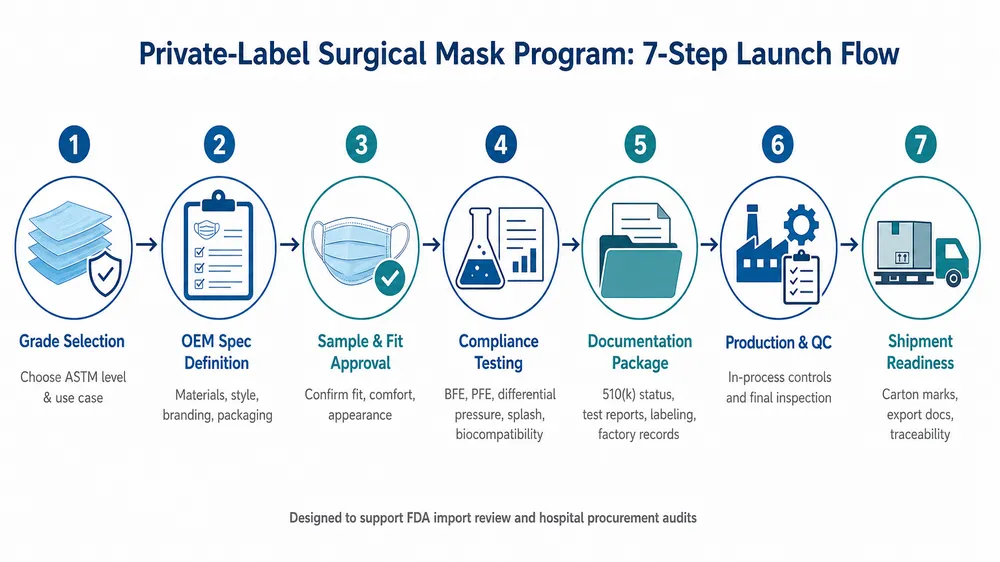
If you're evaluating factory-direct sourcing for your next EN 14683 Type II or Type IIR order, the practical next step is a documentation review before pricing. Send us your grade requirement, target annual volume, and any private-label or packaging specifications — we'll respond with current pricing, lead time, and a sample documentation package including our CE MDR Declaration of Conformity, ISO 13485 certificate, and EN 14683 BFE test reports. Request Quote

N95 Surgical Mask vs Standard N95 Respirator: Key Differences for Hospital Procurement Teams

The confusion is understandable. Both masks carry the N95 designation. Both filter ≥95% of airborne particles. Both look nearly identical in a product photo. But put a standard N95 respirator on a surgeon during a procedure and you've created a compliance gap that your hospital's infection control committee will flag — and that your procurement audit will not survive.

The difference between an N95 surgical mask and a standard N95 respirator is not about filtration performance. It's about fluid resistance. One mask is tested and certified to resist blood and body fluid splash. The other is not. That single distinction determines which mask is legally appropriate in a surgical or procedural setting, and it determines which certification documents your supplier needs to provide.

Quick verdict: If your procurement covers operating rooms, procedure suites, or any setting where fluid splash is a clinical risk, you need a dual-certified N95 — NIOSH-approved for particulate filtration and ASTM F2100-compliant for fluid resistance. A standard N95 respirator does not satisfy that requirement regardless of its filtration rating.

The Regulatory Line That Separates Them: ASTM F2100 Fluid Resistance

NIOSH certification — the TC-84A approval number on every legitimate N95 — tests one thing: particulate filtration efficiency at ≥95% against 0.3-micron particles under controlled airflow. That's the respirator standard. It says nothing about what happens when a fluid splash hits the mask surface.

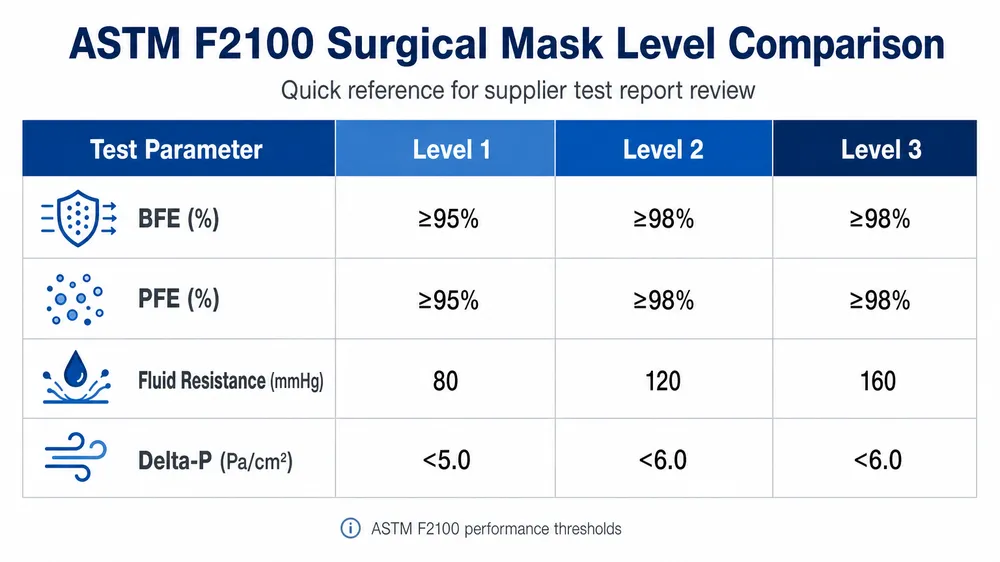
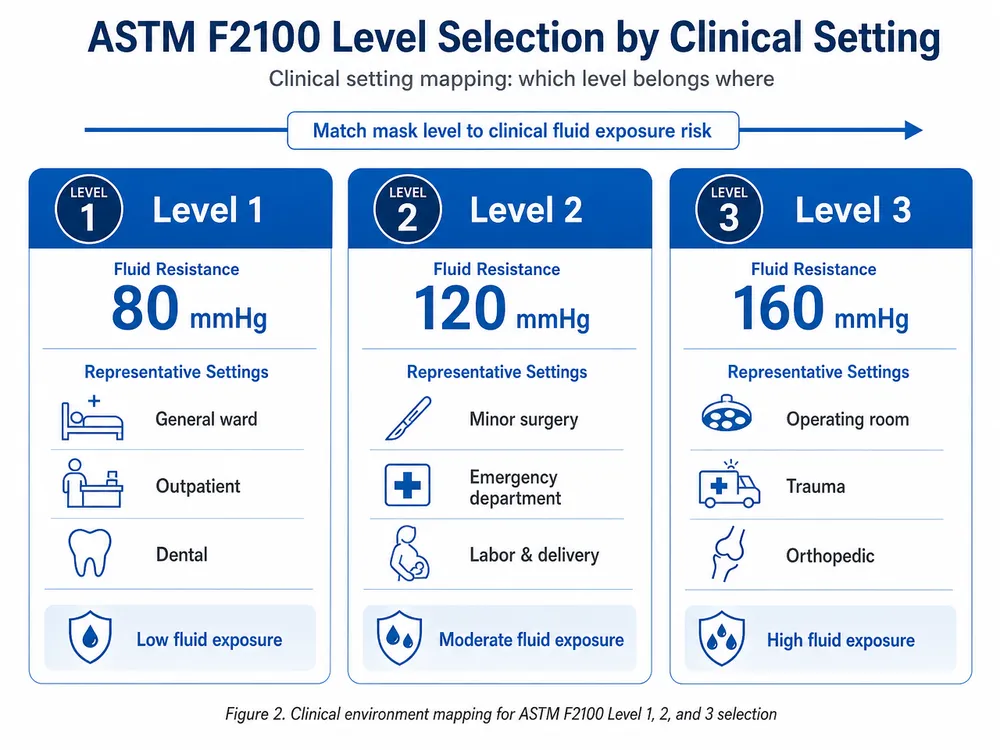
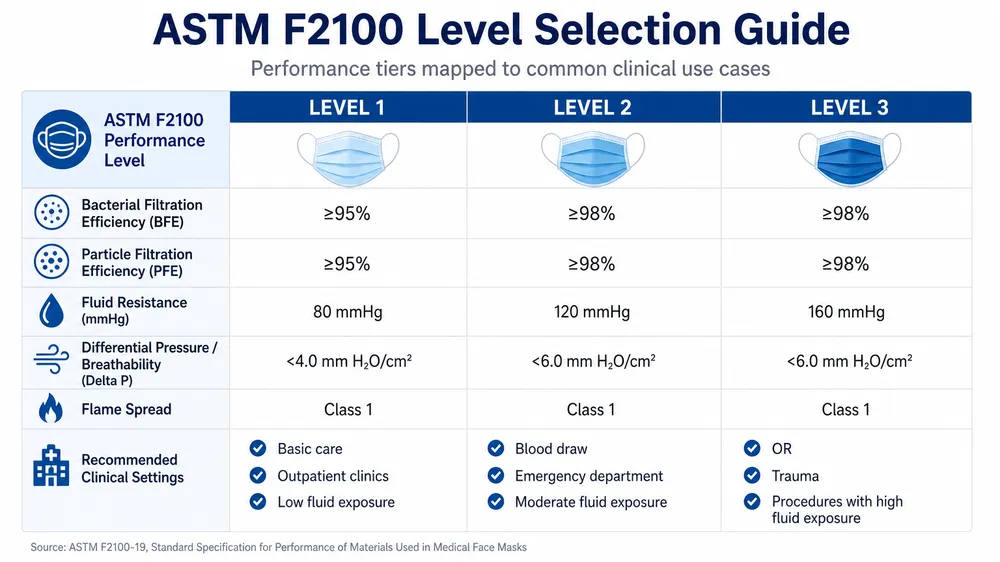
ASTM F2100 is the standard that governs surgical mask performance in the US market. It covers three performance tiers (Level 1, Level 2, Level 3) and includes a fluid resistance test: a synthetic blood challenge at defined pressure (80 mmHg for Level 1, 120 mmHg for Level 2, 160 mmHg for Level 3). A mask that passes this test is rated for surgical use. A mask that doesn't isn't — regardless of its filtration number.

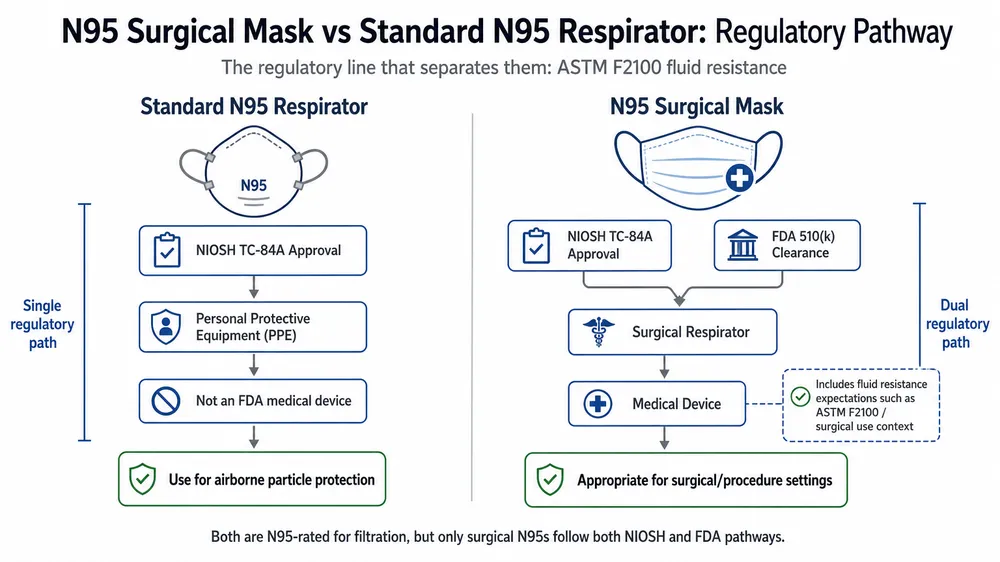
An N95 surgical mask carries both: NIOSH TC-84A approval for the respirator function, and ASTM F2100 compliance (typically Level 2 or Level 3) for the surgical mask function. The FDA classifies it as a combination product — a surgical respirator — and it requires FDA 510(k) clearance to be marketed as such in the US.

A standard N95 respirator carries only the NIOSH approval. It is regulated as a personal protective device, not a medical device. No FDA 510(k) required. No fluid resistance test required.

(We've seen buyers try to substitute standard N95s into surgical settings during supply crunches. Hospital infection control teams catch it. The documentation doesn't match the clinical requirement, and the order gets rejected at the department level even if it cleared central purchasing.)

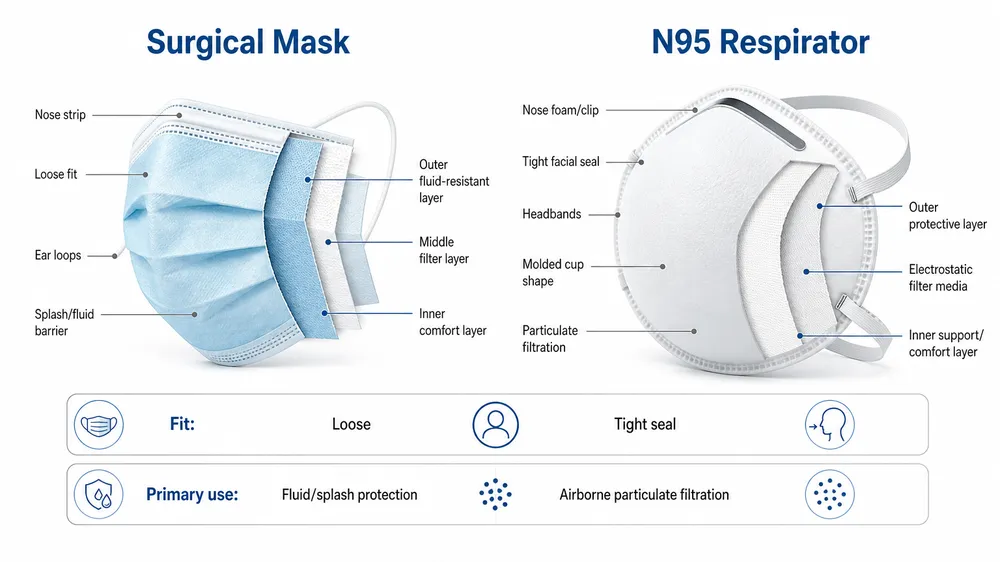
Diagram showing the dual regulatory pathway for N95 surgical masks versus standard N95 respirators under NIOSH and FDA frameworks

Head-to-Head Specification Matrix

The table below covers the commercially meaningful differences — the ones that determine which mask belongs in your order and what documentation your supplier must provide.

Specification N95 Surgical Mask Standard N95 Respirator
Particulate Filtration (PFE) ≥95% ≥95%
Bacterial Filtration Efficiency (BFE) ≥98% (ASTM F2100) Not tested / not required
Fluid Resistance ≥80 mmHg synthetic blood (Level 2) or ≥160 mmHg (Level 3) Not tested — no requirement
Delta-P (Breathability) ≤5.0 mm H₂O/cm² (ASTM F2100) ≤35 mm H₂O/cm² (NIOSH 42 CFR 84)
NIOSH TC-84A Approval Required Required
FDA 510(k) Clearance Required Not required
CE (EU MDR) Classification Class I Medical Device (surgical respirator) PPE Category III (respirator only)
ISO 13485 Manufacturing Required for medical device classification Not required for PPE-only
Applicable Standard ASTM F2100 + NIOSH 42 CFR 84 NIOSH 42 CFR 84 only
Regulatory Classification Surgical respirator (medical device) Personal protective equipment

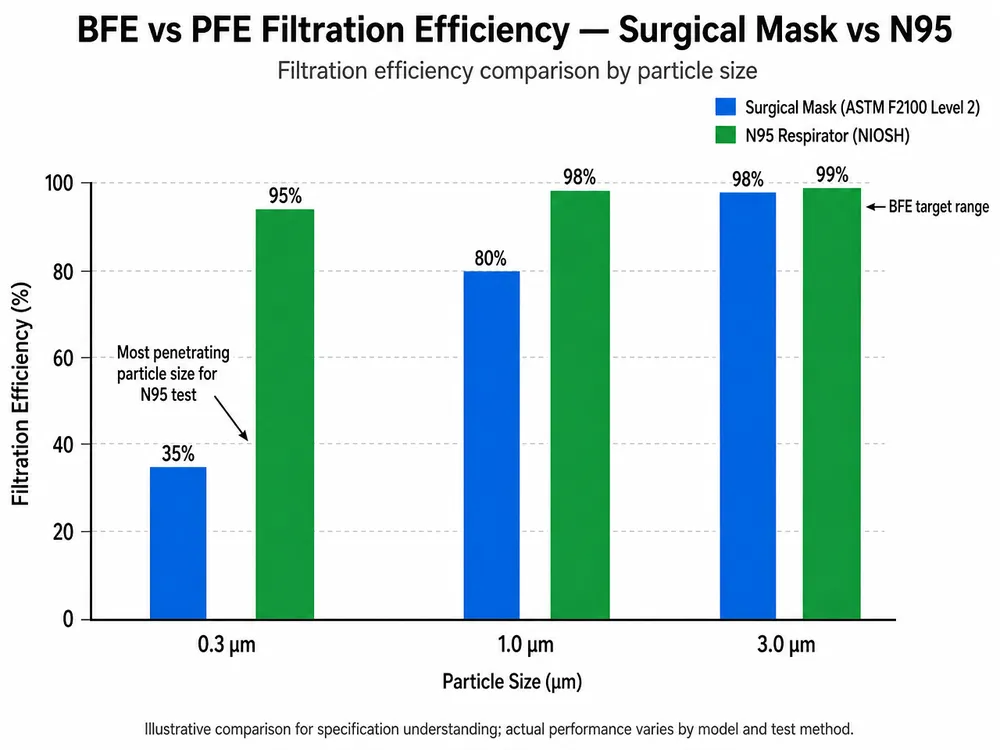
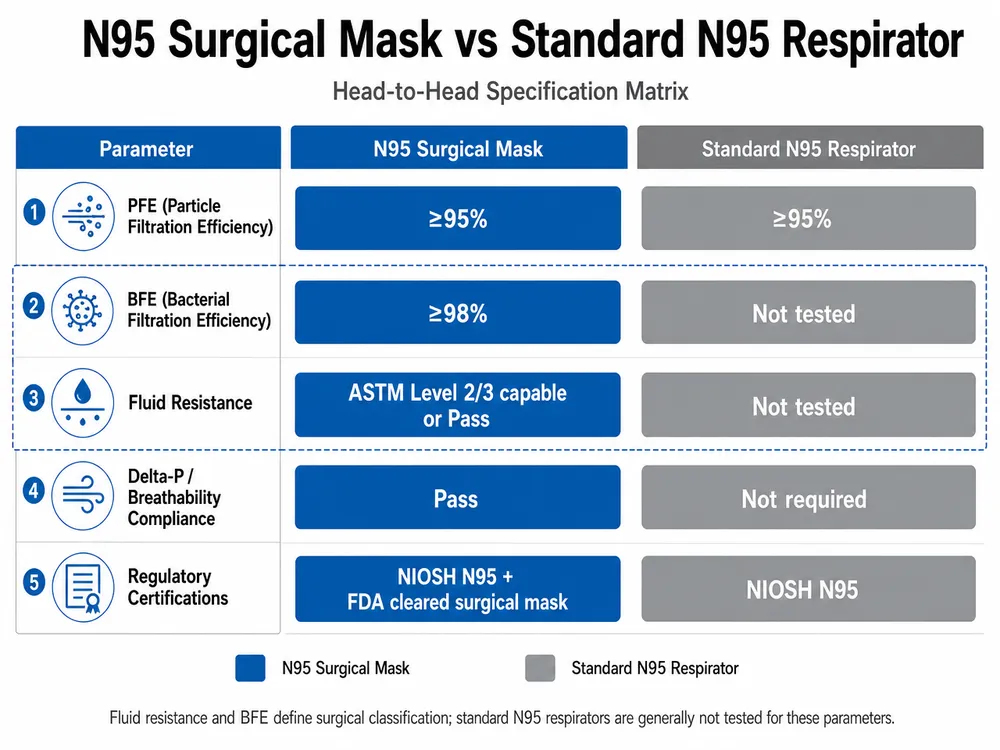
Two numbers in that table deserve attention. The Delta-P limit for surgical masks (≤5.0 mm H₂O/cm²) is significantly tighter than the NIOSH respirator limit (≤35 mm H₂O/cm²). This is not a minor footnote — it means the surgical N95 must achieve high filtration AND maintain breathability within a much narrower window. That's a harder manufacturing target, and it's why meltblown fabric quality is the controlling variable. A fabric that filters well but restricts airflow too much fails the surgical standard even if it passes NIOSH.

The BFE requirement is the other critical line. Standard N95s are never tested for bacterial filtration efficiency because they're not classified as surgical masks. An N95 surgical mask must hit ≥98% BFE — a higher bar than the filtration efficiency the NIOSH test measures, and tested against a different challenge (bacterial aerosol, not polydisperse NaCl particles).

Side-by-side performance comparison chart for N95 surgical mask and standard N95 respirator showing BFE, fluid resistance, and Delta-P values

Where Each Mask Belongs: Clinical Setting Determines the Right SKU

The clinical setting is the decision variable. Not preference, not price, not what was ordered last quarter.

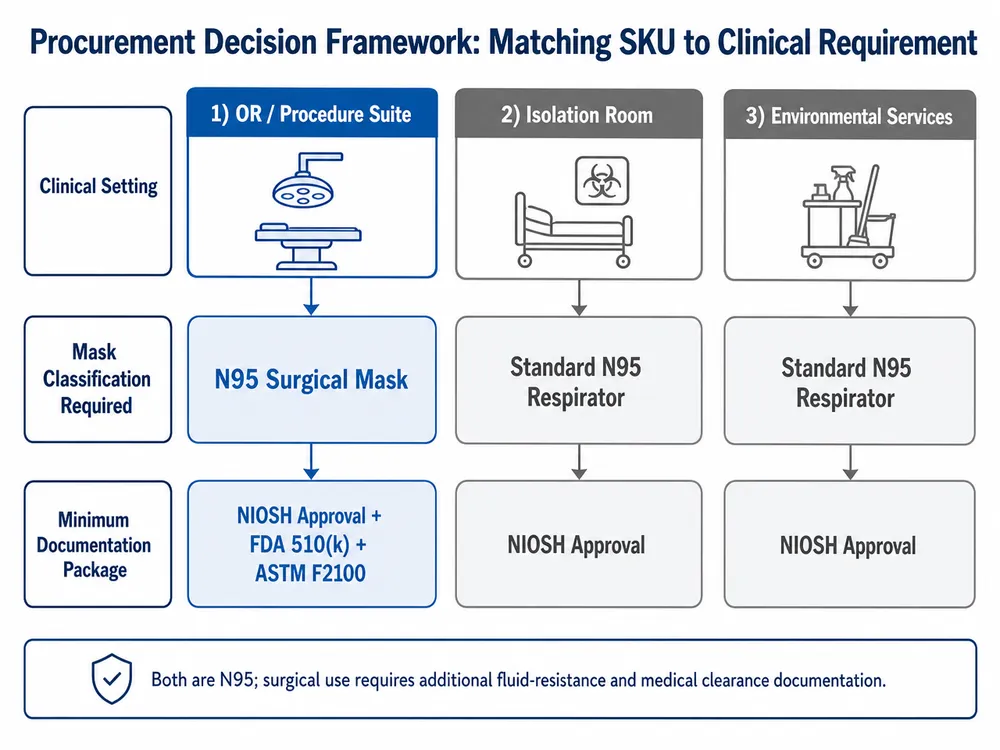
N95 surgical mask — required settings:

  • Operating rooms and procedure suites where aerosol-generating procedures (AGPs) occur alongside fluid splash risk
  • Labor and delivery units during delivery procedures
  • Emergency department trauma bays
  • Bronchoscopy, intubation, and tracheostomy procedures
  • Any setting where your hospital's infection control policy requires both respiratory protection and surgical mask classification

In these settings, the mask must satisfy two simultaneous requirements: protect the wearer from airborne particles (the respirator function) and protect the sterile field and patient from the wearer's respiratory emissions while resisting fluid splash (the surgical mask function). Only a dual-certified product does both. A standard N95 respirator covers the first requirement and fails the second.

Standard N95 respirator — appropriate settings:

  • Isolation rooms for airborne-precaution patients (TB, measles, varicella) where fluid splash is not a clinical concern
  • Respiratory therapy and patient transport in non-procedural contexts
  • Environmental services staff working in airborne-precaution areas
  • Industrial and occupational health programs within the hospital system

The standard N95 is the right tool when the clinical risk is airborne particle exposure without fluid splash. It's also the lower-cost option, which matters when you're managing high-volume consumption in non-surgical departments.

The procurement mistake we see most often: a hospital standardizes on one N95 SKU to simplify inventory, then discovers that the standard N95 they chose doesn't satisfy the surgical requirement in the OR. The result is a split order, a compliance gap in the interim, and a supplier conversation that should have happened before the contract was signed.

The Hidden Procurement Cost: Dual Certification Is Not Just a Label Upgrade

Buyers sometimes approach dual-certified N95 surgical masks as a premium version of the standard N95 — same product, extra paperwork, higher price. That framing misses the manufacturing reality.

Producing a mask that simultaneously meets NIOSH 42 CFR 84 and ASTM F2100 requires a different production environment and a different QC infrastructure. The ASTM F2100 fluid resistance requirement means the outer layer material must be selected and tested for hydrophobic performance. The BFE ≥98% requirement means the meltblown layer must be controlled to a tighter spec than NIOSH alone demands. The Delta-P ceiling of ≤5.0 mm H₂O/cm² means the meltblown basis weight and fiber diameter must be optimized to hit both filtration and breathability targets simultaneously — a narrower process window than standard N95 production.

We produce our meltblown fabric in-house, which is the only way we can reliably hit that dual-spec window. When you're buying from a factory that sources meltblown from an outside supplier, the filtration spec is only as consistent as that supplier's batch-to-batch quality. We've seen what happens when a meltblown roll comes in slightly off-spec: the masks pass visual inspection, they may even pass a quick BFE spot-check, but they fail the full ASTM F2100 battery. That failure shows up in your hospital's incoming inspection, not at the factory.

The manufacturing environment matters too. Our core production runs in a Class 100,000 (ISO 8) cleanroom — continuous particle monitoring, controlled access, documented environmental records. Hospital procurement audits increasingly require evidence of cleanroom manufacturing for surgical-classified products. A factory producing N95 surgical masks in an uncontrolled environment cannot provide that documentation, which means your procurement audit has a gap even if the product itself tests correctly.

(The ISO 13485:2016 certification is the other signal to check. It requires documented risk management and design controls at a level that most PPE-only factories haven't built. If a supplier holds ISO 13485 for their surgical mask line, they've been through the audit discipline that medical device manufacturing requires. If they only hold ISO 9001, they haven't.)

Procurement Decision Framework: Matching SKU to Clinical Requirement

The practical question for hospital supply chain is not "which mask is better" — it's "which mask does each department actually need, and can one supplier provide both with the right documentation?"

Here's the decision logic we walk buyers through:

Step 1 — Map your clinical settings to mask classification:

  • Identify which departments require surgical respirator classification (OR, procedure suites, AGP settings)
  • Identify which departments require respirator-only protection (isolation rooms, transport, environmental services)
  • Determine whether you need one SKU or two

Step 2 — Verify the certification stack for each SKU:

For N95 surgical masks, the minimum documentation package for US hospital procurement:

  • NIOSH TC-84A approval number (verifiable on the NIOSH Certified Equipment List)
  • FDA 510(k) clearance number (verifiable on the FDA 510(k) database)
  • ASTM F2100 Level 2 or Level 3 test report from an accredited laboratory
  • ISO 13485:2016 certificate from the manufacturing facility
  • BFE, PFE, and Delta-P test reports (batch-specific, not just product-level)

For standard N95 respirators, the minimum documentation package:

  • NIOSH TC-84A approval number
  • PFE test report
  • For hospital use: ISO 9001 or ISO 13485 certificate from the manufacturing facility

Step 3 — Evaluate the supplier's manufacturing evidence:

  • Does the factory hold FDA 510(k) for the specific surgical N95 SKU you're ordering?
  • Is the cleanroom classification documented and auditable?
  • Is meltblown production in-house or sourced externally?
  • Can the supplier provide batch-specific test reports, not just product-level certificates?

The last point is where a lot of procurement teams stop short. A product-level certificate tells you the mask design was tested and approved. A batch-specific test report tells you the masks in your shipment were tested. For hospital procurement, you need both.

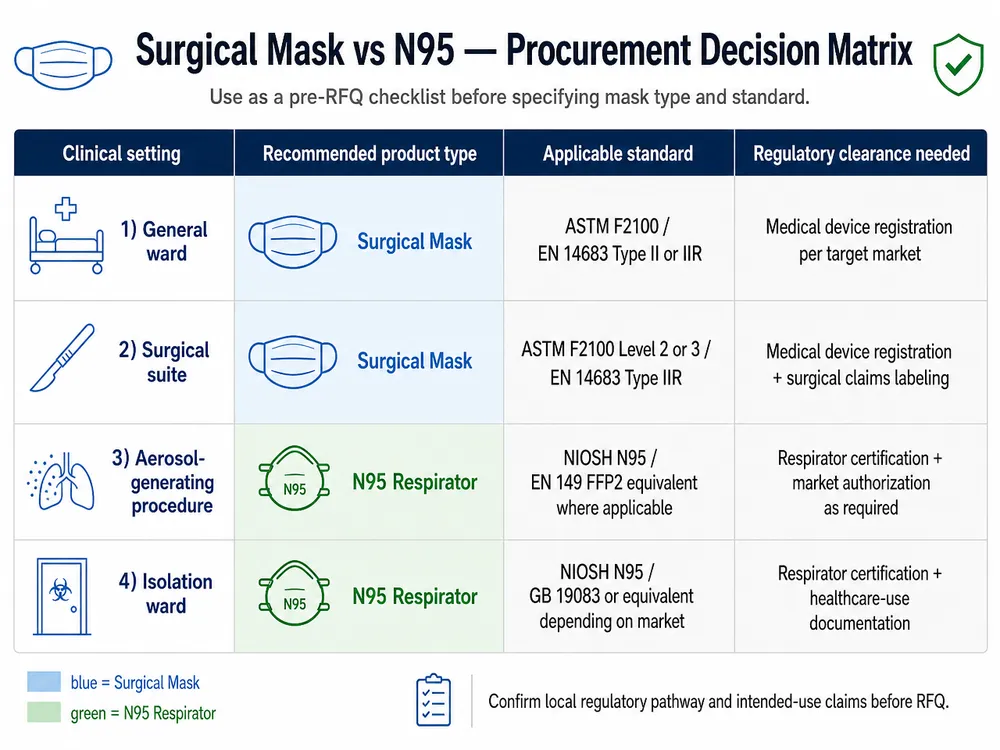
Hospital procurement decision matrix mapping clinical settings to N95 mask type and required certification documentation

Why Dual-Certified Sourcing Reduces Compliance Risk Across Your Supply Chain

The compliance argument for sourcing dual-certified N95 surgical masks from a single qualified supplier is straightforward: fewer documentation gaps, fewer audit findings, fewer emergency substitutions.

When a hospital runs two separate N95 SKUs from two separate suppliers, every procurement cycle carries two sets of certification renewal dates, two sets of batch test reports to track, and two supplier qualification files to maintain. If one supplier has a production disruption, the substitution options are constrained by the certification requirement — you can't substitute a standard N95 into a surgical setting even temporarily without an infection control exception process.

Sourcing both SKUs from a single FDA 510(k)-registered, ISO 13485-certified manufacturer with documented cleanroom production simplifies that picture considerably. One supplier qualification file. One audit relationship. One documentation standard applied across both products.

We hold FDA 510(k) registration and CE under EU MDR for our N95 Surgical Medical Mask line. The same facility, the same cleanroom, the same meltblown production, and the same QC infrastructure that produces our surgical N95s also produces our standard N95 respirators. If your procurement covers both clinical settings, you can source both products from one qualified supplier with one documentation package.

For buyers supplying into the EU market, the CE (EU MDR) classification adds another layer: surgical respirators are classified as Class I medical devices under EU MDR, requiring a technical file, a Declaration of Conformity, and a registered EU Authorized Representative. Standard N95-equivalent respirators (FFP2 under EN 149) are classified as PPE Category III — a different regulatory pathway entirely. If you're building a European hospital supply program, the distinction matters at customs and at the hospital procurement audit level.

Scenario Decisions: Which Mask Wins in Each Procurement Context

Scenario 1: Regional hospital network, OR and ICU procurement

You're sourcing for a 12-hospital network. The OR and ICU departments require surgical respirator classification. The isolation ward and environmental services teams need standard N95 protection. Your compliance team requires FDA 510(k) documentation for all surgical-classified products and ISO 13485 certification for all suppliers.

Winner: Dual-certified N95 surgical mask for OR/ICU, standard N95 for isolation/EVS — both from a single ISO 13485-certified, FDA 510(k)-registered supplier. Consolidating to one supplier reduces your qualification burden and gives you a single point of accountability for documentation.

Scenario 2: Healthcare distributor building a hospital supply catalog

You're building a catalog for hospital system customers. Your buyers will ask for both surgical and non-surgical N95 SKUs. They'll require FDA 510(k) documentation for the surgical SKU and will run incoming inspection on both.

Winner: Source both SKUs from a manufacturer with in-house meltblown production and batch-specific test reports. Your hospital customers' incoming inspection will catch batch-to-batch inconsistency. A supplier without in-house meltblown control cannot guarantee that consistency across large orders. One failed incoming inspection at a hospital customer is a relationship problem, not just a product problem.

Scenario 3: Government or institutional tender requiring dual-certified N95

The tender specification calls for NIOSH-approved N95 surgical masks with FDA 510(k) clearance, ASTM F2100 Level 2 minimum, and ISO 13485 manufacturing certification. The volume is 500,000 pieces with a 30-day delivery requirement.

Winner: A manufacturer with all three certifications already in place, in-house meltblown production for spec consistency, and sufficient line capacity to fulfill the volume without queuing. At 120 million pieces annual capacity across 6 production lines, a 500,000-piece order is a standard run for us — not a capacity stretch that requires overtime or line reallocation.

What to Include in Your RFQ for N95 Surgical Masks

The RFQ language determines whether you get a compliant quote or a generic price. These are the parameters that matter:

For N95 surgical masks:

  • Confirm NIOSH TC-84A approval required (specify the approval number if you have a preferred product)
  • Specify ASTM F2100 Level 2 or Level 3 (Level 2 covers most surgical settings; Level 3 is required for high-fluid-exposure procedures)
  • Require FDA 510(k) clearance number in the quote response
  • Request batch-specific BFE, PFE, and Delta-P test reports with each shipment
  • Specify ISO 13485:2016 manufacturing certification required
  • State whether CE (EU MDR) is required for EU market distribution
  • Confirm cleanroom manufacturing classification required (Class 100,000 / ISO 8 minimum)

For standard N95 respirators:

  • Confirm NIOSH TC-84A approval required
  • Request PFE test report
  • Specify whether ISO 13485 or ISO 9001 manufacturing certification is acceptable
  • State volume and delivery timeline

For both SKUs:

  • Specify OEM/private-label requirements if applicable
  • Confirm packaging format (individual poly bag, bulk clinical pack, retail box)
  • State target market for regulatory documentation alignment (US, EU, Middle East, etc.)

The documentation requirements are not negotiable in hospital procurement. A supplier who can't provide batch-specific test reports alongside the shipment is not a viable hospital supplier, regardless of price.

For a full overview of our Surgical Medical Masks product range — including 3-ply surgical masks, N95 surgical masks, and ASTM F2100 level options — the category page covers the complete specification and certification details. When you're ready to specify your volume and certification requirements, the Request Quote page routes directly to our sales team.

3 Ply Medical Mask Layer Function: What Each Layer Does and Where Cheap Suppliers Cut Corners

Most buyers who've had a shipment fail BFE testing didn't get unlucky. They sourced from a factory that was cutting corners on the meltblown layer — and had no way to know it until the test report came back.

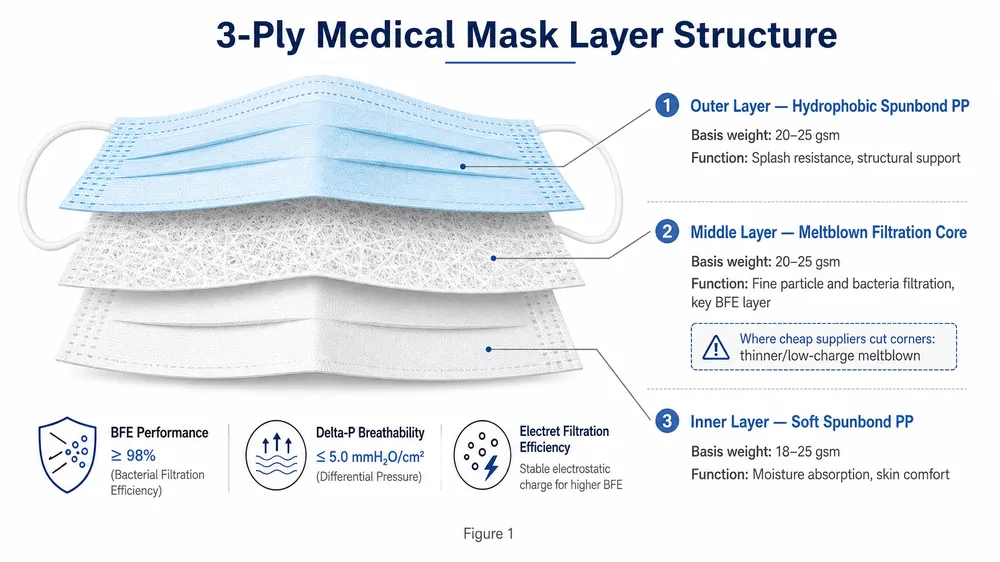
The three-layer structure of a standard 3 Ply Medical Mask looks simple on paper: outer spunbond, meltblown filtration core, inner spunbond. But the performance gap between a mask that passes ≥95% BFE and one that fails isn't random. It's the direct result of specific material choices — basis weight, fiber diameter, electrostatic charge — that are invisible to the eye and easy to fake on a spec sheet.

This article breaks down what each layer actually does, what the performance-critical parameters are, and where the shortcuts happen. If you're sourcing 3-ply surgical masks for distribution, hospital supply, or private-label programs, this is the technical foundation you need before you evaluate a supplier.

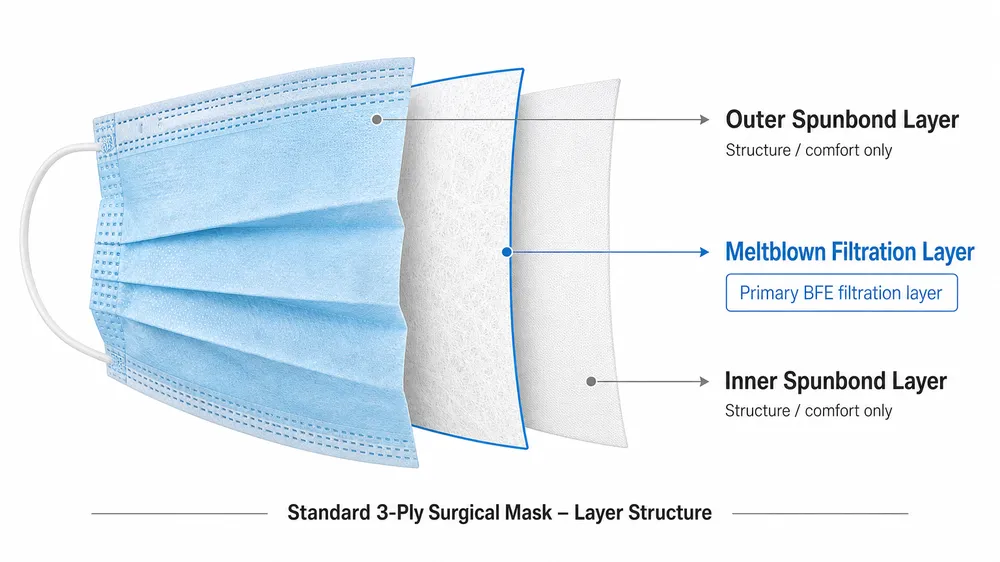
Cross-section diagram of a 3 ply medical mask showing outer spunbond, meltblown filtration, and inner spunbond layers with labeled material specs

Layer 1 — outer spunbond: fluid barrier and structural shell

The outer layer is polypropylene (PP) spunbond nonwoven, typically running between 20–25 g/m² basis weight. Its job is two things: block fluid splash and give the mask its structural shape.

The hydrophobic treatment applied to this layer is what makes it repel blood, saliva, and respiratory droplets rather than absorbing them. Under ASTM F2100 and EN 14683, fluid resistance is a rated performance parameter — Level 1 masks require resistance to 80 mmHg synthetic blood splash, Level 2 and Level 3 step up from there. The outer spunbond is the layer that carries that rating.

Where suppliers cut corners here: underweight fabric. A 20 g/m² outer layer is the standard minimum for a mask that holds its shape and maintains fluid resistance. Some factories drop to 17–18 g/m² to reduce material cost. The mask looks identical. The fluid resistance degrades, and the structural integrity under extended wear weakens. You won't see it in a visual inspection — you'll see it in a fluid resistance test or in field complaints from end users.

The other shortcut is skipping or reducing the hydrophobic treatment. Untreated or undertreated spunbond absorbs moisture instead of repelling it. The outer layer becomes a wick rather than a barrier. This is particularly relevant for buyers supplying clinical environments where splash exposure is a real risk.

What to request: ask for the outer layer basis weight (g/m²) and the hydrophobic treatment specification. A supplier who can't provide these numbers is either buying fabric without spec documentation or doesn't want you to know what's in the mask.

Layer 2 — meltblown filtration core: the layer that determines whether your mask passes or fails

This is the one that matters most. The meltblown layer is the reason a 3-ply surgical mask filters bacteria and particles — and it's the layer where the widest quality gap exists between compliant manufacturers and cheap suppliers.

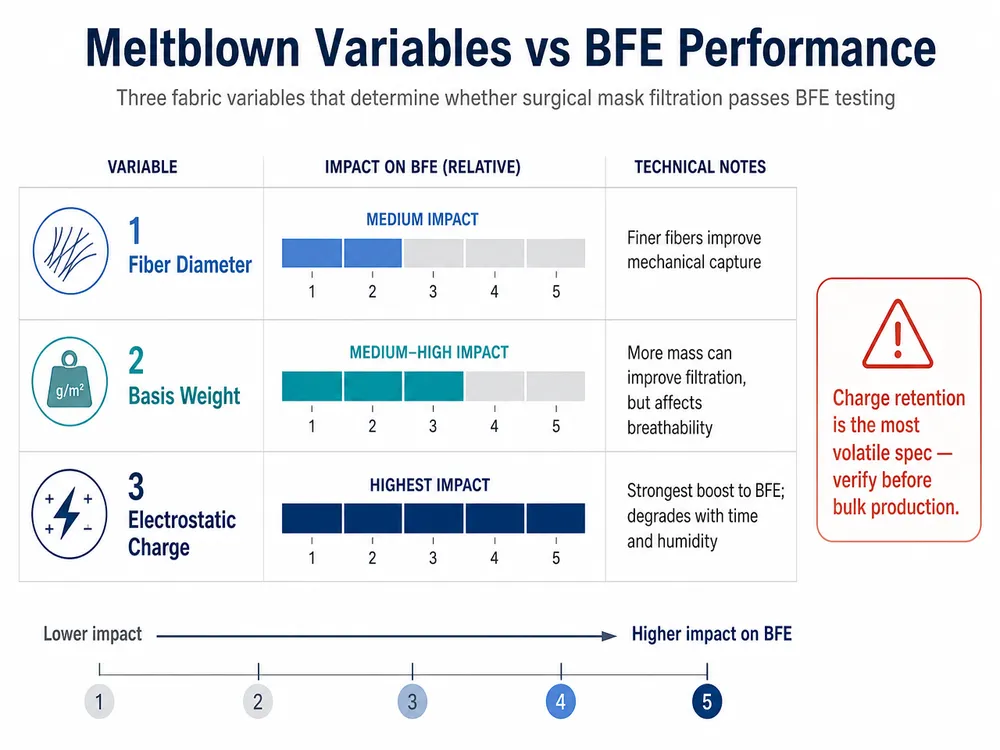
Meltblown nonwoven is produced by extruding polypropylene through extremely fine nozzles under high-velocity hot air, creating fibers in the 1–5 micron diameter range. The resulting fabric has a dense, random fiber matrix that physically traps particles. But physical filtration alone isn't enough to reach ≥95% BFE. The second mechanism is electrostatic charge — the meltblown fabric is corona-charged during production, creating an electrostatic field that attracts and holds charged particles and aerosols that would otherwise pass through the fiber matrix.

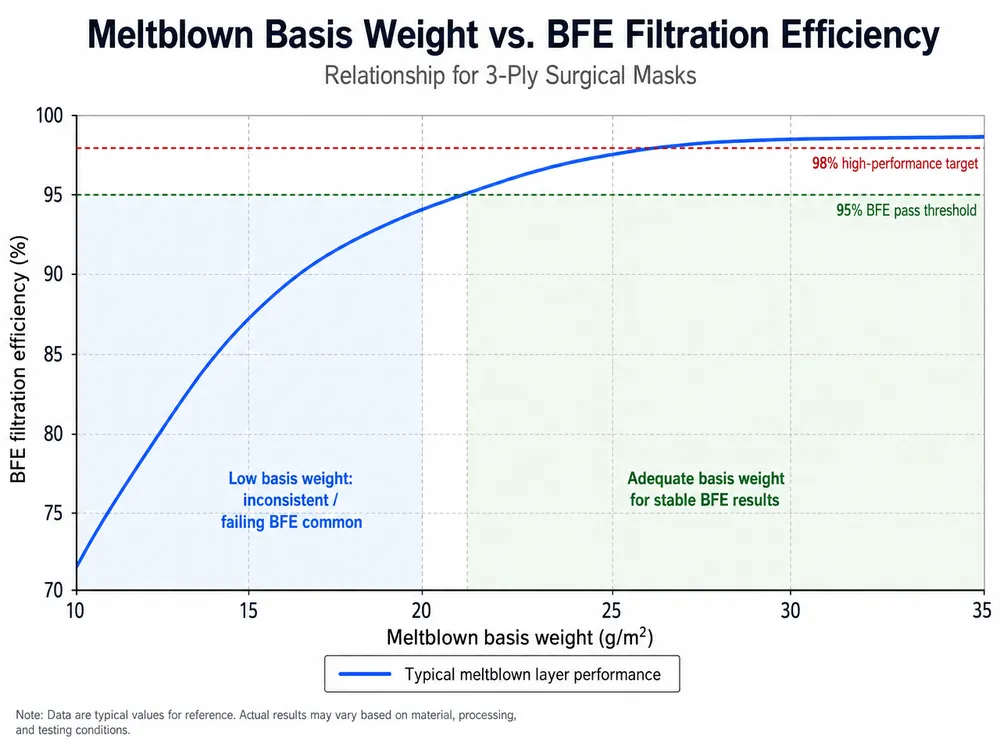
A properly produced meltblown layer for a ≥95% BFE mask typically runs at 20–25 g/m² basis weight. For ≥98% BFE (required for ASTM F2100 Level 2 and Level 3), the basis weight is higher — typically 25–30 g/m² — and the electrostatic charge level is more tightly controlled.

Chart showing the relationship between meltblown nonwoven basis weight in grams per square meter and BFE filtration efficiency percentage for 3 ply surgical masks

The two shortcuts that cause BFE failures:

Reduced basis weight. Dropping the meltblown from 22 g/m² to 15 g/m² cuts material cost significantly. The mask still has three layers. It still looks like a surgical mask. But the fiber density is too low to reliably achieve ≥95% BFE, and the results become inconsistent — some batches pass, some don't, depending on production variables that day.

Missing or degraded electrostatic charge. Meltblown fabric loses its electrostatic charge over time, especially when stored improperly (high humidity, UV exposure, contact with certain chemicals). Some factories use meltblown that was never properly charged to begin with, or use fabric that has been sitting in a warehouse long enough that the charge has dissipated. A mask made with uncharged meltblown at standard basis weight will typically test in the 60–75% BFE range — well below the ≥95% threshold. The fiber matrix is intact; the electrostatic mechanism is gone.

We produce our meltblown in-house. That's not a marketing point — it's the operational reason we can guarantee spec consistency across large orders. When you buy meltblown from a third-party fabric supplier, you're trusting their production parameters, their storage conditions, and their batch-to-batch consistency. We set the fiber diameter, the basis weight, and the charge level ourselves, and we batch-test every roll before it goes into production. (We've seen what happens when factories don't do this. During the 2020–2021 supply crunch, meltblown from some spot-market suppliers was arriving with BFE performance in the 50–60% range. Factories that didn't have in-house testing capability were shipping non-compliant product without knowing it.)

For more on how meltblown quality connects to BFE outcomes, see our detailed guide on meltblown quality in surgical masks.

Layer 3 — inner spunbond: breathability and Delta-P compliance

The inner layer — the one that sits against the face — is also PP spunbond, but typically softer and lighter than the outer layer, running 18–20 g/m². Its primary function is comfort and breathability, but it has a direct effect on a performance parameter that buyers often overlook: Delta-P, the pressure differential across the mask.

Delta-P measures airflow resistance. Under ASTM F2100, the maximum allowable Delta-P is 5.0 mm H₂O/cm² for Level 1 and Level 2 masks, and 5.0 mm H₂O/cm² for Level 3 as well. EN 14683 uses a similar threshold. A mask that exceeds the Delta-P limit is technically non-compliant — it's too restrictive to breathe through comfortably, which matters for extended clinical wear.

The inner spunbond contributes to Delta-P because it adds airflow resistance on top of the meltblown layer. If a supplier substitutes a denser or heavier inner layer — either to reduce cost on the outer layer and compensate structurally, or simply because they're buying whatever nonwoven is available — the combined Delta-P of the three layers can push the mask over the compliance threshold.

The other substitution we see: replacing the soft inner spunbond with a rougher, cheaper nonwoven grade. This doesn't affect BFE directly, but it affects end-user compliance. Masks that are uncomfortable to wear get pulled down or removed, which eliminates whatever protection they provide. For buyers supplying hospital or institutional channels, this is a downstream liability issue — your customer's procurement team will notice the complaint rate.

Layer Material Typical Basis Weight Primary Function Key Performance Parameter
Outer PP Spunbond (hydrophobic) 20–25 g/m² Fluid barrier, structural shell Fluid resistance (ASTM F2100)
Middle PP Meltblown 20–30 g/m² Particle/bacterial filtration BFE ≥95% or ≥98%, PFE
Inner PP Spunbond (soft) 18–20 g/m² Comfort, breathability Delta-P ≤5.0 mm H₂O/cm²

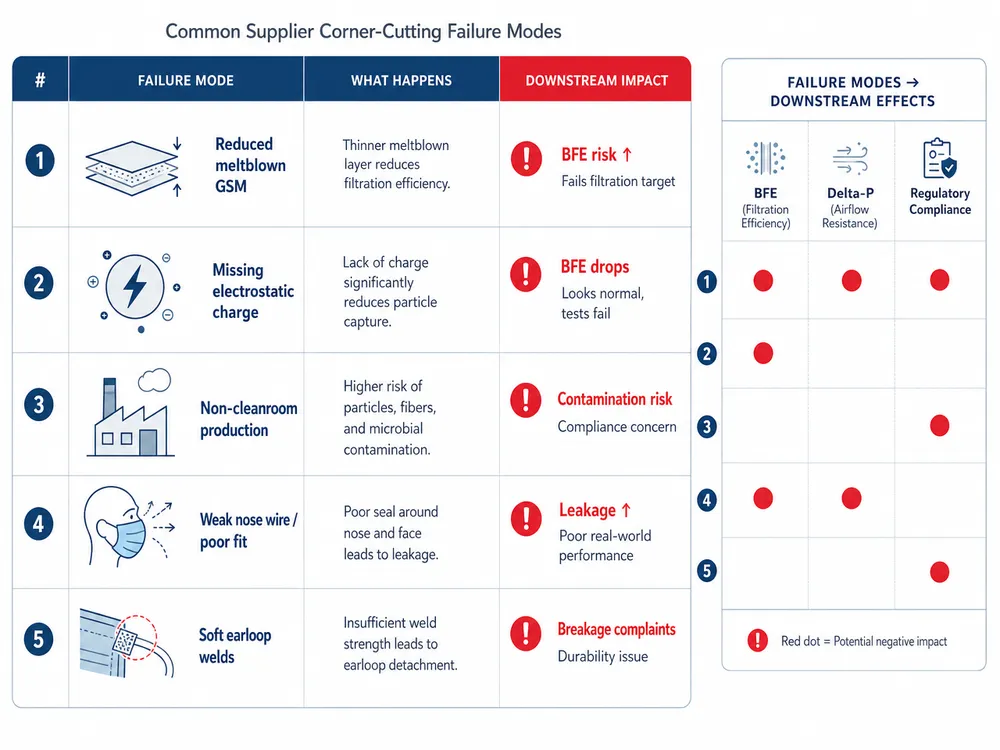
Where cheap suppliers cut corners: the failure modes in practice

The shortcuts above don't happen in isolation. A factory optimizing for the lowest possible unit cost typically cuts across all three layers simultaneously. Here's what that looks like in practice:

Single-layer substitution. Some factories produce what they call a "3-ply" mask using two layers of spunbond and a thin layer of tissue paper or low-grade nonwoven in place of meltblown. The mask has three layers. It has no filtration capability. BFE testing will return results in the 30–50% range. This is the most egregious version of the shortcut, and it's more common than buyers expect — particularly in very low price-point sourcing.

Reduced meltblown GSM with no disclosure. The factory uses genuine meltblown but at 12–15 g/m² instead of the 20–25 g/m² required for reliable ≥95% BFE. The spec sheet says "meltblown middle layer." It doesn't say the basis weight. The mask may pass BFE testing on a good production day and fail on a bad one, creating inconsistent batch results that are difficult to trace.

Uncharged or degraded meltblown. As described above — the fiber matrix is present, the electrostatic mechanism is absent. BFE results cluster in the 60–75% range. The factory may not even know this is happening if they're not running in-house BFE testing on each batch.

Non-cleanroom production. A mask produced outside a controlled environment can have particulate contamination embedded in the nonwoven layers. For buyers supplying hospital procurement channels, this is a compliance issue — hospital procurement standards typically require cleanroom manufacturing documentation. A factory that can't provide ISO 8 or equivalent cleanroom certification is producing in an uncontrolled environment.

Ear-loop and nose wire shortcuts. These don't affect BFE directly, but they affect the mask's ability to seal properly. An ear loop with insufficient tensile strength breaks under normal use. A nose wire that doesn't hold its shape leaves gaps at the nose bridge. Both reduce effective filtration regardless of what the meltblown layer is rated at.

Visual checklist of common quality shortcuts in cheap 3 ply surgical mask production including reduced meltblown basis weight, missing electrostatic charge, and non-cleanroom manufacturing

How to verify layer integrity before accepting a shipment

The documents that matter — and the questions that reveal whether a supplier actually has them.

BFE test report. This is the non-negotiable baseline. The report should show the BFE percentage, the test method (ASTM F2100, EN 14683, or equivalent), the testing laboratory, and the lot or batch number. A test report without a batch number is a generic certificate — it tells you a mask from that factory passed BFE testing at some point, not that your specific shipment will.

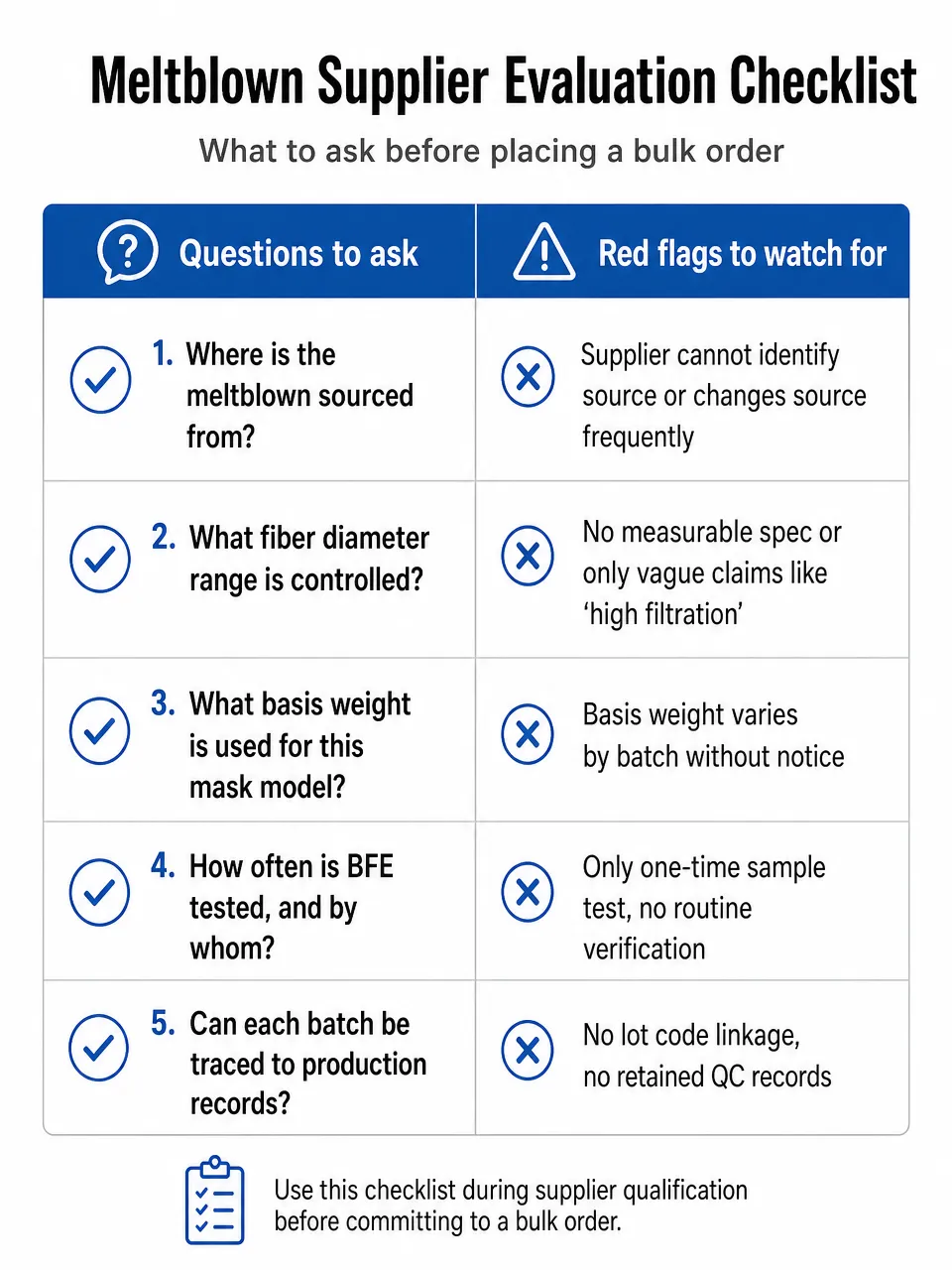
Material specification sheet. Request the spec sheet for the meltblown layer specifically: basis weight (g/m²), fiber diameter range, and electrostatic charge specification. If the supplier can't provide this, they're either buying meltblown without spec documentation or they don't want you to know the basis weight. Both are red flags.

Batch traceability documentation. Under ISO 13485, every production batch should be traceable to its raw material lots. Ask for the batch record or material traceability document for your specific order. A factory operating under a real ISO 13485 QMS can produce this. A factory with a decorative certificate cannot.

Cleanroom certification. For hospital or institutional supply channels, ask for the cleanroom classification certificate and the most recent environmental monitoring report. ISO 8 (Class 100,000) is the standard for medical mask production. If the factory can't provide this, the production environment is uncontrolled.

Delta-P test result. Often overlooked, but required for ASTM F2100 compliance. The Delta-P result should be in the same test report as BFE, or in a separate breathability test report. A mask that passes BFE but fails Delta-P is non-compliant.

The question that separates real manufacturers from trading companies: "Can you provide the meltblown basis weight specification and the in-house BFE test data for the last three production batches?" A factory with in-house testing capability and in-house meltblown production can answer this immediately. A factory buying meltblown from outside and relying on third-party testing will either deflect or provide a generic certificate.

For a deeper look at how to interpret BFE and Delta-P test results when evaluating suppliers, see our guide on BFE and Delta-P performance.

What in-house meltblown production means for your order consistency

Batch-to-batch BFE variance is the sourcing problem that doesn't show up until you're three orders in. The first order passes testing. The second order passes. The third order fails — or passes at 95.2% when your customer's procurement spec requires ≥98%. The factory blames the testing lab. You're holding a non-compliant shipment.

This is almost always a meltblown sourcing problem. Factories that buy meltblown from third-party suppliers are dependent on that supplier's production consistency, storage conditions, and honesty about what they're shipping. When the meltblown supplier has a bad production run, or ships older stock with degraded charge, or substitutes a lower basis weight to manage their own costs, the mask factory may not know until the BFE test comes back.

We brought meltblown production in-house specifically to eliminate this variable. Our meltblown line runs to fixed parameters: fiber diameter, basis weight, and charge level are set for each filtration target and verified on every roll before it enters the mask production line. When you order a ≥95% BFE mask from us, the meltblown going into that mask was produced in our facility, tested in our lab, and meets the spec we committed to. When you order ≥98% BFE, the parameters are adjusted accordingly — we're not hoping the fabric supplier shipped the right grade.

Our in-house QC lab runs BFE, PFE, and Delta-P testing on every production batch. The test data is available per batch, not just per product line. If you're building a private-label program or supplying a hospital procurement channel that requires per-lot test documentation, we can provide it — because we generate it as part of standard production, not as a special request.

The certification stack — ISO 13485:2016, CE under EU MDR, FDA 510(k) registration — means the layer specifications and QC procedures are documented under a regulated quality management system. The meltblown basis weight, the charge specification, the BFE acceptance criteria — these are controlled documents, not informal practices. When your compliance team or your customer's procurement auditor asks for the technical file, it exists.

Our Surgical Medical Masks product range covers standard 3-ply configurations at both ≥95% and ≥98% BFE grades, with full test documentation available for each SKU.

Sourcing decision guide: what to specify and what to verify

If you're evaluating 3-ply surgical mask suppliers, here's the practical framework:

Specify by performance grade, not just "3-ply surgical mask." The difference between a ≥95% BFE mask and a ≥98% BFE mask is a different meltblown spec. Tell your supplier which grade you need and ask for the test report that confirms it. If they can't distinguish between the two, they're not controlling the meltblown layer.

Request per-batch test reports, not just product certificates. A product certificate tells you the design was tested. A per-batch report tells you your specific shipment was tested. For large orders or ongoing supply programs, per-batch documentation is the only way to catch batch-to-batch variance before it becomes a compliance problem.

Ask about meltblown sourcing before you ask about price. "Do you produce meltblown in-house or purchase from a third-party supplier?" is the single most useful question you can ask a mask supplier. The answer tells you how much control they have over the variable that determines BFE performance. A factory that buys meltblown from outside can still produce compliant masks — but their consistency depends on their supplier's consistency, and that's a risk you're carrying.

Verify cleanroom status if your channel requires it. Hospital procurement, government tenders, and institutional supply chains increasingly require cleanroom manufacturing documentation. Get the certificate before you commit to the order, not after.

Sample before scaling. For new supplier relationships, a sample order with independent BFE testing is the lowest-cost way to verify what you're actually getting. Send samples to an accredited third-party lab — Nelson Labs, SGS, Intertek — and compare the results against the supplier's own test report. If the numbers diverge significantly, you have your answer.

The masks that fail in the field — the ones that generate complaints, failed audits, or customs holds — almost always trace back to a meltblown layer that wasn't what the supplier claimed. The layer structure of a 3-ply mask is simple. The quality controls required to make it perform consistently are not.

If you're ready to specify your BFE grade and order volume, Request Quote and we'll respond with the relevant spec sheet, per-batch test report references, and a production timeline for your destination market.

Frequently asked questions

What is the minimum meltblown basis weight for a ≥95% BFE 3-ply surgical mask?

The typical minimum is around 20 g/m², but basis weight alone doesn't guarantee BFE performance — the electrostatic charge level is equally important. A meltblown layer at 20 g/m² with proper corona charging will typically achieve ≥95% BFE. The same basis weight with degraded or absent charge may test in the 60–75% range. When evaluating suppliers, ask for both the basis weight specification and confirmation that the fabric is corona-charged during production.

Can I verify meltblown quality from a finished mask sample?

Not visually. The only reliable verification method is BFE testing at an accredited lab. You can request the meltblown spec sheet from the supplier and cross-reference it against the BFE test report, but the definitive check is independent testing of your actual sample. Some buyers also request a material cross-section or basis weight measurement from a fabric sample cut from the mask — this confirms the layer weight but not the charge level.

What's the difference between BFE and PFE, and which matters for my sourcing decision?

BFE (Bacterial Filtration Efficiency) measures the mask's ability to filter bacteria-sized particles (typically 3.0 micron challenge aerosol). PFE (Particulate Filtration Efficiency) measures filtration of sub-micron particles (typically 0.1 micron latex spheres). For standard surgical mask applications — clinical environments, general healthcare, institutional supply — BFE ≥95% is the primary compliance threshold. PFE becomes relevant when your buyers are supplying environments with sub-micron aerosol exposure risk, or when the procurement spec explicitly requires it. ASTM F2100 Level 2 and Level 3 require both BFE ≥98% and PFE ≥98%.

Why do some 3-ply masks fail BFE testing even when they have a meltblown layer?

Three common reasons: the meltblown basis weight is too low to achieve consistent filtration, the electrostatic charge has degraded (from improper storage or poor production), or the meltblown was never properly charged to begin with. A fourth reason that's less obvious: the mask construction itself — specifically the edge sealing — can create bypass paths where air flows around the meltblown layer rather than through it. Ultrasonic welding with proper seam geometry eliminates this; adhesive bonding or heat sealing with poor tolerances can leave gaps.

What documents should I request before placing a bulk order?

At minimum: BFE test report with batch number, material specification sheet for the meltblown layer (basis weight and charge spec), ISO 13485 certificate, and cleanroom classification documentation. For US import: FDA 510(k) registration number. For EU import: CE technical file reference and EU MDR declaration of conformity. For hospital or institutional supply: per-lot test reports and batch traceability records. If a supplier can't provide all of these before you place the order, the documentation gap will surface at customs or during your customer's procurement audit.