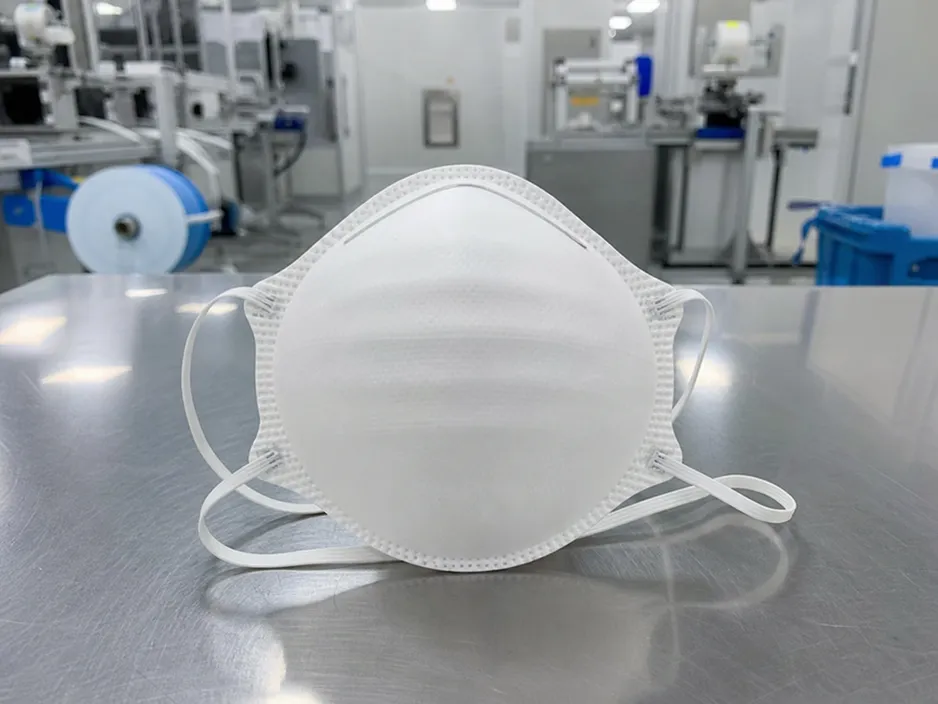
The Real Cost Is the Fit Test Failure Rate, Not the Unit Price
The question most hospital procurement teams ask is: which N95 design is cheaper per unit? The question they should be asking is: which design will my workforce actually pass fit testing in — and what does a 15% failure rate cost me in retraining, compliance documentation, and replacement masks?
Cup-style N95s have been the default for decades. Fold-flat designs have gained ground because they pack denser and adapt to more face shapes. Both observations are true. The tension is real. Cup-style masks are more forgiving to don correctly. Fold-flat masks are more forgiving across diverse face geometries. Neither is universally better — but for most hospital procurement programs with mixed workforces, fold-flat designs produce lower aggregate fit test failure rates, and that difference has a direct cost that doesn't show up in the per-unit price comparison.
Quick verdict: if your workforce has significant face shape variability — which most hospital systems do — fold-flat N95s will reduce your fit test failure rate and your per-compliant-worker cost. If you're running a single-size program for a relatively homogeneous workforce, or if extended-wear breathability is the priority, cup-style is the stronger choice. The filtration spec is identical either way — geometry affects fit, not filtration.
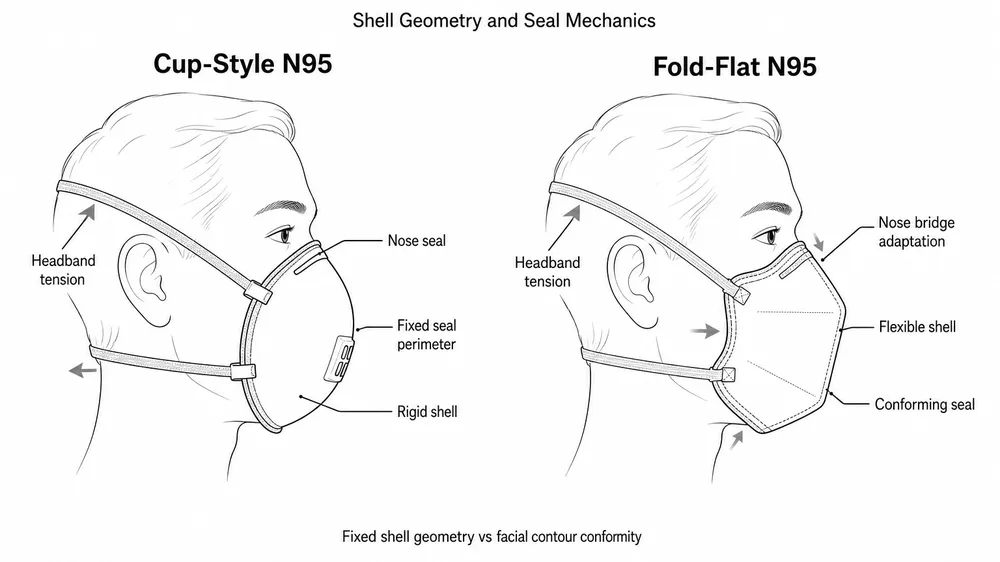
Shell Geometry and Seal Mechanics: How Each Design Interacts with Face Shape
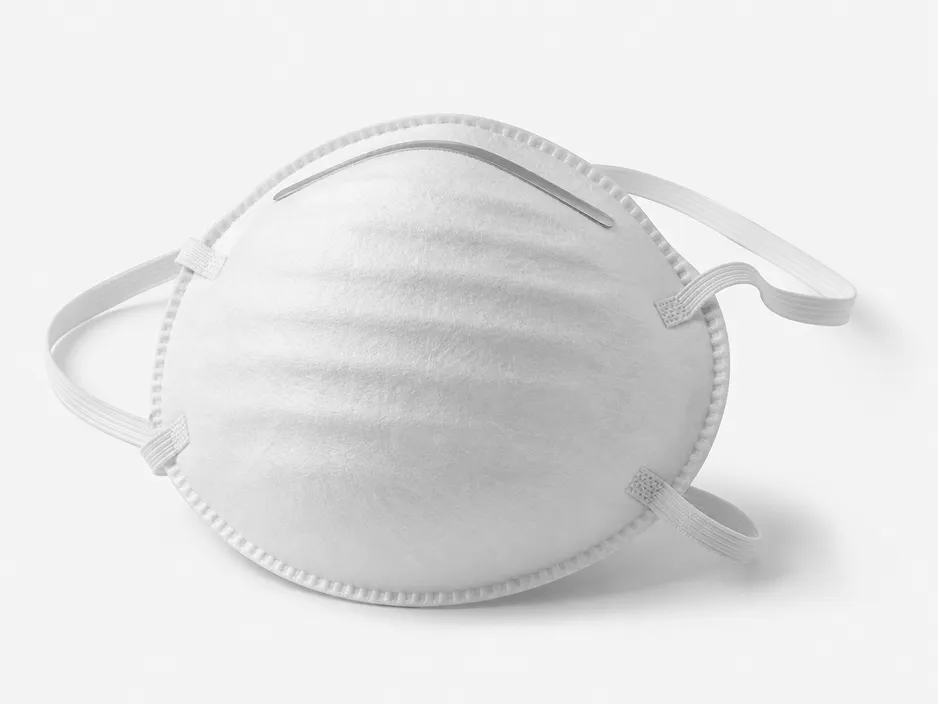
Cup-style N95s use a rigid or semi-rigid dome shell that holds its shape independent of the wearer's face. The seal is created by the foam or rubber nose seal and the tension of the headbands pressing the shell perimeter against the face. Because the shell doesn't deform, the seal geometry is fixed — it works well for faces that match the shell's designed contour, and it fails predictably for faces that don't. The failure mode is almost always the same: cheek-seal gaps on narrower or flatter facial profiles, or nose-bridge gaps on high-bridge faces that push the shell away from the cheek contact points.
Fold-flat N95s use a flexible shell that collapses for storage and expands when donned. The flexible material conforms to the face rather than requiring the face to conform to the shell. This is the mechanical reason fold-flat designs tend to perform better across diverse face shapes: the seal adapts rather than demanding a match.
(We've seen this pattern consistently when supporting hospital buyers through procurement audits. The cup-style failure distribution is predictable — the same face shape clusters fail, and it's almost always a cheek-seal issue. Fold-flat failures are more random, which usually means they're technique-related rather than geometry-related.)
The trade-off is donning technique. A fold-flat mask that isn't fully expanded before donning creates a compromised seal regardless of face shape. Cup-style masks are more technique-tolerant — the shell is already in its final geometry, so there's less that can go wrong during donning. In high-turnover hospital environments where staff may not receive repeated fit training, that technique tolerance has real operational value.

Head-to-Head: Cup vs Fold-Flat Across the Dimensions That Drive Procurement Decisions
| Dimension | Cup-Style N95 | Fold-Flat N95 |
|---|---|---|
| Shell geometry | Rigid/semi-rigid dome | Flexible, collapses flat |
| Fit test pass rate (diverse workforce) | Lower — fixed geometry limits face shape range | Higher — flexible shell adapts to contour variation |
| Donning technique sensitivity | Low — shell pre-formed | Higher — requires full expansion before donning |
| Breathability (Delta-P) | Generally lower resistance — maintained airspace | Slightly higher resistance — shell sits closer to face |
| Storage density per carton | Lower — dome shape wastes cubic space | ~3–4× denser — collapses flat for packing |
| Container loading efficiency | Lower | Higher — significant landed cost advantage at volume |
| Sizing SKU complexity | Often requires S/M/L for diverse workforces | Single size typically covers broader face shape range |
| Extended-wear comfort | Higher — airspace reduces heat and moisture buildup | Lower — shell contact increases warmth during long shifts |
| Donning speed under PPE protocol | Faster — no expansion step | Slightly slower — expansion step required |
| NIOSH N95 / FDA 510(k) availability | Yes | Yes |
| CE (EU MDR) availability | Yes | Yes |
The Hidden Cost: Fit Test Failure Rates Across Diverse Hospital Workforces
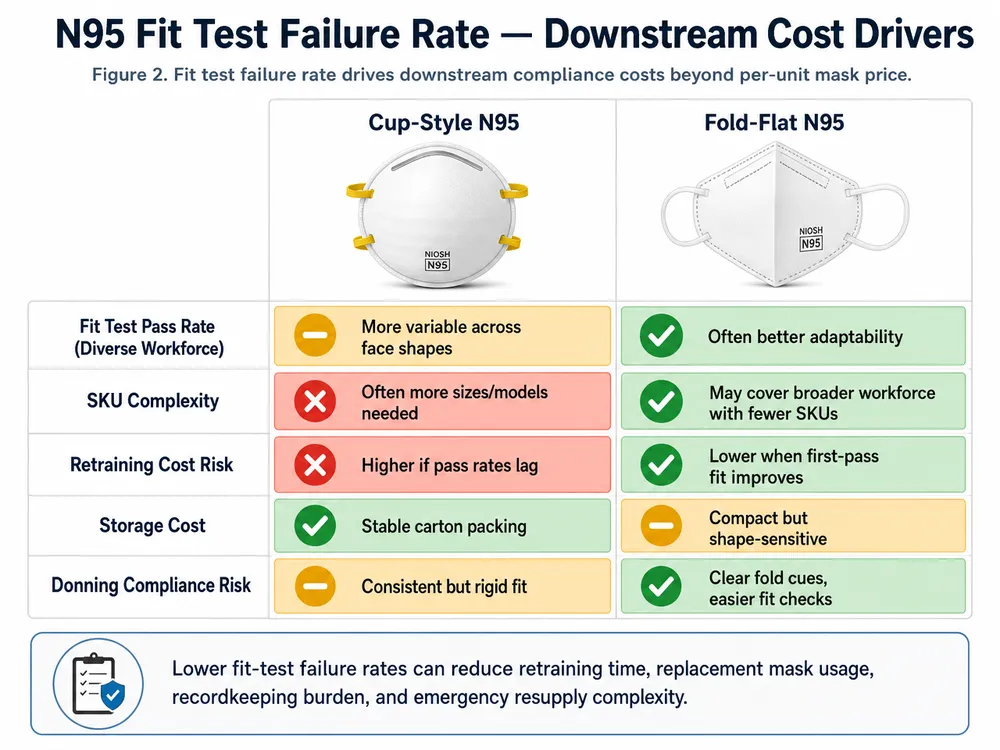
The fit test failure rate is where the geometry choice becomes a financial decision, not just a clinical one.
OSHA 29 CFR 1910.134 requires annual fit testing for all N95 users. A failed fit test means the worker cannot use that respirator model until they either pass a retest with the same model or are fitted to a different model. In a hospital system with 500 N95-wearing staff, a 15% fit test failure rate on a cup-style program means 75 workers need retesting, retraining, or a different mask — and that's before you account for the administrative cost of tracking exceptions and maintaining compliance records for each exception case.
The face shape distribution in a typical US or European hospital workforce is not uniform. Healthcare systems that draw from diverse populations — which is most urban hospital systems — will see a wider range of facial profiles than the face shape data used to design most cup-style shells. Fold-flat designs don't eliminate fit test failures, but they reduce the systematic failures caused by shell geometry mismatch. The failures that remain in a fold-flat program are more likely to be technique-related, which means they're addressable through donning training rather than through a mask model change.
The second hidden cost is SKU complexity. Cup-style N95s often require multiple sizes — small, medium, large — to achieve acceptable fit test pass rates across a diverse workforce. That means three separate SKUs to manage, three separate reorder points, three separate documentation trails for your compliance team, and three separate fit test records per worker. A fold-flat program that achieves acceptable pass rates with a single size simplifies your procurement, your inventory management, and your compliance record-keeping in one move.
The third cost is the one nobody budgets for: the compliance exposure when a worker who failed fit testing is deployed in an N95-required environment because the exception wasn't tracked. That's not a mask cost — it's a liability cost. Reducing your fit test failure rate reduces the surface area for that exposure.
Filtration and Breathability: What the Geometry Does and Doesn't Change
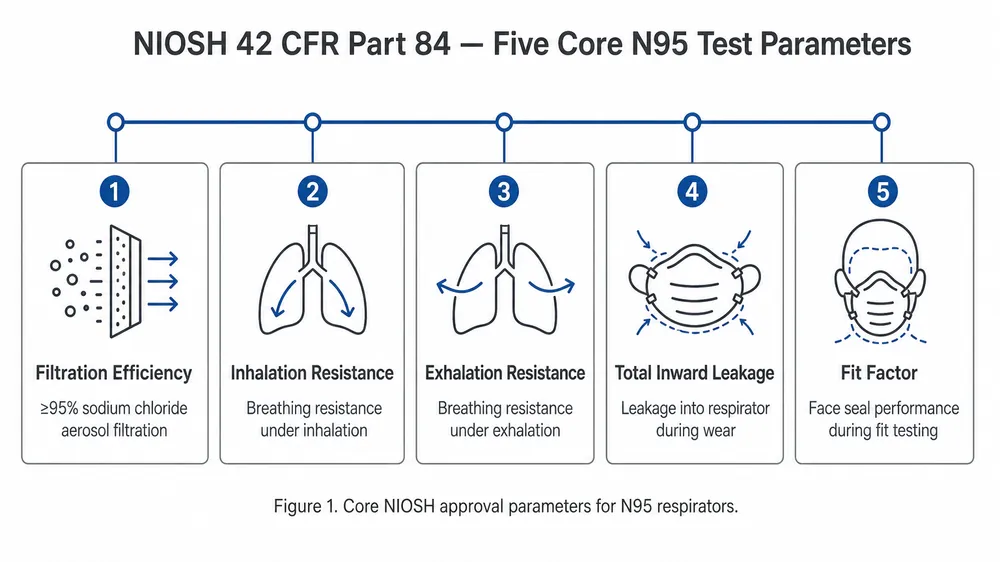
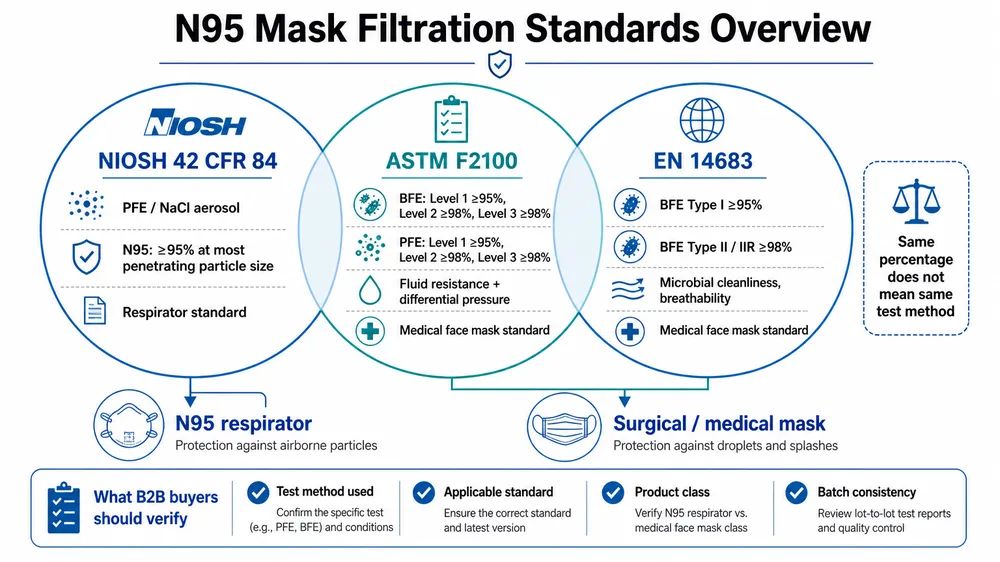
This is the point that gets confused in procurement discussions: shell geometry affects fit, not filtration. A cup-style and a fold-flat N95 built on the same meltblown filtration layer will deliver the same ≥95% PFE performance. The NIOSH N95 designation is a filtration standard, not a geometry standard — and confusing the two is how hospital supply chains end up sourcing the wrong product for the wrong reason.
What geometry does affect is breathability. Cup-style masks maintain an air gap between the filtration layer and the wearer's mouth and nose. That gap reduces the Delta-P (pressure differential across the mask) and makes breathing easier during extended wear. Fold-flat masks sit closer to the face, which can increase breathing resistance slightly — though both designs must meet the NIOSH Delta-P threshold of ≤35 mmH₂O/cm² to carry the N95 designation.
For our Disposable N95 Medical Mask line, we produce both cup-style and fold-flat SKUs using the same in-house meltblown filtration layer. The BFE and PFE specs are identical across both designs — ≥95% PFE at 0.3 micron particle size. The Delta-P values differ slightly by design, and we can provide per-batch test reports for either SKU to support hospital procurement audit requirements.
(One thing worth flagging: some buyers see a higher Delta-P reading on a fold-flat sample and assume it's a lower-quality product. It's not — it's a geometry effect. The filtration performance is the same. If your infection control team is reviewing test reports and sees a Delta-P difference between cup-style and fold-flat samples from the same manufacturer, that's expected and normal.)
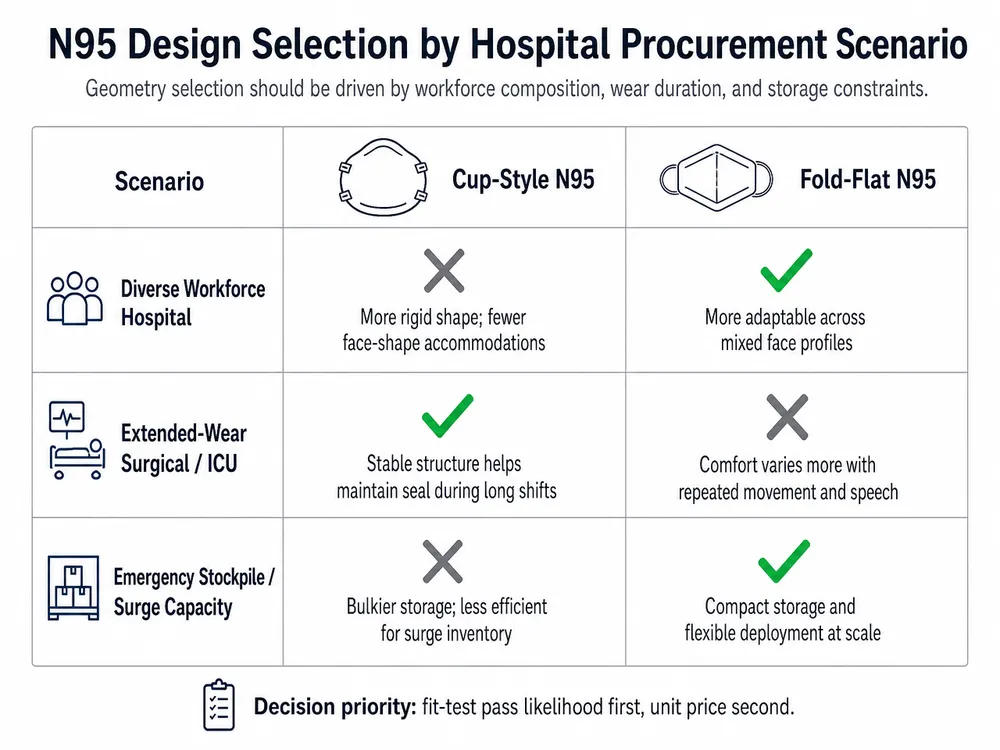
Application Showdown: Three Hospital Procurement Scenarios
Scenario 1: Large Urban Hospital System, Diverse Workforce, Annual Fit Testing Program
Winner: Fold-Flat N95
A 1,200-bed urban hospital with a workforce drawn from a diverse population will see significant face shape variability. Running a cup-style program here typically requires multiple sizes and still produces higher fit test failure rates than a fold-flat program. The fold-flat's conforming shell reduces systematic geometry mismatches, and a single-size program simplifies your SKU management and compliance documentation. The storage density advantage also matters at this scale — fold-flat cartons pack 3–4× denser, which reduces your supply room footprint and your per-unit landed cost on bulk orders. For a 100,000-unit annual contract, that freight difference is not trivial.
Scenario 2: Surgical Suite or ICU, Extended-Wear Protocol, Relatively Homogeneous Workforce
Winner: Cup-Style N95
When staff wear N95s for 4–8 hour shifts in high-acuity environments, the breathability advantage of the cup-style design matters operationally. The maintained airspace reduces heat and moisture buildup, which affects both comfort and compliance — a mask that's uncomfortable to wear for extended periods gets adjusted or removed, which defeats the protection. If your workforce has already been fit-tested to a specific cup-style model and pass rates are acceptable, there's no reason to switch. The cup-style's lower Delta-P is a real advantage in extended-wear scenarios, and the technique-tolerance benefit matters less when staff are trained and experienced with the product.
Scenario 3: Emergency Stockpile or Surge Capacity Program
Winner: Fold-Flat N95
Storage density is the deciding factor for stockpile programs. Fold-flat N95s pack approximately 3–4× more units per equivalent carton volume compared to cup-style. For a 100,000-unit emergency stockpile, that difference translates directly into warehouse space and container shipping costs. The single-size coverage advantage also matters for surge deployment — when you're distributing masks rapidly to staff who haven't been individually fit-tested, a fold-flat design that covers a broader face shape range reduces the risk of deploying masks that won't seal on a meaningful portion of your workforce.
Regulatory Documentation: What Your Compliance Team Needs Before the PO Is Issued
Before placing a bulk N95 order for hospital use, the documentation requirements differ by market — and getting this wrong at the sourcing stage means delays at customs or failed procurement audits downstream.
For US hospital procurement:
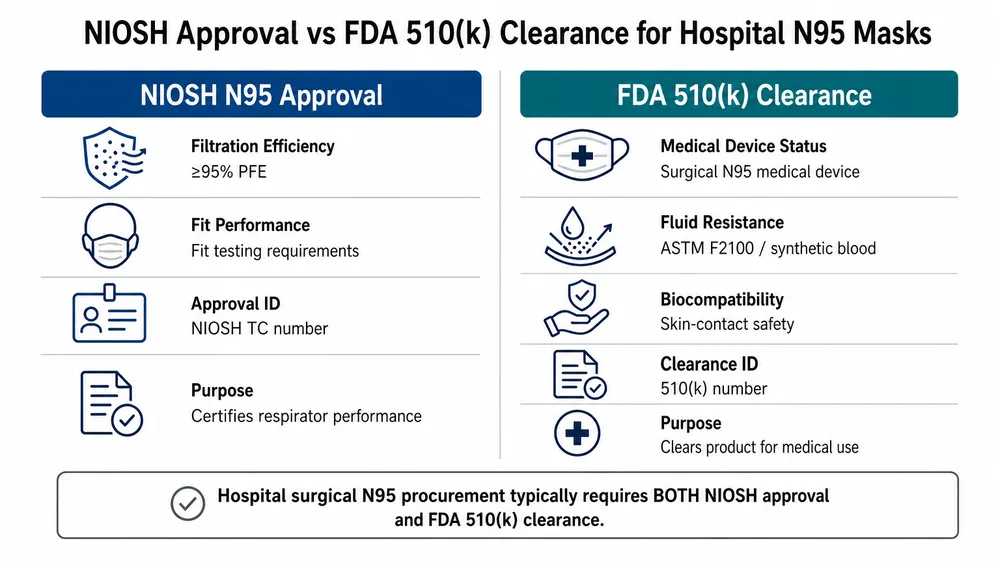
- NIOSH N95 approval — the TC number must appear on the mask itself and on the packaging, not just in a certificate PDF
- FDA 510(k) clearance if the mask is classified as a surgical N95 — required for use in surgical settings where fluid exposure is a risk; standard N95 and surgical N95 are not interchangeable designations
- Per-batch PFE and Delta-P test reports from the manufacturer's in-house QC lab
- Certificate of Conformity referencing the applicable NIOSH standard (42 CFR Part 84)
For EU hospital procurement:
- CE marking under EU MDR (Regulation 2017/745) for medical devices, or EU PPE Regulation (2016/425) for respiratory protective equipment — the applicable regulation depends on the mask's intended use classification, and this distinction matters for your import documentation
- EN 149:2001+A1:2009 test reports for FFP2 (the EU filtration standard equivalent to NIOSH N95)
- Technical file documentation from the manufacturer, available on request for regulatory review
For multi-market buyers:
- Confirm that the same SKU carries both FDA 510(k) and CE (EU MDR) coverage, or that the manufacturer can supply separately certified SKUs for each market without requiring you to manage two separate product lines
- Request that test reports reference both NIOSH and EN 149 standards if you're distributing across the US and EU — this is a documentation request, not a product change, but not all manufacturers maintain dual-standard test reports as a standard deliverable
Our N95 Medical Masks carry FDA 510(k) registration and CE (EU MDR) coverage across both cup-style and fold-flat designs. We can provide per-batch Delta-P and PFE test reports for either SKU — the kind of documentation that survives a hospital procurement audit without requiring follow-up requests. For buyers managing multi-market distribution, having both certifications on the same SKU eliminates the compliance complexity of maintaining separate product lines for different markets.
For a detailed breakdown of what OSHA and NIOSH require from your fit testing program, see our guide on N95 Mask Fit Testing Requirements.
What to Lock Down Before You Issue the RFQ
The geometry choice should be confirmed before the RFQ goes out — not left open for the supplier to decide or for procurement to revisit after samples arrive. Here's what to specify:
Design geometry: Cup-style or fold-flat. If you need both, specify them as separate line items with separate quantities. Mixing them in a single line item creates ambiguity in the supplier's production planning and in your own inventory management.
Headband configuration: Dual-strap (over-head) or single-strap. Dual-strap headbands distribute tension more evenly across the face seal and generally produce better fit test results — particularly for fold-flat designs where the seal depends on even pressure distribution across the flexible shell. We can configure either headband type on both our cup-style and fold-flat SKUs. Most buyers don't think to specify this, but it affects fit test outcomes more than most people expect.
Certification requirements: NIOSH N95, FDA 510(k), CE (EU MDR), or a combination. Specify which markets you're importing into so the documentation package is correct from the start. Retroactively obtaining the right certification documentation from a supplier after the order ships is slower and more stressful than requiring it as a contract deliverable upfront.
Test documentation: Request per-batch PFE, BFE, and Delta-P test reports as a contract deliverable, not as an afterthought. Hospital procurement audits will ask for these. Getting them retroactively is possible, but it adds friction to every reorder cycle.
Packaging format: Bulk clinical packaging (50 per box, 20 boxes per carton) or individual retail packaging. Fold-flat designs can be packaged at higher unit counts per carton due to their storage density — specify your preferred configuration to get an accurate landed cost calculation, not just a per-unit price.
FAQ
Does cup-style or fold-flat design affect NIOSH N95 filtration performance?
No. NIOSH N95 certification requires ≥95% filtration efficiency at 0.3 micron particle size regardless of shell geometry. Both designs can meet this standard. The geometry affects fit, breathability, and storage density — not the filtration layer's performance. At eztio, we use the same meltblown filtration layer specification in both our cup-style and fold-flat SKUs. The PFE test results are identical; the Delta-P values differ slightly due to the airspace difference, which is expected and normal.
Which N95 design has lower fit test failure rates in hospital settings?
Fold-flat designs generally show lower fit test failure rates in workforces with significant face shape variability, because the flexible shell conforms to a wider range of facial profiles. Cup-style designs can match or outperform fold-flat in fit test results when the workforce is relatively homogeneous and the mask model was selected based on actual fit test data from that population. The honest answer: run a fit test pilot with both designs on a representative sample of your workforce before committing to a bulk order. A 50-unit pilot test is far cheaper than a 15% failure rate on a 10,000-unit order.
What is the storage density difference between cup-style and fold-flat N95s?
Fold-flat N95s pack approximately 3–4× more units per equivalent carton volume compared to cup-style. For a 100,000-unit order, this difference affects both your warehouse storage footprint and your container shipping cost. At scale, the landed cost per unit for fold-flat is typically lower than cup-style when you factor in freight — a difference that doesn't appear in the per-unit FOB price comparison.
Can the same N95 mask carry both FDA 510(k) and CE (EU MDR) certification?
Yes, but confirm this with your supplier — not all manufacturers maintain both certifications on the same SKU. At eztio, our FDA 510(k) registration and CE (EU MDR) coverage applies across both cup-style and fold-flat designs, so multi-market buyers don't need to manage separate certified product lines for the US and EU markets. This matters most for distributors who supply both markets from a single inventory position.
What headband configuration should I specify for better fit test results?
Dual-strap (over-head) headbands distribute tension more evenly across the face seal than single-strap designs, which generally produces better fit test outcomes — particularly for fold-flat designs where the seal depends on even pressure distribution. If your current N95 program has higher-than-expected fit test failure rates, switching from single-strap to dual-strap is worth testing before switching mask models entirely. It's a lower-cost intervention and it's often overlooked.
What documentation should I request from a supplier to support a hospital procurement audit?
At minimum: NIOSH TC approval number (verifiable on the CDC NIOSH database), FDA 510(k) clearance number if surgical N95 designation is required, per-batch PFE and Delta-P test reports from the manufacturer's QC lab, and a Certificate of Conformity referencing 42 CFR Part 84. For EU procurement, add EN 149:2001+A1:2009 test reports and CE technical file documentation. Request these as contract deliverables on every order, not as one-time samples — batch-to-batch consistency is what the audit is actually checking.