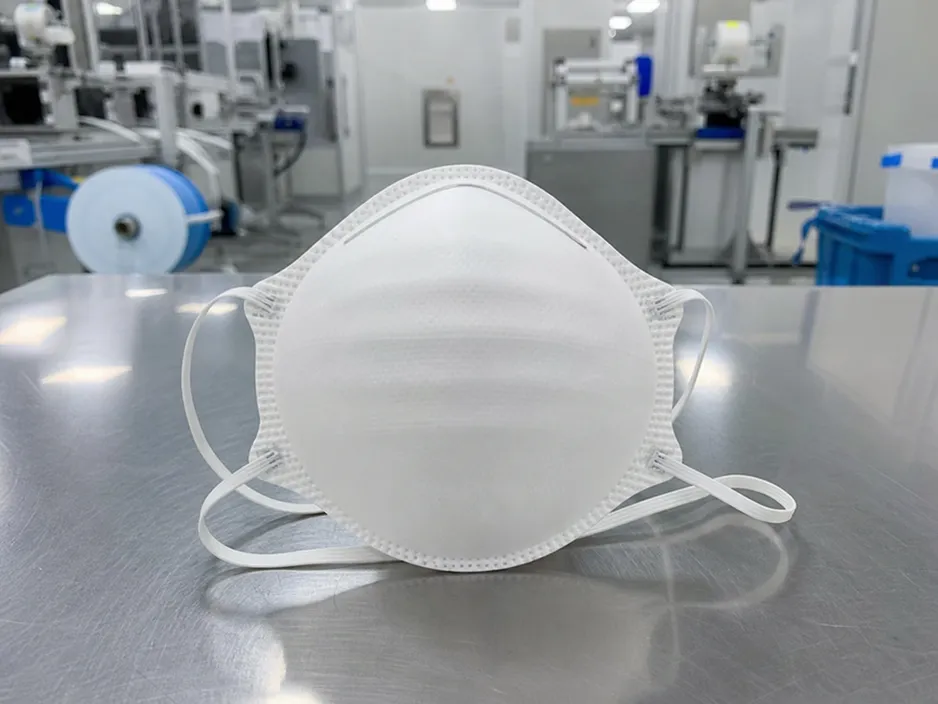
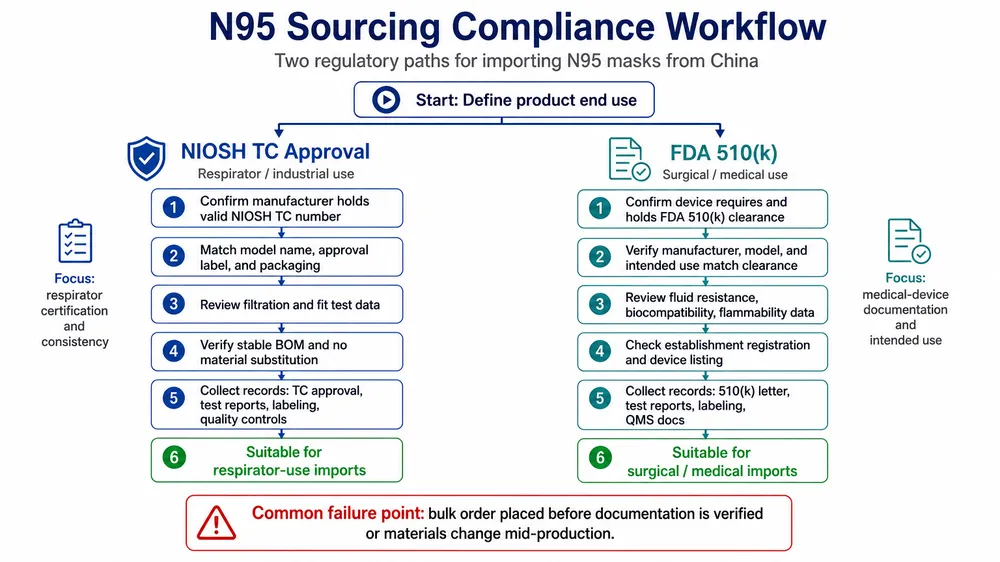
Most N95 sourcing failures don't happen at customs. They happen three months earlier, when a buyer places a bulk order with a factory that can't produce the documentation to back up its certification claims — or worse, a factory that substituted meltblown fabric mid-production and never told anyone.
We've been manufacturing N95-grade respirators and surgical masks at our facility in Gaomi, Shandong since 2012. We hold FDA 510(k) registration, CE under EU MDR, and ISO 13485:2016. We've supported US and Canadian healthcare importers through NIOSH audit preparation and FDA import review. The failures we've seen in this supply chain are not random — they follow predictable patterns, and most of them are preventable if you know what to look for before you place the order.
This guide covers the three audit failure modes that catch buyers off guard, the practical difference between NIOSH and FDA 510(k) that most content gets wrong, and a factory vetting checklist you can use before committing to a trial order.

The Three Failure Modes That Trigger NIOSH and FDA Audit Rejections
If you've been burned by a China N95 order before, it almost certainly came down to one of these three problems.
Failure Mode 1: Missing or unverifiable NIOSH TC number
Every NIOSH-approved respirator carries a TC (Testing and Certification) approval number. The format is TC-84A-XXXX. You can verify any TC number directly on the NIOSH Approved Respirators list at CDC.gov. The problem is that a significant number of Chinese factories print TC numbers on packaging that either belong to a different manufacturer, have expired, or were fabricated outright.
Before you place any order, take the TC number from the factory's product sample or spec sheet and verify it yourself on the NIOSH list. Confirm that the listed approval holder matches the factory you're buying from — not a parent company, not a trading company, not a factory that "supplies" the approval holder. If the names don't match, ask for a written authorization letter from the TC holder. If the factory can't produce one, walk away.
Failure Mode 2: Expired or misapplied FDA 510(k) clearance
FDA 510(k) clearance is not the same as NIOSH approval, and it doesn't cover the same products. A factory can hold a valid 510(k) for a surgical mask and have no clearance at all for an N95 respirator — or vice versa. We see buyers conflate these constantly, and it's the kind of mistake that triggers an FDA import alert on arrival.
510(k) clearances are product-specific and device-specific. The K-number on the factory's documentation must correspond to the exact product you're ordering. Check the FDA 510(k) database directly: search the K-number, confirm the device name matches your product, and confirm the applicant name matches your supplier. Clearances also have no formal expiration date, but they can be superseded or withdrawn — check the status field.
Failure Mode 3: Meltblown substitution
This is the one that's hardest to catch and most expensive when it gets through. Meltblown nonwoven fabric is the filtration layer in an N95 mask — the middle layer that determines whether the mask actually filters at ≥95% particulate efficiency. During periods of supply disruption (and there have been several since 2020), factories that source meltblown from outside suppliers face pressure to substitute lower-grade fabric when their primary supplier can't deliver.
The substitution doesn't always show up in visual inspection. A mask made with substandard meltblown can look identical to a compliant one. The failure shows up in PFE testing — and if you're not running independent PFE tests on incoming shipments, you won't know until your buyer's facility runs a fit test or an institutional audit pulls a sample.
We manufacture our own meltblown fabric in-house. That's not a marketing point — it's the reason we can guarantee spec consistency across your entire order, not just the samples you approved. (The meltblown substitution problem is specifically why we invested in vertical integration. We watched competitors lose accounts over it.)
NIOSH vs FDA 510(k): What Each Certification Actually Covers
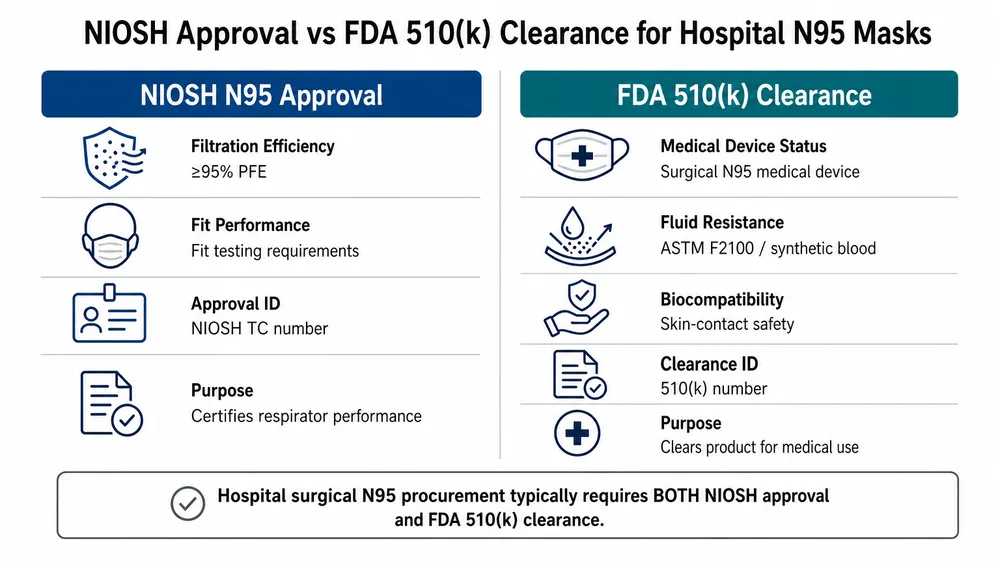
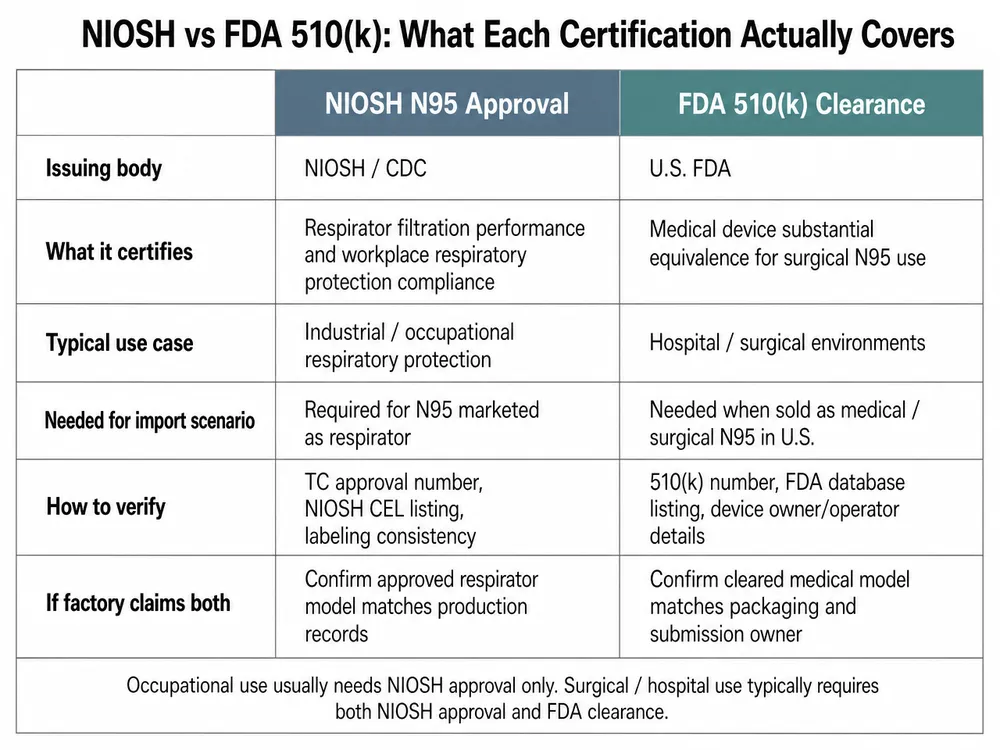
Most content on this topic treats NIOSH and FDA 510(k) as interchangeable or as a hierarchy. They're neither. They cover different regulatory requirements for different end uses, and your order may require one, the other, or both depending on where the product is going and how it will be used.
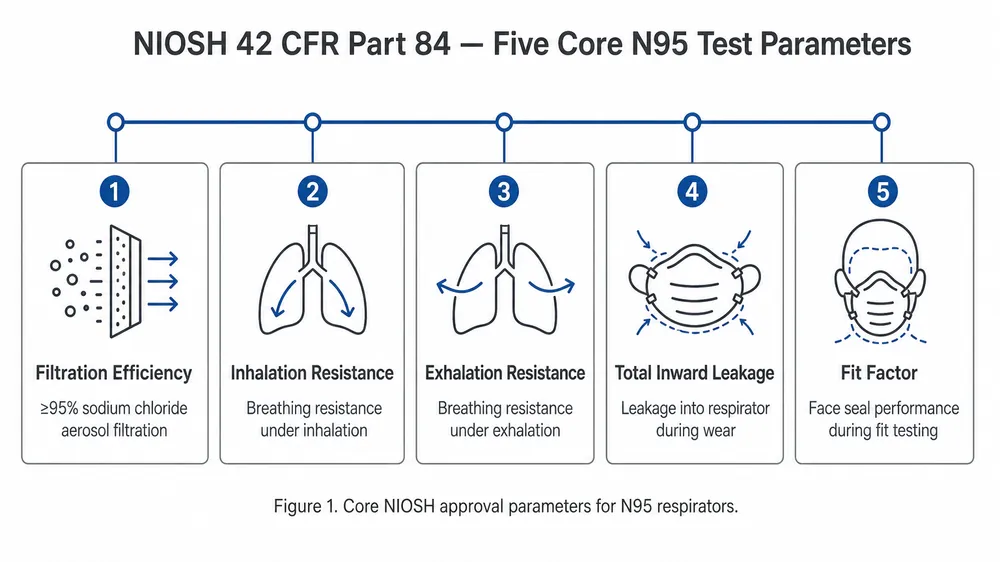
NIOSH N95 approval is a performance certification issued by the National Institute for Occupational Safety and Health. It certifies that a respirator filters at least 95% of airborne particles when tested under NIOSH protocols. NIOSH approval is required for respirators used in occupational settings — healthcare workers, industrial workers, first responders. The approval is tied to a specific respirator model and a specific manufacturer. It does not cover surgical use on its own.
FDA 510(k) clearance is a market authorization issued by the Food and Drug Administration. It clears a medical device for sale in the US market by demonstrating substantial equivalence to a predicate device. For masks, this covers surgical masks and surgical N95 respirators. A surgical N95 is a product that holds both NIOSH N95 approval (for filtration performance) and FDA 510(k) clearance (for surgical use). If your buyer is a hospital purchasing for surgical environments, they need a surgical N95 — which means the product must carry both.
The practical breakdown:
| Use Case | Required Certification |
|---|---|
| Occupational/industrial respirator use | NIOSH N95 TC approval |
| Surgical mask (non-respirator) | FDA 510(k) clearance |
| Surgical N95 (hospital surgical environment) | NIOSH N95 TC + FDA 510(k) |
| EU hospital/medical use | CE under EU MDR |
If you're sourcing for US hospital procurement, confirm with your buyer whether they need a surgical N95 or a standard N95 respirator. The answer changes what documentation you need from your supplier. We hold FDA 510(k) registration and CE under EU MDR, so we can cover both US and EU requirements from a single source — but the product SKU and documentation package differ by end use.
For a deeper comparison of NIOSH N95 and KN95 certifications, see our NIOSH N95 vs KN95 guide.
Factory Vetting Checklist: 8 Questions Before You Place a Trial Order
A factory that can't answer these questions clearly before you order will not be able to support you through an audit after you order.
1. Can you provide the NIOSH TC number for this specific product, and does the approval holder name match your factory?
Ask for the TC number and verify it on the NIOSH list yourself. If the approval is held by a different entity, ask for a written authorization letter. No authorization letter means no verified NIOSH coverage.
2. Can you provide the FDA 510(k) K-number for this product, and does the device name in the FDA database match what I'm ordering?
Search the K-number in the FDA 510(k) database. Confirm device name, applicant name, and clearance status. A factory that can't give you a K-number for a product they claim is FDA-cleared is a red flag.
3. Do you manufacture your own meltblown nonwoven fabric, or do you source it externally?
If they source externally, ask who their meltblown supplier is and whether they have a backup supplier. Ask to see incoming inspection records for meltblown lots. A factory that can't show you meltblown QC records is one substitution away from a spec failure.
4. Can you provide BFE and PFE test reports from a third-party accredited lab, dated within the last 12 months?
Test reports should come from a lab accredited under ISO 17025. Check the lab name, the test date, and the product description on the report. If the product description doesn't match what you're ordering, the report doesn't cover your product.
5. What is your cleanroom classification, and can you show documentation of particle count monitoring?
For medical-grade N95 production, Class 100,000 (ISO 8) is the standard. Ask for recent environmental monitoring records. A factory that claims cleanroom production but can't show monitoring data is claiming a facility condition they may not maintain.
6. Is your QMS certified to ISO 13485:2016, and when was your last surveillance audit?
ISO 13485 is the medical device quality management standard. Ask for the certificate and the audit report from the most recent surveillance cycle. A certificate with no recent audit activity may be lapsed or not actively maintained.
7. What does your in-process inspection cover, and at what intervals?
A compliant factory should be able to describe specific in-process checks: weld integrity, nose wire placement, ear-loop attachment force, mask dimensions. If the answer is vague ("we check quality throughout production"), push for specifics. ISO 13485 requires documented inspection procedures.
8. What documentation do you include with each shipment for US/EU import?
The answer should include: certificate of conformity, third-party test reports, packing list, and any market-specific declarations. For EU imports, ask specifically about the EU MDR technical file and the Declaration of Conformity. For US imports, ask about FDA registration documentation.
Our N95 Medical Masks product pages include the full documentation list we provide with each shipment.
Required Import Documentation for US and EU Buyers
Getting the product right is half the job. Getting the paperwork right is the other half. These are the documents that need to travel with your shipment.
For US import (FDA-regulated medical devices):
- FDA 510(k) clearance documentation — K-number, device name, applicant name. Your customs broker will need this.
- Certificate of Conformity (CoC) — Issued by the manufacturer, stating the product meets the applicable standards (ASTM F2100 for surgical masks, NIOSH 42 CFR Part 84 for respirators).
- Third-party test reports — BFE, PFE, Delta-P from an ISO 17025-accredited lab. These are the documents that get pulled in an FDA import examination.
- FDA Establishment Registration — The manufacturing facility must be registered with FDA. Ask for the registration number and verify it in the FDA database.
- Packing list and commercial invoice — Standard customs documentation, but the product description must match the FDA device name exactly.
For EU import (CE-marked medical devices under EU MDR):
- EU Declaration of Conformity — Signed by the manufacturer, referencing the applicable EU MDR classification and the notified body that issued the CE certificate.
- CE certificate — Issued by the notified body. Check the certificate number, the issuing body, and the expiry date.
- Technical file summary — Not always required at customs, but your importer of record may need it for compliance review. Ask the factory whether they can provide a technical file summary on request.
- EN 14683 or EN 149 test reports — EN 14683 covers surgical masks; EN 149 covers filtering facepiece respirators (FFP2/FFP3). Confirm which standard applies to your product.
(One thing we've seen catch EU buyers off guard: since EU MDR came into full effect in 2021, the documentation requirements for Class I and Class IIa medical devices tightened significantly. If you're importing into the EU for the first time, your importer of record will need the Declaration of Conformity and the CE certificate before the shipment clears. We prepare this documentation as standard for every EU order.)
How to Read a BFE/PFE Test Report and Spot a Fabricated Result
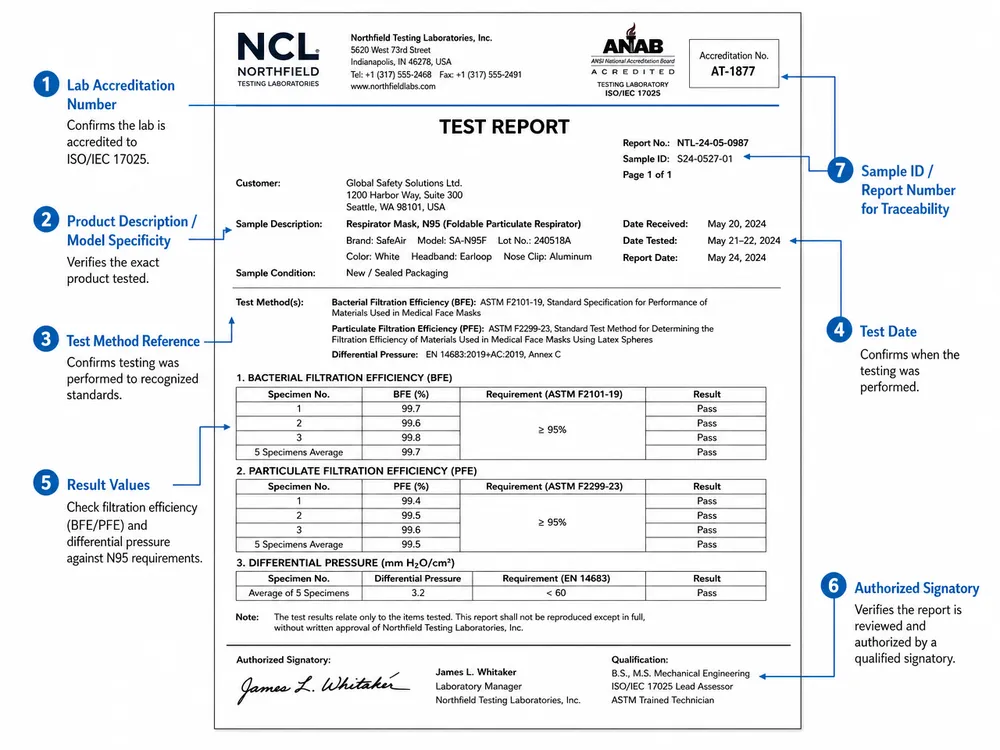
Third-party test reports are the most commonly falsified document in the N95 supply chain. Here's what a legitimate report looks like and what to check.
What a legitimate report contains:
- Lab name, accreditation number, and ISO 17025 scope
- Test date and report issue date
- Product description that matches your specific product (model name, lot number, or product code)
- Test method reference (e.g., ASTM F2101 for BFE, ASTM F2299 for PFE)
- Actual test results with pass/fail determination
- Authorized signatory and lab stamp
Red flags in test reports:
- Test date is more than 24 months old — performance specs can drift with material changes
- Product description is generic ("disposable face mask") rather than specific to the product you're ordering
- Lab name doesn't appear in the ISO 17025 accreditation database (check ILAC MRA signatories)
- Results are suspiciously round numbers (e.g., exactly 99.00% BFE) — real test results have decimal variation
- The report is a scan of a scan, with visible compression artifacts — legitimate labs issue PDFs with digital signatures
- No lot number or batch reference — a report without traceability to a specific production batch can't be verified
We run BFE, PFE, and Delta-P testing in-house on every production batch before submitting to third-party labs for certification documentation. The in-house results and the third-party results are both available to buyers on request. If a supplier can only show you one set of results, ask why.
For a detailed breakdown of FDA 510(k) documentation requirements, see our FDA 510(k) Guide for N95 Masks.
Red Flags in Supplier Communication That Signal Compliance Shortcuts
Before you get to documentation review, supplier communication tells you a lot. These patterns in early conversations are worth paying attention to.
They can't distinguish between NIOSH and FDA 510(k). If a supplier uses these terms interchangeably or says "we have all certifications" without specifying which, they either don't understand the regulatory framework or are hoping you don't. Either way, it's a problem.
They offer to "arrange" certifications after you place the order. Legitimate certifications are held before production, not arranged on request. A factory that offers to get you a NIOSH TC number or a 510(k) clearance after you commit to an order is describing a process that doesn't exist.
They can't tell you who makes their meltblown. A factory that sources meltblown externally should be able to name their supplier and describe their incoming inspection process. Vague answers here ("we use high-quality materials from reliable suppliers") mean they either don't know or don't want you to know.
They push back on third-party inspection. A compliant factory welcomes third-party inspection because it validates what they're already doing. Resistance to pre-shipment inspection or factory audits is a signal that the production reality doesn't match the documentation.
Their sample quality doesn't match their claimed spec. If the sample you receive has visible weld inconsistencies, uneven nose wire placement, or ear loops that detach under light tension, the production line is not running to spec. Don't assume bulk production will be better than the sample — it won't be.
Why In-House Meltblown Production Changes the Spec Consistency Equation
This is worth spending a moment on because it's the single biggest differentiator between N95 factories that consistently pass audit and those that don't.
Meltblown nonwoven fabric is produced by extruding polymer (typically polypropylene) through fine nozzles at high velocity, creating a web of microfibers that are then electrostatically charged. The electrostatic charge is what gives the filtration layer its efficiency — it attracts and captures particles that would otherwise pass through the physical fiber matrix. The charge degrades over time and under certain storage conditions, which is why test reports have dates and why storage conditions matter.
When a factory buys meltblown from an outside supplier, they're accepting whatever fiber diameter, basis weight, and charge level that supplier produced. If the supplier changes their process, switches raw material sources, or ships a batch from a different production run, the filtration performance of the finished mask changes — and the factory may not know until they run a PFE test. During supply disruptions, the pressure to accept whatever meltblown is available is significant.
We produce our own meltblown at our Gaomi facility. We set the fiber diameter, the basis weight, and the electrostatic treatment parameters to match the filtration spec we're targeting. Every meltblown production batch is tested before it enters mask production. When you order a Disposable N95 Medical Mask rated at ≥95% PFE, we know what's in the mask because we made the material — not because we're trusting a supplier's certificate of analysis.
The practical consequence for your order: spec consistency across batches. If you place a 500,000-piece order in three shipments over six months, the third shipment performs the same as the first. That's not a given when meltblown is sourced externally, and it's the kind of consistency that matters when your buyer is a hospital running fit tests on every new lot.
For hospital-grade procurement requirements, see our Hospital N95 Medical Mask product page.
Practical Recommendation: What to Do Before Your Next Order
If you're evaluating Chinese N95 suppliers right now, here's the sequence that reduces your audit risk:
- Verify the TC number and K-number yourself — don't rely on the factory's word. Both databases are publicly accessible.
- Ask for meltblown sourcing documentation — in-house production or named external supplier with incoming inspection records.
- Request test reports from the last 12 months — check the lab accreditation, the product description, and the test method reference.
- Confirm the documentation package — CoC, test reports, FDA establishment registration (for US), CE certificate and Declaration of Conformity (for EU).
- Start with a trial order at 50,000 pieces — enough to validate production quality and documentation before committing to full volume.
Our standard MOQ for N95 SKUs is 50,000 pieces, specifically because we've found that trial orders are how serious buyers validate a new supplier relationship. We include the full compliance documentation package — test reports, CoC, and market-specific declarations — with every shipment, including samples.
If you're ready to discuss your sourcing requirements, Request Quote with your target market (US or EU), required certification, order volume, and delivery timeline. We'll respond with a compliance documentation overview alongside the quote so you can evaluate both the product and the paperwork before you commit.
Frequently Asked Questions
Can a Chinese factory hold NIOSH N95 approval directly, or does the approval have to be held by a US entity?
NIOSH approval can be held by a foreign manufacturer. The TC approval is tied to the specific respirator model and the applicant entity — which can be the Chinese factory itself, a US importer, or a US brand that contracted the factory. What matters is that the TC number is verifiable on the NIOSH list and that the approval holder has a documented relationship with the factory producing the product. If you're buying from a factory that isn't the TC approval holder, get the authorization letter in writing.
What's the minimum order quantity for a compliant N95 trial order from China?
50,000 pieces is a workable trial quantity for most buyers — enough to run incoming inspection, submit samples for independent testing, and validate the documentation package without overcommitting on inventory. Below that, the per-unit cost of third-party testing and documentation preparation starts to erode the economics. We run standard N95 SKUs at 50,000-piece MOQ for exactly this reason.
How do I verify that a Chinese factory's ISO 13485 certificate is current and not lapsed?
ISO 13485 certificates are issued by accredited certification bodies (CBs) and are typically valid for three years with annual surveillance audits. Ask for the certificate and the most recent surveillance audit report. Then verify the issuing CB's accreditation status through the IAF (International Accreditation Forum) database. A certificate from an unaccredited CB, or one with no recent surveillance audit on record, is not reliable evidence of a functioning QMS.
Does CE marking under EU MDR cover N95 masks for export to the US?
No. CE marking under EU MDR is EU market authorization — it doesn't satisfy FDA requirements for US import. For US import, you need FDA 510(k) clearance (for surgical masks and surgical N95s) and/or NIOSH TC approval (for respirator use). A factory that holds both CE and FDA clearance can supply both markets, but the documentation packages are separate and the product specifications may differ slightly between EU and US versions.