Hospital procurement teams screening N95 suppliers face a problem that most ranking articles ignore: the list of brand names is easy to find. What's hard to find is the procurement-relevant detail — NIOSH TC approval numbers, FDA 510(k) clearance status, documentation packages that survive GPO intake review, and MOQ structures that don't force you to overcommit volume on a first order.
This shortlist is built for that decision. Each supplier entry covers the credentials and sourcing characteristics that matter at the intake stage, not just the brand recognition. We've also included an honest comparison of domestic distributor sourcing versus factory-direct import, because the right answer depends on your order size, urgency, and compliance timeline — not on a blanket preference for either model.
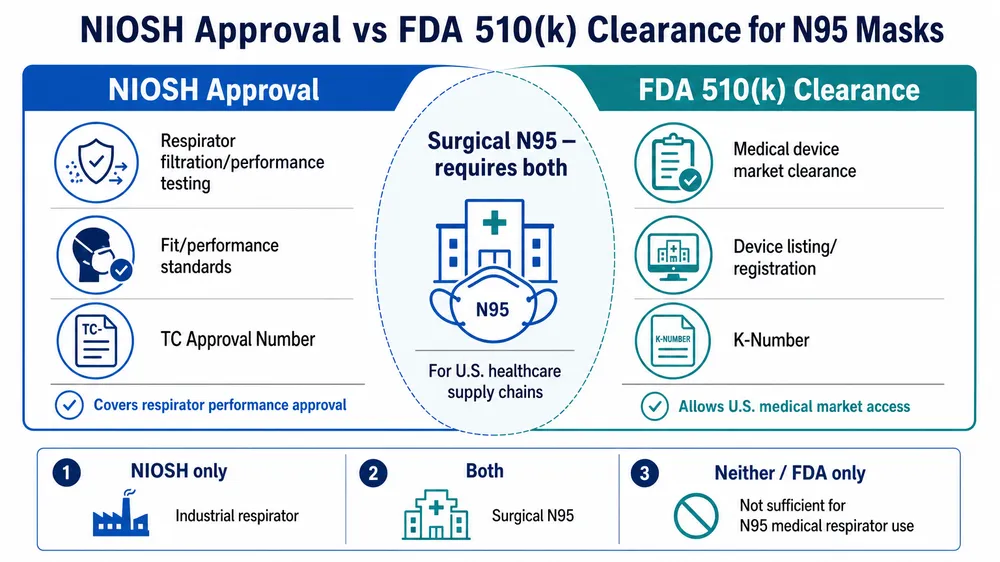
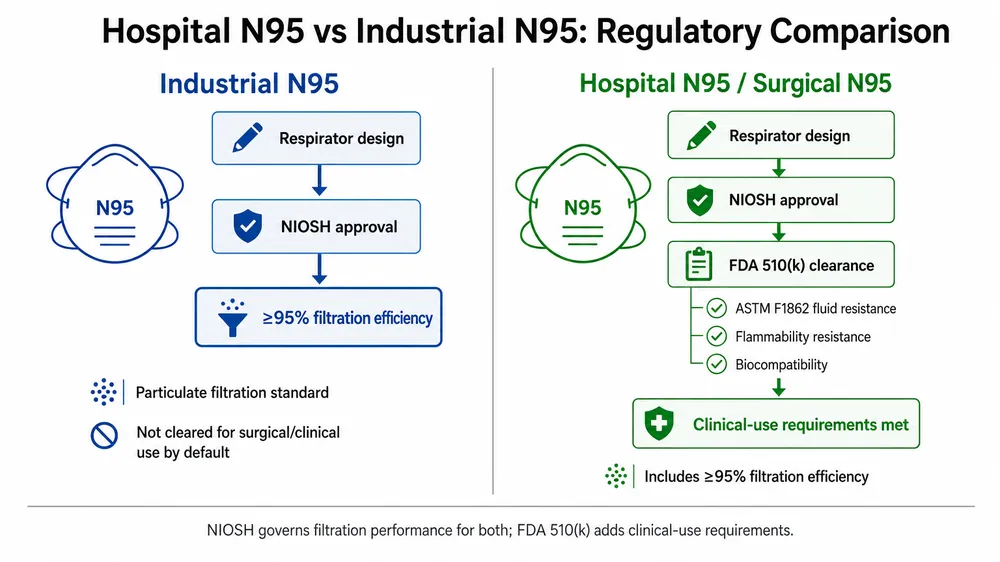
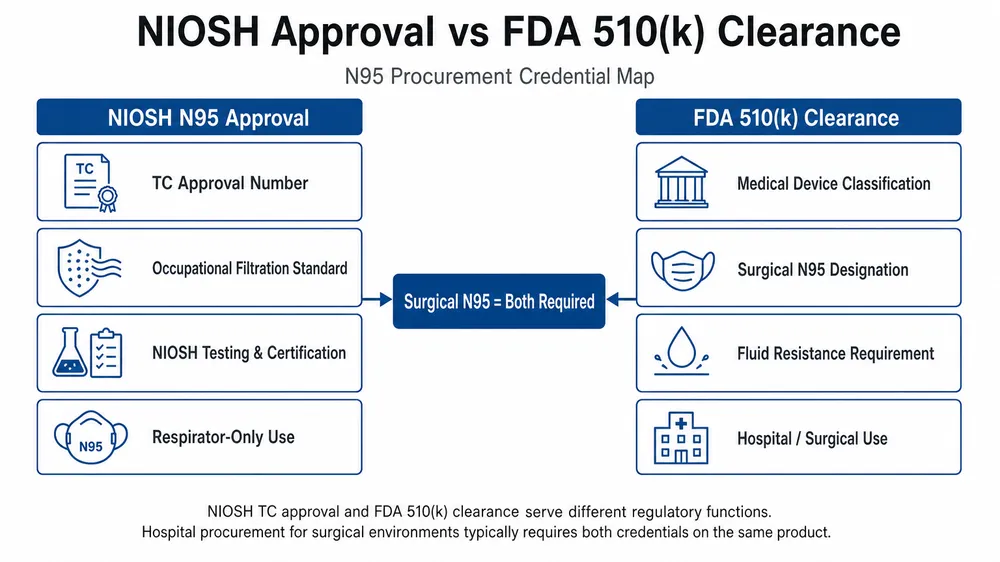
One framing note before the list: NIOSH approval and FDA 510(k) clearance are not the same credential, and confusing them is how hospital supply chains get exposed. NIOSH approval (a TC number from the National Institute for Occupational Safety and Health) certifies that a respirator meets filtration and fit performance standards for occupational use. FDA 510(k) clearance is a separate market authorization that classifies the product as a medical device — specifically a surgical N95 — and is required for use in surgical environments where fluid resistance matters. A mask can hold NIOSH approval without FDA clearance, and vice versa. Hospital procurement for surgical settings typically requires both. We'll flag this distinction for each supplier below.

What Hospital GPOs Actually Check at Supplier Intake
Before the shortlist, it's worth being direct about what a GPO compliance review actually looks at. Most procurement teams know they need "certifications" — fewer have a clear picture of the specific documents that need to be in the file before a supplier passes intake.
The standard documentation package for a US hospital N95 supplier includes:
- NIOSH TC approval number — verifiable on the NIOSH Certified Equipment List (CEL). The TC number must match the exact product model being ordered, not just the brand.
- FDA 510(k) clearance number — required for surgical N95 designation. Verifiable on the FDA 510(k) database. For non-surgical respirator use, NIOSH approval alone may suffice depending on your facility's policy.
- BFE/PFE test reports — third-party lab results showing Bacterial Filtration Efficiency and Particulate Filtration Efficiency at the specified performance level (≥95% for N95-grade product). These should reference the specific lot or production batch.
- Certificate of Conformity (CoC) — manufacturer declaration that the product meets the stated standards, signed and dated.
- FDA import records — for imported product, the FDA Prior Notice and entry documentation confirming the shipment cleared FDA review at the port of entry.
- Labeling compliance — NIOSH-approved N95 masks must carry specific label elements including the TC number, NIOSH logo, and filtration rating. Mislabeled product is a common counterfeit indicator.
(One thing we see regularly: buyers receive a supplier's ISO 13485 certificate and assume that covers everything. ISO 13485 is a quality management system standard — it tells you the factory has documented processes. It does not substitute for NIOSH approval or FDA 510(k) clearance. Both are required separately.)
Supplier Evaluation Criteria for Hospital-Grade N95 Procurement
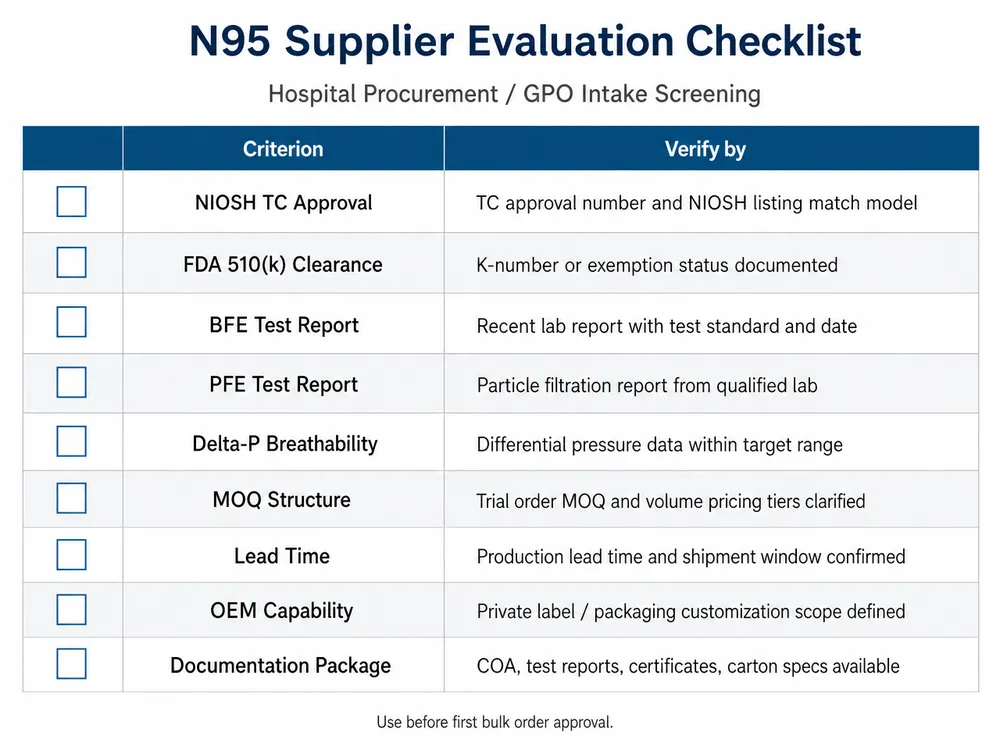
Use this checklist when screening any supplier on this list — or any supplier not on it.
| Criterion | What to Verify | Why It Matters |
|---|---|---|
| NIOSH TC Approval | TC number on NIOSH CEL, matches exact model | Required for N95 designation; counterfeit risk without verification |
| FDA 510(k) Clearance | 510(k) number on FDA database, surgical N95 classification | Required for surgical environments; hospital GPO intake standard |
| BFE ≥95% Test Report | Third-party lab, batch-specific | Confirms filtration performance on the actual product you're buying |
| PFE ≥95% Test Report | Third-party lab, batch-specific | Particulate filtration — critical for airborne pathogen protection |
| Delta-P (Breathability) | ≤35 mm H₂O/cm² per ASTM F2100 | Affects clinical wearability and compliance in extended-use settings |
| MOQ Structure | Minimum order quantity for standard SKUs | Determines whether trial orders and GPO pilots are feasible |
| Lead Time | Confirmed production-to-ship timeline | Affects inventory planning and emergency response capability |
| OEM/Private Label | Capability and minimum run size | Relevant for health systems building branded supply programs |
| Documentation Package | CoC, test reports, FDA import records | Required for customs clearance and GPO compliance file |
Top 10 N95 Medical Mask Suppliers for US Hospital Procurement
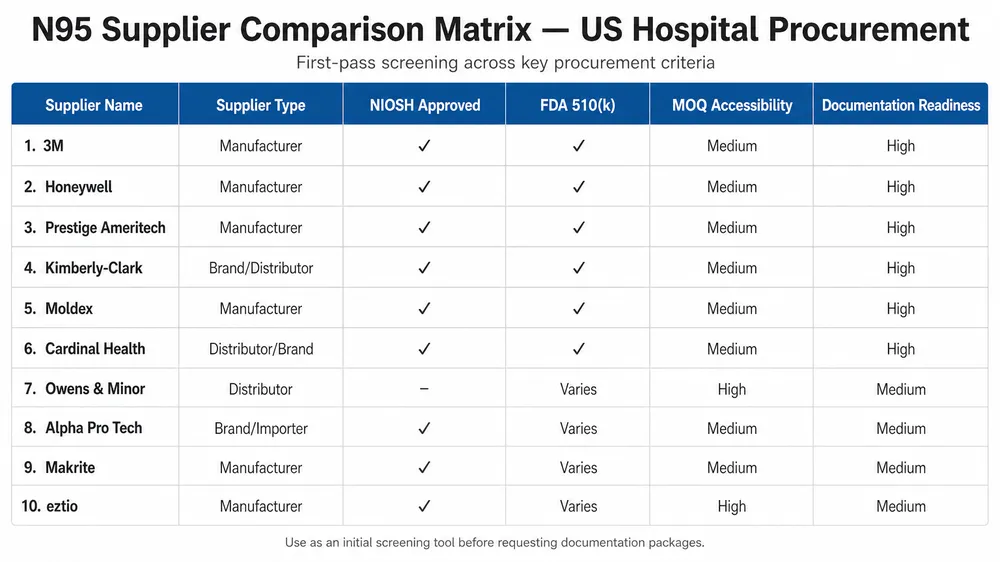
The suppliers below represent the realistic sourcing landscape for US hospital and GPO buyers. They span domestic manufacturers, established distributors, and one factory-direct option. The framing is not a ranked competition — it's a sourcing map. Different suppliers fit different procurement scenarios, and the right choice depends on your volume, urgency, and compliance requirements.
1. 3M — 3m.com
Supplier type: Domestic manufacturer Key products: 1860, 1870+, 8210 series N95 respirators NIOSH approval: Yes — multiple TC numbers across product lines FDA 510(k): Yes — surgical N95 clearance on select models (1860, 1870+) MOQ: Typically distributed through authorized distributors; direct hospital contracts available through GPO agreements
3M is the reference point for N95 procurement in US healthcare. The 1860 and 1870+ are the most widely specified surgical N95 models in hospital formularies, and their NIOSH and FDA credentials are well-documented. The practical procurement reality: 3M product moves through a distributor network, which adds a margin layer, and bulk availability during high-demand periods has historically been constrained. Lead times on large orders can extend significantly when system-wide demand spikes. For routine formulary replenishment through an established GPO contract, 3M is a low-friction choice. For cost-sensitive bidding or large-volume procurement outside existing contracts, the pricing structure warrants comparison.
2. Honeywell Safety Products — honeywell.com
Supplier type: Domestic manufacturer Key products: DF300, DC365 N95 respirators; Honeywell Surgical N95 series NIOSH approval: Yes FDA 510(k): Yes — on surgical N95 models MOQ: Distributor-dependent; direct procurement available for large health systems
Honeywell's N95 line has a strong industrial heritage — their respirator engineering comes from decades of occupational safety product development. The healthcare-specific surgical N95 models carry the required credentials for hospital use. One practical note: Honeywell's primary market orientation is industrial and construction PPE, so their healthcare-specific product range is narrower than 3M's, and OEM or private-label flexibility for health system programs is limited. For standard formulary procurement, the product is solid. For custom programs or non-standard configurations, the options are constrained.
3. Prestige Ameritech — prestigeameritech.com
Supplier type: Domestic manufacturer (Texas-based) Key products: N95 surgical respirators, procedure masks NIOSH approval: Yes FDA 510(k): Yes MOQ: Direct hospital and GPO contracts; capacity-constrained for very large orders
Prestige Ameritech is the largest domestic N95 manufacturer outside of 3M and Honeywell, and they've positioned themselves explicitly as a US-made supply chain resilience option. Their domestic manufacturing story resonates with health systems that experienced supply disruption during the pandemic and want to reduce import dependency. The trade-off is capacity: Prestige Ameritech's production footprint is smaller than the major multinationals, and very large orders can run into lead time constraints. Unit pricing reflects domestic manufacturing costs. For health systems with a domestic-sourcing mandate or a supply chain resilience policy, they're a credible option.
4. Kimberly-Clark Professional — kcprofessional.com
Supplier type: Domestic manufacturer / broad PPE line Key products: Fluidshield N95 Particulate Filter Respirator and Surgical Mask NIOSH approval: Yes FDA 510(k): Yes — Fluidshield series carries surgical N95 clearance MOQ: Distributor-dependent; GPO contract pricing available
Kimberly-Clark's Fluidshield N95 is a well-established surgical N95 in hospital formularies, particularly in facilities that already source KC's broader PPE and surgical supply line. The advantage of sourcing from KC is consolidation — if your facility already has a KC distribution relationship, adding N95 to that contract is administratively simple. The limitation is the same as other large domestic brands: pricing is set at the distributor level, and factory-direct access for mid-size buyers is not available. Custom or private-label programs are not a realistic option through standard channels.
5. Moldex-Metric — moldex.com
Supplier type: Domestic manufacturer (California-based) Key products: 1500 series, 2200 series N95 respirators; Moldex Surgical N95 NIOSH approval: Yes — multiple TC numbers FDA 510(k): Yes — on surgical N95 models MOQ: Distributor-dependent; direct accounts available for larger buyers
Moldex is a US manufacturer with a strong reputation in the industrial and healthcare N95 market. Their products are known for a contoured cup design that performs well in fit testing across diverse face shapes — a practical consideration for health systems running annual fit test programs. (Fit test pass rates matter operationally: a mask that fails fit testing on 20% of your staff creates a compliance gap regardless of its NIOSH credentials.) Moldex's healthcare line is narrower than 3M's, but the products they do make are well-regarded for consistent performance. Pricing is competitive relative to 3M for comparable specifications.
6. Cardinal Health — cardinalhealth.com
Supplier type: Healthcare distributor and private-label manufacturer Key products: AT EASE N95 Respirator; Cardinal Health branded surgical N95 NIOSH approval: Yes — on Cardinal Health branded N95 products FDA 510(k): Yes — surgical N95 clearance on select models MOQ: GPO contract-based; broad distribution network across US health systems
Cardinal Health occupies a different position on this list — they are primarily a healthcare distributor, but they also manufacture and brand their own N95 line. For health systems already in the Cardinal distribution network, their N95 products offer the convenience of consolidated invoicing and established supply chain relationships. The procurement reality: Cardinal's N95 products are manufactured by third-party factories and branded under their label, which means the underlying manufacturing quality depends on their supplier relationships. Documentation for import compliance is handled by Cardinal, which simplifies the process for buyers but reduces visibility into the manufacturing source.
7. Owens & Minor (Halyard Health) — owens-minor.com
Supplier type: Healthcare distributor and manufacturer Key products: FLUIDSHIELD N95 (legacy Halyard line, now under Owens & Minor); AERO PRO N95 NIOSH approval: Yes FDA 510(k): Yes — surgical N95 clearance MOQ: GPO and IDN contract-based distribution
Owens & Minor acquired Halyard Health's medical products division, which included the Fluidshield N95 line. The product credentials are solid — NIOSH-approved, FDA-cleared surgical N95 with an established hospital track record. The procurement dynamic is similar to Cardinal Health: strong distribution infrastructure, GPO contract access, and consolidated invoicing. For health systems that prioritize supply chain simplicity and have existing Owens & Minor relationships, this is a low-friction sourcing path. Unit economics reflect distributor margin structure.
8. Alpha Pro Tech — alphaprotech.com
Supplier type: US-based manufacturer and distributor Key products: N95 respirators, surgical N95 masks NIOSH approval: Yes FDA 510(k): Yes — on surgical N95 models MOQ: Available through direct and distributor channels
Alpha Pro Tech is a smaller US manufacturer with a focused PPE product line that includes NIOSH-approved and FDA-cleared N95 respirators. They've been a consistent supplier to healthcare and industrial markets and expanded production capacity significantly during the pandemic period. Their scale is smaller than the major brands, which can mean more direct access for mid-size buyers but also more limited capacity for very large orders. For health systems looking for a domestic alternative to the major brands — particularly for GPO diversification — Alpha Pro Tech is worth evaluating.
9. Makrite Industries — makrite.com
Supplier type: International manufacturer with US market focus Key products: SEKURA N95 Respirator, surgical N95 models NIOSH approval: Yes — SEKURA series carries NIOSH TC approval FDA 510(k): Yes — surgical N95 clearance on select models MOQ: Available for direct and distributor procurement; flexible for mid-size orders
Makrite is a Taiwan-based manufacturer with a strong US market presence and a well-documented NIOSH approval history. Their SEKURA N95 line has been widely used in US healthcare settings and has a track record in hospital procurement. Makrite represents the international manufacturer model done correctly for US compliance: NIOSH TC numbers are verifiable, FDA clearance is in place, and their documentation package is built for US import requirements. For buyers open to international sourcing but wanting a supplier with an established US compliance track record, Makrite is a credible option. Lead times and pricing are competitive relative to domestic brands.
10. eztio (Gaomi Eztio Medical Technology Co., Ltd.) — eztio.com
Supplier type: Factory-direct manufacturer (China, FDA 510(k) registered) Key products: N95 respirators, surgical N95 masks, disposable medical masks NIOSH approval: In process for US market expansion FDA 510(k): Yes — registered for US market MOQ: 50,000 pieces for standard SKUs Certifications: ISO 13485:2016, ISO 9001:2015, CE (EU MDR), FDA 510(k), SGS
eztio is the factory-direct option on this list, and the differentiation is worth explaining specifically rather than generically. Most Chinese mask manufacturers that appear in US procurement searches do not hold FDA 510(k) registration — they hold ISO 13485 and CE, which are sufficient for European markets but do not satisfy US hospital GPO intake requirements. eztio's FDA 510(k) registration is the credential that changes the import compliance equation for US buyers.
The manufacturing infrastructure behind that credential: 12,000 m² facility in Gaomi, Shandong, running 6 fully automated production lines in a Class 100,000 (ISO 8) cleanroom environment. The detail that matters most for N95 procurement specifically is in-house meltblown nonwoven production. Meltblown fabric is the filtration layer — the component that determines whether a mask actually hits its BFE and PFE specs. Most mask factories buy meltblown from outside suppliers, which means their filtration performance is only as consistent as their fabric supplier's last shipment. We produce our own meltblown, which means we set the fiber diameter, basis weight, and electrostatic charge to match the filtration target. When you order product rated at ≥95% BFE, we know what's in the mask because we made the material.
The in-house QC lab runs BFE, PFE, and Delta-P testing on every production batch before third-party certification. A batch that fails internal BFE testing gets pulled before it reaches outgoing inspection — it doesn't ship and get discovered at your receiving dock. The full export documentation package — test reports, CoC, FDA import records — is prepared with every shipment, so your customs broker and compliance team have what they need without chasing documents after the fact.
At 50,000-piece MOQ on standard SKUs, the entry point is accessible for GPO pilot programs and trial orders without requiring volume commitments that don't match current demand. For health systems building a diversified supply chain that includes a factory-direct option alongside domestic distributor relationships, eztio's documentation readiness and in-house filtration control make it a credible addition to the sourcing mix.
Explore our N95 Medical Masks and Hospital N95 Medical Mask product lines for full specification detail.
Factory-Direct vs Domestic Distributor: What It Means for Landed Cost and Lead Time
The domestic distributor model has real advantages that are worth acknowledging before the cost comparison. Distributor inventory means same-week or next-week delivery for urgent orders. Established GPO contracts mean pre-negotiated pricing and simplified procurement paperwork. Consolidated invoicing across multiple product categories reduces administrative overhead. For emergency replenishment or small fill-in orders, the distributor model is often the right answer regardless of unit cost.
The economics shift when you're looking at planned, repeat-volume procurement — the kind of order that goes on a quarterly or annual purchasing schedule. At that scale, the distributor margin layer becomes a meaningful line item. Domestic distributors typically add 15–30% over manufacturer pricing depending on the product category and contract terms. On a 500,000-piece annual N95 order, that margin differential translates directly to procurement budget.
Factory-direct sourcing from a certified manufacturer changes the cost structure in two ways. First, you're buying at manufacturer pricing without the distributor layer. Second, if the manufacturer holds the right credentials — FDA 510(k), NIOSH approval, full documentation package — the compliance overhead of importing is lower than most buyers expect. The friction point is usually documentation: buyers who haven't imported medical devices before assume the customs and FDA review process is more complex than it is when the paperwork is in order. A manufacturer that ships with complete test reports, CoC, and FDA import records reduces that friction to a manageable process.
The lead time trade-off is real and shouldn't be minimized. Factory-direct production-to-ship lead time runs 15–25 days from order confirmation for standard SKUs, plus ocean freight transit (typically 18–25 days to US West Coast ports, 25–35 days to East Coast). That's a 5–8 week total lead time versus same-week distributor delivery. The practical implication: factory-direct sourcing works for planned procurement with adequate inventory buffer. It doesn't work for emergency orders. A hybrid sourcing model — factory-direct for planned volume, domestic distributor for emergency fill-in — captures the cost advantage of direct sourcing while maintaining the response capability of local inventory.
(We've had buyers come to us after a supply disruption event wanting to switch entirely to factory-direct. We always recommend keeping a domestic distributor relationship active for exactly this reason. The goal is cost optimization on planned volume, not eliminating your emergency supply option.)
What Documentation Does Your Hospital GPO Actually Require?
The documentation gap is where most import sourcing attempts stall. A buyer finds a credentialed manufacturer, confirms the product specs, and then discovers that their GPO's intake process requires a specific set of documents that the supplier either doesn't have or takes weeks to produce. Here's what the standard US hospital GPO intake file looks like in practice.
NIOSH Certification Documentation The NIOSH Certified Equipment List (CEL) entry for the specific product model, including the TC approval number. This is publicly verifiable — your compliance team can check it directly at the NIOSH CEL database. The TC number must match the exact model being ordered, not just the brand family.
FDA 510(k) Clearance Documentation The 510(k) summary or clearance letter for the specific product, verifiable on the FDA 510(k) database. For surgical N95 designation, this document confirms the product's classification as a Class II medical device with fluid resistance properties. Some GPOs require the full 510(k) summary; others accept the clearance number for database verification.
Performance Test Reports Third-party lab test reports for BFE, PFE, and Delta-P, referencing the specific product model and ideally the production lot. ASTM F2100 (for surgical masks) and NIOSH 42 CFR Part 84 (for respirators) are the relevant standards. Reports should be dated within the past 12–24 months; older reports may be flagged for re-verification.
Certificate of Conformity Manufacturer declaration that the product meets the stated standards, signed by an authorized representative, with the specific standards listed. This is a standard export document — any credentialed manufacturer should produce it without delay.
FDA Prior Notice and Import Records For imported product, the FDA Prior Notice filing confirmation and the entry documentation showing the shipment cleared FDA review. First-time importers sometimes don't realize this documentation exists and needs to be retained — it's part of the compliance file for any subsequent audit.
Labeling Compliance Verification NIOSH-approved N95 masks must carry specific label elements: the NIOSH logo, TC approval number, filtration rating, and manufacturer information. Counterfeit N95s are most commonly identified through labeling discrepancies. Your receiving team should verify label elements against the NIOSH CEL entry on every new supplier's first shipment.
For a detailed walkthrough of the FDA 510(k) documentation process for N95 imports, see our N95 Mask FDA 510(k) Guide.
When Local Supply Is the Right Answer
A credible sourcing guide should be direct about this: there are procurement scenarios where domestic distributor sourcing is the better choice, and forcing a factory-direct model into those scenarios creates more problems than it solves.
Emergency and urgent orders — If your facility needs N95 stock within 48–72 hours, a domestic distributor with warehouse inventory is the only viable option. Factory-direct lead times don't compress for urgent orders.
Small fill-in quantities — Orders below 10,000–20,000 pieces don't generate enough unit cost savings from factory-direct sourcing to offset the administrative overhead of import documentation and customs clearance. Distributor convenience wins at small volumes.
First-time compliance situations — If your facility is going through a GPO audit or a Joint Commission review and needs to demonstrate an established, audited supply chain, a domestic distributor relationship with documented history is easier to present than a new import relationship.
Formulary continuity requirements — Some health systems have formulary policies that require specific branded products (3M 1860, for example) by model number. Factory-direct sourcing of equivalent-spec product doesn't satisfy a formulary requirement for a specific brand.
The factory-direct model earns its place in planned, repeat-volume procurement where the cost differential is meaningful, the lead time can be managed with inventory planning, and the compliance documentation is in order. That's a specific scenario, not a universal recommendation.
Sourcing Decision Guide: Which Supplier Model Fits Your Situation
| Procurement Scenario | Recommended Sourcing Model | Rationale |
|---|---|---|
| Emergency replenishment, <72 hours | Domestic distributor | Only viable option for urgent delivery |
| Routine formulary replenishment, GPO contract | Domestic distributor (3M, KC, Honeywell) | Established contract pricing, low administrative friction |
| Large planned order, cost-sensitive bidding | Factory-direct (eztio, Makrite) | Unit cost advantage at volume; documentation manageable with planning |
| GPO pilot program, 50K–200K pieces | Factory-direct with FDA 510(k) | MOQ accessible; documentation package supports intake |
| Private-label or OEM program | Factory-direct manufacturer | Domestic brands don't offer OEM flexibility; factory-direct required |
| Supply chain diversification | Hybrid: domestic + factory-direct | Maintains emergency response capability while optimizing planned volume cost |
For health systems building a Disposable N95 Medical Mask program or evaluating a factory-direct supplier for the first time, the practical starting point is a documented sample order: confirm the product spec, review the documentation package, and run the product through your facility's fit testing protocol before committing to bulk volume. A supplier that can't produce a complete documentation package on a sample order won't produce one on a 500,000-piece shipment either.
Frequently Asked Questions
What is the difference between NIOSH N95 approval and FDA 510(k) clearance for hospital procurement?
NIOSH approval (a TC number) certifies that a respirator meets filtration and fit performance standards for occupational use — it's a performance certification. FDA 510(k) clearance is a separate market authorization that classifies the product as a medical device, specifically a surgical N95, and is required for use in surgical environments where fluid resistance is a requirement. A mask can hold NIOSH approval without FDA clearance. Hospital procurement for surgical settings typically requires both. For non-surgical clinical use (isolation rooms, general patient care), NIOSH approval alone may satisfy your facility's policy — check with your infection control team.
Can a Chinese manufacturer's N95 masks pass US hospital GPO intake review?
Yes, if the manufacturer holds the right credentials. The key requirements are FDA 510(k) registration (for surgical N95 designation) or NIOSH TC approval (for respirator-only use), plus a complete documentation package: BFE/PFE test reports, Certificate of Conformity, and FDA import records. Most Chinese manufacturers hold ISO 13485 and CE certification but not FDA 510(k) — that's the gap that blocks GPO intake. Manufacturers that have done the work to obtain FDA registration can supply US hospitals with the same documentation package as a domestic supplier.
What MOQ is realistic for a hospital GPO pilot program with a factory-direct N95 supplier?
50,000 pieces is a workable entry point for most factory-direct manufacturers with flexible MOQ structures. At that volume, the unit cost savings over domestic distributor pricing are meaningful, the documentation overhead is a one-time setup cost, and the order size is manageable for a pilot program without overcommitting inventory. Below 20,000 pieces, the economics of factory-direct sourcing typically don't justify the import process overhead — distributor sourcing is more efficient at that scale.
How do I verify that an N95 supplier's NIOSH approval is current and applies to the specific product I'm ordering?
Check the NIOSH Certified Equipment List (CEL) directly at the CDC/NIOSH website. Search by manufacturer name or TC number. The CEL entry will show the specific approved models, the TC number, and the approval status. Verify that the TC number on the product packaging matches the CEL entry exactly — including the model designation. Counterfeit N95s frequently use real TC numbers from different products or manufacturers. If the TC number on the packaging doesn't match the CEL entry for that specific product model, the product is not NIOSH-approved regardless of what the label claims.
What is the typical lead time for factory-direct N95 procurement from China to US hospitals?
Production-to-ship lead time for standard SKUs runs 15–25 days from order confirmation, depending on order volume and current line scheduling. Ocean freight transit adds 18–25 days to US West Coast ports (Los Angeles, Long Beach) or 25–35 days to East Coast ports (New York, Savannah). Total lead time from order to US port arrival is typically 5–8 weeks. Add 3–7 days for customs clearance and domestic freight to your facility. Plan for 6–9 weeks total from order placement to receiving dock for first-time import orders; repeat orders with established customs broker relationships typically run faster.