Medical Protective Clothing Standards Explained: EN 13795, AAMI PB70, and ISO 22610 for Buyers
Most sourcing problems with medical protective clothing don't start at the factory. They start when a buyer places an order without specifying which standard applies — and the supplier ships product that meets a standard, just not the one the destination market requires.
I've seen this happen more than once: a buyer sources isolation gowns for a European hospital tender, receives product with AAMI PB70 Level 2 documentation, and then discovers at customs review that the tender required EN 13795 high-performance class. The gowns aren't defective. They're just certified to the wrong framework for that market. The order gets held, the tender deadline passes, and the buyer is out both the cost and the relationship.
This article maps the three standards that govern most of the global medical protective clothing market — EN 13795, AAMI PB70, and ISO 22610 — to the product types they cover, the tests they require, and the documents you should be requesting from any supplier before you commit to a bulk order.

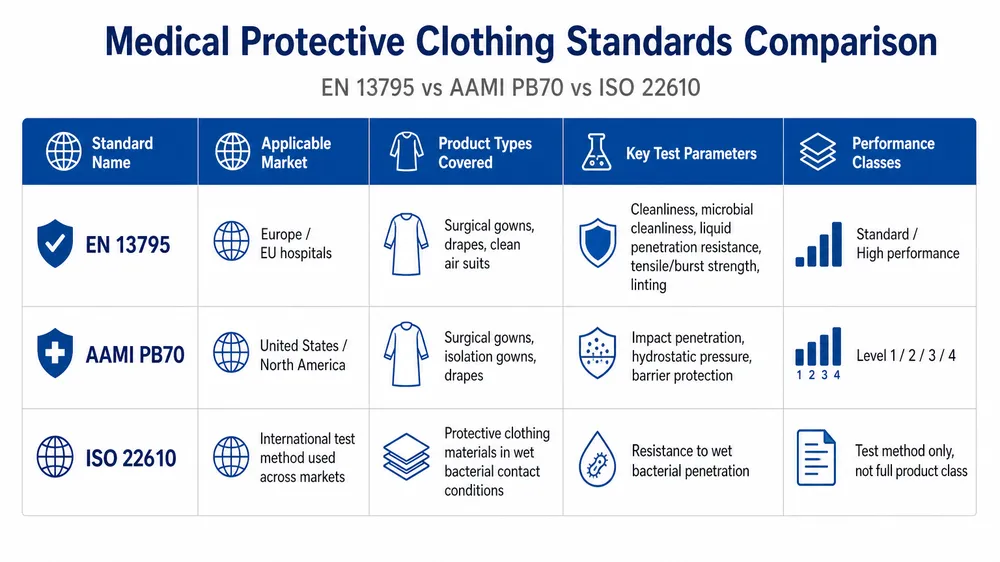
Quick Reference: Three Standards, Three Markets, One Table
Before going deep on each standard, here's the map:
| Standard | Primary Market | Product Types | Key Test Parameters | Performance Classes |
|---|---|---|---|---|
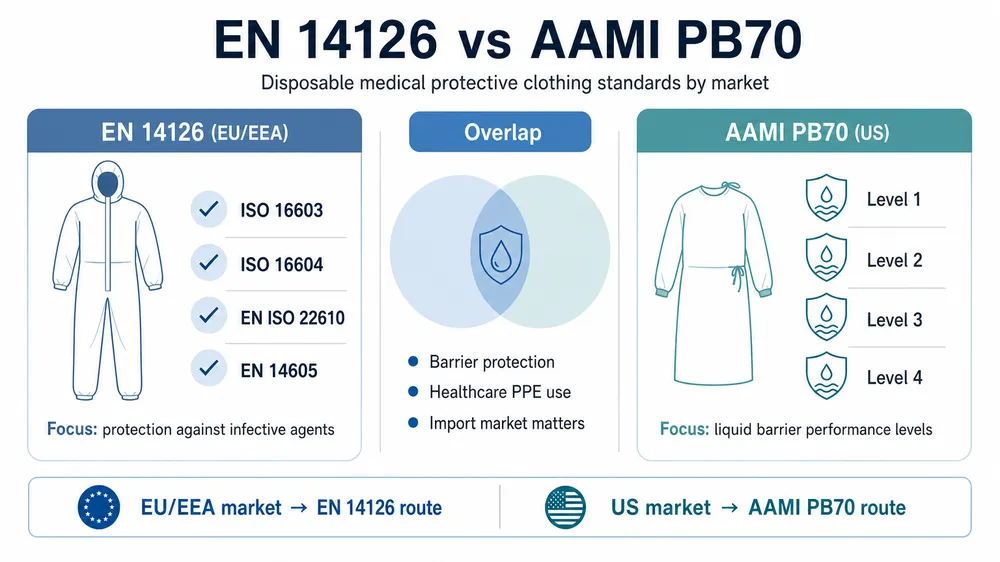
| EN 13795 | EU / Europe | Surgical gowns, surgical drapes, clean air suits | Liquid barrier (wet/dry), microbial penetration, linting, tensile strength | Standard Performance, High Performance |
| AAMI PB70 | US / North America | Isolation gowns, surgical gowns, drapes | Liquid barrier (4 levels), seam strength | Level 1, 2, 3, 4 |
| ISO 22610 | Global (often paired with EN 13795) | Surgical gowns, surgical drapes | Wet bacterial penetration resistance | Pass/Fail against defined index |
The practical implication: if you're sourcing for EU hospital tenders, EN 13795 is the framework. If you're supplying US healthcare distributors or GPOs, AAMI PB70 is what procurement teams will ask for. ISO 22610 is less often a standalone requirement — it's typically referenced within EN 13795 compliance or specified by hospital infection control teams who want explicit wet bacterial barrier data.
If you're building a product line for both markets, you need to understand where the standards overlap and where they diverge, because the production specs that satisfy one don't automatically satisfy the other.
EN 13795: The EU Framework for Surgical Protective Clothing
EN 13795 is the European harmonized standard for surgical gowns, surgical drapes, and clean air suits used in surgical environments. It's published by CEN (European Committee for Standardization) and referenced under EU MDR, which means CE-marked surgical protective clothing sold in Europe needs to demonstrate conformity with it.
The standard covers two performance classes: Standard Performance and High Performance. The distinction matters for procurement because it maps directly to procedure risk level.
Standard Performance products are designed for procedures with lower fluid exposure — think routine surgeries where splash risk is limited and the gown's primary function is microbial barrier, not fluid resistance. High Performance products are specified for fluid-intensive procedures: orthopedic surgery, trauma, cardiovascular work, any procedure where the surgical team is likely to encounter significant blood or fluid volume.
What EN 13795 actually tests:
- Liquid barrier — wet: Resistance to liquid penetration under pressure, tested per EN ISO 811. High Performance requires a higher hydrostatic head value than Standard Performance.
- Liquid barrier — dry: Resistance to dry microbial penetration, tested per EN ISO 22612.
- Wet bacterial penetration: Resistance to wet bacterial penetration, tested per ISO 22610 (this is where ISO 22610 enters the picture — it's a test method referenced within EN 13795, not a separate certification requirement in most EU tenders).
- Linting: Particle shedding from the fabric, tested per EN ISO 9073-10. Surgical environments are sensitive to particulate contamination, so linting limits are specified for both performance classes.
- Tensile strength: Fabric and seam strength, tested per EN ISO 13934-1. Seam strength is where a lot of products fail — more on that below.
The critical zone in any gown is the critical zone: the front panel and sleeves from cuff to above the elbow. EN 13795 specifies that the critical zone must meet the higher performance requirements, while less-exposed areas (back panel, collar) can meet lower thresholds. This zoning approach is practical — it allows manufacturers to use higher-barrier materials where they're needed without making the entire garment out of the most expensive fabric.
(One thing buyers often miss: EN 13795 applies to the finished product, not just the fabric. A gown made from compliant fabric can still fail EN 13795 if the seams aren't sealed properly. We've seen fabric test reports submitted as product compliance documentation — they're not the same thing.)
For EU market access, the relevant documentation chain is: EN 13795 test report from a notified body or accredited lab, CE technical file, and Declaration of Conformity. If a supplier can only provide a fabric test report or a generic ISO 9001 certificate, that's not EN 13795 compliance.
AAMI PB70: The US Liquid Barrier Classification System
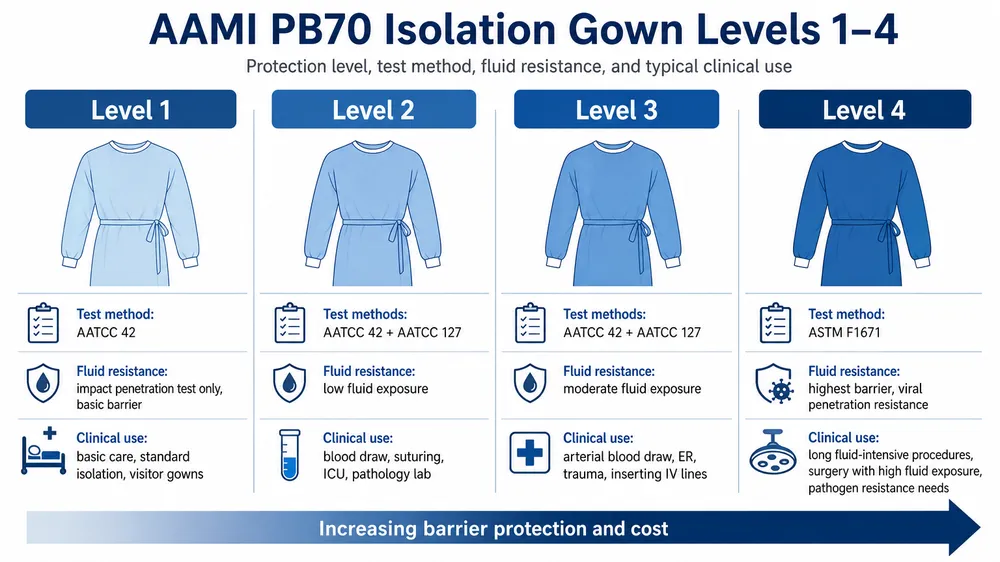
AAMI PB70 is published by the Association for the Advancement of Medical Instrumentation and is the standard framework for liquid barrier performance of protective apparel in US healthcare settings. Unlike EN 13795's two-class system, AAMI PB70 uses four levels — and the level determines which procedures the garment is appropriate for.
The four levels are defined by the test method used to evaluate liquid barrier performance:
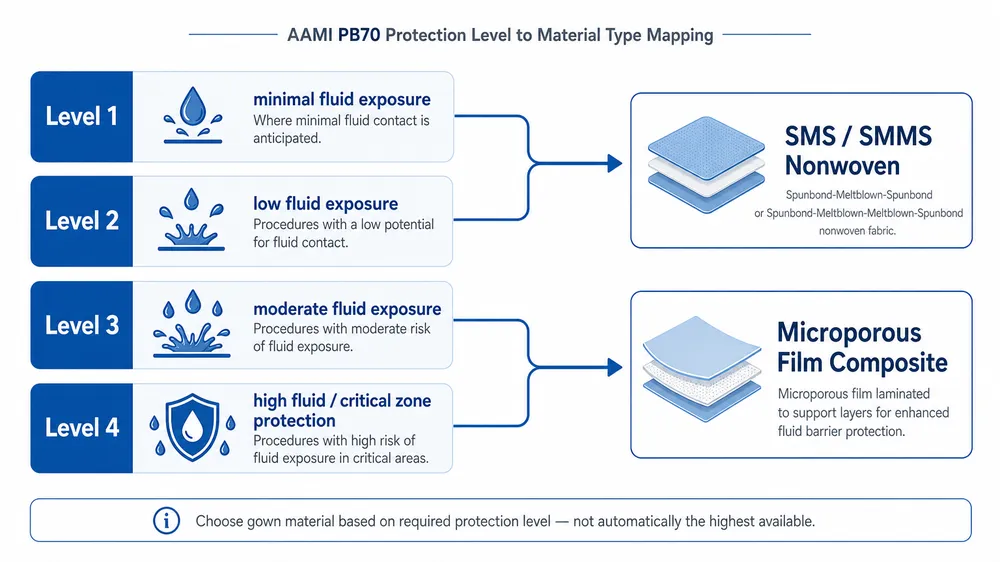
Level 1 — Minimal liquid barrier protection. Tested with a simple spray impact test (AATCC 42). Appropriate for basic care, standard isolation, or situations with minimal fluid exposure. Most disposable isolation gowns sold for general ward use fall here.
Level 2 — Low liquid barrier protection. Tested with spray impact (AATCC 42) plus hydrostatic pressure test (AATCC 127 at 20 cm H₂O). Appropriate for procedures with some fluid exposure risk — blood draws, suturing, ICU care.
Level 3 — Moderate liquid barrier protection. Same tests as Level 2 but at higher hydrostatic pressure (50 cm H₂O). Appropriate for arterial blood draws, IV insertion, trauma care, emergency procedures.
Level 4 — Highest liquid barrier protection. Tested with ASTM F1671 (viral penetration resistance using Phi-X174 bacteriophage as a surrogate for bloodborne pathogens). This is the level required for procedures with high risk of bloodborne pathogen exposure — surgery, high-risk patient care, procedures involving large volumes of blood.
The jump from Level 3 to Level 4 is significant. Level 4 requires viral penetration resistance testing, which is a fundamentally different test from hydrostatic pressure. A Level 3 gown that performs well on hydrostatic tests will not automatically pass Level 4 viral penetration testing — the material and construction requirements are different.
For US hospital procurement, the level specification usually comes from the facility's infection control committee or the GPO contract. If you're supplying a distributor who sells into multiple hospital systems, expect to carry Level 2 and Level 3 as your core SKUs, with Level 4 as a specialty item for surgical and high-risk procedure accounts.

AAMI PB70 also covers seam strength — the seam must meet a minimum tensile strength requirement, and the level of the garment applies to the seams as well as the fabric panels. This is where a lot of lower-cost gowns fail in real use: the fabric passes the liquid barrier test, but the seam construction doesn't hold under the stress of actual clinical use.
ISO 22610: Wet Bacterial Penetration Resistance
ISO 22610 is a test method standard, not a product classification system. It defines the procedure for measuring resistance to wet bacterial penetration — specifically, how well a material prevents bacteria from passing through when the material is wet and under mechanical action (simulating the conditions of a surgical procedure where the gown is in contact with a wet surgical field).
The test uses a defined bacterial suspension, a standardized mechanical action, and measures the number of colony-forming units that penetrate the material. Results are expressed as an index value, and EN 13795 specifies minimum index values for Standard Performance and High Performance classes.
Why does this matter separately from the hydrostatic pressure tests? Because hydrostatic pressure tests measure resistance to liquid penetration under static pressure, while ISO 22610 simulates the dynamic conditions of actual surgical use — movement, contact, friction. A material can pass hydrostatic testing and still allow bacterial penetration under the mechanical stress of a real procedure.
For buyers sourcing surgical gowns for EU hospital tenders, ISO 22610 test data will typically be part of the EN 13795 compliance documentation package. For buyers sourcing for markets that don't mandate EN 13795 — parts of the Middle East, Southeast Asia, some African markets — ISO 22610 test reports are worth requesting independently as a quality indicator, even when they're not a regulatory requirement.
The test is also relevant for surgical drapes. EN 13795 covers surgical drapes as well as gowns, and the wet bacterial penetration requirement applies to drape materials in the critical zone (the area immediately surrounding the surgical site). If you're sourcing surgical drapes alongside gowns, confirm that the ISO 22610 data covers the drape material specifically — fabric test data from the gown doesn't transfer.
How EN 13795 and AAMI PB70 Compare for Dual-Market Sourcing
If you're building a product line for both EU and US distribution, the question isn't which standard is "better" — it's whether a single product can satisfy both, or whether you need separate SKUs.
The honest answer: it depends on the performance level.
For lower-acuity products — standard isolation gowns, basic procedure gowns — there's meaningful overlap. A gown that meets EN 13795 Standard Performance will often also meet AAMI PB70 Level 2 or Level 3 requirements, because the liquid barrier thresholds are in a similar range. But "often" isn't "always," and you need actual test data against both standards to confirm, not an assumption based on one passing the other.
For high-performance surgical gowns, the standards diverge more significantly. EN 13795 High Performance and AAMI PB70 Level 4 both target the most demanding surgical applications, but the test methods are different. EN 13795 High Performance uses hydrostatic pressure and ISO 22610 wet bacterial penetration. AAMI PB70 Level 4 uses ASTM F1671 viral penetration. A gown certified to EN 13795 High Performance is not automatically certified to AAMI PB70 Level 4 — the viral penetration test is a separate requirement that needs separate testing.
We supply to both EU and US markets, and the practical approach we've seen work for buyers building dual-market lines is to specify the higher-barrier material and construction, then test against both standards. The material cost difference between a product that can pass both and one that can only pass one is usually smaller than the cost of maintaining two separate SKUs with separate documentation packages.
| Comparison Point | EN 13795 | AAMI PB70 |
|---|---|---|
| Performance classes | Standard, High Performance | Level 1, 2, 3, 4 |
| Liquid barrier test | EN ISO 811 (hydrostatic) | AATCC 42 (spray), AATCC 127 (hydrostatic), ASTM F1671 (viral, Level 4 only) |
| Wet bacterial penetration | ISO 22610 (required) | Not explicitly required |
| Seam strength | EN ISO 13934-1 | Specified per level |
| Linting | EN ISO 9073-10 | Not specified |
| Market | EU / Europe | US / North America |
| Regulatory reference | EU MDR | FDA guidance |
What Standards Actually Require at the Production Level
This is the part that most distributor-facing content skips, and it's where the real sourcing risk lives.
A standard is a performance specification. It tells you what the finished product must achieve. It doesn't tell you how to achieve it — that's the manufacturer's problem. But the production decisions a factory makes are what determine whether the product actually meets the standard in real use, not just in the test lab.
The three production variables that matter most for medical protective clothing compliance:
Fabric specification. The nonwoven material — typically SMS (spunbond-meltblown-spunbond) or microporous film laminate — determines the baseline liquid barrier and microbial penetration performance. SMS fabric is breathable and comfortable but has a lower liquid barrier ceiling. Microporous film laminates achieve higher hydrostatic head values and are typically used for High Performance / Level 3-4 products. The fabric spec needs to be locked in the product's technical file, not left to the supplier's discretion on a per-order basis.
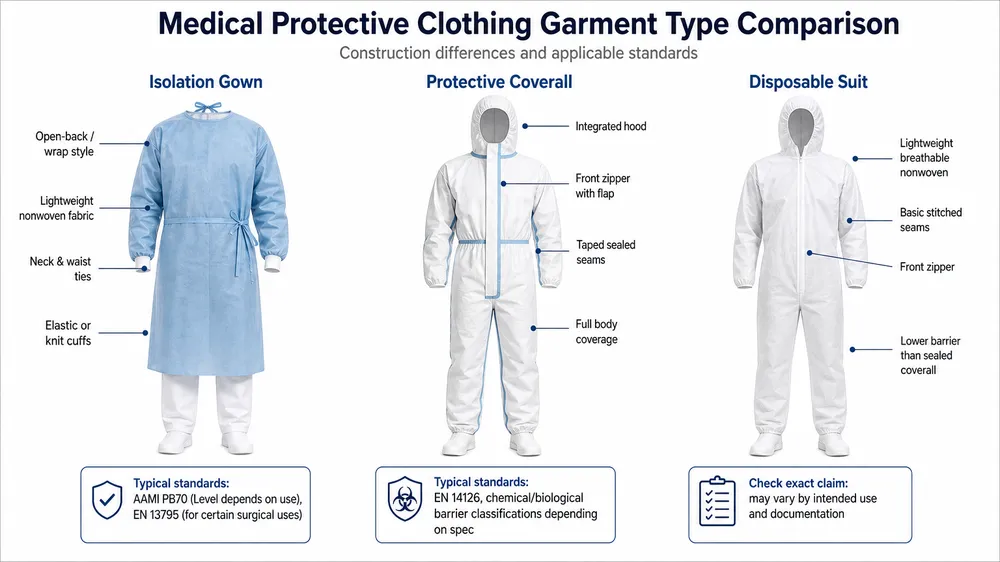
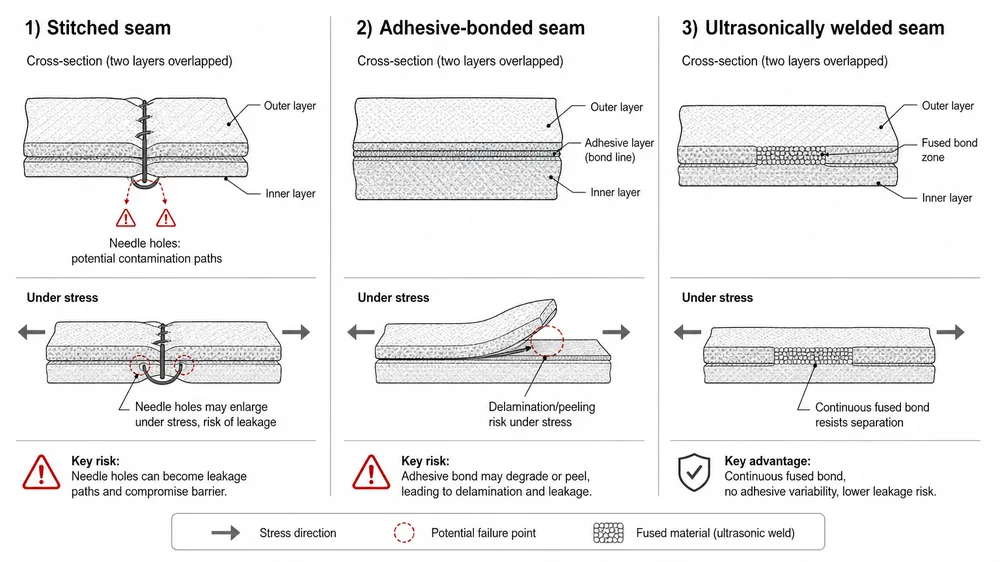
Seam construction. The seam is where most protective clothing fails — and it's the last thing buyers check before placing a bulk order. (That's David Fang's observation from years of reviewing failed shipments, and it's accurate.) A sewn seam without seam tape will allow liquid and microbial penetration at the stitch holes, regardless of how well the fabric panels perform. EN 13795 and AAMI PB70 both specify seam strength requirements, but seam sealing — applying a heat-bonded tape over the seam — is what actually closes the penetration pathway. Critical-zone seams on compliant surgical gowns should be sealed, not just sewn. If a supplier's product photos show exposed stitching on the front panel, that's a flag.
Cleanroom manufacturing environment. EN 13795 specifies linting limits because surgical environments are sensitive to particulate contamination. Meeting those limits requires manufacturing in a controlled environment — not necessarily a pharmaceutical-grade cleanroom, but a facility with controlled particle counts, filtered air supply, and gowning protocols for production staff. A factory running in an uncontrolled environment can produce gowns that pass liquid barrier tests but fail linting requirements. Ask about the manufacturing environment, not just the product test reports.
Our facility runs in a Class 100,000 (ISO 8) cleanroom environment with continuous particle monitoring. That's the same environment we use for mask production, and it's the baseline we apply to any medical protective clothing we produce. It's not a marketing claim — it's a regulatory requirement for the product categories we're certified to manufacture.

Verifying Compliance Before You Place the Order
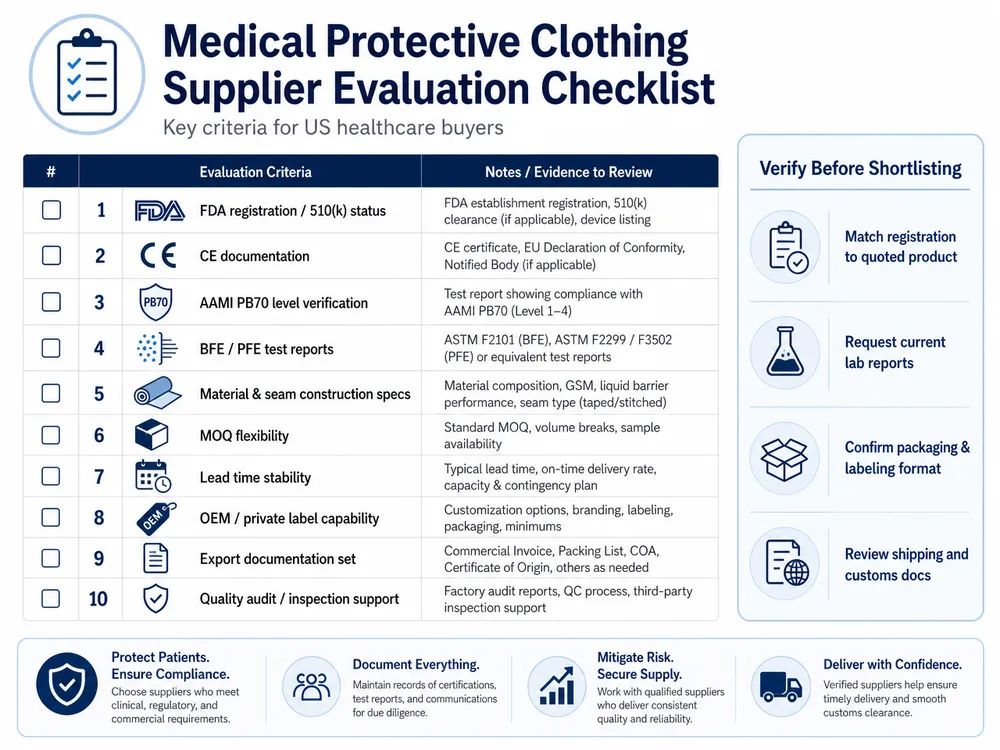
The documents that matter — and what to look for in each:
EN 13795 test report from an accredited laboratory (look for ISO 17025 accreditation on the lab). The report should specify which performance class was tested (Standard or High Performance), list the test methods used, and show results against the standard's threshold values. A report that only shows "pass" without the actual measured values is less useful — you want the numbers so you can compare across suppliers.
AAMI PB70 test report should specify the level tested and show results for each test method required at that level. For Level 4, confirm that ASTM F1671 viral penetration testing is included — some suppliers submit Level 3 test data and label the product as Level 4.
ISO 22610 test report if you're sourcing for EU surgical applications or markets that specify wet bacterial penetration resistance. The report should show the index value achieved, not just a pass/fail notation.
ISO 13485:2016 certificate with scope that covers the product category. ISO 13485 is the quality management system standard for medical device manufacturers. A supplier with ISO 13485 certification has documented design controls, risk management, and traceability processes — which means the product you receive in batch 10 should be the same as the product that was tested in batch 1. Without ISO 13485, there's no systematic guarantee of batch-to-batch consistency.
Declaration of Conformity (for EU market): a formal document signed by the manufacturer declaring that the product meets the applicable standard. Required for CE marking under EU MDR.
Certificate of Conformity (for shipment documentation): confirms that the specific shipment meets the stated standard and performance class. This is the document your customs broker and importer of record will need.
Red flags to watch for:
- Fabric test reports submitted as product compliance documentation (fabric tests ≠ finished product tests)
- Test reports from non-accredited labs or labs with no ISO 17025 certification
- AAMI PB70 Level 4 claims without ASTM F1671 test data
- EN 13795 compliance claims without ISO 22610 wet bacterial penetration data
- ISO 9001 certificate presented as equivalent to ISO 13485 (they're not — ISO 9001 doesn't cover medical device-specific requirements)
- Test reports older than 3 years without re-testing documentation

Sourcing for Medical Protective Clothing: Matching Standard to Market
The practical sourcing decision comes down to three questions:
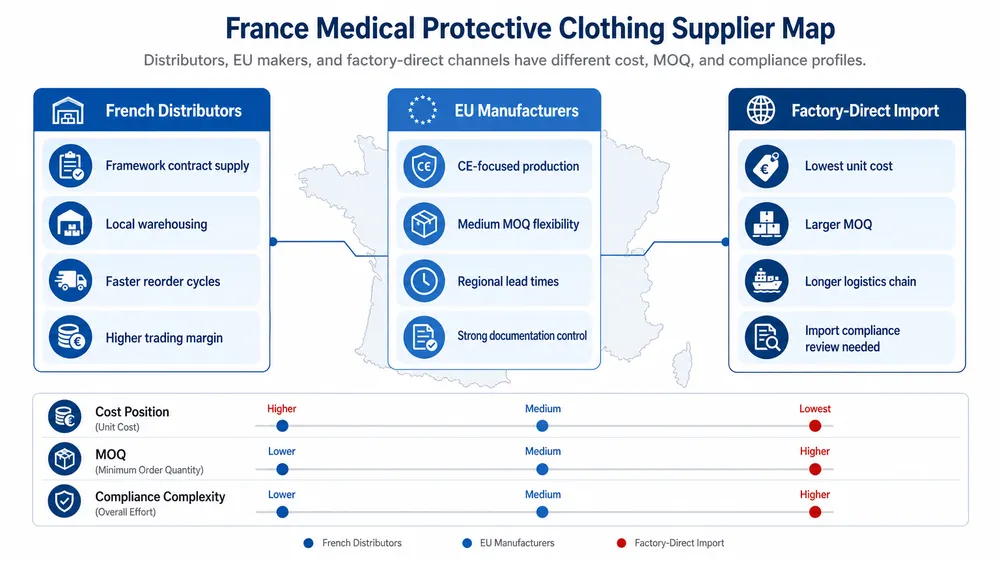
Which market are you selling into? EU hospital tenders and institutional procurement will specify EN 13795 and require CE documentation. US healthcare distributors and GPO contracts will specify AAMI PB70 levels. If you're selling into both, you need a supplier who can provide test documentation for both — not a supplier who can do one and promises the other is "equivalent."
What procedure risk level does your buyer need? For general ward isolation and basic procedure use, EN 13795 Standard Performance or AAMI PB70 Level 1-2 covers the requirement. For surgical use and fluid-intensive procedures, you need EN 13795 High Performance or AAMI PB70 Level 3-4. Specifying a lower performance class to reduce unit cost is a liability risk for your buyer — and for you as the distributor.
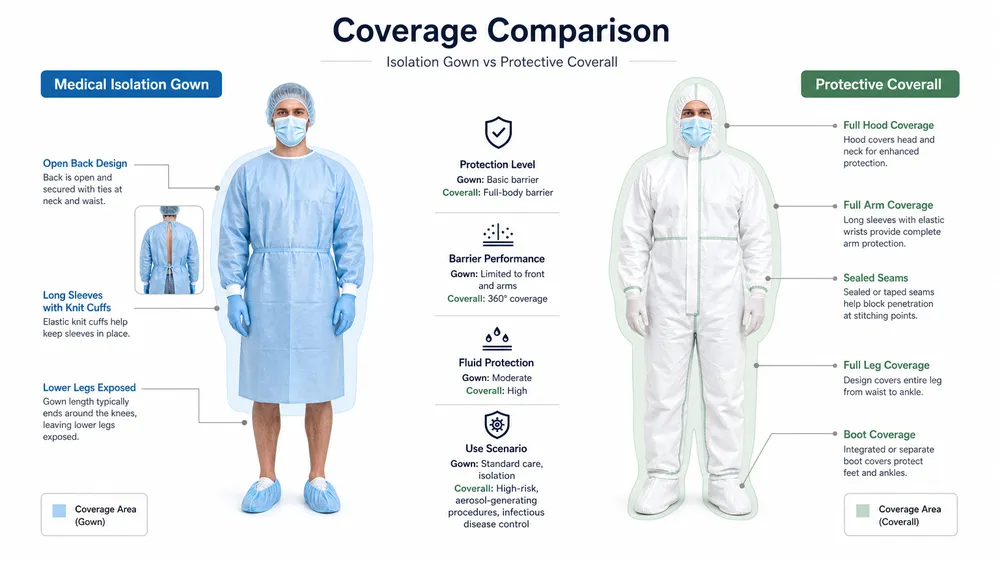
What does the product actually need to do? A medical isolation gown for general ward use has different requirements than a surgical gown for an orthopedic procedure. A medical protective coverall for infectious disease isolation has different requirements than a standard procedure gown. The standard and performance class should follow the clinical application, not the other way around.
We hold ISO 13485:2016, CE under EU MDR, and FDA 510(k) registration — the documentation infrastructure for both EN 13795 and AAMI PB70 compliance is in place. Our in-house QC lab runs the performance tests that underpin both standards, which means we catch specification drift before it becomes a shipment problem. If you're sourcing for a specific standard and performance class, send us the requirement and we'll confirm the applicable test documentation with your quote.
FAQ: Standards Questions Buyers Ask Before Placing Orders
Does EN 13795 High Performance equal AAMI PB70 Level 4?
No. Both target high-risk surgical applications, but the test methods differ. EN 13795 High Performance requires ISO 22610 wet bacterial penetration resistance and high hydrostatic head values. AAMI PB70 Level 4 requires ASTM F1671 viral penetration resistance. A product certified to one is not automatically certified to the other. If you need both, request test reports for both standards from the same product.
Can a supplier's ISO 13485 certificate substitute for product-level test reports?
No. ISO 13485 certifies the quality management system — it confirms the factory has documented processes for design control, risk management, and traceability. It doesn't certify that any specific product meets EN 13795 or AAMI PB70. You need both: ISO 13485 for system confidence, and product-specific test reports for performance confirmation.
What's the difference between SMS and microporous film for gown construction, and does it affect which standard a product can meet?
SMS (spunbond-meltblown-spunbond) nonwoven is breathable and comfortable, but its liquid barrier ceiling is lower than microporous film laminate. SMS products can meet EN 13795 Standard Performance and AAMI PB70 Level 1-2 without difficulty. For EN 13795 High Performance or AAMI PB70 Level 3-4, microporous film laminate is typically required to achieve the higher hydrostatic head and viral penetration resistance values. The material choice is a production decision that determines which performance class is achievable — it's worth confirming with your supplier before sampling.
How often should product test reports be renewed?
EN 13795 and AAMI PB70 don't specify mandatory re-testing intervals, but most hospital procurement standards and GPO contracts expect test reports to be current — typically within 2-3 years. More practically: if a supplier changes their fabric source, seam construction, or manufacturing process, the existing test reports no longer apply to the current product. Ask suppliers to confirm whether the test reports on file reflect the current production specification, not a previous version of the product.
What's the minimum documentation package to request when qualifying a new supplier for EU hospital supply?
At minimum: EN 13795 test report (from an ISO 17025-accredited lab, specifying performance class and showing measured values), ISO 22610 test report, ISO 13485:2016 certificate with scope covering the product category, and Declaration of Conformity. For CE-marked products, the CE technical file should be available on request — you don't need the full file for initial qualification, but a supplier who can't produce it on request is a compliance risk.
If you're qualifying suppliers for a specific standard and performance class, the fastest path is to send us your requirement directly. Specify the target standard (EN 13795, AAMI PB70, or both), the performance class or level, and your estimated order volume — we'll confirm the applicable test documentation and send a spec sheet with your quote. Request a quote here.