The question lands in my inbox regularly: "We need isolation gowns — should we go nonwoven or film?" Nine times out of ten, the buyer already has a budget in mind and a vague sense that film gowns are "better." Sometimes that's right. Often it's not. The real answer depends on which AAMI PB70 protection level your end-users actually need, what procedures those gowns will cover, and what the total landed cost looks like at your order volume.
Here's the short version before we get into the mechanics: SMS nonwoven gowns are the right call for Level 1–2 applications and high-volume stocking programs where breathability and cost efficiency matter. Microporous film gowns are the right call when you need Level 3–4 barrier performance — fluid-intensive procedures, isolation wards, or any setting where strike-through is a real clinical risk. Buying film gowns for routine patient care is overspending. Buying nonwoven gowns for high-fluid-exposure procedures is a liability.
The rest of this article explains why, and gives you the spec data and sourcing logic to back up whichever direction you go.
AAMI PB70 Is the Framework — Start Here Before Comparing Materials
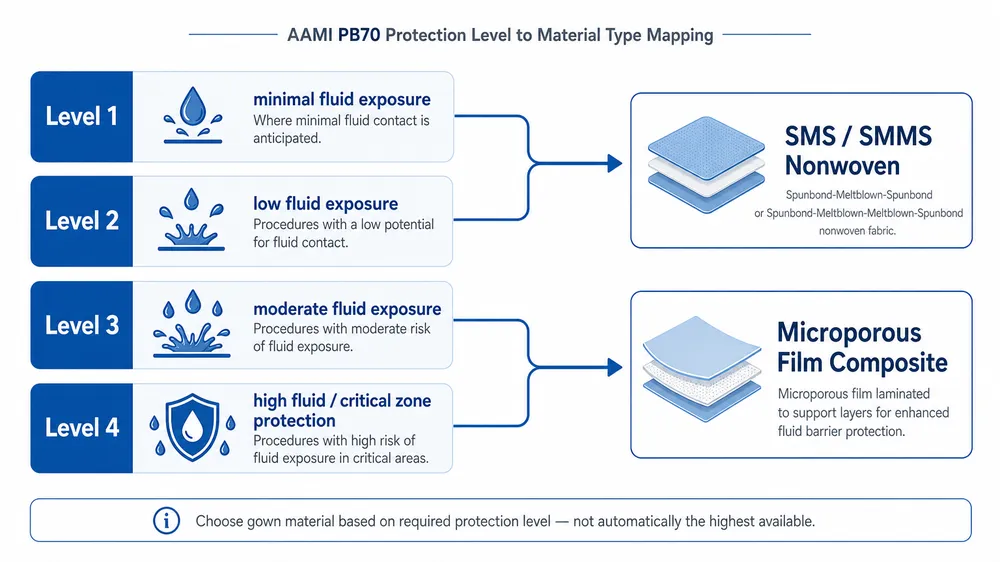
Before the material comparison means anything, you need to anchor it to AAMI PB70. This is the US standard that defines four protection levels for isolation gowns based on fluid barrier performance. Every serious procurement decision for the US market — and increasingly for EU buyers using EN 13795 as a parallel reference — runs through this framework.
| AAMI Level | Barrier Requirement | Typical Application |
|---|---|---|
| Level 1 | Minimal fluid barrier | Routine patient care, standard isolation |
| Level 2 | Low fluid barrier | Blood draw, ICU, light splash risk |
| Level 3 | Moderate fluid barrier | Arterial blood draw, IV insertion, trauma |
| Level 4 | Highest fluid barrier | Long fluid-intensive procedures, surgical |
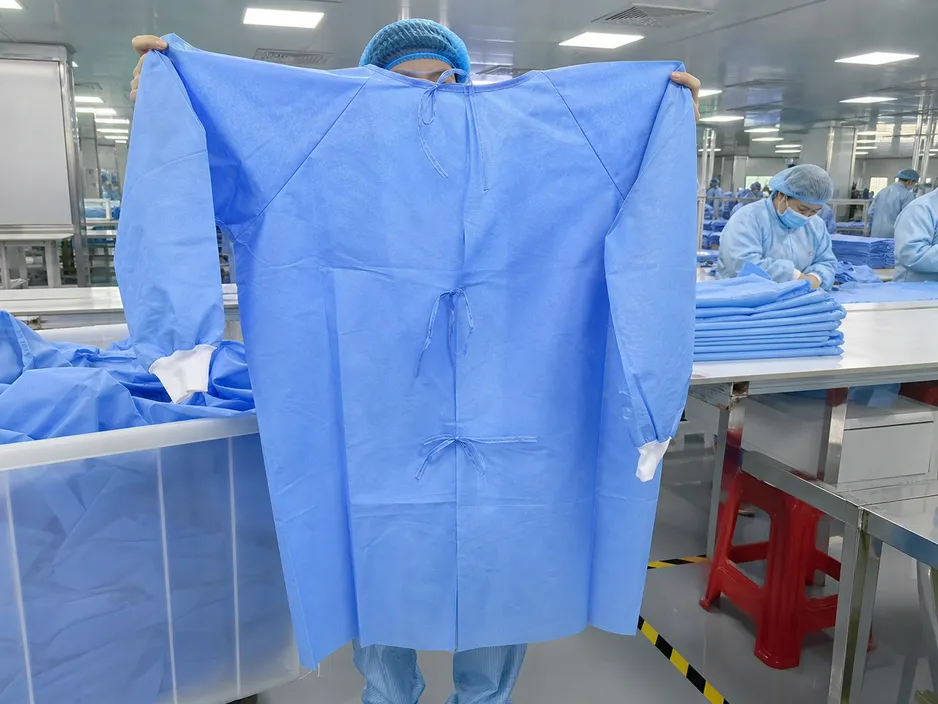
The material choice follows directly from the level requirement. SMS nonwoven constructions — spunbond-meltblown-spunbond laminate — reliably achieve Level 1 and Level 2 performance. SMMS (adding a second meltblown layer) can push into Level 3 territory depending on gsm and construction. Microporous film composites — typically a polyethylene or polypropylene film laminated to a nonwoven backing — are the standard construction for Level 3 and Level 4 gowns where hydrostatic resistance requirements exceed what nonwoven alone can deliver.
(We see buyers occasionally spec Level 4 gowns for general ward use because they assume "higher level = safer." The real cost of that decision shows up in your per-procedure spend and in wearer compliance — staff wearing hot, stiff film gowns for routine tasks will find ways to avoid wearing them.)

For buyers sourcing into the EU, EN 13795 uses a different classification structure (standard vs. high performance) but the underlying material logic is the same: higher fluid exposure risk requires higher hydrostatic resistance, and that's where film constructions earn their price premium.
See our AAMI PB70 Isolation Gown Levels guide for a full breakdown of the test methods behind each level.
Head-to-Head Specification Matrix
The table below covers the dimensions that actually drive procurement decisions. Breathability (MVTR), hydrostatic resistance, tensile strength, and typical gsm ranges are the four parameters worth comparing directly — everything else is downstream of these.
| Specification | SMS Nonwoven (Level 1–2) | SMMS Nonwoven (Level 2–3) | Microporous Film Composite (Level 3–4) |
|---|---|---|---|
| Typical gsm range | 35–50 gsm | 45–60 gsm | 45–70 gsm (film + backing) |
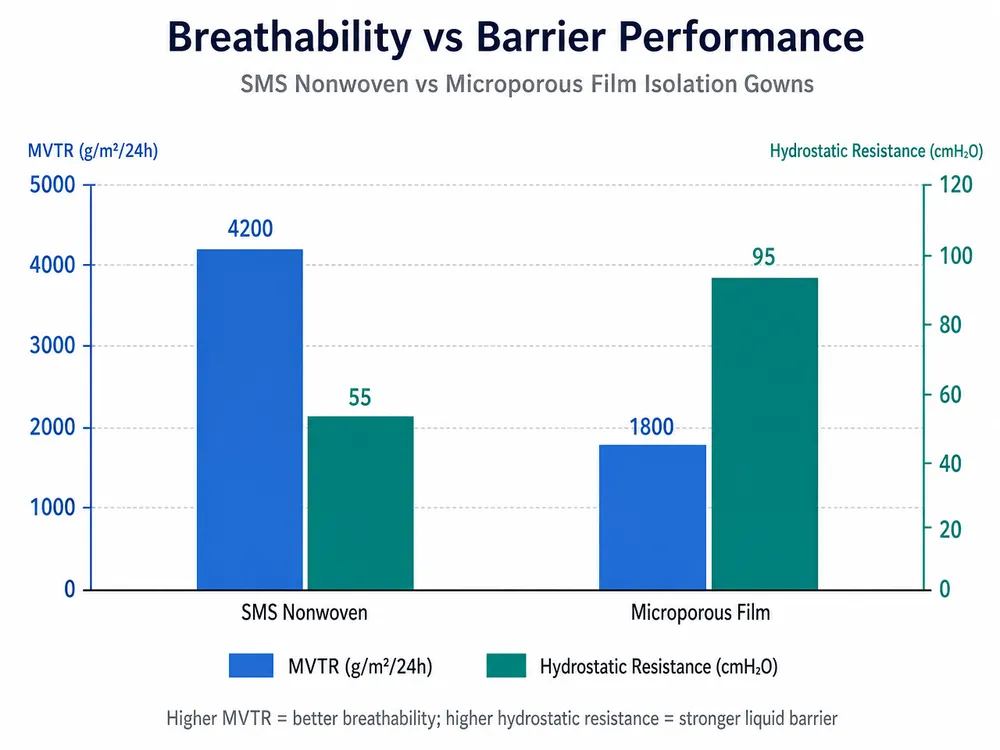
| MVTR (breathability) | 3,000–8,000 g/m²/24h | 2,500–5,000 g/m²/24h | 800–2,500 g/m²/24h |
| Hydrostatic resistance | 20–40 cmH₂O | 40–80 cmH₂O | 80–150+ cmH₂O |
| Tensile strength (MD) | 30–60 N/5cm | 40–70 N/5cm | 50–90 N/5cm |
| Fluid strike-through | Passes Level 1–2 | Passes Level 2–3 | Passes Level 3–4 |
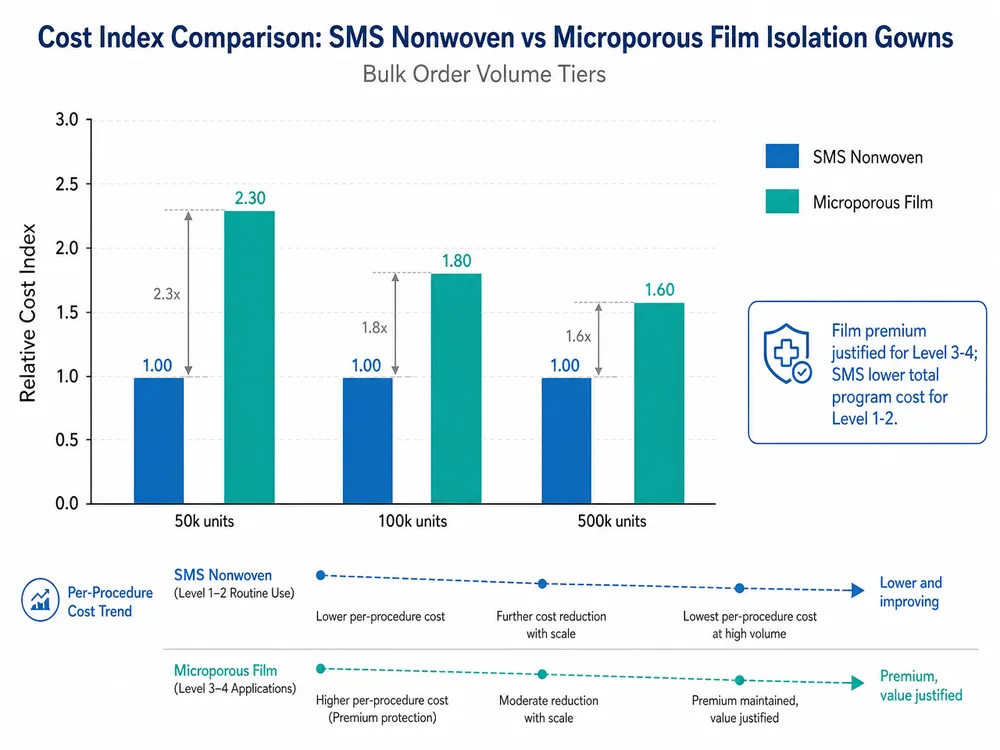
| Typical unit cost (bulk) | Lower | Moderate | Higher (1.5–2.5× nonwoven) |
| Seam sealing required | No (for Level 1–2) | Partial (critical zones) | Yes (taped seams for Level 4) |
| OEM packaging complexity | Low | Low–Moderate | Moderate–High |
The MVTR gap is the number that surprises most buyers. A standard SMS gown at 5,000+ g/m²/24h moves moisture vapor at roughly 3–4× the rate of a microporous film gown. In a four-hour surgical procedure, that difference is the difference between a wearer who stays functional and one who is managing heat stress. For Level 1–2 applications — the majority of isolation gown volume in most hospital systems — that breathability advantage is real and commercially significant.
The hydrostatic resistance gap runs the other direction. At 80–150+ cmH₂O, microporous film constructions resist fluid penetration under sustained pressure that would breach a nonwoven gown. For procedures involving arterial blood, amniotic fluid, or extended contact with body fluids, that resistance is not optional.
The Breathability Cost You're Probably Underestimating
Barrier performance is easy to spec. Breathability cost is harder to quantify, which is why it gets underweighted in procurement decisions.
Here's the mechanism: when a wearer in a low-breathability gown reaches heat stress threshold, they either remove the gown (compliance failure, infection control risk) or they push through (performance degradation, fatigue). In high-volume clinical environments — emergency departments, general wards, long-term care facilities — this plays out across hundreds of gown changes per day. The downstream cost isn't a line item on your invoice; it's in infection control incident rates and staff satisfaction scores that your hospital customers track.
For distributors supplying general acute care hospitals, the practical implication is this: if your customer's primary use case is routine isolation and standard patient care, a Level 1–2 SMS gown at 4,000–6,000 g/m²/24h MVTR is the right product. Selling them a film gown at 1,200 g/m²/24h MVTR to "give them more protection" is not a value-add — it's a mismatch that will show up in reorder behavior. Hospitals that stock the wrong gown for routine use either stop reordering or switch suppliers.
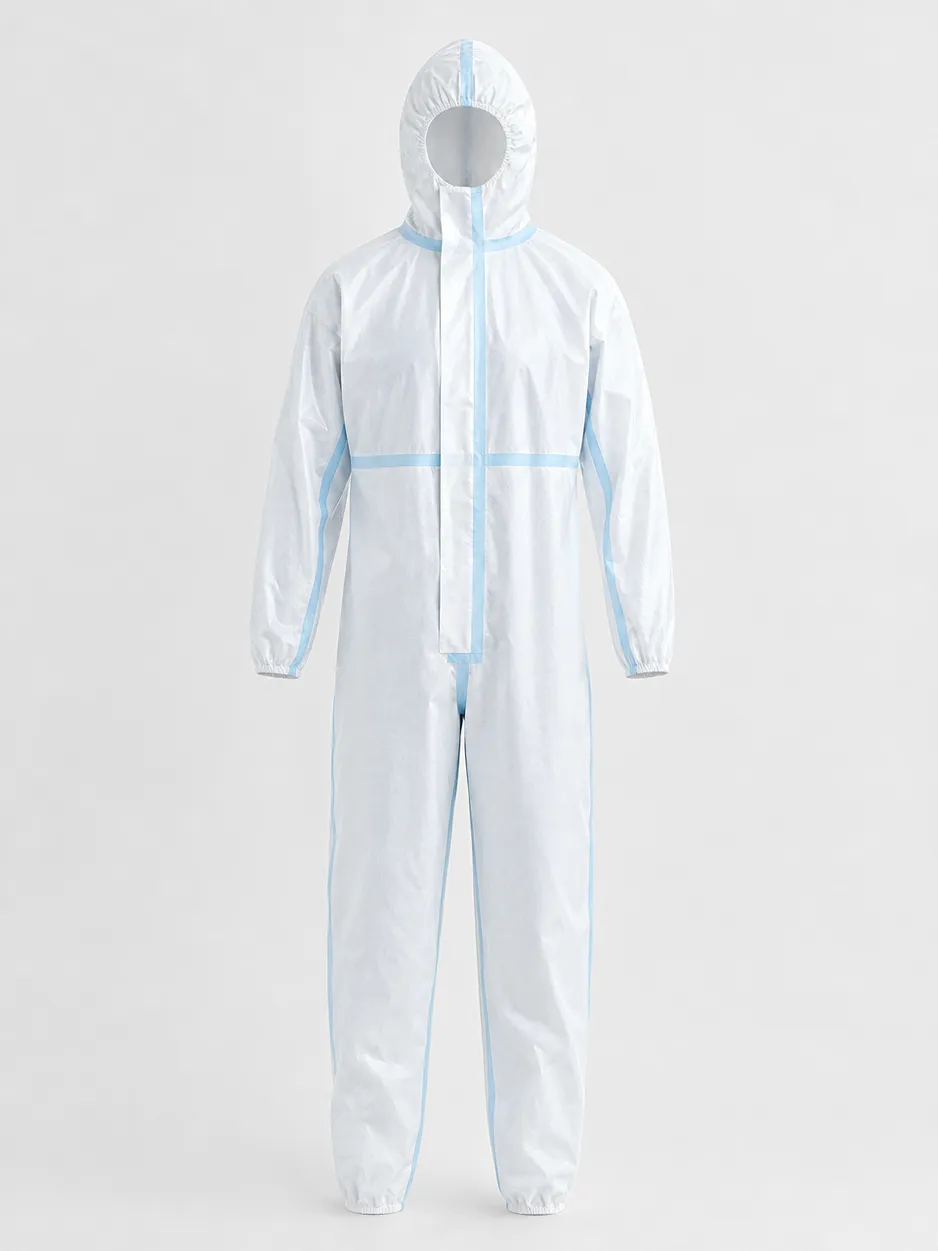
The seam is the other breathability variable that rarely gets discussed. We've seen film gowns with taped seams that create localized heat buildup at the seal lines — the tape itself has near-zero MVTR. For Level 4 gowns where full seam sealing is required, this is unavoidable. For Level 3 applications, partial seam sealing (critical zones only) is often sufficient and preserves more of the gown's overall breathability profile. (This is one of the construction decisions we work through with buyers during spec confirmation — the seam sealing spec affects both performance and unit cost, and the right answer depends on the end-use scenario.)
Barrier Performance: Where Film Earns Its Price Premium
The hydrostatic resistance numbers in the spec table above are test-condition values. What they mean in practice is this: a microporous film gown at 100+ cmH₂O will resist fluid penetration under the kind of sustained pressure that occurs during a long surgical procedure — a surgeon leaning against a wet drape, extended contact with pooled fluid, or a splash event during a high-risk procedure.
SMS nonwoven at 30–40 cmH₂O will handle incidental splash and brief fluid contact. It will not hold up under sustained pressure or high-volume fluid exposure. That's not a defect — it's the correct performance profile for the protection level it's designed to meet.
The particulate protection dimension is worth separating from fluid barrier performance. For standard isolation gowns, the primary concern is fluid strike-through. For applications involving airborne particulates or chemotherapy agents, the barrier requirements shift, and the material selection logic changes accordingly. Most isolation gown procurement decisions are fluid-barrier decisions, so that's where the comparison is most useful.
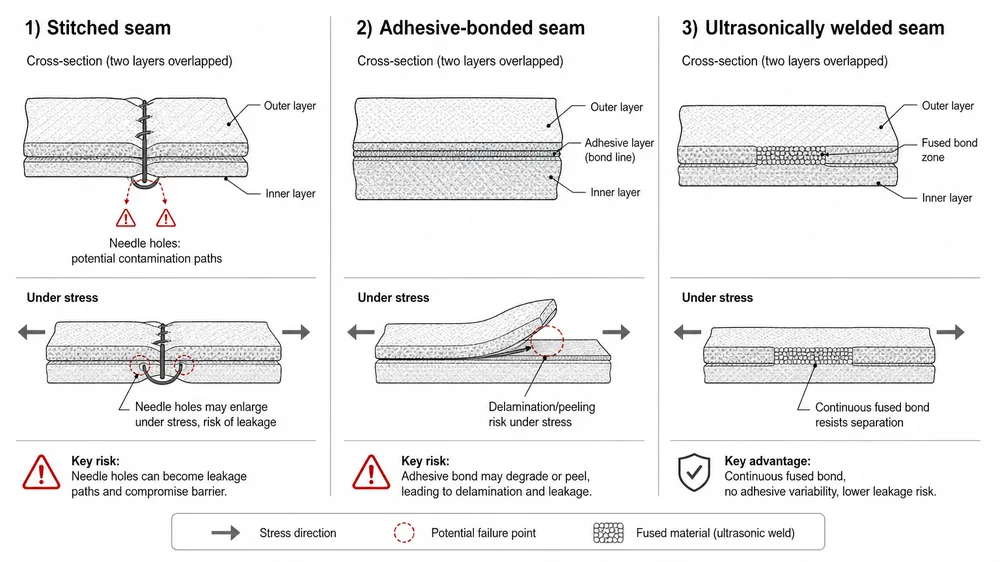
Seam integrity is where most protective clothing failures actually occur — and it's the last thing buyers check before placing a bulk order. For film gowns targeting Level 3–4, the seam construction matters as much as the fabric. Ultrasonic-welded seams with taped reinforcement at critical zones (shoulder, underarm, cuff attachment) are the standard for high-performance configurations. A film gown with stitched-only seams at the shoulder is not a Level 4 gown regardless of what the fabric spec says.
We test seam burst strength and seam peel resistance on every production batch — not just the fabric. A gown that passes fabric hydrostatic testing but fails at the seam is a compliance gap waiting to happen at customs or in a hospital audit.
Cost Trade-Offs at Bulk Order Volumes
The unit cost gap between nonwoven and film gowns is real, but the number that matters for your sourcing decision is landed cost per procedure, not unit cost per gown.
At bulk order volumes (50,000+ units), SMS nonwoven gowns typically run at a meaningful cost advantage over microporous film — the film lamination process, the higher material cost of the film layer, and the more complex seam sealing requirements all add to the manufacturing cost. The exact ratio varies by gsm, construction, and order volume, but a 1.5–2.5× cost premium for film over nonwoven at comparable order sizes is a reasonable working range for planning purposes.
For a hospital system stocking 10,000 gowns per month for general isolation use, that cost difference compounds quickly. At 12 months, the delta between a correctly specified Level 2 nonwoven program and an over-specified Level 3 film program can represent a significant budget line — money that could fund additional PPE categories or higher-volume stocking of the right product.
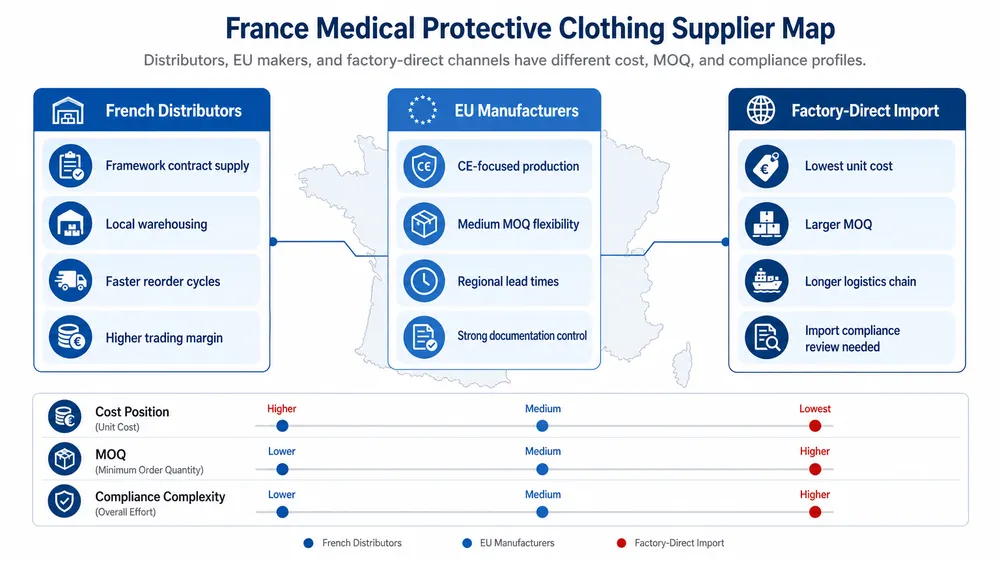
The MOQ and lead time picture also differs by material type. Nonwoven gowns — particularly standard SMS configurations — are higher-volume production items with more flexible MOQ options. Film gowns, especially custom configurations with specific seam sealing specs, typically require higher minimum orders to justify the line setup and material procurement. If you're building a multi-SKU isolation gown program covering multiple AAMI levels, sourcing both from a single factory that manufactures both material types reduces your supplier count and simplifies your documentation management.
OEM and Private-Label Sourcing: Which Material Is Easier to Work With
For distributors building private-label isolation gown programs, the material choice has sourcing implications beyond the spec sheet.
SMS nonwoven gowns are the more straightforward OEM product. The construction is simpler, the packaging options are more flexible, and the certification documentation path is well-established. If you're entering the isolation gown category for the first time or building a high-volume Level 1–2 program, nonwoven is the lower-friction starting point. Standard OEM work — your brand on our existing construction — can move from artwork approval to production in a predictable timeline.
Microporous film gowns require more attention at the specification stage. The seam sealing configuration, the film-to-backing lamination spec, and the AAMI level claim all need to be locked before production starts, because changes after the first production run are costly. For buyers who need Level 3–4 documentation for US or EU market entry, the certification file needs to reflect the exact construction — fabric spec, seam construction, and test results — that will be in every production batch. Variation between batches is a compliance risk, not just a quality issue.
This is where vertical integration in fabric production matters. We manufacture our own nonwoven fabric, which means the gsm, fiber composition, and barrier performance of the fabric going into your gown is controlled at our facility — not dependent on what a third-party fabric supplier shipped that week. For buyers who have experienced batch-to-batch inconsistency from other factories, this is the sourcing variable worth asking about directly: does the factory buy fabric externally, or do they control it?
For EU importers, both nonwoven and film configurations require EN 13795 compliance documentation. We maintain CE technical files for both material types, so your importer of record has the documentation package they need without a separate certification process. (EU MDR compliance for protective clothing has caught several of our new European buyers off guard — the technical file requirements are more detailed than many expect. We walk through this during the pre-order spec confirmation stage.)
Application Showdown: Which Material Wins in Real Procurement Scenarios
Scenario 1: General Acute Care Hospital, High-Volume Stocking Program
A distributor supplying a 400-bed acute care hospital needs to stock isolation gowns for general ward use, standard isolation precautions, and routine patient care. Volume is 8,000–12,000 gowns per month. Budget pressure is real.
Winner: SMS nonwoven, Level 1–2.
The clinical risk profile for general isolation is fluid splash, not sustained fluid exposure. A 40–50 gsm SMS gown at Level 2 meets the barrier requirement, delivers the breathability that supports all-day wear compliance, and lands at a unit cost that makes the stocking program financially sustainable. Specifying film gowns for this application adds cost without adding clinically meaningful protection.
Scenario 2: Surgical Suite and High-Risk Procedure Coverage
A hospital procurement team needs gowns for orthopedic surgery, trauma procedures, and high-risk isolation wards. Procedures involve extended fluid exposure, and the facility's infection control policy requires Level 3–4 barrier performance.
Winner: Microporous film composite, Level 3–4.
There is no nonwoven construction that reliably delivers 80+ cmH₂O hydrostatic resistance at the seam level. For these applications, the film premium is justified — the alternative is a barrier failure during a procedure, which is a clinical and liability event. The breathability trade-off is real but manageable for procedure-specific use where gown wear time is defined and controlled.
Scenario 3: Multi-Level Program for a Healthcare Distributor
A distributor wants to build a complete isolation gown line covering Level 1 through Level 4, private-labeled under their brand, for sale to hospital systems across multiple markets including the US and EU.
Winner: Single-source factory offering both material types with full certification documentation.
The sourcing efficiency of consolidating both material types under one supplier — one set of audit documents, one quality agreement, one point of contact for compliance questions — is worth more than marginal unit cost savings from splitting the program across two factories. For this buyer, the right question isn't nonwoven vs. film. It's which factory can deliver both, with consistent specs and documentation that survives a hospital procurement audit.
This is exactly the program structure we support at eztio. Both material configurations, ISO 13485 and CE documentation for both, OEM packaging handled in-house. Your Level 1 nonwoven gown and your Level 4 film gown ship from the same facility with the same quality system behind them.
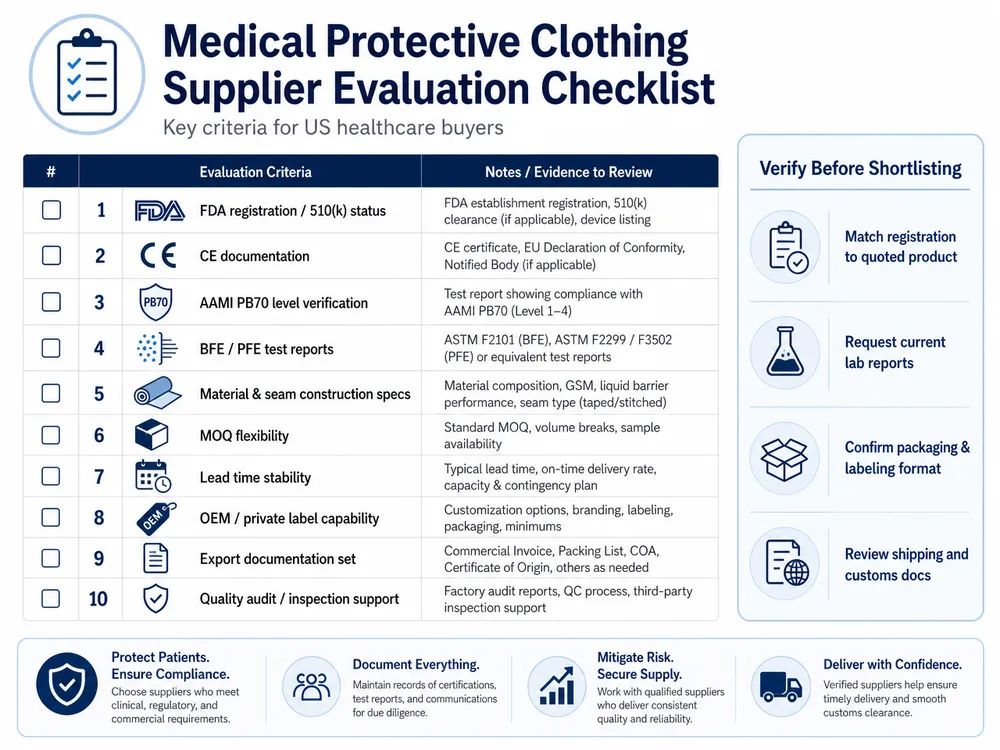
What to Verify Before You Place a Bulk Order
The spec sheet is the starting point, not the finish line. Here's what to confirm before committing volume to either material type.
For nonwoven gowns:
- Request the fabric gsm test report, not just the stated spec. Basis weight variation between batches is the most common quality issue in nonwoven gowns — a gown spec'd at 45 gsm that ships at 38 gsm is a different product.
- Confirm whether the factory produces fabric in-house or sources externally. External fabric sourcing introduces a supply chain variable that affects both consistency and lead time reliability.
- Ask for AAMI PB70 test reports from a recognized third-party lab (Nelson Labs, SGS, Intertek). In-house test reports alone are not sufficient for hospital procurement audits.
For microporous film gowns:
- Confirm the seam construction spec: stitched only, ultrasonically welded, or taped. The seam spec determines the actual protection level, not just the fabric.
- Request the hydrostatic resistance test result at the seam, not just the fabric panel. A fabric that passes at 100 cmH₂O with a seam that fails at 40 cmH₂O is a Level 2 gown in a Level 4 package.
- Verify that the CE technical file or FDA 510(k) registration covers the exact construction you're ordering — film type, backing material, seam configuration. Substitutions between registered and shipped configurations are a common compliance gap.
For both material types:
- Confirm the factory's ISO 13485 certification scope covers isolation gowns specifically, not just masks or other PPE categories.
- Request a sample production batch before committing to full volume. The sample should come from a production run, not a hand-assembled prototype.
- Clarify MOQ by configuration — standard SMS gowns typically have lower MOQ flexibility than custom film configurations.
See our Isolation Gown Bulk Order Checklist for a complete pre-order verification framework.
Frequently Asked Questions
Can SMS nonwoven gowns meet AAMI Level 3?
Standard SMS constructions (35–50 gsm) reliably meet Level 1–2. SMMS constructions with higher gsm and tighter meltblown layers can approach Level 3 performance in fabric panel testing, but seam performance at Level 3 hydrostatic resistance typically requires reinforced seam construction. If your application requires a certified Level 3 claim, verify the test report covers the full gown including seams — not just the fabric panel.
What MVTR value should I specify for extended-wear isolation gowns?
For procedures or shifts where gown wear time exceeds two hours, specify a minimum MVTR of 3,000 g/m²/24h. Below that threshold, heat buildup becomes a compliance risk in warm clinical environments. Standard SMS gowns at 40–50 gsm typically exceed this threshold comfortably. Most microporous film gowns fall below it, which is why film gowns are appropriate for defined-procedure use rather than all-day wear.
Which material is easier to private-label for the US market?
Both are viable for OEM programs, but the documentation path differs. SMS nonwoven gowns for Level 1–2 have a simpler FDA registration pathway. Film gowns targeting Level 3–4 require more detailed 510(k) documentation covering the specific construction. If you're building a private-label program for the first time, starting with a Level 1–2 nonwoven SKU reduces your compliance setup time and lets you establish the distribution relationship before adding higher-complexity configurations.
Does the film layer affect how the gown is packaged and shipped?
Yes, in two ways. Film gowns are less compressible than nonwoven gowns, which affects carton density and container loading efficiency — a factor in your landed cost calculation at high volumes. Film gowns also require more careful packaging to prevent film delamination during transit, particularly in temperature-variable shipping routes. Confirm that the factory's packaging spec accounts for this, especially for shipments to markets with extended transit times.
What's the minimum order quantity for film gowns vs. nonwoven gowns?
For standard SMS nonwoven configurations, MOQ flexibility is higher — we can work with lower entry volumes for buyers testing a new SKU. Custom film configurations with specific seam sealing specs typically require higher minimums to justify the line setup. Contact us with your AAMI level requirement and target volume and we'll give you a specific MOQ and lead time for your configuration.
Matching Your Sourcing Decision to the Right Product
The material comparison resolves cleanly once you anchor it to the protection level your end-users actually need:
- Level 1–2 applications — SMS or SMMS nonwoven. Better breathability, lower unit cost, simpler OEM path. The right product for the majority of isolation gown volume in most healthcare settings.
- Level 3–4 applications — Microporous film composite. Higher hydrostatic resistance, seam-sealed construction, justified premium for fluid-intensive procedures. Not the right default for general use.
- Multi-level programs — Source both from a single factory with ISO 13485 scope covering both configurations. The documentation and supply chain efficiency outweighs any marginal cost difference from splitting suppliers.
We manufacture both configurations at our facility in Gaomi, with in-house nonwoven fabric production for tighter spec control and ISO 13485 / CE documentation available for both material types. If you're building or expanding an isolation gown program and need factory-direct pricing with full compliance documentation, our Medical Isolation Gown product page covers the full range of configurations we supply.
For buyers comparing multiple Medical Protective Clothing categories — gowns, coveralls, surgical drapes — we can consolidate your sourcing under one quality agreement and one documentation package, which simplifies your compliance management across your full PPE line.