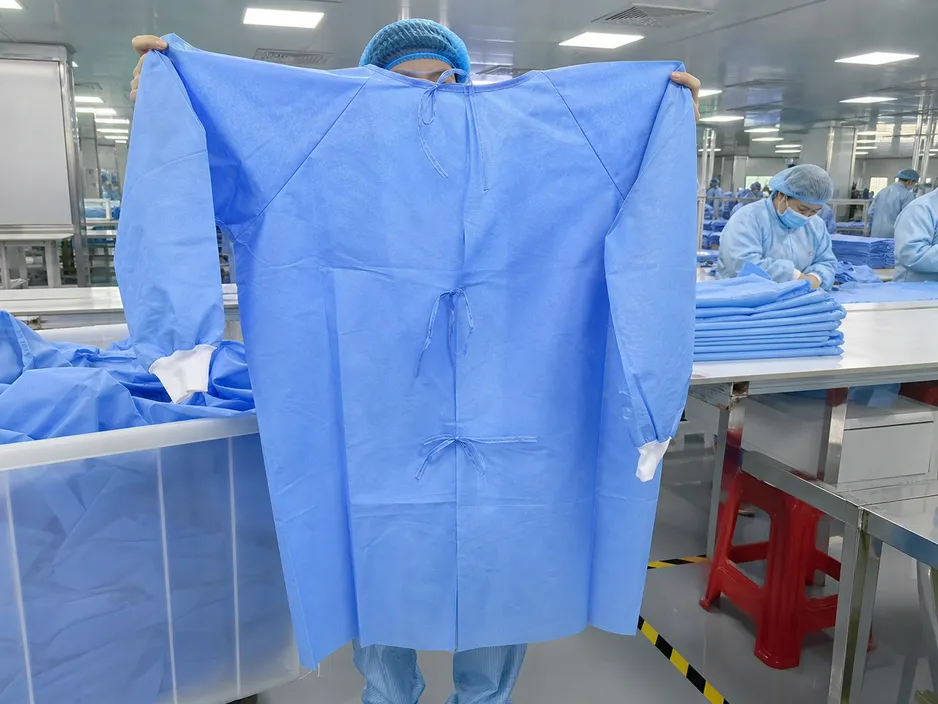
France's medical PPE supply chain went through a structural reset after 2020. Before the pandemic, most hospital procurement teams sourced protective clothing through established distributors on long-term framework contracts — predictable, convenient, and rarely questioned. What the disruption exposed was how thin the actual manufacturing base was. Most of what was being sold as "available stock" was sitting in a distributor's warehouse, sourced from a handful of Asian factories, with the distributor adding margin at every tier.
The EU MDR transition, which became fully applicable in May 2021, added another layer of pressure. Protective clothing classified as medical devices now requires a CE technical file under the new regulation — not just a declaration of conformity under the old MDD. Suppliers who hadn't done that work started disappearing from hospital tender lists. Buyers who had been comfortable with their existing supply chain suddenly needed to verify documentation they'd never looked at closely before.
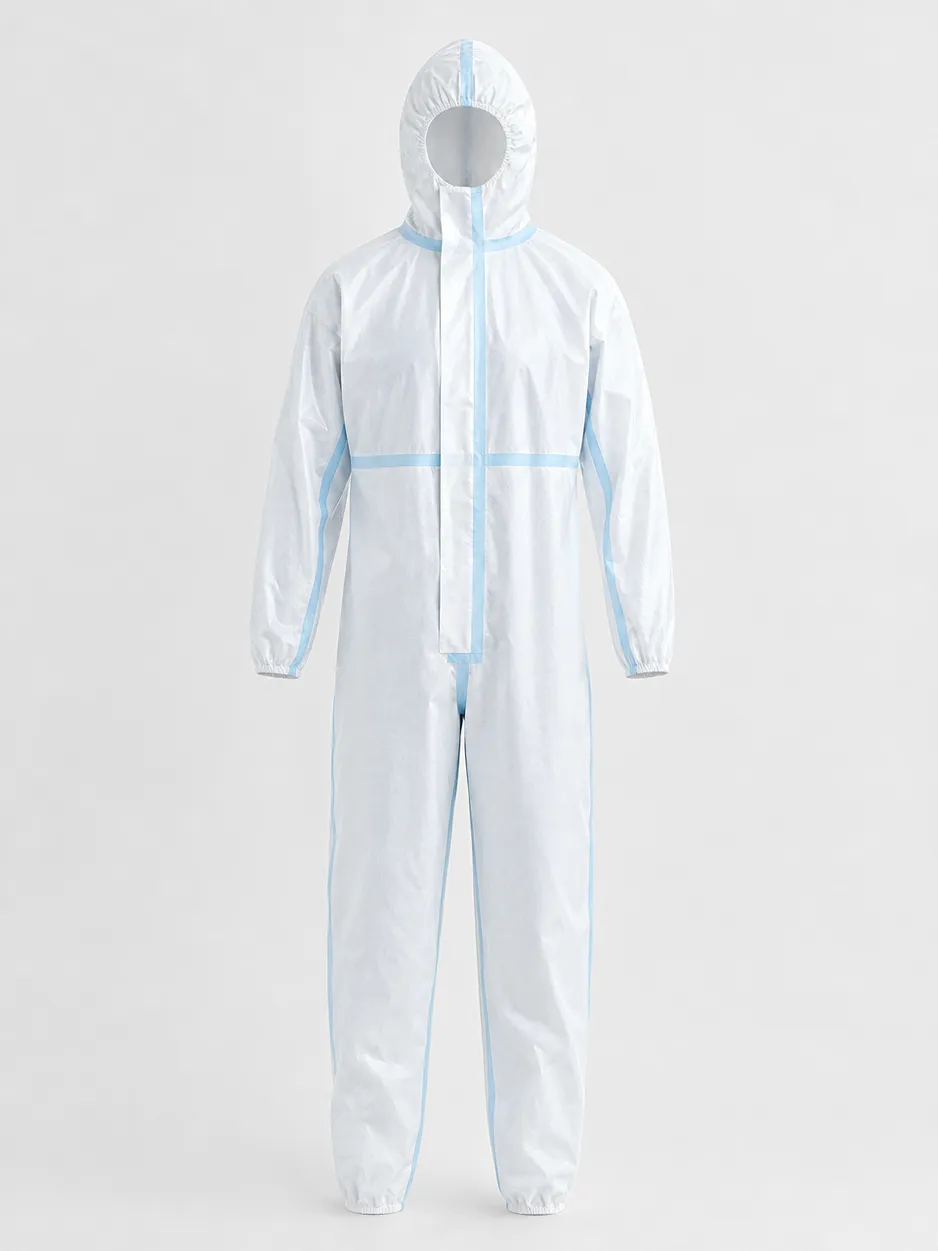
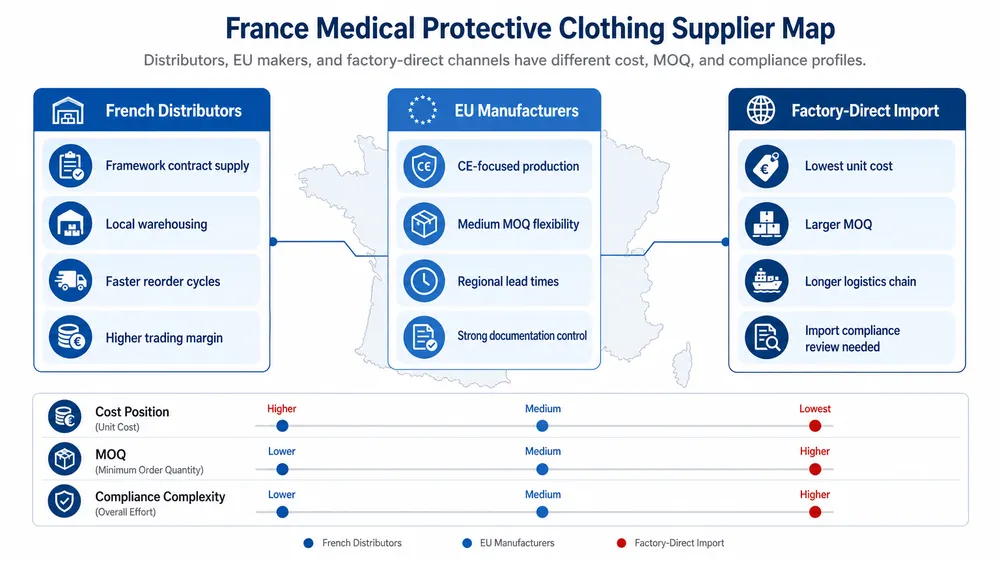
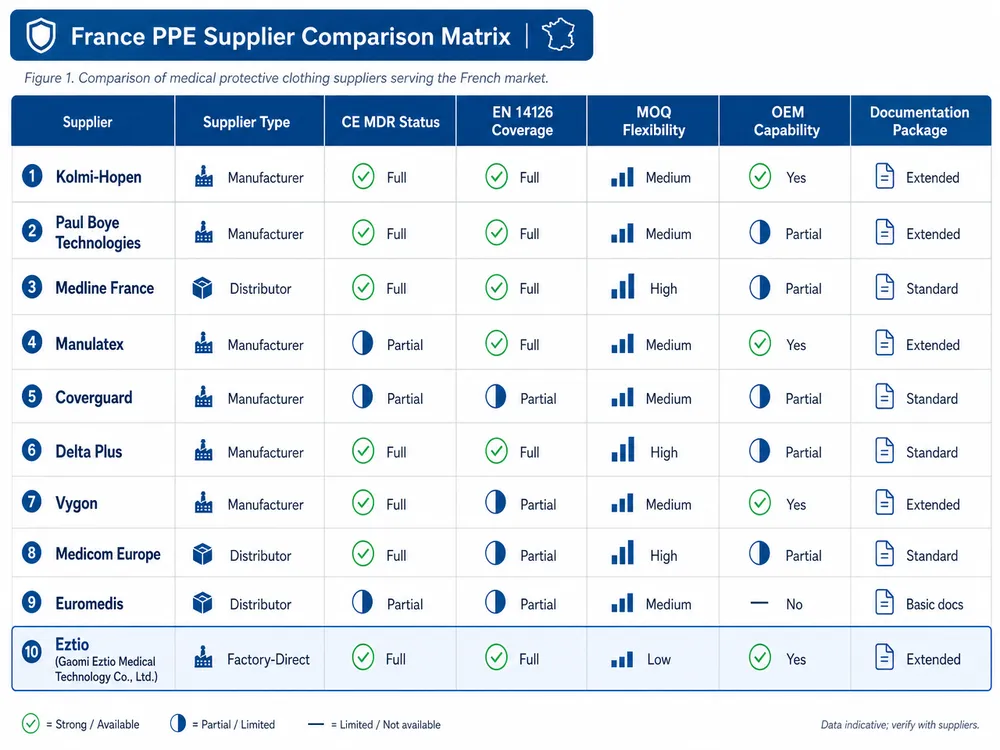
This review covers 10 real suppliers operating in or serving the French market for medical protective clothing — isolation gowns, coveralls, and disposable protective apparel. The list includes French distributors, EU-based manufacturers, and one factory-direct option. The goal is not a theatrical ranking. It's a sourcing map: who these suppliers are, what they're structured to do well, and where the trade-offs sit.

What Serious Buyers Check Before Signing a Supply Agreement
Before the supplier list, the evaluation framework. The French hospital procurement system — and the private-sector distributors who feed it — operates under specific compliance requirements that narrow the field considerably.
EN 14126:2003 is the standard for protective clothing against infective agents. It covers six test methods for barrier performance against biological contamination, and it's the baseline requirement for isolation gowns and coveralls used in clinical settings. A supplier who can't produce a test report to EN 14126 is not a viable option for hospital or institutional buyers in France.
EU MDR (Regulation 2017/745) applies to protective clothing classified as medical devices. The key change from the old MDD is that CE marking now requires a notified body assessment for most Class I sterile and Class IIa products — a declaration of conformity alone is no longer sufficient. Suppliers who were CE-marked under MDD and haven't transitioned their technical files are in a grey zone that French hospital procurement teams are increasingly unwilling to accept.
EN 13795 covers surgical gowns and drapes — relevant if you're sourcing for operating theatre use rather than general isolation. The standard specifies performance levels (standard vs. high performance) and test methods for liquid barrier, microbial barrier, and linting. (Most buyers conflate EN 14126 and EN 13795 — they're different standards for different use contexts. EN 14126 is for infectious disease protection; EN 13795 is for surgical field sterility. You may need both depending on your product range.)
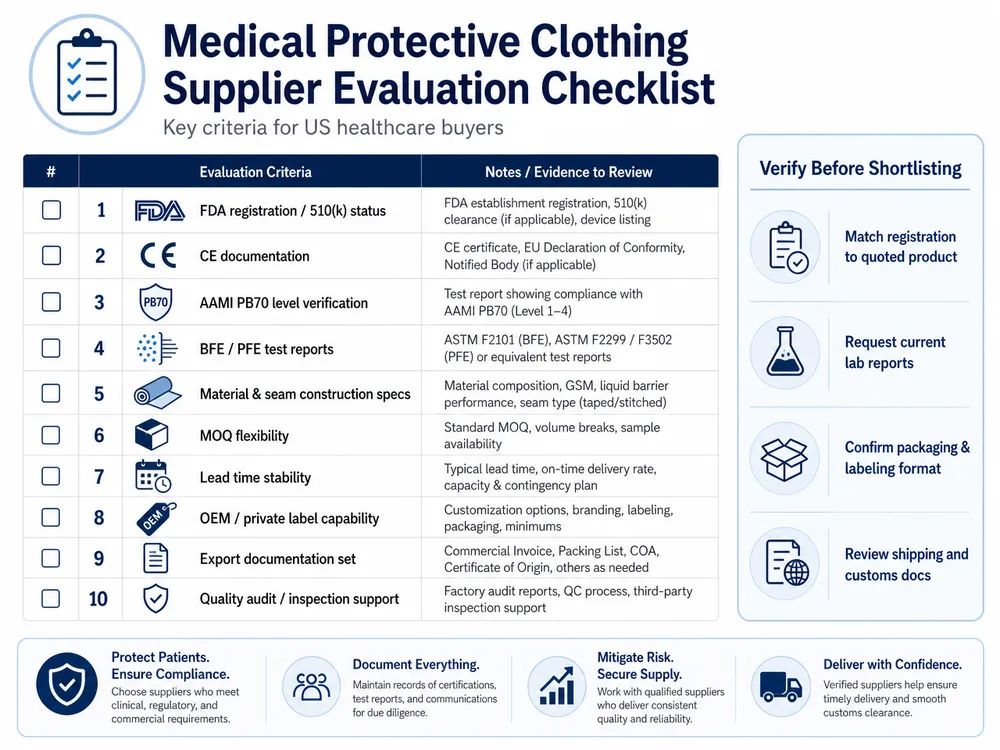
Beyond certifications, the practical evaluation criteria for bulk sourcing:
| Criterion | What to Verify |
|---|---|
| Certification scope | Which specific products are covered — not just "CE marked" |
| MOQ | Minimum per SKU, not just per order |
| Lead time | From order confirmation, not from stock availability |
| OEM capability | Packaging, labeling, private-label printing |
| Documentation package | CE technical file, test reports, declaration of conformity |
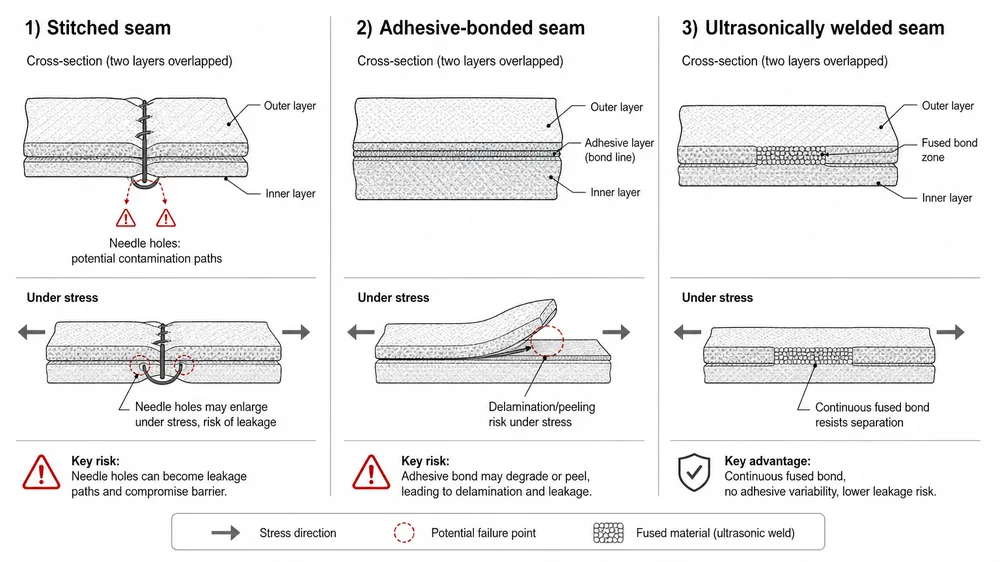
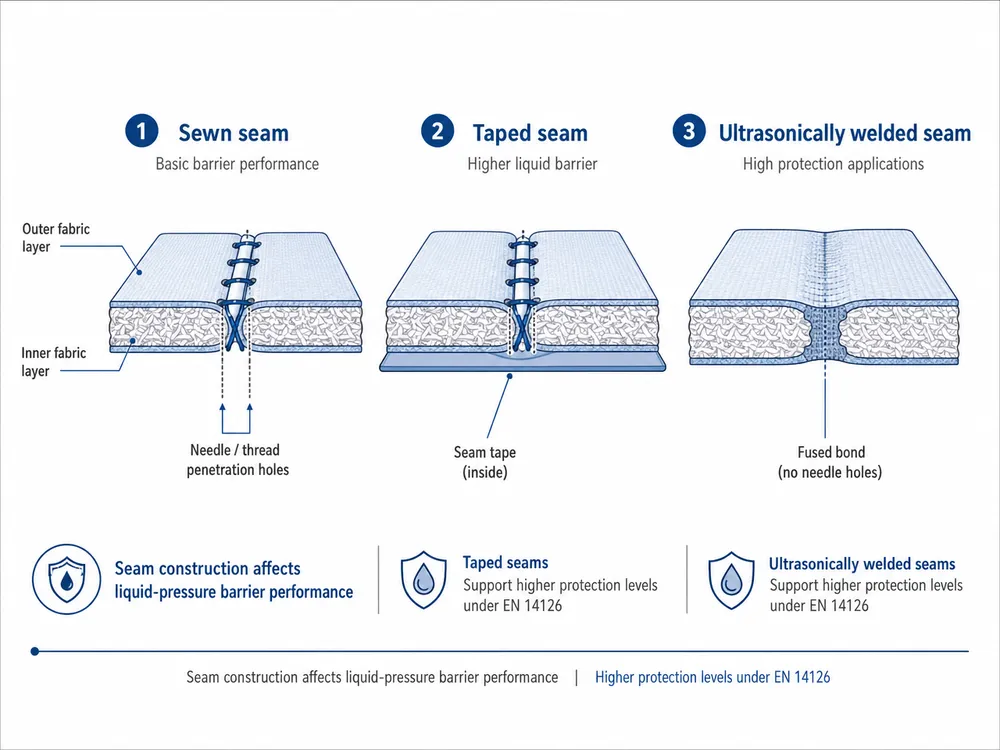
| Seam construction | Sewn, taped, or ultrasonically welded — determines barrier integrity |
| Material spec | SMS, SMMS, microporous film — affects breathability vs. barrier trade-off |
The seam question is worth pausing on. Most protective clothing failures in clinical use trace back to seam integrity, not fabric performance. A gown made from EN 14126-compliant fabric with sewn-only seams will fail the barrier test at the seam line under liquid pressure. Taped seams add cost but are the correct construction for Type 3, 4, and 5 protection levels. If a supplier quotes you a low price on "EN 14126 compliant" gowns, ask specifically about seam construction before you assume the product meets the standard at the seam.
The 10 Suppliers: Profiles and Trade-Off Notes
1. Mölnlycke Health Care — mölnlycke.com
Mölnlycke is a Swedish-headquartered manufacturer with a strong French hospital presence, primarily through its surgical gown and drape lines. Their BARRIER range covers EN 13795 high-performance surgical gowns and is well-established in French operating theatre procurement. French hospital groups running framework contracts for surgical PPE will recognize this name immediately.
Strengths: Strong EN 13795 documentation, established relationships with French hospital purchasing groups (GHT), reliable stock for standard SKUs. Limitations: Premium pricing tier, limited flexibility on OEM or private-label work, minimum order structures designed for hospital framework contracts rather than distributor spot orders. Best fit: Hospital groups and surgical supply distributors sourcing for operating theatre use.
2. Paul Hartmann AG — hartmann.info
Hartmann is a German manufacturer with significant French market penetration through its MedLine and Foliodress product ranges. Their protective clothing portfolio covers surgical gowns, isolation gowns, and procedure packs. They operate a French subsidiary and supply directly to hospital groups and through regional distributors.
Strengths: Broad product range, EU manufacturing base, strong documentation for French hospital tenders, French-language technical support. Limitations: Pricing reflects EU manufacturing cost structure — not competitive for high-volume commodity orders. MOQ and lead time terms are structured for institutional buyers, not flexible for smaller distributors. Best fit: Hospital procurement teams and distributors serving clinical accounts who need EU-manufactured documentation provenance.
3. Kimberly-Clark Professional — kcprofessional.com
Kimberly-Clark's KIMTECH and KLEENGUARD ranges cover disposable protective clothing including coveralls, gowns, and aprons. They distribute through French industrial and medical supply channels. Their protective clothing is primarily positioned for laboratory, pharmaceutical, and light industrial use — the medical-grade clinical positioning is less prominent than Mölnlycke or Hartmann.
Strengths: Wide distribution network in France, consistent product availability, strong brand recognition in lab and pharma procurement. Limitations: Product range skews toward industrial/lab protection rather than clinical medical use. EN 14126 coverage is narrower than dedicated medical PPE suppliers. Best fit: Laboratory, pharmaceutical, and cleanroom applications where clinical-grade barrier performance is not the primary requirement.
4. DuPont Personal Protection — dupont.com/personal-protection
DuPont's Tyvek and Tychem coverall ranges are the reference standard for chemical and biological protective clothing in France. Tyvek 500 and 600 are widely used in French healthcare and emergency response contexts. DuPont distributes through authorized French safety equipment distributors.
Strengths: Tyvek is the benchmark material for Type 5/6 coverall protection — well-understood by French procurement teams, strong test data, broad distributor availability. Limitations: DuPont sells through distributors, not direct to end buyers at standard volumes. Pricing reflects the brand premium. Not structured for OEM or private-label work. Best fit: Emergency response, hazmat, and high-risk infection control applications where Tyvek's specific material properties are specified by the end user.
5. Ansell Healthcare — ansell.com
Ansell covers a broad PPE range including protective clothing through its MICROGARD and ALPHATEC lines. Their French market presence is primarily through industrial safety distributors, with some medical channel penetration. The MICROGARD range includes coveralls tested to EN 14126 for biological protection.
Strengths: EN 14126 coverage in the coverall range, established French distributor network, strong technical documentation. Limitations: Protective clothing is not Ansell's primary product focus — their core strength is hand protection. Coverall range depth is narrower than dedicated protective clothing manufacturers. Best fit: Distributors who want a single-supplier solution covering both hand protection and coveralls for the same accounts.
6. Würth France — wurth.fr
Würth is primarily a fastener and industrial supply company, but their French operation carries a significant PPE range including disposable protective clothing for industrial and some medical applications. They serve a large base of French SME customers through direct sales representatives and branch locations.
Strengths: Extensive French branch network, reliable stock availability, convenient for buyers who already source other supplies through Würth. Limitations: Protective clothing is a secondary category — product range depth and certification documentation are not at the level of dedicated medical PPE suppliers. Not suitable for hospital tender compliance requirements. Best fit: Industrial buyers and small healthcare facilities needing convenience stock of basic disposable protective clothing without complex certification requirements.
7. Berner France — berner.fr
Berner operates similarly to Würth — a broad industrial supply distributor with a French branch network carrying PPE including disposable coveralls and gowns. Their customer base is primarily industrial and construction, with some healthcare facility accounts.
Strengths: Local stock availability, French-language service, convenient for mixed-category procurement. Limitations: Same structural limitation as Würth — protective clothing is not a core category, and medical-grade documentation depth is limited. Best fit: Facilities needing basic disposable protective clothing for non-clinical applications alongside other industrial supplies.
8. Medline France — medline.com
Medline is a US-headquartered medical supply company with European operations serving hospital and long-term care markets. Their protective clothing range covers isolation gowns, surgical gowns, and coveralls. They supply French hospital groups and care facility networks through their European distribution infrastructure.
Strengths: Broad medical product range, hospital-focused sales team, documentation structured for institutional procurement. Limitations: European operations are less mature than their US business — French market depth and local stock availability are more limited than established European manufacturers. Lead times can be longer for non-standard SKUs. Best fit: Hospital groups and care networks already using Medline for other medical supplies who want to consolidate protective clothing into the same supplier relationship.
9. Arjohuntleigh / Arjo — arjo.com
Arjo is a Swedish medical device company with French operations focused on patient handling and hygiene. Their protective clothing range is narrower — primarily disposable aprons, gowns, and basic protective apparel for patient care settings. They supply through French hospital and care facility channels.
Strengths: Established French hospital relationships, documentation aligned with French hospital procurement requirements. Limitations: Protective clothing is a supporting category, not a core product line. Range depth and MOQ flexibility are limited for buyers focused specifically on protective clothing volume. Best fit: Care facilities and hospital wards sourcing protective clothing as part of a broader patient care supply relationship.
10. Eztio (Gaomi Eztio Medical Technology Co., Ltd.) — eztio.com
We're a Chinese manufacturer, not a French distributor — and that distinction is the point. We produce Medical Protective Clothing directly: isolation gowns, coveralls, and disposable protective apparel, manufactured in our 12,000 m² facility in Gaomi, Shandong. We hold CE certification under EU MDR, which means our products carry the documentation French hospital procurement teams and importers actually need — not a legacy MDD declaration, but a current MDR-compliant technical file.
The practical difference for a French buyer: when you source through a local distributor, you're paying for their margin on top of the factory price, and you're accepting their documentation package — which may or may not include the full CE technical file, test reports, and declaration of conformity in the format your compliance team needs. We ship the documentation with the product because we've been through EU import compliance with multiple European customers and we know what gets flagged at customs.
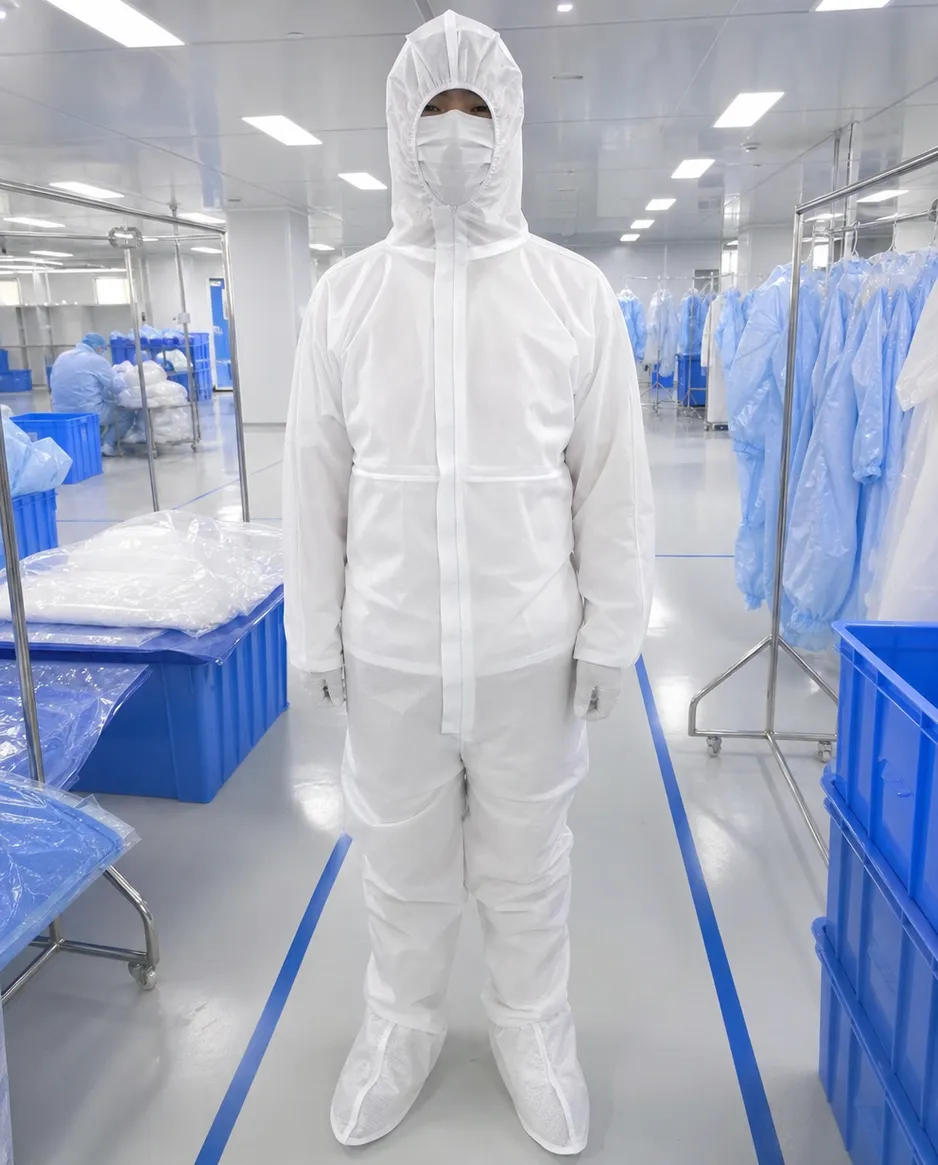
Our Medical Isolation Gown and Medical Protective Coverall lines are produced in a Class 100,000 (ISO 8) cleanroom environment with seam construction appropriate to the protection level — taped seams on barrier-critical products, not sewn-only. MOQ starts at 50,000 pieces per SKU, which is accessible for mid-size French distributors and regional hospital groups without requiring a full-container commitment on a first order.
The Compliance Burden French Importers Actually Face
The EU MDR transition is not theoretical friction — it has real operational consequences for French buyers sourcing from outside the EU. Here's what the documentation chain looks like in practice.
A CE-marked medical device entering France needs: a valid CE certificate issued by a notified body (for Class IIa and above), a Declaration of Conformity referencing the correct EU MDR regulation, a technical file that includes test reports to the relevant harmonized standards (EN 14126, EN 13795, or equivalent), and an EU Authorised Representative if the manufacturer is outside the EU.
That last point catches a lot of buyers off guard. A Chinese manufacturer selling into France needs an EU Authorised Representative — a legal entity registered in the EU who takes on regulatory responsibility for the product. Without one, the product cannot legally be placed on the French market as a medical device. We have this structure in place. (We set it up when we started shipping to European customers in volume — it's not optional, and it's not something you want to discover is missing when your shipment is sitting at Le Havre.)
The practical implication: when you're evaluating a factory-direct supplier from outside the EU, the compliance question is not just "do they have CE?" It's "do they have CE under MDR, with a notified body certificate, an EU AR, and a technical file you can actually review?" Those are four separate things, and a supplier who can only confirm the first one is not fully compliant for the French market.
We can provide all four. The documentation package we ship with every EU order includes the CE certificate, Declaration of Conformity, test reports to the applicable harmonized standards, and EU AR contact details. Your importer of record gets what they need without having to chase us for documents after the shipment arrives.
Local Distributor vs. Factory-Direct: Where the Economics Shift
Local distributors serve a real function. If you need 500 gowns by Thursday for an emergency ward restock, a French distributor with warehouse stock is the right answer. No factory in China can compete with that. Speed and local inventory access are genuine advantages, and any honest sourcing analysis has to acknowledge them.
The economics shift when you move to repeat-volume procurement — orders of 50,000 pieces or more, placed on a planned schedule rather than in response to an emergency. At that volume, the distributor's margin becomes a fixed cost you're paying on every order cycle. A typical French medical PPE distributor operates on 25–40% gross margin. On a 100,000-piece isolation gown order, that margin represents a meaningful per-unit cost difference between buying through the distributor and buying from the factory directly.
The other variable is specification control. A distributor sourcing from multiple factories — which most do — cannot guarantee that the gown you receive in March has the same seam construction, fabric weight, and barrier performance as the gown you received in October. They're buying from whoever has stock at the right price. A factory-direct relationship gives you a fixed spec, a fixed production process, and test reports that correspond to the actual product in your shipment.
(We've had French buyers come to us after receiving a shipment from a distributor that failed their internal QC check — different fabric weight than the previous order, different seam tape width. The distributor had switched factories without notifying the buyer. That's a structural risk in the distributor model that doesn't exist when you're buying direct.)
| Scenario | Local Distributor | Factory-Direct |
|---|---|---|
| Emergency restock, <1,000 units | ✓ Right choice | ✗ Lead time too long |
| Planned order, 50,000+ units | Higher landed cost | Lower per-unit cost |
| Spec consistency across orders | Variable (multi-factory sourcing) | Fixed (single production line) |
| CE MDR documentation | Depends on supplier | Full package, pre-prepared |
| OEM / private-label packaging | Limited | Full capability |
| First-time EU import | Familiar process | Requires EU AR setup (we handle this) |
EN 14126 and Material Selection: What the Standard Doesn't Tell You
EN 14126 defines six test methods for barrier performance against biological agents — penetration by blood and body fluids, contaminated liquids, solid particles, and aerosols. What it doesn't tell you is which material construction will give you the best trade-off between barrier performance and wearer comfort for your specific application.
The two dominant material choices in the French market for medical protective clothing are SMS (spunbond-meltblown-spunbond) nonwoven and microporous film laminate.
SMS nonwoven is the standard construction for most disposable isolation gowns and lower-protection-level coveralls. It's breathable, lightweight, and cost-effective. The barrier performance is adequate for Type 6 (limited splash) and Type 5 (airborne particle) protection. For EN 14126 Type 3 (liquid-tight) or Type 4 (spray-tight) protection, SMS alone is not sufficient — you need a microporous film layer or a full film laminate.
Microporous film laminate (typically a polyethylene or polypropylene film bonded to a nonwoven backing) provides higher liquid barrier performance and is the correct construction for Type 3 and Type 4 protection levels. The trade-off is breathability — microporous film is significantly less breathable than SMS, which matters for extended wear in clinical settings. Wearers in full microporous coveralls for more than 30–45 minutes in a warm environment will experience heat stress. That's not a product defect; it's a physics constraint.
The practical guidance: match the material to the actual risk level, not the highest available protection level. Specifying Type 3 microporous coveralls for a ward where Type 6 SMS gowns are sufficient adds cost and reduces wearer compliance. We've seen buyers over-specify protection level because they're uncertain about the standard — and then find that staff remove the garments early because they're too hot, which defeats the purpose entirely.
For most French hospital isolation ward applications, EN 14126 Type 5/6 SMS construction is the correct specification. For infectious disease units, outbreak response, and high-risk procedures, Type 3/4 microporous construction is appropriate. If you're building a product range for distribution across multiple facility types, you need both.
Sourcing Decision Framework: Which Route Fits Your Situation
The right sourcing route depends on three variables: order volume, urgency, and compliance requirements. Here's how to think through it:
Use a local French distributor when:
- You need stock within 48–72 hours
- Order volume is below 10,000 units
- You're filling a gap in an existing framework contract
- You need French-language technical support for a compliance audit
Consider EU-based manufacturers (Mölnlycke, Hartmann) when:
- EU manufacturing provenance is a tender requirement
- You're sourcing for operating theatre use under EN 13795
- Your buyer requires a European notified body certificate from a European manufacturer
- Volume is moderate and price sensitivity is lower than documentation certainty
Evaluate factory-direct import when:
- Planned order volume is 50,000 pieces or more per SKU
- You're building a private-label healthcare brand and need OEM packaging
- You're a distributor looking to improve margin on repeat-volume SKUs
- You need a consistent spec across multiple order cycles
- Your compliance team can work with a full CE MDR documentation package from a non-EU manufacturer with an EU AR
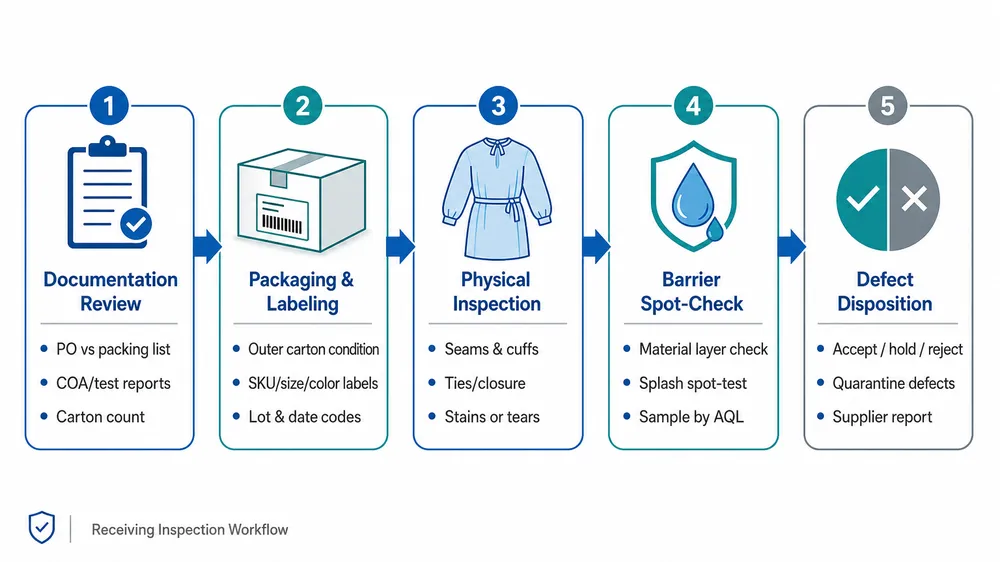
The factory-direct route requires more upfront work — supplier qualification, documentation review, EU AR verification, and a sample approval process. That investment pays back on the second and third order. Most of our French buyers run a 50,000-piece trial order first, verify the documentation against their compliance checklist, and then move to quarterly replenishment orders at higher volume. The per-unit economics at 200,000 pieces per year are materially different from what a distributor can offer.
If you're evaluating factory-direct sourcing for Medical Protective Clothing and want to compare specifications, certifications, and pricing against your current supply chain, Request Quote with your product type, protection level, and annual volume — we'll send back a detailed quote with the full documentation package for your compliance review.