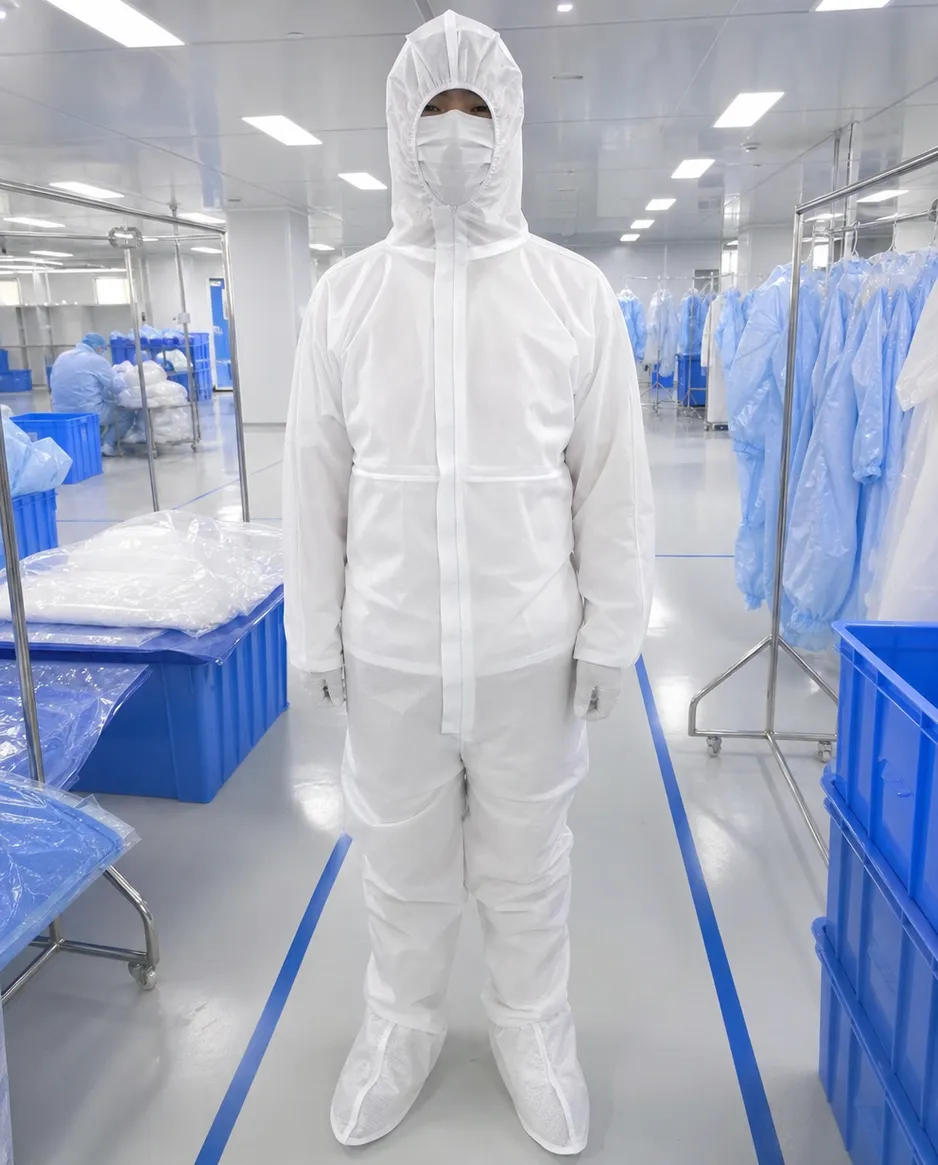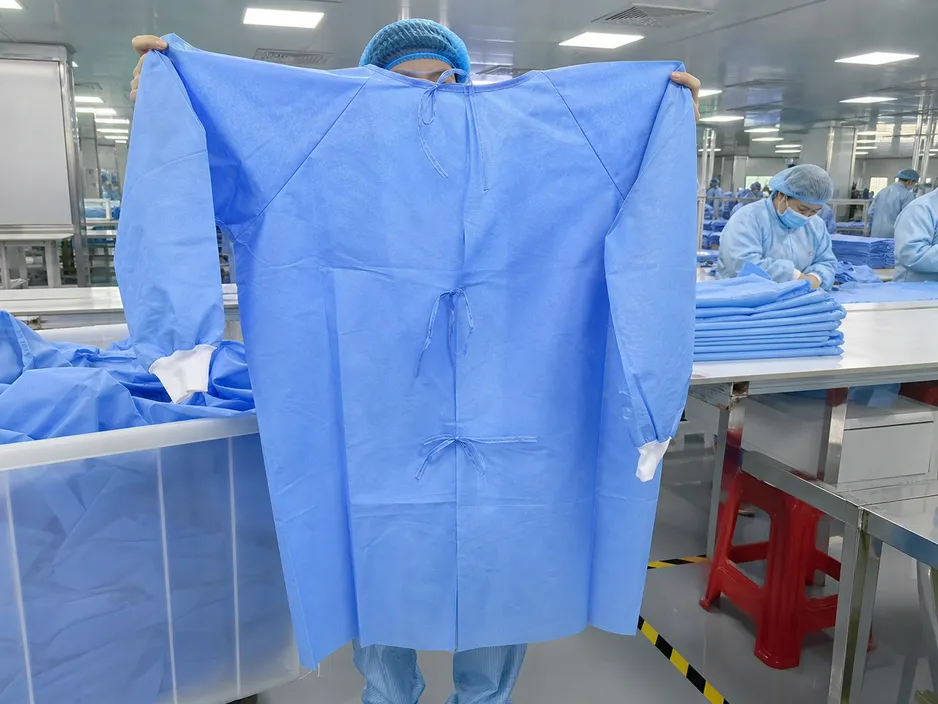
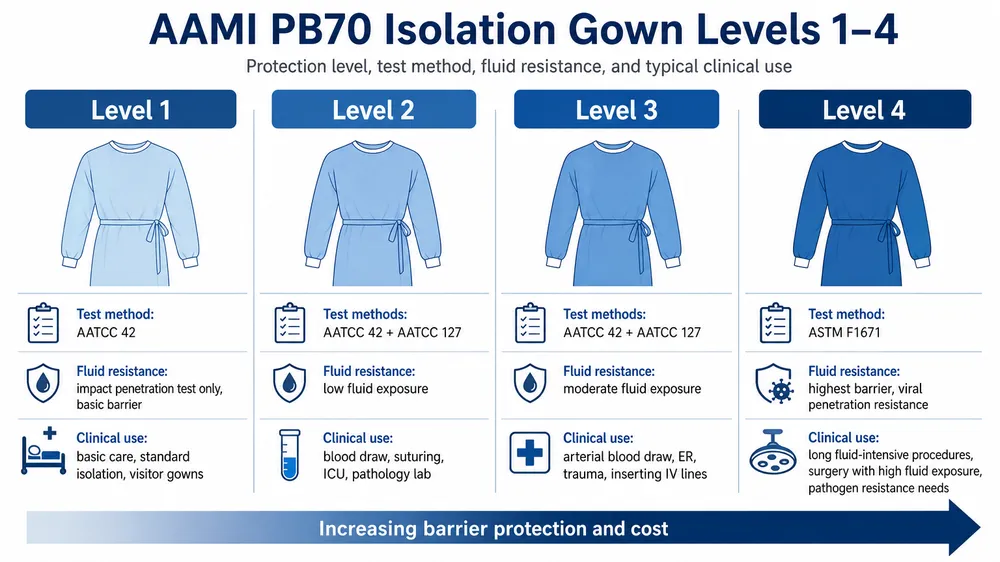
The most expensive mistake I see in isolation gown procurement isn't buying cheap product that fails — it's buying level 4 gowns for general ward use because nobody on the sourcing team had time to read the standard. At scale, that decision adds 30–50% to your per-unit cost for barrier performance you don't need in that environment.
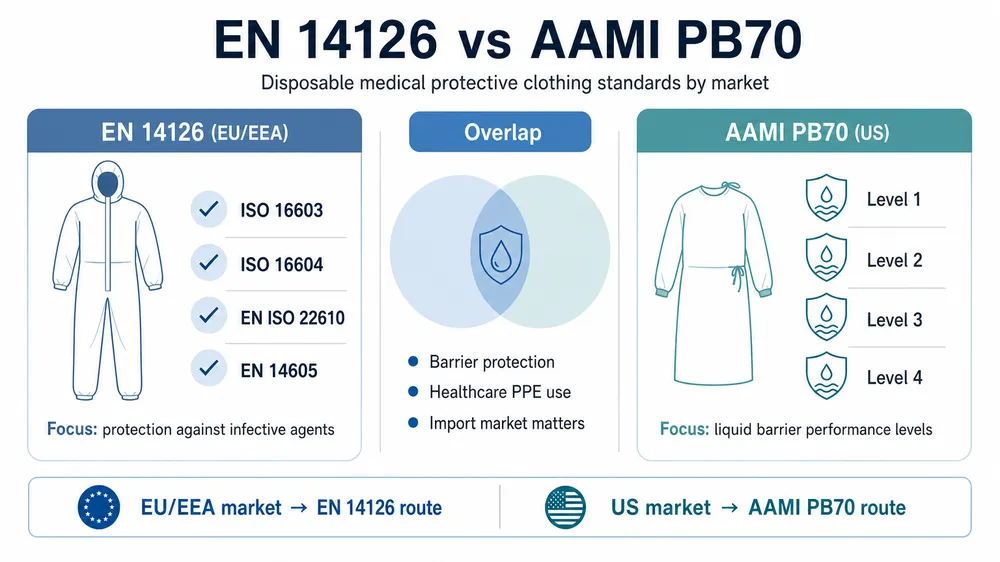
AAMI PB70 is the US standard that classifies isolation gowns and surgical gowns by liquid barrier performance. Four levels, four test methods, four cost tiers. The standard itself is straightforward. The procurement mistake is treating it as a compliance checkbox rather than a decision tool.
This article maps each level to the clinical scenarios it's designed for, explains the fabric construction behind the barrier performance, and tells you what documentation to request before you place a bulk order.

What AAMI PB70 Actually Measures
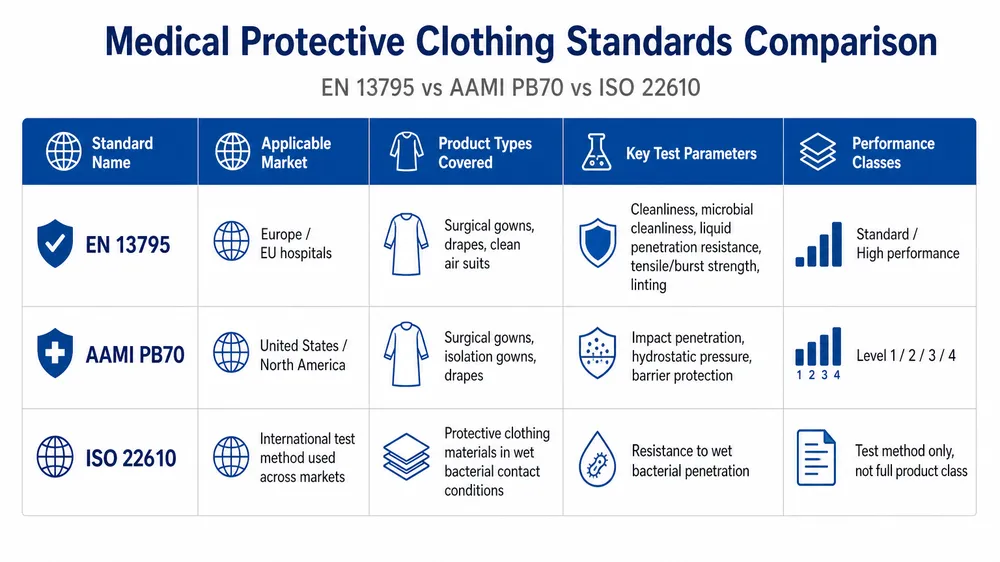
AAMI PB70 is published by the Association for the Advancement of Medical Instrumentation. It defines four protection levels for healthcare apparel based on resistance to liquid penetration — specifically, how well the gown material prevents fluid from reaching the wearer.
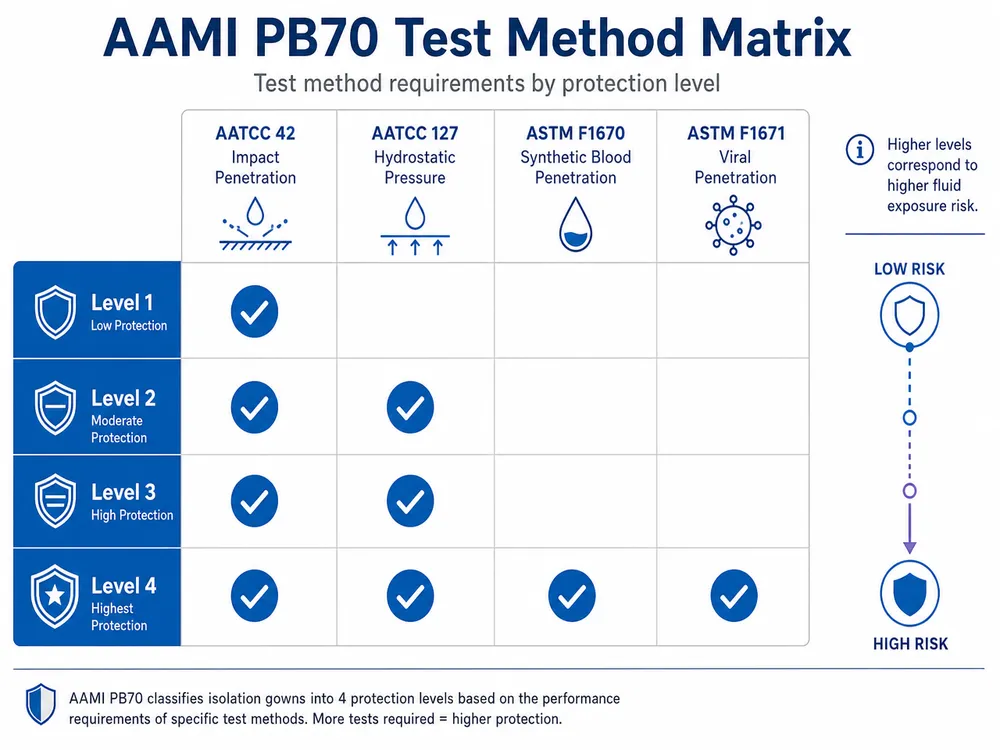
The standard uses four test methods, each simulating a different type of fluid exposure:
- AATCC 42 (Impact Penetration) — measures resistance to water spray impact. This is the baseline test used for Level 1 and Level 2 gowns. It simulates low-velocity splash.
- AATCC 127 (Hydrostatic Pressure) — measures resistance to water under sustained pressure. Used for Level 2 and Level 3. It simulates prolonged contact with fluid, such as leaning against a wet surface.
- ASTM F1670 (Synthetic Blood Penetration) — measures resistance to penetration by synthetic blood under pressure. Level 4 requirement. Simulates high-fluid-exposure surgical environments.
- ASTM F1671 (Viral Penetration) — measures resistance to penetration by a surrogate virus (Phi-X174 bacteriophage) under pressure. Also a Level 4 requirement. This is the most stringent test in the standard.
The progression from Level 1 to Level 4 is not just about "more protection" in a vague sense. Each level adds a more demanding test that corresponds to a specific clinical exposure risk. Understanding that progression is what lets you match the gown to the environment instead of defaulting to the highest level across the board.
The Four Levels: Test Thresholds and Intended Environments
| Level | Test Methods | Fluid Resistance | Intended Use |
|---|---|---|---|
| Level 1 | AATCC 42 | Minimal — resists light spray | Routine patient care, basic exams, low-fluid-contact tasks |
| Level 2 | AATCC 42 + AATCC 127 | Low — resists spray and limited pressure | Blood draws, IV insertion, ICU care with low splash risk |
| Level 3 | AATCC 42 + AATCC 127 (higher threshold) | Moderate — resists sustained fluid contact | Arterial procedures, trauma care, moderate-splash surgical environments |
| Level 4 | AATCC 42 + AATCC 127 + ASTM F1670 + ASTM F1671 | Maximum — resists blood and viral penetration under pressure | High-fluid-exposure surgery, infectious disease isolation, procedures with significant blood loss |
A few things worth noting about this table. Level 3 and Level 4 both use AATCC 127, but Level 3 requires a minimum hydrostatic pressure resistance of 50 cm H₂O, while Level 4 requires 80 cm H₂O — and then adds the synthetic blood and viral penetration tests on top. The jump from Level 3 to Level 4 is not incremental. It's a different category of protection, and the fabric construction required to pass F1671 is fundamentally different from what passes AATCC 127 alone.
Level 1 gowns are often dismissed as "basic" — but for general ward use, routine patient contact, and administrative clinical tasks, they're the correct specification. Buying Level 3 for those environments doesn't make the patient safer. It just increases your cost per gown by 40–60% for barrier performance that never gets tested in that setting.
Clinical Risk Mapping: Which Level Belongs Where
The standard tells you what each level resists. It doesn't tell you which clinical scenario maps to which level — that's the gap most procurement content leaves unfilled.
Here's how we think about it after years of supplying gowns across hospital systems, distributors, and government tenders:
Level 1 — General ward, outpatient, administrative clinical contact. Routine patient care where fluid exposure is incidental and low-velocity. Visiting patients, basic physical exams, non-invasive procedures. The gown's job here is primarily contamination control, not barrier protection against significant fluid exposure.
Level 2 — Phlebotomy, IV access, ICU monitoring, standard nursing care. Any task where there's a realistic chance of blood or body fluid contact, but the exposure is limited in volume and pressure. Blood draws, catheter care, wound dressing changes on non-draining wounds. Level 2 is the workhorse level for most hospital floor environments.
Level 3 — Arterial lines, trauma response, moderate-complexity surgery, emergency department procedures. Environments where fluid exposure is expected and may involve sustained contact or moderate splash. The higher hydrostatic pressure threshold (50 cm H₂O) matters here — it's the difference between a gown that handles a splash and one that handles a sustained wet contact scenario.
Level 4 — High-fluid-exposure surgery, infectious disease isolation (airborne/contact precautions for high-risk pathogens), procedures with significant blood loss. The viral penetration test (ASTM F1671) is the defining requirement. If your buyer's end-use environment involves procedures where bloodborne pathogen transmission is a real risk, Level 4 is the correct specification. For everything else, it's over-specification.
(One pattern we see repeatedly: buyers sourcing for government hospital tenders default to Level 4 across all SKUs because the tender specification was written conservatively. When we ask about the actual use environments, Level 3 covers 70–80% of the volume. The cost difference on a 500,000-unit tender is significant.)
Fabric Construction by Level: SMS vs Microporous Film
The barrier performance difference between levels isn't just a test result — it's a material difference. Understanding the fabric construction tells you what you're actually buying and why the cost tiers exist.
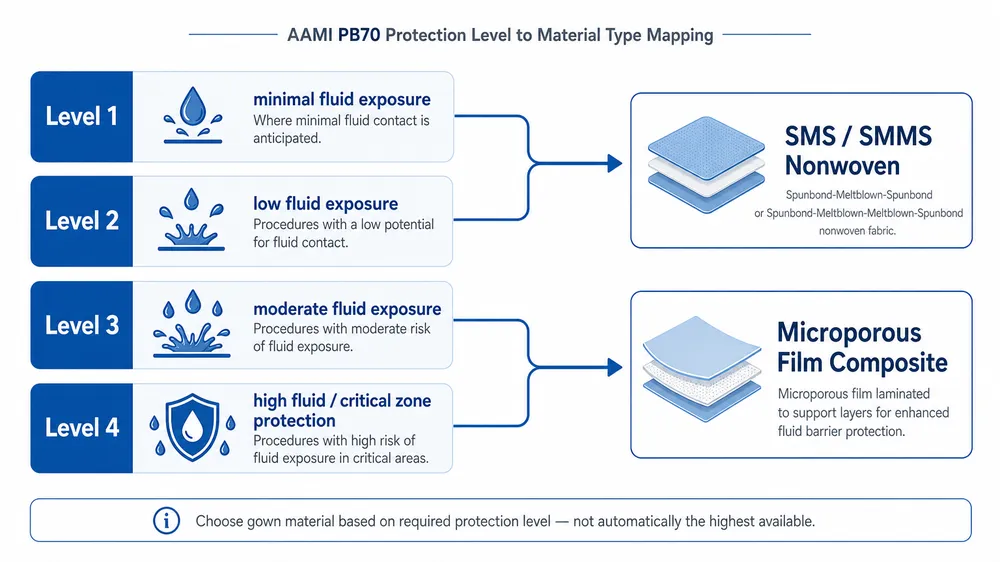
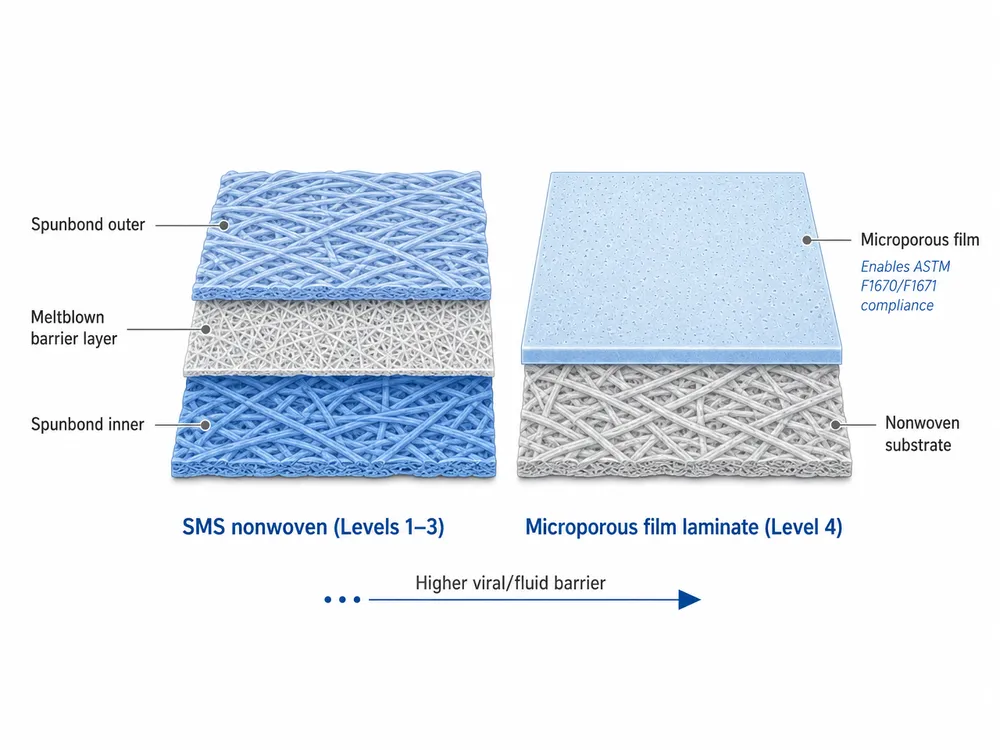
SMS nonwoven (Spunbond-Meltblown-Spunbond) is the standard construction for Level 1 and Level 2 gowns. The meltblown middle layer provides the fluid resistance; the spunbond outer and inner layers provide structural integrity and softness. SMS is breathable, lightweight, and cost-effective. For Level 1 and Level 2 applications, it's the right material — the barrier performance is adequate for the exposure risk, and the breathability matters for staff wearing gowns for extended periods.
Reinforced SMS or laminated SMS is used for Level 3. Higher basis weight meltblown, tighter fiber structure, sometimes with a reinforced panel in the critical zone (chest and forearm area where fluid contact is most likely). The hydrostatic pressure resistance comes from the meltblown layer density, not from a film coating — which means the gown retains some breathability while meeting the Level 3 threshold.
Microporous film laminate is the construction required for Level 4. A microporous polyethylene or polypropylene film is laminated to a nonwoven substrate. The film is what passes ASTM F1670 and F1671 — it creates a physical barrier that SMS alone cannot achieve at the viral penetration test level. The trade-off is breathability: microporous film gowns are significantly less breathable than SMS gowns, which matters for surgical teams wearing them for multi-hour procedures. (We've had buyers ask for Level 4 gowns for 6-hour surgical cases — the right answer is to confirm whether the procedure actually requires F1671 compliance, because the comfort trade-off is real and affects staff performance.)
We produce nonwoven fabric in-house, which means we control the meltblown layer specification directly — fiber diameter, basis weight, and electrostatic charge for the SMS constructions. For Level 3 gowns, that control over the meltblown spec is what determines whether the finished gown passes AATCC 127 at 50 cm H₂O consistently across batches, not just on the certification sample.
For a deeper comparison of SMS and microporous film performance trade-offs across clinical applications, see our guide on nonwoven vs microporous film isolation gowns.
The Over-Specification Problem and Its Cost Impact
This is the sourcing trap that costs buyers the most money, and it's almost never discussed in standard documentation.
Level 4 gowns cost roughly 2–3x more per unit than Level 1 gowns, and 40–60% more than Level 3. At 100,000 units, the difference between specifying Level 3 and Level 4 for a moderate-risk surgical environment can be $15,000–$30,000 on a single order. At 500,000 units for a hospital system tender, it's a budget line item.
The over-specification pattern usually comes from one of three places:
- Conservative tender writing — procurement teams writing specifications default to the highest level to avoid liability, without mapping the spec to actual clinical risk.
- Distributor upselling — distributors earn higher margin on Level 4 product and have no incentive to recommend Level 3 when Level 4 is available.
- Certification confusion — buyers assume that a higher AAMI level means the gown is "more certified" or more likely to pass import inspection. It doesn't. A Level 1 gown with proper AAMI PB70 documentation is fully compliant for its intended use.
The correct approach is to map each use environment to the minimum AAMI level that covers the actual exposure risk, then source each level separately. A hospital system running Level 1 for general wards, Level 2 for nursing floors, Level 3 for surgical suites, and Level 4 for high-risk isolation rooms will spend significantly less per year than one running Level 4 across all environments — with no reduction in clinical protection.
We've worked through this analysis with distributors supplying multi-facility hospital networks. The SKU mix that comes out of a proper risk mapping exercise is almost always 40–50% Level 1/2, 30–40% Level 3, and 10–20% Level 4. The all-Level-4 approach is rarely justified by the actual clinical environment breakdown.
What to Request from a Supplier Before Placing a Bulk Order
The documentation gap is where most sourcing problems originate. A supplier can claim AAMI PB70 compliance without providing the test reports that prove it. Here's what to request at the RFQ stage, before you commit to volume:
Test reports by level:
- AATCC 42 test report (required for all levels)
- AATCC 127 test report with the specific hydrostatic pressure result (required for Levels 2, 3, 4 — confirm the Level 3 result is ≥50 cm H₂O and Level 4 is ≥80 cm H₂O)
- ASTM F1670 test report (Level 4 only)
- ASTM F1671 test report (Level 4 only)
Test reports should be from an accredited third-party laboratory, not internal testing only. The report should show the specific test result, not just a pass/fail notation.
Quality system documentation:
- ISO 13485:2016 certificate — this is the medical device quality management standard. A supplier without ISO 13485 is not operating under a documented medical device QMS, which creates traceability and consistency risk.
- ISO 9001:2015 certificate (baseline quality system)
- CE certificate if you're importing into the EU — confirm it's issued under EU MDR, not the older MDD framework
Per-shipment documentation:
- Certificate of Conformity (COC) specifying the AAMI level, lot number, and applicable test standards
- Packing list with lot traceability
- Test reports from the production batch (not just the certification sample)
(The distinction between certification-sample test reports and production-batch test reports matters more than most buyers realize. A gown can pass AATCC 127 on the certification sample and fail on production batches if the meltblown fabric spec isn't controlled consistently. Ask specifically for batch-level test reports, not just the certification file.)
We provide ISO 13485 and CE/FDA documentation with every shipment, along with per-batch test reports for the specific AAMI level ordered. If you're importing into the US, the FDA 510(k) registration covers the product category. For EU imports, the CE technical file under EU MDR is available for review before you place the order.
For a broader look at the Medical Protective Clothing category and how isolation gowns fit within the full protective apparel range, that page covers the product family context.
Seam Construction: The Specification Most Buyers Skip
I'll say this plainly because it's the thing that causes the most field failures: the seam is where most protective clothing fails, and it's the last thing buyers check before placing a bulk order.
A gown can pass AATCC 127 on the fabric panel and still leak at the seam under the same hydrostatic pressure. AAMI PB70 requires that seam construction meet the same barrier performance as the fabric — but not all suppliers test seams separately, and not all buyers ask.
For Level 1 and Level 2 gowns, standard ultrasonic-welded or heat-sealed seams are adequate. The fluid exposure risk is low enough that seam construction is not the limiting factor.
For Level 3 and Level 4 gowns, seam construction is critical. Stitched seams — even with seam tape — are not appropriate for Level 3 and Level 4 applications. The correct construction is fully sealed seams: ultrasonic welding or heat sealing that creates a continuous bond across the seam line. On Level 4 gowns with microporous film construction, the seam seal must maintain the film's barrier integrity — a poorly sealed seam on a film gown is a direct pathway for fluid penetration regardless of what the fabric panel test shows.
When you request samples, test the seam specifically. Apply hydrostatic pressure to the seam area, not just the panel. If a supplier's sample passes panel testing but the seam leaks, that's the production gown's failure mode in a real clinical environment.
Sourcing Checklist: What to Confirm Before Your First Order
Pull this list into your RFQ process for any isolation gown supplier:
Specification confirmation:
- [ ] AAMI level confirmed in writing (Level 1, 2, 3, or 4)
- [ ] Fabric construction specified (SMS basis weight, film type for Level 4)
- [ ] Seam construction method confirmed (ultrasonic weld, heat seal, or stitched — avoid stitched for Level 3/4)
- [ ] Critical zone reinforcement confirmed for Level 3/4 (chest and forearm panels)
Documentation package:
- [ ] Third-party test reports for all applicable test methods (AATCC 42, AATCC 127, F1670, F1671 as applicable)
- [ ] ISO 13485:2016 certificate (current, not expired)
- [ ] CE certificate under EU MDR (if importing to EU)
- [ ] FDA 510(k) registration confirmation (if importing to US)
- [ ] Per-batch COC available with each shipment
Commercial terms:
- [ ] MOQ confirmed per AAMI level (different levels may have different minimums)
- [ ] OEM/private-label capability confirmed if needed
- [ ] Lead time confirmed from order to shipment
- [ ] Sample availability before bulk order commitment
For the Medical Isolation Gown product page, you'll find the specific SKUs we produce across AAMI levels, with available certifications listed per product.
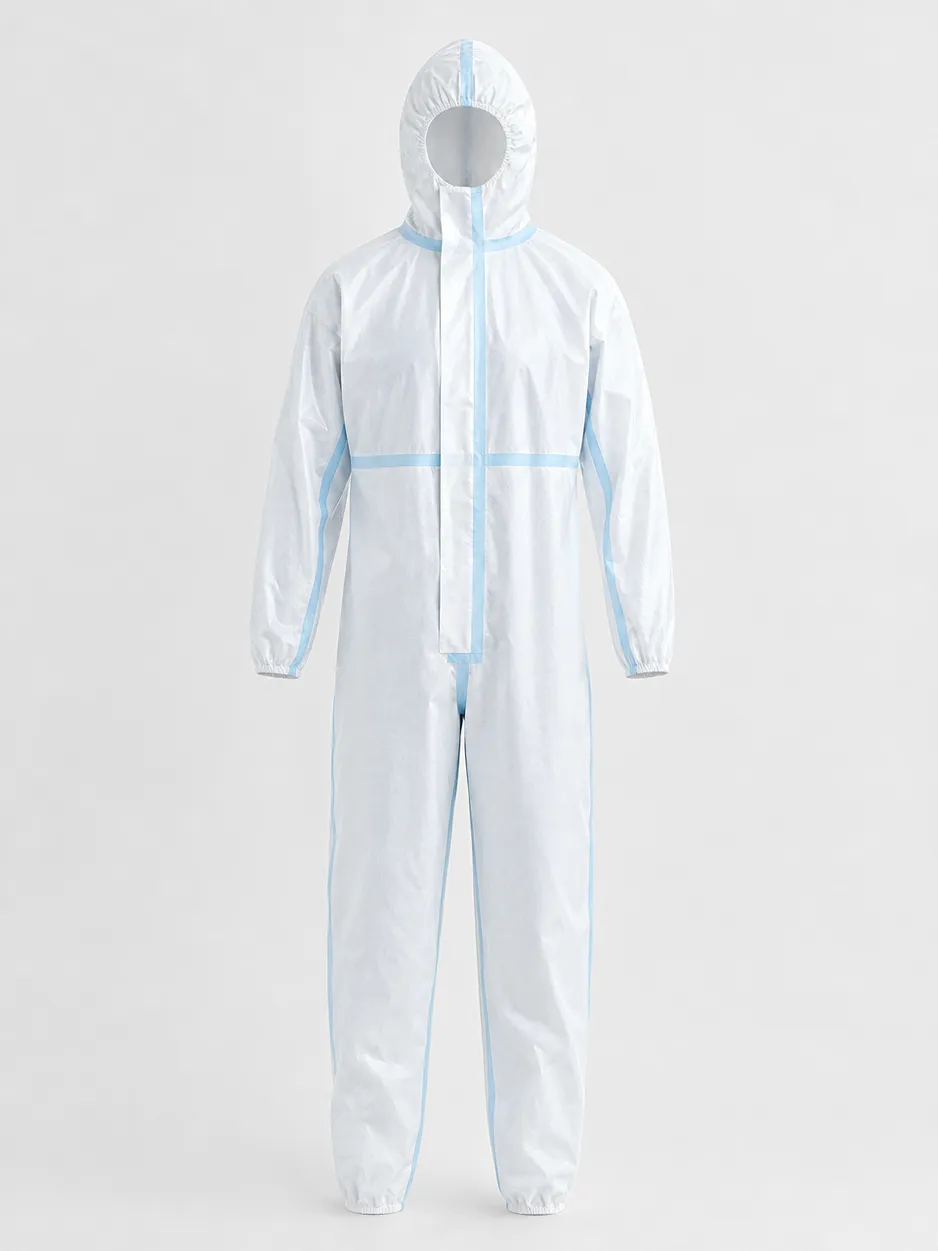
If you're deciding between an isolation gown and a full protective coverall for your specific application, the isolation gown vs protective coverall comparison covers the protection scope, regulatory classification, and cost differences between the two product types.
Frequently Asked Questions
What is the difference between AAMI Level 3 and Level 4 isolation gowns?
Level 3 requires AATCC 42 and AATCC 127 at ≥50 cm H₂O hydrostatic pressure. Level 4 adds ASTM F1670 (synthetic blood penetration) and ASTM F1671 (viral penetration) on top of a higher AATCC 127 threshold (≥80 cm H₂O). The practical difference: Level 3 handles moderate fluid exposure in surgical environments; Level 4 is required when bloodborne pathogen transmission risk is present. The fabric construction also changes — Level 4 requires microporous film laminate, which Level 3 does not.
Can a Level 1 gown be used in a hospital setting?
Yes. Level 1 is appropriate for routine patient care, basic exams, and any clinical task where fluid exposure is incidental and low-velocity. It's the correct specification for general ward use, outpatient settings, and administrative clinical contact. Using Level 3 or Level 4 in these environments doesn't improve clinical protection — it increases cost without a corresponding benefit.
What test reports should I request from an isolation gown supplier?
At minimum: AATCC 42 (all levels), AATCC 127 with the specific hydrostatic pressure result (Levels 2–4), ASTM F1670 and F1671 (Level 4 only). All reports should be from accredited third-party laboratories. Also request ISO 13485:2016 certificate and, for US imports, FDA 510(k) registration confirmation. For EU imports, CE certificate under EU MDR.
Does AAMI PB70 apply to surgical gowns as well as isolation gowns?
Yes. AAMI PB70 covers both isolation gowns and surgical gowns. The same four-level classification and test methods apply. The distinction between an isolation gown and a surgical gown under the standard relates to design and intended use — surgical gowns have additional requirements for critical zone coverage — but the barrier performance levels are defined by the same test methods.
What is the minimum MOQ for sourcing isolation gowns at specific AAMI levels?
This varies by supplier and by level. Level 4 gowns with microporous film construction typically require higher minimums than Level 1/2 SMS gowns because the material cost and line setup are higher. At eztio, standard SKU MOQ starts at 50,000 pieces. For level-specific OEM programs or mixed-level orders, send an RFQ with your volume breakdown by level and we'll confirm minimums and pricing per SKU.
How do I verify that a supplier's gown actually meets the claimed AAMI level?
Request the third-party test report, not just a certificate. The test report shows the actual measured result (e.g., hydrostatic pressure resistance of 62 cm H₂O for a Level 3 claim) — a certificate alone doesn't tell you how close to the threshold the product tested. Also request batch-level test reports from recent production, not just the original certification sample. The certification sample and the production batch can differ if the supplier's material sourcing isn't controlled.