Most procurement teams know they need NIOSH-approved N95s. Fewer know what NIOSH actually tested to issue that approval — or what it means when a supplier's documentation is incomplete, inconsistent, or missing a parameter entirely.
That gap is where sourcing mistakes happen. A mask can carry an approval number and still fail in the field if the underlying test data doesn't hold up across production batches. Understanding what each NIOSH test parameter measures, what the threshold is, and what failure looks like in practice gives you the tools to ask better questions before you place an order — not after a shipment arrives.
This breakdown covers the full NIOSH 42 CFR Part 84 test framework for N95 respirators: what each parameter tests, what the regulatory threshold is, and what it means for your procurement decision.
What NIOSH Certification Actually Means — and What It Doesn't
NIOSH approval under 42 CFR Part 84 means the National Institute for Occupational Safety and Health has tested a specific respirator model and confirmed it meets minimum performance standards for filtration efficiency, breathing resistance, and fit. The approval is model-specific and manufacturer-specific. It does not transfer to similar-looking products from the same factory, and it does not cover every performance dimension your end-use application may require.
The approval number format is TC-84A-XXXX. That number is tied to a specific device, a specific manufacturer, and a specific set of test results on file with NIOSH. When you're evaluating a supplier, that number is the starting point — not the finish line.
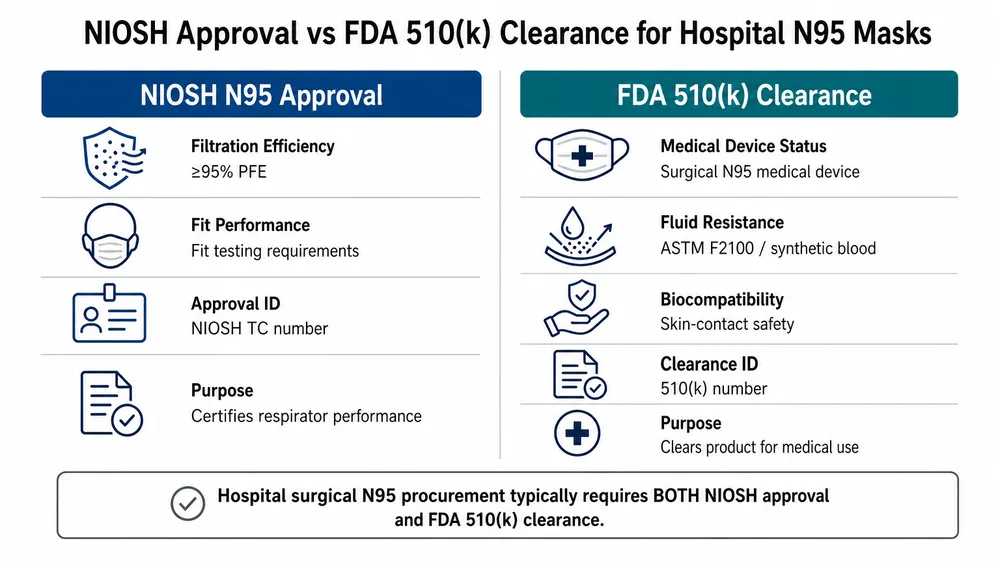
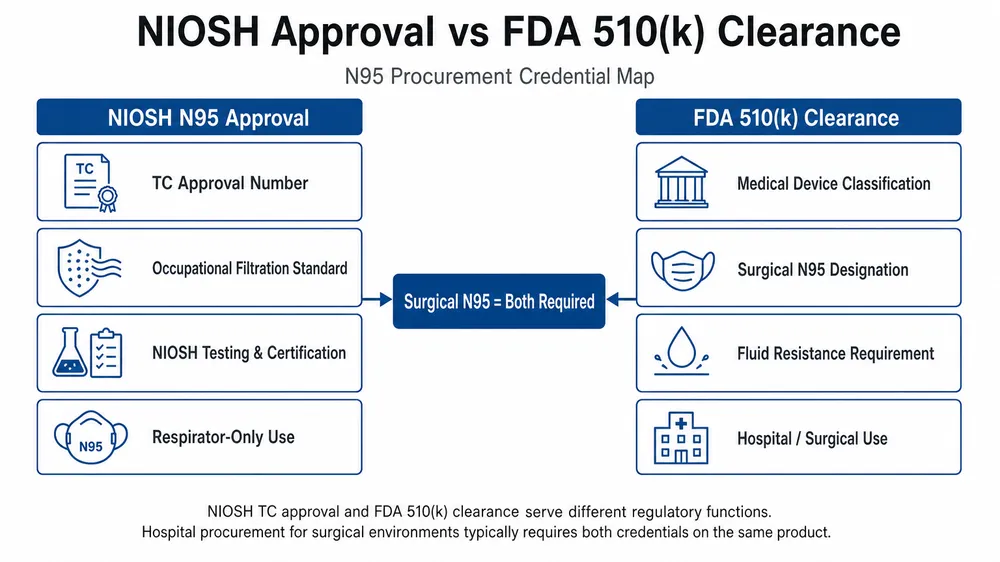
Two things NIOSH approval does not cover: fluid resistance and biocompatibility. If your buyers are deploying these masks in surgical or procedural settings where blood or fluid splash is a risk, NIOSH alone is not sufficient. That's where FDA 510(k) clearance as a surgical N95 becomes relevant — it adds ASTM F1862 fluid resistance testing on top of the NIOSH filtration and fit requirements. We'll come back to that distinction in a later section.
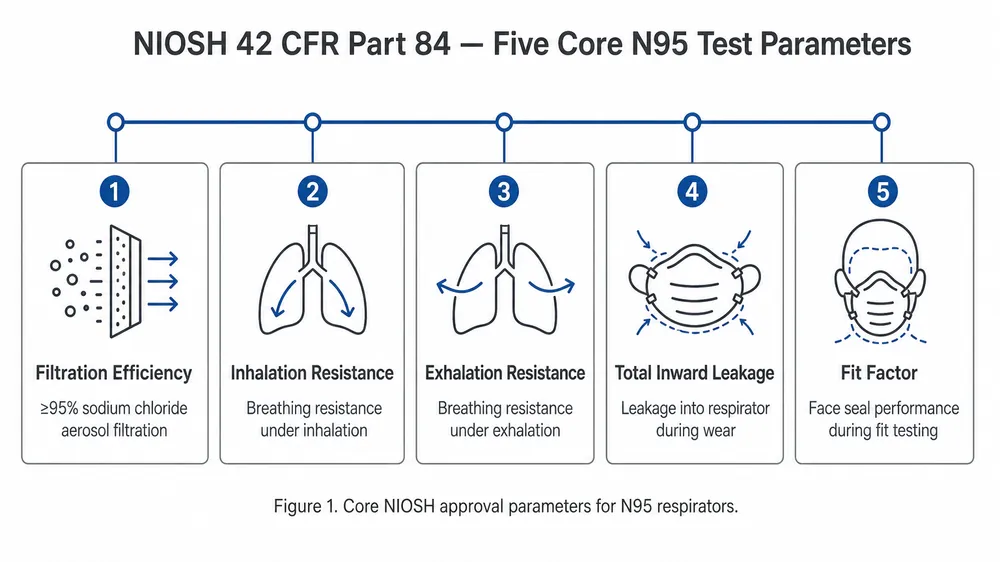
For now, the core framework: NIOSH tests five performance dimensions under 42 CFR Part 84. Each one has a defined threshold, a defined test method, and a specific failure mode that matters to your end users.

The Five NIOSH Test Parameters: Thresholds, Methods, and What Failure Costs You
Filtration Efficiency (≥95% NaCl Aerosol)
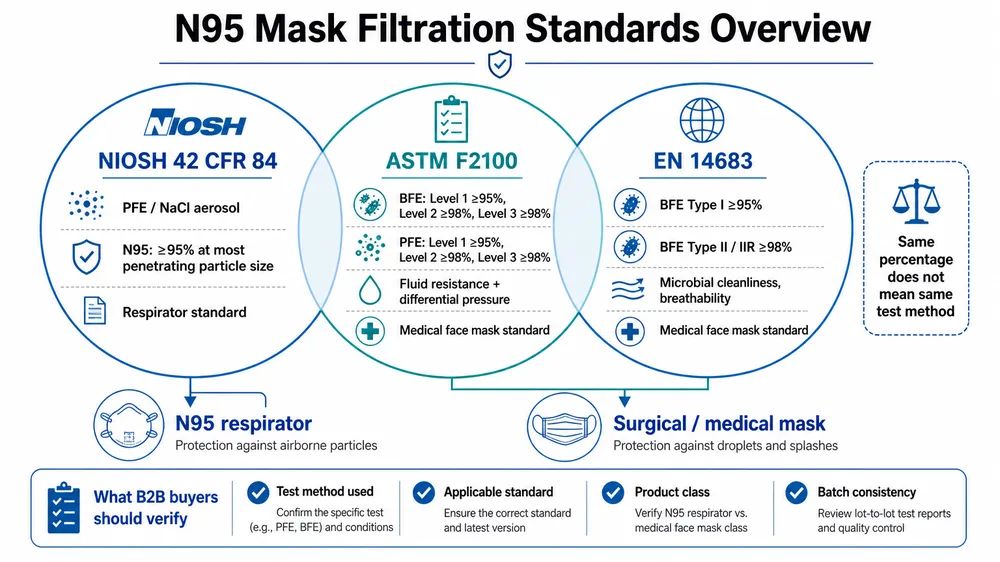
This is the parameter that defines the "95" in N95. NIOSH tests filtration efficiency using a sodium chloride (NaCl) aerosol at a particle size of 0.3 microns — the most penetrating particle size for electrostatic filter media. The test runs at a flow rate of 85 L/min, which simulates moderate-to-heavy work breathing. The mask must filter ≥95% of those particles to pass.
The 0.3-micron particle size is not arbitrary. Electrostatic meltblown media — the filtration layer in every N95 — captures particles through a combination of mechanical interception and electrostatic attraction. Particles at 0.3 microns are small enough to slip past mechanical capture but not yet small enough to be dominated by diffusion. They represent the worst case for the filter. If the mask passes at 0.3 microns, it performs better at both larger and smaller particle sizes.
What failure looks like in practice: a mask that tests at 93% instead of 95% doesn't sound like much. But in a hospital setting where staff are wearing these masks for 8-hour shifts in high-exposure environments, that 2% gap compounds across thousands of exposures. More practically, a mask that fails NIOSH filtration testing cannot be legally sold or distributed as an N95 in the US market. Your buyers face import holds, product recalls, and liability exposure.
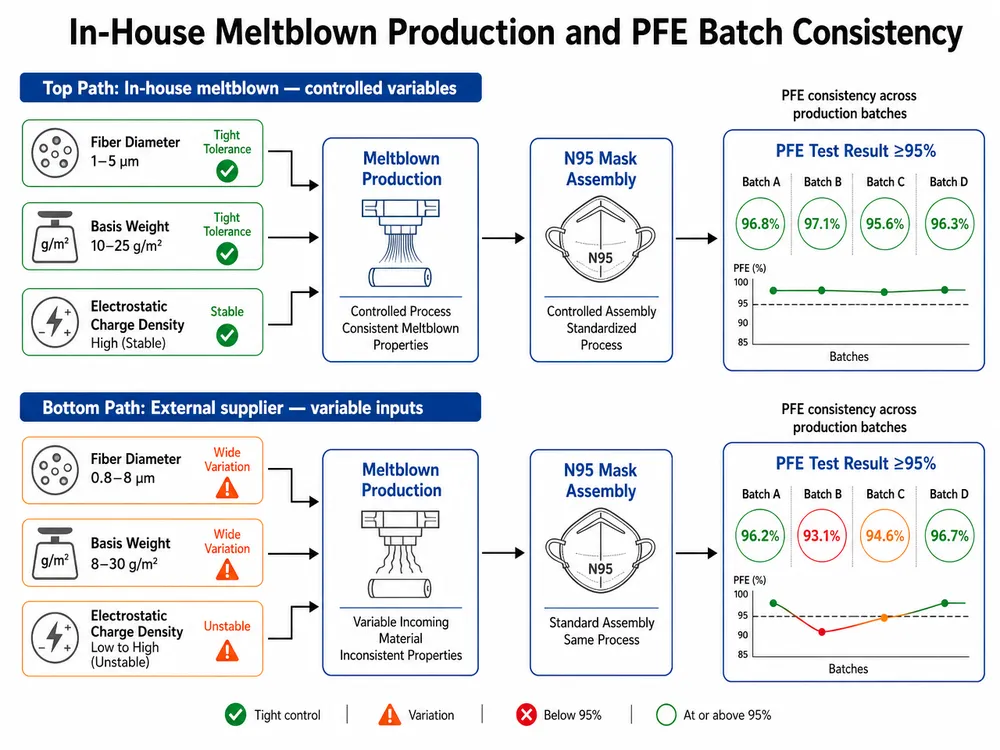
The variable that controls this outcome at the production level is the meltblown nonwoven fabric — specifically its fiber diameter, basis weight, and electrostatic charge density. Factories that buy meltblown from outside suppliers are dependent on that supplier's consistency. We produce our own meltblown fabric in-house, which means we set those parameters ourselves and test every production batch before it goes into mask assembly. When a batch tests at 96.8% PFE in our in-house lab, we know what's in the fabric that produced that result.
(The electrostatic charge in meltblown fabric degrades over time if the masks are stored improperly — high humidity accelerates it. This is worth flagging to your buyers if they're stocking for emergency reserves.)
Inhalation Resistance (≤35 mm H₂O)
Inhalation resistance measures the pressure differential across the mask when air is drawn through it at 85 L/min. The NIOSH threshold is ≤35 mm H₂O. Lower is better — a mask with 20 mm H₂O inhalation resistance is easier to breathe through than one at 32 mm H₂O.
This parameter matters commercially because it directly affects wear compliance. Healthcare workers who find a mask uncomfortable to breathe through will adjust it, remove it, or wear it incorrectly — all of which defeat the filtration performance entirely. Institutional buyers who have experienced high mask rejection rates from their staff often trace the problem back to inhalation resistance, not filtration efficiency.
The design trade-off here is real: higher filtration efficiency generally requires denser filter media, which increases breathing resistance. Getting both parameters right simultaneously — ≥95% filtration and ≤35 mm H₂O resistance — requires precise control of meltblown fiber diameter and basis weight. It's not a difficult balance to hit with well-controlled production, but it's easy to miss if the meltblown spec drifts between batches.
Exhalation Resistance (≤25 mm H₂O)
Exhalation resistance is tested at 85 L/min and must not exceed 25 mm H₂O. The lower threshold compared to inhalation resistance reflects the fact that exhalation is an active process — the respiratory muscles are working — while inhalation through a respirator requires more effort against the filter media.
For N95 designs with exhalation valves, this parameter is easier to meet because the valve opens during exhalation, bypassing the filter. For valveless designs — which are required in surgical settings because an exhalation valve allows unfiltered exhaled air to escape — the exhalation resistance is determined entirely by the filter media and mask geometry.
If your buyers are deploying masks in surgical or sterile field environments, confirm the mask is a valveless design. An N95 with an exhalation valve is not appropriate for those settings regardless of its NIOSH approval status.
Total Inward Leakage (TIL) and Fit Factor
Total inward leakage measures how much contaminated air bypasses the filter and enters the breathing zone through gaps at the face seal. This is distinct from filtration efficiency — a mask can have excellent filter media and still fail if it doesn't seal properly against the wearer's face.
NIOSH tests TIL using a panel of human subjects performing defined exercises (head movements, speaking, deep breathing) in a controlled aerosol environment. The fit factor is the ratio of aerosol concentration outside the mask to concentration inside — a fit factor of 100 means 1% of outside aerosol is entering the breathing zone. NIOSH requires a minimum fit factor of 100 for N95 respirators.
The practical implication for procurement: fit factor is population-dependent. A mask that achieves fit factor ≥100 on the NIOSH test panel may not achieve the same result on every individual wearer, particularly those with facial hair, unusual facial geometry, or scars that prevent a complete seal. This is why OSHA requires individual fit testing for workers who wear N95s in regulated occupational settings — the NIOSH approval establishes that the mask can achieve adequate fit, not that it will on every face.
For hospital and healthcare facility buyers, this means your procurement decision should account for whether your end users will undergo fit testing, and whether the mask design (cup-style vs. fold-flat) is compatible with your facility's fit testing protocol.
The Full Parameter Reference Table
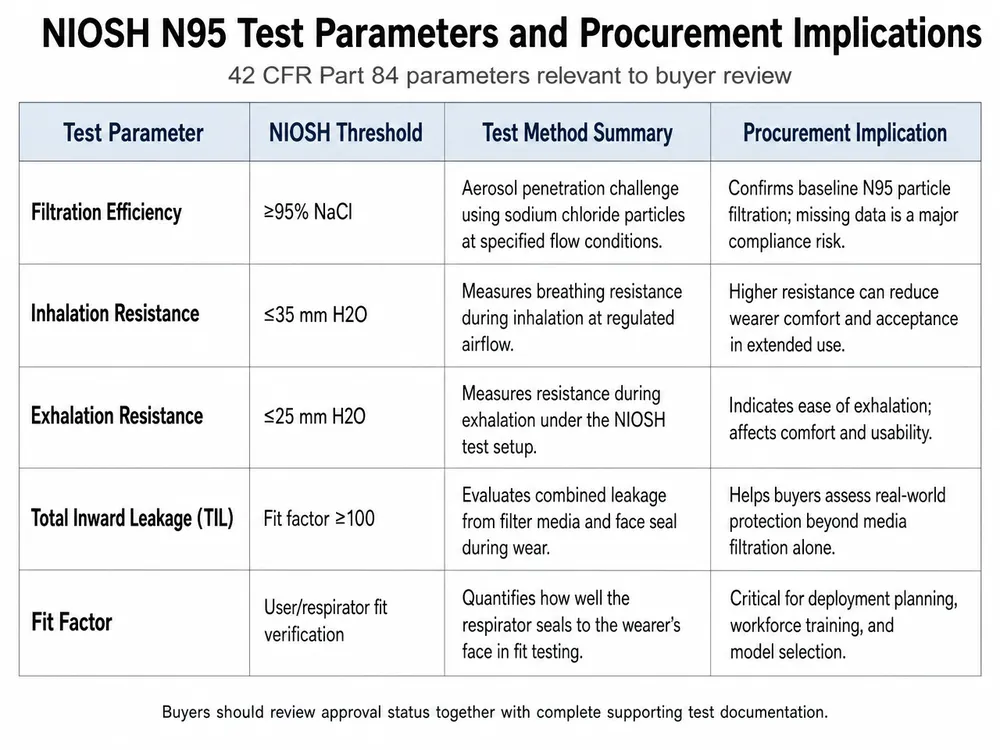
| Test Parameter | NIOSH Threshold | Test Aerosol / Method | What Failure Means for Buyers |
|---|---|---|---|
| Filtration Efficiency | ≥95% | NaCl aerosol, 0.3 µm MMAD, 85 L/min | Mask cannot be sold as N95; import hold risk; end-user exposure |
| Inhalation Resistance | ≤35 mm H₂O | 85 L/min constant flow | Wear discomfort; compliance failures; mask adjustment defeats filtration |
| Exhalation Resistance | ≤25 mm H₂O | 85 L/min constant flow | Discomfort on exhalation; valved designs not suitable for surgical use |
| Total Inward Leakage | ≤10% (fit factor ≥100) | Human subject panel, defined exercises | Face seal failure; filtration performance irrelevant if seal is broken |
| Exhalation Valve Leakage | ≤30 mL/min (if valve present) | Static pressure test | Valve failure allows unfiltered exhaled air to escape |
How to Read a NIOSH Approval Number and Verify It
Every NIOSH-approved respirator carries an approval number in the format TC-84A-XXXX. The "TC" prefix stands for Testing and Certification. "84A" references 42 CFR Part 84, Subpart A. The four-digit suffix is the unique approval number assigned to that specific device and manufacturer.
This number must appear on the mask itself and on the packaging. If a supplier provides a mask where the approval number appears only on the box but not on the mask, that's a compliance gap — NIOSH requires the number on the respirator.
To verify any approval number, use the CDC NIOSH Approved Equipment List (AEL) at cdc.gov/niosh/npptl/topics/respirators/cel/. The AEL is searchable by approval number, manufacturer name, and model. It shows the approval status (active or revoked), the manufacturer of record, and the specific model covered by the approval.
Three things to check when you look up a supplier's approval number:
- Manufacturer of record matches your supplier. An approval issued to Manufacturer A does not cover the same product made by Manufacturer B, even if the design is identical.
- Approval status is active. NIOSH revokes approvals when manufacturers fail surveillance testing or discontinue the product. A revoked approval number on a mask is a serious compliance problem.
- Model description matches what you're receiving. The AEL lists the specific model covered. If your supplier is shipping a different configuration than what's on the approval, the approval doesn't apply.
We hold our NIOSH approval under our registered manufacturer name. When you request our documentation package, the approval number on the mask, the packaging, and the AEL listing will all match.
What NIOSH Certification Does Not Cover — and Which Certifications Fill the Gaps
NIOSH approval under 42 CFR Part 84 establishes respirator performance. It does not address three areas that matter for specific procurement contexts:
Fluid resistance. NIOSH does not test splash resistance to blood or body fluids. For surgical and procedural settings, ASTM F1862 fluid resistance testing is required. A mask that passes ASTM F1862 at 120 mmHg is rated for high-splash surgical environments. This testing is part of the FDA 510(k) clearance pathway for surgical N95 respirators.
Biocompatibility. NIOSH does not test for skin sensitization, cytotoxicity, or other biocompatibility parameters. ISO 10993 biocompatibility testing is required for masks classified as medical devices in most regulated markets. Our products carry ISO 13485:2016 certification, which requires documented biocompatibility assessment as part of the design file.
EU market access. NIOSH approval is a US regulatory credential. It has no standing in the EU. For European procurement, the relevant standard is EN 149:2001+A1:2009 (FFP2 for the N95 equivalent), and market access requires CE marking under EU MDR. Our CE certification covers EU market entry — NIOSH and CE are separate approvals, and we hold both.
The practical procurement matrix looks like this:
| End-Use Application | Required Certifications |
|---|---|
| US industrial / occupational use | NIOSH TC-84A approval |
| US healthcare, non-surgical | NIOSH TC-84A approval |
| US healthcare, surgical / procedural | NIOSH TC-84A + FDA 510(k) surgical N95 |
| EU healthcare / industrial | CE (EN 149 FFP2) |
| Multi-market distribution | NIOSH + CE + FDA 510(k) |
Our Disposable N95 Medical Mask carries NIOSH approval, FDA 510(k) registration, and CE marking — which covers the full matrix for buyers distributing across North America and Europe from a single SKU.
Why Meltblown Production Control Determines Whether PFE Holds Across Batches
The filtration efficiency number on a NIOSH approval certificate reflects the performance of the specific production samples submitted for testing. What it does not guarantee is that every production batch after that test will hit the same number.
Filtration efficiency in N95 respirators is determined almost entirely by the meltblown nonwoven layer — the middle layer of the mask. Meltblown fabric is produced by extruding polymer through fine nozzles at high velocity, creating a web of ultrafine fibers that are then electrostatically charged. The filtration performance of the finished fabric depends on fiber diameter (typically 1–5 microns for N95-grade material), basis weight (grams per square meter), and the density and stability of the electrostatic charge.
Factories that source meltblown from external suppliers have limited visibility into batch-to-batch variation in those parameters. A supplier who ships fabric at 40 g/m² one month and 38 g/m² the next has changed the filtration performance of every mask made from that roll — and the mask manufacturer may not know until in-process testing catches it, or until a third-party audit pulls samples.
We produce our own meltblown fabric. The extrusion line is in our facility. We set the fiber diameter target, the basis weight spec, and the charging parameters. Every roll is tested before it enters mask production. When our in-house PFE lab runs a batch test and returns 96.2%, we know exactly which production variables produced that result and can reproduce it on the next run.
This matters to you in two specific ways. First, batch-to-batch consistency: your 500,000-unit order will test the same as your 50,000-unit trial order, because the meltblown spec doesn't change between runs. Second, documentation: we can provide batch-specific PFE test reports for every shipment, so your compliance team has the data to support import documentation and institutional procurement audits.
(We've had buyers come to us after a previous supplier's masks failed hospital fit testing — not because the NIOSH approval was fake, but because the meltblown spec had drifted and nobody caught it before shipment. In-house production is the only reliable way to prevent that.)
Supplier Documentation Checklist: What to Request Before Placing an Order
NIOSH approval is the entry requirement. The documentation package around it is what tells you whether a supplier's production actually delivers what the approval certificate promises.
Before committing to a bulk order, request and verify the following:
Certification documents
- NIOSH approval certificate with TC-84A number matching the specific model you're ordering
- FDA 510(k) clearance letter (required if end use is surgical or if your buyers are US healthcare facilities)
- CE certificate with EN 149 standard reference (required for EU distribution)
- ISO 13485:2016 certificate from an accredited certification body
Test reports
- NIOSH filtration efficiency test report (NaCl aerosol, ≥95%)
- Inhalation and exhalation resistance test report
- Fit test / TIL test report with panel data
- Recent third-party PFE test report (within 12 months) — this is separate from the original certification test and shows current production performance
- Batch-specific in-house PFE test reports for the production run you're ordering
Production documentation
- Meltblown fabric source declaration: in-house production or named external supplier
- If external supplier: supplier qualification records and incoming inspection data
- QC inspection report for the specific production batch
The batch-specific test report is the one most buyers skip requesting — and it's the one that matters most for verifying that current production matches the certified spec. A NIOSH certificate issued three years ago tells you the mask passed testing three years ago. A batch PFE report from last month tells you what you're actually receiving.
We provide the full documentation package with every order: NIOSH certificate, FDA 510(k) clearance letter, CE certificate, ISO 13485 certificate, and batch-specific PFE test reports. If your compliance team needs additional documentation for a specific import market or institutional procurement audit, tell us upfront — we've handled documentation requirements for US, Canadian, EU, and Gulf state procurement processes and can prepare what you need before the order ships.
NIOSH vs. KN95 vs. Surgical N95: The Procurement Distinction That Matters
This comes up in almost every sourcing conversation, so it's worth being direct about it.
KN95 is a Chinese standard (GB 2626-2019) that specifies ≥95% filtration efficiency using NaCl aerosol — the same filtration threshold as NIOSH N95. The test method is similar. The standard is not the same. KN95 masks are not NIOSH-approved and cannot be sold or distributed as N95 respirators in the US market. During the COVID-19 pandemic, the FDA issued Emergency Use Authorizations that temporarily allowed KN95 use in healthcare settings — those EUAs have expired. For current US procurement, NIOSH approval is required.
NIOSH N95 covers occupational and healthcare use but does not address fluid resistance. It's appropriate for most healthcare settings where splash exposure is not a primary concern.
Surgical N95 (FDA 510(k)-cleared) adds fluid resistance testing to the NIOSH N95 requirements. It's required for surgical and procedural settings. The FDA 510(k) clearance pathway requires NIOSH approval as a prerequisite — you cannot have a surgical N95 without first having NIOSH approval.
The sourcing implication: if you're building a product line for US healthcare distribution, you need to decide upfront whether your buyers will need surgical N95 capability. A standard NIOSH N95 and a surgical N95 are different products with different regulatory pathways, different test requirements, and different price points. Sourcing the wrong one creates compliance problems that are expensive to unwind.
Our N95 Medical Masks product line covers both configurations. If you're not certain which certification tier your buyers require, that's a conversation worth having before you finalize your order specs — not after.
N95 Filtration Efficiency Testing: What the Lab Actually Does
Understanding the test method helps you evaluate supplier claims more critically. Here's what happens in a NIOSH filtration efficiency test:
The mask is mounted on a test fixture that simulates a face seal. A NaCl aerosol is generated at a count median diameter of approximately 0.075 microns (mass median aerodynamic diameter of 0.3 microns) — this is the most penetrating particle size for electrostatic filter media. The aerosol is drawn through the mask at a constant flow rate of 85 L/min for a defined loading period. Particle counts upstream and downstream of the mask are measured continuously.
The filtration efficiency is calculated as: (1 - downstream count / upstream count) × 100%
The test also includes a loading phase — the mask is exposed to a defined aerosol mass before the final efficiency measurement. This simulates real-world use conditions where the filter accumulates particles over time. A mask that starts at 97% efficiency but drops to 93% after loading fails the test.
What this means for your supplier evaluation: ask whether the test report shows pre-loading and post-loading efficiency values. A supplier who only reports the initial efficiency number may be obscuring performance degradation under load. The NIOSH-required threshold of ≥95% applies to the loaded condition.
For N95 mask filtration efficiency in more depth — including how electrostatic charge affects performance over the mask's service life — that topic is covered separately.
Frequently Asked Questions
Can a NIOSH approval number be transferred to a different manufacturer?
No. NIOSH approval is issued to a specific manufacturer for a specific model. If a factory changes ownership, relocates production, or modifies the product design, the original approval may no longer apply. The manufacturer of record on the AEL must match the entity supplying your product. We've seen buyers receive masks with a valid-looking approval number that was actually issued to a different company — the AEL lookup takes 30 seconds and catches this immediately.
What does it mean if a supplier's NIOSH approval is listed as "revoked" on the AEL?
A revoked approval means NIOSH has determined the product no longer meets the requirements — typically because the manufacturer failed surveillance testing, changed the product without notifying NIOSH, or voluntarily withdrew the approval. Masks sold under a revoked approval number are not legally N95 respirators in the US market. If you discover a revoked approval after placing an order, you have a compliance problem. Check the AEL before you commit.
How often does NIOSH conduct surveillance testing on approved products?
NIOSH conducts periodic surveillance testing by purchasing approved respirators from the market and retesting them against the original approval requirements. The frequency varies, but manufacturers cannot predict when surveillance testing will occur. This is why production consistency matters — a mask that passes certification testing but drifts in production quality is at risk of failing surveillance and losing its approval.
Does NIOSH approval cover the mask's shelf life?
No. NIOSH does not specify a shelf life for N95 respirators. Manufacturers set their own shelf life based on material stability data, typically 3–5 years for standard disposable N95s. The primary concern is electrostatic charge degradation in the meltblown layer, which reduces filtration efficiency over time. Proper storage conditions (cool, dry, away from UV exposure and ozone) extend effective shelf life. For emergency stockpile procurement, ask your supplier for the basis of their stated shelf life — it should be supported by accelerated aging test data.
What's the minimum order quantity for NIOSH-approved N95s from eztio?
Standard SKUs start at 50,000 pieces. For buyers entering a new market or running a trial program, that's a manageable commitment. If you need a custom configuration — different headband style, private-label packaging, or a modified filtration spec — the MOQ is higher to cover line setup and material procurement, and we'll tell you the exact number upfront.
If I need both NIOSH approval and CE marking for multi-market distribution, can a single product cover both?
Yes, but it requires deliberate design and testing. NIOSH and EN 149 use different test aerosols (NaCl vs. NaCl and paraffin oil for FFP2), different flow rates, and different fit test protocols. A mask designed to pass both standards needs to be tested against both independently. Our disposable N95 carries both NIOSH approval and CE marking under EN 149 FFP2, so a single SKU covers US and EU procurement requirements. Request a quote with your target markets and we'll confirm the certification documentation that ships with your order.
Reading NIOSH Documentation as a Sourcing Tool
The NIOSH approval process generates a paper trail that most buyers never look at. That's a missed opportunity.
When NIOSH approves a respirator, the approval file includes the test data, the product description, and the labeling requirements. Some of this information is publicly accessible through the AEL. The approval number, manufacturer name, model description, and approval status are all searchable. For buyers who want to go deeper, NIOSH publishes guidance documents on 42 CFR Part 84 that explain the test methods in detail — the same methods your supplier's test reports should reference.
The practical sourcing habit: when a supplier sends you a test report, check that the test method cited matches the NIOSH 42 CFR Part 84 protocol. A report that cites a different standard, a different aerosol, or a different flow rate is not a NIOSH-equivalent test result, regardless of what the filtration efficiency number says.
We provide test reports that cite the specific NIOSH test methods, with the approval number, test date, and laboratory accreditation information included. If a report doesn't include those details, ask why.
Sourcing N95s Without Triggering Import or Audit Failures
The US import process for N95 respirators involves FDA oversight in addition to NIOSH approval. FDA monitors imports of medical devices — and N95 respirators classified as surgical N95s are Class II medical devices subject to 510(k) clearance requirements. Customs brokers and FDA import reviewers check for the 510(k) number on import documentation for surgical N95 shipments.
For standard NIOSH N95s (non-surgical), the FDA import process is less intensive, but FDA still has authority to detain shipments that appear to be misbranded or that carry approval numbers that don't match the product description. The most common import problem we see buyers encounter: the approval number on the shipping documentation doesn't match the number on the masks, because the supplier shipped a different model than what was ordered.
The fix is straightforward: confirm the exact model number and NIOSH approval number before the order is placed, verify it against the AEL, and confirm that the same number appears on the masks in your pre-shipment sample. We send pre-shipment samples on request for orders above 200,000 pieces — it's the fastest way to catch a documentation mismatch before it becomes a customs hold.
For buyers distributing into the EU, the CE technical file requirements under EU MDR have become significantly more demanding since 2021. The technical file must include clinical evaluation data, risk management documentation, and post-market surveillance plans — not just a test report and a CE certificate. We've supported multiple European importers through this process and can provide the technical file documentation your EU importer of record will need.
Putting It Together: A Practical Sourcing Framework
The NIOSH certification framework gives you a structured way to evaluate N95 suppliers beyond the approval number itself. Here's how to apply it:
Step 1: Verify the approval number on the AEL. Manufacturer of record, active status, model description. Takes 30 seconds. Non-negotiable.
Step 2: Request the full test report package. Filtration efficiency (pre- and post-load), inhalation resistance, exhalation resistance, TIL/fit factor. Confirm the test methods cited match 42 CFR Part 84.
Step 3: Request a recent batch PFE report. The certification test is historical. A batch report from current production tells you what you're actually buying.
Step 4: Confirm the meltblown source. In-house production or named external supplier. If external, ask for incoming inspection data. This is the variable that determines whether the certification test result holds across your order.
Step 5: Match the certification tier to your end-use application. NIOSH only, or NIOSH + FDA 510(k) for surgical use. NIOSH + CE for EU distribution. Confirm before you finalize specs.
Step 6: Confirm labeling compliance. The NIOSH approval number must appear on the mask itself, not just the packaging. Check your pre-shipment sample.
This framework applies to any N95 supplier you're evaluating. For buyers sourcing from China specifically, the additional layer is confirming that the manufacturer of record on the NIOSH approval is the factory you're actually buying from — not a trading company that holds the approval on behalf of a production facility that may or may not be running the same process.
We are the manufacturer of record on our NIOSH approval. Our production facility in Gaomi is the facility that was audited. The masks you receive are made in the same building where the approval was issued.
If you're ready to move from evaluation to sourcing, request a quote with your required certification tier, intended end-use application, and target volume. We'll confirm the documentation package and provide batch test reports with your sample order.