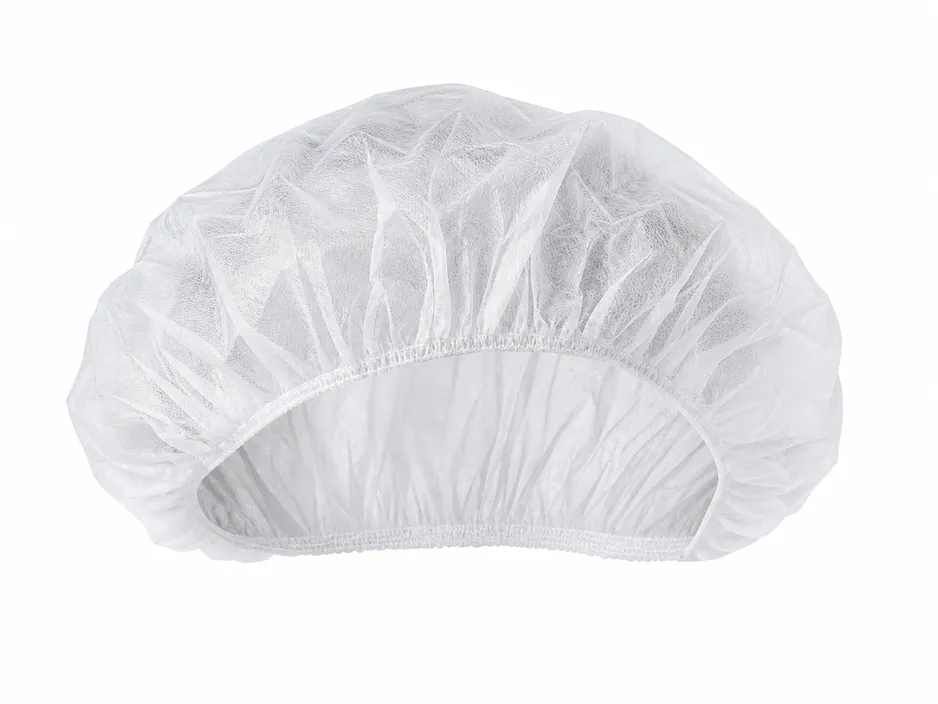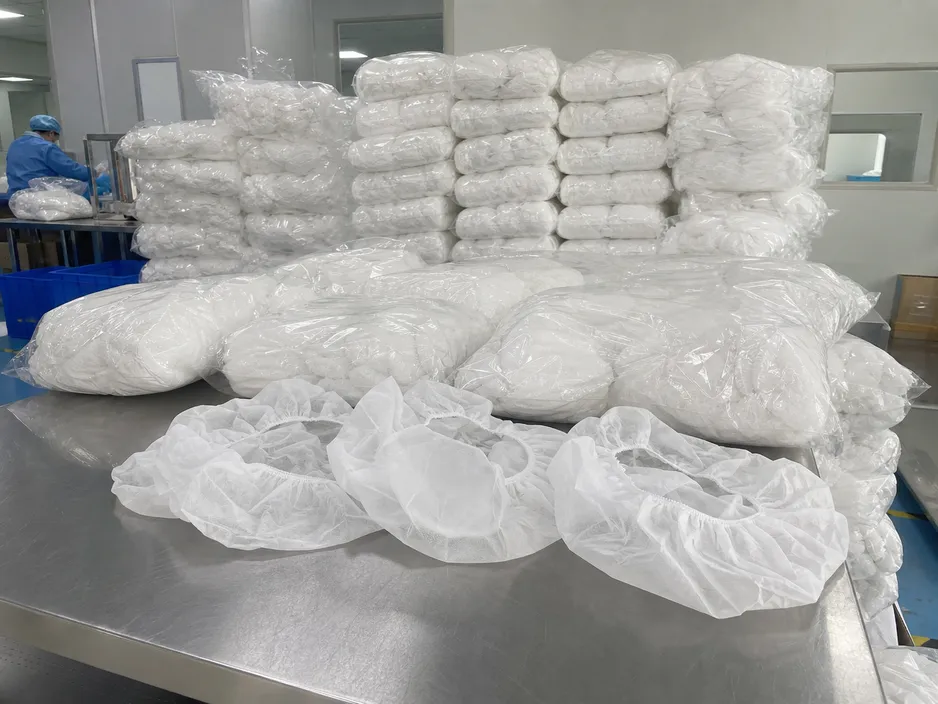
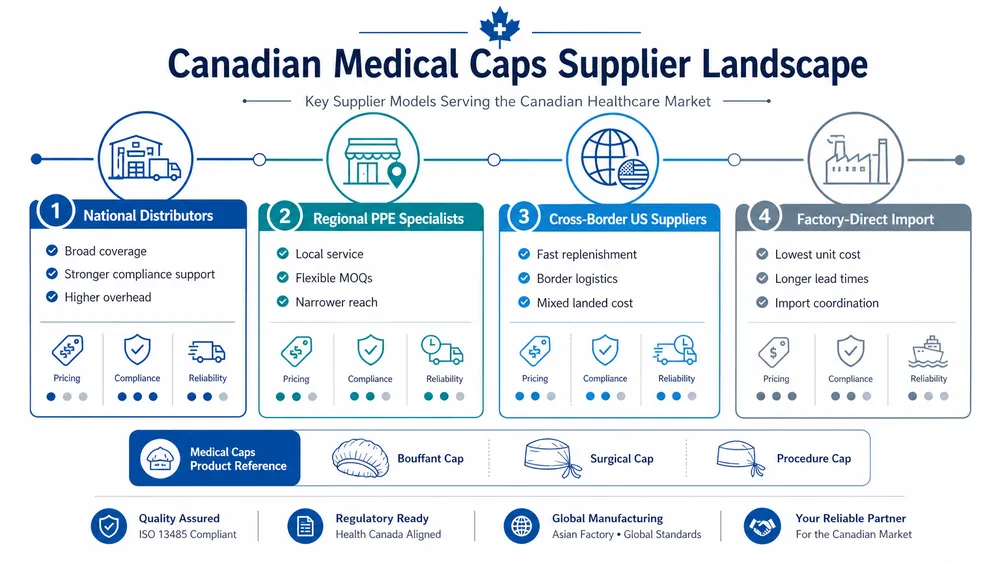
The Canadian market for disposable medical caps — bouffant caps, surgical caps, and procedure caps — runs through a relatively small number of distribution channels. Most procurement teams end up talking to the same four or five national distributors, a handful of regional PPE suppliers, and an increasing number of cross-border US sources that ship into Canada. That's not a criticism of the landscape; it's just the reality of a market this size. But it does mean that if you're sourcing at volume, you're often paying a distributor margin on top of a distributor margin, and your spec consistency depends on whoever that distributor's current factory relationship happens to be.
This article maps the 10 most relevant suppliers serving the Canadian market for disposable medical caps, explains what each model is actually good for, and lays out the trade-offs between domestic distribution and factory-direct import — so you can make the sourcing decision that fits your volume, timeline, and compliance requirements.

What Serious Buyers Evaluate Before Approving a Medical Caps Supplier
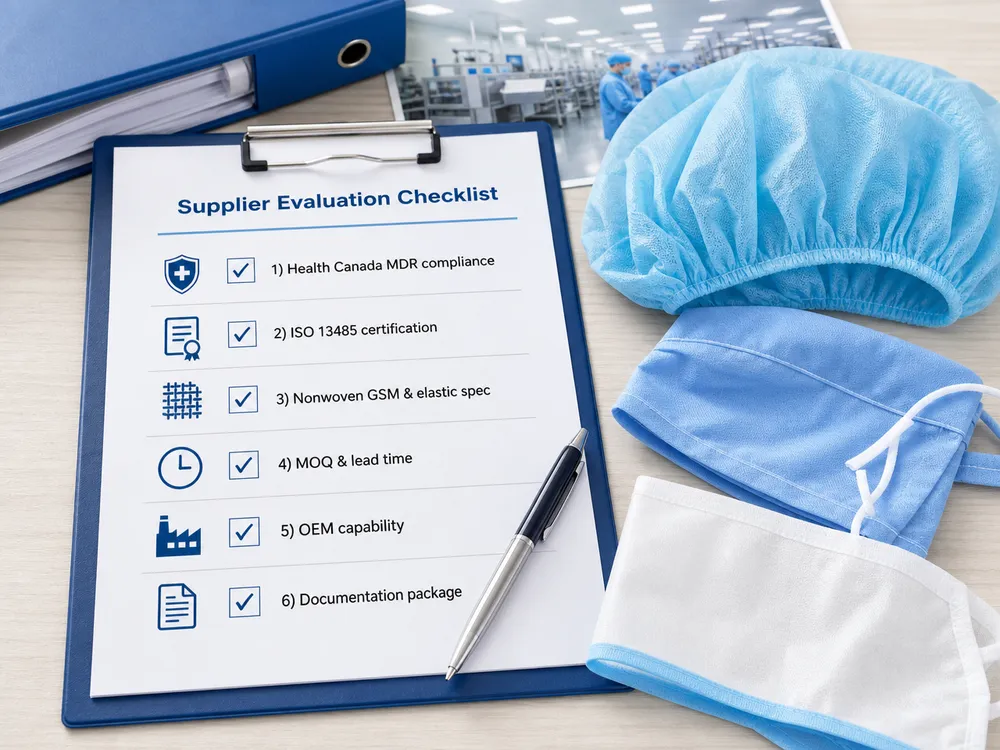
Before the list, the criteria. Canadian hospital procurement teams and institutional buyers don't evaluate suppliers the same way a retail buyer does. The questions that actually determine approval are:
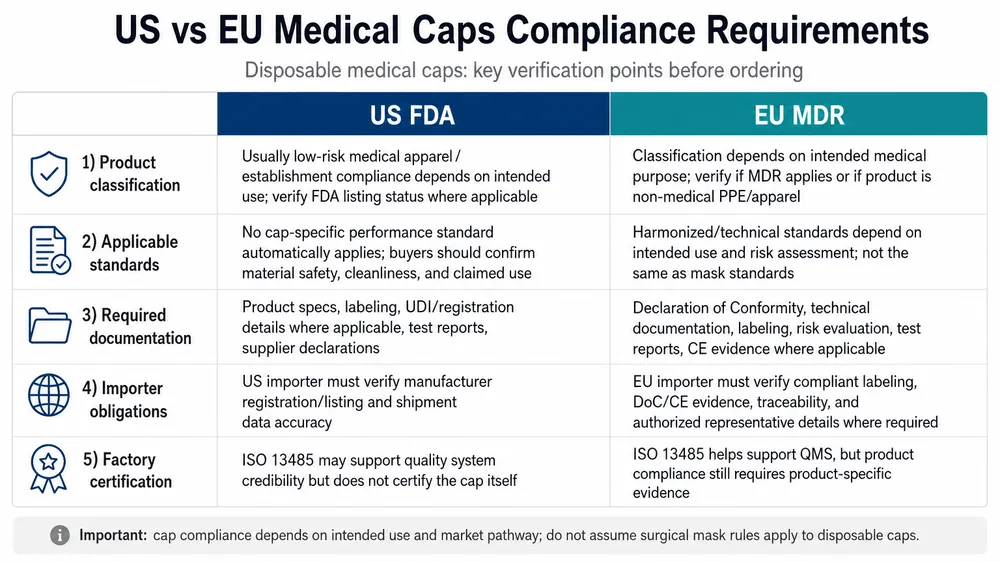
Health Canada MDR compliance. Disposable medical caps classified as Class I medical devices under Canada's Medical Devices Regulations require a valid Medical Device Establishment Licence (MDEL) from the importer or distributor. If you're importing directly, you need your own MDEL or a licensed importer of record. If you're buying from a domestic distributor, they carry the MDEL — but you should still verify it's current.
ISO 13485:2016 certification. Health Canada's quality system expectations for medical device supply chains align closely with ISO 13485. A supplier holding a current ISO 13485 certificate has documented risk management, traceability, and corrective action processes — the infrastructure that keeps spec consistency across repeat orders. ISO 9001 alone is not equivalent.
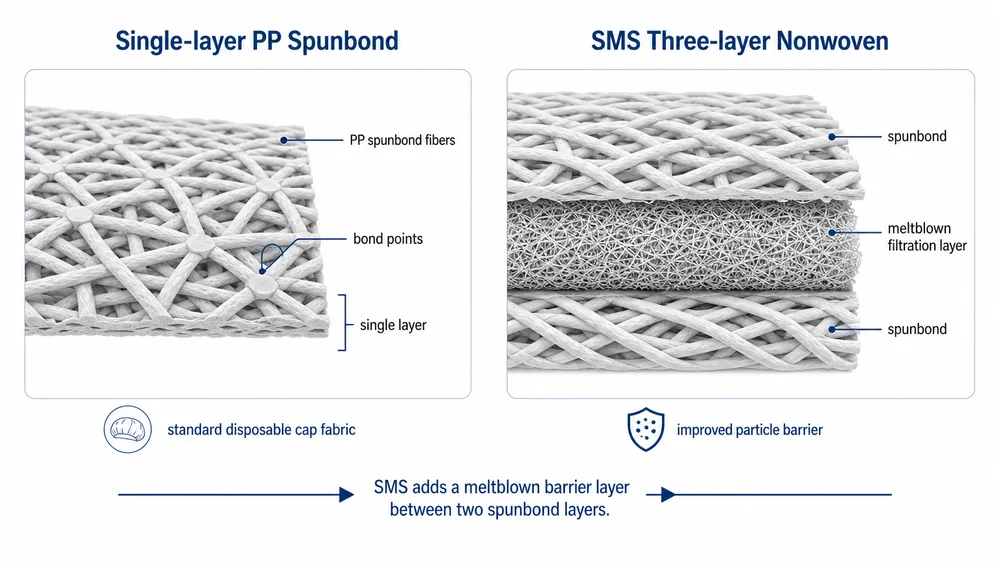
Nonwoven GSM and elastic specification. This is where most sourcing decisions go wrong. A bouffant cap listed as "21 GSM polypropylene" from two different suppliers can perform very differently depending on fiber uniformity, bonding method, and elastic tensile strength. (We've seen buyers approve a sample that passes, then receive bulk product where the elastic has 30% less tensile force — the cap fits the sample but fails at scale.) Ask for the elastic tensile spec in Newtons, not just the GSM.
MOQ and lead time structure. National distributors typically carry stock and can ship within days. Factory-direct sources require 4–8 weeks lead time but offer significantly lower per-unit cost at volumes above 50,000 pieces. The right answer depends on your order cadence, not just your unit price target.
OEM and private-label capability. If you're building a branded product line or supplying under a house brand, you need a supplier with in-house packaging capability — not a distributor who outsources the labeling to a third party.
The 10 Suppliers Serving the Canadian Medical Caps Market
The suppliers below represent the realistic sourcing landscape for Canadian buyers. They span national distribution, regional PPE supply, cross-border US channels, and factory-direct import. No theatrical ranking — the order reflects supplier model type, moving from the largest domestic distributors down to factory-direct alternatives.
1. McKesson Canada — mckesson.ca
Supplier model: National healthcare distributor Product range: Full PPE line including bouffant caps, surgical caps, and procedure caps across multiple brands Certifications: Carries Health Canada MDEL; product certifications vary by brand MOQ: No formal minimum for stocked items; volume pricing tiers apply Lead time: 1–5 business days from Canadian distribution centres Pricing tier: Mid to high — distributor margin built in
McKesson Canada is the largest healthcare distributor in the country, with distribution infrastructure across every province. For hospital procurement teams that need caps on short notice or want consolidated invoicing across a full PPE category, McKesson is the default choice. The trade-off is cost: you're paying for the distribution layer, the warehousing, and the account management overhead. For emergency replenishment or low-volume orders where speed matters more than unit economics, that premium is justified. For repeat high-volume procurement, it compresses your margin.
2. Medline Canada — medline.ca
Supplier model: National healthcare distributor and private-label manufacturer Product range: Bouffant caps, surgical caps, isolation caps under Medline house brand and third-party brands Certifications: Health Canada MDEL; ISO 13485-aligned quality systems MOQ: Stock items available in case quantities; volume programs for institutional buyers Lead time: 2–5 business days from Canadian stock Pricing tier: Mid — competitive on volume programs
Medline operates both as a distributor and as a private-label brand owner, which gives them more control over product specs than a pure distributor. Their house-brand caps are manufactured to defined specifications, and they maintain consistent SKUs across order cycles — a meaningful advantage over distributors who switch factories based on price. For institutional buyers running annual supply contracts, Medline's volume program pricing is worth negotiating. (Their Canadian operation has expanded significantly since 2020, and their stock depth on PPE is more reliable than it was during the COVID-era disruptions.)
3. Henry Schein Canada — henryschein.ca
Supplier model: Healthcare products distributor, dental and medical Product range: Disposable caps, bouffant caps, and surgical head covers across multiple brands Certifications: Health Canada MDEL; product-level certifications vary MOQ: Case quantities; no formal volume minimum for stocked items Lead time: 2–5 business days Pricing tier: Mid to high
Henry Schein's Canadian operation serves both dental and medical markets, which means their cap inventory skews toward procedure caps and bouffant caps used in clinical and dental settings rather than OR-grade surgical caps. If your buyers are dental clinics, outpatient surgical centres, or medical offices, Henry Schein's distribution network and account management infrastructure is well-suited. For hospital-grade surgical cap procurement at volume, their product depth is narrower than McKesson or Medline.
4. Cardinal Health Canada — cardinalhealth.ca
Supplier model: National healthcare distributor Product range: Surgical caps, bouffant caps, and OR accessories under Cardinal Health and third-party brands Certifications: Health Canada MDEL; Cardinal Health's own-brand products carry relevant certifications MOQ: Case quantities for stocked items; contract pricing for institutional volumes Lead time: 2–5 business days from Canadian distribution Pricing tier: Mid — competitive on institutional contracts
Cardinal Health Canada focuses heavily on hospital and surgical centre supply chains. Their OR-grade surgical cap range is more developed than general PPE distributors, and they have established relationships with Canadian hospital group purchasing organizations (GPOs). If you're supplying into hospital systems that already have Cardinal Health contracts, working within their distribution framework reduces procurement friction. The limitation is the same as any national distributor: you're buying at their margin, and their product sourcing decisions are made at the corporate level, not based on your spec requirements.
5. Kimberly-Clark Professional Canada — kcprofessional.com/en-ca
Supplier model: Brand manufacturer with Canadian distribution Product range: Surgical caps and head covers under Kimberly-Clark and Halyard Health brands Certifications: ISO 13485; CE; FDA; Health Canada MDEL MOQ: Case quantities through distribution partners; direct programs for large institutional buyers Lead time: 3–7 business days through Canadian distributors Pricing tier: Mid to high — brand premium applies
Kimberly-Clark's Halyard Health line is one of the few brand-name surgical cap products with a full certification stack including ISO 13485 and CE. For hospital procurement teams that require named-brand products for formulary compliance, Halyard is a credible option. The brand premium is real — you're paying for the certification documentation and the brand recognition, not just the nonwoven fabric. For buyers who need the certification stack but don't need the brand name on the packaging, factory-direct sourcing with equivalent certifications is worth comparing on landed cost.
6. Ansell Healthcare Canada — ansell.com/en-ca
Supplier model: Global PPE manufacturer with Canadian market presence Product range: Protective apparel including surgical caps and head covers Certifications: ISO 13485; CE; Health Canada MDEL MOQ: Case quantities through distribution; direct programs for volume buyers Lead time: Variable — some products stocked in Canada, others shipped from US or international distribution Pricing tier: Mid to high
Ansell's Canadian presence is primarily through distribution partners rather than direct sales for most cap products. Their certification stack is solid, and their quality systems are well-documented — relevant for buyers who need to pass hospital procurement audits. The practical limitation is that Ansell's core business is gloves and protective apparel; caps are a secondary category, which means product range depth and stock reliability are less consistent than their primary lines.
7. Uline Canada — uline.ca
Supplier model: Industrial and packaging distributor with PPE range Product range: Bouffant caps, disposable caps, and basic procedure caps Certifications: Product-level certifications vary; not a medical device specialist MOQ: Case quantities; no formal minimum Lead time: 1–3 business days from Canadian distribution centres Pricing tier: Low to mid — competitive on commodity caps
Uline Canada is worth knowing about for one specific use case: commodity bouffant caps for food processing, light industrial, and non-clinical environments where medical device certification is not required. Their pricing on basic polypropylene bouffant caps is competitive, their stock depth is reliable, and their logistics infrastructure is fast. For clinical or hospital procurement where Health Canada MDR compliance is required, Uline is not the right channel — their cap products are not positioned as medical devices. For buyers supplying food service, manufacturing, or non-regulated environments, Uline is a practical option.
8. Allegro Industries Canada — allegro.ca
Supplier model: Safety and PPE distributor Product range: Disposable caps, bouffant caps, and head protection products Certifications: Product-level certifications vary by item MOQ: Case quantities Lead time: 2–5 business days Pricing tier: Low to mid
Allegro serves the industrial safety and PPE market in Canada, with cap products that span both regulated and non-regulated applications. Their medical cap range is narrower than dedicated healthcare distributors, but for buyers who are sourcing caps alongside other PPE categories (gloves, gowns, masks), Allegro's consolidated ordering can reduce procurement overhead. Verify product-level certifications individually before using Allegro-sourced caps in clinical settings.
9. Dynarex Canada (via cross-border distribution) — dynarex.com
Supplier model: US-based medical supply manufacturer shipping to Canada Product range: Bouffant caps, surgical caps, and disposable head covers Certifications: FDA; ISO 13485; Health Canada MDEL through Canadian importers MOQ: Case quantities; volume pricing available Lead time: 5–10 business days cross-border Pricing tier: Low to mid — US pricing with cross-border freight added
Dynarex is a US manufacturer that supplies a significant portion of the North American disposable medical cap market. Their products are available in Canada through licensed importers and some direct cross-border programs. The pricing is competitive relative to Canadian national distributors, and their product range covers standard bouffant and surgical cap SKUs. The cross-border logistics add 3–5 days to lead time compared to domestic stock, and you need to confirm that the Canadian importer of record holds a current MDEL for the specific product. For buyers comfortable managing cross-border procurement, Dynarex is a cost-effective option for standard SKUs.
10. Protective Industrial Products (PIP) Canada — pipcanada.com
Supplier model: Safety and PPE distributor with Canadian operations Product range: Disposable caps and head protection across industrial and healthcare applications Certifications: Product-level certifications vary MOQ: Case quantities Lead time: 2–5 business days Pricing tier: Low to mid
PIP Canada operates across industrial safety and healthcare PPE categories. Their cap range is primarily positioned for industrial and light-clinical use. For buyers sourcing caps for non-sterile clinical environments, food processing, or manufacturing, PIP's pricing and stock availability are competitive. For OR-grade or hospital-formulary procurement, verify product certifications and Health Canada MDR status before committing to volume.
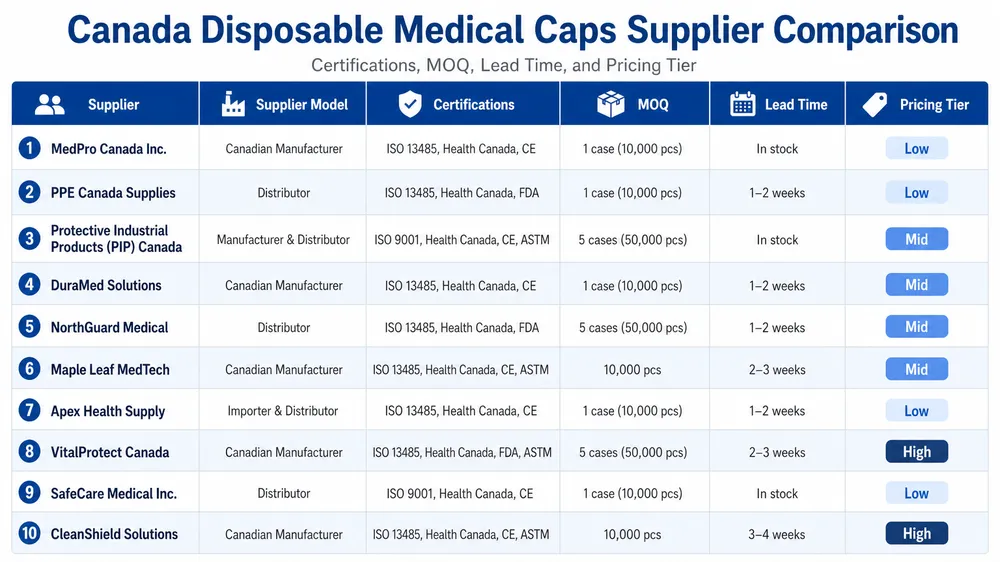
The Supplier Comparison at a Glance
| Supplier | Model | ISO 13485 | Health Canada MDEL | MOQ | Lead Time | Pricing Tier |
|---|---|---|---|---|---|---|
| McKesson Canada | National distributor | Via products | Yes | Case qty | 1–5 days | Mid–High |
| Medline Canada | Distributor + private label | Aligned | Yes | Case qty | 2–5 days | Mid |
| Henry Schein Canada | Healthcare distributor | Via products | Yes | Case qty | 2–5 days | Mid–High |
| Cardinal Health Canada | National distributor | Via products | Yes | Case qty | 2–5 days | Mid |
| Kimberly-Clark Professional | Brand manufacturer | Yes | Yes | Case qty | 3–7 days | Mid–High |
| Ansell Healthcare Canada | Global PPE manufacturer | Yes | Yes | Case qty | Variable | Mid–High |
| Uline Canada | Industrial distributor | Not medical | No (non-clinical) | Case qty | 1–3 days | Low–Mid |
| Allegro Industries Canada | Safety/PPE distributor | Varies | Varies | Case qty | 2–5 days | Low–Mid |
| Dynarex (cross-border) | US manufacturer | Yes | Via importer | Case qty | 5–10 days | Low–Mid |
| PIP Canada | Safety/PPE distributor | Varies | Varies | Case qty | 2–5 days | Low–Mid |
Where Local Distribution Earns Its Premium
The national distributors on this list — McKesson, Medline, Cardinal Health — exist because they solve real problems. Emergency replenishment when a ward runs short. Consolidated invoicing across 50 product categories. Account managers who know your procurement system. Delivery in 48 hours to a hospital in Winnipeg.
For those use cases, the distributor margin is not waste — it's the cost of the service. If you're running a hospital supply chain and you need 500 bouffant caps by Thursday, you're not going to wait six weeks for a factory shipment. The local distributor earns that premium every time.
The question is whether that premium makes sense for your entire volume, or just for the urgent portion of it.
Where the Distributor Model Compresses Your Margin
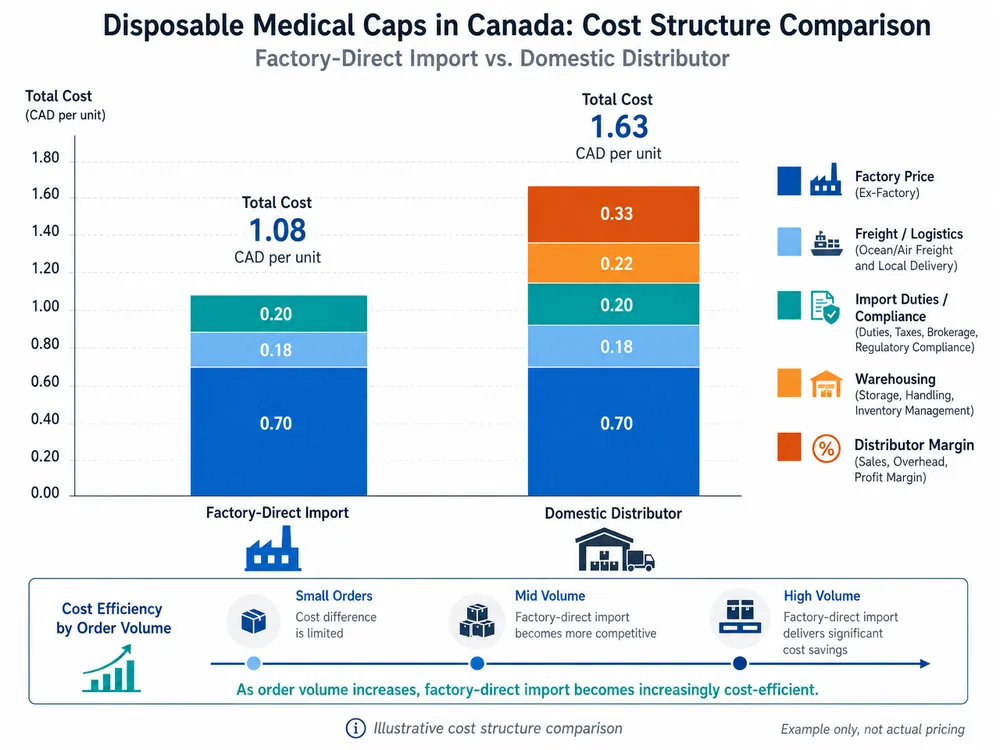
Here's the math that most Canadian buyers don't run explicitly. A national distributor sources caps from a factory — often in China, sometimes in the US — at a factory price. They add warehousing cost, logistics overhead, account management, and their margin. By the time the cap reaches your purchase order, you're typically paying 40–80% above the factory price, depending on the distributor's cost structure and your volume tier.
For a buyer purchasing 500,000 bouffant caps per year, that margin layer is a significant number. At a conservative 50% markup over factory cost, you're paying for half a year's worth of caps just to cover the distribution infrastructure.
The second issue is spec consistency. A distributor doesn't manufacture — they source. When their current factory relationship changes (and it does change — pricing pressure, capacity shifts, supply disruptions), the product you receive in Q3 may not be identical to what you approved in Q1. The GSM might be the same on the spec sheet, but the elastic tensile, the bonding uniformity, and the dimensional tolerances can drift. (We've had Canadian buyers come to us specifically because their previous distributor-sourced caps started failing fit checks after a supplier switch they weren't told about.)
Health Canada MDR Compliance: What Changes When You Import Directly
If you're considering factory-direct import, the compliance picture is straightforward but requires attention. Disposable medical caps classified as Class I medical devices under Canada's Medical Devices Regulations require:
- A valid Medical Device Establishment Licence (MDEL) held by the Canadian importer of record
- A Declaration of Conformity from the manufacturer confirming the device meets applicable safety and effectiveness requirements
- Manufacturer quality system documentation — ISO 13485 certification is the standard expectation
The manufacturer's certification stack matters here. A factory holding ISO 13485:2016 and CE (EU MDR) has already been through a quality system audit that Health Canada's MDR framework recognizes as credible evidence of compliance. CE under EU MDR is one of the more rigorous conformity assessment pathways globally — if a factory has maintained it through the post-2021 MDR transition, their documentation infrastructure is solid.
(One practical note: if you're setting up a direct import program for the first time, the MDEL application process takes 30–60 days. Build that into your timeline before you place the first order.)
Factory-Direct Sourcing: The Economics and the Trade-Offs
We manufacture disposable medical caps at eztio — bouffant caps, surgical caps, and procedure caps — and we supply Canadian buyers directly. I'll be straightforward about where factory-direct makes sense and where it doesn't.
Where it makes sense:
- Repeat-volume procurement above 50,000 pieces per order cycle. At that volume, the per-unit savings over distributor pricing are substantial, and the 4–6 week lead time is manageable with basic inventory planning.
- Private-label or OEM programs. If you're building a branded cap line or supplying under a house brand, you need a factory with in-house packaging capability. Distributors can't do this without adding another supplier to the chain.
- Spec-critical procurement where consistency across batches matters. We produce our own nonwoven fabric, which means the GSM, fiber uniformity, and elastic tensile spec are controlled at the source — not dependent on whoever our fabric supplier shipped last week.
- Cost-sensitive bidding on institutional or government tenders. Factory-direct landed cost gives you a margin buffer that distributor-sourced product doesn't.
Where local distribution is still the right answer:
- Urgent orders under 10,000 pieces where speed matters more than unit cost.
- First-time procurement where you need to test product before committing to volume.
- Situations where your procurement system requires a Canadian-registered supplier and you don't have the bandwidth to set up an MDEL-compliant import program.
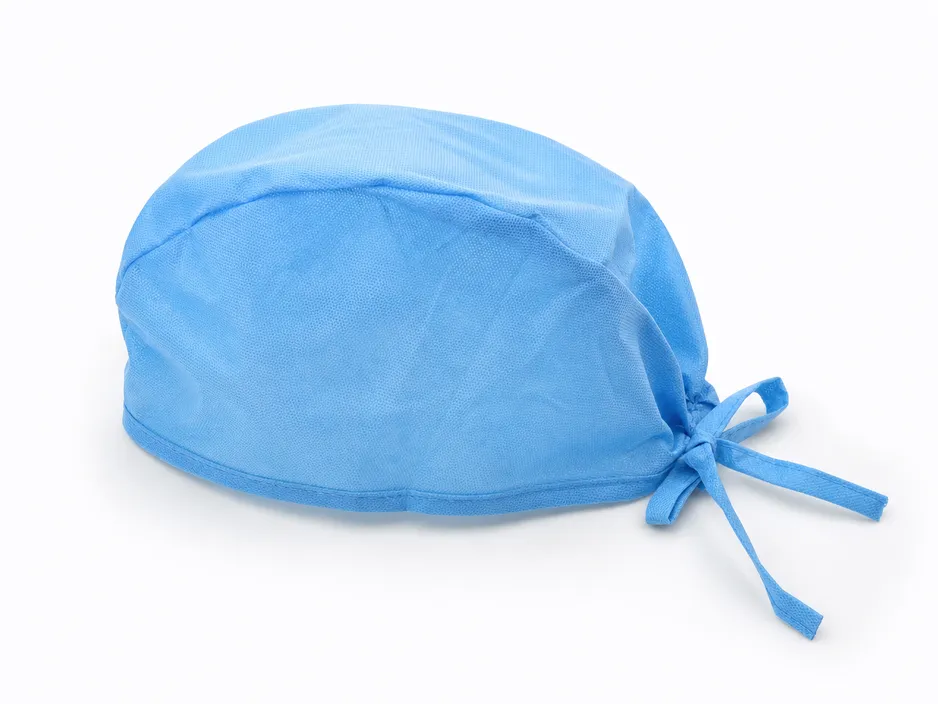
Our bouffant medical caps run at 21 GSM polypropylene nonwoven with elastic tensile tested to ≥15N — the spec that prevents the fit failures that happen when elastic degrades under extended wear. Our surgical medical caps are produced in our Class 100,000 (ISO 8) cleanroom, which is the facility standard that hospital procurement audits look for. Both product lines carry ISO 13485:2016 and CE (EU MDR) certification — the documentation your compliance team needs to clear Health Canada review.
The 50,000-piece MOQ on standard SKUs is accessible for mid-size Canadian distributors and regional hospital networks. We're not asking you to commit to a container before you've tested the product — most Canadian buyers start with a sample evaluation, then move to a trial order before setting up a repeat procurement program.
What Canadian Hospital Procurement Teams Actually Ask
Hospital procurement teams in Canada — particularly those operating under provincial health authority frameworks — run a more structured supplier evaluation than most buyers expect. The questions that come up consistently:
"Is the manufacturer ISO 13485 certified, and is the certificate current?" Not ISO 9001. ISO 13485 specifically. The certificate should show the scope of certification (it should include disposable medical caps or nonwoven medical devices), the issuing body, and the expiry date. A certificate that expired 18 months ago and hasn't been renewed is a red flag.
"What is the nonwoven GSM and elastic tensile specification?" Hospital infection control teams have learned — often the hard way — that caps that fit the sample don't always fit at scale. The elastic tensile spec in Newtons is the number that matters. A cap with 21 GSM fabric and ≥15N elastic tensile will maintain fit through a full surgical shift. A cap with the same GSM but 8N elastic will loosen within an hour.
"Can you provide batch traceability documentation?" ISO 13485 requires it, but not every supplier actually maintains it. Ask for a sample traceability record from a previous production batch — lot number, raw material source, in-process inspection records, and outgoing test results. If the supplier can't produce this within 24 hours, their quality system is documentation on paper, not in practice.
"What is your lead time reliability record?" Not the quoted lead time — the actual on-time delivery rate across the last 12 months. Distributors with deep stock can answer this easily. Factory-direct suppliers should be able to provide order history data. A supplier who quotes 4 weeks and delivers in 4 weeks consistently is more valuable than one who quotes 3 weeks and delivers in 5.
"Do you have OEM or private-label capability?" For health authorities building house-brand supply programs, this is increasingly relevant. The answer should include in-house packaging capability, not just "we can arrange it."
Choosing the Right Sourcing Route for Your Volume and Timeline
The sourcing decision for disposable medical caps in Canada isn't binary — it's a question of which model fits which portion of your procurement.
For urgent, low-volume, or emergency orders: McKesson Canada, Medline Canada, or Cardinal Health Canada. Fast, reliable, MDEL-compliant, and consolidated with your existing supply chain. The premium is real but justified.
For mid-volume repeat procurement where spec consistency matters: Medline's private-label program or Kimberly-Clark's Halyard line are the strongest domestic options. Both have more control over their product specs than pure distributors. Expect mid-tier pricing.
For commodity caps in non-clinical environments: Uline Canada or Allegro Industries for basic bouffant caps where medical device certification is not required. Competitive pricing, fast delivery, no compliance overhead.
For high-volume repeat procurement, private-label programs, or cost-sensitive institutional bidding: Factory-direct sourcing from a certified manufacturer. The economics improve significantly above 50,000 pieces per order, and the spec consistency advantage compounds across repeat orders. The compliance setup (MDEL, import documentation) is a one-time investment that pays back on the first container.
The buyers who get the best economics on medical caps in Canada are typically running a hybrid model: domestic distributor for emergency and low-volume needs, factory-direct for their planned repeat volume. That split lets you capture the cost advantage where it matters most without sacrificing the speed you need for urgent situations.
Frequently Asked Questions
What certifications should a medical caps supplier have for the Canadian market?
At minimum: a current ISO 13485:2016 certificate covering disposable medical caps or nonwoven medical devices, and a valid Health Canada Medical Device Establishment Licence (MDEL) held by the Canadian importer or distributor. For hospital and institutional procurement, CE (EU MDR) or FDA 510(k) registration from the manufacturer adds credibility and simplifies the Declaration of Conformity documentation. ISO 9001 alone is not sufficient for medical device supply chains — it doesn't cover the risk management and traceability requirements that Health Canada MDR expects.
What is a realistic MOQ for factory-direct medical caps from China?
For standard bouffant and surgical cap SKUs from a certified manufacturer, 50,000 pieces per order is a typical accessible minimum. Below that threshold, the per-unit economics of factory-direct sourcing narrow significantly — freight and import costs become a larger share of landed cost. For custom configurations or private-label programs, MOQ is typically higher (100,000+ pieces) to justify line setup and packaging tooling. If a factory quotes you 10,000-piece MOQ on custom OEM caps, ask how they're handling the line changeover cost — it's usually absorbed into a higher unit price.
How do I verify that a medical caps supplier's ISO 13485 certificate is current and in scope?
Request the full certificate document, not just a logo or a claim. The certificate should show: the issuing certification body (DEKRA, BSI, TÜV, SGS, etc.), the certificate number, the scope of certification (should explicitly include disposable medical caps, nonwoven medical devices, or equivalent), the issue date, and the expiry date. You can verify most ISO 13485 certificates directly through the issuing body's online registry. A certificate that's expired or whose scope doesn't cover the specific product type is not valid evidence of compliance.
What nonwoven GSM is appropriate for bouffant caps used in surgical environments?
For OR and surgical environments, 21–25 GSM polypropylene spunbond nonwoven is the standard range. Below 18 GSM, the fabric becomes too lightweight to maintain structural integrity under extended wear and may allow hair penetration at the edges. Above 28 GSM, the cap becomes stiffer and less comfortable for long procedures without meaningful performance gain. The GSM spec matters less than the elastic tensile — a 21 GSM cap with ≥15N elastic tensile will outperform a 25 GSM cap with 8N elastic in a real OR environment. Always ask for both specs.
When does factory-direct sourcing make financial sense for Canadian buyers?
The crossover point is typically around 50,000 pieces per order cycle. Below that, the freight cost per unit and the compliance setup overhead (MDEL, import documentation) erode the factory-direct price advantage. Above 50,000 pieces on a repeat basis, factory-direct landed cost is typically 30–50% below domestic distributor pricing for equivalent certified product. The other trigger is private-label or OEM requirements — if you need your brand on the packaging, factory-direct is almost always the right route because distributors can't offer in-house packaging capability at competitive cost.