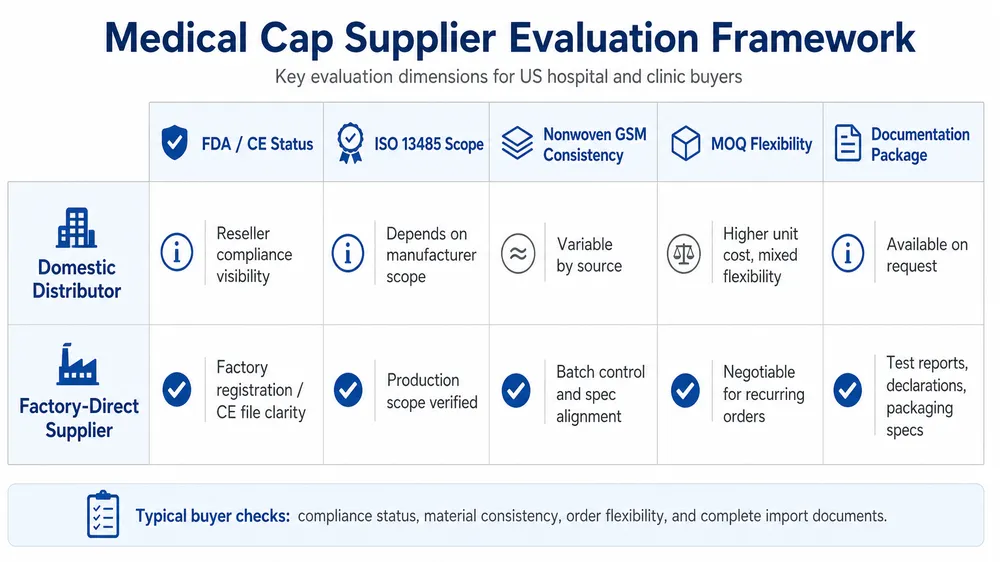
eztio

DNOOO blank theme is active for local preview.

How to Customize Surgical Medical Caps for Private-Label Programs Without Delaying Certification

The most common mistake we see in surgical cap OEM programs isn't a quality problem. It's a sequencing problem. A buyer finalizes their branding, approves packaging artwork, and then asks whether the customization affects their CE or FDA clearance. At that point, the answer can cost them four to six weeks — or more, if the change they made requires new performance testing.

The certification risk in surgical cap OEM is real, but it's also predictable. The line between "this change is fine" and "this change requires re-testing" is not arbitrary. It follows the logic of your existing approval scope. If you understand that logic before you start customizing, you can build a private-label program that ships with full documentation and no surprises.

This guide walks through the exact process we use at eztio for OEM and private-label cap programs — what you can change freely, what triggers our ISO 13485 design-change review, and how to move from artwork submission to production without stalling your certification timeline.

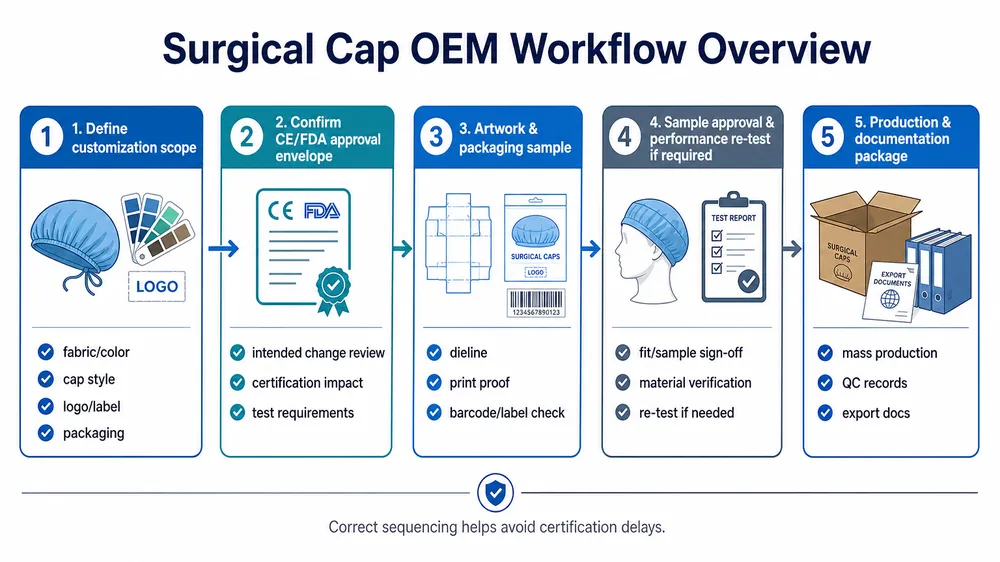
Surgical cap OEM customization workflow from artwork submission to certified production and export documentation

The real certification risk: which customizations void your approval scope

Your CE mark and FDA 510(k) registration cover a specific product configuration. The approval is tied to the device as it was tested and documented — the nonwoven fabric specification, the filtration layer, the structural dimensions, the materials in contact with the wearer. Change any of those parameters and you've moved outside the approved configuration. That's not a bureaucratic technicality; it's the mechanism by which the certification works.

The good news is that most of what buyers actually want to customize — branding, packaging, color, tie configuration — sits entirely outside the performance-critical parameters. These changes don't touch the filtration layer, the fabric spec, or the structural dimensions that determine whether the cap performs to EN 13795 or equivalent standards. They're cosmetic and commercial changes, and they stay within the existing approval envelope.

The changes that create certification risk are the ones that alter how the cap performs:

  • Changing the nonwoven fabric GSM or grade — the outer and inner layers affect breathability, particle shedding, and fluid resistance. A different fabric spec requires re-testing.
  • Modifying the filtration layer — for surgical caps with a filtration component, any change to the meltblown layer or its basis weight requires BFE re-testing.
  • Altering structural dimensions — if the cap's coverage area, seam placement, or overall dimensions change materially, the device is no longer the same configuration that was tested.
  • Substituting elastic or tie materials — elastic tensile spec and tie material affect fit and contamination control. A different elastic supplier or spec requires validation.

Everything else — your logo, your color, your packaging format, your label language — is fair game without triggering re-certification.

(One thing worth flagging early: label compliance is separate from device certification. Your label must meet the regulatory requirements of your target market — language, symbol standards, UDI requirements for EU MDR, lot traceability. We review label artwork against target-market requirements before printing. This catches problems that have nothing to do with the cap itself but can still hold up your import clearance.)

Step 1 — Define your customization scope before sampling begins

The first conversation we have with any new OEM buyer is about scope. Not artwork. Not pricing. Scope.

We need to know four things:

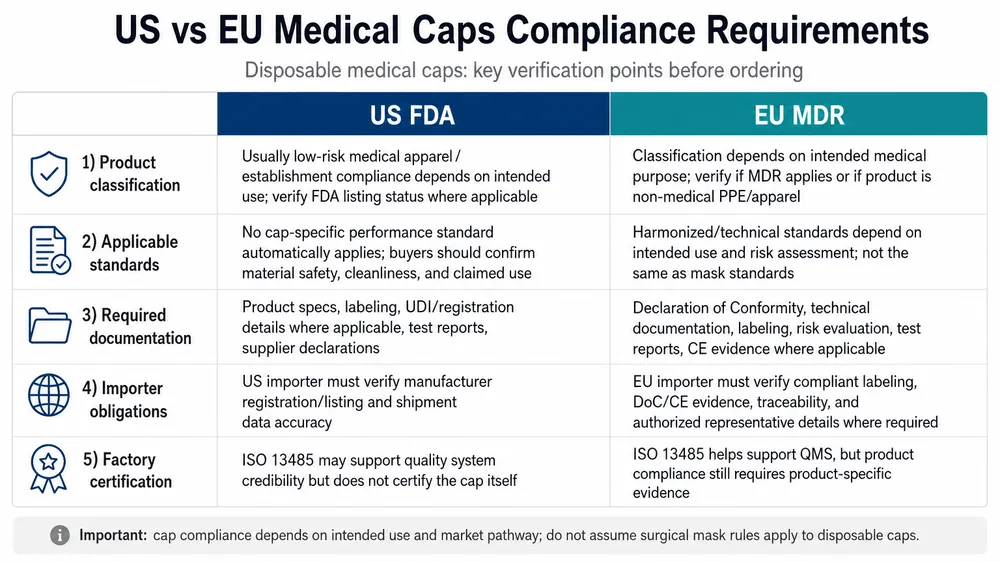
  1. Target market — CE for EU, FDA 510(k) for US, or both. This determines which certification documentation travels with your shipment and which label requirements apply.
  2. Branding and packaging requirements — logo, color, label language, retail vs. clinical packaging format, inner pack configuration.
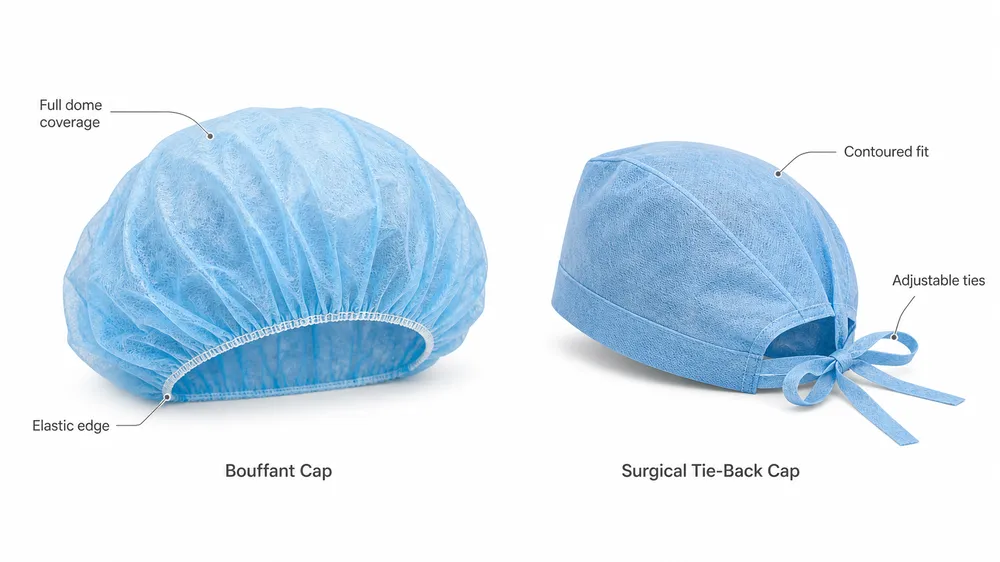
  3. Product configuration — standard bouffant cap, surgical tie-back cap, or a specific size/coverage requirement. If you need a configuration we don't currently run, that's an ODM project with a different timeline.
  4. Fabric or performance spec changes — if you have a specific GSM requirement, a different color preference that requires a different nonwoven dye lot, or a filtration spec that differs from our standard, we need to know this before sampling.

Getting this on paper before we start saves time on both sides. We've had buyers come back after sample approval to say they need a different elastic color — which is fine — and buyers who come back to say they need a different fabric weight — which is not fine at that stage, because it means the sample they approved is no longer the product they're ordering.

Send us your requirements in writing. A one-page brief covering the four points above is enough to start. We'll confirm what falls within the existing approval scope and flag anything that requires additional review before we cut samples.

Step 2 — What stays within the existing CE and FDA approval envelope

Our Surgical Medical Cap carries CE certification under EU MDR and FDA 510(k) registration. The approved configuration covers the standard nonwoven fabric spec, the elastic and tie configurations we currently produce, and the structural dimensions of our standard cap range.

Within that envelope, you can customize freely:

Customization Within approval scope? Notes
Logo and brand name on cap Yes Printed or woven label
Custom packaging (box, poly bag, header card) Yes Label compliance review required
Cap color (standard nonwoven color options) Yes Subject to available dye lots
Tie-back vs. elastic configuration Yes Both configurations are within our standard range
Label language (English, French, German, Arabic, etc.) Yes Must meet target-market symbol and language requirements
Inner pack quantity (10s, 20s, 100s) Yes Packaging spec change only
Custom carton branding Yes No device change
Fabric GSM change No — requires re-testing Triggers design change review
Different nonwoven supplier No — requires re-qualification New material validation required
Filtration layer modification No — requires BFE re-test Performance parameter change
Structural dimension change No — requires re-testing Device configuration change
Elastic spec change (different supplier or tensile rating) No — requires validation Fit and contamination control parameter

The table above reflects our ISO 13485 design-change classification. Changes in the left column are documented as cosmetic/commercial modifications — they go through our standard OEM process without triggering a new performance test cycle. Changes in the right column are classified as design changes under our QMS and require a formal review, updated risk assessment, and re-testing before production.

For more on how tie-back configuration and fabric spec interact with fit performance, see our post on surgical cap tie-back design and fabric spec.

Decision matrix showing which surgical cap customizations stay within CE and FDA approval scope versus which require re-testing

Step 3 — Artwork submission and packaging sample production

Once scope is confirmed, the OEM process moves to artwork and packaging.

What we need from you:

  • Logo files in vector format (AI, EPS, or high-resolution PDF). We can work with raster files if vector isn't available, but print quality on small label text is better with vector.
  • Pantone color references if color matching matters for your brand. Standard nonwoven cap colors (white, blue, green) don't require color matching, but if your packaging uses a specific brand color, give us the Pantone reference.
  • Label text in final form — product name, lot number format, expiry date format, regulatory symbols, language. We'll review this against target-market requirements before we go to print.
  • Packaging format — retail box, poly bag with header card, bulk clinical bag, or custom carton. If you have a reference sample from your current supplier, send it. It's faster than describing it.

What we produce:

We run a pre-production sample set — typically 50–100 caps in your branded packaging — before committing to full production. This sample run uses the same production line, the same materials, and the same process parameters as the bulk order. It's not a hand-assembled prototype; it's a short production run.

The sample set goes through our standard outgoing inspection: visual check, packaging integrity, label verification, and dimensional check. We ship the sample set to you for approval. If you need to test the caps against your own internal protocol or submit them to your own lab, this is the stage to do it.

Sample production lead time is typically 7–10 working days from artwork approval. We'll give you a specific date when we confirm the artwork files are complete.

Step 4 — Sample approval and performance re-testing (when required)

For standard OEM programs — branding and packaging changes only — sample approval is the final gate before production. You review the samples, confirm the branding and packaging meet your requirements, and we proceed to bulk production.

If your program includes any changes that fall outside the standard approval envelope (see Step 2), this is where the re-testing happens. We don't skip this step, and we don't recommend buyers try to work around it. The re-test is what gives you a defensible certification position when your product goes through import inspection or procurement audit.

What re-testing covers:

  • BFE (Bacterial Filtration Efficiency) — required if any change was made to the filtration layer or fabric spec. We run this in-house first, then submit to a third-party lab for the certification documentation.
  • PFE (Particulate Filtration Efficiency) — required for caps with a filtration rating claim.
  • Delta-P (breathability) — required if fabric spec changed. A fabric that's denser than spec will fail breathability even if it passes filtration.
  • Elastic tensile testing — required if elastic spec or supplier changed. We test elongation at break and recovery force against our standard spec.

We run in-house testing first. If the in-house results are within spec, we submit to the third-party lab. If the in-house results flag a problem, we investigate and correct before spending time and money on third-party testing. (This is the part of having an in-house QC lab that actually matters — catching a fabric batch that's off-spec before it becomes a certification delay.)

Third-party re-testing adds 10–15 working days to the timeline, depending on the lab's current queue. We'll tell you this upfront when we classify your customization scope in Step 1, so it doesn't come as a surprise when you're planning your launch date.

How in-house meltblown production protects your filtration spec during customization

This is worth explaining directly, because it's the question we get most often from buyers who've had problems with other suppliers.

Most surgical cap factories buy their nonwoven fabric — including any filtration layer — from outside suppliers. When you ask them to customize the fabric spec, they have to go back to their fabric supplier, request a new material, qualify it, and re-test. That process takes time, and it introduces a variable they don't control: whether the new fabric actually performs to the spec they ordered.

We produce our own meltblown nonwoven fabric in-house. The meltblown layer is the filtration component — fiber diameter, basis weight, and electrostatic charge level are all set by our own production parameters, not by a supplier's delivery. When a buyer asks us to adjust the filtration spec, we adjust our own production parameters. We don't need to qualify a new supplier. We don't need to wait for a new material delivery. We run a test batch, confirm the BFE result, and proceed.

For OEM programs where the buyer wants to maintain the existing filtration spec — which is most programs — this means the spec is stable across every order. We're not dependent on a fabric supplier shipping the right roll. The meltblown production team sets the parameters, the QC lab tests the output, and the result is consistent batch to batch.

(We've had buyers come to us specifically because their previous supplier couldn't hold BFE spec across reorders. The fabric supplier had changed their process, the cap factory didn't catch it, and the buyer's product failed an import test. That's the downstream cost of not controlling the filtration layer. We control it.)

For a broader look at how we structure private-label programs across our cap range, see medical caps OEM private label.

Diagram showing how in-house meltblown nonwoven production controls filtration spec consistency across surgical cap OEM orders

Step 5 — Production, documentation package, and export clearance

Once samples are approved and any required re-testing is complete, production proceeds on the confirmed schedule.

What ships with your order:

Every eztio shipment includes a full export documentation package. This isn't optional and it isn't an add-on — it's part of what you're buying when you source from a certified manufacturer.

  • Certificate of Conformity (CoC) — confirms the product meets the applicable standard and was manufactured under our ISO 13485 QMS
  • CE Technical File reference and Declaration of Conformity (for EU-bound shipments)
  • FDA 510(k) registration documentation (for US-bound shipments)
  • Third-party test reports — BFE, PFE, Delta-P from our accredited testing lab
  • Packing list and commercial invoice in the format your customs broker needs
  • Any market-specific declarations required by your import country

If your target market requires additional documentation — SFDA equivalents for Gulf states, ANVISA for Brazil, TGA for Australia — tell us at the scope definition stage. We've handled most of these markets and can prepare the documentation accordingly, or tell you what additional steps are required on your end.

Production lead time:

Standard OEM orders (branding and packaging changes only) run 15–25 working days from sample approval, depending on order volume and current line scheduling. We'll give you a specific production date, not a range, when we confirm your order.

Orders that include re-testing add the testing timeline on top of production. We run production and testing in parallel where possible — if the in-house test results are clean, we don't wait for the third-party report to start production. We start production, and the third-party documentation catches up before the shipment date.

MOQ:

Standard SKUs start at 50,000 pieces. For buyers entering a new market or testing a private-label program for the first time, this is a workable entry point — it's enough volume to run a meaningful market test without committing to inventory you can't move. Custom configurations with non-standard dimensions or fabric specs typically require a higher minimum to justify the line setup; we'll confirm this when we review your scope.

Common mistakes that delay certification and how to avoid them

These are the patterns we see most often. None of them are unusual — they're the predictable results of buyers who didn't get clear guidance from their supplier upfront.

Changing fabric GSM without re-testing BFE. A buyer switches from 25 GSM to 30 GSM nonwoven because they want a more substantial feel. The cap looks and feels better. It also has different breathability and potentially different particle shedding characteristics. If the original CE certification was based on 25 GSM fabric, the 30 GSM version is a different device. We've seen this create problems at EU customs when the product is tested on import and the results don't match the documentation.

Skipping label compliance review for the target market. CE label requirements changed significantly under EU MDR 2017/745. Required symbols, UDI requirements, and language rules are different from what was acceptable under the old MDD. A label that was compliant in 2019 may not be compliant now. We review every label against current target-market requirements before printing. If you're bringing your own label artwork from a previous supplier, don't assume it's still current.

Approving samples without confirming the elastic spec. Elastic tensile spec affects fit, and fit affects contamination control performance. We've had buyers approve samples and then request a different elastic color for the bulk order — which is fine — and buyers who approve samples and then request a different elastic supplier because their procurement team found a cheaper source. The second request is a spec change. It requires validation. It adds time. Confirm your elastic spec at the scope definition stage, not after sample approval.

Treating the OEM process as a packaging exercise. Private-label surgical caps are medical devices. The branding is commercial; the product is regulated. Buyers who approach OEM customization as a pure packaging project sometimes miss the device-level requirements — lot traceability, expiry dating, regulatory symbols — until their shipment is held at customs. We catch most of these in the label review, but the cleanest programs are the ones where the buyer comes in understanding that the label is part of the device documentation, not just a marketing asset.

FAQ

Can I change the cap color without affecting the CE certification?

Standard color options — white, blue, green — use nonwoven fabric from our approved material range. Switching between these colors doesn't change the fabric spec or the device configuration, so it stays within the existing CE approval scope. If you want a non-standard color that requires a different dye lot or a different fabric supplier, that's a material change and requires review. Tell us the color you need at the scope definition stage and we'll confirm whether it's within our standard range.

What is the minimum order quantity for a private-label surgical cap program?

50,000 pieces for standard SKUs. This covers standard bouffant and tie-back configurations in our existing fabric and elastic spec range, with your branding and packaging. Custom configurations — non-standard dimensions, modified fabric spec, new elastic configuration — typically require a higher minimum. We'll confirm the MOQ for your specific configuration when we review your scope brief.

Does changing the packaging format (retail box vs. clinical bulk bag) require re-testing?

No. Packaging format is a commercial change, not a device change. It doesn't affect the cap's performance parameters or its certification scope. It does require a label compliance review for the new packaging format, and we'll confirm that the new packaging meets the requirements of your target market before we go to print.

How long does the full OEM process take from brief to first shipment?

For standard OEM programs (branding and packaging only): 7–10 working days for sample production, plus your sample review time, plus 15–25 working days for bulk production. Total is typically 5–7 weeks from brief submission to shipment, assuming no revision rounds on artwork. Programs that require re-testing add 10–15 working days for third-party testing. We'll give you a specific timeline when we confirm your scope.

Can I use my own packaging materials or labels?

Yes, with conditions. If you supply your own packaging materials, we'll review them for compatibility with our production process and confirm they meet the regulatory requirements of your target market. Labels you supply must meet current target-market requirements — we'll review them before use. If there are compliance gaps, we'll flag them before production, not after.

If you're ready to start a surgical cap private-label program, the fastest path forward is a scope brief: your target market, required certifications, branding requirements, and estimated annual volume. Send that to us and we'll confirm what falls within the existing approval scope, flag anything that requires additional review, and give you a timeline and MOQ for your specific configuration.

Request Quote — or browse our full Medical Caps range to confirm the base product before submitting your brief.

Nonwoven Medical Caps: Material Grades and What They Mean for Contamination Control

Most contamination failures in disposable cap programs don't start on the production floor. They start at the spec stage, when a buyer accepts a default material without knowing what they're actually getting. The cap looks right, the price is right, and then six months into a hospital supply contract, you're fielding complaints about particle shedding or fluid strike-through that the cap was never built to stop.

Material grade is the decision that determines whether a cap performs or fails in its actual environment. This article breaks down the nonwoven fabric types used in medical caps, what GSM ranges mean in practice, and how to read a supplier's material spec before you commit to volume.

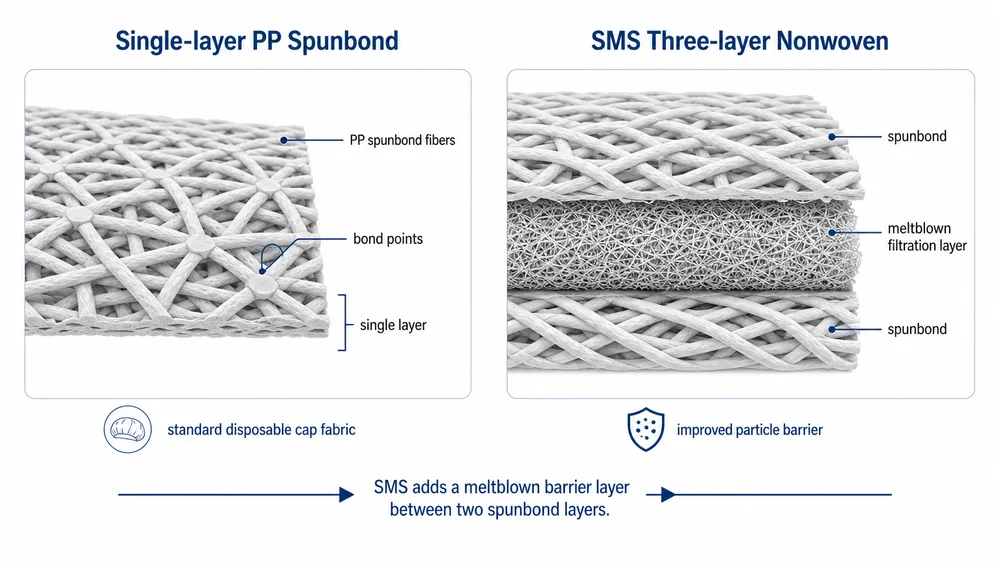
Cross-section diagram comparing PP spunbond, SMS, and SMMS nonwoven fabric layers used in medical caps

What "nonwoven" actually means for contamination control

Nonwoven fabric is made by bonding fibers directly — thermally, chemically, or mechanically — without weaving or knitting. For single-use medical caps, that matters because there are no yarn interstices to trap particles or harbor moisture. The fiber matrix is continuous, and when it's made correctly, it sheds almost nothing.

The contamination control function of a nonwoven cap depends on two things: the fiber construction (how the layers are built) and the GSM (grams per square meter, which determines fabric density and weight). Get either wrong and the cap either restricts airflow enough to cause compliance issues, or it passes particles it was supposed to block.

We've been producing nonwoven caps since 2012. The material selection conversation comes up on almost every OEM program — buyers often arrive with a cap style in mind but no fabric spec. That's where the real sourcing work starts.

The three fabric constructions you'll encounter

PP spunbond

Polypropylene spunbond is the baseline construction. Continuous PP filaments are extruded, laid randomly, and thermally bonded. The result is a soft, breathable fabric with good tensile strength and low linting.

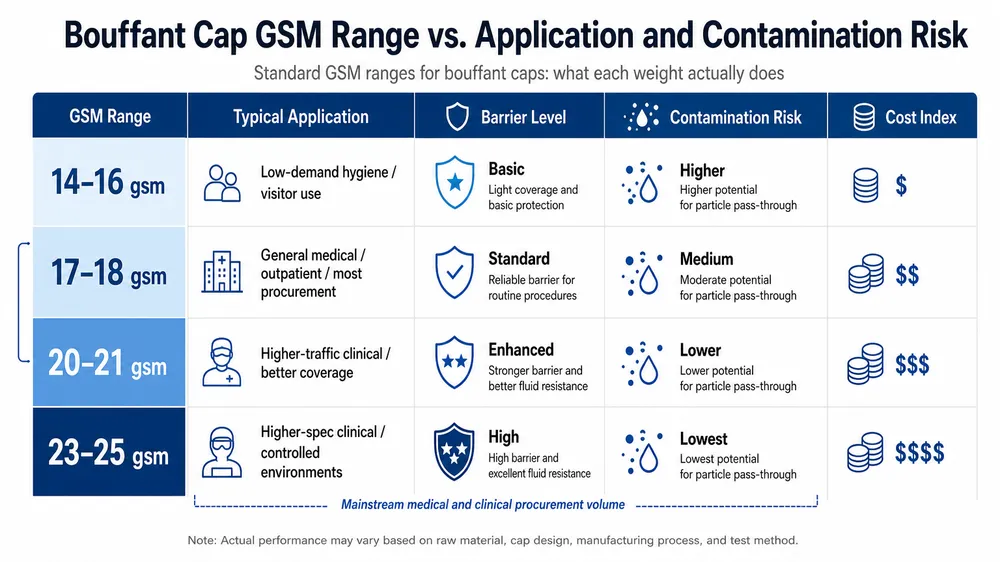
For medical caps, PP spunbond at 17–25 gsm covers general-purpose applications: visitor caps, food processing environments, basic clinical settings where the primary requirement is hair containment and minimal particle shedding. It's not a barrier fabric. Fluid resistance is low, and it won't meet the filtration requirements of a surgical environment.

The advantage is cost and breathability. For high-volume programs where the cap is worn for short durations in low-risk environments, spunbond is the right call. Specifying SMS for a visitor cap program adds cost without adding protection that the application actually needs.

SMS (spunbond-meltblown-spunbond)

SMS adds a meltblown layer between two spunbond layers. The meltblown core is where the barrier function lives — fine fibers in the 1–5 micron range create a filtration matrix that blocks particles, aerosols, and fluid penetration that spunbond alone can't stop.

For medical caps used in surgical environments, cleanrooms, or any setting where the cap needs to function as part of a contamination barrier system, SMS is the standard construction. Typical GSM range for surgical caps is 20–30 gsm. The meltblown layer adds barrier performance without making the cap significantly heavier or less breathable than a comparable spunbond weight.

One thing worth knowing: SMS quality varies considerably between suppliers. The meltblown layer is the expensive, technically demanding part of the construction. A factory that buys SMS fabric from a third-party supplier has no visibility into how that meltblown layer was produced — fiber diameter, uniformity, or whether the gsm split between layers matches the spec sheet. We produce our meltblown nonwoven in-house, which means we control the fiber diameter and layer distribution directly. That's not a minor point when you're sourcing caps for a hospital tender that requires documented barrier performance.

SMMS (spunbond-meltblown-meltblown-spunbond)

SMMS adds a second meltblown layer. The result is higher barrier performance at the same or lower total GSM compared to SMS — you get more filtration without proportionally more weight.

SMMS is used where barrier requirements are more demanding: high-risk surgical environments, ISO Class 5–7 cleanrooms, or applications where the cap needs to meet EN 13795 surgical drape and gown standards. At 25–35 gsm, SMMS caps provide fluid resistance and particle filtration that single-layer meltblown constructions can't reliably deliver.

The tradeoff is cost. SMMS fabric runs higher than SMS at equivalent GSM, and not every cap manufacturer has access to consistent SMMS supply. If a supplier quotes you SMMS at a price that looks like SMS, ask for the fabric test report.

Bar chart comparing barrier performance ratings of PP spunbond, SMS, and SMMS nonwoven medical cap fabrics across GSM ranges

GSM ranges and what they mean in practice

GSM is the most commonly misunderstood spec in cap sourcing. Buyers often treat higher GSM as automatically better. It's not that simple.

Fabric Type Typical GSM Range Barrier Level Primary Application
PP Spunbond 17–25 gsm Low (hair/particle containment only) Visitor caps, food processing, general clinical
SMS 20–30 gsm Medium (fluid splash resistance, aerosol filtration) Surgical caps, OR environments, ISO Class 7–8 cleanrooms
SMMS 25–35 gsm High (fluid penetration resistance, fine particle filtration) High-risk surgical, ISO Class 5–6 cleanrooms, EN 13795 applications

A few things this table doesn't show:

GSM within the same construction type affects breathability and wear compliance. A 30 gsm SMS cap is noticeably denser than a 20 gsm SMS cap. In environments where staff wear caps for full shifts, the heavier fabric increases heat buildup and reduces compliance. We've had buyers come back after their first bulk order asking to drop from 25 gsm to 20 gsm because their OR staff were removing caps during procedures. The barrier spec was right; the wearability spec wasn't.

The gsm split between layers matters in SMS and SMMS. A 25 gsm SMS cap could be built as 10/5/10 (spunbond/meltblown/spunbond) or 8/9/8. The second configuration has more meltblown content and better barrier performance at the same total weight. Most suppliers won't volunteer this information. Ask for the layer breakdown, not just the total GSM.

Lower GSM doesn't mean lower quality. A well-produced 20 gsm SMS cap outperforms a poorly produced 25 gsm SMS cap on every barrier metric. The fiber diameter, bonding uniformity, and meltblown consistency matter more than the number on the spec sheet.

(We typically recommend 20–22 gsm SMS for standard surgical cap programs — it hits the barrier requirements without the wearability complaints. For cleanroom applications above ISO Class 7, we move to SMMS.)

How material grade connects to regulatory compliance

This is where material selection stops being a preference and becomes a procurement risk.

EN 13795 (Surgical drapes, gowns, and clean air suits) sets performance requirements for surgical protective clothing, including caps used in sterile field environments. The standard defines two performance levels — standard and high performance — with specific requirements for microbial penetration, linting, and tensile strength. A PP spunbond cap cannot meet EN 13795 requirements. An SMS cap at adequate GSM can meet the standard performance level. SMMS is typically required for high performance classification.

ASTM F2132 covers the performance of surgical caps specifically, including resistance to penetration by synthetic blood and particle filtration. If your buyers are supplying US hospital systems, this standard is likely in their procurement spec.

ISO 13485:2016 doesn't specify fabric construction, but it requires documented material traceability and process control. A factory that buys fabric from a spot-market supplier and can't provide material test certificates is an ISO 13485 compliance risk for your downstream buyers — even if the cap looks fine.

The practical implication: if you're sourcing caps for a hospital tender, a government procurement program, or a private-label brand that sells into regulated healthcare markets, the material grade isn't a spec preference. It's a compliance requirement. Specifying the wrong construction means your buyer fails their procurement audit, not just their product test.

For buyers building private-label cap programs, we can supply caps against a specific material spec — fabric type, GSM, layer construction, and the test documentation to support it. That's the OEM angle that most factories don't offer because they're working from a fixed material inventory. See our disposable medical caps spec page for the full parameter list we work against.

Matrix showing which nonwoven fabric constructions meet EN 13795, ASTM F2132, and ISO 13485 requirements for medical caps

The sourcing trap: what factories don't tell you about their fabric

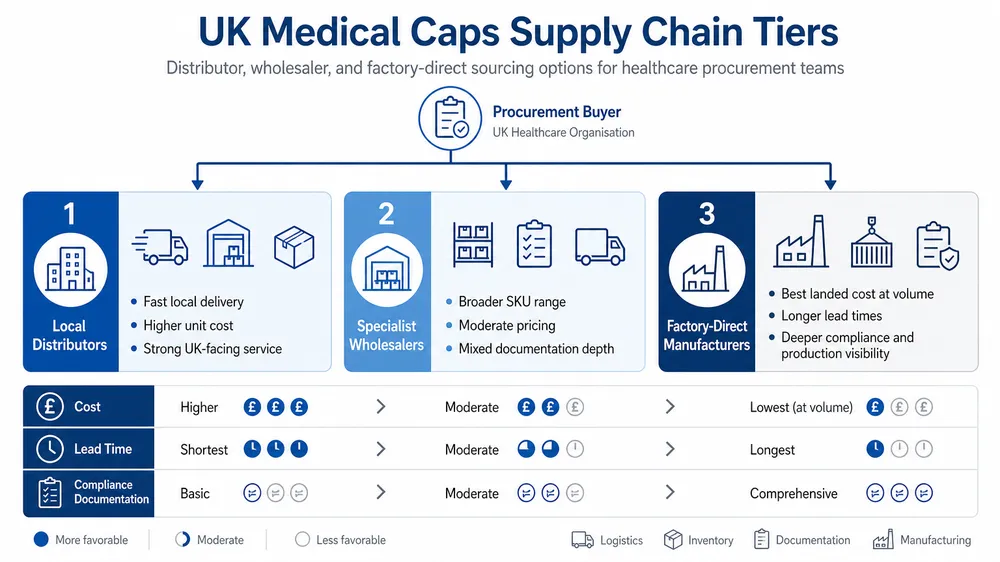
Most disposable cap factories buy nonwoven fabric from third-party suppliers. That's not inherently a problem — but it creates a quality control gap that shows up in bulk orders, not in samples.

Here's how it typically goes: you receive a sample that tests well. The factory used fabric from their current inventory, which happened to be from a good production run. You place a 500,000-unit order. Three months later, the factory's fabric supplier has switched to a different meltblown line, or the GSM has drifted by 2–3 grams, or the bonding uniformity has changed. The caps still look identical. The barrier performance has dropped.

We see this pattern in sourcing reviews regularly. The tell is usually a factory that can quote you a GSM but can't tell you who makes their fabric, what the fiber diameter spec is, or whether they test incoming fabric against a defined acceptance standard.

What to ask during RFQ:

  • Who is your nonwoven fabric supplier, and can you provide their material test certificate?
  • Do you test incoming fabric for GSM, tensile strength, and barrier performance before production?
  • What is your fabric rejection rate, and what happens to rejected rolls?
  • Can you provide batch-level traceability from fabric roll to finished cap?

A factory that produces nonwoven in-house answers these questions differently. We run our meltblown line at defined fiber diameter parameters, test every production batch for GSM and filtration efficiency, and can trace any finished cap back to the fabric roll it came from. That traceability is what survives a compliance audit.

(The in-house fabric production is also why our lead times are more predictable than factories dependent on spot-market fabric supply — we're not waiting on a supplier's production schedule.)

How to specify material grade in an RFQ

If you're sourcing caps for a regulated market or a private-label program, a vague RFQ gets you a vague quote. Here's what to include:

Fabric construction: PP spunbond / SMS / SMMS — don't leave this open. If you don't specify, the factory will default to whatever they have in stock.

GSM: State the target GSM and acceptable tolerance (typically ±2 gsm). If you need a specific layer split for SMS/SMMS, state it.

Barrier performance requirement: Reference the applicable standard (EN 13795 standard or high performance, ASTM F2132) or state the specific test requirement (e.g., synthetic blood penetration resistance at X cm H₂O).

Certifications required: ISO 13485, CE under EU MDR, FDA 510(k) registration — state which are required for your target market. These affect which factories can actually supply you.

Cap style and elastic spec: Bouffant, surgeon's cap, or tie-back — each has different fabric tension requirements that interact with the GSM selection. For more on how GSM interacts with cap fit and elastic spec, see our bouffant cap nonwoven GSM guide.

Quantity and packaging: OEM/private-label packaging requirements, inner pack count, carton configuration.

A complete RFQ against these parameters gets you a quote you can actually compare across suppliers — not a price that looks competitive until you discover the factory substituted 17 gsm spunbond for the 22 gsm SMS you needed.

Matching material grade to your market segment

The right material grade depends on where the cap ends up, not just what it looks like.

General clinical and visitor programs (outpatient facilities, food processing, pharmaceutical manufacturing at ISO Class 8): 17–20 gsm PP spunbond covers the requirement. The contamination control need is hair containment and basic particle shedding reduction. Specifying SMS adds cost without adding protection the environment requires.

Surgical and OR environments (hospital operating rooms, sterile processing, ISO Class 7 cleanrooms): 20–25 gsm SMS is the standard spec. The meltblown layer provides the aerosol and fluid splash resistance that surgical environments require. EN 13795 standard performance is achievable at this spec.

High-risk surgical and cleanroom environments (cardiac surgery, orthopedic implant manufacturing, ISO Class 5–6 cleanrooms, pharmaceutical sterile fill): 25–30 gsm SMMS. The double meltblown layer provides the particle filtration and fluid penetration resistance that high-performance EN 13795 classification requires.

Private-label programs for multiple market segments: This is where OEM flexibility matters. If you're building a cap line that covers both general clinical and surgical applications, you need a factory that can produce against two different material specs — not one that has a single default fabric. We run both SMS and SMMS cap programs and can produce against buyer-specified GSM within the ranges above.

If you're ready to specify material grade and get a quote against your exact requirements, send us an RFQ with the parameters above. We'll confirm the material spec, provide a sample against the target GSM, and quote against your volume.

FAQ

What is the difference between SMS and SMMS nonwoven for medical caps?

SMS has one meltblown layer between two spunbond layers. SMMS has two meltblown layers. The additional meltblown layer in SMMS increases particle filtration efficiency and fluid penetration resistance without proportionally increasing total GSM. For standard surgical environments, SMS at 20–25 gsm is sufficient. For high-risk surgical or ISO Class 5–6 cleanroom applications, SMMS provides the barrier performance that single-layer meltblown constructions can't reliably deliver.

What GSM should I specify for a surgical cap that meets EN 13795?

EN 13795 standard performance is achievable with SMS at 20–25 gsm, provided the meltblown layer meets the microbial penetration and linting requirements. High performance classification typically requires SMMS at 25–30 gsm. The GSM alone doesn't determine compliance — the layer construction and meltblown fiber quality matter equally. Request the fabric test report alongside the GSM spec.

How do I verify that a supplier's nonwoven fabric matches the spec they quoted?

Ask for the material test certificate from the fabric manufacturer, not just the finished cap test report. The certificate should show GSM, tensile strength (MD and CD), and for SMS/SMMS, the filtration efficiency of the meltblown layer. If the supplier can't provide fabric-level documentation, they're buying from a spot market and can't guarantee batch-to-batch consistency.

Can I specify a custom GSM for a private-label cap program?

Yes, if the factory produces nonwoven in-house or has a fixed supply agreement with a fabric manufacturer. Factories buying from spot-market suppliers typically can't guarantee a specific GSM outside their standard inventory. For OEM programs where material spec is part of your product differentiation, confirm the factory's fabric sourcing model before finalizing the spec.

Does a higher GSM always mean better contamination control?

No. Within the same fabric construction, higher GSM increases density and barrier performance but also reduces breathability and increases cost. A 30 gsm SMS cap is not necessarily better than a 22 gsm SMS cap for a standard surgical application — it may just be heavier and less comfortable to wear for a full shift. The right GSM is the one that meets the barrier requirement for the specific environment without over-specifying wearability out of the design.

How to Source Disposable Medical Caps in Bulk: Avoiding Elastic Failure and Fabric Inconsistency

The two complaints we hear most often from buyers who've had a bad run with a previous supplier: caps that lose their fit after a few hours of wear, and batches where the fabric feels noticeably different from the last order. Both problems are preventable. Both trace back to decisions made before the order was placed — not during production.

This guide walks through the sourcing steps that actually matter for Disposable Medical Caps in bulk: how to specify correctly, what to ask suppliers before you commit, and what documentation to require with every shipment.

Diagram showing the two main failure modes in bulk disposable medical cap orders — elastic degradation and fabric weight drift

The Two Failure Modes That Cost Buyers the Most

Elastic failure and fabric weight drift are not random quality problems. They have specific mechanisms, and once you understand them, you can screen for them before placing an order.

Elastic degradation happens when the elastic band or ear-loop material doesn't hold its tensile strength across the product's expected use window. In a clinical setting, a cap worn for a 6-8 hour shift needs to maintain consistent circumferential pressure throughout. When the elastic is undersized in cross-section, made from a lower-grade spandex blend, or heat-bonded at the wrong temperature during assembly, it relaxes faster than it should. The cap starts slipping. In an OR or sterile processing environment, that's not a comfort issue — it's a contamination control failure.

The failure usually doesn't show up in a quick visual inspection of a sample. It shows up at hour four of a shift, or in the second batch of a reorder when the supplier quietly switched elastic suppliers. We've seen this pattern enough times that our incoming inspection now tests elastic tensile strength at the dock, before production starts — not after the caps are assembled.

Fabric weight drift is subtler but just as damaging to your supply chain. Nonwoven polypropylene fabric for medical caps is typically specified at 20-25 GSM for standard bouffant caps, with some surgical cap constructions running slightly heavier. When a supplier sources fabric from the spot market or uses multiple mills without a locked spec, the GSM can drift 15-20% between batches. The caps still look the same. But the barrier performance changes, the feel changes, and if you're selling into a hospital system with a documented product spec, you have a compliance problem.

The root cause is almost always that the supplier doesn't control their own fabric supply. They buy from whoever has stock.

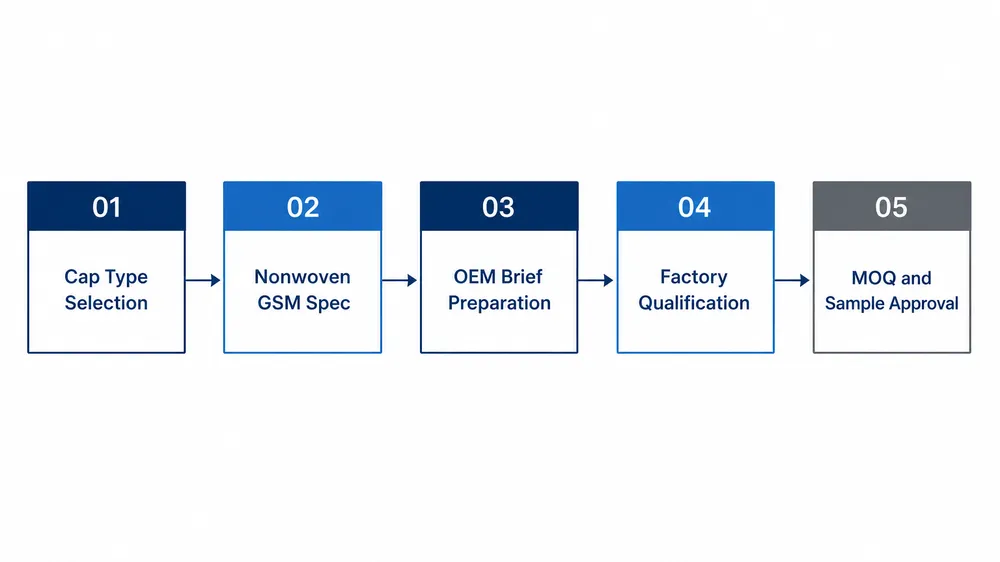
Step 1: Specify the Cap Type and Construction Before Contacting Suppliers

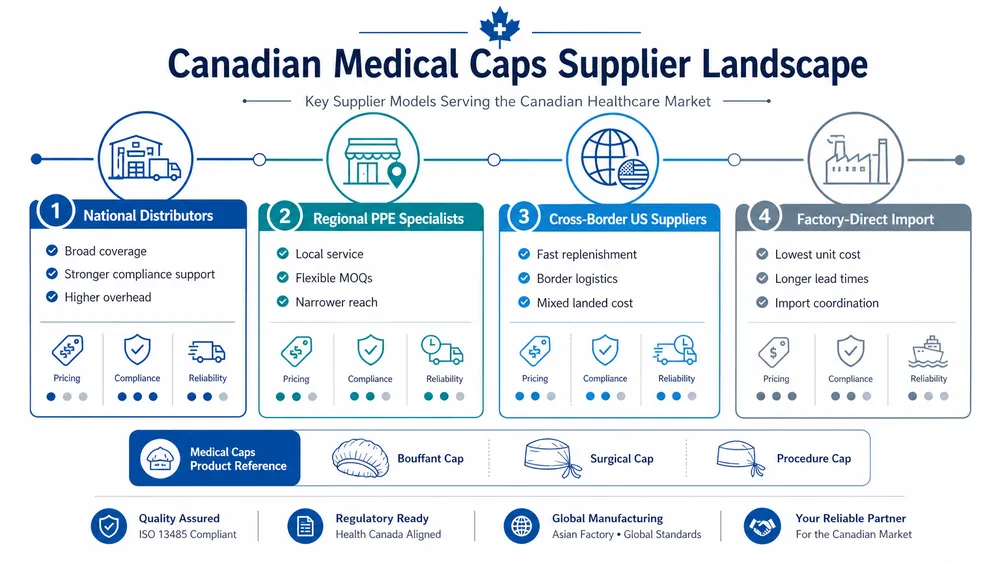
Buyers who skip this step end up comparing quotes that aren't comparable. A Bouffant Medical Cap and a Surgical Medical Cap are different products with different construction requirements, and within each type there are meaningful spec decisions that affect both performance and price.

Before you send an RFQ, lock down:

  • Cap type: Bouffant (gathered, full-coverage) or surgical (flat-folded, ties or elastic)
  • Closure method: Elastic band, ear-loop, or tie-on — each has different tensile requirements and failure modes
  • Fabric weight: Specify GSM range, not just "nonwoven polypropylene." 20 GSM and 25 GSM are not interchangeable in a clinical protocol
  • Size range: Standard one-size-fits-most vs. S/M/L sizing — if you need a size range, confirm the supplier runs all sizes on the same line with the same elastic spec
  • Color and packaging: Sterile individual wrap vs. bulk poly bag — this affects MOQ and lead time significantly

(A note on sizing: the most common spec drift we see in multi-size orders is elastic circumference — suppliers sometimes use the same elastic length across sizes and just adjust the fabric gather. That produces a cap that fits differently at each size. Ask specifically how elastic length is adjusted across the size range.)

Side-by-side construction comparison of bouffant medical cap and surgical medical cap showing elastic band placement and fabric fold differences

Step 2: Qualify the Supplier's Material Controls

This is where most buyers don't dig deep enough. A supplier can hold ISO 13485 certification and still source fabric from three different mills depending on availability. The certification covers their process controls — it doesn't guarantee material consistency unless their QMS explicitly locks the approved supplier list.

Ask these questions directly:

On fabric supply:

  • Do you produce your own nonwoven fabric, or do you source it from third parties?
  • If third-party, how many approved fabric suppliers are on your AVL (Approved Vendor List)?
  • What is your incoming inspection spec for fabric GSM — what's the acceptable tolerance?
  • Can you provide incoming inspection records for the last three fabric lots?

On elastic and ear-loop components:

  • What is the tensile strength spec for your elastic band/ear-loop material?
  • At what point in production is tensile strength tested — incoming material, in-process, or finished product?
  • What is your rejection threshold?

A supplier who can answer these questions with specific numbers and show you the records is operating a real QMS. A supplier who says "we use high-quality materials" and can't produce incoming inspection data is running on trust — which is fine until the spot market tightens and they switch suppliers without telling you.

We produce our own nonwoven fabric in-house, which means our fabric GSM is controlled at the source, not at the receiving dock. When a buyer asks for batch-level fabric consistency data, we can pull it because we generated it ourselves.

Step 3: Request Incoming Inspection Records for Elastic and Ear-Loop Components

This step is specific enough that it deserves its own section. Most buyers ask for finished-product test reports. That's necessary but not sufficient for catching elastic failure before it reaches your customers.

Finished-product testing tells you the cap passed inspection on the day it was tested. It doesn't tell you whether the elastic will hold its tensile strength after 6 months in a warehouse, or whether the ear-loop bond will survive the mechanical stress of repeated donning and doffing.

What to request:

Document What It Tells You
Incoming elastic tensile test report Whether the raw elastic met spec before assembly
Elastic aging/retention data Whether tensile strength holds over time (ask for 6-month data if available)
Ear-loop bond strength test Pull force required to separate the ear-loop from the cap body
Fabric GSM incoming inspection log Batch-by-batch fabric weight records, not just a single certificate
Finished product dimensional check Cap circumference and depth across the size range

Under ISO 13485, incoming inspection of critical components is a documented requirement — not optional. If a supplier can't produce these records, they either don't have them or their QMS isn't functioning as certified.

(We run elastic tensile testing at the dock on every incoming lot. The threshold is set based on the finished-product performance spec, not just the raw material spec — because the bonding process affects final tensile strength, and we need to know the incoming material has enough headroom to survive assembly.)

Incoming inspection checklist for disposable medical cap bulk orders covering elastic tensile strength, fabric GSM, and ear-loop bond force

Step 4: Verify Certification Scope — Confirm It Covers Caps, Not Just Masks

This is a sourcing trap that catches buyers more often than it should. A manufacturer can hold FDA 510(k) registration and CE marking for surgical masks without those certifications covering their cap products. The scope of a medical device registration is product-specific.

Before you rely on a supplier's certifications for your compliance documentation:

  • Ask for the specific FDA 510(k) number and confirm the product description includes caps
  • For CE, ask for the Declaration of Conformity and check that the product category listed matches what you're buying
  • For ISO 13485, the certificate covers the QMS scope — confirm that caps are within the certified product scope, not just masks or other PPE
  • If you're selling into the EU under MDR, confirm the supplier's CE is issued under EU MDR 2017/745, not the older MDD

Most Medical Caps sold on Alibaba and wholesale directories carry no certification detail at all. The ones that do often show mask certifications applied to cap products — which doesn't hold up in a procurement audit or customs review.

Our ISO 13485:2016 and CE (EU MDR) certifications cover our full disposable medical cap line. We can provide the specific documentation scope on request before you place an order.

Step 5: Run a Trial Order Before Committing to Volume

The purpose of a trial order is not just to check whether the caps look right. It's to stress-test the supplier's consistency before you're committed to a large volume.

A useful trial order protocol for bulk disposable medical caps:

  1. Order at minimum MOQ — our standard MOQ for caps is 50,000 pieces, which is enough to run a meaningful incoming inspection and distribute to a test site
  2. Request caps from at least two production batches if possible — this tests batch-to-batch consistency, not just single-batch quality
  3. Run your own incoming inspection against the spec you defined in Step 1 — measure GSM, test elastic tensile, check cap circumference across the size range
  4. Deploy to a test site for at least 2-4 weeks — clinical staff will identify fit and durability issues that lab testing misses
  5. Compare the trial order documentation to what you'll require for full-volume orders — if the supplier can't produce batch-level test reports for a 50,000-piece trial, they won't produce them for 500,000 pieces either

The 50,000-piece MOQ exists specifically to make trial orders viable. A supplier with a 200,000-piece minimum is asking you to commit to volume before you've validated consistency — that's a risk structure that favors the supplier, not you.

What Documentation to Require with Every Bulk Shipment

Once you've qualified a supplier and placed a volume order, the documentation package that ships with each order is your audit trail. For healthcare procurement, this matters.

Require these with every shipment:

  • Certificate of Conformance (CoC): Signed statement that the batch meets the agreed specification. Should reference the specific batch/lot number, not just the product name.
  • Batch test report: Results from finished-product testing for that specific lot — not a generic product certificate. Should include cap dimensions, elastic performance, and any applicable barrier test results.
  • Packing list with lot traceability: Each carton should be traceable to a production lot. If a quality issue surfaces after distribution, you need to be able to pull the affected lot without recalling everything.
  • Fabric lot records: If you've specified a GSM range, the supplier should be able to show which fabric lot was used in each production batch.
  • Shipping marks and labeling compliance: Confirm labeling meets the requirements of your target market — FDA labeling requirements differ from EU MDR requirements.

(One thing we've learned from working with US and UK hospital procurement teams: they often need the CoC and batch test report before the shipment clears customs, not after. Build that into your supplier agreement so the documents travel with the commercial invoice, not two weeks later.)

Documentation flow diagram for bulk disposable medical cap shipments showing CoC, batch test report, and lot traceability requirements

Common Sourcing Mistakes and How to Avoid Them

These are the patterns we see repeatedly from buyers who've had a bad experience before coming to us.

Accepting product-level certificates instead of batch-level reports. A product certificate says the product design was tested once. A batch test report says this specific lot was tested. For medical-grade products, you need the latter.

Not specifying GSM in the RFQ. If your RFQ says "20-25 GSM nonwoven polypropylene," the supplier is locked to that range. If it says "nonwoven medical cap," the supplier will use whatever fabric they have in stock.

Treating elastic closure type as interchangeable. Ear-loop caps and elastic-band caps have different tensile requirements and different failure modes. Switching between them mid-contract without re-qualifying the spec is a common source of fit complaints.

Relying on a single sample for qualification. One sample from one batch tells you the supplier can make a good cap. It doesn't tell you they make a consistent cap. Request samples from two different production runs before qualifying a new supplier.

Not confirming certification scope before the order. Ask for the specific certificate number and product scope in writing before you place the order. Getting this wrong costs you a compliance audit, not just a reorder.

Skipping the trial order to save time. The time saved by skipping a trial order is almost always less than the time lost managing a quality dispute on a 500,000-piece order.

Supplier Qualification Checklist for Bulk Disposable Medical Caps

Use this before placing any volume order with a new supplier:

Material controls

  • [ ] Supplier produces own nonwoven fabric, or has locked AVL with GSM tolerance spec
  • [ ] Incoming inspection records available for fabric GSM (last 3 lots minimum)
  • [ ] Elastic/ear-loop tensile spec documented and tested at incoming inspection
  • [ ] Elastic aging/retention data available on request

Certifications

  • [ ] ISO 13485:2016 certificate — confirm scope includes caps
  • [ ] CE Declaration of Conformity — confirm EU MDR (not MDD) and product scope
  • [ ] FDA 510(k) registration — confirm product description includes caps (if selling into US)
  • [ ] SGS or equivalent third-party audit report available

Production and QC

  • [ ] Batch-level test reports available (not just product-level certificates)
  • [ ] Lot traceability from fabric through finished product
  • [ ] Cap circumference and elastic performance tested across full size range
  • [ ] QC records available for review before shipment

Commercial terms

  • [ ] MOQ allows trial order before full-volume commitment
  • [ ] Documentation package (CoC, batch report, packing list) ships with each order
  • [ ] Supplier can confirm certification scope in writing before order placement

If you're sourcing Disposable Medical Caps in bulk and want to verify spec, MOQ, and certification scope before committing, send us your requirements — cap type, size range, target quantity, and any market-specific certification requirements. We'll confirm what we can supply and provide the documentation scope upfront.