Most buyers who've been burned by a medical cap OEM program weren't burned by the factory. They were burned by the structure of the deal they agreed to before production started.
The pattern is consistent: a buyer requests a quote, gets a per-SKU MOQ that looks manageable, approves a sample, and then discovers that running three cap styles under one brand means committing to 150,000 pieces before a single unit has sold. Or they approve packaging artwork without locking the nonwoven spec, and the second batch ships with a lighter GSM fabric that changes how the cap fits. Or they clear their first EU shipment and then find out their private-label documentation doesn't satisfy the MDR technical file requirements their importer of record needs.
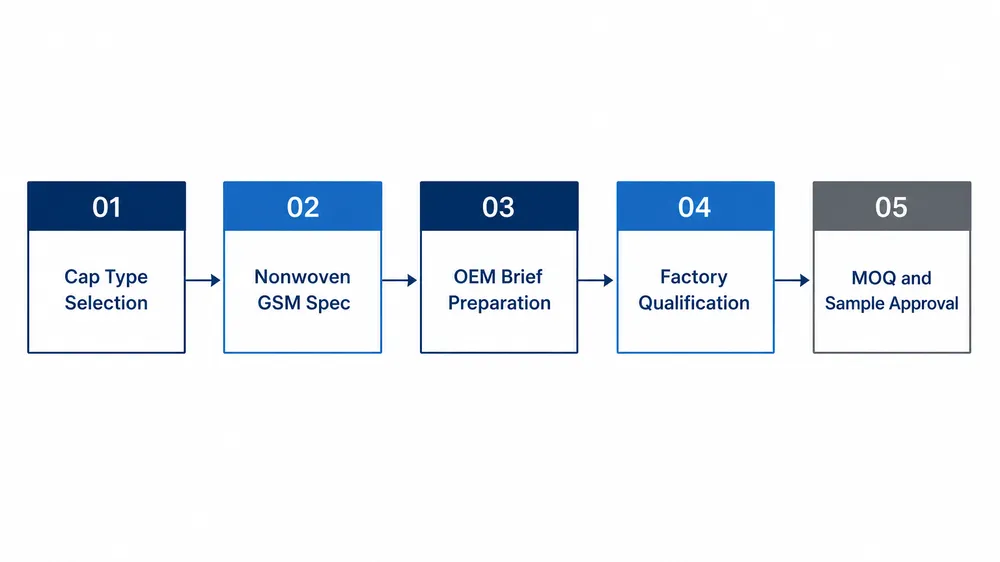
These aren't factory failures. They're upstream decisions made without enough information. This guide covers the decisions that actually matter — cap type selection, fabric spec, OEM documentation, factory qualification, and MOQ negotiation — so your program starts on terms you can build on.

The MOQ trap: per-SKU minimums vs. per-program minimums
Before anything else, understand how MOQ is actually calculated — because this is where most private-label programs get expensive before they start.
A factory's published MOQ (say, 50,000 pieces) typically applies per SKU, not per program. If you're building a cap line with three styles — a bouffant cap, a surgical tie-on cap, and a disposable non-woven cap — you're looking at 150,000 pieces minimum before you've validated any of them in your market. For a brand entering a new segment, that's a significant inventory commitment on unproven SKUs.
The smarter structure is a per-program MOQ: a single minimum that covers your entire cap range, with the factory allocating production across SKUs based on your split. Not every factory will offer this, but it's worth asking for explicitly. A factory that runs bouffant, surgical, and disposable cap lines under one roof has more flexibility to consolidate your program than one that sources cap types from different suppliers.
The second trap is the sample-to-production gap. A factory quotes you a low MOQ to win the sample order, then raises the minimum when you go to production — or adds tooling fees, packaging setup charges, or color-matching costs that weren't in the original quote. The fix is simple: get the production MOQ, unit price at that MOQ, and any one-time setup fees in writing before you approve the sample. If a factory won't commit to production terms before sample approval, that's a signal.
(We've seen buyers spend three months on sample development only to find out the production MOQ was four times what they'd planned for. Get the commercial terms first, then develop the sample.)
Step 1 — Choosing your cap type: what actually drives the decision
The three main SKUs in a medical cap program are bouffant caps, surgical caps, and disposable non-woven caps. The choice isn't primarily aesthetic — it's driven by the clinical protocol or distribution channel you're selling into.
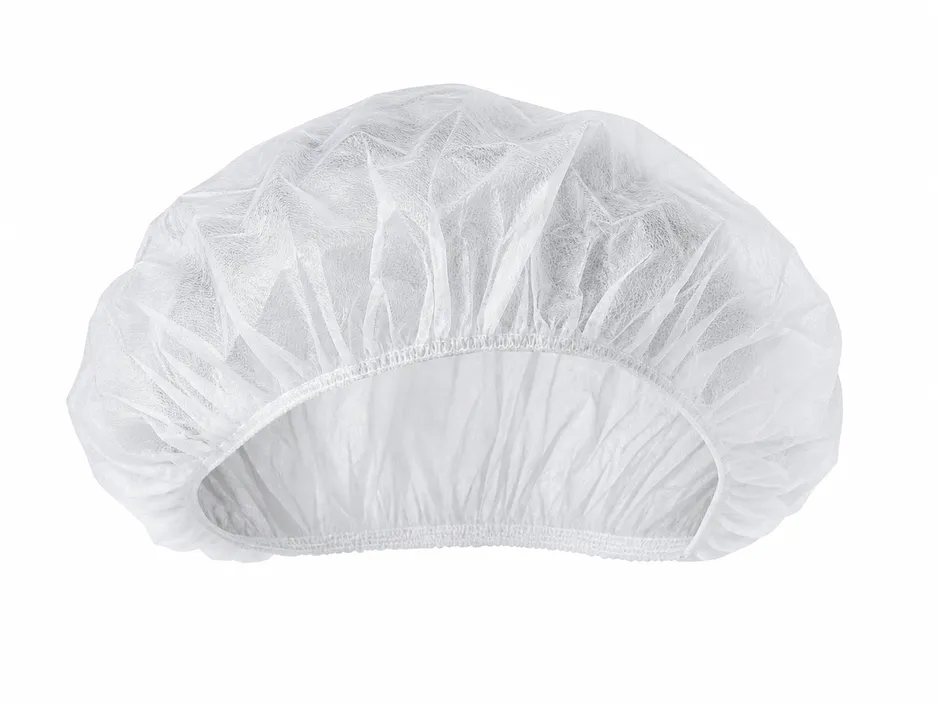
Bouffant caps are the standard for OR and procedure room environments. The gathered elastic perimeter creates a full coverage profile that contains hair reliably across different head sizes. Most hospital procurement specs call for bouffant caps in surgical and sterile processing areas. If your buyers are hospital supply chains or surgical center distributors, this is your primary SKU.
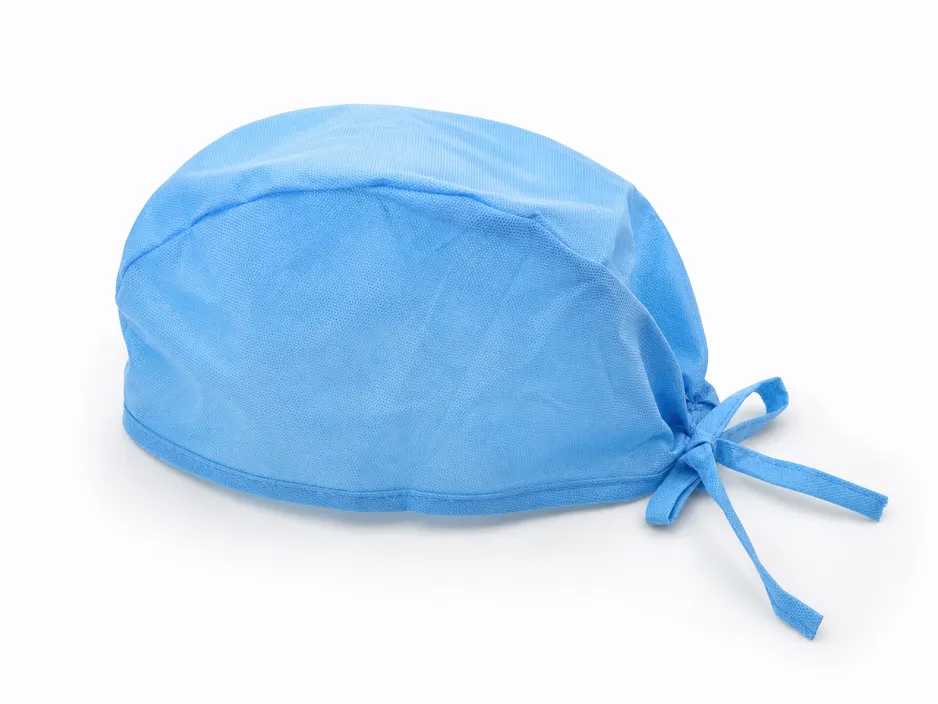
Surgical caps — the tie-on style — are preferred in environments where fit needs to be adjusted precisely, or where the buyer's protocol specifies a tied closure. They're also common in food processing and pharmaceutical manufacturing, where the cap is part of a contamination control protocol rather than a sterile field requirement. The tie-on configuration adds a small amount of labor to donning, which matters in high-turnover environments.
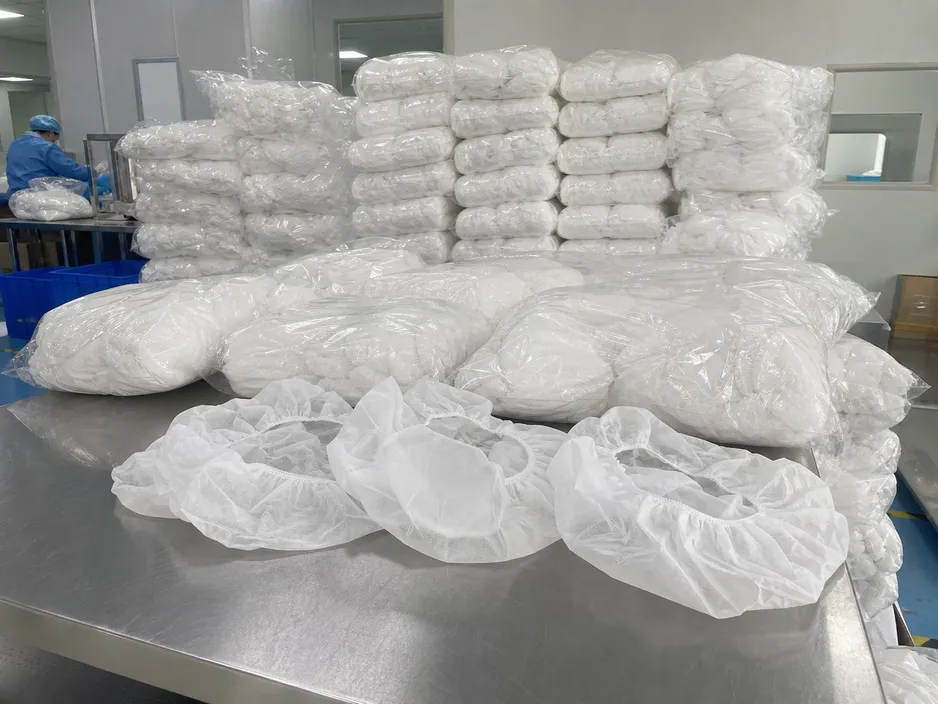
Disposable non-woven caps cover the broadest range of applications: dental clinics, outpatient facilities, lab environments, and light industrial use. They're typically the entry point for a private-label program because the per-unit cost is lower and the MOQ is more manageable. If you're testing a new market or building a starter SKU, this is usually where to begin.
The practical guidance: if you're building a multi-SKU program, start with the cap type that matches your primary distribution channel, validate it with a first order, then add SKUs in subsequent cycles. Trying to launch three cap styles simultaneously multiplies your inventory risk and your compliance documentation workload.
Step 2 — Nonwoven GSM: the spec that controls cost, fit, and compliance
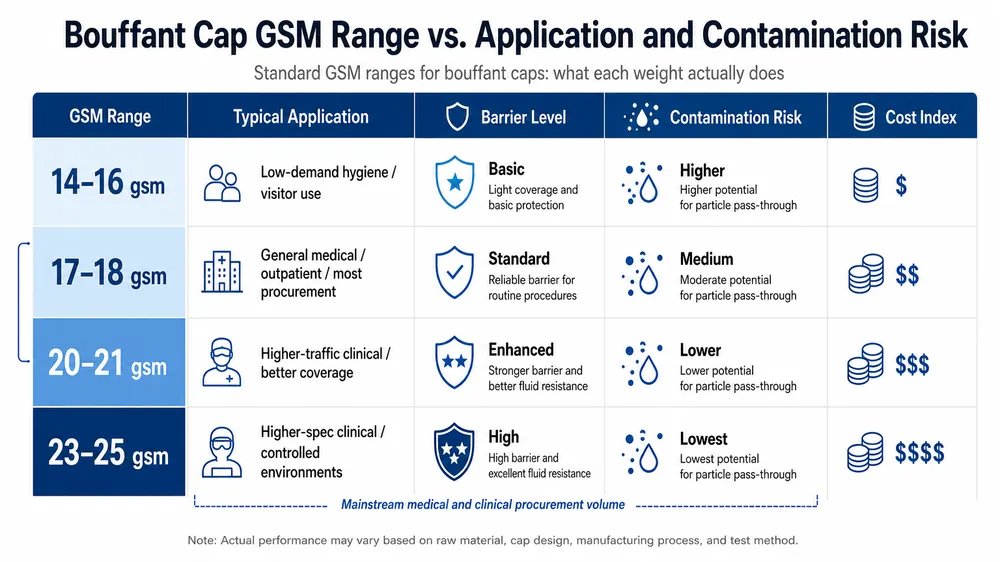
Nonwoven GSM (grams per square meter) is the single most important material parameter in a medical cap program, and it's the one most buyers don't specify until something goes wrong.
GSM determines three things simultaneously: per-unit material cost, cap stiffness and drape, and whether the cap meets the contamination control performance your buyers expect. A lighter fabric (around 17–20 GSM) cuts material cost but produces a cap that's flimsy, prone to collapsing on the head, and unlikely to satisfy hospital procurement specs that require a defined coverage profile. A heavier fabric (30–40 GSM) gives you a cap with structure and a professional appearance, but adds to unit cost and may be overspecified for light clinical or dental use.
For most hospital-grade bouffant and surgical cap programs, 25–30 GSM polypropylene spunbond is the working range. It's stiff enough to hold shape, light enough to be comfortable for extended wear, and the material cost is predictable. For disposable caps going into dental or outpatient settings, 20–25 GSM is typically sufficient and keeps your unit economics competitive.
The compliance angle matters here too. If your caps are going into EU markets under MDR, the technical file needs to document the material specification — fabric type, GSM, and any relevant performance parameters. A factory that can't tell you the exact GSM and fabric grade of the material in your cap can't give you the documentation your importer of record needs. This is one of the reasons we control our own nonwoven material selection at eztio — when a buyer asks for the material spec for their technical file, we can provide it because we set it ourselves.
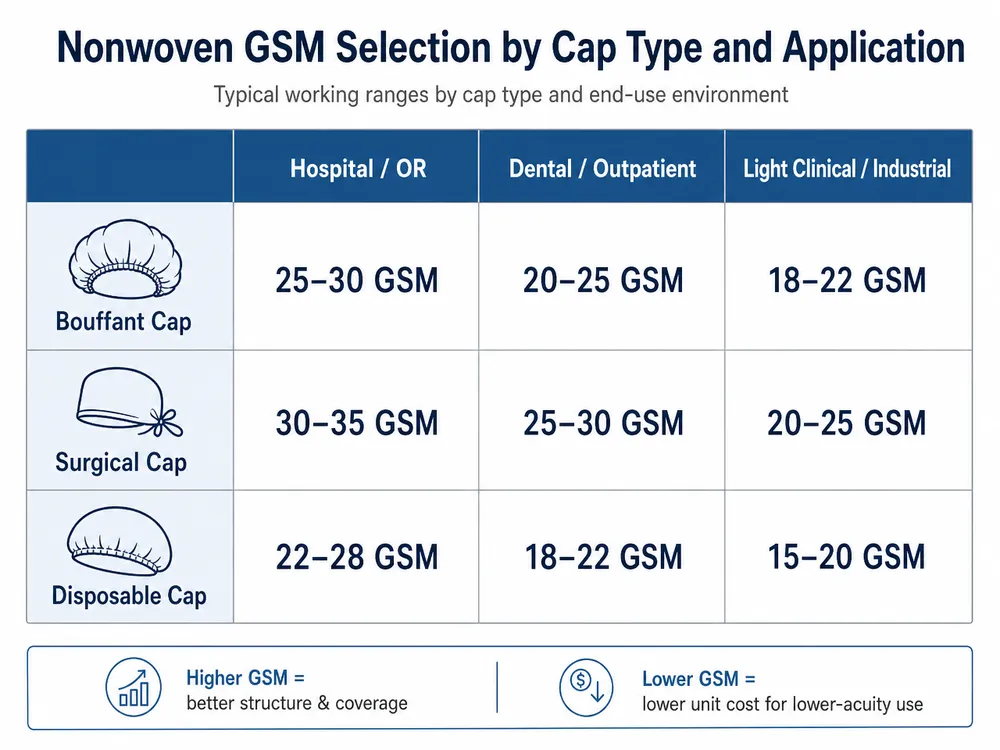
One more thing on GSM: if you're comparing quotes from multiple factories, make sure you're comparing the same spec. A quote for a bouffant cap at 20 GSM will always be cheaper than one at 28 GSM. That's not a better price — it's a different product. Ask every factory to state the GSM and fabric grade in the quote, not just the unit price.
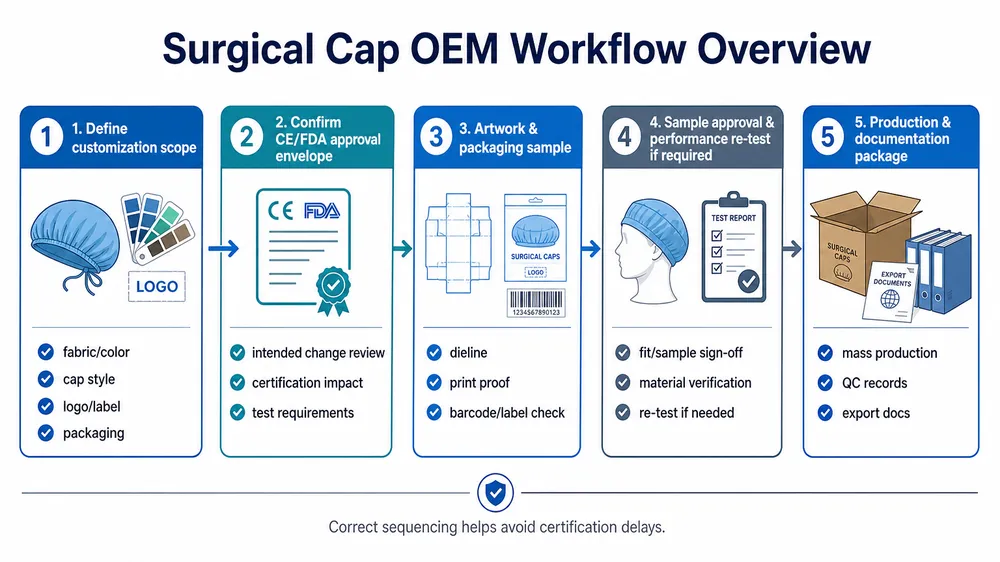
Step 3 — Preparing your OEM brief: what a factory actually needs
Most buyers send a factory their logo and a rough description of what they want. That's not an OEM brief — it's the start of a long back-and-forth that delays sample development and increases the chance of spec drift between sample and production.
A complete OEM brief for a medical cap program includes:
Artwork and packaging files:
- Logo in vector format (AI, EPS, or SVG — not PNG or JPEG)
- Pantone color codes for brand colors (not RGB or CMYK approximations)
- Packaging dimensions and carton configuration (retail box, polybag, bulk carton)
- Label copy: brand name, product name, material description, size, quantity, country of origin, and any required regulatory statements
Product specification:
- Cap type (bouffant, surgical, disposable)
- Nonwoven GSM and fabric type
- Elastic specification: width, tensile strength range, and color
- Cap diameter or size range (one-size-fits-most vs. sized)
- Color (white is standard; other colors require minimum run confirmation)
Regulatory and market information:
- Destination market (EU, US, Canada, Gulf, etc.)
- Required certifications or test reports (CE, FDA, ISO 13485)
- Any market-specific labeling requirements (MDR UDI for EU, FDA establishment registration for US)
- Importer of record details if you need the factory to prepare market-specific documentation
The reason this matters: a factory that receives a complete brief can produce an accurate sample on the first run. A factory working from incomplete information will make assumptions — and those assumptions become the spec unless you catch them at sample review. We've had buyers come to us after approving samples from another factory, only to find out the production run used a different elastic spec because the original brief didn't specify tensile strength. The cap looked identical but failed fit testing at scale.
Step 4 — Qualifying the factory: what ISO 13485 actually means for your program
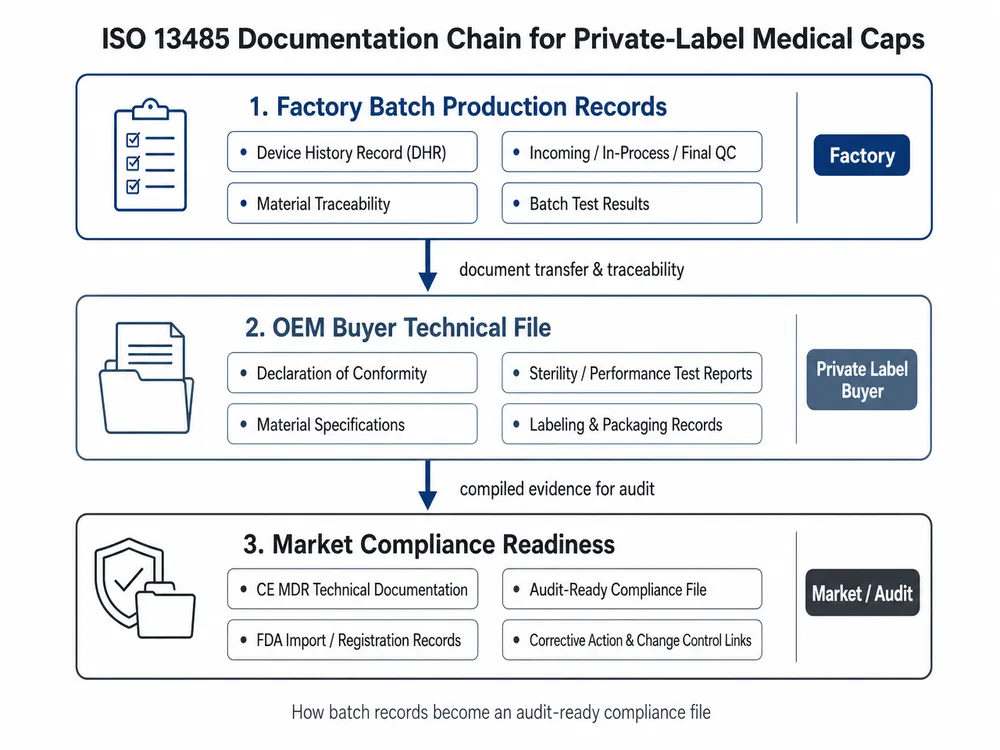
ISO 13485:2016 is the quality management standard for medical device manufacturers. For a private-label medical cap program, it matters for one specific reason: it determines whether the factory's documentation will survive a compliance audit.
When you put your brand on a medical cap and sell it into a regulated market, you become the legal manufacturer of record in that market. Your importer of record, your hospital procurement customer, or a regulatory authority can ask to see the technical documentation behind your product. If your factory isn't ISO 13485 certified, the documentation they can provide is limited — and the gaps in that documentation become your compliance risk.
What ISO 13485 certification actually means in practice:
- The factory has documented risk management procedures (ISO 14971 alignment)
- Design and development controls are in place for any product modification
- Raw material traceability is maintained from incoming inspection through finished goods
- Corrective and preventive action (CAPA) processes are documented and auditable
- Each production batch has a device history record (DHR) that can be retrieved
For your private-label program, the practical implication is this: an ISO 13485 factory can give you a batch-level DHR for every order you place. That document traces the material lot, production date, QC test results, and operator records for your specific shipment. If a compliance question arises six months after delivery, you have the paper trail. A non-certified factory typically can't produce that documentation.
Ask any factory you're evaluating for their ISO 13485 certificate number and the issuing certification body. Then verify it. Certificates can be checked against the issuing body's registry. A factory that's reluctant to provide the certificate number or can't tell you the certification body is a red flag.
CE marking under EU MDR adds another layer. For medical caps sold in the EU, the CE technical file needs to include clinical evaluation data, a Declaration of Conformity, and a summary of safety and performance (SSCP for Class I devices). The factory can provide the product-level documentation; the importer of record is responsible for the market-specific declarations. Make sure you understand which documents the factory provides and which ones you're responsible for before you place the order.
Step 5 — MOQ negotiation and sample approval: what to lock in writing
By the time you reach sample approval, you should already have the commercial terms confirmed. If you don't, the sample approval process gives the factory leverage — you've invested time and development cost, and walking away is harder.
The terms to confirm before sample approval:
- Production MOQ at the agreed unit price (not the sample price)
- One-time setup fees: packaging die, printing plate, or tooling charges — these should be stated as a fixed cost, not buried in the unit price
- Lead time from order confirmation to ex-factory: get a specific number of days, not a range
- Reorder terms: same MOQ and price for repeat orders, or does the price change after the first run?
- Spec lock: the approved sample becomes the production reference — any deviation requires written approval before production proceeds
On the sample itself: approve the sample against your written spec, not against your memory of what you asked for. Check the GSM against your brief. Check the elastic tensile strength — a simple pull test with a scale will tell you if the elastic is within spec. Check the label copy against your regulatory requirements for the destination market. Check the packaging dimensions against your carton configuration.
The most common mistake at this stage is approving a sample that "looks right" without verifying the underlying spec. The cap that looks identical to your approved sample but uses a 20 GSM fabric instead of 28 GSM will fit differently at scale — especially on the range of head sizes in a real clinical environment. We catch this in our own production through incoming material inspection on every fabric lot, but you need to verify it at sample stage before production starts.
(One thing we tell buyers: if a factory won't give you the material spec of the sample you're approving, don't approve it. You can't lock a spec you don't know.)
Common mistakes that derail private-label cap programs
These aren't edge cases. We see versions of these regularly.
Approving samples without a written spec sheet. The sample is the reference, but the spec sheet is the contract. Without a written spec, "same as sample" is unenforceable — the factory's interpretation of "same" may differ from yours.
Skipping the compliance documentation conversation until after production. CE and FDA documentation requirements need to be discussed before production, not after. Some documentation (like a Declaration of Conformity) requires factory input; some (like importer of record registration) is your responsibility. Sorting this out post-production delays your market entry.
Underestimating lead time on custom packaging. Standard cap production runs 15–20 days. Custom packaging — printed polybags, retail boxes, or custom carton printing — adds 10–15 days for artwork approval and printing setup. If you're working to a launch date, build the packaging lead time into your timeline from the start.
Running multiple cap styles simultaneously on a first order. The first order is a validation run. Run one SKU, confirm the spec holds in production, confirm the documentation is complete, and confirm the product performs in your market. Then add SKUs. Launching three styles at once multiplies the risk of a spec problem and makes it harder to identify the source if something goes wrong.
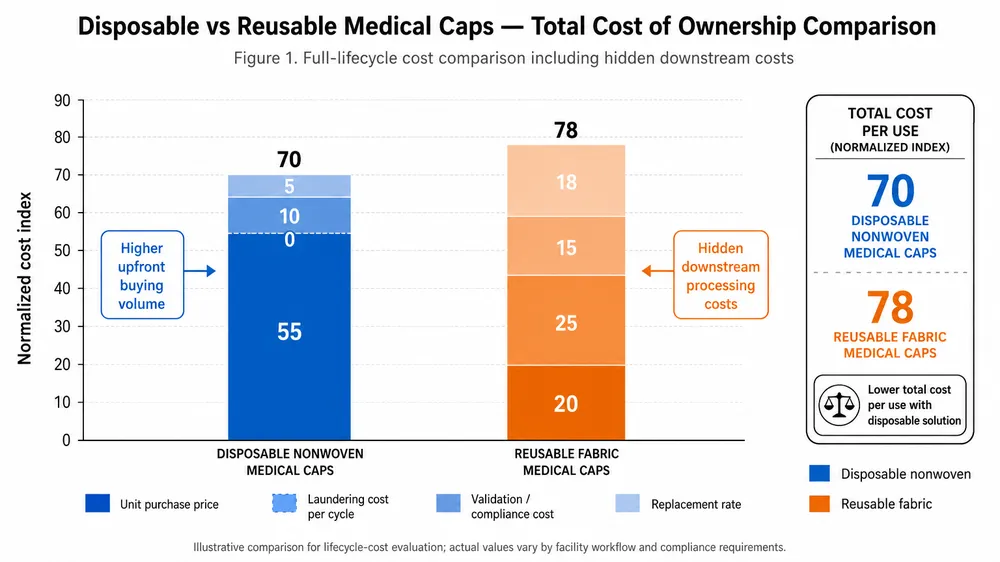
Choosing a factory based on unit price alone. A 10% lower unit price from a factory without ISO 13485 certification can cost you significantly more in compliance remediation, documentation gaps, or a failed customs clearance. The landed cost calculation needs to include documentation risk, not just FOB price.
What to send a factory before requesting a sample
This checklist covers the minimum information a factory needs to produce an accurate first sample. Missing items will either delay the sample or result in a sample that doesn't match your actual requirements.
Product specification:
- [ ] Cap type (bouffant / surgical / disposable)
- [ ] Nonwoven GSM and fabric type (polypropylene spunbond, SMS, etc.)
- [ ] Elastic width and color
- [ ] Cap size or diameter
- [ ] Product color
Packaging and branding:
- [ ] Logo in vector format (AI, EPS, or SVG)
- [ ] Pantone color codes
- [ ] Packaging type (polybag, retail box, bulk carton)
- [ ] Label copy (all required text for destination market)
- [ ] Carton quantity (pieces per inner pack, inner packs per carton)
Regulatory and market:
- [ ] Destination market(s)
- [ ] Required certifications (CE, FDA, ISO 13485 documentation)
- [ ] Any market-specific labeling requirements (UDI, establishment registration, etc.)
- [ ] Importer of record name and country (for EU MDR Declaration of Conformity)
Commercial terms (confirm before sample approval):
- [ ] Production MOQ at quoted unit price
- [ ] One-time setup fees (packaging, tooling, printing plates)
- [ ] Lead time from order confirmation to ex-factory
- [ ] Reorder terms
FAQ
What is a reasonable MOQ for a private-label medical cap program?
For standard bouffant and disposable cap SKUs from an established factory, 50,000 pieces per SKU is a workable starting point. Below that, the economics of custom packaging setup don't work for either side. If you're running multiple SKUs under one program, ask the factory whether they can apply a per-program MOQ rather than per-SKU — this is more common with factories that run multiple cap types in-house. Custom configurations (non-standard colors, modified elastic specs, unique packaging formats) typically require higher minimums to justify the setup cost.
Does my private-label medical cap need CE marking for EU distribution?
Yes, if the cap is classified as a medical device under EU MDR (Regulation 2017/745). Most medical-grade bouffant and surgical caps fall under Class I (non-sterile, non-measuring). Class I devices require a Declaration of Conformity and CE marking, but don't require Notified Body involvement for the conformity assessment. The factory provides the product-level technical documentation; you (or your EU importer of record) are responsible for the Declaration of Conformity and market registration. If your cap is positioned as a general-purpose protective cap rather than a medical device, the classification may differ — confirm with your regulatory advisor before entering the EU market.
How does nonwoven GSM affect the per-unit cost of a private-label cap?
Directly and proportionally. Nonwoven fabric is the primary material cost in a disposable cap. Moving from 20 GSM to 28 GSM on a bouffant cap increases material cost by roughly 30–40% per unit, which flows through to the quoted price. The trade-off is structural: a 28 GSM cap holds its shape better, fits more consistently across head sizes, and is less likely to generate fit complaints from clinical users. For hospital-grade programs, the higher GSM is usually worth the cost. For dental or light clinical use, 20–22 GSM is often sufficient and keeps your margin competitive.
What documentation does an ISO 13485 factory provide for a private-label order?
At minimum: a Certificate of Conformity for the shipment, batch-level test reports (if performance testing applies to the product), a material specification sheet, and a Device History Record (DHR) for the production batch. For CE-marked products, the factory also provides the technical file documentation that supports your Declaration of Conformity. The specific documents vary by product classification and destination market — confirm the documentation package with the factory before placing your first order, not after.
Can I run bouffant, surgical, and disposable caps under one OEM program with a single factory?
Yes, if the factory produces all three cap types in-house. The advantage is consolidated documentation, a single quality system covering all SKUs, and the ability to negotiate a per-program MOQ rather than per-SKU minimums. The risk of splitting cap types across multiple factories is that your compliance documentation comes from different quality systems, your reorder coordination is more complex, and you lose the leverage of consolidated volume. For a private-label program targeting multiple clinical segments, a single factory covering all three cap types is the cleaner structure. Our Medical Caps program at eztio covers bouffant, surgical, and disposable cap SKUs under one OEM agreement for exactly this reason.
If you're ready to structure a private-label cap program, the most useful first step is sending us your target cap type, destination market, estimated monthly volume, and any existing spec or sample you're working from. We'll confirm MOQ, lead time, and the documentation package your market requires — typically within one business day. Submit your requirements here.