The question sounds simple: buy once and launder, or buy in bulk and discard. In practice, the cost math is rarely what it looks like on the purchase order, and the contamination risk difference between the two options is the part most procurement teams don't price in until after an infection control audit.
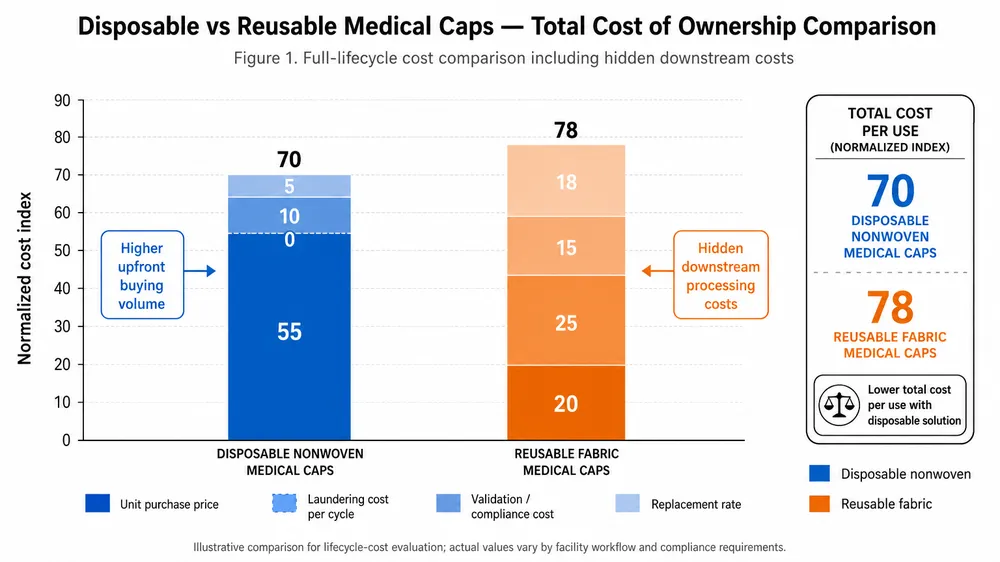
Here's the short verdict before we get into the numbers: for high-volume clinical settings — operating rooms, ICUs, procedure suites, and any environment with active infection control protocols — disposable nonwoven caps deliver lower total cost of ownership and meaningfully lower contamination risk than reusable fabric caps once you account for laundering infrastructure, validation cycles, and fabric degradation. Reusable caps have a defensible place in low-volume or sustainability-mandate environments, but the economics only hold when the laundering program is properly costed and validated. Most aren't.
The rest of this article shows you exactly why, with numbers you can use in your own procurement analysis.

What You're Actually Comparing: Materials, Construction, and Use Context
Before the cost table, a quick grounding on what each option actually is — because the material difference is what drives every downstream cost and risk difference.
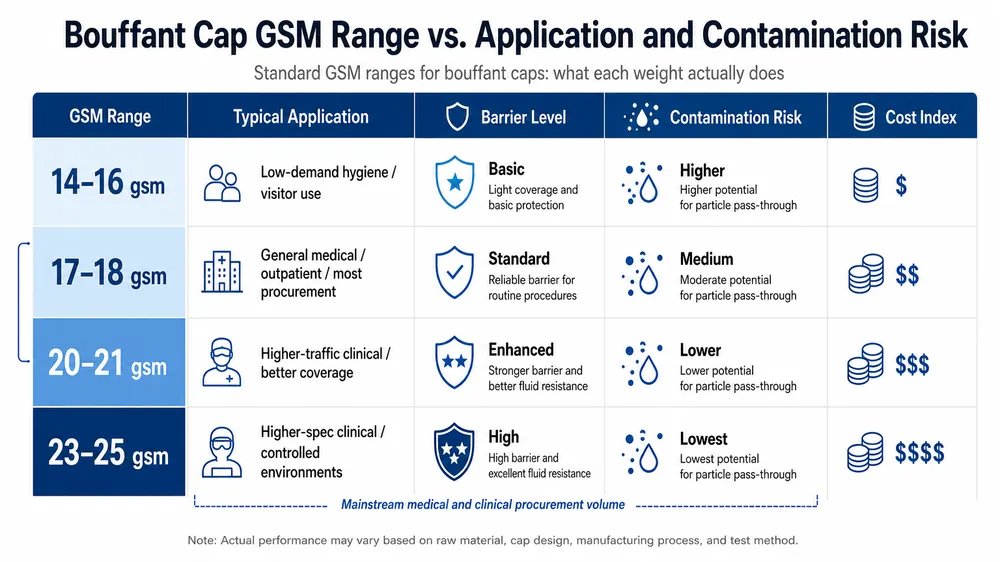
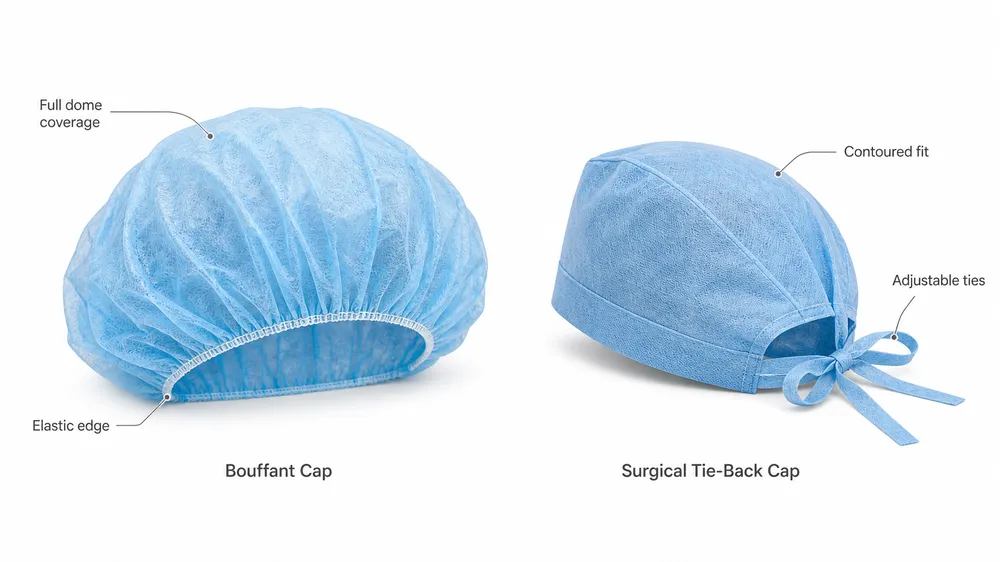
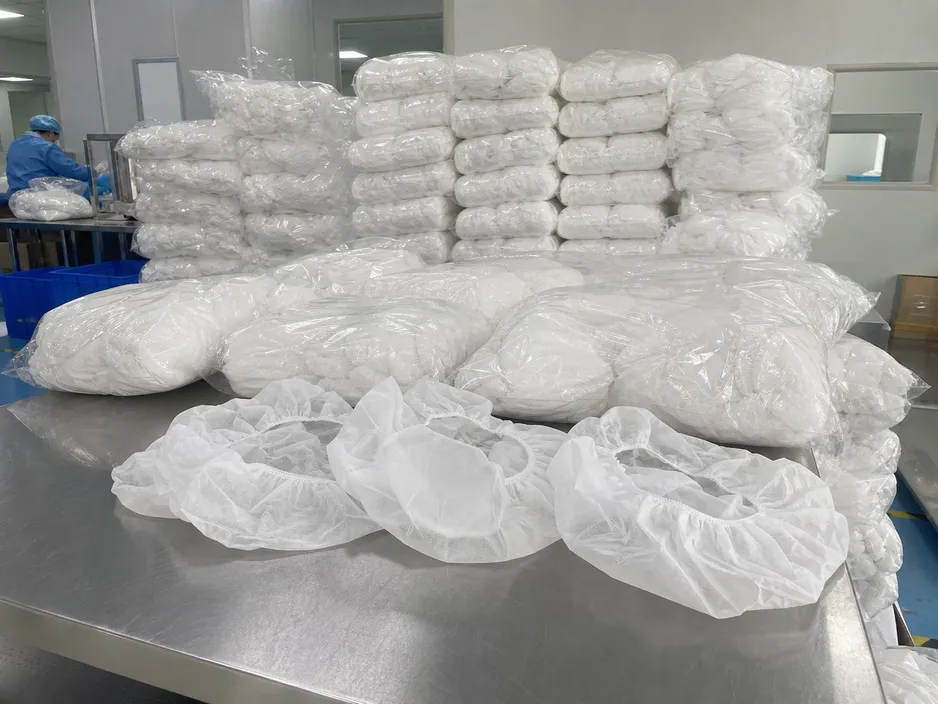
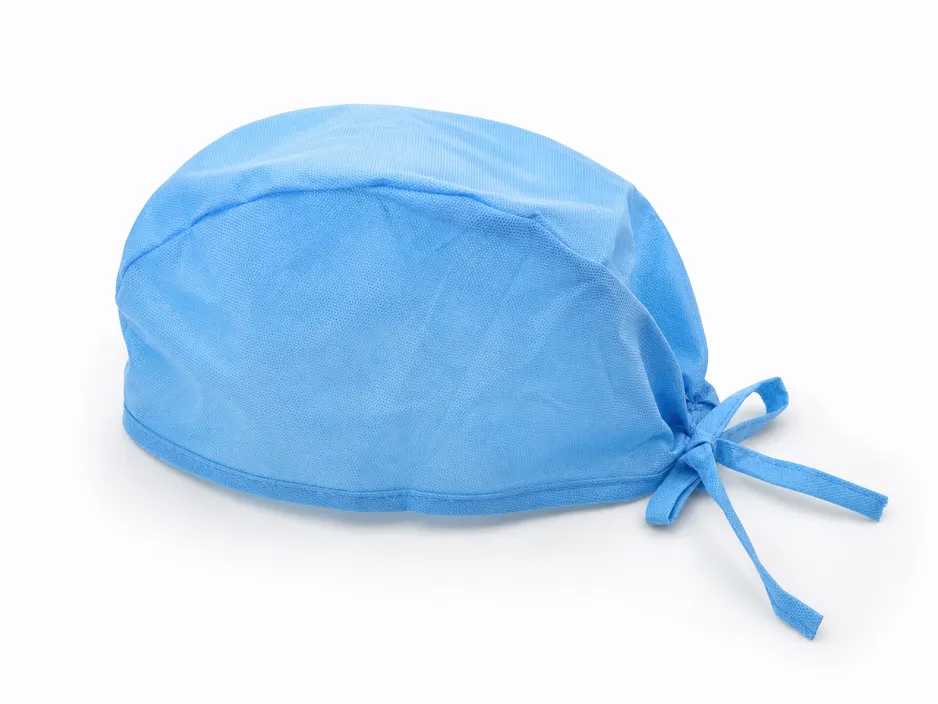
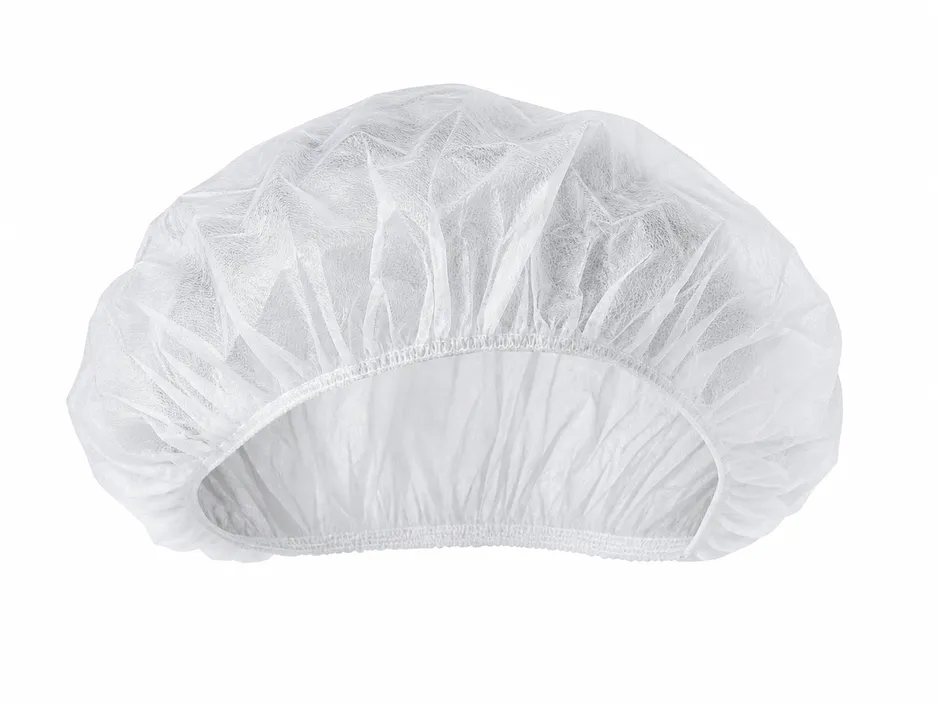
Disposable nonwoven medical caps are made from polypropylene spunbond nonwoven fabric, typically 17–25 GSM for standard bouffant styles and 20–30 GSM for surgical tie-back configurations. The fabric is hydrophobic, lint-free, and produced in a single-use format — it has no wash cycle life because it's not designed for one. The elastic band is ultrasonically welded or sewn into the hem; the cap ships sterile-packed or clean-packed depending on the application. At eztio, we produce these in a Class 100,000 (ISO 8) cleanroom, which matters for the contamination argument we'll get to shortly.
Reusable fabric caps are typically woven polyester, cotton-polyester blends, or knit fabrics. They're designed for repeated laundering — usually rated for 50–100 wash cycles before the fabric barrier properties degrade to the point of replacement. The upfront unit cost is higher (typically 8–15× the cost of a disposable cap), and the economics depend entirely on how many wash cycles you actually get before the cap is retired.
The use context matters too. Disposable caps are the standard in OR environments, procedure rooms, and any setting where single-use PPE is mandated by infection control policy. Reusable caps appear more often in food processing, pharmaceutical manufacturing, and some outpatient clinical settings where the contamination risk profile is lower and sustainability mandates carry institutional weight.
Total Cost of Ownership: The Numbers Most Buyers Miss
The purchase price comparison is the easy part. A disposable bouffant cap in bulk runs roughly $0.05–$0.15 per unit depending on GSM, order volume, and supplier. A reusable fabric cap runs $1.50–$4.00 per unit. On that basis alone, reusable looks expensive.
But the real comparison is cost per use, and that's where the math shifts — or doesn't, depending on how honestly you cost the laundering program.
| Cost Component | Disposable Nonwoven Cap | Reusable Fabric Cap |
|---|---|---|
| Unit purchase price | $0.05–$0.15 | $1.50–$4.00 |
| Wash cycles per unit | 0 (single use) | 50–100 (rated) |
| Laundering cost per cycle | — | $0.30–$0.80 per item |
| Validation / compliance cost | Included in certification | $500–$2,000+ per laundering protocol |
| Replacement rate | 100% per use | 20–40% annual attrition |
| Estimated cost per use | $0.05–$0.15 | $0.35–$0.90+ |
| Infrastructure required | None | Validated laundry facility |
(The laundering cost range above reflects industrial healthcare laundry rates in North America and Western Europe. In-house laundry operations in lower-cost markets can reduce this, but the validation cost is fixed regardless of geography.)
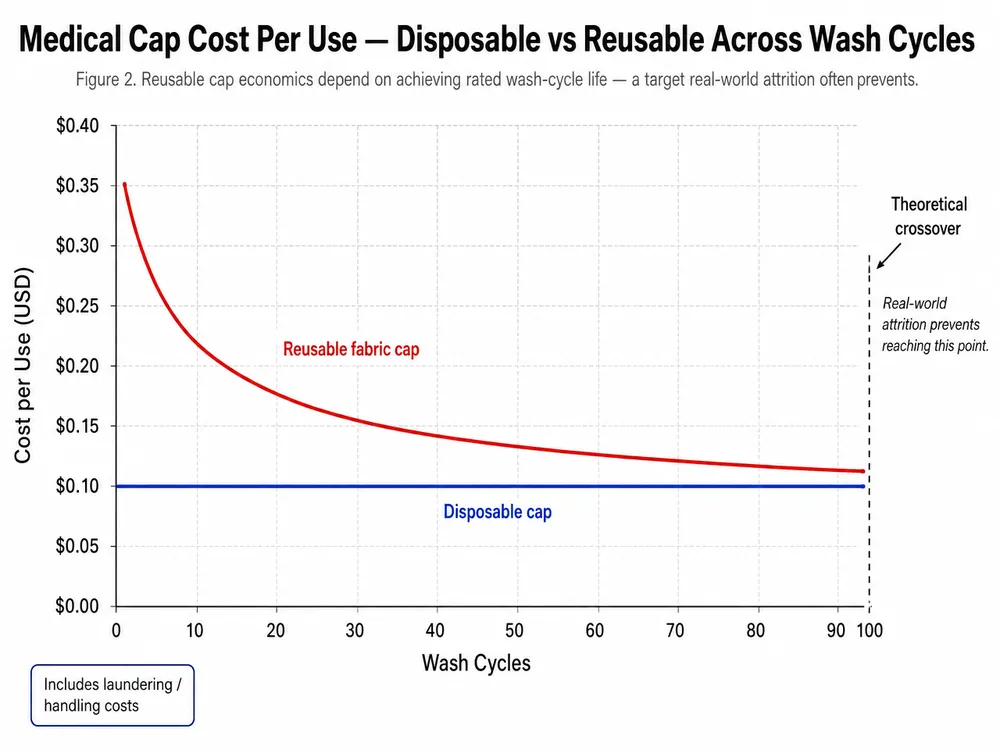
The laundering cost is the number that surprises most buyers. At $0.40 per cycle — a conservative mid-range figure for a validated healthcare laundry — a reusable cap that gets 75 wash cycles before retirement costs $30 in laundering alone, on top of the $2.50 purchase price. That's $32.50 total for a cap that was supposed to save money over disposables. At $0.10 per disposable cap, you'd need to use 325 disposable caps to match that spend — roughly 16 months of daily use for a single staff member.
The laundering cost is also the number most procurement analyses undercount, because it often sits in a different budget line (facilities or linen services) rather than in the PPE procurement budget. When you consolidate the full cost, disposable caps are cheaper per use in virtually every high-volume clinical scenario we've seen.
There's also the replacement rate. Reusable caps don't last their rated wash cycle life in practice. Elastic degrades, fabric thins at stress points, and caps get lost in the laundry cycle. A realistic annual attrition rate of 25–35% means you're replacing a meaningful fraction of your reusable cap inventory every year — which erodes the amortized cost advantage further.
Contamination Risk: Where Fabric Barrier Properties Actually Matter
Cost is one half of the decision. Contamination risk is the other — and for clinical environments, it's often the more important half.
The contamination control function of a medical cap is straightforward: prevent hair, scalp particles, and skin flora from entering the sterile field or contaminating the environment. The question is how reliably each cap type performs that function across its use life.
Disposable nonwoven caps provide consistent barrier performance from the first use to the last — because there is only one use. The nonwoven fabric structure is intact, the fiber density is at spec, and the hydrophobic treatment hasn't been degraded by heat, detergent, or mechanical agitation. At eztio, we produce our nonwoven fabric in-house, which means we control the GSM, fiber diameter, and electrostatic properties to a tighter tolerance than caps made from purchased fabric. A 20 GSM spunbond cap from our line has the same barrier properties on unit 50,000 as it does on unit 1.
Reusable fabric caps degrade with every wash cycle. The degradation isn't always visible — a cap that looks intact after 60 washes may have lost 30–40% of its original particle barrier efficiency due to fiber breakdown, pilling, and detergent residue accumulation. Woven and knit fabrics also have inherent porosity that nonwoven structures don't — the interlocking fiber matrix of a nonwoven creates a more tortuous path for particles than a woven grid of the same weight.
The cross-contamination pathway that gets underweighted in most analyses is the laundering process itself. Reusable caps from different departments, different staff members, and different contamination exposure levels are processed together in industrial laundry batches. Even with validated laundering protocols, the risk of cross-contamination between items in the same wash load is non-zero — and the validation burden to demonstrate adequate decontamination is substantial.
Healthcare-associated infection (HAI) data consistently identifies hair and scalp as a contamination vector in surgical site infections, particularly for procedures involving implants or open cavities. The CDC and WHO both recommend single-use PPE in high-risk surgical environments specifically because the barrier consistency of disposable products eliminates the degradation variable. That recommendation has procurement implications: if your buyer is a hospital system operating under Joint Commission or equivalent accreditation, their infection control policy likely already mandates single-use caps in OR settings — which means the reusable option isn't actually on the table for that segment.
(We've had buyers come to us after switching from reusable to disposable caps following an infection control audit. The audit finding wasn't that the reusable caps were visibly defective — it was that the laundering validation documentation couldn't demonstrate consistent decontamination across the cap's rated wash cycle life. That's a documentation problem as much as a performance problem.)
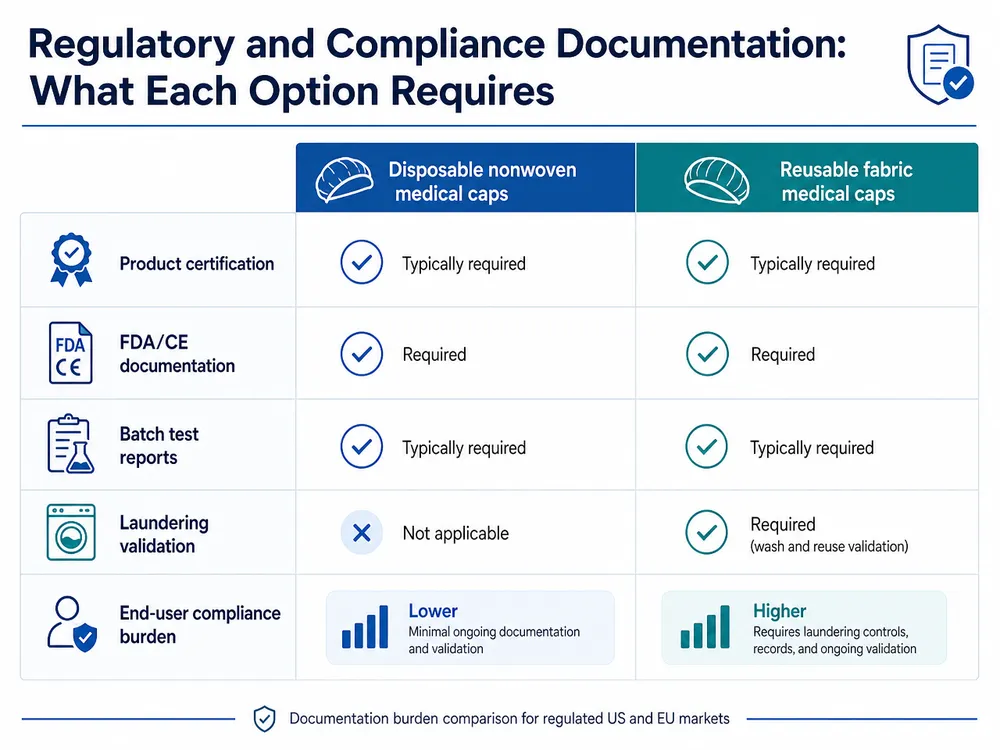
Regulatory and Compliance Documentation: What Each Option Requires
This is the section that procurement teams often skip until they're in the middle of a compliance review.
Disposable nonwoven medical caps from a certified manufacturer come with a complete documentation package: ISO 13485:2016 quality management certification, CE (EU MDR) technical file, FDA 510(k) registration, and batch-level test reports. When you source from eztio, that documentation travels with every shipment. Your hospital procurement team or institutional buyer can reference the manufacturer's certification directly — there's no additional validation burden on your end.
Reusable fabric caps require a different compliance structure. The cap itself may have a product certification, but the laundering process requires separate validation — and that validation is the buyer's responsibility, not the manufacturer's. A validated laundering protocol for medical textiles under ISO 15797 or equivalent standards involves documented wash cycle parameters, temperature verification, detergent concentration testing, and periodic re-validation when any process variable changes. For a hospital running its own linen service, this is manageable. For a distributor supplying caps to multiple facilities, the compliance burden multiplies across every customer's laundering operation.
The FDA and EU MDR frameworks treat single-use medical devices differently from reusable ones. Single-use devices carry the manufacturer's performance claims for the intended single use. Reusable devices require the manufacturer to validate the reprocessing method — and if the end user deviates from the validated method, the performance claims no longer apply. In practice, this means a hospital using reusable caps with a laundering process that differs from the manufacturer's validated protocol is operating outside the device's cleared use conditions.
For buyers supplying into regulated markets — US hospitals under FDA oversight, EU healthcare facilities under MDR — the documentation simplicity of disposable caps is a real commercial advantage. Your customers' compliance teams have one document to review (the manufacturer's certification) rather than two (the product certification plus the laundering validation).
See our disposable medical caps specification page for the full technical documentation available with each order.
Application Scenarios: Which Option Wins Where
High-Volume OR and Procedure Suite Procurement
Winner: Disposable nonwoven caps — decisively.
An OR running 20 procedures per day with 5 staff per procedure uses 100 caps daily, 2,000+ per month. At that volume, the per-unit cost of disposables is at its lowest (bulk pricing applies), the laundering infrastructure cost is eliminated entirely, and the infection control documentation is straightforward. The reusable option at this volume requires either a substantial in-house laundry operation or a contracted healthcare laundry service — both of which add cost, logistics complexity, and compliance overhead that the disposable option simply doesn't have.
For distributors supplying hospital systems, this is the segment where disposable caps generate the most reliable repeat volume. A hospital that standardizes on disposable caps for OR use is placing predictable monthly orders — the kind of recurring revenue that makes a distribution program worth building.
Outpatient Clinics and Low-Volume Clinical Settings
Winner: Situational — depends on infection control policy and sustainability mandate.
A small outpatient clinic running 10–15 procedures per week has a different cost profile. At lower volumes, the per-unit cost of disposables is higher (smaller order quantities), and the laundering cost per cap is spread across fewer units. If the clinic already has a validated laundry operation for other medical textiles (gowns, drapes), adding caps to that program has marginal incremental cost.
That said, if the clinic's infection control policy mandates single-use PPE in procedure rooms — which is increasingly common as accreditation standards tighten — the reusable option is off the table regardless of cost. Check the policy before the procurement analysis.
Pharmaceutical and Food Processing Environments
Winner: Disposable nonwoven caps for contamination-sensitive lines; reusable acceptable for lower-risk zones.
Pharmaceutical cleanroom environments and food processing lines have contamination control requirements that parallel clinical settings in some ways but differ in others. The key difference: laundering validation in these environments is often more mature and better-resourced than in clinical settings, because textile reprocessing is a standard part of cleanroom operations management.
For pharmaceutical GMP environments operating under EU Annex 1 or FDA 21 CFR Part 211, the contamination control logic favors disposables in Grade A/B zones for the same reason it does in ORs — consistent barrier performance, no degradation variable, and simpler documentation. In Grade C/D zones or food processing lines with lower contamination risk, reusable caps with a validated laundering program are a defensible choice.
Sustainability-Mandate Procurement Programs
Winner: Reusable — with caveats.
Some institutional buyers operate under sustainability mandates that require minimizing single-use plastics or disposable materials. In these environments, reusable caps may be the required option regardless of cost or contamination risk analysis. If your buyer is in this category, the procurement conversation shifts from "which is cheaper" to "how do we validate the reusable program properly."
The honest caveat: the environmental math on reusable vs disposable medical PPE is more complicated than it appears. Laundering reusable caps consumes water, energy, and detergent — and the carbon footprint of 75 industrial wash cycles is not trivially lower than the footprint of 75 disposable caps. Life cycle assessment data on medical PPE consistently shows that the environmental advantage of reusable products depends heavily on the energy source of the laundry facility and the actual wash cycle life achieved. This is worth knowing if your buyer's sustainability team asks.
Sourcing Logistics: What the Supply Chain Actually Looks Like
The operational difference between sourcing disposable and reusable caps is significant, and it affects your supply chain complexity in ways that don't show up in the unit cost comparison.
Disposable caps ship ready to use. No laundry infrastructure, no reprocessing validation, no cycle tracking. You order, we ship, your customer opens the box and uses the product. For distributors managing multiple hospital accounts, this simplicity is a real operational advantage — you're not coordinating between a cap supplier and a laundry service provider to deliver a complete solution.
MOQ for our standard disposable cap SKUs starts at 50,000 pieces, which is low enough for a trial order before committing to a full program. Lead time on standard configurations runs 15–25 days from order confirmation. We can ship bouffant caps (17 GSM, 21 GSM, or 25 GSM) and surgical tie-back caps in standard sizes, with OEM packaging available for private-label programs.
Reusable caps require a supply chain that includes the cap manufacturer, a validated laundry service or in-house laundry operation, a cycle tracking system (to know when caps have reached their rated wash life and need replacement), and a replacement procurement program. For a distributor, this means either building that infrastructure for your customers or selling into accounts that already have it. The complexity is manageable, but it's real — and it's a reason why many hospital supply distributors have moved toward disposable-only cap programs over the past decade.
One practical note on documentation for disposable cap sourcing: when you're importing into the US or EU, the FDA 510(k) registration and CE (EU MDR) technical file need to be in order before the shipment arrives at customs. We prepare the full documentation package with every order — test reports, certificate of conformity, and any market-specific declarations your compliance team needs. This is the part of sourcing from a certified manufacturer that saves you time at the import stage.
For a detailed look at our disposable cap range and bulk sourcing options, see bulk sourcing disposable medical caps.
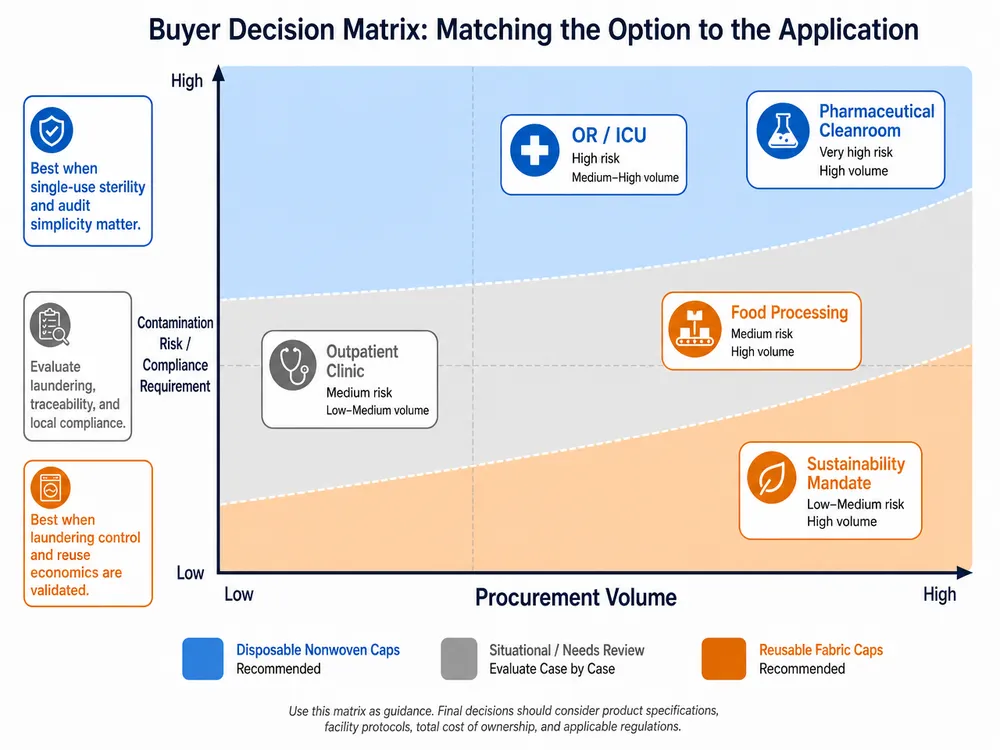
Buyer Decision Matrix: Matching the Option to the Application
| Scenario | Recommended Option | Key Reason |
|---|---|---|
| High-volume OR / ICU (100+ caps/day) | Disposable | Lower TCO, no laundry infrastructure, infection control compliance |
| Procedure rooms with single-use PPE mandate | Disposable | Policy requirement; reusable not compliant |
| Pharmaceutical GMP Grade A/B cleanroom | Disposable | Consistent barrier performance, simpler documentation |
| Low-volume outpatient clinic with existing laundry | Situational | Cost depends on laundering program efficiency |
| Food processing / lower-risk industrial | Either | Reusable viable if laundering program is validated |
| Sustainability-mandate institutional buyer | Reusable | Policy-driven; validate laundering program carefully |
| Hospital distributor building recurring revenue | Disposable | Predictable repeat orders, no laundry coordination |
What to Verify When Sourcing Either Option
Whether you're sourcing disposable or reusable caps, the documentation and specification verification steps are different — and both have failure modes that show up after the order is placed.
For disposable nonwoven caps, verify:
- ISO 13485:2016 certification — This is the medical device quality management standard. A supplier without it is not operating a medical-grade QC system, regardless of what their product spec sheet says.
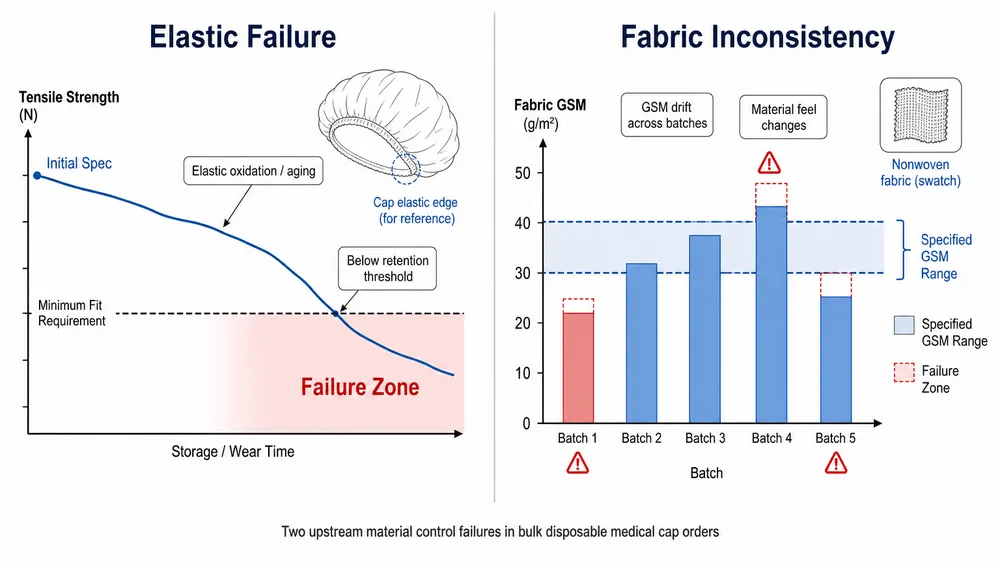
- Nonwoven GSM and fabric grade — Ask for the specific GSM of the spunbond fabric used. 17 GSM is the minimum for standard bouffant caps; 20–25 GSM provides better barrier performance and durability. Suppliers who can't specify GSM are buying fabric from spot markets and can't guarantee consistency across batches.
- Elastic tensile specification — The elastic band is the most common failure point in disposable caps. Ask for the tensile strength spec and whether it's tested per batch. A cap that loses elastic tension after 2 hours of wear is a fit failure, and fit failures are a contamination risk.
- Cleanroom manufacturing environment — Medical cap production in a Class 100,000 (ISO 8) or better cleanroom is the standard for products going into clinical environments. Ask for the cleanroom classification and whether it's third-party verified.
- CE and FDA documentation — For US and EU market access, confirm the specific registration numbers and request copies of the test reports. A certificate of conformity without underlying test data is not sufficient for hospital procurement audits.
For reusable fabric caps, verify:
- Rated wash cycle life and test method — Ask how the wash cycle rating was determined and under what laundering conditions. A cap rated for 100 cycles under gentle domestic washing is not the same as one rated for 100 cycles under industrial healthcare laundering at 71°C.
- Laundering validation protocol — Request the manufacturer's validated laundering procedure. If they don't have one, the product's performance claims after washing are unvalidated.
- Fabric barrier performance after washing — Ask for particle filtration or barrier test data at 50% and 100% of rated wash cycle life. Barrier performance at new condition is not the relevant data point.
- Replacement cycle planning — Understand the expected attrition rate and build it into your procurement model. A supplier who can't give you a realistic attrition estimate is not helping you plan your program correctly.
See our Disposable Medical Caps product page for the full specification and certification documentation available with each order.
Frequently Asked Questions
Are disposable medical caps actually cheaper than reusable caps over time?
For high-volume clinical settings, yes — typically by a significant margin once laundering costs are properly accounted for. The crossover point depends on your laundering cost per cycle and the actual wash cycle life you achieve. At $0.40 per laundering cycle and 75 wash cycles per cap, a reusable cap costs roughly $32.50 total (purchase + laundering). At $0.10 per disposable cap, you'd use 325 disposable caps for the same spend — about 16 months of daily use for one staff member. Most high-volume OR environments find disposables cheaper per use when the full cost is consolidated.
What nonwoven GSM should I specify for disposable medical caps in OR settings?
For standard OR bouffant caps, 20–21 GSM spunbond polypropylene is the most common specification — it provides adequate barrier performance, comfortable fit, and good elastic retention. For higher-risk environments or longer procedure durations, 25 GSM offers better barrier properties and more durable elastic performance. We produce both grades; the 25 GSM option is worth the marginal cost increase for implant procedures or extended OR sessions.
How do I know if a disposable cap supplier's nonwoven fabric is consistent across batches?
Ask whether the supplier produces their own nonwoven fabric or purchases it from external suppliers. Factories that buy nonwoven from spot markets have no control over GSM variation, fiber diameter, or barrier properties between batches. At eztio, we produce our nonwoven fabric in-house — the same production controls that apply to our masks apply to our cap fabric. Batch-to-batch GSM variation is held within ±1 GSM, which is the tolerance that matters for consistent fit and barrier performance across a large order.
What documentation do I need to import disposable medical caps into the US or EU?
For US import: FDA 510(k) registration number, certificate of conformity, and batch test reports. For EU import: CE (EU MDR) technical file reference, declaration of conformity, and test reports to the applicable standard. We prepare the full documentation package with every shipment. If you're importing into the EU for the first time under MDR (post-2021), the importer of record requirements have changed — we've walked multiple European buyers through this and can advise on what your customs broker will need.
What is the minimum order quantity for disposable medical caps from eztio?
50,000 pieces for standard SKUs (bouffant and surgical tie-back in standard sizes). This is intentionally set at a level that allows a meaningful trial order before committing to a full program. OEM packaging and private-label printing are available on standard MOQ orders. Custom configurations — modified sizes, non-standard GSM, or specialty elastic specs — typically require a higher minimum; we'll confirm that upfront before you approve samples.
Can reusable fabric caps meet the same contamination control standard as disposable caps in OR settings?
In theory, a properly validated reusable cap with a rigorous laundering protocol can meet contamination control requirements. In practice, the validation burden is substantial, and the barrier performance degrades with wash cycles in ways that are difficult to monitor in real-time. Most infection control guidelines — including CDC and WHO recommendations for surgical environments — favor single-use PPE specifically because the performance consistency of disposable products eliminates the degradation variable. For OR settings, the practical answer is that disposable caps are the standard, and reusable caps require explicit infection control policy approval to use.
For the full Medical Caps product range and sourcing options, including bouffant caps, surgical tie-back caps, and OEM packaging programs, visit our medical caps category page.