GSM is the number most buyers skip when they write a bouffant cap RFQ. They specify size, elastic type, color — and leave fabric weight as "standard." That gap is where substitution happens. A supplier who receives an underspecified order will fill it with whatever nonwoven roll is on the floor, and you won't know the difference until your hospital client flags a fit failure or a contamination audit comes back with questions.
This article explains what GSM actually controls in a disposable bouffant cap, how to read the tradeoffs across the common weight ranges, and what to put in your spec sheet to close the substitution window.
What GSM measures and why it's the wrong number to leave blank
GSM stands for grams per square meter. For spunbond polypropylene nonwoven — the material used in virtually all disposable bouffant caps — it's a direct measure of fabric density. Higher GSM means more fiber per unit area: thicker, stiffer, more opaque, heavier per cap.
What it doesn't tell you on its own is fiber diameter, bonding pattern, or tensile strength. Two rolls of 20 gsm spunbond from different production lines can behave differently under tension, drape differently over a head, and shed particles at different rates. GSM is a necessary spec, not a sufficient one — but it's the starting point, and without it, you have no spec at all.
For bouffant caps specifically, GSM controls four things that matter to your buyers:
- Barrier performance: higher GSM reduces particle migration through the fabric
- Fit retention: heavier fabric holds the elastic channel shape better under movement
- Tactile perception: thinner caps feel flimsy to clinical staff, which affects compliance rates
- Per-unit cost: fabric is the largest material cost component, so GSM directly drives unit price at volume
(We've seen buyers spec 17 gsm for a hospital OR program and then wonder why staff keep adjusting their caps mid-procedure. The cap isn't failing — it's just too light to hold its shape under the elastic tension at that head circumference. A 20 gsm cap in the same size solves it.)
Standard GSM ranges for bouffant caps: what each weight actually does
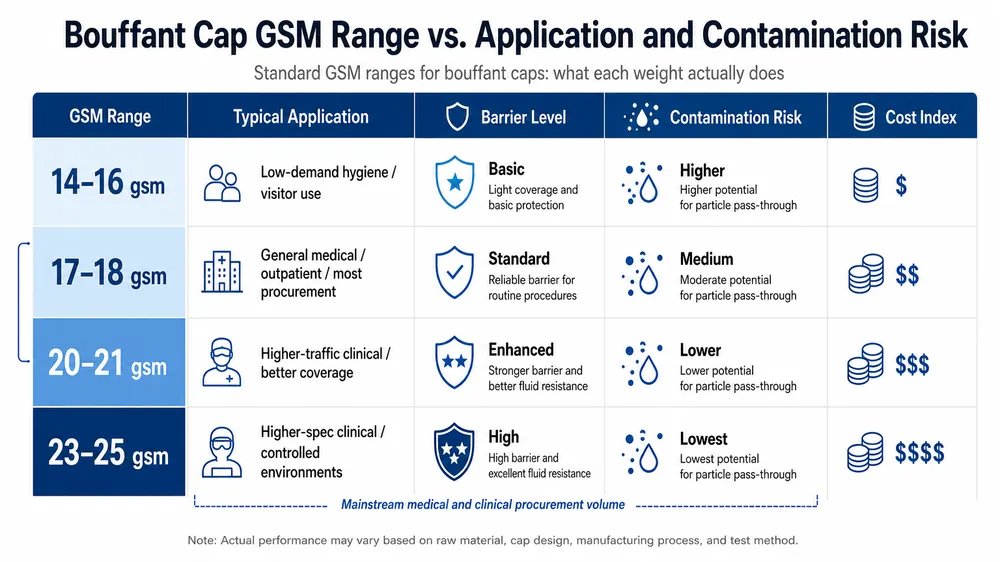
The market runs on four practical weight bands. Here's how they map to use case and contamination risk:
| GSM | Typical application | Barrier level | Fabric feel | Cost index |
|---|---|---|---|---|
| 14–16 gsm | Food service, light industrial, visitor caps | Low | Very light, semi-transparent | Lowest |
| 17–18 gsm | General clinical, outpatient, dental | Moderate | Light but opaque | Low–mid |
| 20–21 gsm | OR, sterile processing, ISO 7–8 cleanroom | Standard medical | Structured, holds shape | Mid |
| 23–25 gsm | High-contamination risk, long-duration procedures | High | Noticeably heavier | Higher |
The 17 gsm and 20 gsm weights are where most of the volume sits. Food service and visitor programs run 14–16 gsm because cost per unit is the primary driver and contamination risk is low. Hospital OR programs typically land at 20 gsm because that's where the balance between barrier performance and wearability stabilizes.
The 23–25 gsm range is less common in standard procurement but comes up in two situations: extended surgical procedures where the cap is worn for 4+ hours, and cleanroom environments where particle counts are monitored against ISO 5–6 standards. At those weights, the fabric is stiff enough that some buyers find it uncomfortable — worth sampling before committing to a large run.

How GSM affects contamination control in OR and cleanroom environments
The contamination control question isn't just about whether the cap blocks particles — it's about whether it blocks them consistently across a full shift, under movement, and across every cap in a 10,000-unit order.
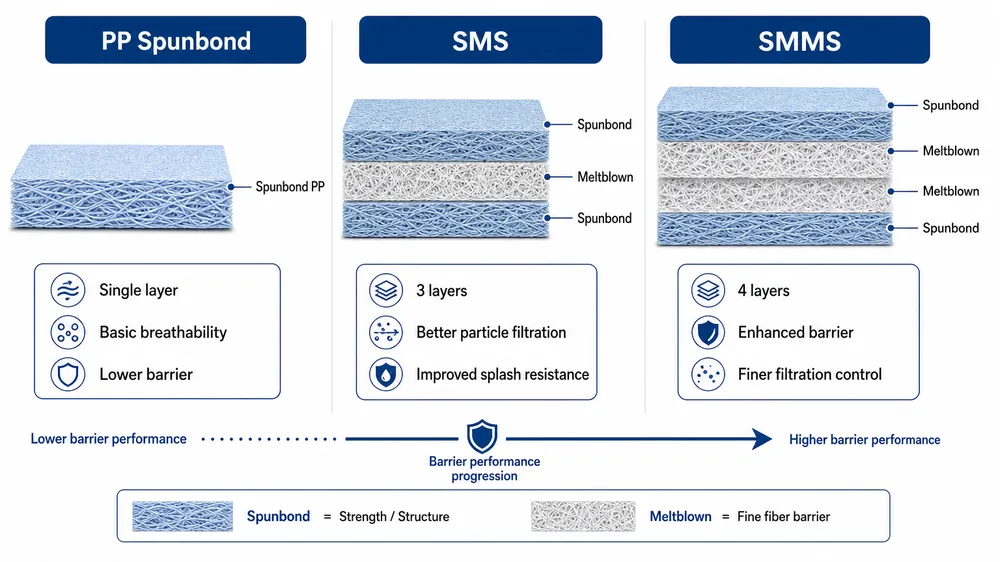
Spunbond nonwoven works as a barrier through two mechanisms: mechanical filtration (fiber density physically blocks particles) and electrostatic charge (fibers attract and hold charged particles). GSM directly affects the mechanical component. A 20 gsm fabric has roughly 25% more fiber mass per unit area than a 16 gsm fabric, which means more fiber-to-particle contact points and a lower probability of particle migration through the material.
For hair containment — the primary function of a bouffant cap in OR settings — the relevant failure mode isn't the fabric itself. It's the seal at the elastic edge. A cap that fits correctly at the forehead and nape creates a closed system; a cap that gaps because the elastic is under-tensioned or the fabric is too light to hold the channel shape creates a contamination path. This is why GSM and elastic spec need to be evaluated together, not independently.
In cleanroom environments rated ISO 7 (Class 10,000) or ISO 8 (Class 100,000), the cap is part of a gowning protocol that has a defined particle budget. The cap's contribution to that budget depends on both the fabric's barrier properties and the fit. A 20 gsm cap that fits correctly contributes less to particle counts than a 25 gsm cap that gaps at the forehead. Spec the fabric weight and the elastic tension together, and confirm both with a fit test on your actual head size range before you commit to volume.
(We run fit testing on our bouffant cap samples using a standard head form at 56 cm and 60 cm circumference. If you're sourcing for a population with a different size distribution, tell us — we can adjust the elastic spec and run a sample set before production.)
GSM and cost per unit: what the numbers look like at volume
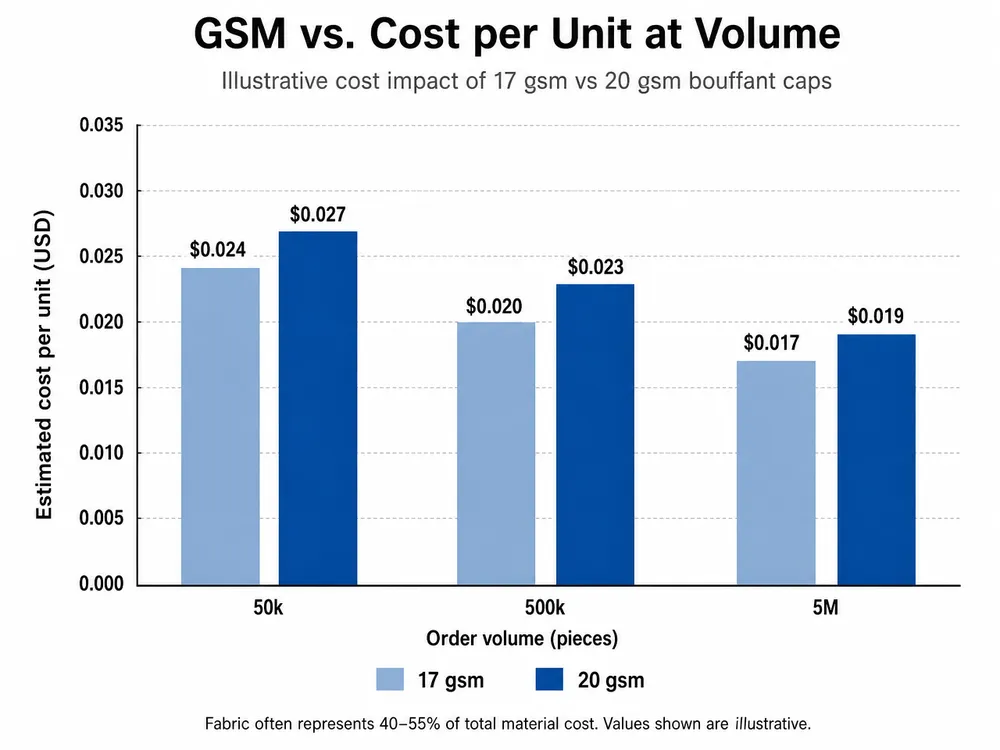
Fabric is typically 40–55% of the total material cost in a disposable bouffant cap. The rest is elastic, thread or ultrasonic bonding, and packaging. That means GSM has a direct, roughly linear effect on material cost — moving from 17 gsm to 20 gsm adds approximately 15–18% to the fabric cost component, which translates to roughly 8–10% on the total unit cost depending on your other specs.
At volume, that math compounds:
| Order volume | 17 gsm unit cost delta vs. 20 gsm | Annual cost difference (illustrative) |
|---|---|---|
| 50,000 pcs | ~$0.008–0.012/pc | ~$400–600 |
| 500,000 pcs | ~$0.008–0.012/pc | ~$4,000–6,000 |
| 5,000,000 pcs | ~$0.008–0.012/pc | ~$40,000–60,000 |
These are illustrative ranges, not quoted prices — actual figures depend on your full spec, packaging, and order frequency. The point is that the cost difference between adjacent GSM weights is real but not dramatic at moderate volumes. At 5 million pieces annually, the difference between 17 gsm and 20 gsm is meaningful enough to justify a spec review, but not so large that it should drive you to under-spec for a clinical application.
Where buyers get into trouble is when they optimize for the lowest unit price without anchoring the spec. A supplier who quotes 14 gsm when you asked for 17 gsm will show a lower price — and the caps will look identical in a photo. The difference shows up in the OR, not in the inbox.
Batch consistency: why GSM tolerance matters more than nominal weight
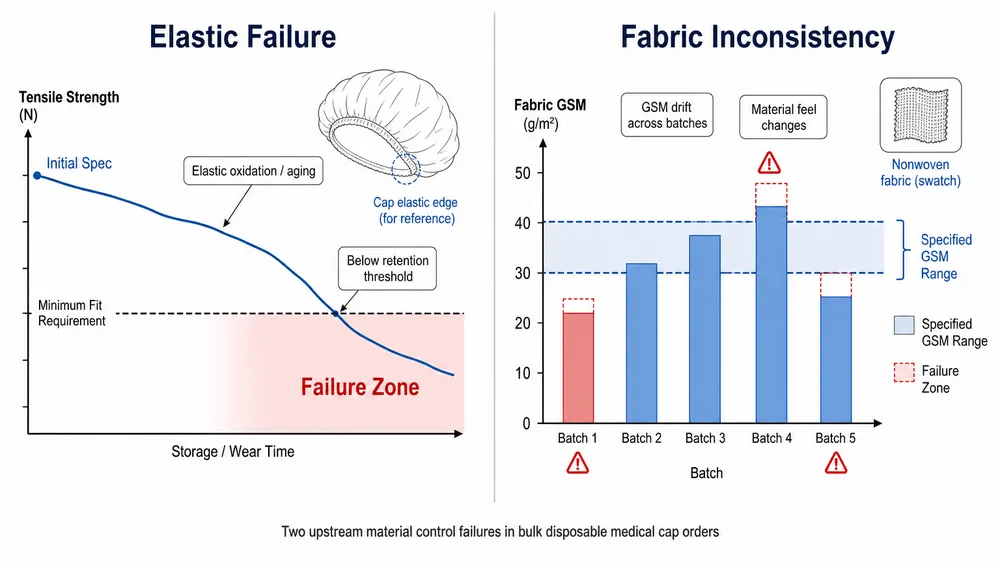
The number on the spec sheet is the nominal GSM. What actually ships is a distribution around that number, and the width of that distribution is what determines whether your QC pass rate holds across batches.
Standard commercial nonwoven production runs at ±2–3 gsm tolerance. That means a "20 gsm" roll can legally be anywhere from 17 to 23 gsm under loose commercial specs. For food service caps, that range is irrelevant. For OR caps going into a hospital procurement program with defined contamination control requirements, a batch that runs at 17 gsm when you ordered 20 gsm is a compliance problem, not just a quality complaint.
Tighter tolerance — ±1 gsm — requires either in-house nonwoven production or a supplier with a dedicated, calibrated production line and the measurement infrastructure to verify it. Most cap factories source their nonwoven externally and have no visibility into the actual GSM distribution of the rolls they receive. They test incoming fabric by weight, but batch-to-batch variation from their fabric supplier passes through to your caps.
We produce our own spunbond nonwoven at eztio. That's not a marketing point — it's the operational reason we can hold ±1 gsm tolerance on bouffant cap orders and provide batch-level GSM test documentation with each shipment. When you're running a hospital supply program across multiple order cycles, that documentation is what keeps your procurement audit clean.
For buyers who need to verify this: ask your supplier for the incoming fabric inspection records, not just the finished cap test report. If they can't produce fabric-level GSM data, they're not controlling the spec — they're hoping the fabric supplier shipped correctly.
The sourcing trap: how GSM substitution happens and how to close it
GSM substitution is the most common material-level quality issue in disposable cap procurement. It happens in two ways.
The first is intentional: a supplier quotes your spec, wins the order, and substitutes a lighter fabric to protect margin. The caps look identical. The GSM difference is invisible without a scale and a sample cutter. By the time the substitution is discovered — if it's discovered — the order has shipped and you've distributed product that doesn't match your spec.
The second is unintentional: the supplier's fabric source changes between orders, the new roll runs lighter, and nobody catches it because incoming inspection is cursory. The supplier isn't trying to cheat you — they just don't have the measurement discipline to notice.
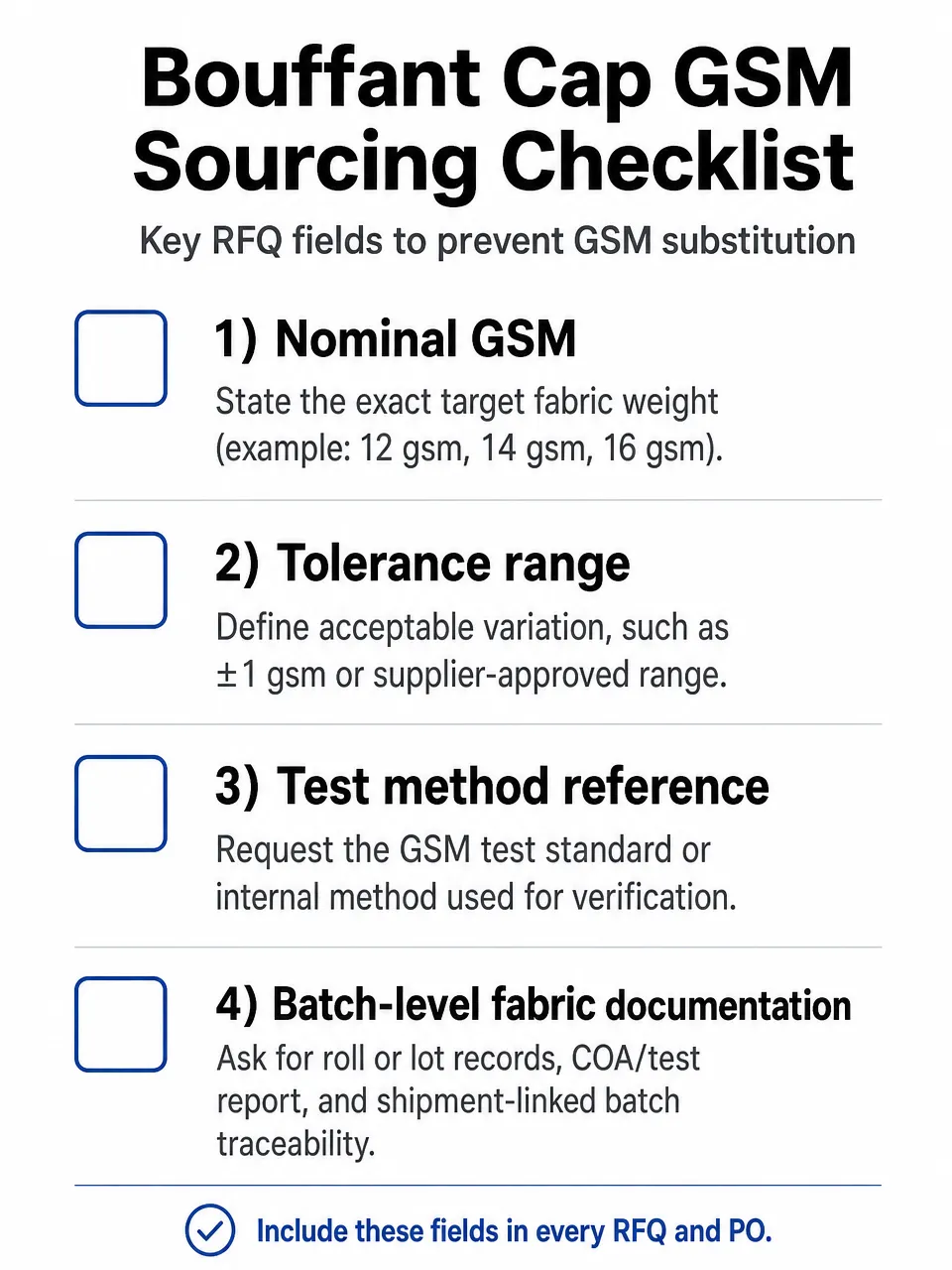
Both problems have the same solution: specify GSM in your purchase order with a tolerance range, and require batch-level fabric test documentation as a shipment condition.
Your RFQ should include:
- Nominal GSM (e.g., 20 gsm)
- Tolerance (e.g., ±1 gsm for medical applications, ±2 gsm for general clinical)
- Test method reference (e.g., ISO 9073-1 or ASTM D3776 for fabric weight)
- Documentation requirement: fabric GSM test report per production batch, not per product type
If a supplier can't provide batch-level fabric documentation, that's a sourcing signal. It means they're buying nonwoven on the open market and accepting whatever arrives. For a food service cap program, that's probably fine. For a hospital OR program, it's a risk you're carrying on behalf of your end customer.
How to specify GSM in your RFQ without over-engineering it
Most buyers either under-specify (no GSM at all) or over-specify (a tolerance so tight that no supplier can meet it without custom production). The practical middle ground depends on your application.
For general clinical and outpatient programs:
- Specify 17–18 gsm nominal, ±2 gsm tolerance
- Request a fabric weight test report per product type (not per batch)
- This is sufficient for most non-OR clinical environments
For hospital OR and sterile processing:
- Specify 20 gsm nominal, ±1 gsm tolerance
- Require batch-level fabric GSM documentation
- Confirm elastic spec alongside fabric weight — the two interact
For cleanroom environments (ISO 7 or tighter):
- Specify 20–21 gsm nominal, ±1 gsm tolerance
- Request particle shedding test data if available (not all suppliers have this)
- Consider a fit test protocol as part of your qualification process
For food service and visitor programs:
- 14–16 gsm is appropriate; tolerance can be ±2 gsm
- Cost optimization is the right driver here; contamination risk is low
- No batch-level documentation required unless your customer requires it
One thing worth saying directly: if you're sourcing for a hospital system that has its own procurement standards, ask them what GSM they require before you spec the product. Some hospital procurement teams have defined minimum fabric weights in their supplier qualification documents. Sourcing below that threshold — even if the caps look fine — can disqualify your product from the approved vendor list.
eztio's nonwoven production and what it means for your GSM spec
We've been making disposable medical products since 2012. The nonwoven production capability came later — we brought spunbond production in-house because external sourcing created the exact batch consistency problems described above. When your fabric supplier changes their production parameters between orders, your cap spec drifts. We decided that wasn't acceptable for the hospital and cleanroom programs we were running.
Our spunbond line produces the outer and inner layers for our bouffant caps at controlled GSM with ±1 gsm tolerance. Every production batch is weighed against spec before it enters cap production. The test records are part of our ISO 13485 quality management documentation and travel with the shipment as part of the standard document package.
For OEM and private-label buyers, this means you can specify a custom GSM — say, 19 gsm for a specific program — without hitting a minimum fabric order constraint. Because we're producing the nonwoven ourselves, we can run a custom weight for your program without needing to order a dedicated fabric roll from an external supplier. That flexibility matters when you're building a differentiated product for a specific market segment.
We can also produce bouffant caps across the full 14–25 gsm range from our Medical Caps line, with the same batch documentation regardless of weight. If you're running multiple programs at different GSM specs — a food service line at 16 gsm and a hospital OR line at 20 gsm — we can manage both under a single supplier relationship with separate batch records for each.
For buyers evaluating our Bouffant Medical Cap specifically, the standard production spec is 20 gsm spunbond PP with ±1 gsm tolerance. We can adjust that for your program — lighter for cost-sensitive applications, heavier for high-contamination environments — and confirm the adjusted spec with a sample run before you commit to volume.
Frequently asked questions
What GSM is standard for hospital OR bouffant caps?
20 gsm spunbond polypropylene is the most common specification for OR environments. It provides adequate barrier performance for hair and particle containment, holds its shape under elastic tension, and is comfortable enough for extended wear. Some hospital procurement standards specify a minimum of 18 gsm; 20 gsm meets those requirements with margin.
What's the difference between 17 gsm and 20 gsm bouffant caps in practice?
At 17 gsm, the cap is lighter and more pliable — appropriate for general clinical use where contamination risk is moderate. At 20 gsm, the fabric is stiffer, holds the elastic channel shape better, and provides a more consistent fit across a wider head size range. For OR programs, the 20 gsm cap reduces the frequency of staff adjusting their caps mid-procedure, which is itself a contamination event.
Can I request batch-level GSM test documentation from my supplier?
Yes, and you should for any medical or cleanroom application. Ask for the fabric weight test report (referencing ISO 9073-1 or ASTM D3776) per production batch, not per product type. If your supplier can't provide this, they're not testing incoming fabric at the batch level — which means GSM consistency across your orders is not controlled.
Does higher GSM mean better contamination control?
Not automatically. GSM affects the mechanical barrier component of the fabric, but contamination control also depends on fit, elastic tension, and gowning protocol. A 25 gsm cap that gaps at the forehead provides worse contamination control than a 20 gsm cap that fits correctly. Specify GSM alongside elastic spec and confirm fit with a sample test before volume production.
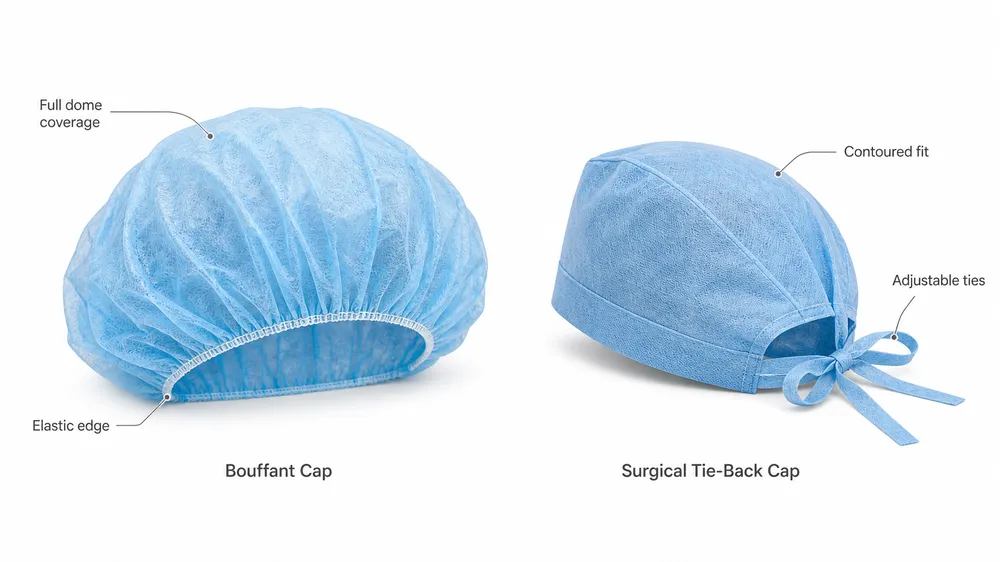
What is the bouffant cap vs surgical cap difference for GSM selection?
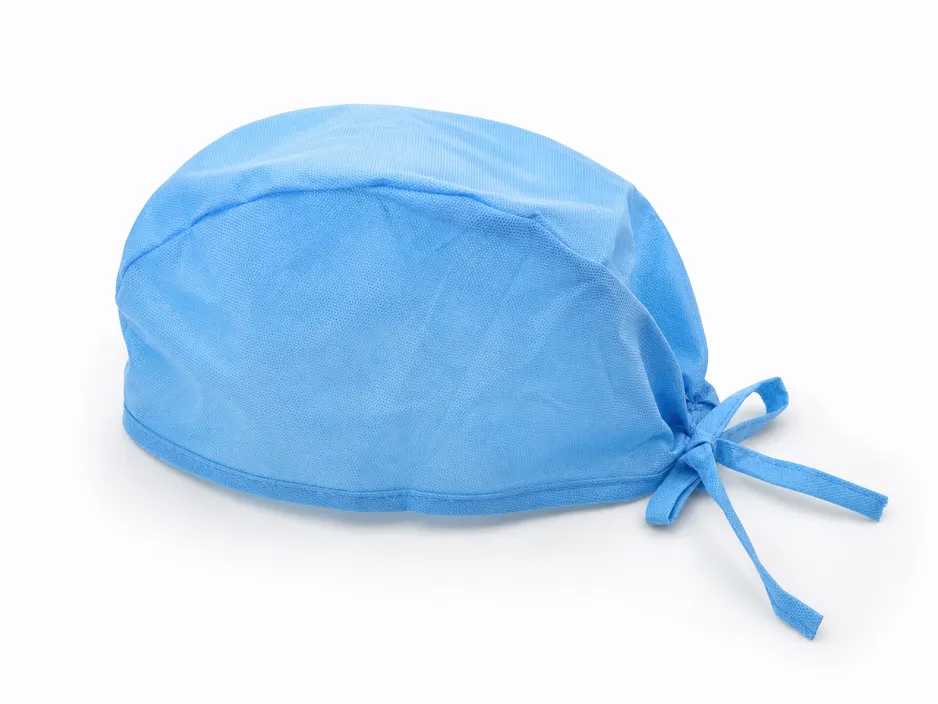
Surgical caps (tie-back or bouffant style with ties) are typically used in higher-risk OR environments and may be specified at 20–25 gsm. Standard bouffant caps with elastic are more common in general clinical and food service settings and typically run 17–20 gsm. See our bouffant cap vs surgical cap comparison for a full breakdown of application differences.
How do I avoid GSM substitution when sourcing at volume?
Specify nominal GSM and tolerance in your purchase order, reference a test method (ISO 9073-1 or ASTM D3776), and require batch-level fabric documentation as a shipment condition. For large programs, consider a pre-shipment inspection that includes fabric weight sampling from the production batch.
Putting the spec together
GSM is a procurement variable, not just a material property. The weight you specify determines barrier performance, fit consistency, per-unit cost, and your exposure to substitution risk across order cycles. Leaving it blank or accepting "standard" from a supplier is a decision — just not one you made deliberately.
For most hospital OR programs, 20 gsm at ±1 gsm tolerance with batch-level documentation is the right starting point. For general clinical programs, 17–18 gsm with ±2 gsm tolerance is sufficient. For food service and visitor programs, 14–16 gsm optimizes cost without meaningful contamination risk.
If you're building a private-label cap program or sourcing for a specific clinical protocol, the GSM spec should be part of your initial RFQ — not something you negotiate after samples arrive. Request a quote with your target GSM, cap size, and annual volume, and we'll confirm availability, tolerance range, and unit pricing within one business day.