The question lands in procurement queues constantly: bouffant or surgical cap? On the surface it looks like a simple product selection. In practice, it's a compliance decision with a cost tail attached to it — and getting it wrong means either a failed facility audit or a per-unit spend that erodes your margin on every reorder.
Here's the short answer before we get into the mechanics: bouffant caps are the default choice for OR and sterile field compliance under AORN and Joint Commission frameworks. Surgical tie-back caps serve specific clinical roles — scrub tech preference, procedural areas with lower contamination risk, and markets where tie-back styling carries institutional tradition. If your buyer is stocking a hospital OR program, bouffant is the safer compliance bet. If they're building a mixed clinical supply catalog or a private-label line that needs both SKUs, the sourcing logic changes.
The rest of this article explains why — and what the cost difference actually looks like at volume.

What Each Cap Actually Is — Specs That Drive the Compliance Decision
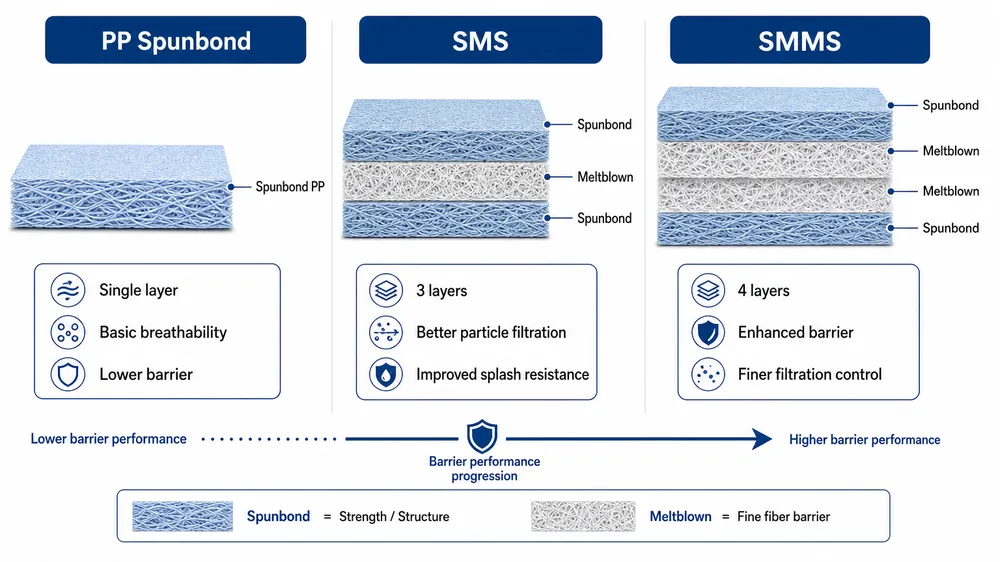
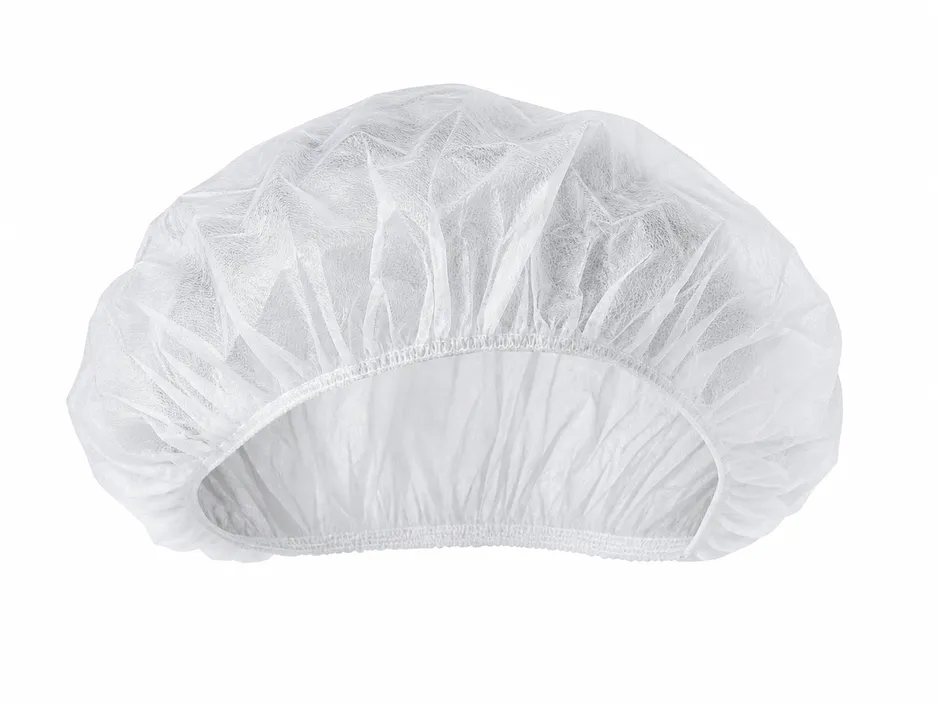
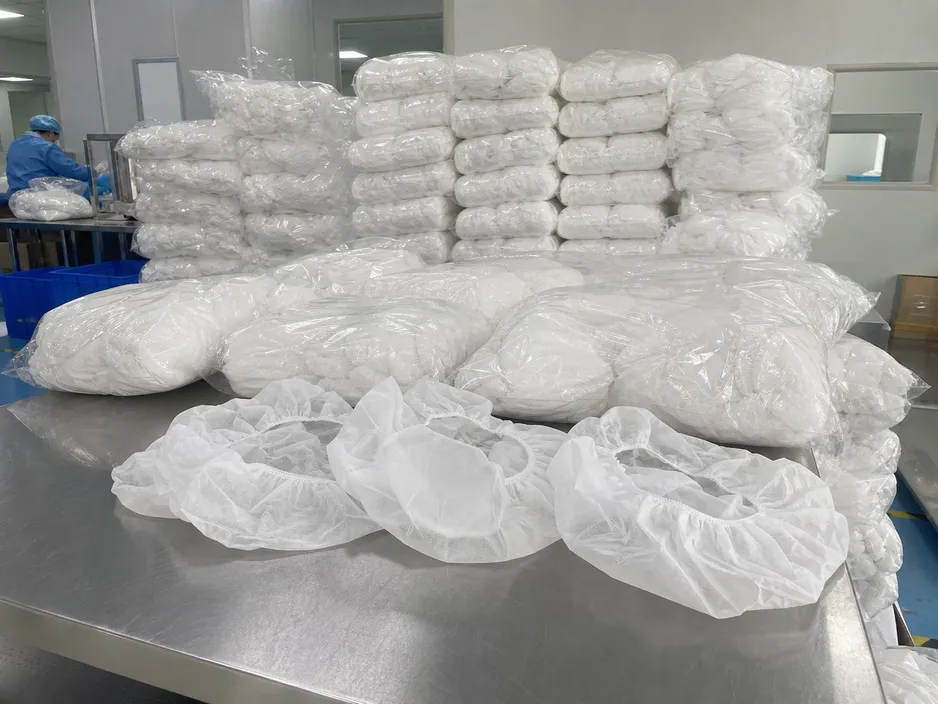
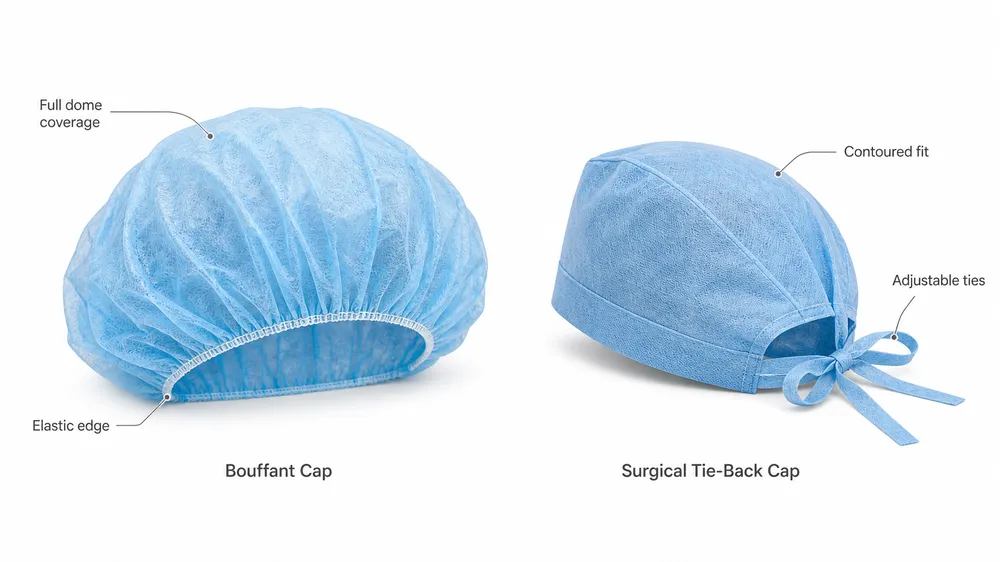
A bouffant cap is a dome-shaped, single-use nonwoven cap with an elastic band running the full perimeter of the opening. The dome is gathered or pleated to create volume, which is the functional point: it contains all hair regardless of length or volume without requiring the wearer to adjust or tie anything. Standard bouffant caps run 21 inches in diameter (fits most adult head circumferences), with nonwoven fabric in the 17–25 GSM range depending on the application tier. The elastic is typically a flat knit band, 5–8mm wide, with enough tensile recovery to maintain a seal through a full surgical shift without loosening.
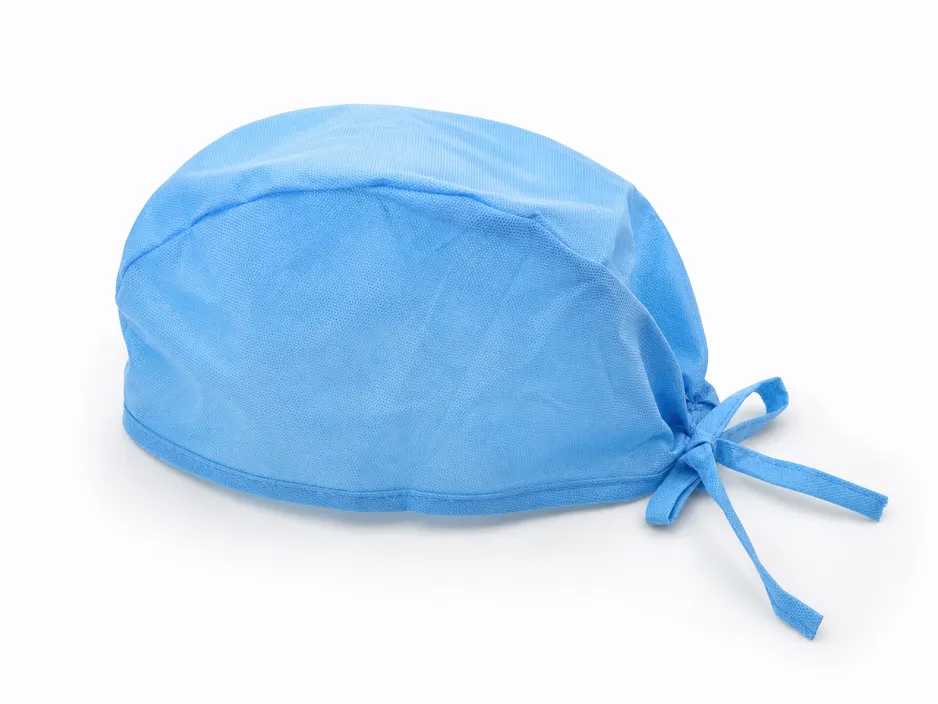
A surgical tie-back cap — what most people picture when they say "surgeon's cap" — is a contoured, fitted cap with two sets of ties: one pair at the back of the head and one pair that crosses over the crown. The fit is adjustable, which is why surgeons and scrub techs who wear them for long procedures often prefer them. The fabric is typically the same nonwoven spunbond in the 20–30 GSM range, but the construction is more complex: there's a front band, a crown panel, and the tie attachment points, all of which require more cut-and-sew steps than a bouffant.
(We run both on the same nonwoven lines at our Gaomi facility. The bouffant is a simpler cut — essentially a circle with an elastic channel. The surgical cap requires a multi-panel pattern and tie attachment, which adds roughly 15–20% to the per-unit production time at equivalent GSM.)
The compliance difference comes down to coverage geometry. A bouffant cap, when properly sized, covers the entire scalp including the hairline at the nape of the neck. A standard surgical tie-back cap covers the crown and sides but leaves the nape partially exposed depending on how the ties are positioned. AORN's Recommended Practices for Surgical Attire specify that all hair — including facial hair and the nape — must be contained in the sterile field. That language is why many hospital systems have moved to bouffant-only policies for OR personnel.
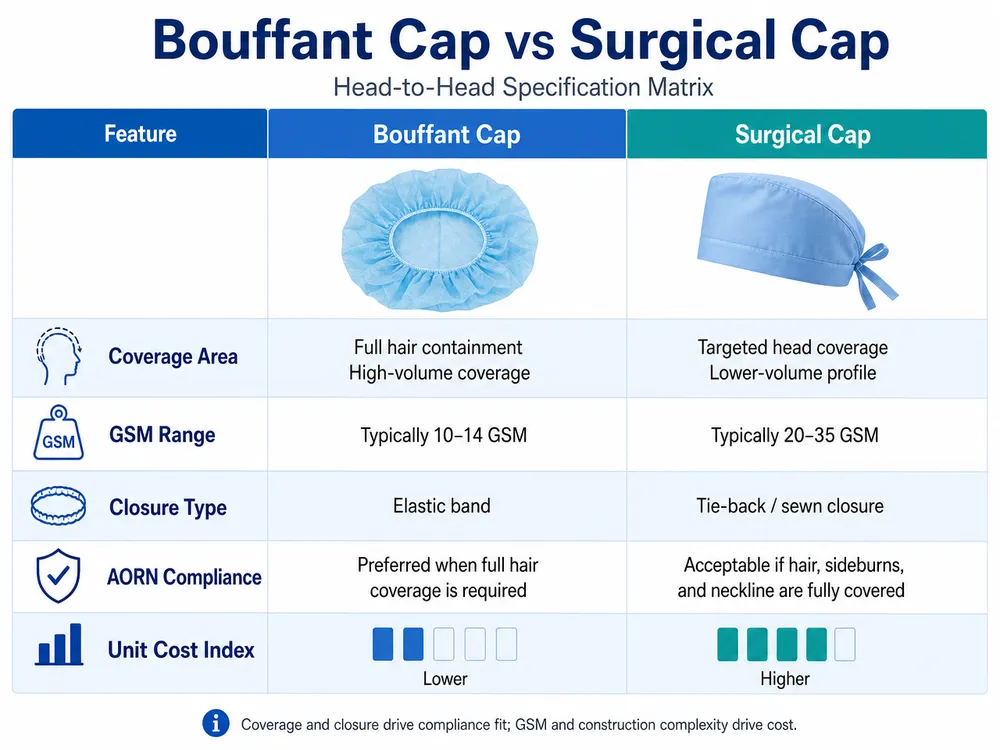
Head-to-Head Specification Matrix
| Specification | Bouffant Cap | Surgical Tie-Back Cap |
|---|---|---|
| Construction | Single-panel dome, elastic edge | Multi-panel contoured, tie closure |
| Nonwoven GSM range | 17–25 GSM | 20–30 GSM |
| Closure type | Elastic band (full perimeter) | Fabric ties (adjustable) |
| Coverage area | Full scalp + hairline | Crown + sides (nape variable) |
| AORN full-coverage compliance | Yes | Conditional (depends on tie positioning) |
| Typical head circumference fit | 21" standard (fits 54–60 cm) | Adjustable via ties |
| Per-unit production complexity | Lower | Higher |
| Typical unit cost range (FOB) | Lower | 15–25% higher |
| Standard MOQ (eztio) | 50,000 pcs | 50,000 pcs |
| OEM/private-label available | Yes | Yes |
| Certifications (eztio) | ISO 13485, CE, FDA 510(k) | ISO 13485, CE, FDA 510(k) |
The Hidden Cost the Spec Table Doesn't Show
The per-unit price difference between bouffant and surgical caps is real but not the number that matters most. The number that matters is the cost of a compliance failure at your buyer's facility.
Hospital systems running Joint Commission accreditation surveys get cited for OR attire violations. A facility that switched to surgical tie-back caps to save $0.02 per unit — then got cited for inadequate hair containment because the nape wasn't covered — doesn't save anything. The corrective action process, the policy rewrite, the re-training documentation: that's a cost that doesn't appear on the purchase order but lands on the supply manager's desk.
We've seen this pattern with buyers who were sourcing surgical caps for OR programs because the per-unit price was lower. The cap itself wasn't wrong — the application was. Surgical tie-back caps are appropriate for procedural areas, pre-op, and clinical environments where the contamination risk profile is lower. Putting them in the OR to save margin is the wrong trade.
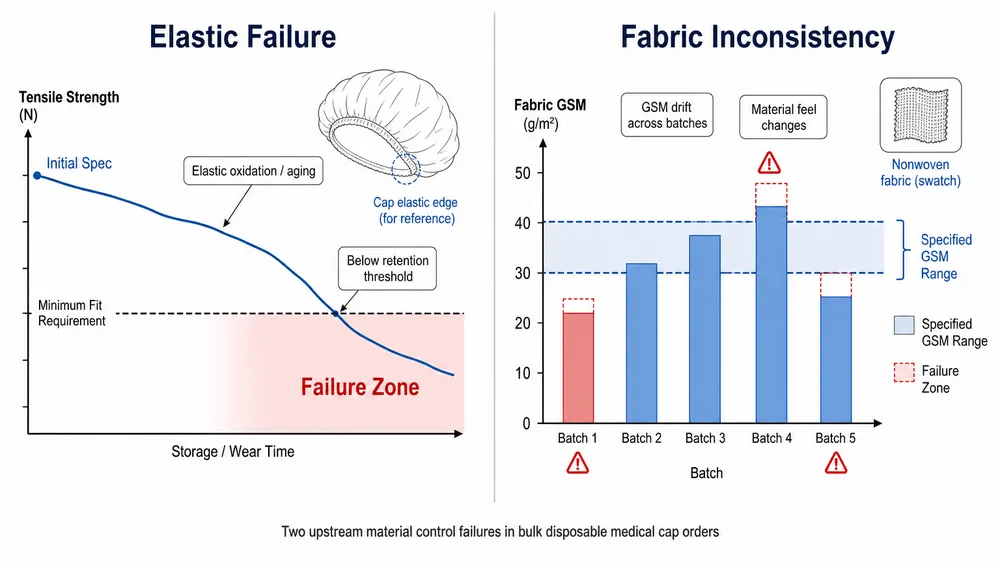
The second hidden cost is elastic failure at scale. This is where GSM and elastic spec matter more than most buyers realize. A bouffant cap running 17 GSM nonwoven with a narrow, low-recovery elastic band will lose its seal after 2–3 hours of wear. The fabric stretches, the elastic fatigues, and the cap rides up — which means hair exposure, which means a contamination event. We spec our standard bouffant elastic at 6mm flat knit with a minimum 80% tensile recovery after 50 stretch cycles. Below that threshold, you start seeing fit failures in the second half of long procedures. (This is exactly what Helen's signature quote is about — a cap that fails fit at scale isn't a sizing problem, it's a fabric and elastic spec problem caught too late.)
For surgical tie-back caps, the hidden cost is tie durability. Thin ties that fray or break mid-procedure create a different kind of problem — the cap has to be replaced, which means a sterile field interruption. We run tie attachment with reinforced stitching at the anchor point, and we test tie tensile strength as part of outgoing QC. It's a detail that doesn't appear in a standard product spec sheet but shows up in the field.
OR Protocol Fit: Where Each Cap Belongs in Your Buyer's Program
Bouffant cap — the OR default:
Any facility operating under AORN Recommended Practices or Joint Commission standards for surgical attire should be running bouffant caps in the OR. The full-perimeter elastic seal and dome geometry are the only reliable way to contain all hair without depending on correct tie technique. For hospital systems, ambulatory surgery centers, and any facility subject to accreditation survey, bouffant is the lower-risk choice. Your buyers in this segment need documentation — ISO 13485 certification, lot traceability, and test reports — because their own compliance audits require it.
Surgical tie-back cap — where it earns its place:
Procedural areas, endoscopy suites, cardiac cath labs, and clinical environments where the contamination risk profile is lower than a sterile OR field. Also: markets where tie-back styling is institutionally preferred — parts of the Middle East and Southeast Asia where surgical cap tradition runs toward the tie-back style, and private-label programs targeting the professional aesthetics or dental markets where the fitted look matters to the end user. Distributors building a full clinical supply catalog need both SKUs. Stocking only bouffant caps means losing the procedural area business to a competitor who carries both.
The mixed-program case:
Most hospital systems actually run both. OR and sterile processing: bouffant. Pre-op, PACU, procedural areas: surgical tie-back or bouffant depending on facility policy. If your buyer is a hospital GPO or a large distributor stocking multiple facility types, they need a supplier who can quote both SKUs from a single ISO 13485-certified source — same documentation package, same audit trail, same lead time structure. That's the sourcing efficiency argument for consolidating both cap types with one manufacturer.
Per-Unit Cost and MOQ: What the Numbers Look Like at Volume
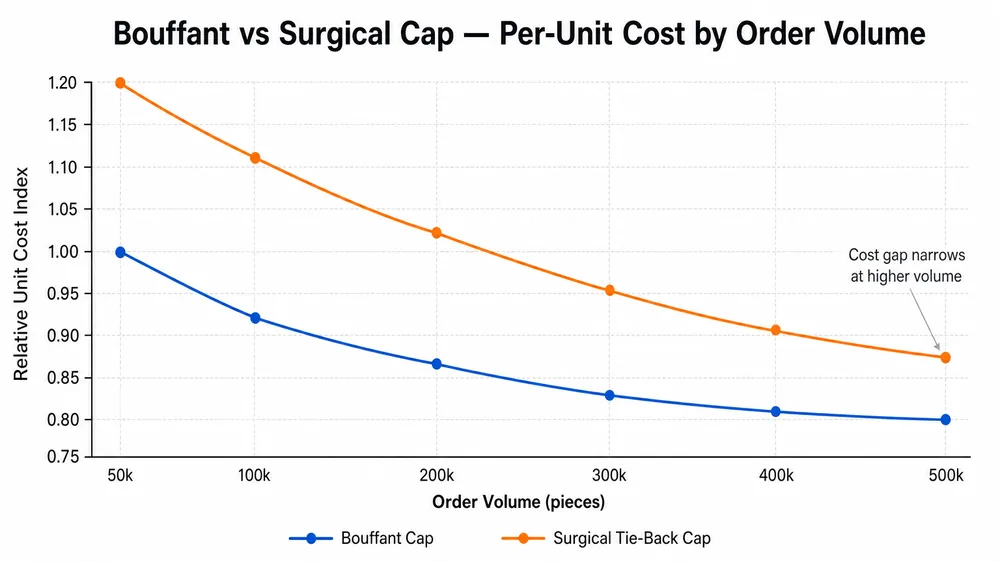
The cost difference between bouffant and surgical caps is driven by construction complexity, not material cost. Both use similar nonwoven spunbond fabric in overlapping GSM ranges. The surgical cap's multi-panel cut, tie attachment, and additional sewing steps add production time per unit — which translates directly to a higher FOB price.
At standard commercial GSM (20–22 GSM nonwoven, standard elastic or tie configuration):
- Bouffant cap: lower per-unit cost baseline
- Surgical tie-back cap: typically 15–25% higher per unit at equivalent volume
The gap narrows at very high volumes (500,000+ pieces) because the fixed setup cost per unit decreases. It widens if you're ordering custom configurations — non-standard elastic width, printed branding on the cap, or custom tie length — because those require line changeover and material procurement adjustments.
MOQ at eztio is 50,000 pieces for standard SKUs on both cap types. That's the trial-order threshold — enough volume to validate the spec with your buyer before committing to a full program. For mixed programs (bouffant + surgical cap in the same order), we can split the MOQ across both SKUs, which means you're not forced to hit 50,000 pieces on each type independently to get started.
(One note on GSM selection: buyers sometimes request the lowest GSM available to minimize unit cost. We'll run 17 GSM if that's what you need, but we'll also tell you that 17 GSM bouffant caps in high-humidity OR environments — particularly in Southeast Asia and the Gulf — show higher rates of fabric softening and elastic fatigue. The 20–22 GSM range is where we see the best balance of cost and performance for OR applications. For procedural areas with lower wear duration, 17–19 GSM is fine.)
OEM and Private-Label: Custom Configurations for Both Cap Types
Both cap types are available for OEM and private-label programs. The configuration variables that matter for procurement:
Nonwoven GSM: We run 17, 19, 20, 22, and 25 GSM as standard options. Custom GSM is available on runs over 200,000 pieces — below that, the fabric procurement and line setup cost doesn't justify the deviation from standard.
Elastic specification (bouffant): Standard is 6mm flat knit. We can run 5mm for cost-sensitive programs or 8mm for premium positioning. Elastic color (white, blue, green) is available on standard runs. Custom elastic color requires a minimum dye lot, which we'll confirm at RFQ stage.
Tie configuration (surgical cap): Standard tie length is 45cm. Extended ties (55cm) are available for larger head circumferences or markets where the tie-over-crown style is preferred. Tie color matching to cap color is standard.
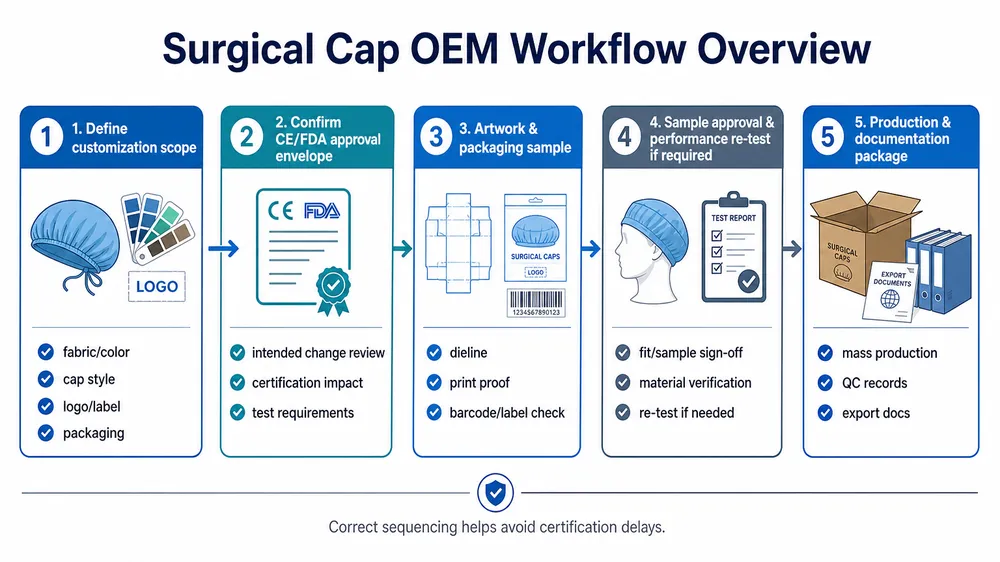
Packaging: Bulk poly bag (standard), individual poly bag, or retail box. For private-label programs, we handle artwork printing on the outer carton and individual packaging. The packaging spec is confirmed during sample approval — we don't change it between batches without written sign-off.
Branding: Logo printing on the cap itself is available via heat transfer on runs over 100,000 pieces. Most buyers in the hospital supply channel don't need cap-level branding — the carton and individual bag carry the brand. But for the professional aesthetics and dental markets, cap-level branding is a differentiator worth the MOQ.
Our ISO 13485 certification covers both cap types and all OEM configurations. That means your private-label program ships with the same documentation package as our standard SKUs — certificate of conformity, lot traceability records, and test reports. For buyers selling into hospital procurement systems or government tenders, that documentation is non-negotiable.
Scenario Decision Map: Which Cap Wins for Your Buyer
Scenario 1: Hospital system OR program, 200,000+ pieces per year
Winner: Bouffant cap. AORN compliance, full-coverage geometry, and lower per-unit cost make this the only defensible choice for sterile field applications. Specify 20–22 GSM, 6mm elastic, ISO 13485 documentation. The surgical cap has no role in this program.
Scenario 2: Multi-facility distributor stocking OR + procedural areas
Winner: Both, from a single source. The OR floors need bouffant. The procedural areas — endoscopy, cath lab, pre-op — can run either, and many facilities prefer surgical tie-back for non-OR clinical staff. Sourcing both from one ISO 13485-certified manufacturer reduces your supplier audit burden and simplifies your documentation management. A 50,000-piece trial split across both SKUs is the right starting point.
Scenario 3: Private-label brand targeting professional aesthetics, dental, or food service
Winner: Surgical tie-back cap for the primary SKU, with bouffant as a secondary option. The fitted, adjustable styling of the tie-back cap has stronger visual appeal in non-clinical professional markets. GSM can run lower (17–19 GSM) because the wear duration and contamination risk profile are different from OR applications. Custom elastic color and cap-level branding are worth the MOQ in this segment.
Scenario 4: Government or institutional tender, single cap type required
Winner: Bouffant cap in almost every case. Government healthcare tenders in North America, Europe, and the Gulf typically specify full hair containment, which maps to bouffant geometry. If the tender spec explicitly calls for tie-back caps, that's the exception — but verify the spec language before assuming. We've seen tenders that said "surgical cap" but meant any disposable hair cover, and bouffant was the compliant and lower-cost option.
What to Verify When Sourcing Either Cap Type
The most common sourcing problem we see is GSM misrepresentation. A supplier quotes 22 GSM, ships 17 GSM. The caps look similar in the bag — the difference shows up in wear performance and elastic recovery, not in a visual inspection. Request a fabric basis weight test report (GSM per ASTM D3776 or equivalent) with every production lot. If a supplier can't provide it, that's the answer.
The second issue is elastic tensile recovery. Elastic that tests fine at room temperature but fatigues in a warm, humid OR environment is a real failure mode. Ask for tensile recovery data after 50 stretch cycles. Standard commercial elastic should show ≥80% recovery. Below that, you'll see fit failures in the field.
For surgical tie-back caps, check tie attachment strength. The tie should withstand a minimum 5N pull force at the attachment point without tearing. This isn't a spec that appears on most product sheets, but it's the one that determines whether the cap stays on through a long procedure.
ISO 13485 certification is the baseline for hospital and institutional supply. It means the manufacturer has documented quality management, lot traceability, and a corrective action process. It doesn't guarantee product quality on its own — but it means there's a system in place to catch and document problems. For buyers selling into accredited facilities, it's the minimum supplier qualification.
Our Medical Caps product line covers both bouffant and surgical cap SKUs under a single ISO 13485-certified quality system. If you're evaluating both cap types for a mixed program, you can request samples and test reports for both from one RFQ submission — no separate supplier qualification process required.
For detailed product specifications on each cap type, see our Bouffant Medical Cap and Surgical Medical Cap pages.
FAQ: Bouffant Cap vs Surgical Cap for B2B Sourcing
Does AORN require bouffant caps specifically, or will any disposable cap satisfy the standard?
AORN's Recommended Practices for Surgical Attire require that all hair be contained — scalp, nape, and facial hair. The standard doesn't name "bouffant cap" as a required product, but the coverage geometry it describes maps to bouffant construction. A surgical tie-back cap that leaves the nape exposed does not satisfy the standard. Some facilities interpret this strictly (bouffant-only OR policy); others allow tie-back caps if the wearer demonstrates full coverage. For procurement purposes, bouffant is the lower-risk default for OR programs subject to AORN or Joint Commission review.
What nonwoven GSM should I specify for OR applications vs procedural areas?
For OR and sterile field applications: 20–22 GSM minimum. This range provides adequate fabric integrity and elastic recovery for full-shift wear in warm, humid environments. For procedural areas (endoscopy, pre-op, dental): 17–19 GSM is sufficient and reduces per-unit cost. Don't apply OR-spec GSM to procedural area programs — you're paying for performance you don't need. Don't apply procedural-area GSM to OR programs — you'll see fit failures and fabric degradation in the field.
Can I source both bouffant and surgical caps from the same manufacturer, and does it reduce my audit burden?
Yes, and it does. When both SKUs come from a single ISO 13485-certified source, you run one supplier qualification audit, maintain one documentation relationship, and manage one lot traceability system. For distributors stocking mixed clinical programs, this is a meaningful operational simplification. The alternative — two separate suppliers, two audit cycles, two documentation packages — adds compliance overhead that doesn't add value.
What's the minimum order quantity for a trial program covering both cap types?
At eztio, standard MOQ is 50,000 pieces per SKU. For mixed programs, we can structure the trial order as a split across both cap types — for example, 30,000 bouffant and 20,000 surgical — to reach the 50,000-piece threshold without forcing you to over-commit to one SKU before you've validated demand. Confirm the split at RFQ stage and we'll structure the quote accordingly.
How do I verify that a supplier's stated GSM matches what's actually in the product?
Request a fabric basis weight test report per ASTM D3776 or ISO 9073-1 with each production lot. The test weighs a defined fabric sample area and calculates grams per square meter. Any ISO 13485-certified manufacturer should have this data available as part of incoming material inspection records. If a supplier can't produce lot-level GSM test data, treat that as a quality system gap — not just a documentation gap.
Ready to quote both cap types for your program? Submit your cap type, target quantity, GSM preference, and any OEM packaging requirements through our Request Quote page — we'll respond with a detailed quote covering both SKUs from a single ISO 13485-certified source.