Most spec disputes we see on tie-back surgical caps don't start with a bad product. They start with an incomplete purchase order — one that listed "tie-back surgical cap, 100 pcs/bag" and nothing else. By the time the shipment arrives and the OR team flags a problem with tie length or fabric feel, the factory has already run 50,000 units to a spec that was never written down.
A complete surgical medical cap specification covers six parameters: nonwoven type, fabric GSM, tie-back material, tie-back length, knot configuration, and manufacturing environment. Miss any one of them and you're sourcing on assumptions.
This article walks through each parameter, explains what the acceptable ranges look like for OR use, and ends with a verification checklist you can attach to your RFQ.
What a surgical cap specification actually covers
The term "surgical cap specification" gets used loosely. Some suppliers treat it as a product description — style, color, packaging count. That's not a spec. A spec is a set of measurable, verifiable parameters that a factory can be held to across every batch.
For a tie-back surgical cap going into an OR environment, the spec needs to cover:
- Nonwoven fabric type — SMS (spunbond-meltblown-spunbond) or PP spunbond, and why the distinction matters for particle shedding
- Fabric GSM — the weight per square meter, which directly affects barrier performance and comfort under extended wear
- Tie-back material — whether the ties are flat PP ribbon, fabric tape, or a bonded extension of the cap body
- Tie-back length — the usable length from the cap edge to the tie end, which determines whether the cap can be secured under OR protocol
- Knot configuration — whether the tie ends are heat-sealed, knotted, or raw-cut, and what that means for durability during donning
- Manufacturing environment — whether the cap was produced in a cleanroom or standard production environment, and what documentation supports that claim
Each of these has a right answer for OR procurement. The sections below go through them in order.
Nonwoven fabric type and what it means for contamination control
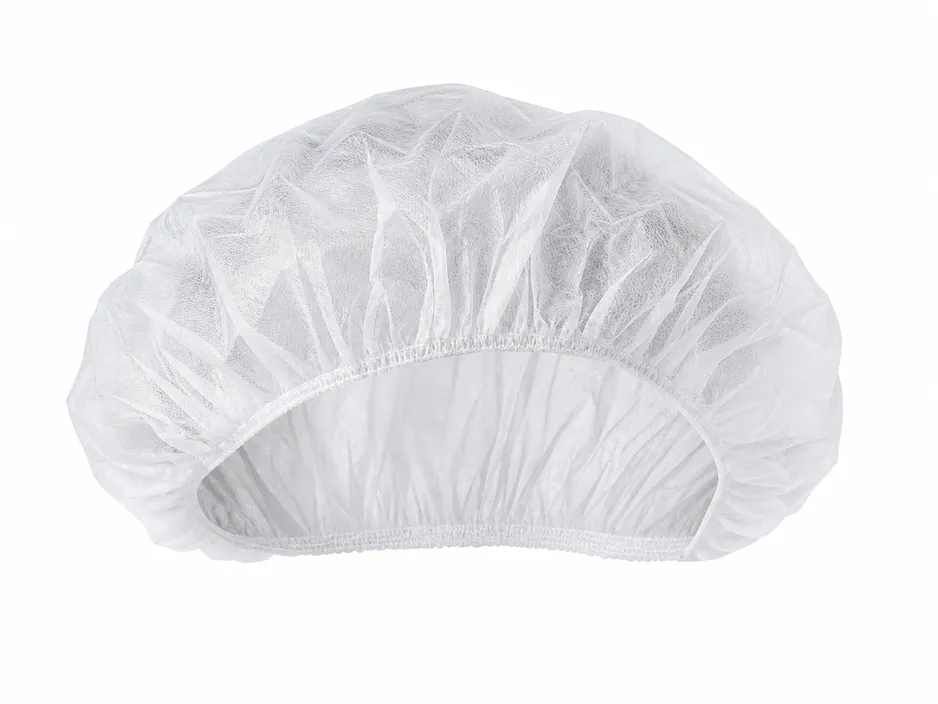
The two nonwoven types you'll encounter in surgical cap sourcing are PP spunbond and SMS.
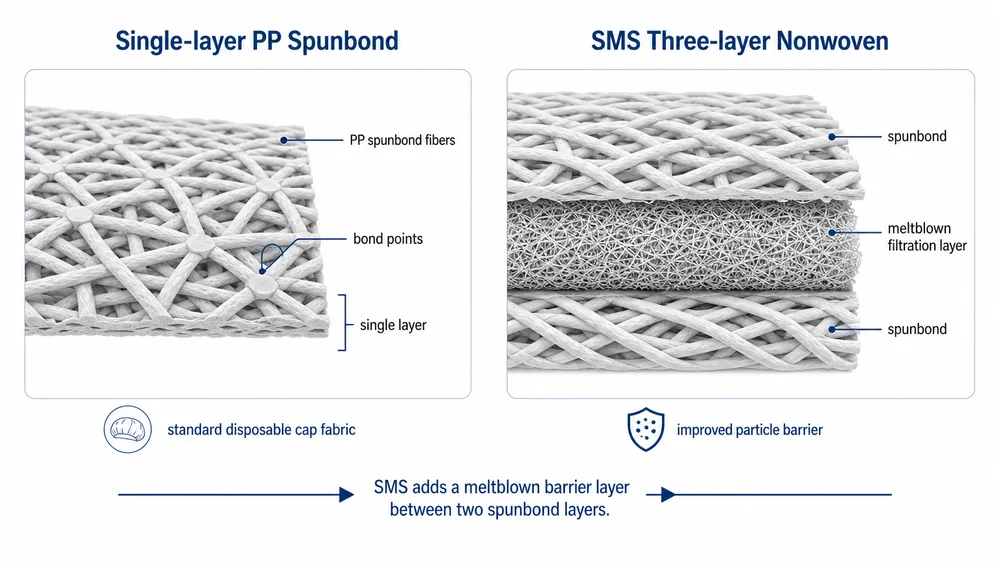
PP spunbond is a single-layer structure — polypropylene fibers bonded by heat and pressure. It's the standard for lower-acuity disposable caps: clinic use, food service, general healthcare. Particle shedding from spunbond is manageable in most environments, but the single-layer structure offers no meaningful fluid resistance.
SMS adds a meltblown layer between two spunbond layers. The meltblown core is what gives SMS its filtration and fluid-barrier properties. For OR use — where the cap is worn in proximity to open surgical fields — SMS is the appropriate choice. The meltblown layer traps fine particles that a spunbond-only cap would shed into the environment.
(We run both configurations on our lines. The SMS cap costs more to produce because meltblown fabric is more expensive and the lamination step adds process time — but for any buyer supplying OR environments, the spunbond-only option isn't the right call.)
When you're evaluating a supplier, ask specifically: is this SMS or spunbond? A supplier who can't answer that question immediately, or who says "high-quality nonwoven" without specifying the structure, is sourcing fabric externally and may not have visibility into what they're actually running.
We produce our nonwoven fabric in-house, which means we can confirm the layer structure, fiber density, and GSM on every roll before it enters production. That's not a common capability — most cap factories buy fabric from a separate mill and have limited ability to verify what they received.

Fabric GSM: the number that determines OR suitability
GSM — grams per square meter — is the single most useful number in a cap fabric spec. It tells you the weight of the nonwoven, which correlates directly with barrier density, durability, and how the cap behaves under extended wear.
For OR-grade tie-back surgical caps, the typical GSM range is 25–35 g/m² for SMS fabric. Below 25 g/m², the cap is too light for reliable barrier performance and tends to tear at the tie attachment points under normal donning tension. Above 40 g/m², the cap becomes stiff and uncomfortable for extended procedures — you'll hear complaints from OR staff within the first hour.
The 28–32 g/m² range is where most OR-grade caps land. It's heavy enough to hold structure and provide meaningful particle filtration, light enough to remain comfortable through a four-hour procedure.
| Fabric type | GSM range | Typical application |
|---|---|---|
| PP spunbond | 18–25 g/m² | Clinic, food service, general disposable |
| PP spunbond | 25–30 g/m² | General healthcare, non-OR environments |
| SMS | 25–30 g/m² | OR-adjacent use, lower-acuity surgical settings |
| SMS | 30–35 g/m² | OR use, standard surgical procedures |
| SMS | 35–40 g/m² | High-barrier OR use, extended procedures |
The problem with GSM in sourcing is that it's easy to misrepresent. A supplier can quote "30 g/m² SMS" and ship 25 g/m² spunbond — the caps look similar in the bag, and most buyers don't have a scale in the receiving dock. The verification step is to request a fabric test report from the supplier's QC lab, or to weigh a sample yourself: cut a 10 cm × 10 cm square and multiply the weight in grams by 100. That gives you the GSM.
Because we produce fabric in-house, our GSM is controlled at the production line, not estimated from a mill certificate. We run incoming inspection on every roll and can provide batch-specific GSM data with each shipment — which matters when your procurement audit requires documented spec consistency across orders.
Tie-back design: geometry, material, and what fails under OR conditions
The tie-back is where most surgical cap spec problems show up in practice. It's also the parameter that almost no supplier spec sheet addresses in detail.
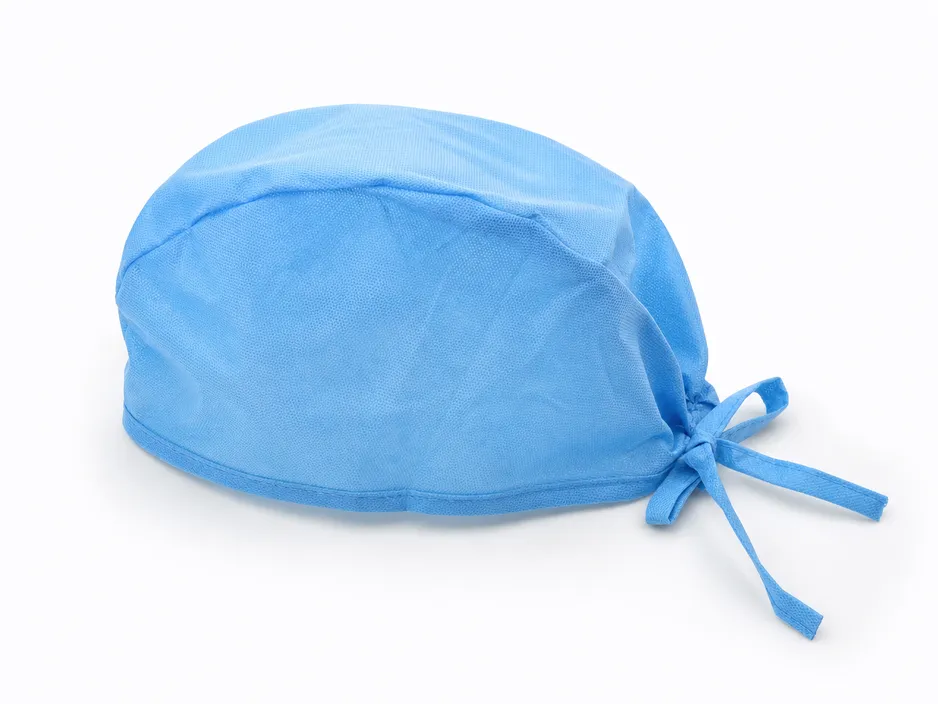
A tie-back surgical cap has two ties — one on each side of the cap — that the wearer crosses behind the head and secures. The functional requirements are straightforward: the tie must be long enough to reach and cross comfortably, strong enough to hold a knot through a full procedure, and finished in a way that doesn't unravel during donning.
Tie-back material options
Flat PP ribbon is the most common tie material. It's cut from the same nonwoven roll as the cap body or from a separate PP ribbon stock. Ribbon ties are lightweight, inexpensive, and adequate for most OR use. The failure mode is fraying at the cut ends — if the ends aren't heat-sealed, the ribbon unravels after a few knots and becomes difficult to tie securely.
Fabric tape ties (woven or knitted) are softer and more durable than PP ribbon. They're used in premium cap configurations and in markets where OR staff preference drives procurement decisions. The trade-off is cost: fabric tape adds roughly 15–20% to the cap unit price.
Bonded cap-body extensions — where the tie is simply an extended flap of the cap nonwoven — are the lowest-cost option and the least reliable. The tie tears at the attachment point under moderate tension. We don't recommend this configuration for OR procurement.
Tie-back length
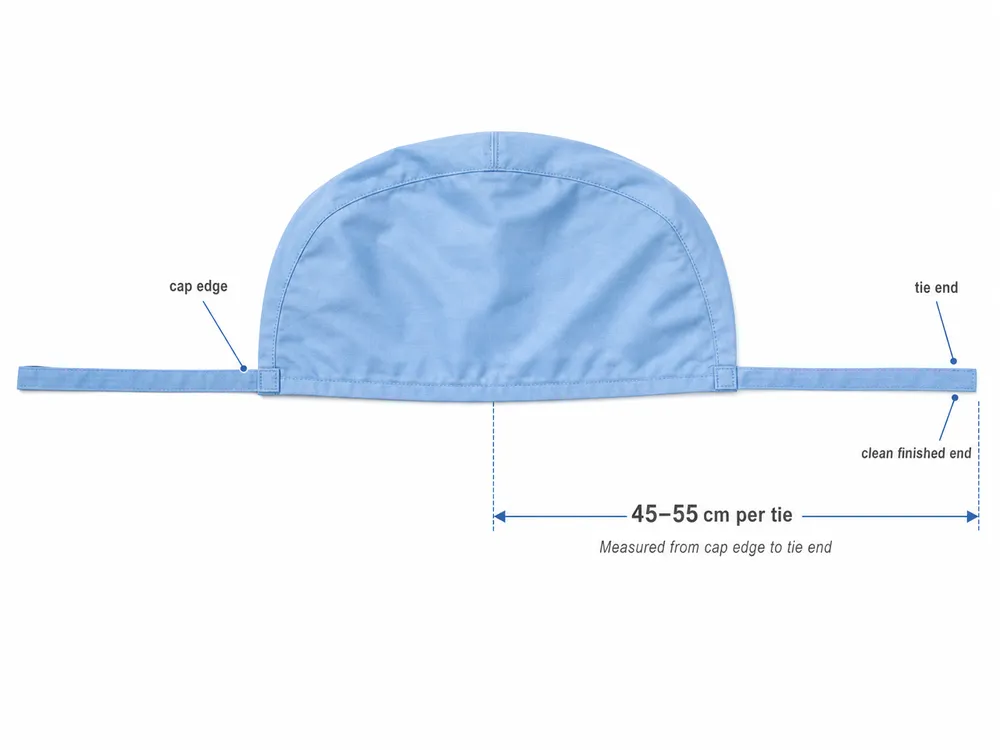
Standard tie-back length for OR surgical caps is 45–55 cm per tie, measured from the cap edge to the tie end. This range accommodates most adult head circumferences and allows a secure double-knot without excess material.
Ties shorter than 40 cm create a real problem: staff with larger head circumferences can't achieve a secure knot, and the cap shifts during the procedure. We've seen this cause OR protocol violations when the cap slips and requires adjustment mid-procedure.
Ties longer than 60 cm are a nuisance — excess material hangs loose and can contact the sterile field. Some OR protocols specifically prohibit ties over a certain length for this reason.
(The 45–55 cm range is our standard. If your OR protocol specifies a different length, we can adjust under our ODM program — it's a simple die change, and we document the custom spec on the product spec sheet.)
Knot and end finish
The tie ends should be heat-sealed. Heat sealing melts the PP fibers at the cut edge, preventing fraying and maintaining tie integrity through repeated knotting. A raw-cut tie end will fray after 2–3 knots — not a problem for a single-use cap, but it makes the cap harder to tie quickly under OR conditions.
Some configurations use a pre-tied loop at the end of each tie. This is a preference item — some OR teams like it, others find it adds bulk. It's worth confirming with your end users before specifying.
Cleanroom manufacturing: when it matters and how to verify it
Not every surgical cap needs to come from a cleanroom. But OR procurement teams increasingly ask about manufacturing environment — and for good reason.
A cleanroom-produced cap has lower baseline particle contamination than a cap produced in a standard factory environment. For caps going into high-acuity OR settings, the manufacturing environment is part of the contamination control chain.
The relevant classification for disposable medical cap production is ISO 8 (Class 100,000) — meaning the air in the production area contains no more than 100,000 particles ≥0.5 μm per cubic meter. This is the standard for non-sterile medical device manufacturing in a controlled environment.
Our production facility operates a Class 100,000 (ISO 8) cleanroom environment. This is documented in our ISO 13485:2016 quality management system, which covers cap production alongside our mask lines. When you request a factory audit or documentation package, the cleanroom classification is part of what we provide.
What to ask a supplier to verify:
- ISO 13485:2016 certificate (confirms QMS covers the product category)
- Facility audit report or cleanroom classification documentation
- Whether the cap production area is physically separated from non-medical production
A supplier who produces caps in the same open factory as non-medical products — packaging materials, industrial nonwovens — cannot credibly claim cleanroom-origin caps. The physical separation matters.
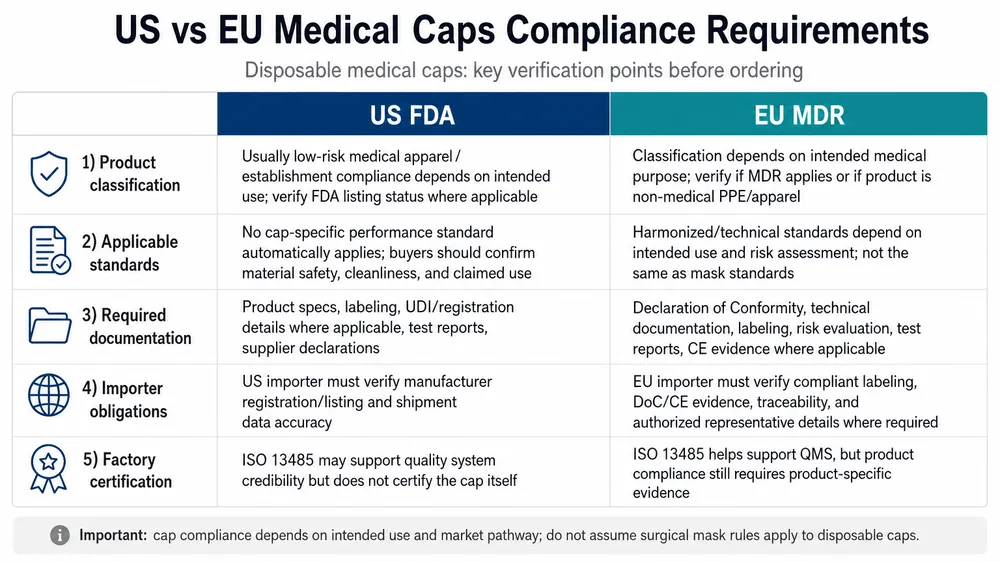
AORN guidance and EN 13795: what the standards actually require
Two references come up regularly in OR cap procurement: AORN (Association of periOperative Registered Nurses) guidelines and EN 13795 (the European standard for surgical drapes, gowns, and clean air suits).
It's worth being precise about what each one requires — and what it doesn't.
AORN guidelines address surgical attire broadly. The current guidance recommends that surgical caps cover all hair and scalp skin, fit securely, and be made from low-lint material. AORN does not specify a minimum GSM, a nonwoven type, or a tie-back length. The guidelines are performance-based, not material-based — which means the spec decisions are left to the procurement team and the OR protocol.
EN 13795 covers surgical drapes, gowns, and clean air suits used in the surgical environment. Surgical caps are not directly within the scope of EN 13795 as a standalone product — the standard applies to items that form part of the sterile barrier system. However, some European hospital procurement teams reference EN 13795 performance criteria (particularly particle shedding and microbial barrier) as a benchmark when evaluating cap suppliers, even though it's not a formal requirement for caps.
What this means practically: there is no single international standard that mandates specific fabric or tie-back specs for disposable surgical caps. The spec is yours to define. AORN and EN 13795 give you a performance framework — low lint, secure fit, appropriate barrier — but the measurable parameters (GSM, nonwoven type, tie length) need to come from your procurement spec.
This is why a written spec matters. Without one, you're relying on a supplier's interpretation of "OR-grade" — and that interpretation varies considerably across factories.
Our ISO 13485:2016 QMS means every cap batch ships with documented production records, incoming material inspection data, and finished product inspection results. That documentation package is what survives a procurement audit, not a marketing claim about "hospital-grade" fabric.
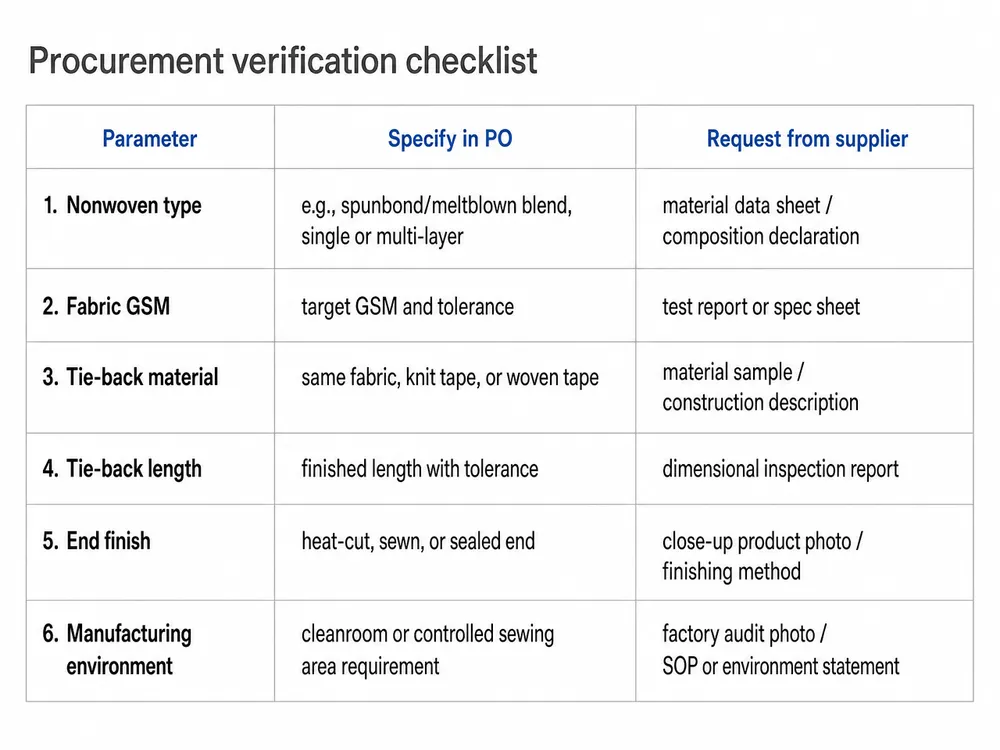
Procurement verification checklist: six parameters to confirm before issuing a PO
Before you issue a purchase order for tie-back surgical caps, confirm these six parameters in writing with your supplier:
| Parameter | What to specify | What to request from supplier |
|---|---|---|
| Nonwoven type | SMS or PP spunbond | Fabric structure confirmation, mill certificate or in-house production record |
| Fabric GSM | Target GSM ± tolerance (e.g., 30 g/m² ± 2) | Batch-specific GSM test report |
| Tie-back material | PP ribbon (heat-sealed ends) or fabric tape | Material spec sheet, sample for physical review |
| Tie-back length | Length in cm ± tolerance (e.g., 50 cm ± 3) | Dimensional inspection report or sample measurement |
| Knot/end finish | Heat-sealed ends, no raw cut | Sample inspection, production QC record |
| Manufacturing environment | ISO 8 cleanroom or equivalent | ISO 13485 certificate, facility audit report |
Two additional items worth confirming for bulk orders:
Batch-to-batch consistency documentation. A supplier who can't provide GSM data across multiple production batches is sourcing fabric from multiple mills without consistent incoming inspection. For a 12-month supply contract, batch consistency is a supply chain risk, not just a quality preference.
Packaging configuration. OR procurement typically requires individual poly bags or specific count-per-box configurations for dispensing. Confirm this before the order runs — repackaging 100,000 caps after the fact is expensive and delays deployment.
Spec drift across batches: the sourcing risk most buyers don't catch until the second order
The first order usually looks fine. The problem shows up on the third or fourth reorder, when the factory has quietly switched fabric suppliers or adjusted the GSM to manage material costs.
We see this pattern regularly when buyers come to us after a sourcing problem with another factory. The original sample was 30 g/m² SMS. By the fourth order, the factory was running 22 g/m² spunbond — same cap style, same packaging, different fabric. The buyer didn't catch it because they had no incoming inspection process and no batch documentation requirement in the contract.
The fix is straightforward: require batch-specific test reports with every shipment, not just a one-time sample approval. Under our ISO 13485:2016 QMS, we generate production records for every batch — fabric lot, GSM measurement, finished product inspection results. Those records travel with the shipment and are available for your procurement audit.
For buyers running disposable medical caps across multiple SKUs, the documentation requirement is the same regardless of cap style. The spec sheet you approve at sample stage should be the spec sheet that governs every subsequent batch.
If you're evaluating whether a tie-back cap or a bouffant configuration better fits your OR protocol, the bouffant cap vs surgical cap comparison covers the fit and coverage differences in detail.
What to send in your RFQ
A well-structured RFQ for tie-back surgical caps should include:
- Required nonwoven type (SMS preferred for OR use)
- Target GSM with acceptable tolerance
- Tie-back length specification
- Tie-back material preference (PP ribbon or fabric tape)
- End-finish requirement (heat-sealed)
- Annual volume and order frequency
- Destination market (affects packaging and labeling requirements)
- Documentation requirements (ISO 13485, batch test reports, cleanroom certification)
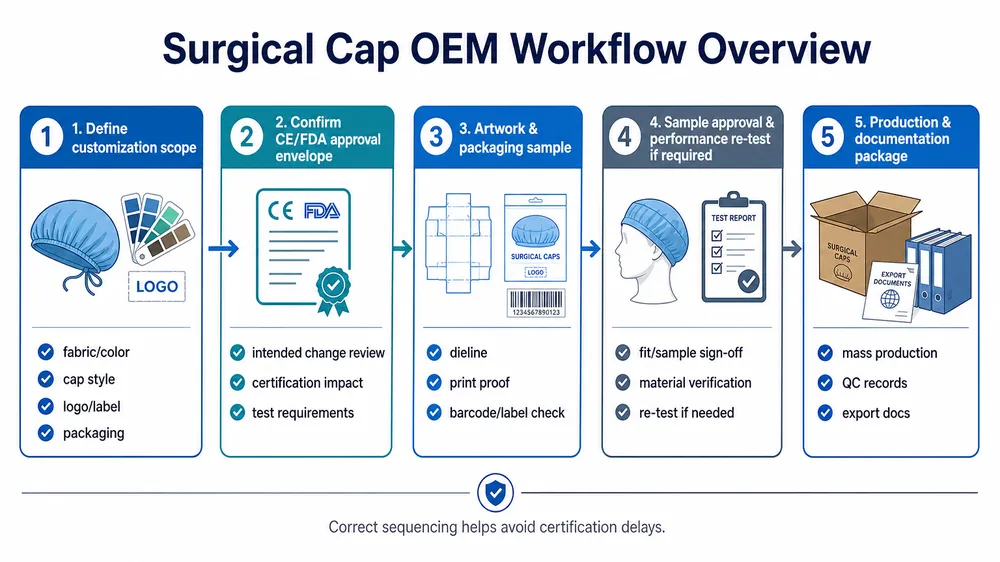
With that information, we can return a spec sheet, a sample set, and a unit price within a standard lead time. The sample set includes caps from actual production — not prototype samples made by hand — so what you approve is what ships.
Request a quote with your fabric grade, tie-back configuration, and volume requirements. We'll match the spec to your OR protocol and provide the documentation package your procurement team needs for supplier qualification.
For a broader overview of our Medical Caps range — including bouffant caps, mob caps, and non-woven surgical caps — the category page covers the full product line with spec comparisons.