
Medical Caps Disposable Non Woven Caps
Certified disposable medical caps from a dedicated nonwoven manufacturer — three product variants, cleanroom-produced, ready for private-label or bulk wholesale.
Bouffant caps, surgical caps, and standard disposable caps — all produced in our Class 100,000 cleanroom facility in Shandong, China. ISO 13485:2016 certified, CE and FDA 510(k) registered.

What We Make and Why It Belongs in Your Supply Chain
Medical caps are a high-turnover, low-margin category — which is exactly why sourcing discipline matters more here than almost anywhere else in disposable PPE. A buyer who locks in a reliable, certified supplier for caps can run that SKU on autopilot: consistent specs, predictable lead times, documentation that clears customs without surprises. A buyer who doesn't ends up chasing quality issues on a product that should never require attention.
We are Gaomi Eztio Medical Technology Co., Ltd., a disposable medical product manufacturer based in Shandong, China. We've been producing nonwoven medical products since 2012, and medical caps have been part of our line since the beginning — not as an afterthought added to round out a catalog, but as a product we've refined through years of production runs for hospital supply chains, institutional distributors, and private-label healthcare brands across North America, Europe, the Middle East, and Southeast Asia.
Our caps are produced in the same Class 100,000 (ISO 8) cleanroom environment as our surgical masks. The same quality management system — ISO 13485:2016 — governs the production process. The same in-house QC lab that tests our masks for BFE and Delta-P also runs dimensional checks, tensile testing on elastic bands, and particle contamination checks on our cap production. If you're already sourcing masks from a certified facility, you should expect the same standard from your caps supplier. We hold that standard.
Learn more about our facility and certifications
Why This Matters for Caps Sourcing
-
Same ISO 13485 QMS as surgical mask production
-
In-house QC lab: dimensional checks, tensile testing, particle contamination
-
Class 100,000 (ISO 8) cleanroom environment
-
Documentation that clears customs without surprises
Our Medical Caps Product Line
Three variants, each designed for a specific use context. The differences between them matter for your downstream customers — a hospital OR suite has different requirements than a food processing line or a general clinical ward.

Disposable Medical Caps
The standard workhorse of the category. Flat-cut or pleated non woven construction, elastic band closure, available in multiple sizes. These are the caps that move in the highest volumes — hospital wards, clinical labs, dental offices, food processing facilities, and anywhere that requires basic hair containment without the full coverage of a bouffant.
If you're building a starter SKU for a new distribution account or filling a hospital tender that specifies basic disposable caps, this is the product.

Bouffant Medical Cap
Full-coverage bouffant construction — the round, gathered-crown design that provides complete hair and ear coverage. This is the cap that OR nurses and surgical techs actually prefer because it stays in place through a long procedure and covers more hair volume than a flat cap. Spunbond nonwoven, 20–40 gsm depending on the spec, elastic band sized for a secure fit without pressure discomfort.
We've had buyers request a slightly wider elastic band for extended-wear applications — that's a straightforward customization we can accommodate on runs over 100,000 pieces. The bouffant is also the cap that private-label healthcare brands tend to lead with, because it photographs well and has clear differentiation from commodity flat caps.

Surgical Medical Cap
Tie-back surgical cap designed for operating room use — the style that surgeons and scrub techs wear in the OR, with long ties that allow a custom-fit wrap rather than a one-size elastic band. Produced from spunbond nonwoven at 25–35 gsm, with reinforced tie attachment points to prevent tearing during donning.
This is a lower-volume SKU than the bouffant, but it's a necessary part of any complete surgical PPE line. Buyers supplying hospital procurement departments often need all three cap variants to fulfill a single tender — having them from one supplier simplifies your documentation and reduces your vendor count.
Material Specifications and Production Parameters
All three cap variants are produced from spunbond polypropylene nonwoven fabric — the same base material used across the disposable medical PPE category. The differences between a cap that performs well and one that generates complaints from end users come down to fabric weight selection, elastic specification, and production consistency.
| Parameter | Disposable Medical Cap | Bouffant Medical Cap | Surgical Medical Cap |
|---|---|---|---|
| Fabric Type | Spunbond PP nonwoven | Spunbond PP nonwoven | Spunbond PP nonwoven |
| Fabric Weight (gsm) | 17–25 gsm | 20–40 gsm | 25–35 gsm |
| Closure Type | Elastic band | Elastic band | Tie-back strings |
| Standard Sizes | One-size / adjustable | 19", 21", 24" diameter | One-size (tie-adjustable) |
| Color Options | White, blue, green | White, blue, green | White, blue, green |
| Packaging | 100 pcs/bag, 10 bags/carton | 100 pcs/bag, 10 bags/carton | 100 pcs/bag, 10 bags/carton |
| MOQ | 50,000 pcs | 50,000 pcs | 50,000 pcs |
On Fabric Weight
The 17–20 gsm range is appropriate for single-use, short-duration applications — food service, general clinical use, visitor caps.
The 25–40 gsm range is what you want for surgical and extended-wear applications where the cap needs to maintain its shape and barrier properties through a full procedure.
We don't recommend the lightest fabric weights for OR use, and we'll tell you that directly if you ask for a spec that doesn't match the application.
On Elastic
We use flat elastic band rather than round cord on all our elastic-closure caps. Flat elastic distributes pressure more evenly across the forehead, which matters for extended wear.
The elastic tensile spec is tested at incoming inspection — we've seen batches from other suppliers where the elastic relaxes after 30 minutes of wear, which is a complaint that comes back to you, not to the factory.
Our elastic is tested to maintain closure force through the rated wear period.

Cleanroom Production and the QC Process Behind Every Batch
Medical caps are classified as medical devices in most regulated markets — Class I in the EU under MDR, Class I in the US under FDA. That classification means the production environment and quality management system matter, not just the finished product test results.
ISO 8 Cleanroom Standard
Our cap production runs in the same Class 100,000 (ISO 8) cleanroom as our mask lines. This isn't a separate "medical grade" area we set up for audits — it's the standard operating environment for everything we make.
-
Particle counts monitored continuously
-
Access controlled with gowning protocols
-
Same environment for all medical product lines

Three-Stage QC Process
Incoming Inspection
Covers every fabric lot, elastic lot, and packaging material. Fabric basis weight, uniformity, and tensile strength are checked before the material enters production.
In-Process Inspection
Runs at defined intervals on each production run: dimensional checks against spec, elastic attachment integrity, and visual inspection for defects.
Outgoing Inspection
Pulls a statistically sampled batch from each production run for final verification before packaging.
What We Check That Most Factories Skip
Particle contamination on the finished cap. A cap produced in a non-cleanroom environment can carry particulate contamination that's invisible to visual inspection but shows up in a cleanroom particle count test.
We test finished caps for this because our hospital buyers run their own incoming inspection, and a contamination failure at their dock is a supply chain problem for you.
Documentation That Ships With Your Order
Certificate of conformity, production batch records, and test reports — prepared to support your import documentation and your own customers' procurement audits.
If you're supplying a hospital system or a government tender, that documentation package is what gets your product through their approval process.
Compliance Coverage Across Your Key Export Markets
The certifications we hold cover the regulatory frameworks that matter for the markets where medical caps actually move in volume:
ISO 13485:2016
The medical device quality management standard. This is the baseline requirement for supplying hospital procurement in most regulated markets. It governs our entire production system, not just the finished product.
CE (EU MDR)
European market access. Since the EU Medical Device Regulation replaced the old MDD in 2021, the documentation requirements for CE-marked medical devices have become significantly more demanding. We've been through the MDR transition with multiple European buyers and have the technical file structure in place.
If you're new to importing medical devices into the EU, the MDR importer-of-record requirements are worth understanding before you place your first order — we can walk you through what your EU representative will need.
FDA 510(k) Registered
US market clearance. Your US customs broker and your downstream hospital or distributor customers will ask for this. We have it.
ISO 9001:2015 & SGS
General quality management and third-party audit verification.
These certifications mean your shipment arrives with the compliance documentation already in place for North America and Europe — the two markets where regulatory requirements are most likely to create import delays if the paperwork isn't right.

Where Medical Caps Move: Market Segments Worth Building
Medical caps are a consumable that gets reordered on a predictable cycle — which makes them a reliable revenue line for distributors who get the initial placement right. The segments where volume is consistent:
Hospital & Surgical Center Supply Chains
OR suites, procedure rooms, and sterile processing departments consume bouffant and surgical caps in high volumes on a scheduled procurement cycle. Hospital GPOs and IDNs typically run annual or multi-year contracts for disposable PPE.
Getting on a hospital system's approved vendor list with a certified product is the work — once you're in, the reorders are predictable. The surgical cap variant is often required alongside the bouffant to fulfill a complete OR cap specification.
Clinical & Diagnostic Labs
Lab environments require hair containment for contamination control, not sterility. Standard disposable caps at 17–20 gsm are the typical spec here.
Volume per account is lower than hospital OR, but the account base is large — independent labs, hospital lab departments, research institutions, and diagnostic centers all consume this product.
Food Processing & Industrial Hygiene
Technically outside the medical channel, but the same non woven medical caps product serves food processing lines, pharmaceutical manufacturing, and cleanroom industrial environments.
Buyers in this segment often source through industrial distributors rather than medical distributors, which means a different sales channel but the same product. If you're already distributing into food processing, adding medical caps to your line is a natural extension.
Government & Institutional Tenders
Public health agencies, military medical units, and government hospital systems run periodic tenders for disposable PPE that typically include caps alongside masks and gowns.
These tenders require certified products with full documentation — which is exactly what our certification stack provides. The volumes can be significant, and the documentation requirements are where non-certified suppliers get eliminated.
Private-Label Healthcare Brands
Distributors building their own brand in the disposable PPE space often start with masks and add caps as a second SKU. Our OEM packaging capability means your brand goes on the product without a separate packaging supplier in the chain.
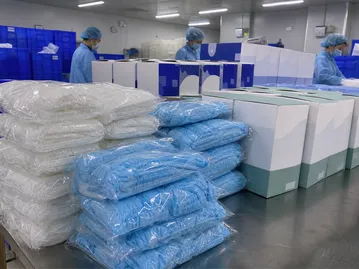
OEM Packaging and Private-Label Options
If you're building a private-label healthcare brand or need custom packaging for a specific distribution channel, we handle that in-house. Standard OEM work — your brand on our existing product — requires artwork files, packaging spec confirmation, and a sample approval run before full production. The process is straightforward and doesn't require a separate packaging supplier.
Custom configurations — modified elastic specs, non-standard sizes, different fabric weights for specific applications — go through our product development process. We have the in-house capability to adjust fabric weight selection, elastic specifications, and packaging formats. We'll tell you the MOQ implications upfront: standard SKUs start at 50,000 pieces; custom configurations typically require higher minimums to justify the line setup and material procurement.
Color customization is available on runs over 100,000 pieces — we can produce caps in custom colors for branded programs or color-coded department identification systems. Color-coding by department is common in larger hospital systems — different colors for OR, ICU, and general ward staff. If your hospital accounts use this system, it's worth asking about.

Standard OEM Process
- 1 Submit artwork files and packaging specifications
- 2 Packaging spec confirmation and sample approval run
- 3 Full production — no separate packaging supplier needed
MOQ Reference
What Goes Wrong with Cheap Cap Suppliers — and How We Prevent It
Medical caps look simple. That's why buyers sometimes treat them as a commodity and source on price alone. The failure modes are predictable, and they all come back to you as the distributor.
Elastic Failure During Wear
Most Common ComplaintThe Problem
Elastic that relaxes after 20–30 minutes of wear means the cap slips, which means the end user stops wearing it or complains to whoever sold it to them.
Root Cause
Elastic that wasn't tested at incoming inspection — the factory accepted a batch that didn't meet tensile spec.
Our Prevention
We test every elastic lot at the dock. Batches that don't hold closure force through the rated wear period don't enter production.
Fabric Weight Inconsistency Across Batches
The Problem
A cap that feels right in the sample but arrives lighter in the production run. Spunbond nonwoven fabric has a basis weight tolerance, and factories that don't test incoming fabric lots will ship product that varies batch to batch.
Root Cause
Fabric weight control problem — no incoming inspection on fabric lots from the nonwoven supplier.
Our Prevention
Our incoming inspection includes basis weight testing on every fabric lot. If the lot is out of spec, it goes back to the supplier.
Particle Contamination from Non-Cleanroom Production
The Problem
Caps produced outside a controlled environment can carry particulate contamination that's invisible to visual inspection. Hospital buyers who run incoming particle count tests will catch this.
Root Cause
Production in an uncontrolled environment without particulate monitoring or air filtration systems.
Our Prevention
We produce in a Class 100,000 cleanroom and test finished caps for particle contamination before shipment.
Documentation Gaps at Customs
The Problem
A cap without proper CE or FDA documentation doesn't clear customs in regulated markets, or clears customs but fails the hospital's incoming compliance check. Either way, you're holding inventory you can't sell.
Root Cause
Supplier lacks proper regulatory certifications or fails to provide complete documentation packages with each shipment.
Our Prevention
Our certification stack and documentation package are designed to prevent this specific problem. CE, FDA, and ISO 13485 documentation ships with every order.

Sourcing Questions Buyers Ask About Medical Caps
What is the MOQ for disposable medical caps wholesale orders?
What is the MOQ for disposable medical caps wholesale orders?
50,000 pieces on standard SKUs — bouffant caps, surgical caps, and standard disposable caps in our existing configurations. Custom configurations (non-standard sizes, modified elastic specs, custom colors) typically require higher minimums; we'll confirm the specific MOQ when you share your requirements.
What fabric weight should I specify for surgical and OR applications?
What fabric weight should I specify for surgical and OR applications?
For operating room use — surgeons, scrub techs, OR nurses — specify 25–35 gsm spunbond nonwoven. This weight maintains shape and barrier properties through a full procedure.
The 17–20 gsm range is appropriate for general clinical use, lab environments, and food processing, where the cap is worn for shorter durations and full structural integrity isn't the priority.
If you're unsure which spec fits your downstream application, send us the end-use context and we'll recommend the right configuration.
What's the difference between a bouffant cap and a surgical cap?
What's the difference between a bouffant cap and a surgical cap?
The bouffant uses an elastic band closure and a gathered-crown construction that provides full hair and ear coverage — it's the standard cap for OR nursing staff and most clinical environments.
The surgical cap uses tie-back strings for a custom-fit wrap, and is the style typically worn by surgeons and scrub techs who prefer a tighter, more controlled fit.
Both are produced from spunbond nonwoven; the difference is closure style and fit preference. Many hospital tenders specify both variants for different staff roles.
Do your medical caps meet CE and FDA requirements?
Do your medical caps meet CE and FDA requirements?
Yes. We hold CE certification under EU MDR and FDA 510(k) registration. The documentation package that ships with your order includes the certificate of conformity and test reports needed to support import clearance and your customers' procurement audits.
If you're importing into the EU for the first time under MDR, the importer-of-record documentation requirements have changed significantly since 2021 — contact us before you place the order and we'll walk you through what your EU representative will need.
Can you produce non woven medical caps with our brand and packaging?
Can you produce non woven medical caps with our brand and packaging?
Yes. Standard OEM work — your brand on our existing product — requires artwork files, packaging spec confirmation, and a sample approval run. We handle packaging in-house, so there's no separate packaging supplier in the chain.
Custom configurations and non-standard packaging formats are available; MOQ and lead time depend on the specific requirements.
What is the lead time for a standard bulk order?
What is the lead time for a standard bulk order?
15–25 days from order confirmation for standard SKUs, depending on order volume and current line scheduling. We give you a specific date, not a range, once we confirm your order.
Custom configurations add time for sample approval and line setup — typically 5–10 additional days depending on the modification.
Ready to Source Medical Caps?
If you're building a disposable PPE line, adding caps to an existing mask program, or looking for a certified supplier to replace a current source, the next step is straightforward.
Send us your target volume, the variants you need, and any packaging requirements. We'll come back with a specific quote, lead time, and sample availability.
Most buyers in this category start with a sample order across all three variants before committing to a full production run — we can ship samples within 5–7 business days. If you're evaluating us against a current supplier, we're happy to run a side-by-side spec comparison.
Explore Our Medical Cap Products
View detailed specifications for each variant