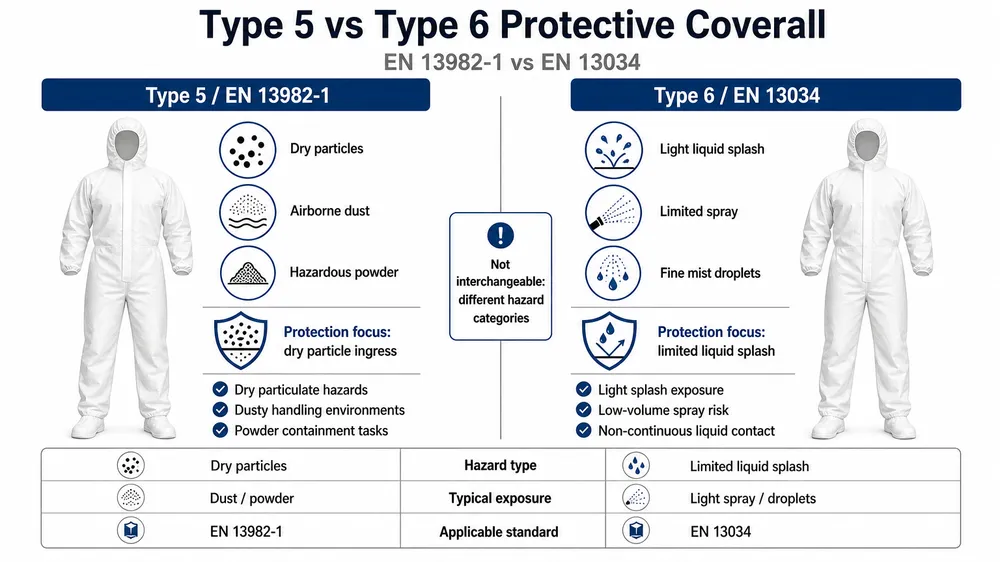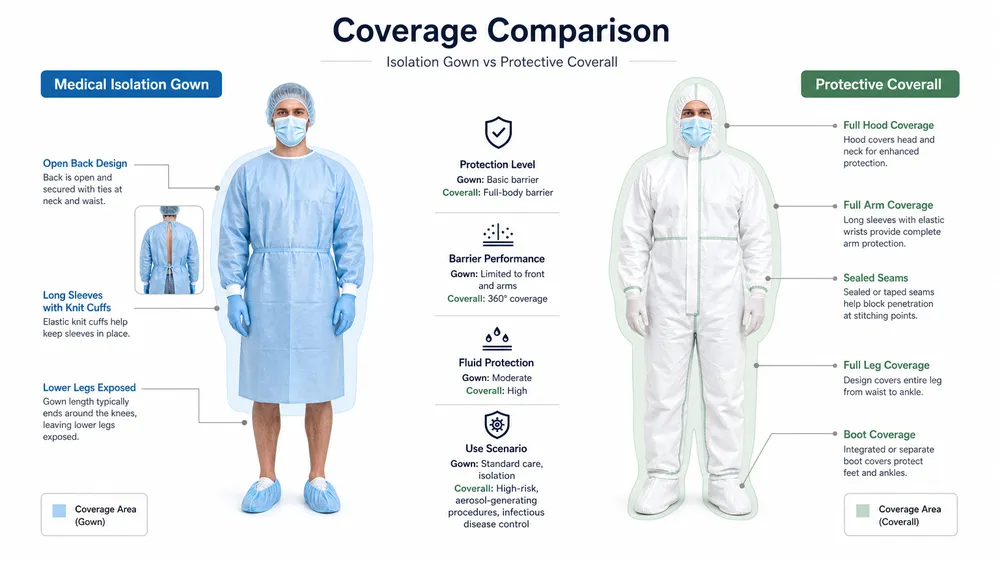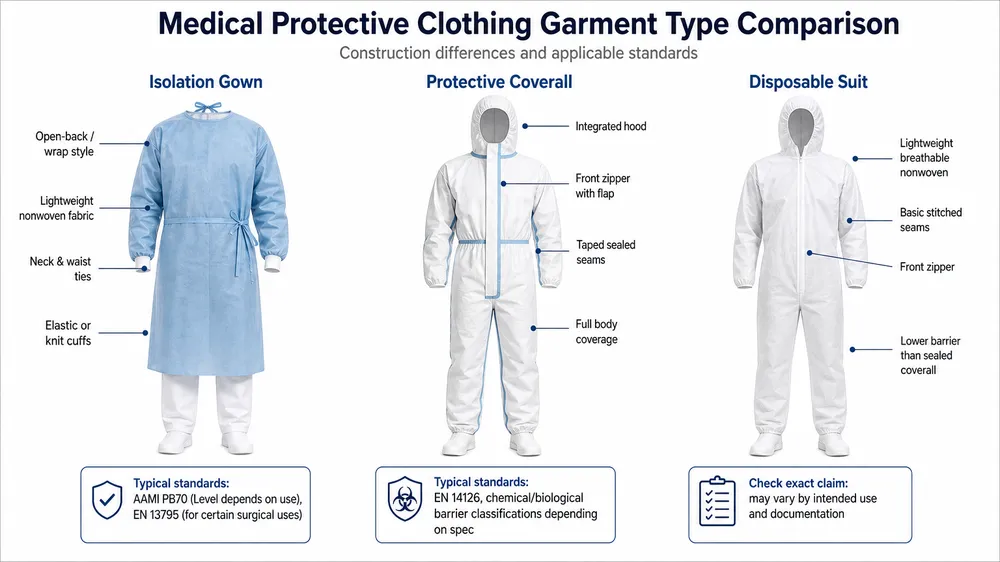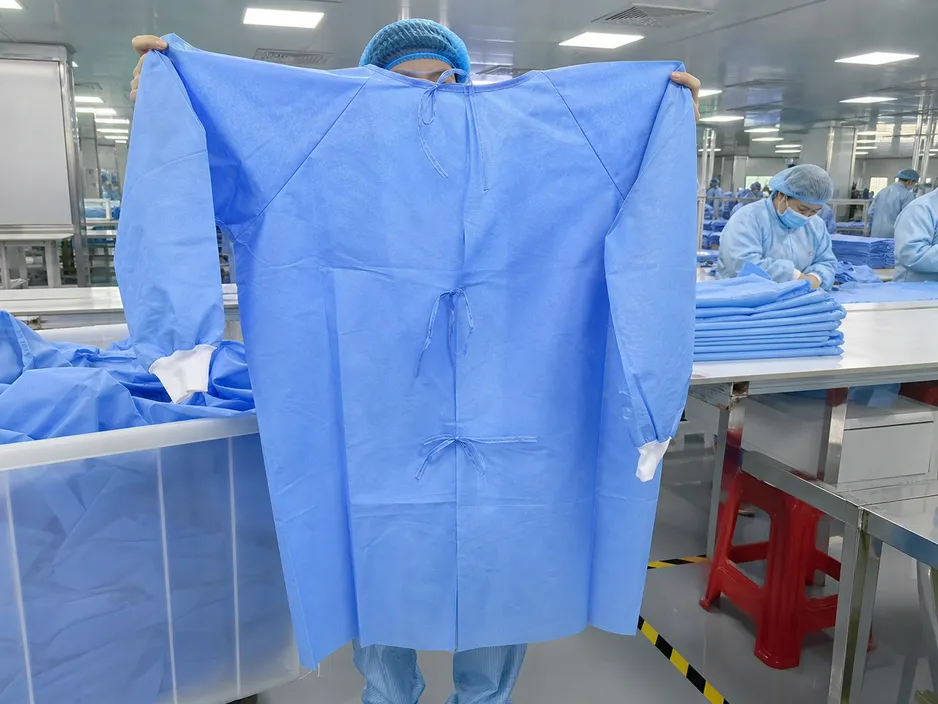
The fabric choice is where most protective clothing orders go wrong — not at the seam, not at the packaging, but at the material spec stage, before production even starts. Pick SMS when your application needs microporous film, and you'll have a garment that passes breathability tests but fails barrier requirements at the fluid challenge. Pick microporous film for a low-risk isolation gown application, and you've added cost and stiffness that your buyers don't need and won't pay a premium for.
Both SMS and microporous film laminates are legitimate medical protective clothing nonwoven materials. The question is which one belongs in your specific order — and that answer depends on the garment type, the target standard, the end-use environment, and what your downstream buyers actually need to clear procurement audits.
This article walks through both materials from a sourcing decision standpoint: construction, barrier performance, breathability trade-offs, compliance mapping, and the questions you should be asking any manufacturer before you commit to a fabric spec.

What SMS and Microporous Film Actually Are
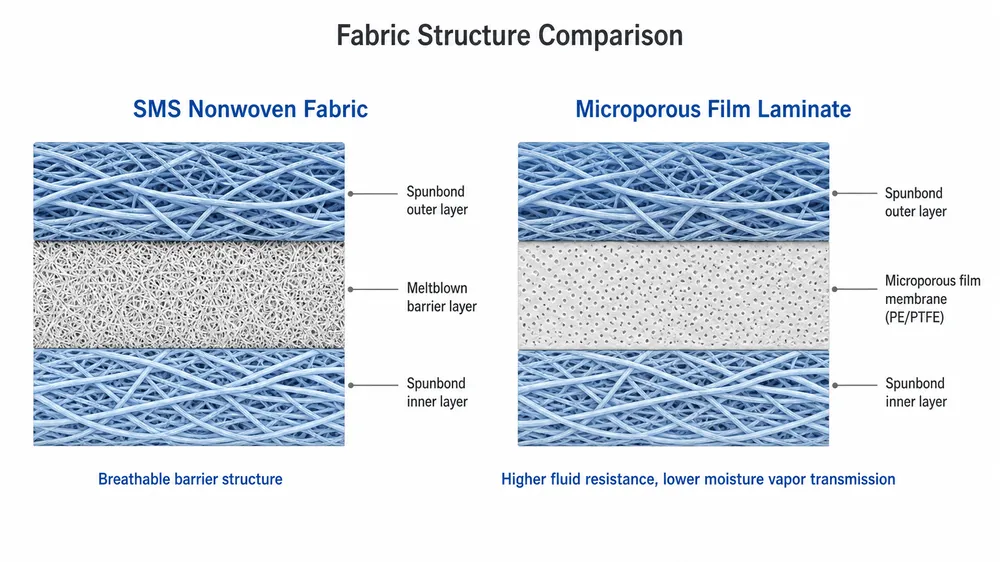
SMS stands for spunbond-meltblown-spunbond. Three layers, thermally bonded together. The outer and inner spunbond layers provide mechanical strength and softness. The meltblown middle layer is where the barrier work happens — fine fibers with a tight pore structure that blocks liquid droplets and particles while still allowing air and moisture vapor to pass through.
The meltblown layer is the variable that matters most. Fiber diameter, basis weight, and electrostatic charge all affect how well it performs. We produce our own meltblown fabric at eztio — the same in-house production capability we use for our mask filtration layers — which means we control those parameters directly rather than accepting whatever a third-party roll delivers. (This distinction matters when you're ordering at volume: a meltblown layer that's 5 g/m² light on basis weight will pass a visual inspection and fail a fluid resistance test.)
Microporous film laminates work differently. The barrier layer is a thin membrane — typically expanded PTFE (ePTFE) or a polyethylene-based microporous film — bonded to one or two spunbond carrier layers. The membrane has pores small enough to block liquid water and blood-borne pathogens, but large enough to allow water vapor molecules to pass. The result is a fabric with significantly higher fluid barrier performance than SMS, at the cost of reduced breathability and higher material cost.
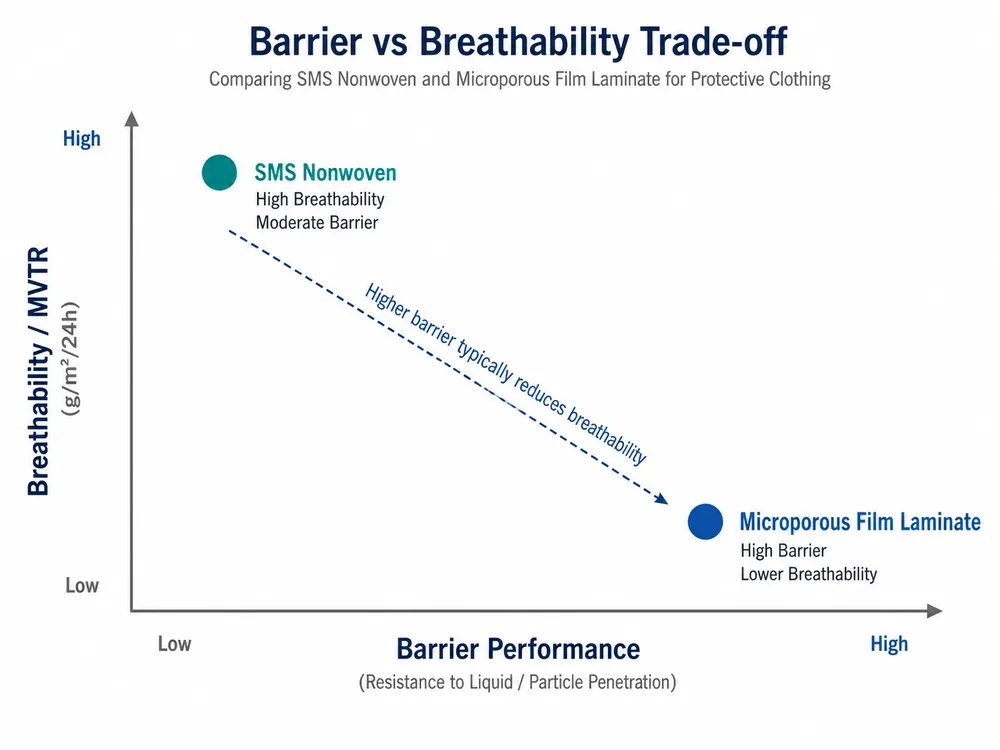
The practical difference: SMS breathes more freely and costs less. Microporous film blocks more aggressively and costs more. Neither is universally better — the right choice depends on what the garment needs to do.
Side-by-Side: How the Two Materials Compare Across Sourcing-Relevant Parameters
| Parameter | SMS Nonwoven | Microporous Film Laminate |
|---|---|---|
| Barrier mechanism | Meltblown fiber matrix | Microporous membrane |
| Typical gsm range | 35–70 g/m² (garment weight) | 50–80 g/m² (laminate total) |
| Fluid resistance | Moderate — passes EN 13795 standard performance; limited at high-pressure splash | High — passes EN 13795 high performance and AAMI PB70 Level 3–4 |
| Moisture vapor transmission (MVTR) | High — comfortable for extended wear | Lower — can cause heat stress in prolonged use |
| Particle resistance | Good for typical clinical environments | Excellent — suitable for infectious agent protection (EN 14126) |
| Seam sealing requirement | Stitched seams acceptable for lower barrier levels; taped seams for higher levels | Taped or ultrasonically welded seams required for barrier integrity |
| Typical applications | Isolation gowns, surgical gowns, low-to-medium fluid exposure | Coveralls, high-fluid-exposure procedures, infectious disease environments |
| Cost tier | Lower | Higher (membrane adds 30–60% to fabric cost depending on spec) |
| Drape and comfort | Soft, good drape | Stiffer, rustling sound — relevant for patient-facing environments |
| Certification pathway | EN 13795 standard/high performance, AAMI PB70 Level 1–2 | EN 13795 high performance, AAMI PB70 Level 3–4, EN 14126 |
Mapping Fabric Type to Compliance Standards
This is where most procurement teams lose time. The fabric spec and the garment standard are not the same thing — but they are tightly linked, and choosing the wrong fabric makes it impossible to certify the garment at the level your buyers need.
EN 13795 (surgical gowns and drapes) defines two performance levels: standard and high performance. Standard performance covers most routine surgical procedures and can typically be achieved with SMS fabrics in the 40–60 g/m² range, depending on construction quality and seam treatment. High performance — required for procedures with significant fluid exposure — demands higher fluid resistance values that SMS can meet at the upper end of its range, but microporous film laminates achieve more reliably and with more margin.
AAMI PB70 (US standard for liquid barrier performance) uses four levels. Level 1 and Level 2 are achievable with SMS. Level 3 requires resistance to a directed splash test, and Level 4 requires resistance to bloodborne pathogen penetration under pressure — both of which push into microporous film territory. If your buyers are supplying US hospitals and specifying Level 3 or Level 4 gowns, SMS is not the right fabric.
EN 14126 covers protective clothing against infectious agents. This standard is relevant for coveralls used in high-risk infectious disease environments. It requires testing against specific biological agents and penetration resistance that SMS fabrics generally cannot meet. Microporous film laminates — particularly ePTFE-based membranes — are the standard material choice for EN 14126-compliant coveralls.
ISO 16603 and ISO 16604 test resistance to penetration by blood and body fluids under pressure. These tests are referenced in both EN 13795 and EN 14126. The pass/fail threshold depends on the classification level, and the fabric's performance on these tests is a direct function of the membrane or meltblown layer quality — not just the gsm.
One thing we see regularly: buyers specify a garment standard without confirming that the fabric their supplier is using can actually achieve it. The garment might be labeled EN 13795 high performance, but if the SMS fabric is 40 g/m² with no seam taping, it won't pass the fluid resistance test. The label and the spec need to match.
Application Guide: Which Fabric Belongs in Which Garment
The decision isn't just about barrier level in the abstract — it's about what the garment is, where it's used, and what your buyers need to demonstrate to their procurement auditors.
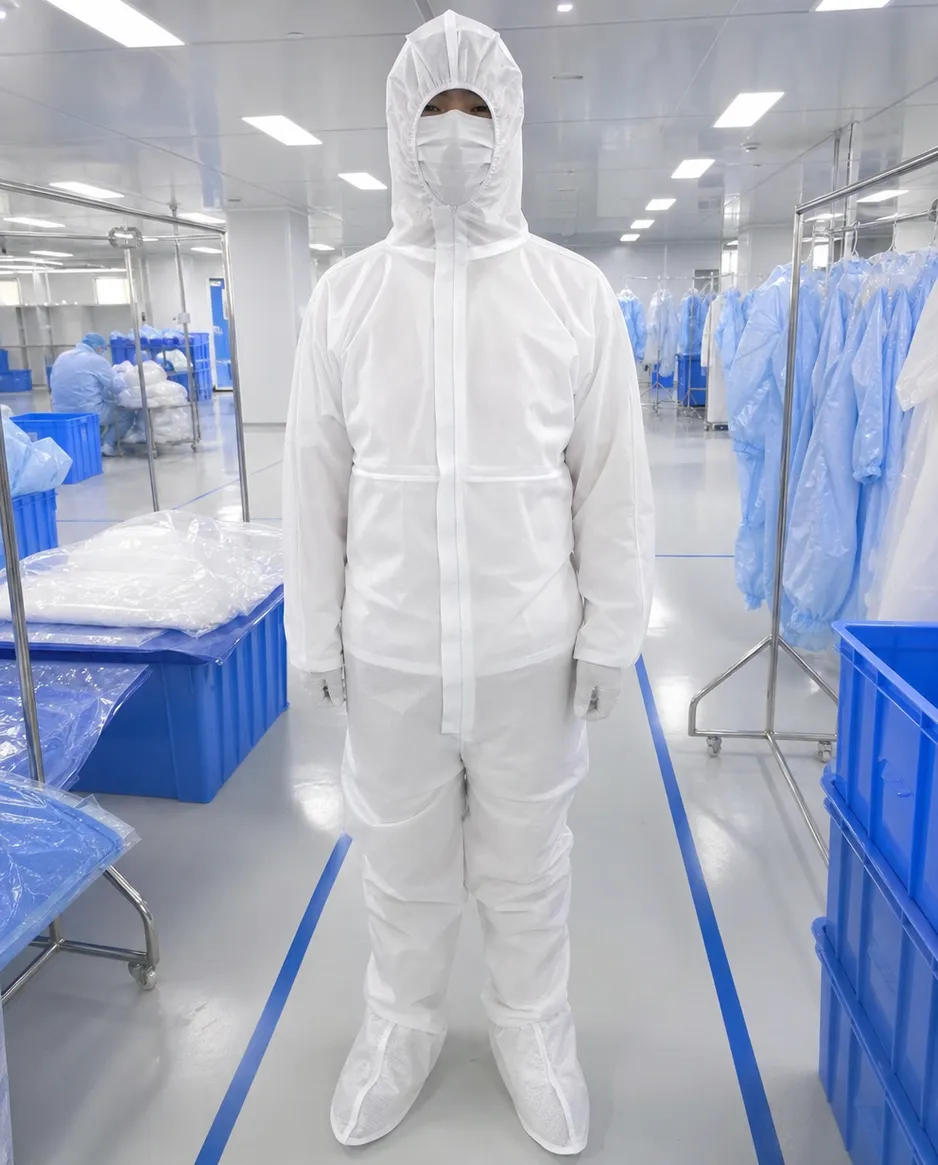
SMS for isolation gowns and standard surgical gowns. Most medical isolation gown applications — routine patient care, standard surgical procedures, low-to-moderate fluid exposure — are well served by SMS in the 40–60 g/m² range. The breathability keeps wearers comfortable during extended shifts. The cost is manageable for high-volume hospital procurement. And the certification pathway to EN 13795 standard performance or AAMI PB70 Level 1–2 is straightforward with a quality SMS fabric and proper seam construction.
For isolation gowns going into markets where AAMI PB70 Level 2 is the standard specification — which covers most US hospital supply contracts — SMS at 45–55 g/m² with reinforced critical zones is the typical solution. We run this configuration regularly.
Microporous film for coveralls and high-exposure environments. Medical protective coveralls used in infectious disease response, high-fluid surgical environments, or any application requiring EN 14126 compliance need microporous film. The barrier performance gap between SMS and microporous film becomes commercially significant here: a coverall that fails EN 14126 testing cannot be sold into the markets that require it, regardless of how well it's constructed otherwise.
The other consideration is seam integrity. Microporous film coveralls require taped or ultrasonically welded seams to maintain the barrier across the garment. A stitched seam through a microporous film laminate creates needle holes that compromise the membrane. This is a manufacturing requirement, not just a design preference — and it's worth confirming with any supplier before you approve samples.
The gsm question. Heavier isn't always better. A 70 g/m² SMS gown is stiffer, hotter, and more expensive than a 50 g/m² version — and if the application only requires AAMI PB70 Level 1, the extra weight adds cost without adding compliance value. We've seen buyers over-specify gsm because they associate heavier fabric with higher quality. The right gsm is the one that achieves the required barrier level with adequate seam strength, not the heaviest option available.
(A practical note on gsm consistency: batch-to-batch variation in SMS fabric is a real sourcing risk. A supplier quoting 50 g/m² SMS should be able to show you incoming inspection records demonstrating that their fabric lots actually arrive at spec. We test every incoming nonwoven lot at our facility — basis weight, tensile strength, and fluid resistance — before it enters production.)
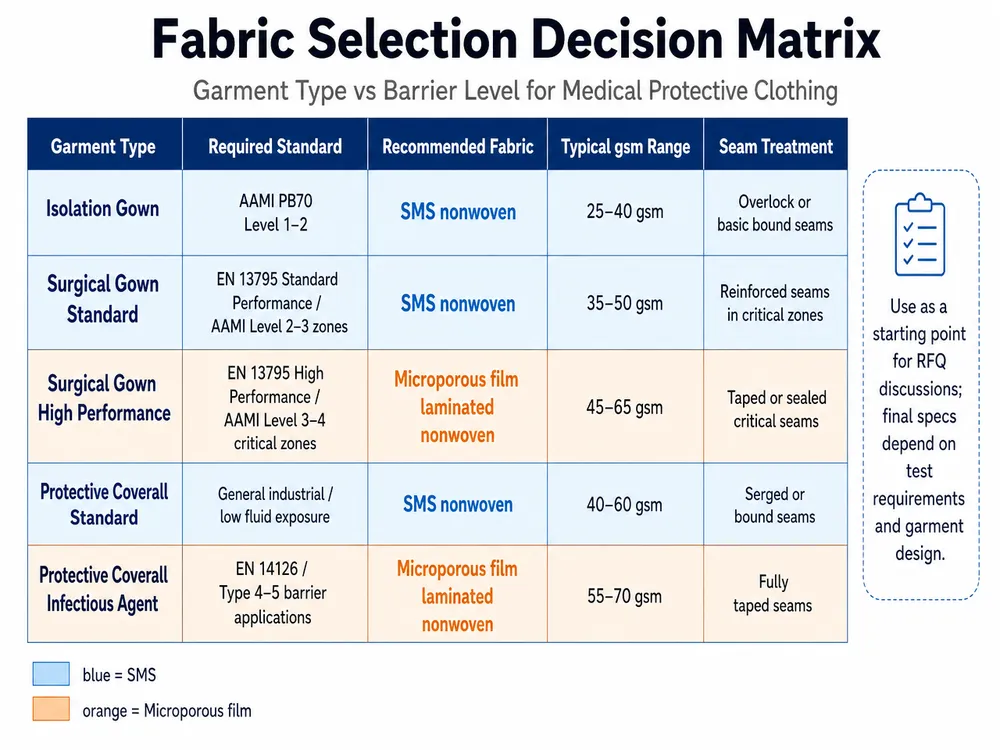
The Spec-Matching Framework: Application → Standard → Fabric → gsm
Use this as a starting reference when building your RFQ or evaluating a supplier's proposed spec:
| Garment Type | Target Standard | Fabric Type | Typical gsm | Seam Treatment |
|---|---|---|---|---|
| Isolation gown, routine care | AAMI PB70 Level 1–2 | SMS | 35–50 g/m² | Stitched or bound |
| Isolation gown, moderate fluid | AAMI PB70 Level 2–3 | SMS (reinforced critical zones) | 45–60 g/m² | Bound seams, critical zone taping |
| Surgical gown, standard performance | EN 13795 standard | SMS | 40–60 g/m² | Stitched or bound |
| Surgical gown, high performance | EN 13795 high performance | SMS (high-spec) or microporous film | 55–70 g/m² | Taped critical zones |
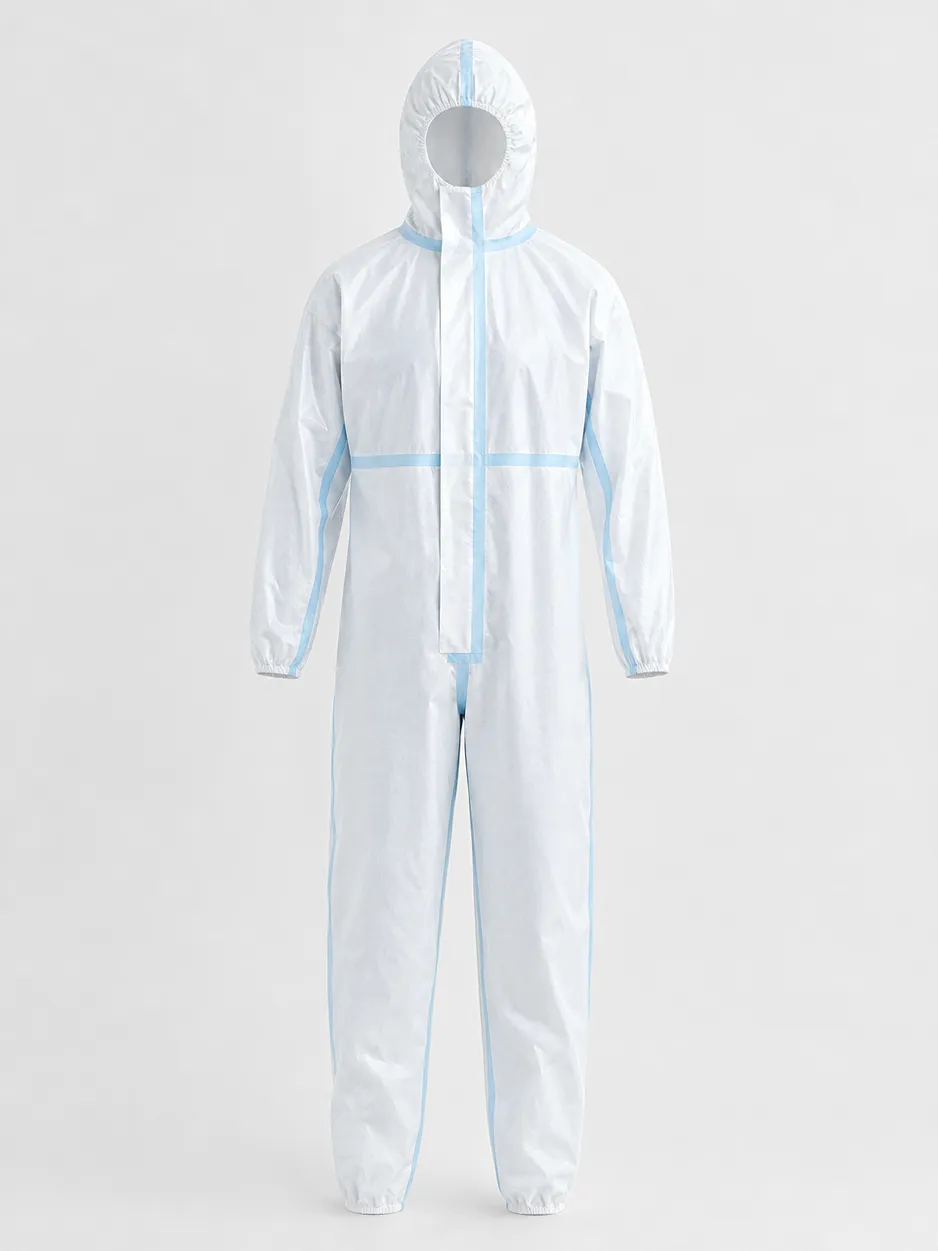
| Protective coverall, standard | EN 13795 / AAMI PB70 Level 3 | Microporous film laminate | 55–70 g/m² | Taped seams |
| Protective coverall, infectious agent | EN 14126 | Microporous film laminate (ePTFE) | 60–80 g/m² | Fully taped or ultrasonically welded |
This framework is a starting point, not a substitute for testing. The actual performance of any garment depends on the specific fabric construction, the seam method, and the manufacturing quality — not just the gsm number on a spec sheet.
What to Ask Your Manufacturer About Their Nonwoven Supply Chain
The fabric spec on a purchase order is only as reliable as the supplier's ability to deliver it consistently. These are the questions worth asking before you commit to a bulk order:
Where does the nonwoven fabric come from? Third-party fabric suppliers introduce a variable the garment manufacturer doesn't fully control. Ask whether the manufacturer sources from a single approved supplier or multiple, and whether they have incoming inspection records for fabric lots. A manufacturer who can't tell you their fabric supplier's name is a risk.
Do they test incoming fabric lots? Basis weight, tensile strength, and fluid resistance should be tested on every incoming lot — not assumed from the supplier's certificate. Ask to see a sample incoming inspection record. If they don't have one, that's your answer.
What's their seam construction for the specified barrier level? For any garment targeting AAMI PB70 Level 3 or above, or EN 13795 high performance, ask specifically how critical zone seams are treated. Stitched seams with no taping are not adequate for these levels. Get this confirmed in writing before sampling.
Can they provide batch traceability? For medical devices, traceability from raw material lot to finished garment batch is a regulatory requirement in most markets. If your buyers are supplying hospitals or government tenders, they will need this documentation. Confirm the manufacturer's traceability system before production, not after.
What certifications cover the finished garment — not just the fabric? A fabric supplier's test report for SMS nonwoven is not the same as a garment-level test report against EN 13795 or AAMI PB70. The garment needs to be tested as a complete assembly, including seams. Ask for garment-level test reports, not just fabric datasheets.
We've been through this process on both sides — as a manufacturer being audited by buyers, and as a team reviewing supplier documentation for our own raw material sourcing. The questions above are the ones that separate a supplier with a real quality system from one with a well-formatted spec sheet.
Sourcing SMS and Microporous Film Garments from a Manufacturer with In-House Nonwoven Control
Most protective clothing manufacturers buy their nonwoven fabric from outside suppliers. That's a standard arrangement, and it works fine when the fabric supplier is consistent and the manufacturer has a real incoming inspection process. The risk is that the garment manufacturer is one step removed from the material that determines barrier performance.
At eztio, our background is nonwoven production. We started as a nonwoven products operation in 2012, and our in-house meltblown capability — the same production we use for our mask filtration layers — gives us direct control over the fiber parameters that determine barrier performance. For SMS-based protective clothing, this means we're not dependent on a third-party roll arriving at spec. We set the meltblown layer parameters ourselves.
For microporous film laminates, we source from qualified membrane suppliers with documented incoming inspection on every lot. The seam construction for coveralls requiring EN 14126 compliance uses ultrasonic welding — the same technology we run on our mask production lines — which eliminates the needle-hole problem that stitched seams create in membrane fabrics.
Our Medical Protective Clothing range covers both fabric types across isolation gown and coverall configurations. If you're working through a spec decision and need a manufacturer's input on which fabric and gsm combination fits your target standard and market, that's a conversation we're set up to have before you place an order.
Frequently Asked Questions
What gsm SMS fabric is standard for medical isolation gowns? For AAMI PB70 Level 1–2 isolation gowns, 40–55 g/m² SMS is the typical range. Level 2 gowns often use 45–55 g/m² with reinforced critical zones at the forearms and chest. Heavier SMS (60–70 g/m²) is sometimes used for Level 3 applications, though microporous film becomes the more reliable choice at that barrier level.
Can SMS nonwoven meet EN 13795 high performance requirements? It depends on the specific SMS construction and the test values required. High-performance SMS fabrics — tighter meltblown fiber structure, higher basis weight, quality seam treatment — can achieve EN 13795 high performance in some configurations. But the margin is narrower than with microporous film, and batch consistency matters more. If your order requires EN 13795 high performance with no room for borderline test results, microporous film is the lower-risk choice.
Does microporous film protective clothing require special seam treatment? Yes. Stitched seams through a microporous membrane create needle penetrations that compromise barrier integrity. Garments targeting AAMI PB70 Level 3–4 or EN 14126 require taped seams (heat-sealed seam tape applied over the stitch line) or ultrasonically welded seams. This is a manufacturing requirement that affects both cost and lead time — confirm it with your supplier before sampling.
What's the difference between EN 14126 and EN 13795 for protective clothing? EN 13795 covers surgical gowns and drapes — primarily fluid barrier performance in surgical environments. EN 14126 covers protective clothing against infectious agents — it tests resistance to biological penetration, including viruses and bacteria, under more demanding conditions. A garment certified to EN 13795 high performance is not automatically compliant with EN 14126. If your buyers need infectious agent protection (pandemic response, biosafety environments), EN 14126 is the relevant standard, and microporous film is the appropriate fabric.
What documents should I request with a protective clothing order? At minimum: garment-level test reports against the specified standard (EN 13795 or AAMI PB70 level), fabric incoming inspection records, certificate of conformity, and batch traceability documentation. For EU market entry, you'll also need the technical file supporting the CE marking. For US import, FDA registration documentation for the manufacturer. Request these before production confirmation, not at shipment.
How does fabric choice affect the landed cost of a protective clothing order? Microporous film laminates typically add 30–60% to fabric cost compared to equivalent-weight SMS, depending on the membrane type and supplier. For isolation gowns where SMS meets the required standard, the cost difference is a margin decision. For coveralls requiring EN 14126, microporous film is not optional — the cost is part of the product spec. The mistake to avoid is specifying microporous film for applications where SMS is sufficient, or specifying SMS for applications where it won't pass certification testing.
If you're ready to match a garment spec to the right nonwoven configuration, submit an RFQ with your target garment type, required standard, and order volume — we'll come back with a specific fabric recommendation and pricing.