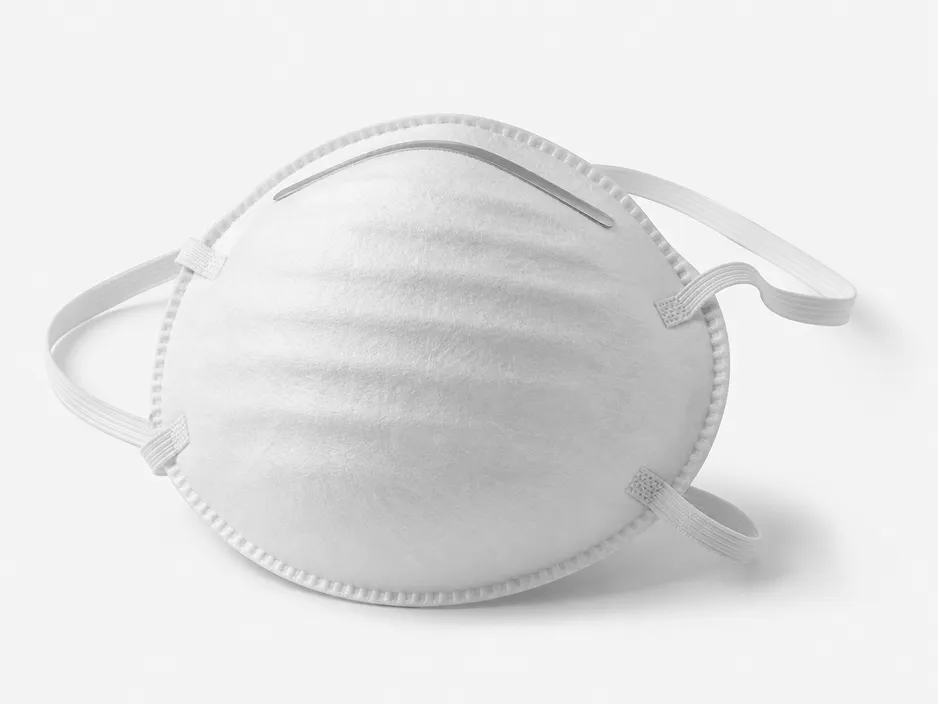
Fit testing failures don't usually come from the wrong protocol or an undertrained technician. They come from inconsistent masks. A healthcare facility can run a textbook OSHA-compliant fit testing program and still see 15–20% failure rates across a staff cohort if the N95s they're using vary in nose wire stiffness or face seal geometry from one production batch to the next.
That's the sourcing problem most compliance guides don't address. OSHA.gov tells you what the regulation requires. This guide covers that too — but it also covers what the regulation means for the masks you buy, and what to ask a supplier before you commit to a large order.
What OSHA 29 CFR 1910.134 actually requires
The mandate is straightforward: any employee required to wear a tight-fitting respirator — including N95 respirators — must be fit tested before initial use and at least annually thereafter. This is not a recommendation. It's a federal OSHA standard, and healthcare facilities are among the most frequently cited industries for non-compliance.
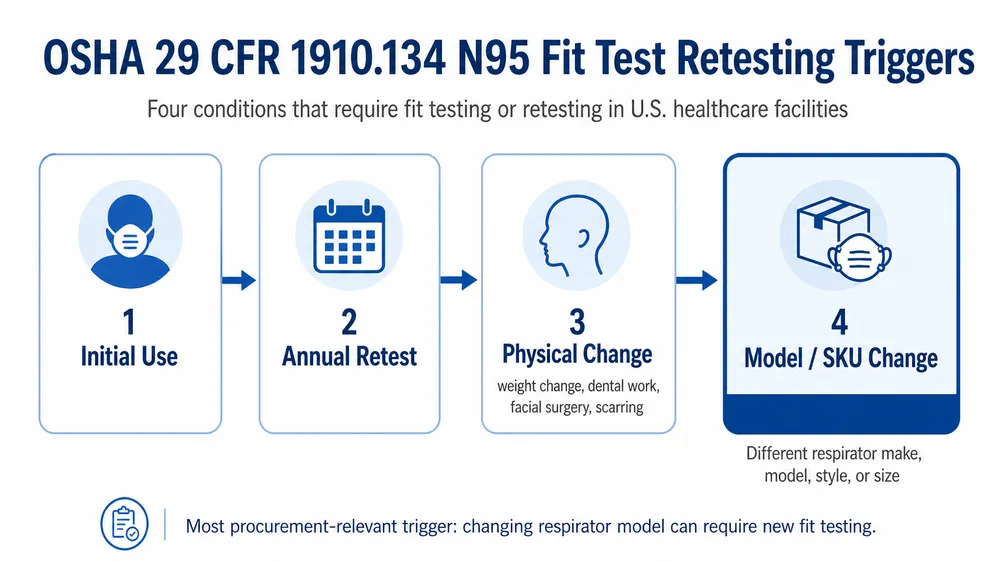
The specific triggers for retesting matter for procurement planning:
- Initial fit test before the employee wears the respirator in a hazardous environment for the first time
- Annual retesting — at minimum, once every 12 months
- Change in physical condition — significant weight change (typically defined as ≥10% body weight), dental work, facial surgery, or scarring that could affect the face seal
- Change in respirator model or size — if you switch N95 suppliers or SKUs, every affected employee must be retested on the new model
That last trigger is the one procurement teams underestimate. Switching from one N95 model to another — even if both are NIOSH-approved and nominally the same size — requires a full retest cycle for your entire workforce. At a 500-person hospital, that's a significant operational and cost burden. It's one reason why supply chain stability and consistent mask geometry across reorders matter beyond just price.
The regulation also requires a written respiratory protection program, medical evaluation before fit testing, and training on proper donning, doffing, and seal checks. Fit testing is one component of a larger compliance structure — but it's the component most directly affected by which masks you source.

Qualitative vs quantitative fit testing: which protocol, which mask
OSHA accepts two fit testing methods for N95 respirators. The choice between them affects your facility's equipment investment, testing time per employee, and — less obviously — which N95 configurations tend to perform better.
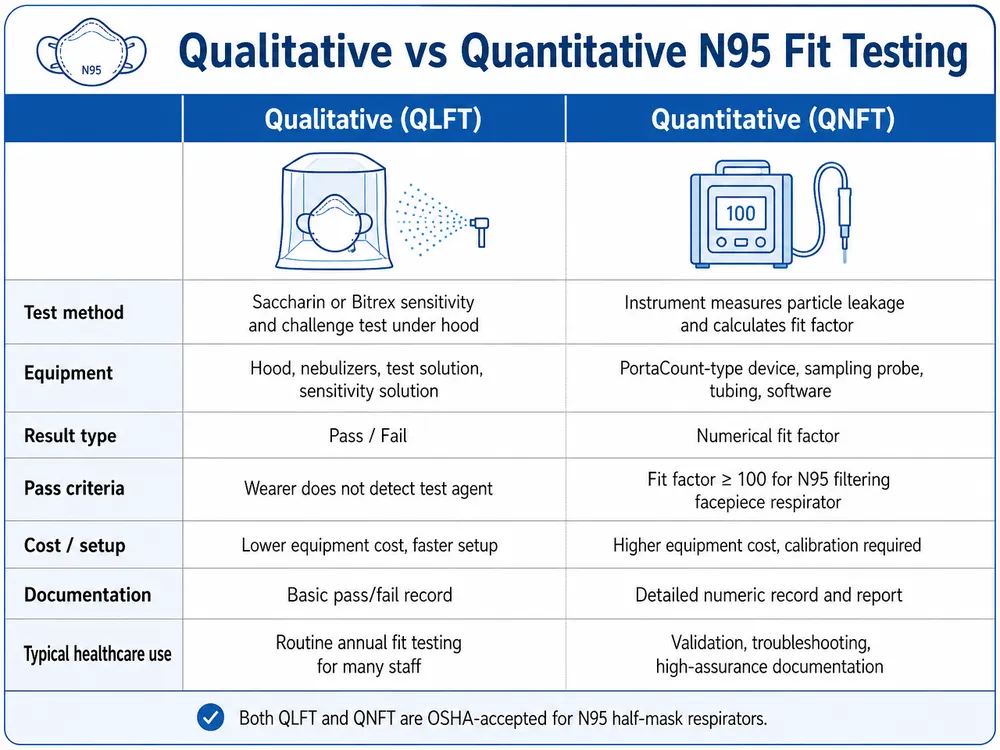
Qualitative fit testing (QLFT) uses the wearer's sensory response to a test agent to detect leakage. The four OSHA-accepted QLFT agents are:
| Agent | Detection mechanism | Notes |
|---|---|---|
| Isoamyl acetate (banana oil) | Smell | Requires olfactory sensitivity screening |
| Saccharin solution aerosol | Taste | Most common in healthcare settings |
| Bitrex (denatonium benzoate) aerosol | Taste | Bitter taste; high sensitivity |
| Irritant smoke (stannic chloride) | Irritation | Less common; requires careful administration |
QLFT is pass/fail — the employee either detects the agent or doesn't. It's lower cost, requires no specialized electronic equipment, and is faster per employee. The limitation is that it's subjective and only valid for half-mask respirators with an assigned protection factor (APF) of 10 or less. N95 respirators fall within this category, so QLFT is fully acceptable for standard healthcare N95 programs.
Quantitative fit testing (QNFT) measures actual particle concentration inside and outside the mask simultaneously, producing a numerical fit factor. OSHA requires a minimum fit factor of 100 for half-mask respirators. QNFT methods include:
- Generated aerosol (corn oil, polyethylene glycol, or sodium chloride) — measures particle counts with a photometer
- Ambient aerosol condensation nuclei counter (CNC) — the PortaCount method, most widely used in US healthcare
- Controlled negative pressure (CNP) — measures pressure decay; less common
QNFT is objective, produces a documented numerical result, and is required for respirators with APF above 10 (powered air-purifying respirators, supplied-air respirators). For standard N95 programs, it's optional but increasingly preferred by larger health systems because the numerical record is more defensible in a compliance audit.
The practical difference for procurement: QLFT is more sensitive to gross seal failures — a mask that's clearly the wrong size or shape for a face. QNFT catches marginal failures that QLFT might miss. If your facility uses QNFT and you're seeing fit factors clustering just above 100 for a significant portion of your staff, that's often a mask geometry issue, not a testing issue.
How N95 mask design affects fit test pass rates
This is where the compliance conversation and the sourcing conversation meet.
An N95 respirator's fit test performance is determined by three physical variables: nose wire geometry, face seal profile, and overall cup or fold-flat configuration. These aren't abstract design choices — they're the dimensions that determine whether the mask seals against a given face shape, and whether that seal holds across the range of head movements required during fit testing.
Nose wire stiffness and formability is the most common source of fit test failures we see reported from healthcare facilities. A nose wire that's too stiff doesn't conform to the nasal bridge under normal hand pressure. A wire that's too soft loses its shape during wear. The target is a wire that holds its formed shape after a single adjustment — typically a 1.5–2.0mm aluminum or aluminum-alloy wire with a defined bend radius. (We run our nose wire at 1.8mm with a controlled temper spec. Softer than that and the wire creeps back; stiffer and you need two hands to form it properly, which most wearers don't do.)
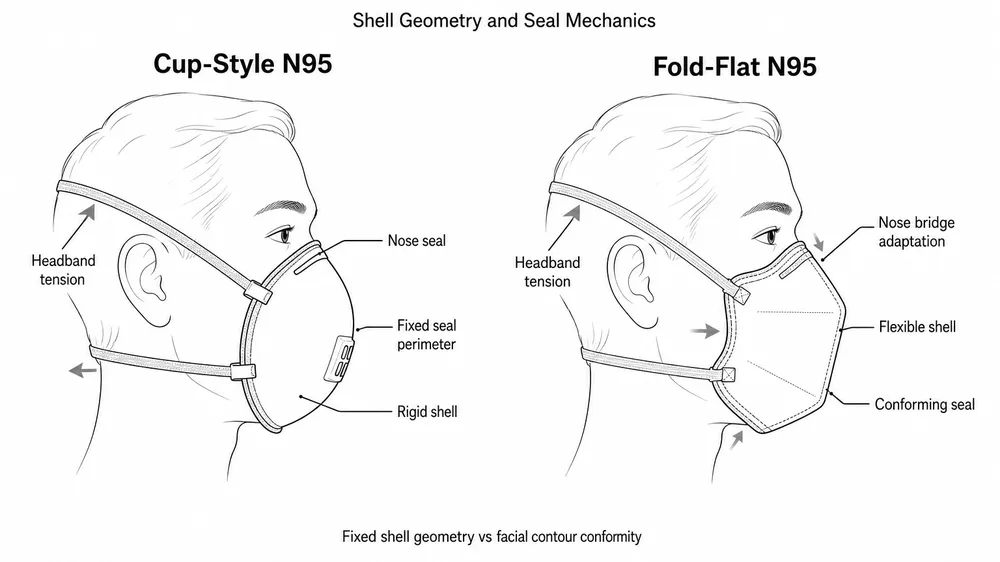
Face seal geometry — the shape of the perimeter that contacts the face — varies significantly between cup-style and fold-flat N95 designs. Cup-style masks maintain a fixed three-dimensional shape; the seal geometry is set by the molded form. Fold-flat masks conform more to the face during wear but depend on the wearer's head strap tension to maintain the seal. Neither is universally better for fit testing — it depends on the face shape distribution of your workforce. Facilities with diverse staff populations often find that stocking both configurations improves overall program pass rates.
Dimensional consistency across batches is the variable that procurement teams control directly. A mask that passes fit testing in your initial evaluation will fail for some employees if the production geometry shifts between your first order and your third. Nose wire placement tolerance, ear-loop attachment position, and cup depth all affect the seal. If these dimensions drift by even 2–3mm between production runs, you'll see it in your annual retest numbers.
We produce our N95 Medical Masks on fully automated lines using ultrasonic welding for nose wire embedding and ear-loop attachment. The weld parameters are machine-controlled, not operator-dependent, so the 500,000th mask in a production run has the same nose wire position and ear-loop tension as the first. That consistency is what makes fit test results from your initial evaluation predictive of results across your entire staff cohort — and across reorders.
The documentation your respiratory protection program needs from suppliers
OSHA's written respiratory protection program requirement means your facility needs to document not just that fit testing happened, but that the respirators used are appropriate for the hazard and meet the applicable standards. When a compliance auditor or accreditation body reviews your program, they'll look at your supplier documentation as part of that review.
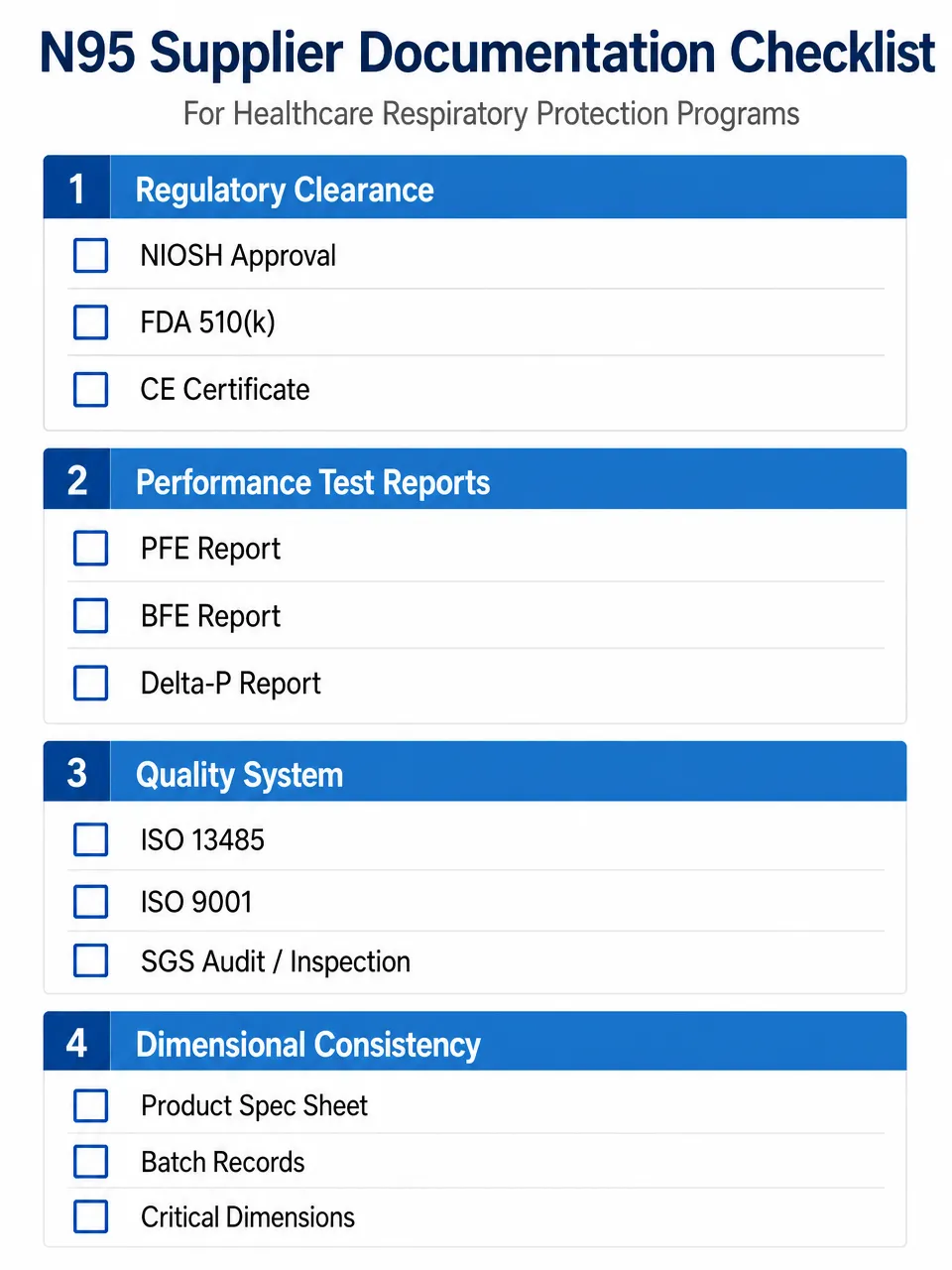
Here's what to request from any N95 supplier before placing a healthcare facility order:
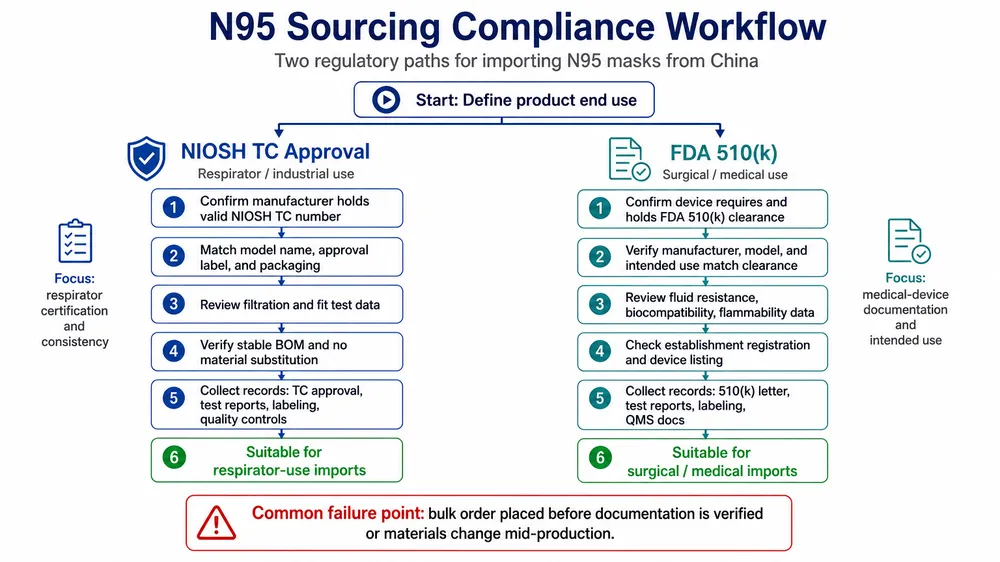
Regulatory clearance documents
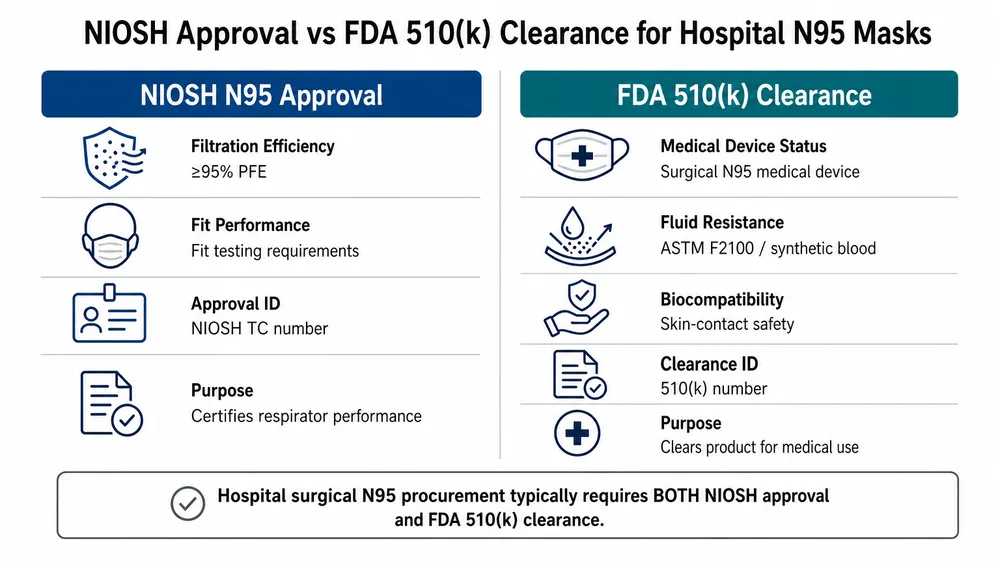
- NIOSH approval number and approval certificate — confirms the respirator meets 42 CFR Part 84 filtration and performance requirements
- FDA 510(k) clearance number (for surgical N95 respirators) — required if the mask will be used in surgical environments where fluid resistance is needed
- CE marking technical file summary (if the product is also sold in EU markets — useful as a secondary quality signal)
Performance test reports
- PFE (Particulate Filtration Efficiency) test report — should show ≥95% at 0.3 micron with NaCl aerosol per NIOSH protocol
- BFE (Bacterial Filtration Efficiency) test report — relevant for surgical N95 applications
- Delta-P (pressure differential / breathability) test report — confirms the mask meets breathability requirements for extended wear
- Third-party lab name and accreditation status on all reports
Quality system documentation
- ISO 13485:2016 certificate — medical device quality management system; this is the QMS standard that governs design controls, traceability, and corrective action processes
- ISO 9001:2015 certificate — general QMS; present in most manufacturers but less specific to medical devices than 13485
- SGS or equivalent third-party audit report
Dimensional and batch consistency records
- Product specification sheet with dimensional tolerances (nose wire length, cup depth, ear-loop length, face seal perimeter dimensions)
- Batch-to-batch consistency data or process capability records — not all suppliers provide this proactively, but it's the most direct evidence that the mask geometry your staff fit tested on will be the same geometry in future orders
(In practice, most suppliers will provide the regulatory clearance documents and performance test reports without hesitation. The dimensional consistency records are where you'll find out how seriously a manufacturer takes process control. If a supplier can't provide tolerance specs for their nose wire placement, that's a signal worth noting.)
Our FDA 510(k) registration and ISO 13485:2016 certification cover the audit trail healthcare procurement teams need. We provide full documentation packages — NIOSH approval, PFE/BFE/Delta-P test reports, ISO certificates, and product spec sheets — with every RFQ response. If your compliance team needs specific documentation formats for a Joint Commission or CMS audit, tell us upfront and we'll prepare accordingly.
Batch geometry consistency: the sourcing variable that determines fit test repeatability at scale
A single-facility fit testing program with 50 employees is manageable even with some mask variability. A health system running annual retests across 3,000 employees across multiple sites is a different problem. At that scale, mask geometry consistency isn't a quality preference — it's a program cost driver.
Here's the math: if 10% of your staff fails the annual retest because the new batch of N95s has a slightly different nose wire profile than the batch they were originally fit tested on, you're looking at 300 retests, the staff time to administer them, and the documentation burden of updating 300 individual fit test records. If the failure rate is high enough, you may also need to source an alternative model and retest the failures on that model — which triggers another documentation cycle.
The root cause in most of these cases isn't the fit testing protocol. It's that the masks changed.
Automated production with machine-controlled weld parameters is the manufacturing answer to this problem. When nose wire placement is controlled by a servo-driven positioning system rather than manual feeding, the placement tolerance is ±1mm or better across the entire production run. When ear-loop attachment force is set by ultrasonic weld energy parameters rather than operator technique, the tension is consistent from the first mask to the last. These aren't marketing claims — they're the mechanical reason why automated lines produce more consistent fit test results than semi-manual production.
We've been running fully automated lines since we rebuilt our production infrastructure between 2015 and 2017. The consistency data is in our process capability records, and we can share batch-to-batch dimensional reports with buyers who need them for their respiratory protection program documentation.
For health systems evaluating Hospital N95 Medical Masks for large-scale procurement, the question to ask any supplier isn't just "are these NIOSH-approved?" It's "what are your dimensional tolerances, and can you show me batch-to-batch consistency data across your last six production runs?"
Cup vs fold-flat N95: fit test performance by configuration
The configuration question comes up in almost every healthcare procurement conversation we have, and the honest answer is that neither cup nor fold-flat is universally better for fit testing. They perform differently across face shape populations, and the right choice depends on your workforce demographics and your facility's storage constraints.
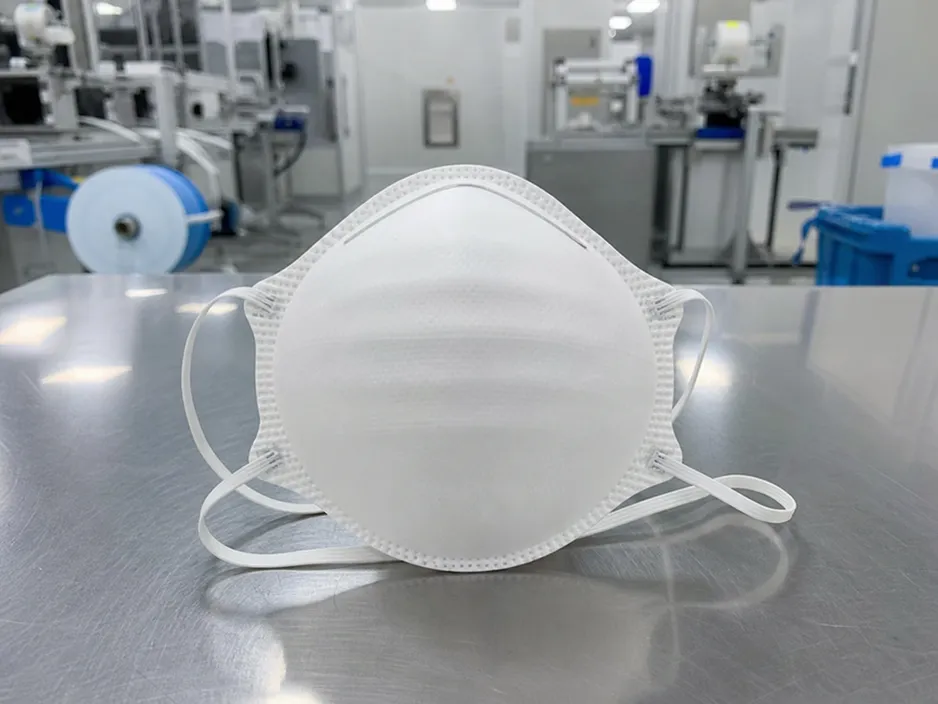
Cup-style N95s maintain a fixed three-dimensional shape. The face seal geometry is determined by the mold, not by the wearer's adjustment. This makes them more consistent across wearers who don't adjust their masks carefully — the seal is either right for their face shape or it isn't, and there's less variability introduced by donning technique. Cup-style masks also tend to perform better in QNFT because the fixed geometry produces more predictable fit factors. The tradeoff is storage volume: cup masks don't compress, so they take more shelf space and more carton volume per unit.
Fold-flat N95s (sometimes called duckbill or tri-fold configurations) compress flat for storage and shipping, which matters for facilities managing large inventory volumes. They conform more to the face during wear, which can improve comfort for extended shifts. The fit test performance depends more on proper donning — the mask needs to be fully opened and the nose wire properly formed before the seal check. Facilities that see higher QLFT failure rates with fold-flat masks often find that the issue is donning technique, not mask geometry.
For mixed-population workforces, stocking both configurations and allowing employees to use the model they fit tested on is the most defensible approach from a compliance standpoint. It also means your procurement program needs a supplier who can provide both configurations with consistent geometry — not two separate suppliers with different documentation stacks.
Our Disposable N95 Medical Mask line covers both cup and fold-flat configurations, produced on the same automated lines with the same QMS controls. If you're building a program that needs both, we can supply them under a single documentation package.
Frequently asked questions
How often is N95 fit testing required under OSHA?
At minimum, annually. OSHA 29 CFR 1910.134 requires fit testing before initial use and at least once every 12 months. Retesting is also required when an employee has a physical change that could affect the face seal (significant weight change, dental work, facial surgery) or when the respirator model or size changes. That last trigger — model change — is the one most often missed in procurement planning.
Does switching N95 suppliers require a new fit test?
Yes, if the new supplier's product is a different model or has different physical dimensions. OSHA's position is that fit testing is specific to the respirator model, not the NIOSH approval category. Two NIOSH-approved N95s from different manufacturers can have meaningfully different face seal geometries. If you change suppliers and the new product has different dimensional specs, your employees need to be retested on the new model before using it in a hazardous environment.
What's the difference between NIOSH N95 approval and FDA 510(k) clearance for N95 masks?
NIOSH approval (42 CFR Part 84) certifies that the respirator meets filtration and performance requirements as a respiratory protective device — it's an occupational safety certification. FDA 510(k) clearance certifies the mask as a medical device, specifically a surgical N95 respirator, which must also meet fluid resistance requirements (ASTM F1862). For general healthcare worker respiratory protection, NIOSH approval is the primary requirement. For use in surgical environments where blood or body fluid splash is a risk, you need a surgical N95 with both NIOSH approval and FDA 510(k) clearance. Confusing these two is how hospital supply chains end up with the wrong product for the application.
Can qualitative fit testing be used for all N95 respirators in healthcare?
Yes. QLFT is OSHA-accepted for all tight-fitting half-mask respirators with an assigned protection factor of 10, which includes standard N95 respirators. The limitation is that QLFT is only valid for APF ≤10 respirators — it cannot be used for PAPRs or supplied-air respirators. For standard healthcare N95 programs, QLFT with saccharin or Bitrex is fully compliant and is the most common method used in US hospitals.
What dimensional specs should I request from an N95 supplier to support fit testing?
At minimum: nose wire length and placement tolerance, face seal perimeter dimensions (height and width at the seal contact zone), cup depth (for cup-style masks), and ear-loop length and attachment position. Ask for these as engineering tolerances, not nominal values — a supplier who can only give you nominal dimensions without tolerances is telling you something about their process control. Batch-to-batch consistency data (process capability records or dimensional inspection reports across multiple production runs) is the most useful document for predicting fit test repeatability across large staff populations.
What's the minimum order quantity for N95 masks with full compliance documentation?
Our standard MOQ is 50,000 pieces for standard SKUs. Full compliance documentation — NIOSH approval certificate, PFE/BFE/Delta-P test reports, ISO 13485 certificate, FDA 510(k) registration, and product spec sheet — is included with every order regardless of volume. For healthcare procurement programs that need specific documentation formats for accreditation review, we prepare those on request.
If you're sourcing N95 respirators for a healthcare facility or distribution program, the compliance documentation and dimensional consistency data your fit testing program depends on should be part of your supplier evaluation, not an afterthought. Request a quote and tell us your volume, configuration requirements, and any specific documentation needs — we'll respond with samples and a full compliance documentation package.