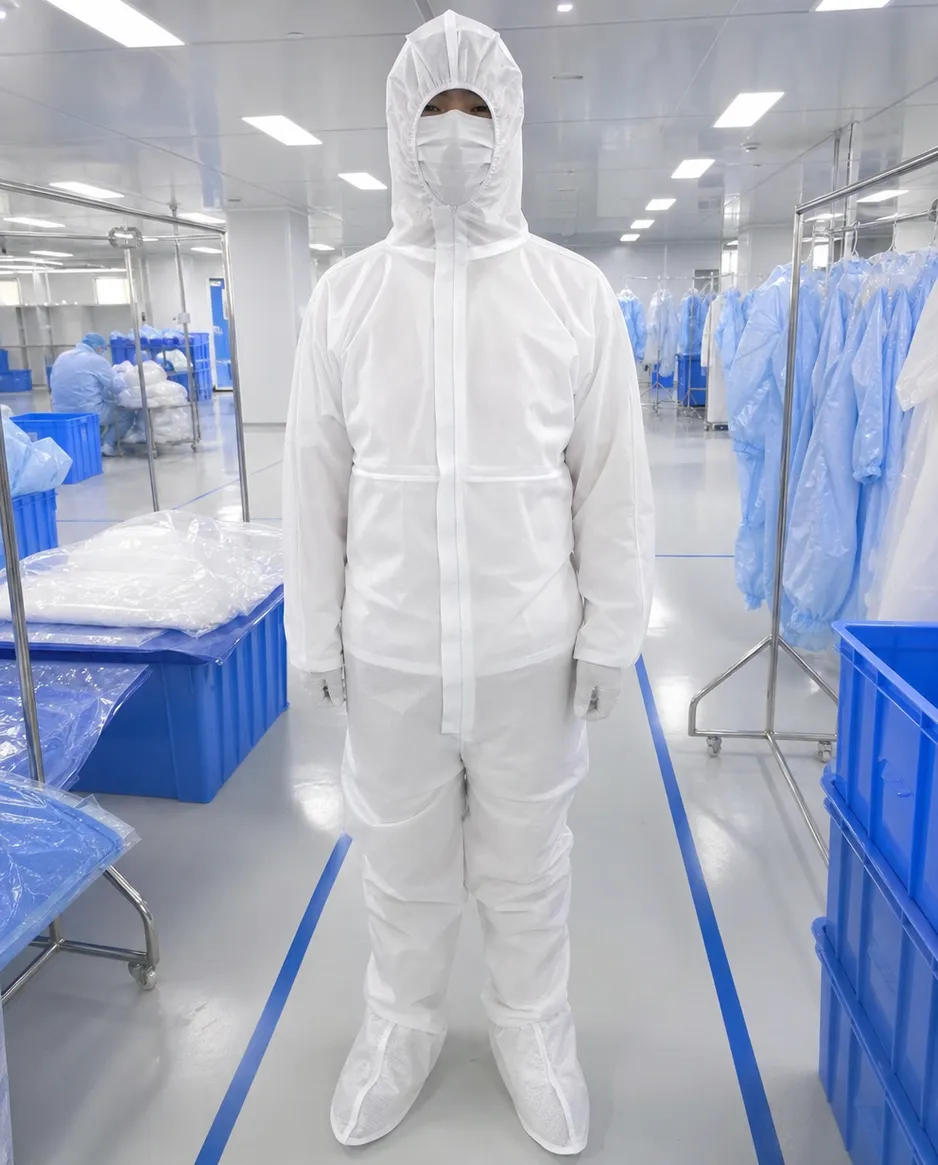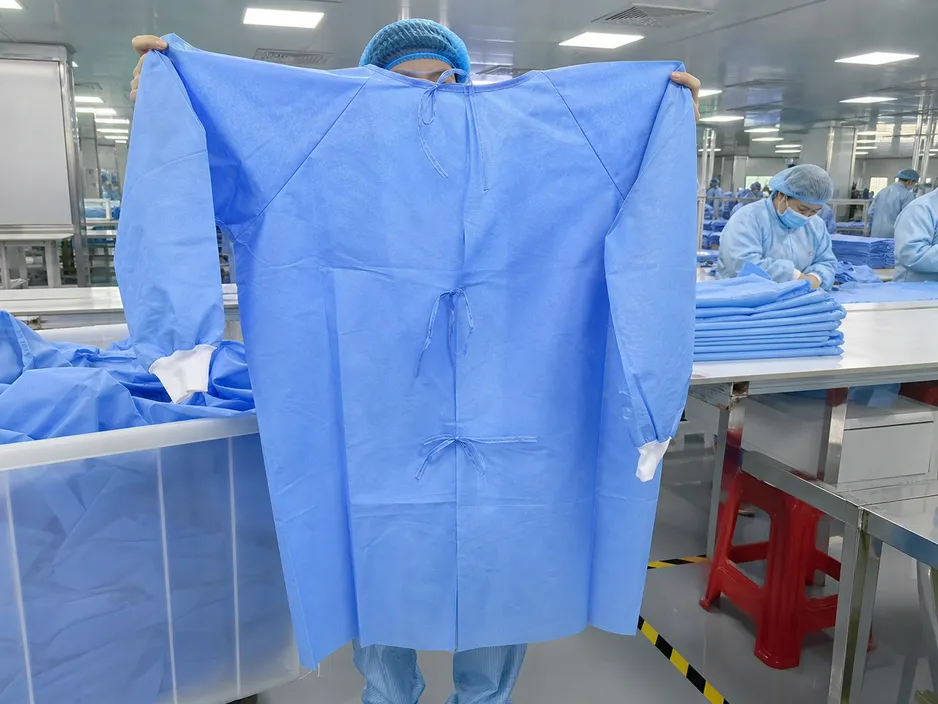
The most common sourcing mistake we see with protective coveralls is not choosing the wrong fabric weight — it's choosing the wrong protection type entirely. A buyer specifies Type 6 because it's cheaper, the end user gets exposed to dry particles, and the distributor ends up managing a liability claim. Or the reverse: a buyer over-specifies Type 5 for a low-splash environment, pays 30–40% more per unit, and loses the tender to a competitor who read the standard correctly.
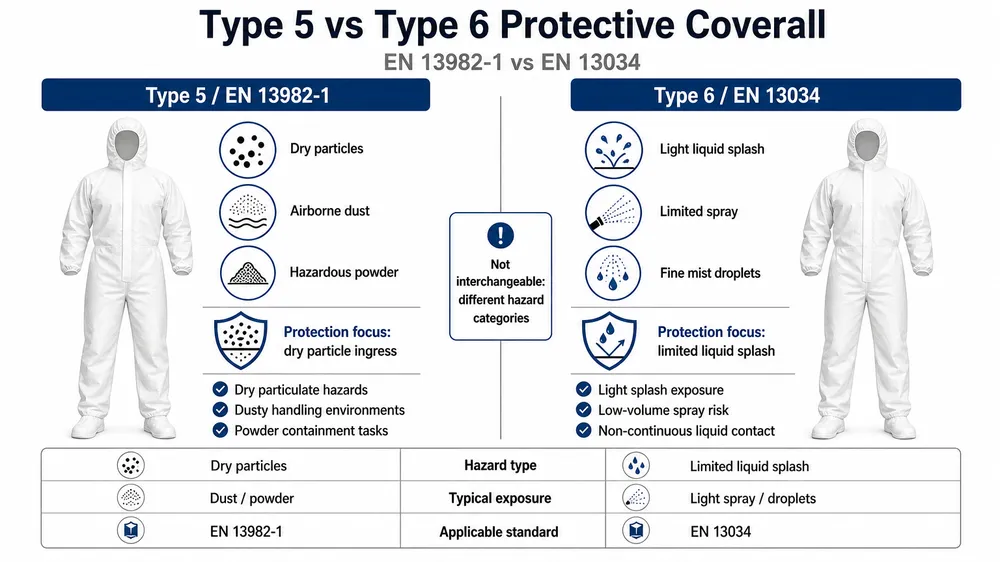
Type 5 and Type 6 are not a quality ladder. They are two different protection categories, each governed by a different European standard, each tested against a different hazard. Getting this right before you place a bulk order is the difference between a compliant product and a customs rejection or, worse, a field failure.

What EN 13982-1 and EN 13034 Actually Test
EN 13982-1 governs Type 5 coveralls. The standard tests resistance to airborne solid particles — specifically, it measures inward leakage of fine dry particulate through the garment system, including seams, closures, and interfaces. The test method uses a tracer aerosol and measures how much penetrates to the wearer's body. Pass criteria require total inward leakage below 15% for the garment ensemble.
EN 13034 governs Type 6 coveralls. This standard tests resistance to limited liquid chemical splash — light spray and mist, not immersion or pressurized jets. The test uses a spray of sulfuric acid solution and measures penetration through the fabric. It is explicitly a "limited protection" standard; the EN 13034 designation itself signals that the garment is not intended for high-hazard liquid environments.
The practical implication: a Type 6 coverall will not protect against fine dry particles. A Type 5 coverall may or may not provide liquid splash resistance — that depends on the fabric, not the type classification. Some manufacturers produce dual-certified Type 5/6 garments, but that requires passing both test protocols independently.
(We see a lot of spec sheets that list "Type 5/6" as a single classification. That's legitimate when both standards are tested and certified — but always ask for the test report, not just the label.)
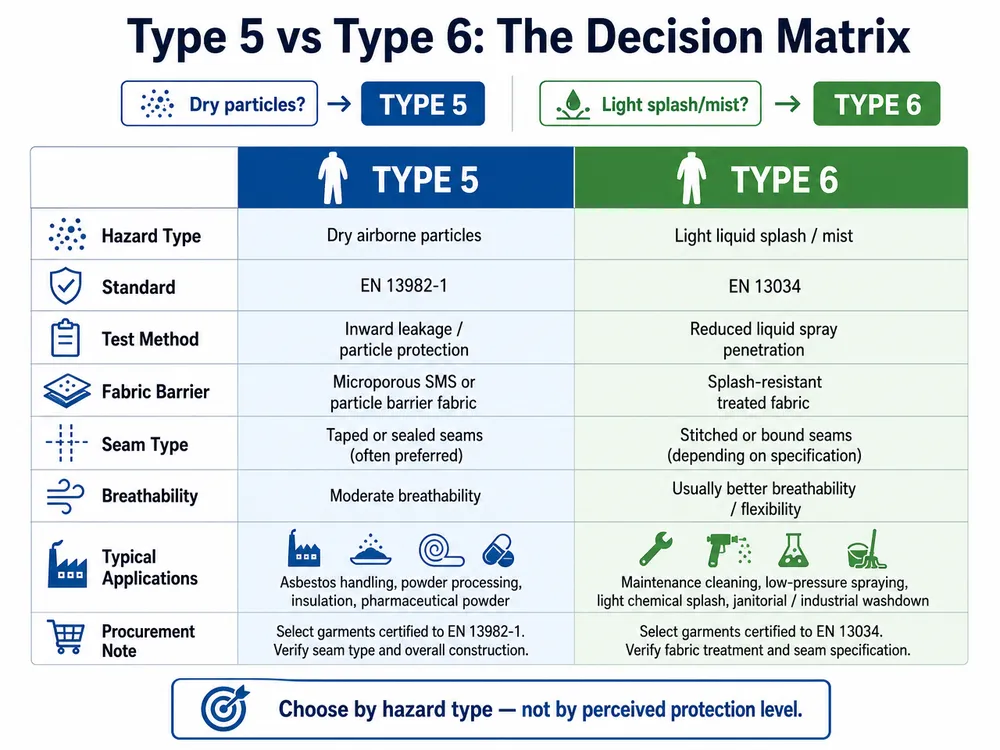
Type 5 vs Type 6: The Decision Matrix
| Parameter | Type 5 (EN 13982-1) | Type 6 (EN 13034) |
|---|---|---|
| Hazard addressed | Dry airborne solid particles | Limited liquid chemical splash |
| Governing standard | EN 13982-1 | EN 13034 |
| Test method | Tracer aerosol inward leakage | Sulfuric acid spray penetration |
| Pass threshold | Total inward leakage ≤ 15% | Penetration ≤ 30% per test zone |
| Typical fabric | Microporous film laminate or SMS with tight construction | SMS nonwoven (typically 40–60 gsm) |
| Seam requirement | Seam sealing typically required to pass | Stitched seams often acceptable |
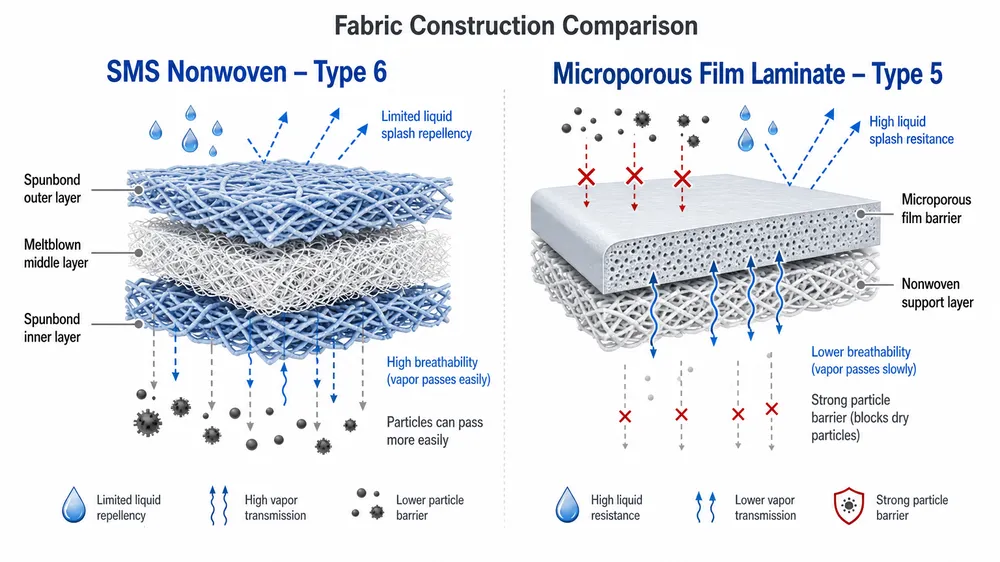
| Breathability | Lower (film laminates restrict vapor) | Higher (SMS allows more vapor transmission) |
| Typical unit cost | Higher | Lower |
| Common applications | Asbestos abatement, pharmaceutical mfg, fine chemical handling, nuclear decontamination | Healthcare isolation, light industrial spray, food processing, general maintenance |
Where Each Type Belongs: Application Mapping for Procurement
Type 5 applications — where particle exclusion is the risk
Pharmaceutical manufacturing is the clearest Type 5 market. Active pharmaceutical ingredient (API) handling, tablet coating operations, and cleanroom maintenance all involve fine dry powders that become inhalation or contamination hazards. Regulatory bodies in the EU and US expect Type 5 or higher for these environments, and your hospital or pharma procurement customers will have this written into their facility protocols.
Asbestos abatement and demolition work in Europe requires Type 5 as a minimum under most national regulations. This is a high-volume, repeat-purchase segment — remediation contractors buy in bulk and need consistent certification documentation for site compliance records.
Nuclear and radiological decontamination work also falls here. The particle exclusion requirement is absolute, and buyers in this segment will ask for test reports, not just CE marks.
Type 6 applications — where light splash is the risk
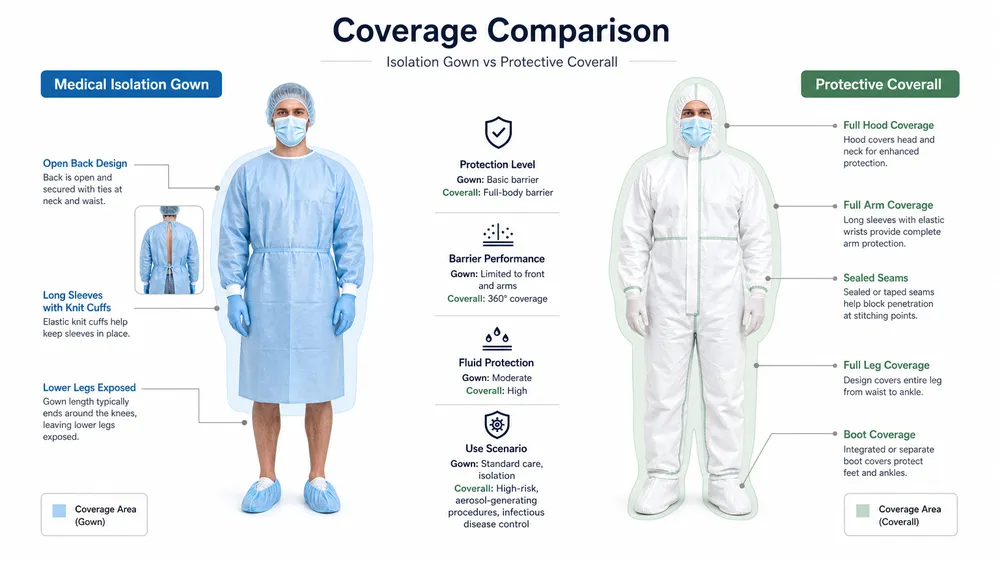
Healthcare isolation is the dominant Type 6 market. Hospitals and clinics use Type 6 coveralls for patient contact in standard isolation scenarios, light fluid exposure during procedures, and general infection control. The breathability advantage of SMS-based Type 6 garments matters here — clinical staff wearing coveralls for extended shifts need vapor transmission, and a microporous film garment becomes uncomfortable quickly.
(We've had healthcare buyers switch from Type 5 to Type 6 after their staff complained about heat stress during 8-hour shifts. The protection requirement was light splash, not particle exclusion — Type 6 was always the right call, and the switch reduced their per-unit cost by about 25%.)
Food processing and light industrial maintenance are also natural Type 6 segments. The hazard is incidental liquid contact — cleaning agents, light chemical spray — not immersion or fine particle exposure.
Emergency response and first responder staging areas often use Type 6 as a baseline garment for unknown-hazard environments where the risk assessment suggests limited exposure. These buyers typically need fast delivery and flexible MOQ for stockpile management.
Fabric and Construction: What Drives the Classification
The fabric choice is not arbitrary — it directly determines which type a coverall can achieve.
SMS nonwoven (spunbond-meltblown-spunbond) is the standard material for Type 6. The meltblown core layer provides the liquid repellency needed to pass EN 13034 spray tests. SMS at 40–60 gsm passes Type 6 comfortably. The same material will not pass Type 5 particle inward leakage tests because the fiber structure, while tight, allows fine aerosol penetration at the seams and fabric interstices.
Microporous film laminates — typically a polyethylene or polypropylene film bonded to a nonwoven substrate — are the standard route to Type 5 certification. The film layer creates a continuous barrier against dry particles. The trade-off is breathability: moisture vapor transmission rate (MVTR) drops significantly compared to SMS, which is why Type 5 garments feel warmer in use.
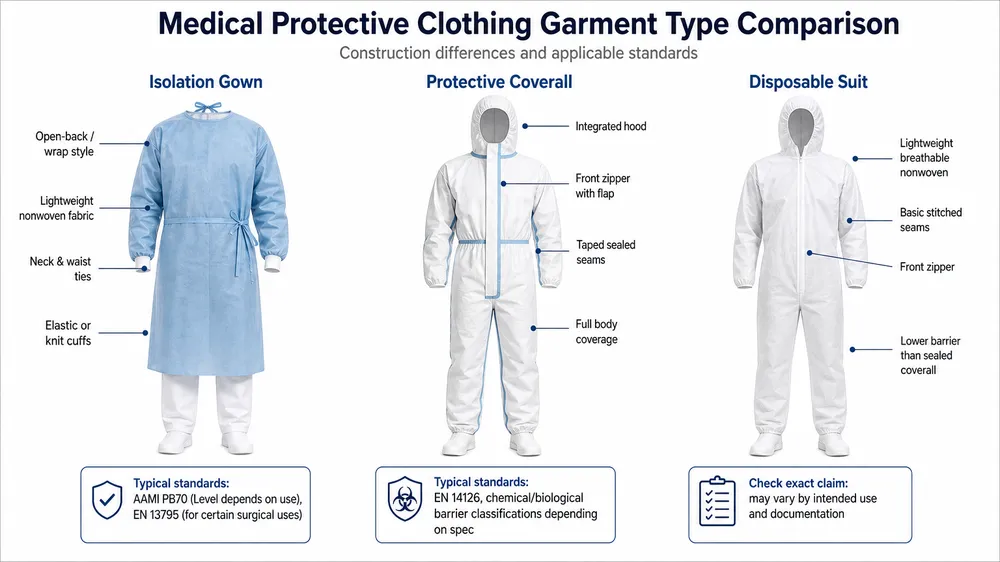
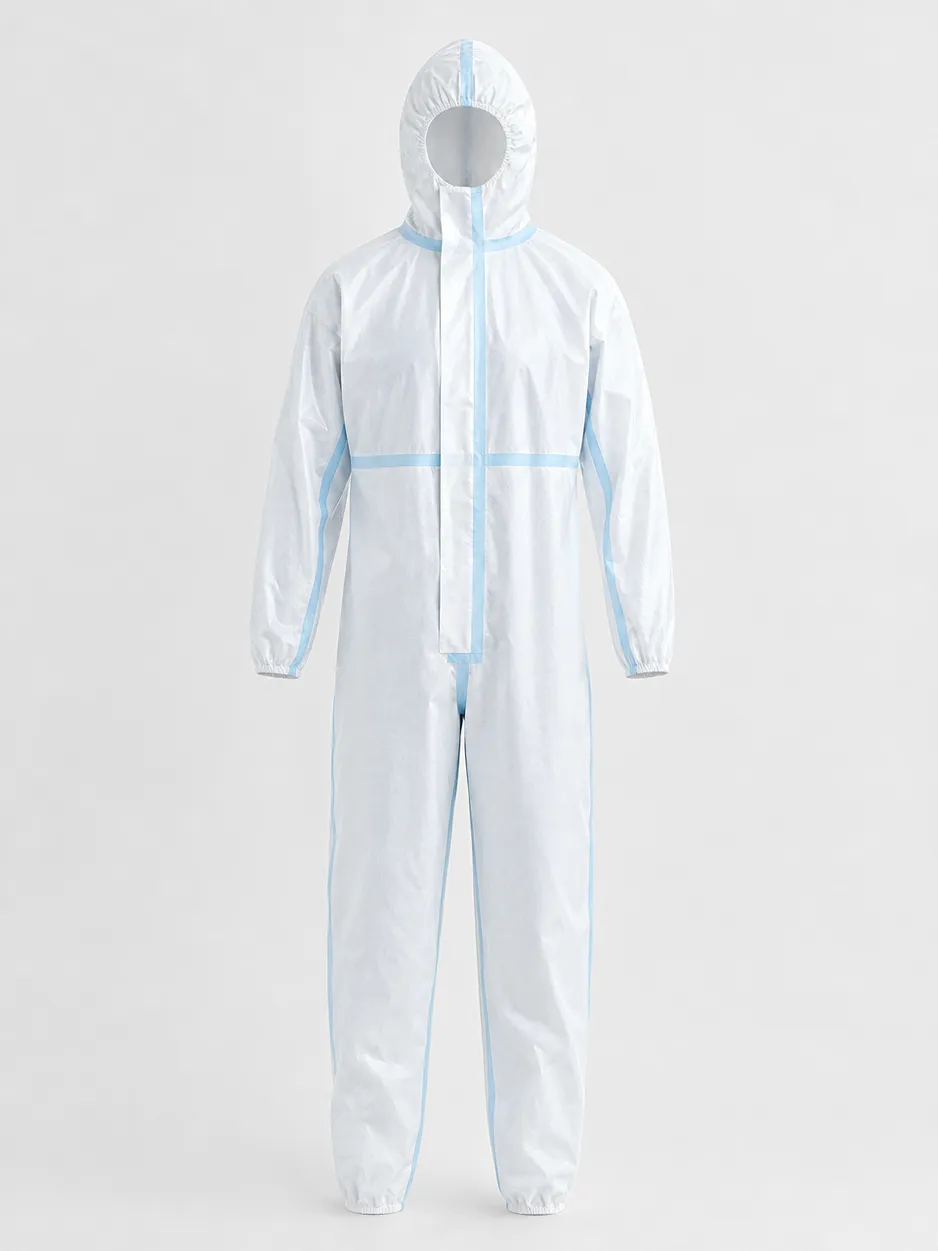
Seam construction is where a lot of sourcing errors happen. A Type 5 garment with stitched seams will fail the inward leakage test — the needle holes create particle pathways. Type 5 certification requires either taped seams (a heat-sealed tape bonded over the stitch line) or ultrasonically welded seams. Type 6 garments can pass with stitched seams because the test is spray penetration through fabric, not aerosol inward leakage through the full garment system.
For more detail on how seam construction affects barrier performance and certification outcomes, see our article on seam sealing in protective coveralls.
The Sourcing Trap: What Buyers Get Wrong at RFQ Stage
The most common documentation gap we see in import shipments is a CE mark without the underlying test report. A CE mark on a Type 5 coverall means the manufacturer has declared conformity to EN 13982-1 — but the declaration is only as good as the test behind it. For EU market entry, you need the Declaration of Conformity (DoC) and, for PPE Category III products (which Type 5 is), a notified body certificate. Type 6 is Category II PPE, which requires notified body involvement for type examination but has a slightly different documentation path.
What to request at RFQ stage:
- EN 13982-1 test report (for Type 5) or EN 13034 test report (for Type 6) from an accredited laboratory
- EU Declaration of Conformity referencing the specific standard
- Notified body certificate number and issuing body name
- Fabric composition and gsm specification
- Seam construction method (stitched, taped, or ultrasonically welded)
- Lot traceability documentation if you're buying for tender or government supply
For FDA-registered markets, the classification path is different. Protective coveralls used in healthcare settings in the US are typically regulated as Class II medical devices under 21 CFR Part 880 if they carry fluid resistance claims. If your buyer is a US hospital system, confirm whether the product needs 510(k) clearance or falls under a general wellness or non-device classification — this affects what documentation you need to clear customs and pass procurement audits.
We manufacture under ISO 13485:2016 and hold CE under EU MDR and FDA 510(k) registration, which means our Medical Protective Coverall products carry the documentation stack that healthcare procurement teams need — not just a CE mark on a label.
OEM and Private-Label Sourcing: What Distributors Need to Know
If you're building a private-label PPE line or entering a new market with your own brand, the type classification affects more than the product spec — it affects your certification obligations.
For Type 5 (Category III PPE), the EU requires that the manufacturer's quality system be audited by a notified body under Module D or Module C2 of the PPE Regulation (EU) 2016/425. You cannot self-certify a Type 5 coverall. This means your OEM supplier needs an active notified body relationship, and you need to verify that the certificate covers the specific product you're ordering, not just a generic product family.
For Type 6 (Category II PPE), the path is simpler — type examination by a notified body, then the manufacturer can self-declare conformity for production. But the test report still needs to be product-specific, not a generic fabric test.
Our in-house nonwoven production gives us flexibility that most coverall suppliers don't have. We can adjust fabric weight, barrier treatment, and laminate configuration to hit a specific protection level — useful when you're building a product line that needs to span both Type 5 and Type 6 SKUs without sourcing from two different factories. MOQ starts at 50,000 pieces for standard configurations, which is workable for distributors doing trial orders in a new market.
(One thing worth knowing: if you're entering the Middle East or Southeast Asian markets, local regulatory bodies often accept CE certification as a baseline but may require additional local registration. We've handled export documentation for these markets before and can advise on what's typically needed.)
For a broader view of our Medical Protective Clothing range and how coveralls fit into a full PPE sourcing program, the category page covers the full product scope.
Regulatory and Procurement Checklist
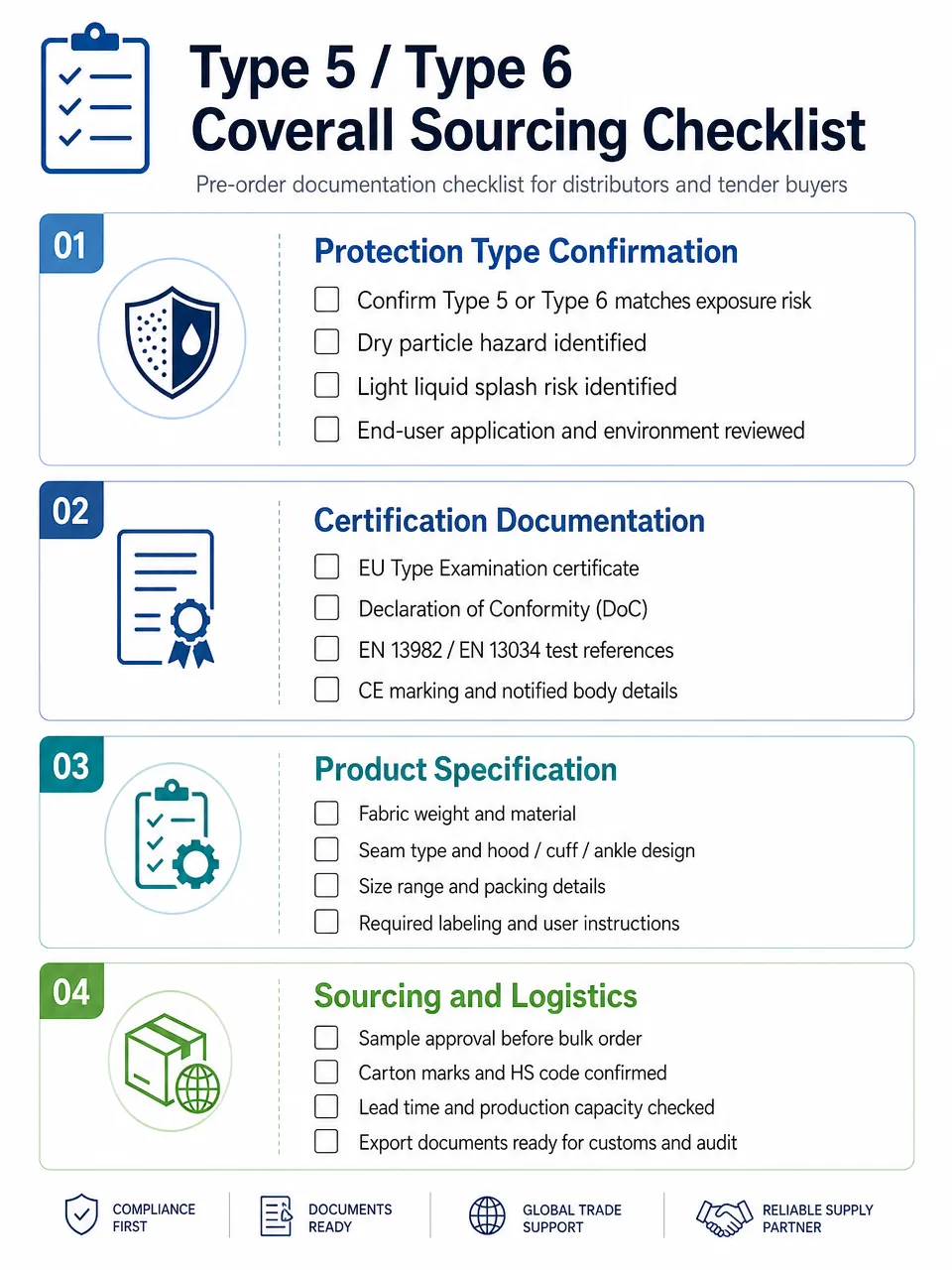
Before finalizing a coverall specification for tender or import, run through this:
Protection type confirmation
- [ ] Hazard identified: dry particles (→ Type 5) or liquid splash (→ Type 6)?
- [ ] Dual certification needed (Type 5/6)? If yes, both test reports required.
Certification documentation
- [ ] EN 13982-1 or EN 13034 test report from accredited lab
- [ ] EU Declaration of Conformity (product-specific, not generic)
- [ ] Notified body certificate (mandatory for Type 5; required for type examination on Type 6)
- [ ] ISO 13485 certificate from manufacturer (required for medical-grade positioning)
Product specification
- [ ] Fabric composition and gsm confirmed
- [ ] Seam construction method confirmed (taped/welded for Type 5)
- [ ] Closure type (zipper with storm flap, elastic cuffs, boot covers)
- [ ] Sizing range available for your market
Sourcing and logistics
- [ ] MOQ confirmed against your order volume
- [ ] Lead time confirmed for your tender deadline
- [ ] OEM/private-label packaging available if needed
- [ ] Lot traceability documentation available for institutional buyers
Frequently Asked Questions
Can a Type 6 coverall be used in pharmaceutical manufacturing?
No. Pharmaceutical manufacturing environments with API handling or powder exposure require Type 5 minimum — the hazard is fine dry particles, and Type 6 is not tested or certified for particle exclusion. Using Type 6 in this environment creates both a compliance gap and a real exposure risk. If your buyer is a pharma facility, confirm the hazard classification in their facility risk assessment before specifying.
What is the difference between Type 5/6 dual certification and a Type 5 coverall?
A Type 5/6 dual-certified coverall has passed both EN 13982-1 (particle inward leakage) and EN 13034 (liquid splash penetration) independently. A Type 5-only coverall has only been tested against EN 13982-1 — it may or may not repel liquid splash depending on the fabric, but it carries no certified liquid protection claim. For environments with both particle and splash hazards, dual certification is the correct specification.
Does ISO 13485 certification on the manufacturer matter for coverall sourcing?
It matters significantly for healthcare procurement. ISO 13485 is the quality management standard for medical device manufacturers — it governs design control, production traceability, and post-market surveillance. A coverall manufacturer with ISO 13485 certification has a documented quality system that healthcare procurement auditors recognize. For industrial PPE buyers, it's less critical, but it signals a higher baseline of process control than a standard ISO 9001 facility.
What seam type should I specify for Type 5 coveralls?
Taped seams or ultrasonically welded seams. Stitched seams create needle holes that allow fine particle penetration and will fail the EN 13982-1 inward leakage test. When reviewing a supplier's Type 5 product, ask specifically about seam construction — some suppliers use stitched seams with a tape overlay that only partially covers the stitch line, which may not provide full protection at the seam interface.
What MOQ is realistic for a trial order of Type 5 or Type 6 coveralls?
50,000 pieces is our standard MOQ for both types in standard configurations. For distributors entering a new market or testing a new SKU, this is a workable trial volume — it's enough to run a meaningful market test without committing to a full container. Custom configurations (non-standard sizing, private-label packaging, modified closure design) may require higher minimums depending on the production run economics.
How do I verify that a supplier's Type 5 certification is current and product-specific?
Request the notified body certificate number and check it directly against the notified body's public registry. EU notified bodies are listed in the NANDO database (New Approach Notified and Designated Organisations). The certificate should reference the specific product model, not just a product category. Also confirm the certificate expiry date — EN 13982-1 certifications require periodic renewal, and an expired certificate means the product is no longer legally CE-marked as Type 5.
If you're sourcing Medical Protective Clothing for a specific application and need to confirm the right type classification, documentation stack, or OEM configuration, Request Quote with your target application, required protection type, order volume, and destination market — we'll confirm the spec and send back a detailed quote with the relevant certification documentation.