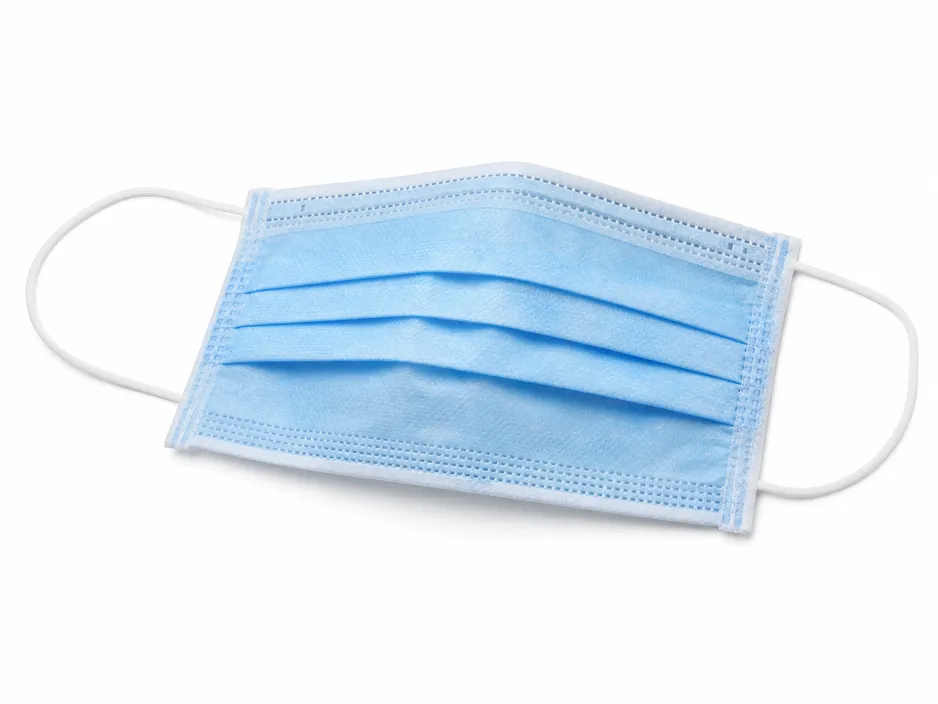
The question lands in my inbox constantly, and it's almost never as simple as it sounds. A distributor building a hospital supply program asks whether to stock surgical masks or N95s. A government tender specifies "medical-grade respiratory protection" without clarifying which standard. A private-label buyer wants to launch both SKUs but doesn't understand why the documentation packages look so different at customs.
The confusion is understandable. Both products cover the face. Both carry medical certifications. Both get called "masks" in casual conversation. But from a procurement standpoint, they are fundamentally different products — different regulatory pathways, different performance standards, different cost structures, and different supply chain risks. Ordering the wrong one doesn't just waste budget. It can fail a compliance audit, get rejected at the hospital procurement gate, or leave your end users with inadequate protection for their actual exposure level.
Here's the short verdict before we get into the detail: surgical masks are the right call for fluid-barrier protection in standard clinical environments, and N95 respirators are the right call when airborne particulate filtration is the primary requirement. The decision hinges on what your downstream buyers are actually protecting against — and what regulatory documentation their market requires. Everything below is the evidence behind that verdict.

What Each Product Is Actually Tested For
Before the procurement decision, the performance standards need to be clear — not as textbook definitions, but as the specific test parameters that determine whether your product clears customs and passes hospital procurement review.
A surgical mask is tested under ASTM F2100 (US) or EN 14683 (EU). The core performance parameters are:
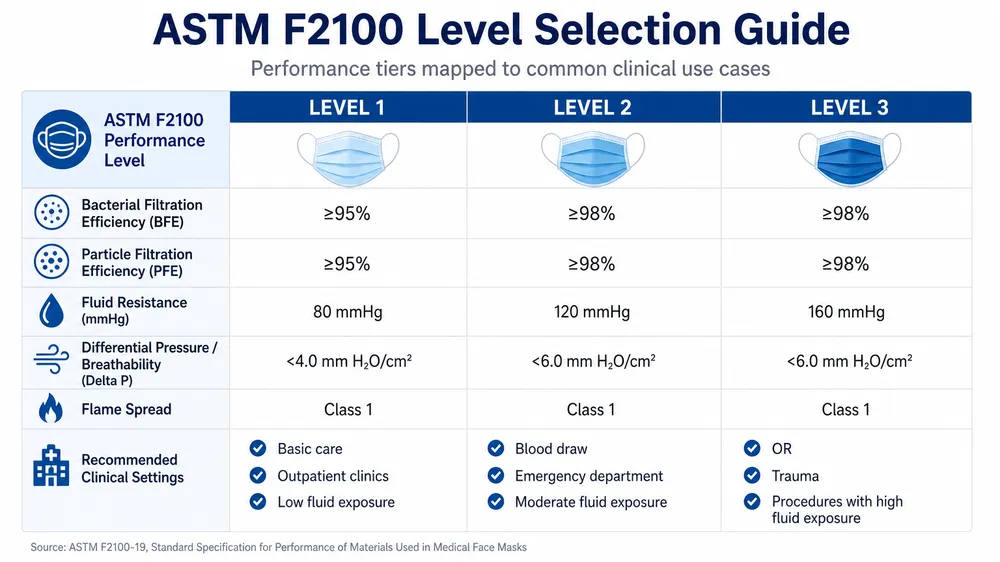
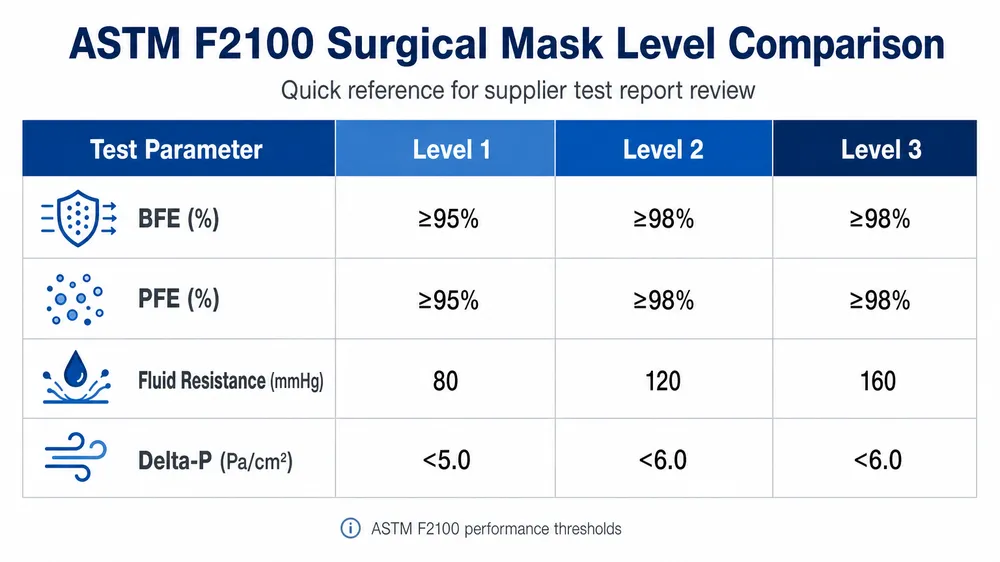
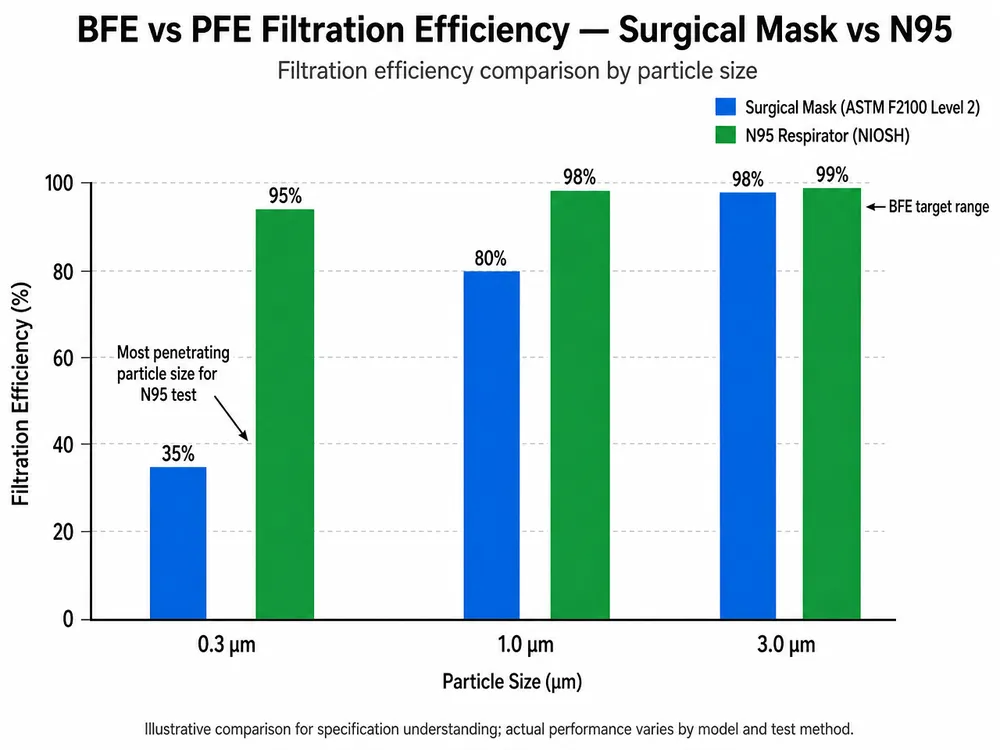
- BFE (Bacterial Filtration Efficiency): measures how effectively the mask filters bacteria-sized particles (3.0 µm mean particle size). ASTM F2100 Level 1 requires ≥95% BFE; Level 2 and Level 3 require ≥98%.
- Delta-P (Differential Pressure / Breathability): measures airflow resistance across the mask. Lower is more breathable. ASTM F2100 Level 1 allows up to 4.0 mm H₂O/cm²; Level 2 and 3 tighten to ≤5.0 mm H₂O/cm² with higher filtration requirements.
- Fluid Resistance: measures resistance to synthetic blood splash at defined pressures — 80 mmHg for Level 1, 120 mmHg for Level 2, 160 mmHg for Level 3.
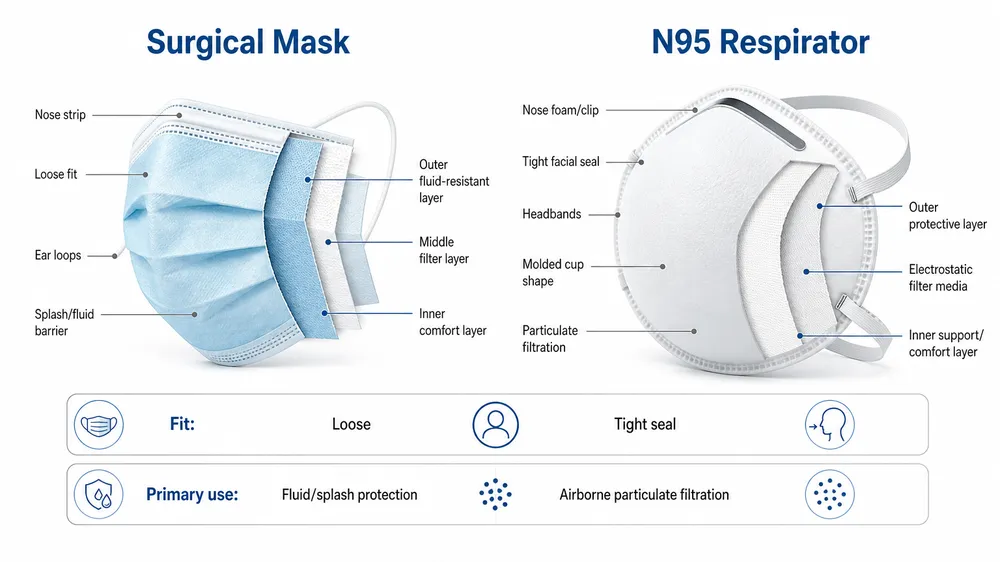
A surgical mask is a fluid barrier device. It protects the patient from the wearer's respiratory droplets, and it protects the wearer from blood and fluid splash. It does not form a tight seal against the face, and it is not designed to filter fine airborne particles.
An N95 respirator is tested under NIOSH 42 CFR Part 84 (US) or equivalent standards (EN 149 FFP2/FFP3 in the EU). The core performance parameter is:
- PFE (Particulate Filtration Efficiency): ≥95% filtration of 0.3 µm NaCl aerosol particles — the hardest particle size to filter. This is the "95" in N95.
- Fit: N95 respirators are designed to form a tight seal against the face. The filtration spec is meaningless without the seal — a poorly fitted N95 performs no better than a surgical mask in practice.
- Breathability: N95s have higher airflow resistance than surgical masks by design. The tight filtration media and face seal create more resistance, which is why extended wear in high-activity settings requires careful selection.
(One thing that trips up a lot of buyers: an N95 respirator can also carry a surgical mask designation — "N95 Surgical Respirator" — if it additionally meets ASTM F2100 fluid resistance requirements. These are the products used in surgical suites where both particulate filtration and fluid barrier protection are needed. They require both NIOSH approval and FDA 510(k) clearance. We produce both configurations.)
Head-to-Head Specification Matrix
| Parameter | Surgical Mask (ASTM F2100 L2) | N95 Respirator (NIOSH) |
|---|---|---|
| Primary Standard | ASTM F2100 / EN 14683 | NIOSH 42 CFR Part 84 / EN 149 |
| Filtration Target | Bacteria / droplets (≥3.0 µm) | Fine particles (≥0.3 µm NaCl) |
| BFE Requirement | ≥98% (Level 2/3) | Not the primary metric |
| PFE Requirement | ≥98% (Level 2/3) | ≥95% (defining spec) |
| Fluid Resistance | ≥120 mmHg (Level 2) | Not required (unless surgical N95) |
| Delta-P (Breathability) | ≤5.0 mm H₂O/cm² | Higher resistance by design |
| Face Fit | Loose — no seal | Tight seal required |
| US Regulatory Clearance | FDA 510(k) | NIOSH Approval |
| EU Regulatory Clearance | CE (EU MDR) | CE (EN 149 / PPE Regulation) |
| Typical Unit Cost | Lower | Higher (2–4× surgical mask) |
| MOQ at eztio | 50,000 pcs | 50,000 pcs |
| Standard Lead Time | 15–25 days | 15–25 days |
The Regulatory Documentation Gap That Catches Buyers Off Guard
This is the section most procurement guides skip, and it's where the real sourcing risk lives.
For surgical masks entering the US market, you need FDA 510(k) clearance. This is a premarket notification — the manufacturer demonstrates that the product is substantially equivalent to a legally marketed predicate device. The 510(k) number travels with the product and is what your customs broker and hospital procurement team will ask for. Without it, your shipment can be detained at the border or rejected by institutional buyers who run compliance checks.
For N95 respirators entering the US market, you need NIOSH approval — a separate regulatory pathway administered by the National Institute for Occupational Safety and Health, not the FDA. NIOSH approval requires the manufacturer to submit product samples and documentation for independent testing. The approval number (TC-84A-XXXX format) must appear on the respirator packaging and on the mask itself. Hospitals and healthcare systems verify NIOSH approval numbers against the NIOSH Certified Equipment List before accepting product into their supply chains.
These are two completely different regulatory bodies with two completely different approval processes. A factory that holds FDA 510(k) for surgical masks does not automatically have NIOSH approval for N95s — and vice versa. We hold both, which matters when you're building a dual-SKU program and need a single documentation package for your compliance team.
For the EU market, the split is similar but structured differently. Surgical masks fall under EU MDR (Medical Device Regulation) and require CE marking under that framework. N95-equivalent respirators (FFP2/FFP3) fall under the EU PPE Regulation (2016/425) — a different regulatory framework entirely. An EU importer sourcing both product types needs CE documentation under two separate regulations. We've walked multiple European distributors through this, and the most common mistake is assuming that CE on the surgical mask box covers the respirator too. It doesn't.
(The Middle East adds another layer: Gulf states typically require SFDA registration for Saudi Arabia, or equivalent national authority approvals for UAE and Kuwait. We've handled these documentation packages for our regional buyers — it's manageable, but it needs to be planned before the order, not after the shipment arrives.)
The Cost Structure Behind the Price Difference
N95 respirators cost more than surgical masks. The gap is real and it's structural — not a margin play by the supplier.
The meltblown filtration layer in an N95 requires tighter fiber diameter control and higher electrostatic charge density than the meltblown used in a standard surgical mask. We produce our own meltblown fabric in-house, so I can tell you exactly where the cost difference comes from: the N95 meltblown spec requires slower extrusion speeds, more precise temperature control, and higher electrostatic treatment intensity to hit ≥95% PFE at 0.3 µm. The material cost per square meter is higher, and the yield rate is lower because the tolerance window is tighter.
Add the cup-style or duckbill forming process (N95s require a 3D structure that maintains its shape under the face seal pressure), the nose clip and adjustable strap hardware, and the per-unit NIOSH testing cost amortized across the production run — and the cost structure of an N95 is genuinely different from a flat-fold surgical mask.
For procurement planning, the relevant question isn't "why does the N95 cost more?" It's "does my buyer's application actually require N95-level protection?" If the answer is yes, the cost is justified and non-negotiable. If the answer is no — if the exposure risk is droplet-based rather than fine-aerosol-based — then specifying N95s is overspending on protection the application doesn't need, and that budget gap compounds across large tender volumes.
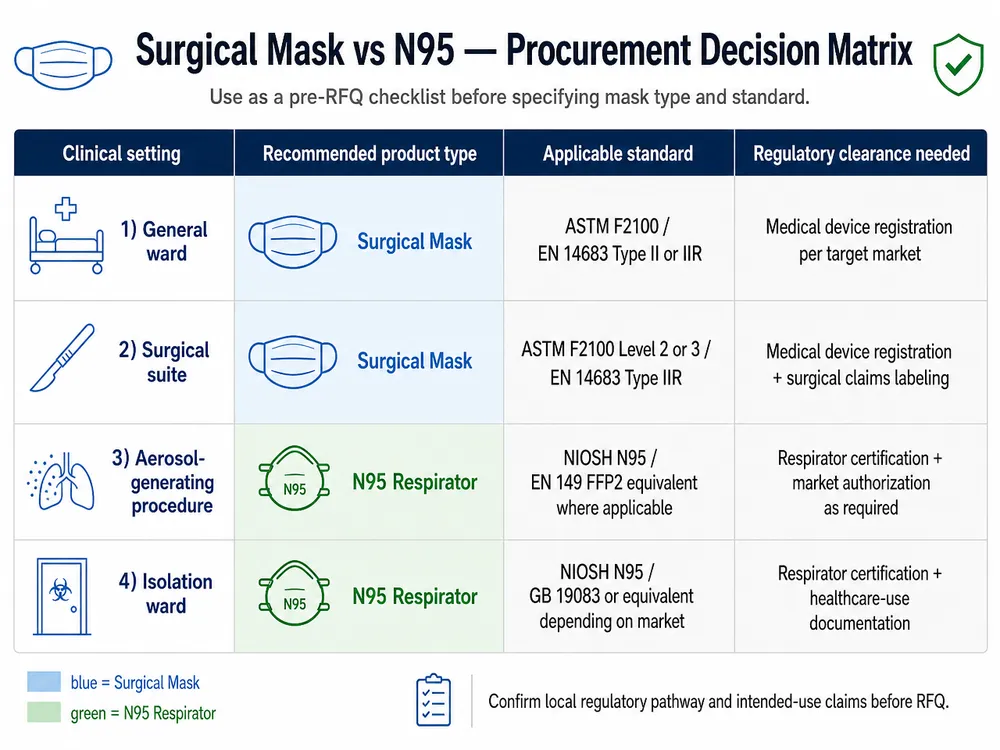
A hospital stocking 500,000 masks per quarter for general ward use doesn't need N95s for every role. Surgical masks at ASTM F2100 Level 2 cover the fluid-barrier requirement for most clinical interactions. The N95 budget is better reserved for high-risk aerosol-generating procedures, isolation wards, and respiratory therapy settings where the tight seal and fine-particle filtration actually matter.
Application Scenarios: Which Product Wins and Why
General Clinical and Surgical Environments
Winner: Surgical Mask (ASTM F2100 Level 2 or Level 3)
Standard surgical and clinical settings — operating rooms, outpatient clinics, general wards, dental practices — require fluid barrier protection. The primary risk is blood and fluid splash, not fine airborne aerosols. ASTM F2100 Level 2 (≥98% BFE, ≥120 mmHg fluid resistance) covers this application. Level 3 adds higher fluid resistance (≥160 mmHg) for high-splash procedures.
N95s in this setting add cost without adding relevant protection. The tight face seal also increases wearer fatigue during extended procedures — a practical issue that affects compliance. For a distributor supplying hospital systems with general clinical stock, surgical masks are the right SKU and the right margin structure.
Aerosol-Generating Procedures and Isolation Wards
Winner: N95 Respirator (NIOSH-approved)
Intubation, bronchoscopy, nebulizer treatment, and other aerosol-generating procedures create fine-particle exposure that surgical masks are not designed to filter. Isolation wards for airborne-transmitted pathogens (tuberculosis, measles, and similar) require the tight seal and ≥95% PFE that only an N95 provides. Hospital infection control protocols in the US and EU explicitly specify NIOSH-approved N95s (or FFP2/FFP3 equivalents) for these settings.
For distributors supplying ICUs, respiratory therapy departments, or infectious disease units, N95s are non-negotiable. The regulatory and clinical requirement is clear, and substituting surgical masks creates liability exposure for the distributor.
Government and Institutional Tenders
Winner: Depends on tender specification — verify before quoting
Government tenders are where the most procurement errors happen. Tender documents often use "medical mask" and "respirator" interchangeably, or specify a standard without clarifying the level. We've seen tenders that list "N95 or equivalent" where the actual clinical use case would be fully covered by ASTM F2100 Level 2 surgical masks — and the buyer is paying N95 prices for surgical mask applications.
Before quoting a government tender, verify: (1) the specific standard cited, (2) the intended use environment, and (3) whether the tender authority will accept a compliant alternative with equivalent or superior specs. A well-documented surgical mask at ASTM F2100 Level 3 with FDA 510(k) and CE MDR clearance can satisfy many tender requirements that nominally specify "high-filtration medical masks."
(We've helped several distributors navigate tender spec clarification requests. If you're unsure whether a tender spec maps to surgical mask or N95, send us the tender document — we'll tell you which product fits and what documentation package you'll need.)
Private-Label Healthcare Brand Launch
Winner: Both — dual-SKU from a single certified supplier
Private-label buyers launching a healthcare mask brand typically need both SKUs to cover the full clinical market. The sourcing risk in this scenario is splitting the two products across two factories — different meltblown quality standards, different QC documentation formats, different lead time reliability. When a compliance issue surfaces on one SKU, tracing it back through two separate supply chains is expensive and slow.
We manufacture both surgical masks and N95 respirators under one roof, with the same in-house meltblown production, the same Class 100,000 cleanroom, and the same in-house BFE/PFE/Delta-P lab. Your private-label program gets consistent spec documentation across both SKUs, and your compliance team deals with one factory's quality system instead of two.
Why Meltblown Quality Is the Hidden Variable in N95 Sourcing
Most procurement teams evaluate N95 suppliers on price, lead time, and certification documents. The variable that actually determines whether the product performs is the meltblown fabric — and it's the one you can't see on the spec sheet.
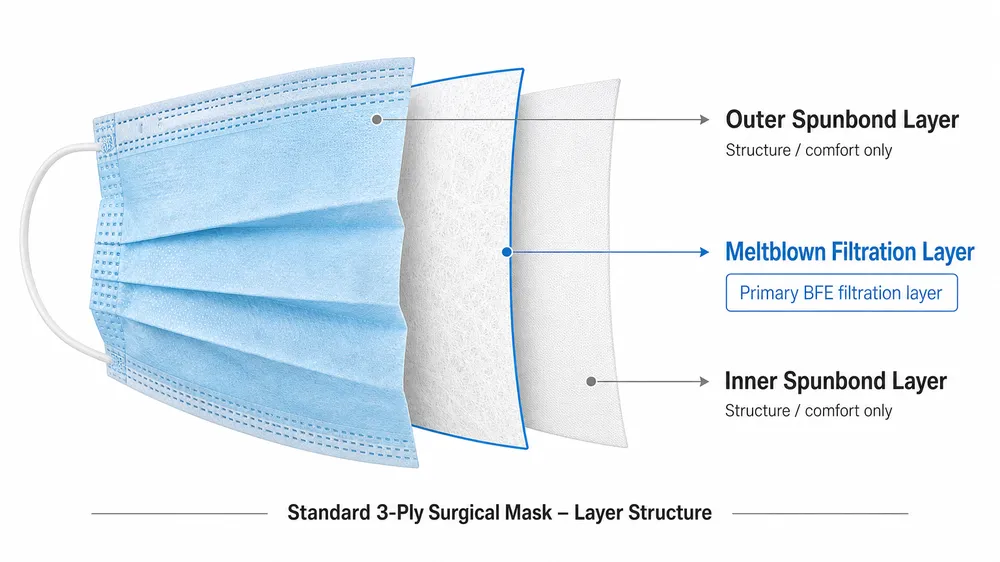
Meltblown nonwoven fabric is the middle filtration layer in both surgical masks and N95 respirators. In a surgical mask, the meltblown layer needs to achieve ≥95–98% BFE at 3.0 µm particle size. In an N95, it needs to achieve ≥95% PFE at 0.3 µm — a significantly harder filtration target that requires tighter fiber diameter control (typically 1–4 µm fiber diameter) and consistent electrostatic charge across the entire roll width.
The problem in the market is that most mask factories buy meltblown from external suppliers. During normal supply conditions, this works adequately. During supply disruptions — and we've seen several significant ones since 2020 — external meltblown suppliers either run out of capacity or reduce quality controls to meet volume demand. Factories that depend on purchased meltblown either stop shipping or ship product that passes visual inspection but fails BFE/PFE testing. The failure doesn't show up until the product reaches a lab — which, for many buyers, means it shows up at the hospital procurement audit or the customs inspection.
We brought meltblown production in-house specifically to control this variable. Our meltblown line produces fabric to a defined spec: fiber diameter, basis weight, and electrostatic charge level are set for each product type and verified by batch testing before the fabric enters the mask production line. When you order N95 respirators from us, the meltblown in those masks was produced in our facility, tested in our lab, and matched to the filtration spec before production started. We're not hoping the roll we received from a supplier meets the spec — we know it does because we made it and tested it.
For buyers placing large N95 orders — 500,000 pieces and above — this is the sourcing question worth asking every supplier: do you produce your own meltblown, or do you buy it? The answer tells you more about supply chain risk than any certification document.
Regulatory Clearance Checklist Before You Place the Order
Before finalizing an order for either product type, verify these documentation items with your supplier:
For Surgical Masks:
- [ ] FDA 510(k) clearance number (US market)
- [ ] CE certificate under EU MDR with notified body number (EU market)
- [ ] ASTM F2100 level specified (Level 1, 2, or 3) with corresponding test report
- [ ] BFE, PFE, Delta-P, and fluid resistance test reports from accredited third-party lab
- [ ] EN 14683 Type IIR test report if EU market requires it
For N95 Respirators:
- [ ] NIOSH approval number (TC-84A-XXXX format) — verify against NIOSH Certified Equipment List
- [ ] FDA 510(k) clearance if surgical N95 designation is required
- [ ] CE certificate under EN 149 / PPE Regulation 2016/425 (EU market)
- [ ] PFE test report at 0.3 µm NaCl aerosol
- [ ] Fit test data or fit test protocol documentation if required by institutional buyer
For both product types, request:
- [ ] ISO 13485:2016 certificate (quality management system for medical devices)
- [ ] Certificate of conformity for the specific order
- [ ] Packing list and carton marking samples before shipment
(We prepare this full documentation package as standard for every order. If your compliance team or customs broker has specific format requirements, tell us before production starts — it's easier to configure the documentation correctly upfront than to reissue documents after the shipment has left.)
Sourcing Both from One Factory: The Compliance Efficiency Argument
The practical argument for dual-sourcing surgical masks and N95 respirators from a single certified manufacturer isn't about convenience — it's about compliance risk management.
When you source from two factories, you have two quality systems, two documentation formats, two audit histories, and two sets of batch records to manage. If a compliance issue surfaces — a BFE test failure, a packaging labeling error, a customs hold — you're running two parallel investigations with two different factories. The time cost of that process is significant, and the reputational risk to your brand or distribution program is real.
When both SKUs come from one factory with a unified quality system, the compliance picture is simpler. One ISO 13485 certificate covers both product lines. One set of test reports follows the same format and references the same lab. One factory contact handles documentation requests for both SKUs. For distributors managing hospital supply programs or private-label brands across multiple markets, that consolidation has direct value in reduced compliance overhead.
Our Surgical Medical Masks and N95 Surgical Medical Mask lines run in the same Class 100,000 cleanroom, use the same in-house meltblown production, and go through the same in-house BFE/PFE/Delta-P lab before shipment. The FDA 510(k) and CE (EU MDR) certifications cover both product types. If you're building a dual-SKU program for the US or EU market, the documentation package is already in place.
Frequently Asked Questions
Can a surgical mask substitute for an N95 in aerosol-generating procedure settings?
No. Surgical masks are not designed to form a tight face seal, and they are not tested for fine-particle filtration at 0.3 µm. In aerosol-generating procedure settings — intubation, bronchoscopy, nebulizer treatment — the exposure risk requires the tight seal and ≥95% PFE that only a NIOSH-approved N95 (or FFP2/FFP3 equivalent) provides. Hospital infection control protocols and OSHA respiratory protection standards are explicit on this point. Substituting a surgical mask in these settings creates clinical risk and regulatory liability.
What is the difference between FDA 510(k) and NIOSH approval for masks?
FDA 510(k) is a premarket clearance for medical devices, administered by the Food and Drug Administration. It applies to surgical masks and surgical N95 respirators. NIOSH approval is a separate certification for respiratory protective equipment, administered by the National Institute for Occupational Safety and Health under CDC. Standard N95 respirators (non-surgical) require NIOSH approval but not FDA 510(k). Surgical N95 respirators require both. These are different regulatory bodies with different approval processes — a factory holding one does not automatically hold the other.
What ASTM F2100 level should I specify for hospital procurement?
For general clinical use (outpatient, general ward, dental), ASTM F2100 Level 1 (≥95% BFE, 80 mmHg fluid resistance) is the minimum. For surgical environments with moderate fluid exposure, Level 2 (≥98% BFE, 120 mmHg) is the standard specification. For high-splash surgical procedures, Level 3 (≥98% BFE, 160 mmHg) is appropriate. Most hospital procurement standards specify Level 2 as the baseline for surgical masks. If the tender or procurement spec doesn't specify a level, ask — the level determines the test requirements and the documentation package.
What is the minimum order quantity for N95 respirators?
Our standard MOQ for N95 respirators is 50,000 pieces on existing SKUs. This is the same MOQ as our surgical mask line, which makes trial orders viable before committing to large tender volumes. Custom configurations — modified cup geometry, different strap systems, private-label packaging — typically require higher minimums to justify line setup. We'll confirm the MOQ for your specific configuration before you approve samples.
How do I verify that an N95 supplier's meltblown quality is consistent across large orders?
Request batch-level BFE/PFE test reports, not just a single certification document. A certification document shows that one sample passed testing at one point in time. Batch-level test reports show that the factory is testing every production run and that the results are consistent. Ask whether the factory produces its own meltblown or purchases it externally — in-house meltblown production is the strongest indicator of spec consistency across large orders. Ask to see the meltblown production spec and the incoming inspection records for the fabric used in your order.
Ready to specify the right product for your program? Send your requirements — mask type, target regulatory market, required certifications, and order volume — to Request Quote and we'll return a quote with the correct spec and full documentation package.