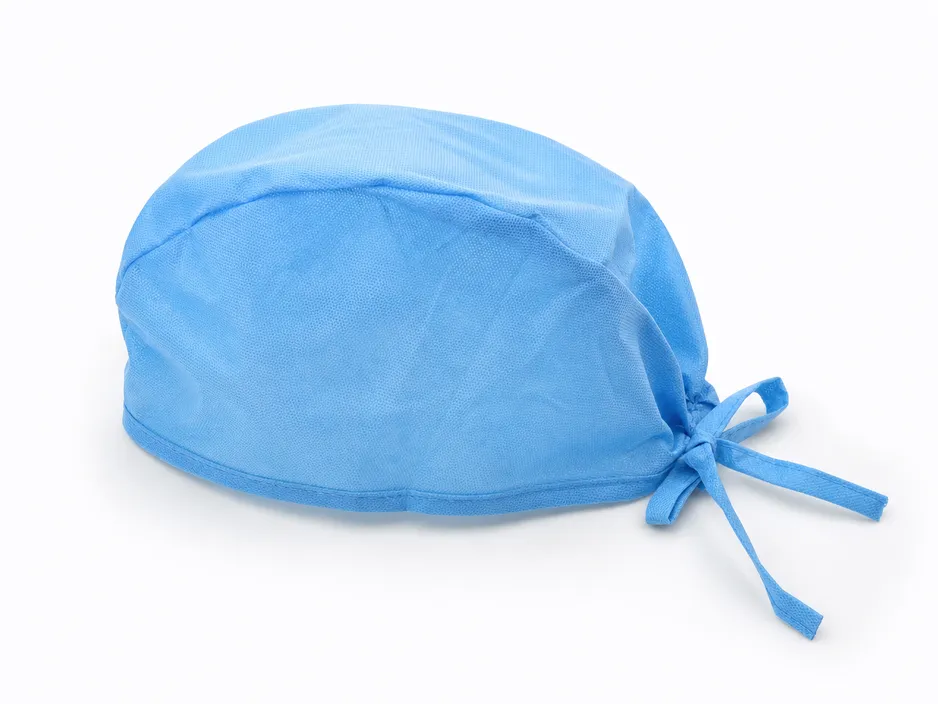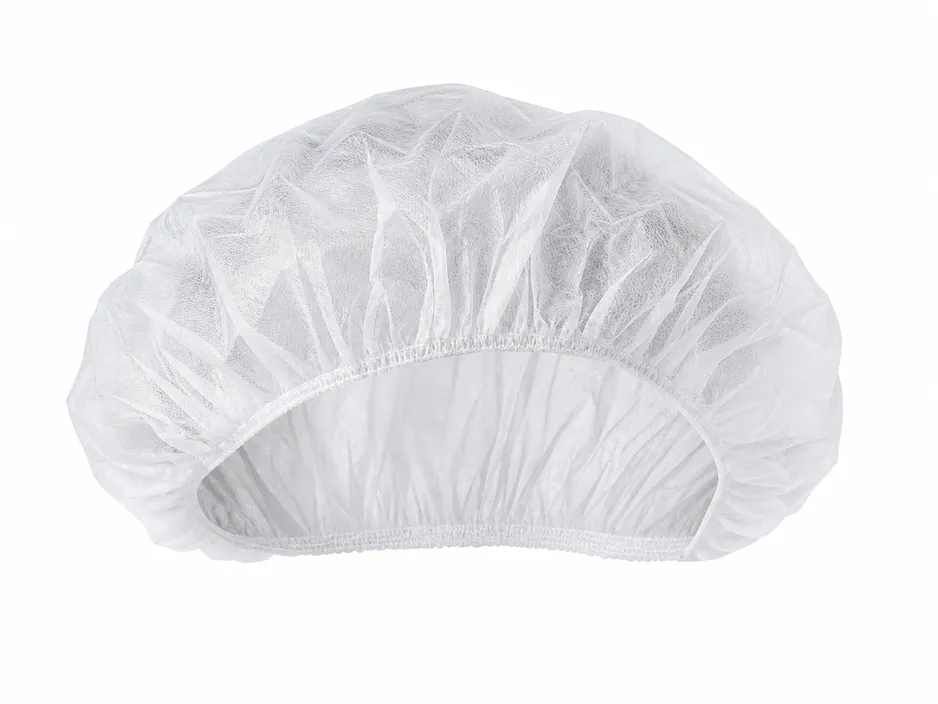
The failure mode we see most often in bouffant cap private-label programs isn't a quality problem — it's a communication problem that becomes a quality problem at scale. A buyer approves a sample, places a 100,000-piece order, and receives caps where the elastic is 2mm narrower than the sample, the nonwoven GSM has drifted down by 4–5 grams, and the print registration on the polybag is off enough to look like a different product. None of these changes were intentional. The supplier didn't swap materials to cut costs. What happened is that the sample was made from a different fabric roll than the production run, the elastic came from a secondary vendor when the primary was out of stock, and nobody locked the spec in writing before production started.
That's the real cost of skipping the setup work: not a catastrophic failure, but a slow erosion of the product you thought you were buying. Your downstream customers notice. Your reorder looks different from your initial stock. And when you go back to the supplier, there's nothing in writing to enforce.
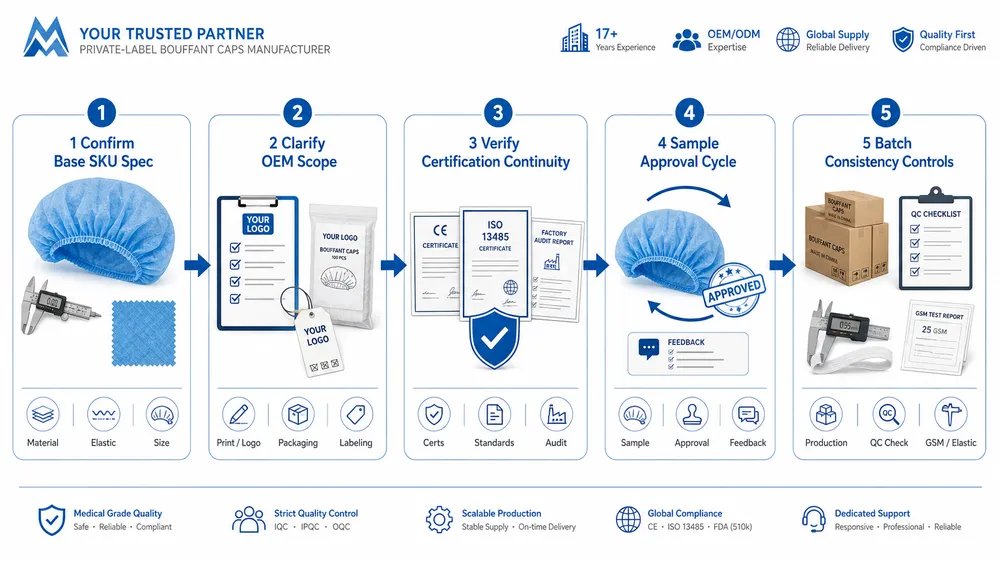
This guide walks through the five steps that prevent that outcome — from confirming your base SKU spec before you send artwork, through locking batch-to-batch consistency controls before your first full production run.

Step 1 — Confirm the base SKU spec before you send artwork
Most buyers start a private-label program by sending a logo file. That's the wrong starting point. Before artwork, you need a written spec sheet that defines the physical product — because once production starts, the spec sheet is the only document that gives you grounds to reject non-conforming product.
For a Bouffant Medical Cap, the spec sheet should cover:
| Parameter | What to specify | Why it matters |
|---|---|---|
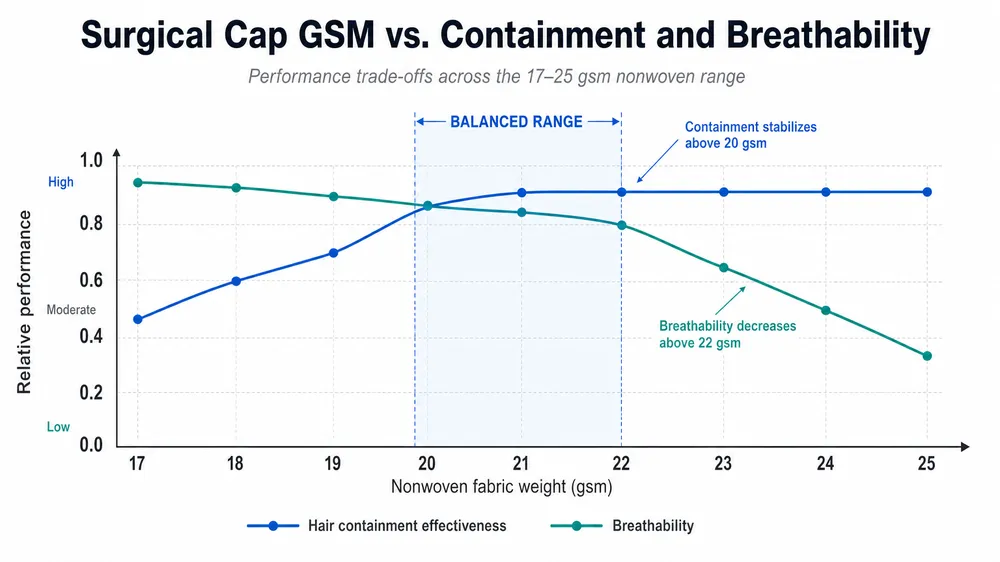
| Nonwoven GSM | e.g., 20 gsm, 25 gsm, 30 gsm | Determines cap weight, drape, and hair-containment performance |
| Nonwoven type | Spunbond PP, SMS, or PE-coated | Affects breathability, fluid resistance, and feel |
| Cap diameter | e.g., 21 inches (53 cm) | Determines fit range — one size does not fit all head circumferences |
| Elastic type | Flat elastic vs. round cord | Flat elastic distributes pressure more evenly; round cord is lower cost |
| Elastic width | e.g., 6mm, 8mm | Narrower elastic is cheaper but marks the skin on long wear |
| Elastic tensile spec | e.g., minimum 15N break force | Prevents elastic failure during donning |
| Color | White, blue, green, or custom | Custom colors require minimum run quantities |
| Packaging | Individual polybag, bulk box, or retail box | Affects per-unit cost and shelf presentation |
We run our standard bouffant caps at 20 gsm and 25 gsm spunbond PP. The 20 gsm is the volume SKU — it's what most hospital supply buyers specify for general clinical use. The 25 gsm is what we recommend when your downstream channel is surgical or OR environments where the cap needs to hold its shape through a full shift. (We've had buyers try to save cost by dropping to 18 gsm. The caps look fine in the box. They don't hold their shape on the head after 30 minutes, and the returns come back fast.)
For bouffant cap sizing and elastic spec guidance in more detail, that post covers the fit failure mechanisms and how to match elastic configuration to your target head circumference range.
Red flag: If a supplier quotes you a price without asking for your GSM and elastic spec, they're quoting their default configuration — which may or may not match what you need. Get the spec confirmed in writing before you accept any price.
Step 2 — Clarify OEM scope: artwork-only vs. modified configuration
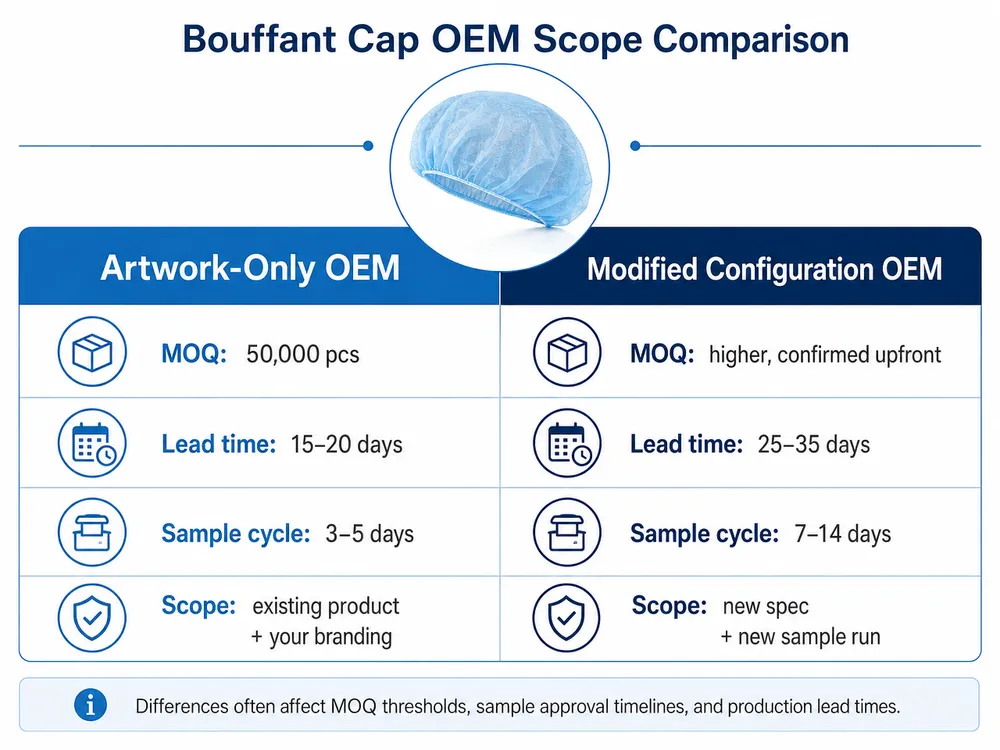
"Private label" covers a wide range of actual work, and the scope determines your MOQ, your lead time, and your sample approval timeline. There are two distinct tracks:
Artwork-only OEM means your brand goes on the supplier's existing product — same cap, same spec, your logo on the polybag and outer carton. This is the fastest and lowest-MOQ path. At eztio, artwork-only OEM on standard bouffant cap SKUs starts at 50,000 pieces. Lead time from artwork approval to shipment runs 15–20 days on standard configurations.
Modified configuration OEM means you're changing something about the product itself — different GSM, different elastic width, different cap diameter, added features like a tie-back or a colored elastic. This requires a new sample run, a longer approval cycle, and typically a higher MOQ to justify the line setup and material procurement. We'll tell you the MOQ upfront for any modified configuration — it's not a number we hold back until after you've approved samples.
The practical question to ask your supplier: "Is this cap in your current production lineup, or does it require a new setup?" If it's a new setup, ask for the MOQ in writing before you invest time in sample approval.
One thing worth knowing about artwork-only OEM: the packaging spec matters as much as the cap spec. Polybag dimensions, print colors (CMYK vs. Pantone), barcode placement, and language requirements (English, French, Arabic, etc.) all need to be confirmed before artwork goes to print. We've seen programs delayed by two weeks because the buyer sent artwork sized for a different polybag format than the one we run. Confirm the packaging template first, then build your artwork to fit it.
Step 3 — Verify certification continuity for your private-label SKU
This is the step most sourcing guides skip entirely, and it's the one that creates compliance problems at customs.
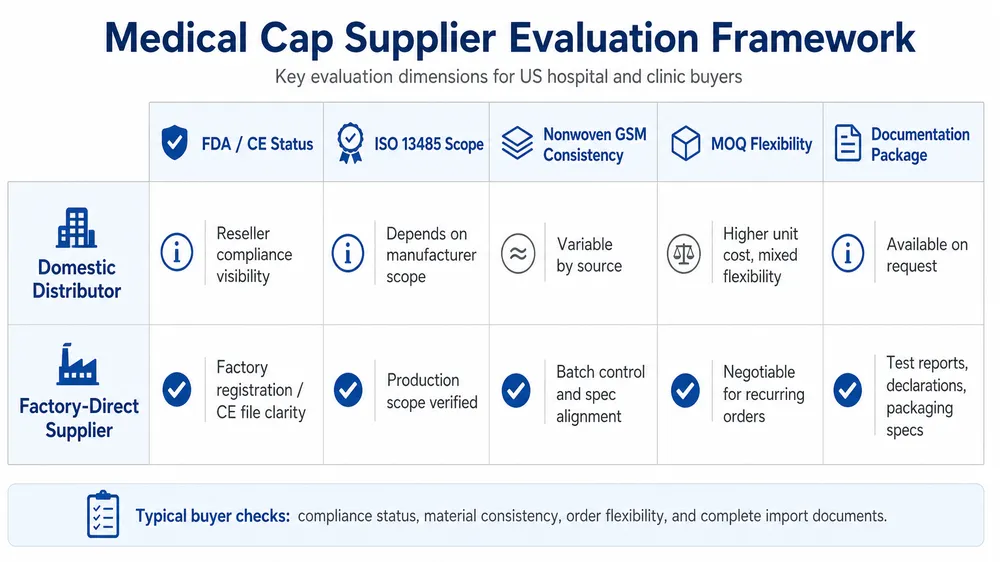
When a manufacturer holds ISO 13485:2016 and FDA 510(k) registration, those certifications cover the manufacturer's quality management system and specific product configurations. The question you need to answer before placing a private-label order is: does the manufacturer's certification cover the product as it will be sold under your brand?
For ISO 13485, the answer is generally yes — the certification covers the QMS that produces the product, not the brand name on the packaging. Your private-label SKU is produced under the same quality management system, so the ISO 13485 certificate is valid for the manufacturing process regardless of whose name is on the box.
FDA 510(k) is more specific. The 510(k) clearance is tied to the device as described in the submission — including the manufacturer's name, the product configuration, and the intended use. If you're importing a bouffant cap under your own brand into the US market, you need to understand whether you're importing as a relabeler (which has its own FDA registration requirements) or whether the product falls under a category that doesn't require 510(k) clearance for the end buyer. Most disposable bouffant caps used in non-sterile clinical environments are Class I exempt devices — they don't require 510(k) clearance for the product itself, but the manufacturer still needs to be registered with FDA as a device establishment.
eztio holds FDA 510(k) registration and ISO 13485:2016. Both cover our OEM and ODM output. When you place a private-label order with us, we can provide the certificate of conformity, the ISO 13485 certificate, and the FDA establishment registration documentation that your customs broker or compliance team needs. We've shipped private-label programs into the US, Canada, the UK, and EU markets — the documentation package is standard, not something we build from scratch for each order.
What to ask any supplier before committing:
- "Does your ISO 13485 certificate cover OEM/private-label production?"
- "Are you FDA-registered as a device establishment?"
- "What documentation do you provide with each shipment for import compliance?"
- "Can you provide a certificate of conformity naming my brand as the label holder?"
If the answers are vague or the supplier can't produce the actual certificate numbers, that's a sourcing risk you're carrying into every import.
Step 4 — Run a proper sample approval cycle
Sample approval is where most spec drift problems are either caught or locked in permanently. A sample approval cycle that's done correctly takes 7–14 days and prevents problems that would otherwise surface in a 100,000-piece production run. A sample approval cycle that's done incorrectly — or skipped — means you're approving a product you haven't actually tested.
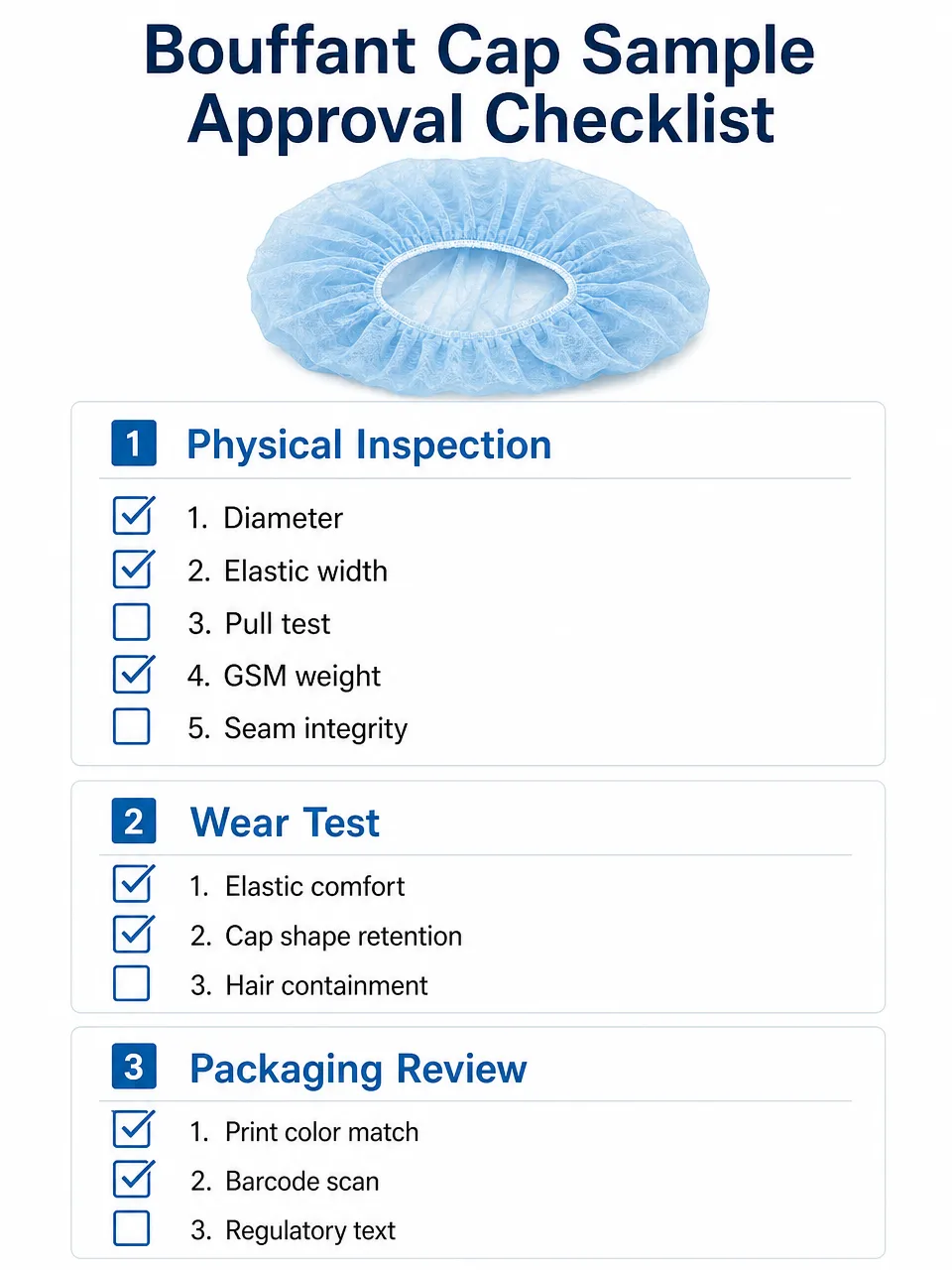
Here's what a proper sample approval cycle covers:
Physical inspection of the sample:
- Measure the cap diameter against your spec (tolerance: ±5mm is typical)
- Check elastic width with calipers — not by eye
- Pull-test the elastic attachment at the seam (the seam is the failure point, not the elastic itself)
- Weigh the cap on a gram scale and back-calculate the GSM against the stated spec
- Check the seam integrity around the full circumference — look for skipped stitches or ultrasonic weld gaps
Wear test:
- Put the cap on a head form or have someone wear it for 2–4 hours
- Check whether the elastic marks the skin (a sign the elastic is too narrow or too tight)
- Check whether the cap holds its shape or collapses at the crown (a sign the GSM is too low)
- Check whether hair escapes at the neckline (a sign the diameter is too small for your target head circumference range)
Packaging review:
- Confirm print colors match your approved artwork file (use a Pantone reference if color accuracy matters)
- Check barcode scannability
- Confirm language and regulatory text is correct for your target market
We send two sets of samples for every new private-label program: one set for physical inspection and wear testing, one set retained at our facility as the production reference standard. The retained set is what our QC team checks production output against. If there's ever a dispute about whether production matches the approved sample, we have the reference on file.
(One thing we've learned from running these programs: buyers who skip the wear test almost always come back with fit complaints after the first shipment. The cap can look perfect in the box and still be wrong for the head circumference range your customers actually have. Wear testing is not optional.)
Step 5 — Lock in batch-to-batch consistency controls
Approving a sample is a one-time event. Batch-to-batch consistency is an ongoing process. The two are not the same, and confusing them is how spec drift happens across repeat orders.
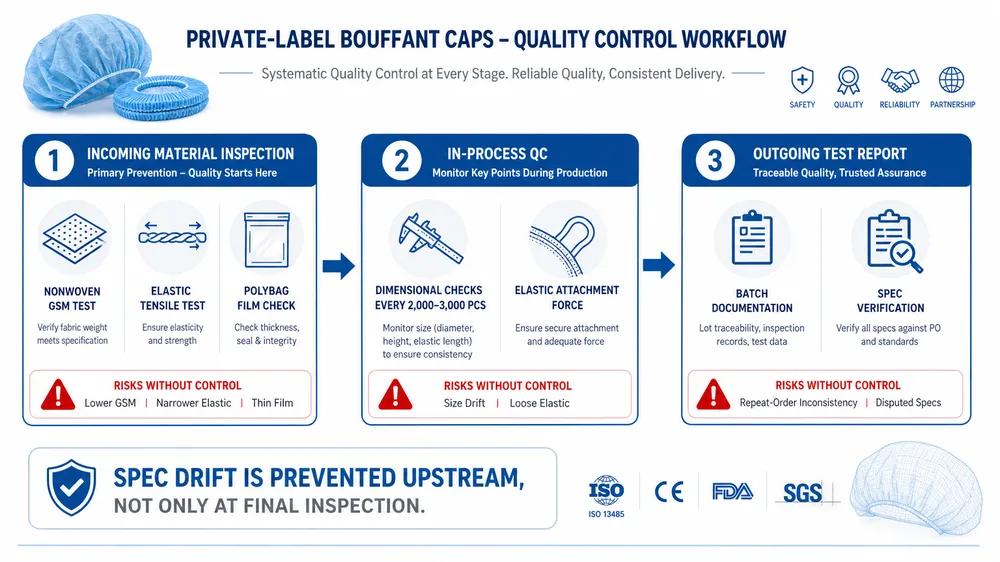
Spec drift doesn't usually happen because a supplier decides to change your product. It happens because the supplier's incoming material varies and nobody catches it before production. The elastic comes from a different lot with slightly different tensile properties. The nonwoven fabric is from a roll at the edge of the GSM tolerance range. The polybag film is from a new supplier who runs slightly thinner. None of these changes are intentional, and none of them are visible in the finished product until you're comparing your third order to your first.
The controls that prevent this are upstream, not downstream:
Incoming material inspection — Every raw material lot should be tested against spec before it enters production. For bouffant caps, the critical incoming checks are: nonwoven fabric GSM (weigh a sample from each roll), elastic tensile strength (pull-test samples from each lot), and polybag film thickness. If the incoming material is out of spec, it doesn't go into production.
In-process QC checkpoints — During production, cap dimensions and elastic attachment force should be checked at defined intervals — not just at the start of the run. A production run of 50,000 caps takes several hours. Material variation within a single roll can cause drift over the course of a run. Checking every 2,000–3,000 pieces catches this before it becomes a full-batch problem.
Outgoing test reports — Every production batch should come with a test report that documents the actual measured values: cap diameter, elastic break force, GSM (if tested), and any performance parameters relevant to your market (BFE for surgical-grade caps, for example). This report is your evidence that the batch matches the approved spec.
At eztio, incoming inspection, in-process QC, and outgoing test reports are standard for every production run — not something we add for premium orders. Our ISO 13485 QMS requires documented inspection at all three stages. The outgoing test report travels with your shipment and is part of the documentation package your customs broker receives.
For nonwoven GSM selection and how GSM affects cap performance across different clinical environments, that post covers the material science in more detail.
What to ask your supplier about batch consistency:
- "Do you test incoming nonwoven fabric GSM before production?"
- "What are your in-process QC checkpoints during a production run?"
- "Can you provide an outgoing test report for each batch?"
- "If I reorder in 6 months, how do you ensure the product matches my original approved sample?"
A supplier who can answer all four questions with specific procedures — not general assurances — is a supplier who has actually built consistency controls into their process.
Common mistakes that create MOQ surprises and spec drift
These are the patterns we see most often when buyers come to us after a bad experience with a previous supplier:
Accepting verbal MOQ commitments. A supplier tells you the MOQ is 10,000 pieces. You place the order. The invoice arrives with a line item for "small order surcharge" that effectively doubles the per-unit cost. Get the MOQ and any associated surcharges in writing before you approve samples.
Skipping sample approval to save time. The sample approval cycle feels like a delay when you're trying to get to market. It's not. It's the only point in the process where you can reject non-conforming product at zero cost. After production starts, rejection means a full-batch dispute and a delayed shipment.
Not specifying elastic width in the RFQ. Elastic width is the spec that varies most between suppliers' "standard" configurations. One supplier's standard is 6mm flat elastic; another's is 4mm round cord. Both are "standard." Neither is wrong. But they produce different products, and if you don't specify, you'll get whatever the supplier runs most often.
Assuming the sample GSM matches production GSM. Samples are often made from whatever fabric roll is open on the floor. Production uses whatever roll is scheduled. If you don't weigh the sample and document the GSM, you have no baseline to compare production against.
Not requesting batch test reports on reorders. The first order gets scrutiny. The third order gets assumed to be the same as the first. Spec drift happens on reorders, not on initial orders, because the initial order gets attention and the reorders don't. Request a test report on every batch, including reorders.
Supplier evaluation checklist for bouffant cap private-label programs
Before committing to a supplier for a private-label bouffant cap program, work through this checklist. Any "no" or "unclear" answer is a risk you're accepting.
Certification and compliance:
- [ ] ISO 13485:2016 certificate — confirm it covers OEM/private-label production
- [ ] FDA establishment registration number — verify on the FDA database
- [ ] CE marking documentation (if selling into EU markets)
- [ ] Certificate of conformity available for each shipment
Spec control:
- [ ] Supplier can provide a written spec sheet for the base SKU
- [ ] Nonwoven GSM is documented and tested at incoming inspection
- [ ] Elastic tensile spec is documented and tested at incoming inspection
- [ ] Cap diameter tolerance is specified (±5mm is typical)
OEM process:
- [ ] MOQ confirmed in writing for your specific configuration
- [ ] Sample approval process includes a retained reference sample at the factory
- [ ] Outgoing test report provided for each production batch
- [ ] Reorder process includes batch-to-batch spec verification
Supply chain:
- [ ] Nonwoven fabric source is disclosed (in-house or named supplier)
- [ ] Elastic source is disclosed (in-house or named supplier)
- [ ] Supplier has a documented procedure for material substitution notification
The last point matters more than it sounds. Material substitution — switching to a different elastic supplier when the primary is out of stock — is the most common source of spec drift. A supplier with a documented substitution notification procedure will tell you before they switch. A supplier without one will switch and hope you don't notice.
What a complete RFQ should include
When you send an RFQ to a bouffant cap supplier, the more specific your request, the more useful the response. A vague RFQ gets a vague quote — and a vague quote is where MOQ surprises come from.
A complete RFQ for a private-label bouffant cap program should include:
Product spec:
- Cap diameter (inches or cm)
- Nonwoven type and GSM
- Elastic type (flat or round) and width (mm)
- Color
- Any performance requirements (e.g., fluid-resistant, anti-static)
OEM scope:
- Artwork-only or modified configuration
- Packaging format (individual polybag, bulk box, retail box)
- Languages required on packaging
- Barcode format (UPC, EAN, etc.)
Order parameters:
- Target order quantity (initial order and expected reorder frequency)
- Target delivery port (affects freight and lead time calculation)
- Required certifications for your target market
Documentation requirements:
- Certificate of conformity
- ISO 13485 certificate
- FDA establishment registration (if importing to US)
- Outgoing test report per batch
Sending this level of detail upfront does two things: it gets you a quote that reflects your actual product, and it tells you immediately whether the supplier has the capability to deliver what you need. A supplier who can't respond to a detailed RFQ with specific answers probably can't deliver a consistent private-label program.
If you're ready to start a private-label bouffant cap program, Request Quote with your target GSM, elastic spec, print requirements, and order volume. We'll confirm MOQ, lead time, and sample availability for your specific configuration — not a generic range.
For a broader look at the full Medical Caps range and how bouffant caps fit into a complete clinical headwear program, that category page covers the product lineup and application matching in detail.