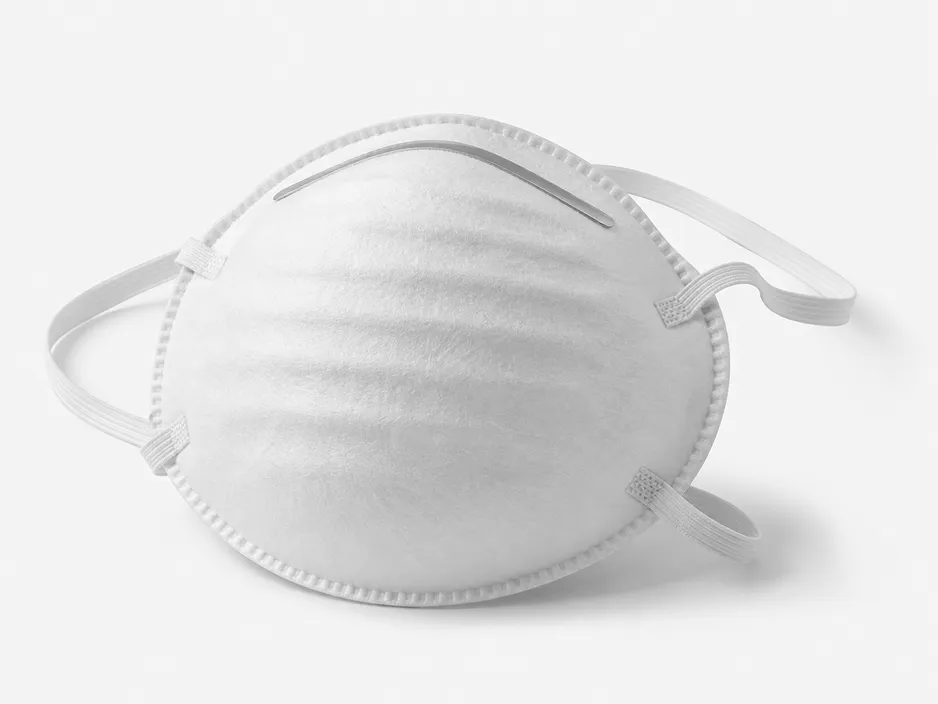
Most N95 sourcing conversations start in the wrong place. Buyers ask about certifications, price per piece, and lead time — all reasonable questions — but skip the one technical question that determines whether the mask will actually perform: what is the meltblown layer, who made it, and how do you know it meets spec?
A disposable N95 mask that fails PFE testing doesn't fail because of the outer spunbond layer, the nose wire, or the ear loops. It fails because the meltblown filtration layer didn't do its job. Every other component in the mask is structural. The meltblown layer is the only one doing actual filtration work. Get that layer wrong and the rest of the mask is irrelevant.
This article explains how the meltblown layer works, what variables determine PFE outcomes, and what the difference between in-house and outsourced meltblown production means for your procurement risk.

What the meltblown layer actually does — and why the other layers don't
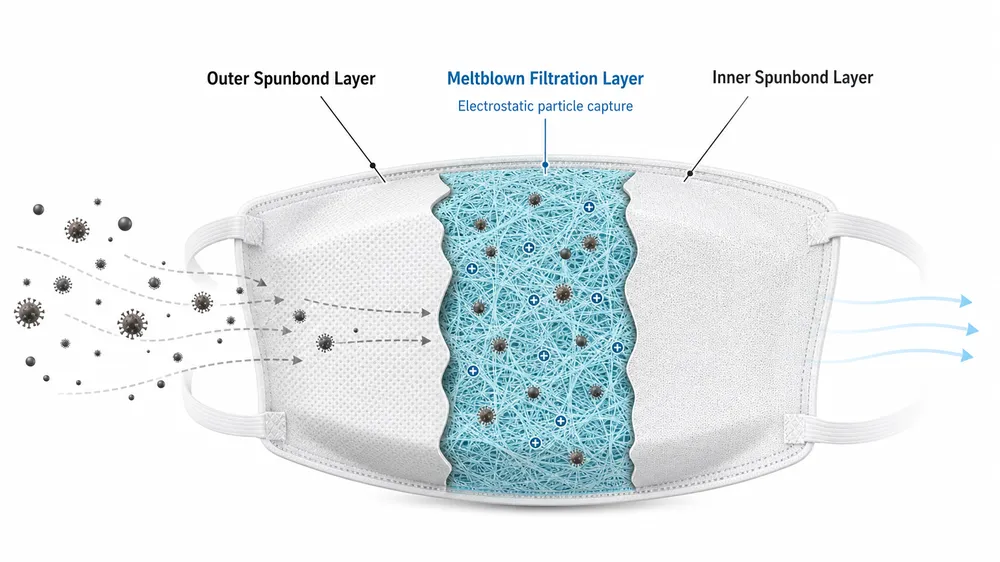
A standard disposable N95 mask has three layers. The outer layer is spunbond polypropylene — it provides structural shape and some splash resistance. The inner layer is also spunbond — it's the comfort layer against the face. Neither of these layers filters particles in any meaningful way.
The middle layer is meltblown nonwoven fabric. This is where filtration happens.
Meltblown fabric is produced by extruding molten polypropylene through very fine nozzles under high-velocity hot air, which attenuates the polymer into extremely fine fibers — typically in the range of 1–5 microns in diameter. Those fibers are collected on a moving belt and bonded by their own heat into a web. The resulting material has a dense, random fiber structure with very small interfiber gaps.
The mechanical filtration from that fiber structure alone would not get a mask to 95% PFE. What pushes it over the threshold is electrostatic charge. During or after production, the meltblown web is subjected to a corona discharge or hydrocharging process that deposits a persistent electrostatic charge on the fibers. That charge attracts and captures particles — including submicron particles that would otherwise pass through the mechanical fiber matrix.
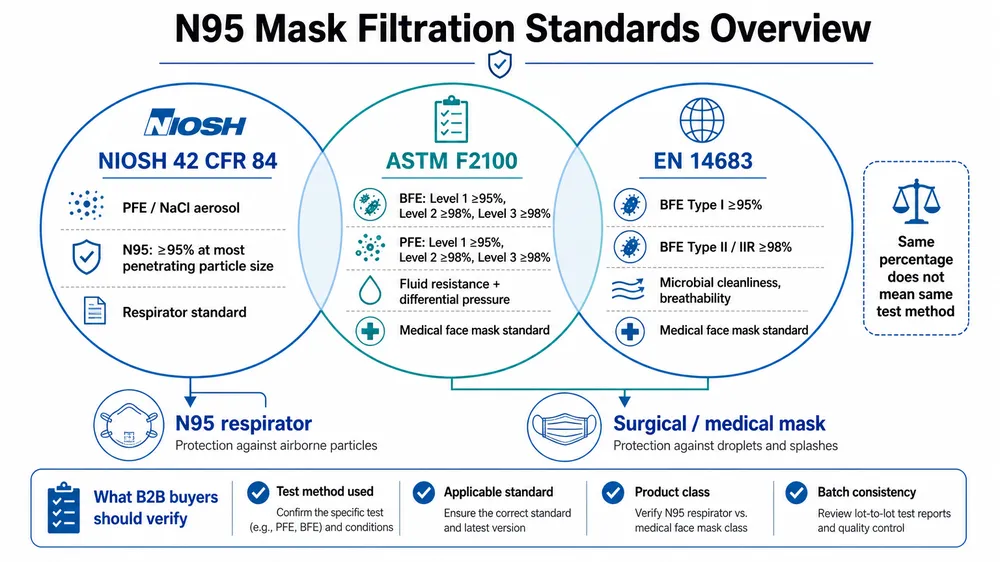
This is the mechanism that NIOSH tests when it runs the PFE challenge. The test uses a NaCl aerosol at a particle size of approximately 0.3 microns — the most penetrating particle size for mechanical filtration — at a flow rate of 85 L/min. A mask that passes at ≥95% filtration efficiency earns the N95 designation. A mask that comes in at 94.8% does not.
The electrostatic charge is what separates a passing mask from a failing one at that margin. And the electrostatic charge is entirely a function of the meltblown layer — how it was produced, what charge level was applied, and whether that charge has been maintained.
The four meltblown variables that determine PFE outcome
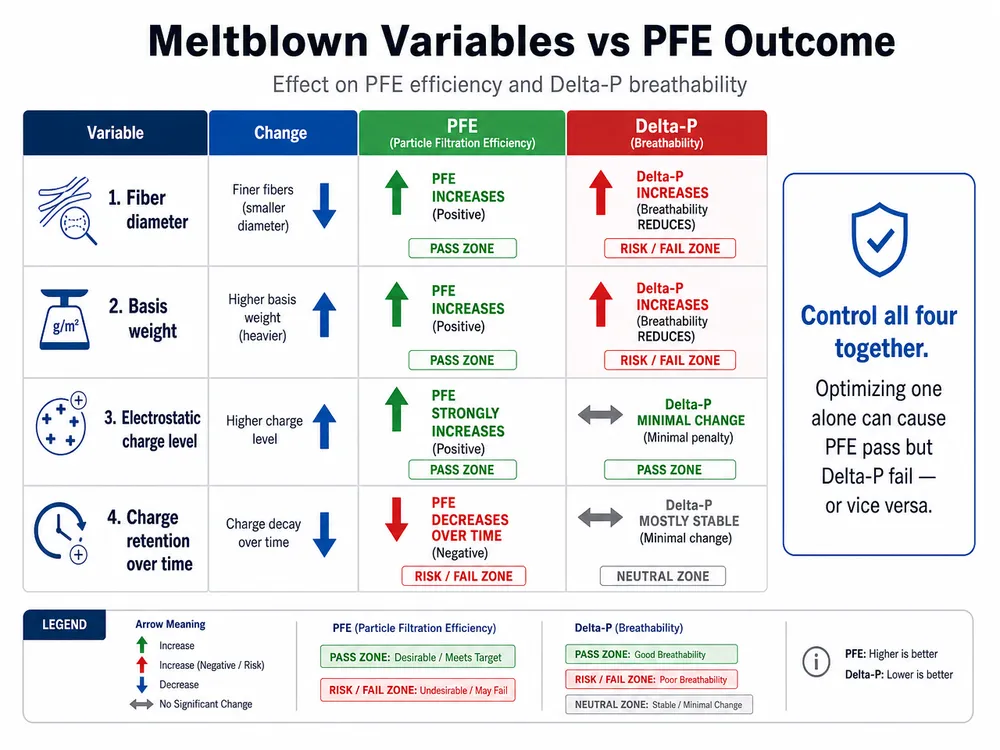
When we're setting up a production run for our Disposable N95 Medical Mask, these are the four parameters we control on the meltblown line. Each one directly affects PFE results.
Fiber diameter
Finer fibers mean more surface area per unit weight, which means more fiber-particle contact opportunities and better mechanical filtration. For N95-grade meltblown, fiber diameters in the 1–3 micron range are typical. Coarser fibers — above 5 microns — reduce filtration efficiency and require higher electrostatic charge to compensate. The problem is that charge compensation has limits; you can't charge your way out of a fundamentally coarse fiber structure.
We run our meltblown line at a die-to-collector distance and air pressure combination that consistently produces fiber diameters in the 1.5–2.5 micron range for N95-grade fabric. (This is tighter than what most commodity meltblown suppliers specify — they typically give a range of 1–5 microns, which is wide enough to include material that won't reliably pass PFE testing.)
Basis weight
Basis weight is the mass of fabric per unit area, measured in grams per square meter (gsm). For N95 applications, meltblown basis weight typically runs between 20–40 gsm. Higher basis weight means more fiber mass in the filtration path, which improves mechanical filtration but increases breathing resistance (Delta-P). Lower basis weight reduces resistance but puts more load on the electrostatic charge to achieve the 95% threshold.
The right basis weight is a balance between filtration efficiency and breathability. For N95 masks, we target a basis weight that keeps Delta-P within NIOSH limits while giving the electrostatic charge enough fiber surface to work with. Drift outside that window in either direction and you're either failing PFE or failing breathability — both are disqualifying.
Electrostatic charge level and uniformity
This is the variable that most commodity meltblown suppliers handle inconsistently. Applying charge to a meltblown web requires either corona discharge (passing the web through a high-voltage electric field) or hydrocharging (forcing water through the web under pressure, which generates triboelectric charge). Both methods work, but both require precise process control to produce uniform charge across the full web width.
Uneven charge distribution means uneven filtration efficiency across the mask face. A mask might pass PFE testing on the center sample but fail on the edges — which is exactly the kind of defect that shows up in NIOSH audit testing when samples are taken from multiple locations. We've seen this failure mode in third-party meltblown rolls that came in with acceptable average charge levels but poor uniformity.
Charge retention over time
Electrostatic charge on meltblown fabric degrades. The rate of degradation depends on storage conditions — humidity and temperature are the main factors — and on the charging method used. Hydrocharged meltblown generally retains charge better than corona-charged material under humid conditions, which matters for masks stored in tropical climates or shipped through high-humidity transit routes.
For masks with a stated shelf life of 3–5 years, the meltblown layer needs to retain sufficient charge to pass PFE testing at the end of that period, not just at the time of manufacture. This is a real-world sourcing risk that doesn't show up in a factory's initial test report.
How PFE testing works and where masks fail
The NIOSH PFE test is not complicated, but it is unforgiving. A NaCl aerosol is generated at a mass median diameter of approximately 0.075 microns (count median diameter around 0.3 microns), which represents the most penetrating particle size for electrostatically charged fibrous filters. The aerosol is drawn through the mask at 85 L/min — the flow rate corresponding to heavy work breathing. The test measures what fraction of particles are captured.
To earn the N95 designation, the mask must capture ≥95% of those particles. That's the threshold. There's no partial credit.
Where masks fail in practice:
Charge degradation before testing. Meltblown fabric that was adequately charged at production but stored improperly — high humidity, elevated temperature, or simply too long — can arrive at the test lab with insufficient charge to pass. The mask looks identical to a passing mask. The only way to know is to test it.
Batch-to-batch variation in outsourced meltblown. A factory that buys meltblown from an external supplier is dependent on that supplier's process consistency. If the supplier changes their charging parameters, switches raw material grades, or has a process excursion on a particular production run, the mask factory may not know until their finished masks fail PFE testing — or worse, until a NIOSH audit pulls samples from a shipment already in the field.
Basis weight drift. Meltblown production lines can experience basis weight variation across the web width and over time. A roll that averages 25 gsm might have sections at 18 gsm — thin enough that the electrostatic charge can't compensate. If the mask factory isn't testing incoming meltblown rolls for basis weight uniformity, those thin sections end up in finished masks.
Fiber diameter creep. Meltblown die nozzles wear over time. As nozzle geometry changes, fiber diameter increases. A supplier running worn tooling will produce progressively coarser fiber without necessarily detecting it unless they're measuring fiber diameter on a regular basis.
The common thread in all four failure modes: they're invisible to a buyer who only sees the finished mask. You can't look at a mask and tell whether the meltblown layer has adequate charge, correct basis weight, or the right fiber diameter. The only way to know is documentation — and the only documentation that matters is test data from the actual production batch you're buying.
In-house vs outsourced meltblown: what it means for your order
This is the sourcing question that almost no one asks, and it's the one that matters most.
Most disposable mask factories — including many that hold legitimate certifications — buy their meltblown nonwoven fabric from external suppliers. There's nothing inherently wrong with that. The problem is what it means for spec consistency across your orders.
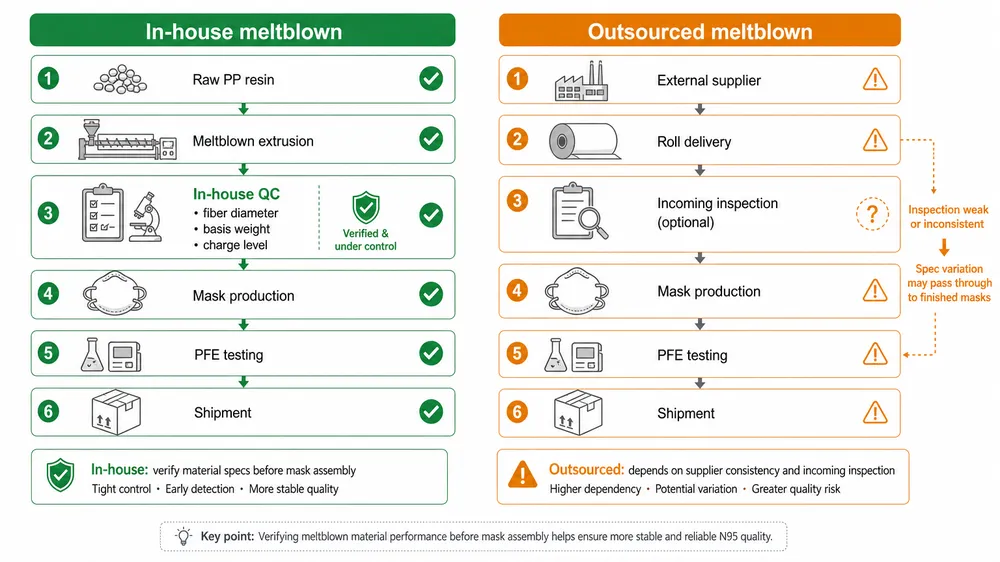
When a mask factory buys meltblown externally, they are buying a material with a specification sheet. That spec sheet describes the material the supplier intends to produce. It does not guarantee that every roll in every shipment matches that spec. Meltblown production is sensitive to process conditions — die temperature, air pressure, collector speed, charging parameters — and those conditions vary. A supplier running multiple product grades on the same line will have changeover variation. A supplier under capacity pressure may relax tolerances. The mask factory receives rolls, may or may not test them on arrival, and runs them through production.
We brought meltblown production in-house specifically because we couldn't accept that dependency. We set the fiber diameter. We set the basis weight. We set the charging parameters. When a production batch comes off our meltblown line, we test it before it goes into mask production — basis weight, fiber diameter, and charge level are all verified against our internal spec. If a roll doesn't meet spec, it doesn't go into masks. (We've scrapped meltblown production runs. It's not pleasant, but it's the only way to guarantee what's in the finished product.)
The commercial implication for your order: when you source from a factory with in-house meltblown production and in-house PFE testing, the test report attached to your shipment reflects the actual material in those masks. When you source from a factory that buys meltblown externally, the test report reflects a sample from a previous production run — possibly with different meltblown from a different supplier lot.
For a single trial order, that distinction may not matter. For a recurring supply relationship where you're stocking hospital supply chains or fulfilling institutional tenders, it's the difference between a supplier you can rely on and one that will eventually surprise you.
See our N95 mask filtration efficiency article for a deeper look at how BFE and PFE ratings interact across different mask types.
What to ask any N95 supplier about their meltblown before placing a bulk order
The questions below are not hypothetical. They're the questions that separate suppliers who control their filtration performance from suppliers who hope their meltblown supplier shipped the right rolls.
1. Do you manufacture meltblown nonwoven in-house, or do you purchase it from an external supplier?
This is the first question. If the answer is "we purchase externally," the follow-up questions become more important, not less.
2. What is your incoming inspection protocol for meltblown rolls?
A factory buying external meltblown should be testing every incoming lot for basis weight, fiber diameter, and charge level — not just reviewing the supplier's certificate. Ask for their incoming inspection procedure and what happens when a roll fails.
3. Can you provide batch-specific PFE test reports, not just a product certification?
A product certification tells you that a mask design passed PFE testing at some point. A batch-specific test report tells you that the masks in your specific order were tested. These are different documents. For any order going into a regulated supply chain, you want the batch report.
4. What is your meltblown charge retention specification, and how do you verify it?
If the supplier can't answer this question, they're not testing charge retention. That means they don't know whether the masks they shipped six months ago still meet PFE spec today.
5. What is your meltblown fiber diameter specification and how do you measure it?
Fiber diameter measurement requires SEM (scanning electron microscopy) or equivalent imaging. A supplier who specifies fiber diameter but can't describe their measurement method is likely quoting a nominal spec from their material supplier, not a verified production parameter.
6. What is your process for handling a PFE test failure on a production batch?
The answer to this question tells you more about a supplier's QC culture than any certification document. A factory with real QC discipline has a documented corrective action process. A factory without it will give you a vague answer about "re-testing" or "working with the supplier."
| Question | What a strong answer looks like | Red flag |
|---|---|---|
| Meltblown source | "We produce in-house" or "We test every incoming lot" | "We use a certified supplier" with no testing detail |
| Batch PFE reports | Provides batch-specific test data on request | Offers only product certification |
| Charge retention | States a spec and a test method | Can't describe how charge is verified |
| Fiber diameter | States a range and a measurement method | Quotes supplier nominal spec only |
| PFE failure response | Describes documented corrective action | "We re-test until it passes" |
Batch-to-batch consistency: the procurement risk that certifications don't cover
Certifications — NIOSH approval, FDA 510(k), CE — are issued based on testing of a specific product design. They tell you the mask design is capable of meeting the performance standard. They do not tell you that every production batch meets that standard.
This distinction matters more than most buyers realize. NIOSH approval is granted to a specific respirator model based on testing of submitted samples. Once approved, the manufacturer is responsible for maintaining production consistency. NIOSH conducts surveillance testing — pulling samples from the market and re-testing — but that surveillance doesn't cover every batch from every factory.
The practical implication: a factory can hold a valid NIOSH approval and still ship batches with PFE below 95% if their production process drifts. The approval doesn't prevent that. Only in-process QC prevents it.
For buyers sourcing N95 Medical Masks for hospital supply chains or institutional tenders, the documentation requirement should go beyond the certification number. You want batch test reports. You want incoming meltblown inspection records. You want evidence that the factory's QC process catches problems before they reach your shipment — not after.
We run PFE testing on every production batch at our in-house lab before outgoing inspection. The test reports from that process travel with every shipment. If a batch fails internal PFE testing, it doesn't ship — it gets investigated, the meltblown parameters are reviewed, and production resumes only after the root cause is identified and corrected. That's not a marketing claim; it's the ISO 13485 corrective action requirement, and we've built it into our standard operating procedure because the alternative is shipping product we can't stand behind.
FAQ: meltblown filtration and PFE testing for N95 procurement
What is the meltblown layer in a disposable N95 mask?
The meltblown layer is the middle layer of a disposable N95 mask — the only layer that performs actual particle filtration. It's made from extremely fine polypropylene fibers (typically 1–5 microns in diameter) produced by a melt-extrusion process, then electrostatically charged to capture submicron particles. The outer and inner spunbond layers provide structure and comfort but contribute negligible filtration efficiency.
Why do N95 masks fail PFE testing?
Most PFE failures trace back to the meltblown layer: insufficient electrostatic charge, charge degradation from improper storage, basis weight variation across the web, or fiber diameter outside the target range. Masks can also fail if the meltblown material was produced to a lower grade and substituted for N95-spec fabric — a risk that's higher when the mask factory buys meltblown externally and doesn't test incoming rolls.
What is the NIOSH PFE 95% threshold and how is it tested?
NIOSH tests N95 respirators using a NaCl aerosol at approximately 0.3 microns count median diameter — the most penetrating particle size for electrostatically charged filters — at a flow rate of 85 L/min. The mask must capture ≥95% of those particles to pass. There is no partial credit; 94.9% is a failing result.
Does a NIOSH approval number guarantee every production batch passes PFE?
No. NIOSH approval is granted based on testing of submitted samples from a specific product design. It does not guarantee that every subsequent production batch meets the same standard. Batch-to-batch consistency depends on the manufacturer's production controls — specifically, the consistency of the meltblown layer. Buyers sourcing for regulated supply chains should request batch-specific PFE test reports, not just the NIOSH approval number.
How does in-house meltblown production reduce procurement risk?
A factory that manufactures meltblown in-house controls the fiber diameter, basis weight, and electrostatic charge parameters directly. They can test the material before it enters mask production and catch spec deviations before they become finished-product failures. A factory that buys meltblown externally depends on their supplier's process consistency and their own incoming inspection — if either is inadequate, spec variation reaches finished masks without detection.
What documents should I request from an N95 supplier to verify meltblown quality?
At minimum: batch-specific PFE test reports (not just product certification), incoming meltblown inspection records showing basis weight and charge level verification, and the supplier's corrective action procedure for PFE failures. If the supplier can't provide batch-specific test data, you're buying on the strength of their certification alone — which doesn't cover production variation.
If you're evaluating N95 suppliers and want to understand how our meltblown production and batch testing process works in practice, request a quote and specify your target PFE rating, order volume, and destination market. We'll send back our standard batch documentation package so you can see exactly what travels with a shipment before you commit to an order.