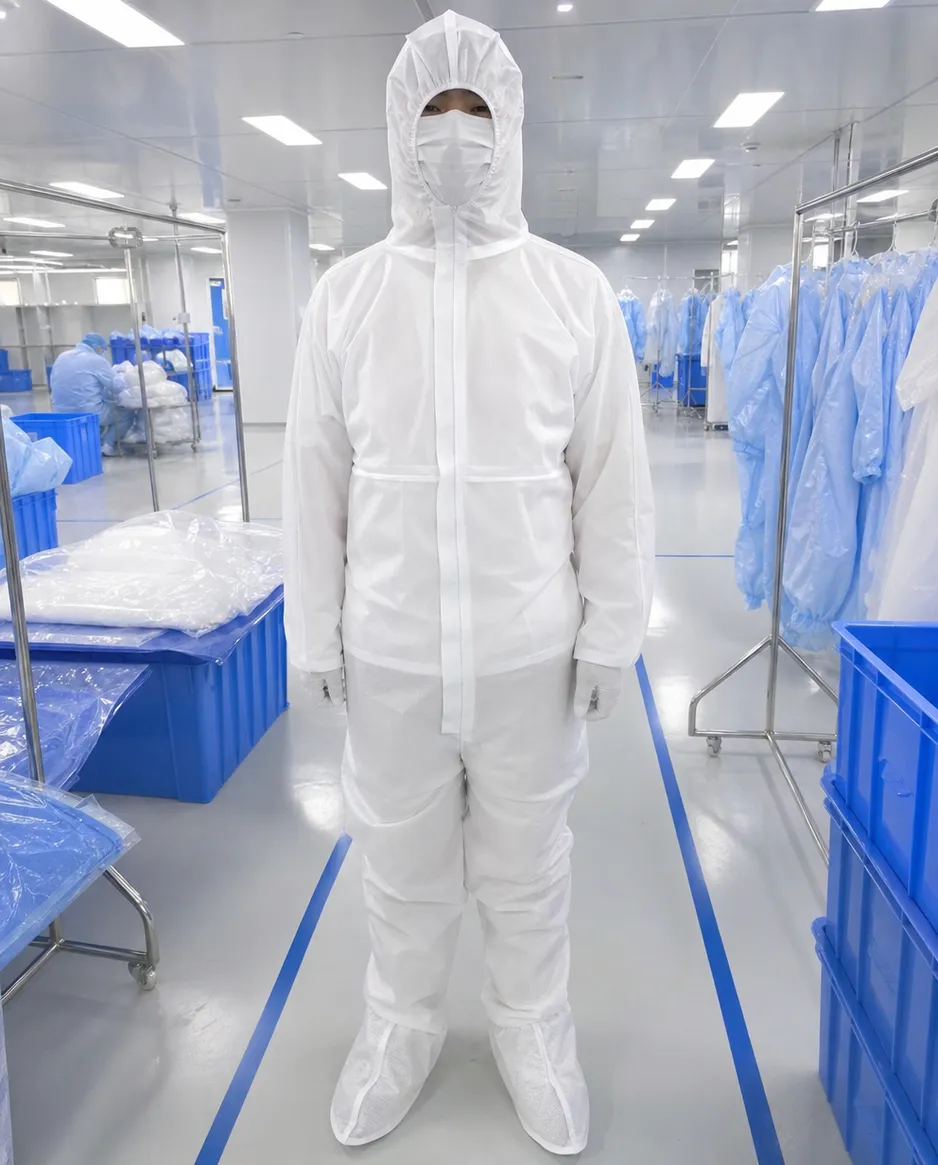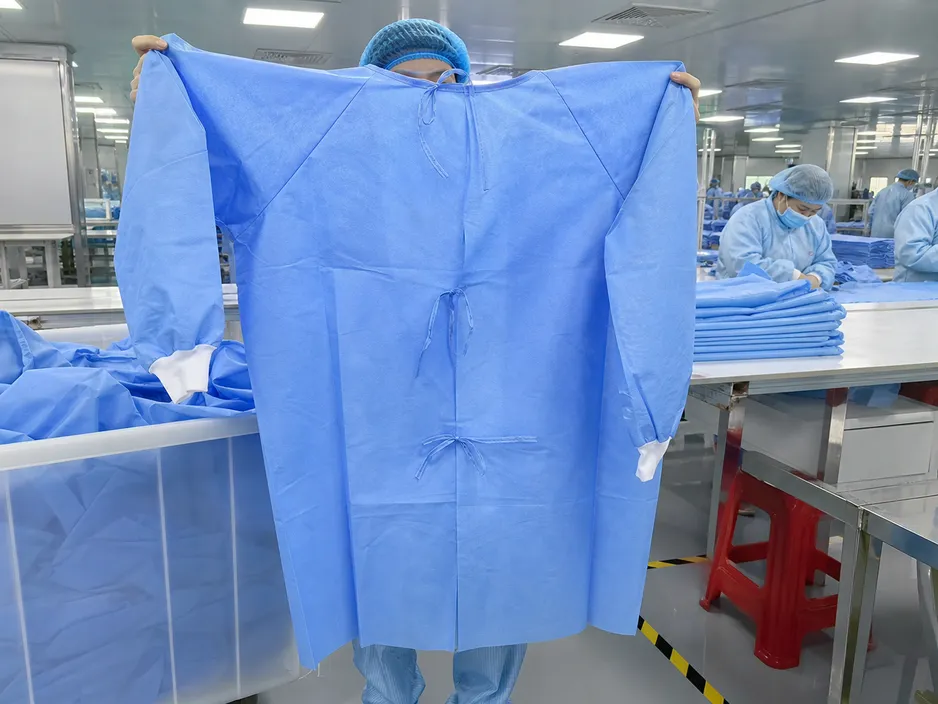
The two most expensive sourcing mistakes in disposable protective clothing don't show up until after the order ships. The first is seam delamination — garments that pass visual inspection at the factory but fail under stress in the field, splitting at the shoulder or crotch seam when a healthcare worker bends or reaches. The second is a certification gap — product that clears your supplier's QC but arrives with documentation that doesn't match the protection level your tender or import authority requires.
Both failures are preventable. Neither requires you to become a textile engineer. You need to know what to ask for, what to check in the sample stage, and what documentation to demand before production starts.
This guide covers the full sourcing sequence: protection level selection, fabric spec evaluation, seam construction methods, QC infrastructure assessment, and the documentation package your compliance team will need at customs.

The Two Failure Modes That Cost Buyers the Most
Seam delamination: what it is and why it happens
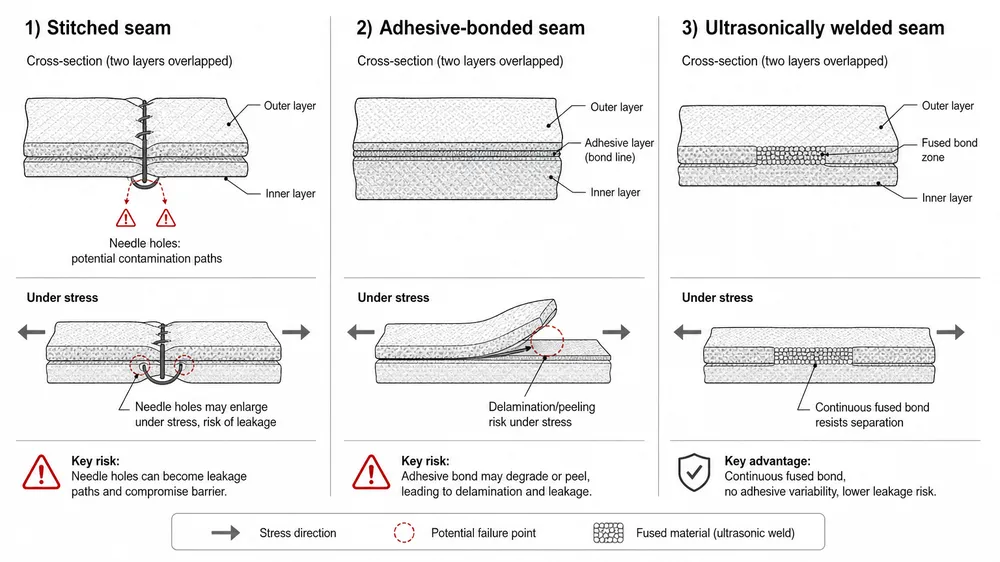
Seam failure in disposable protective clothing almost always traces back to one of three construction methods: stitched seams, adhesive-bonded seams, or ultrasonically welded seams. Each has a different failure profile.
Stitched seams are the cheapest to produce and the most common in low-cost garments. The problem is structural: every needle hole is a potential contamination pathway, and the thread itself can wick fluids through the seam. For any garment claiming liquid barrier performance — EN 14126 Type 4, 5, or 6, or AAMI PB70 Level 2 and above — a stitched seam without seam tape is a spec violation, not just a quality concern.
Adhesive-bonded seams are better than stitched for barrier performance, but they introduce a different variable: bond consistency. Adhesive application is sensitive to temperature, pressure, and operator technique. A seam that looks correct on the surface can have micro-gaps in the bond line that only show up under hydrostatic pressure testing or physical stress. We've seen this failure mode in samples from suppliers who pass visual inspection but can't hold up under ASTM F1671 (viral penetration resistance) testing.
Ultrasonically welded seams fuse the nonwoven layers together using high-frequency vibration. There's no adhesive, no thread, no bond line variability — the weld strength is determined by machine parameters (frequency, amplitude, pressure, dwell time), not by operator consistency. The 500th garment in a production run has the same seam integrity as the first. For buyers sourcing at volume, this matters: adhesive-bonded seams can drift across a production run as adhesive temperature fluctuates or application pressure varies. Ultrasonic welding doesn't drift.
(The practical test: ask your supplier how they verify seam integrity in-process. If the answer is "visual inspection," that's an adhesive or stitched operation. Ultrasonic welding lines typically have in-process weld parameter monitoring — frequency, pressure, and dwell time logged per cycle.)
Certification gaps: where they actually occur
A certification gap isn't always a fraudulent certificate. More often it's a mismatch between what the certificate covers and what your market or tender requires.
The most common version: a supplier holds a CE certificate for a Type 5 coverall under EN 13982-1 (protection against dry particulates), but your hospital tender requires EN 14126 (protection against infective agents). These are different standards with different test protocols. A garment can pass one and fail the other. If your supplier's CE documentation doesn't reference EN 14126 specifically, it doesn't cover biological barrier performance — regardless of what the product listing says.
The second version: FDA registration exists for the product category, but the specific SKU you're ordering hasn't been tested to the performance level you need. FDA 510(k) clearance for a surgical gown covers AAMI PB70 Level 1 or 2 performance. If you need Level 3 or 4 for a high-fluid-exposure environment, you need test reports showing the garment meets those specific AAMI PB70 performance thresholds — not just that the product category is registered.
The fix is straightforward: before you approve samples, ask for the actual test reports, not just the certificate numbers. The test report shows which standard was tested, which test method was used, which specific product was tested, and what the results were. A certificate number without a test report is unverifiable.
Protection Level Primer: EN 14126, AAMI PB70, and FDA 510(k)
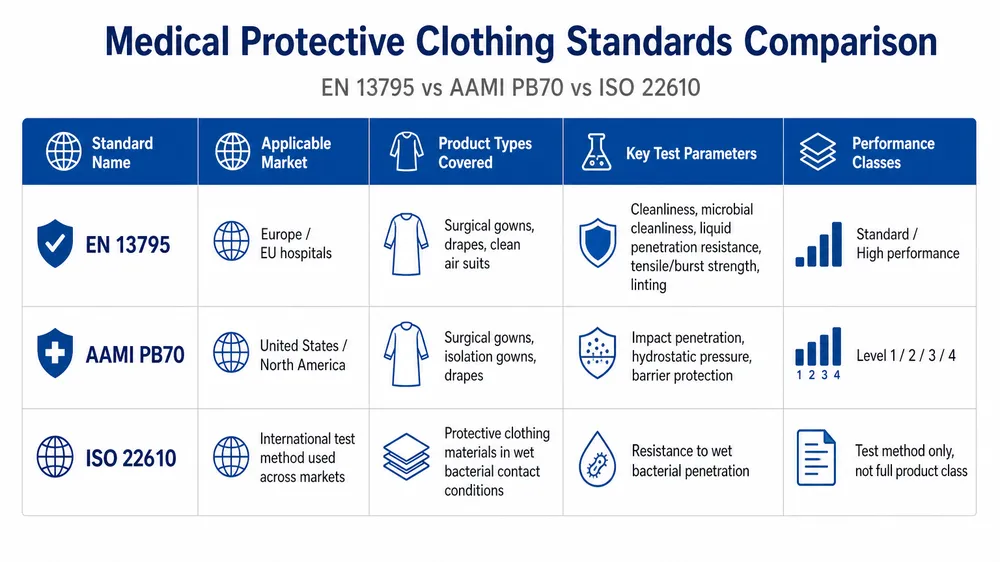
Most sourcing confusion around protective clothing comes from mixing up three different regulatory frameworks that cover overlapping but distinct performance requirements. Here's how they map.
EN 14126 — European biological barrier standard
EN 14126 is the European standard for protective clothing against infective agents. It defines performance requirements for resistance to penetration by blood, body fluids, and microorganisms. The standard has four test methods:
- ISO 16603 — resistance to penetration by blood and body fluids (hydrostatic pressure)
- ISO 16604 — resistance to penetration by blood-borne pathogens (viral penetration, equivalent to ASTM F1671)
- ISO 22610 — resistance to wet bacterial penetration
- ISO 22611 — resistance to aerosol penetration
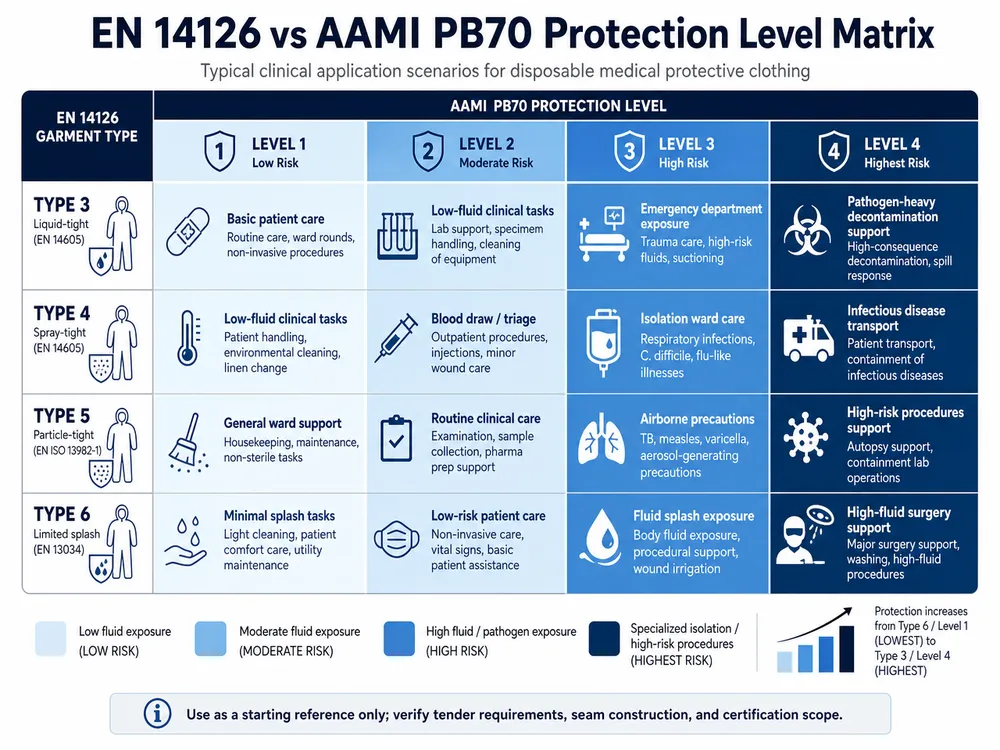
EN 14126 garments are classified as Type 3 through Type 6 depending on the level of liquid protection, with Type 3 being the highest (jet-tight) and Type 6 the lowest (splash-resistant). For most hospital and clinical applications, Type 4 (spray-tight) or Type 5/6 (particulate and splash protection) are the relevant levels.
If you're sourcing for EU markets, your supplier's CE documentation must reference EN 14126 explicitly — not just EN 13982 or EN 14605. The standard number in the certificate matters.
AAMI PB70 — US liquid barrier performance standard
AAMI PB70 is the US standard for liquid barrier performance in healthcare protective apparel. It defines four protection levels:
| Level | Test Method | Typical Application |
|---|---|---|
| Level 1 | AATCC 42 (spray impact) | Minimal fluid exposure, basic isolation |
| Level 2 | AATCC 42 + AATCC 127 (hydrostatic) | Low-to-moderate fluid exposure |
| Level 3 | AATCC 42 + AATCC 127 (higher pressure) | Moderate-to-heavy fluid exposure |
| Level 4 | ASTM F1671 (viral penetration) | High-risk procedures, bloodborne pathogen exposure |
AAMI PB70 Level 4 is the most demanding — it requires passing ASTM F1671, which tests resistance to penetration by a surrogate virus (Phi-X174 bacteriophage) under continuous liquid contact. This is the level required for surgical gowns used in high-fluid procedures and for coveralls used in infectious disease response.
For FDA import clearance, your supplier needs 510(k) clearance for the specific product type, and the test reports must show the AAMI PB70 level the garment was tested to. "FDA registered" without a specific AAMI PB70 level in the test report doesn't tell your compliance team what they need to know.
Matching protection level to application
The practical question is which level your end market actually requires. Overspending on Level 4 protection for a low-fluid-exposure application adds cost without adding value. Underspecifying for a high-risk environment creates liability.
A working reference:
- General isolation, low-fluid contact: EN 14126 Type 6 / AAMI PB70 Level 1–2
- Surgical procedures, moderate fluid exposure: EN 14126 Type 4–5 / AAMI PB70 Level 2–3
- High-risk procedures, bloodborne pathogen exposure: EN 14126 Type 3–4 / AAMI PB70 Level 4
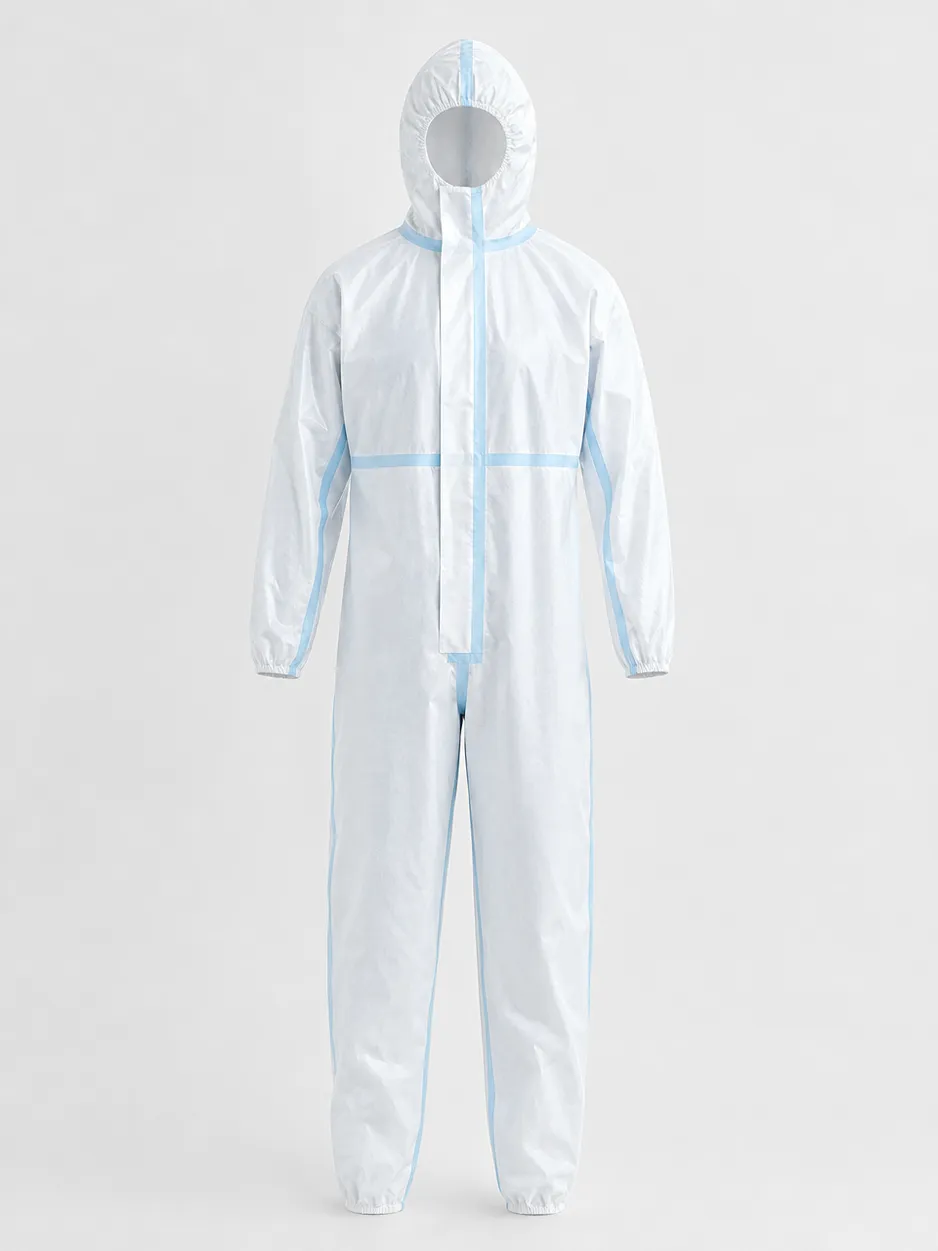
- Infectious disease response, full-body protection: EN 14126 Type 3 with taped seams / AAMI PB70 Level 4
If you're supplying hospital tenders, the tender specification will usually name the standard and level directly. If you're building a distribution catalog, match your SKU range to the risk profiles of your target market segments.
Fabric Spec Evaluation: SMS vs SMMS, GSM, and What Actually Determines Barrier Performance
The fabric construction is where most sourcing guides stop at the marketing layer — "SMS nonwoven" appears on every spec sheet, but the number that actually determines barrier performance is the basis weight (gsm) and the layer construction.
SMS vs SMMS: the construction difference
SMS (Spunbond-Meltblown-Spunbond) is the standard three-layer construction for disposable protective clothing. The outer and inner spunbond layers provide mechanical strength and abrasion resistance. The middle meltblown layer provides the barrier function — it's the layer that blocks liquid penetration and particulate passage.
SMMS (Spunbond-Meltblown-Meltblown-Spunbond) adds a second meltblown layer. The practical effect is higher barrier performance at the same total basis weight, because you have two meltblown layers filtering in series. For EN 14126 Type 4 and above, or AAMI PB70 Level 3–4, SMMS construction is typically required to meet the hydrostatic pressure and viral penetration thresholds.
The spec sheet will usually list the total gsm. What it won't always tell you is the meltblown layer weight within that total. A 50 gsm SMS garment with a 10 gsm meltblown layer performs very differently from a 50 gsm SMS garment with a 20 gsm meltblown layer. Ask for the layer breakdown, not just the total.
Basis weight ranges by protection level
Working guidance for typical production specs:
- Type 6 / Level 1–2: 35–45 gsm SMS, meltblown layer 8–12 gsm
- Type 5 / Level 2–3: 45–55 gsm SMS or SMMS, meltblown layer 12–18 gsm
- Type 4 / Level 3–4: 55–70 gsm SMMS, meltblown layer 18–25 gsm (two layers combined)
- Type 3 / Level 4: 60–80 gsm SMMS with taped seams, meltblown layer 20–28 gsm
These are typical working ranges, not certified performance guarantees — actual barrier performance depends on fiber diameter, electrostatic charge, and layer uniformity, not just basis weight. The test report is the only reliable confirmation.
Why in-house fabric production matters for spec consistency
Most protective clothing factories buy nonwoven rolls from external suppliers. The problem is batch-to-batch variability: meltblown fabric quality is sensitive to extrusion temperature, die pressure, and electrostatic charging conditions. A supplier who buys fabric from outside has no control over these variables — they're trusting that the roll they received matches the roll that was tested.
We produce our own meltblown nonwoven fabric at eztio. The same team that controls our mask filtration layer controls the fabric going into our protective clothing. We set the fiber diameter, basis weight, and electrostatic charge to match the barrier spec we're targeting. When a production lot ships, we know the meltblown layer spec because we made it — we're not relying on a third-party supplier's certificate of conformity for the most performance-critical component in the garment.
(This is the same reason our mask BFE specs are consistent across batches. In-house meltblown production is the single biggest variable we control that most competitors can't.)
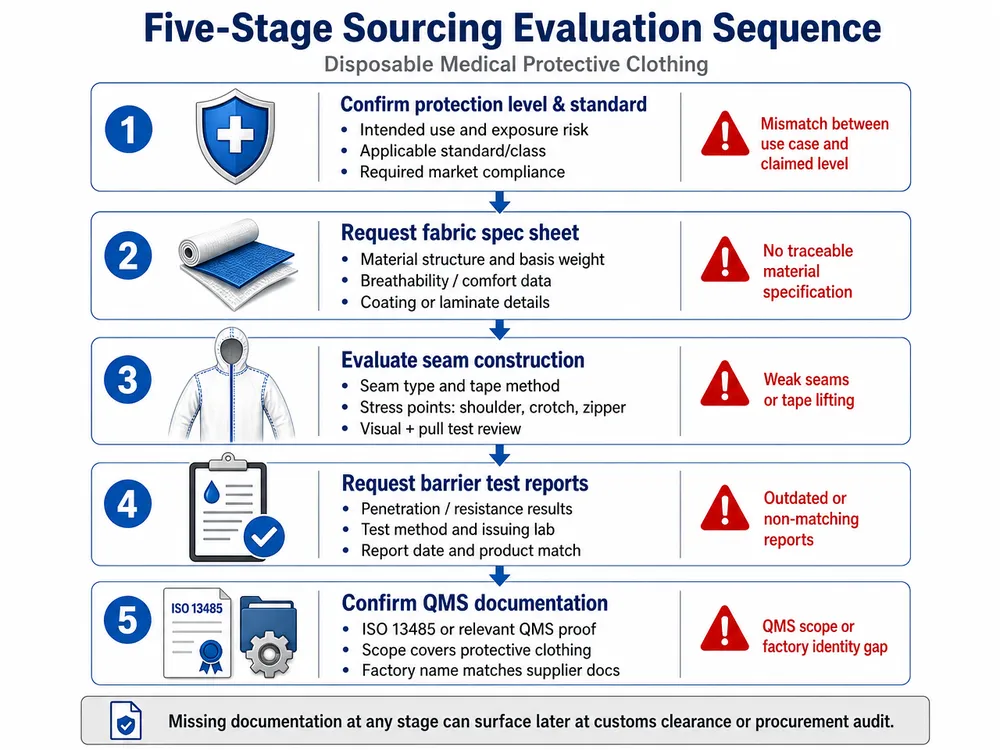
Step-by-Step Sourcing Checklist
Use this sequence when evaluating a new supplier or qualifying a new SKU.
Step 1: Confirm the protection level and standard
Before requesting samples, confirm in writing:
- Which standard applies to your destination market (EN 14126 for EU, AAMI PB70 for US, or both)
- Which protection level or type your application requires
- Whether the supplier's existing certification covers that specific standard and level
Red flag: A supplier who quotes "CE certified" without specifying which EN standard and which type. CE covers dozens of standards — it tells you nothing about biological barrier performance without the standard number.
Step 2: Request the fabric spec sheet
Ask for:
- Total basis weight (gsm)
- Layer construction (SMS or SMMS)
- Meltblown layer weight (gsm, per layer if SMMS)
- Fiber composition (typically polypropylene)
- Fabric supplier name and country of origin (relevant for EU customs declarations)
Red flag: A supplier who can't provide the meltblown layer weight separately. This usually means they're buying fabric from outside and don't have visibility into the layer breakdown.
Step 3: Evaluate seam construction
Ask specifically:
- What seam construction method is used (stitched, adhesive-bonded, or ultrasonic welding)?
- For adhesive-bonded seams: what adhesive type, application temperature, and bond width?
- For ultrasonic welding: what frequency and weld parameters are used?
- Are seams taped? (Required for Type 3 and some Type 4 applications)
- What in-process seam integrity check is performed?
Red flag: "Seams are visually inspected" as the only QC method. Visual inspection doesn't detect micro-gaps in adhesive bonds or incomplete ultrasonic welds.
Step 4: Request barrier test reports
The test reports you need depend on the protection level:
| Protection Level | Required Test Reports |
|---|---|
| EN 14126 Type 6 | ISO 16603 (hydrostatic), EN 13938-1 (burst strength) |
| EN 14126 Type 4–5 | ISO 16603, ISO 22610 (wet bacterial penetration) |
| EN 14126 Type 3 | ISO 16603, ISO 16604 (viral penetration), ISO 22610 |
| AAMI PB70 Level 3 | AATCC 42, AATCC 127 |
| AAMI PB70 Level 4 | AATCC 42, AATCC 127, ASTM F1671 |
Check that the test report names the specific product (model number or SKU), the test date, and the accredited lab that performed the test. A test report from an unaccredited internal lab is not acceptable for customs documentation in the EU or US.
Step 5: Confirm QMS documentation
For institutional tenders and hospital procurement, you'll typically need:
- ISO 13485:2016 certificate (not just ISO 9001)
- Incoming inspection records for raw material lots
- In-process inspection records
- Outgoing test reports per production batch
ISO 13485 is the medical device quality management standard. It requires documented risk management, design controls, and traceability that ISO 9001 doesn't mandate. A supplier with only ISO 9001 is running a general manufacturing QMS, not a medical device QMS. For hospital procurement audits, this distinction matters.
How to Evaluate a Supplier's QC Infrastructure
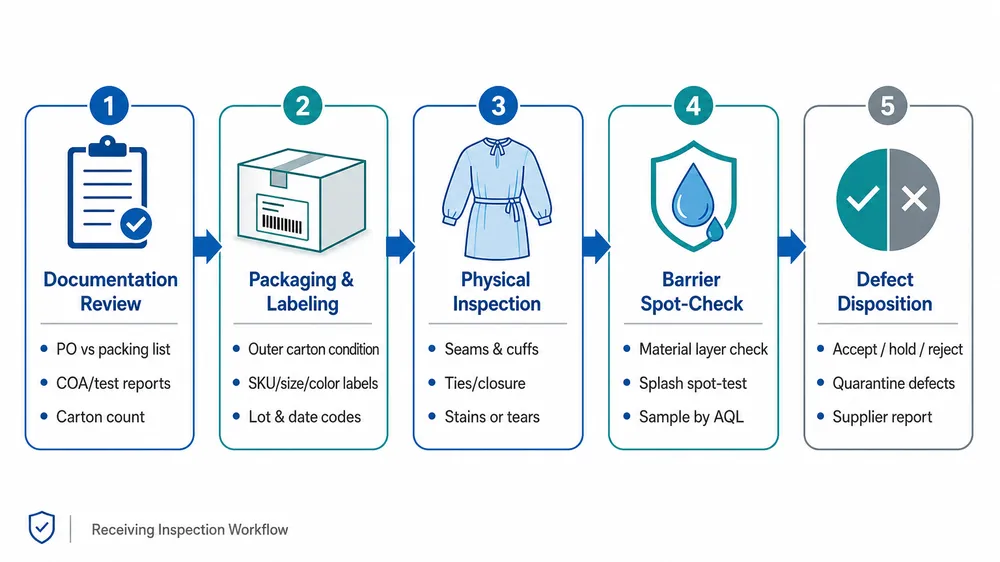
The certificate tells you what the system is designed to do. The QC process tells you whether it actually does it. When you're evaluating a new supplier, ask about three specific stages.
Incoming inspection
A factory with a real incoming inspection program tests every raw material lot before it enters production. For protective clothing, that means:
- Nonwoven fabric: basis weight, tensile strength, uniformity
- Elastic and closures: tensile strength, elongation
- Zippers and seam tape (if applicable): peel strength, adhesion
- Packaging materials: print quality, seal integrity
Ask for a sample incoming inspection record. It should show the lot number, test date, test parameters, measured values, and pass/fail result. If the supplier can't produce one, incoming inspection is either not happening or not documented — both are problems under ISO 13485.
In-process inspection
In-process inspection for protective clothing should cover:
- Seam integrity checks at defined intervals (not just at shift start)
- Garment dimensions against tolerance specs
- Closure and zipper function
- Weld parameter monitoring (for ultrasonic welding lines)
The critical question is what happens when an in-process check fails. Under ISO 13485, a non-conforming product must be identified, segregated, and investigated before production continues. A factory that "sorts it out at the end of the shift" is not running a medical device QMS — they're running a general manufacturing operation with a certificate on the wall.
We stop the line when an in-process check fails. That's not a policy we advertise — it's just what ISO 13485 requires, and we've built it into the standard operating procedure. The discipline to stop a running line is the part of the standard that most factories find uncomfortable.
Outgoing inspection and test reports
Before shipment, a statistically sampled batch from each production run should go through:
- Full barrier performance testing (the same tests required for certification)
- Visual inspection for cosmetic defects
- Packaging integrity check
- Label verification against the approved artwork
The outgoing test report is the document that travels with your shipment. It's what your customs broker presents for import clearance, and it's what your compliance team needs for procurement audit documentation. Ask to see a sample outgoing test report before you place your first order — the format and content tell you a lot about how seriously the supplier takes the documentation side of the business.
Documentation for EU MDR Import and FDA Clearance
This is the section most sourcing guides skip. Getting the product right is half the job — getting the paperwork right is the other half.
EU MDR documentation requirements
Since the EU Medical Device Regulation (MDR 2017/745) came into full effect, the documentation requirements for medical protective clothing imported into the EU have become significantly more demanding. Your importer of record will need:
- CE certificate referencing the specific EN standard (EN 14126 for biological barrier, EN 13795 for surgical drapes and gowns)
- EU Declaration of Conformity — signed by the manufacturer, naming the notified body, and listing the specific standards the product conforms to
- Technical file summary — not the full technical file, but a summary showing the product description, intended use, risk classification, and test evidence
- Test reports from an EU-recognized accredited laboratory — test reports from Chinese labs are acceptable if the lab holds CNAS accreditation and the test method is recognized under the relevant EN standard
- Unique Device Identification (UDI) — required for Class I medical devices under EU MDR; your supplier needs to have registered the product in the EUDAMED database
(The UDI requirement has caught a lot of buyers off guard since 2021. If your supplier hasn't registered the product in EUDAMED, your EU importer of record can't legally place it on the market. Check this before you approve samples.)
FDA documentation requirements
For US import clearance, the documentation requirements depend on the product classification:
- Surgical gowns (FDA product code FYA): require 510(k) clearance, with test reports showing AAMI PB70 performance level
- Isolation gowns (FDA product code FYB): may be exempt from 510(k) if they meet the non-surgical isolation gown definition, but still require labeling that accurately states the AAMI PB70 level
- Coveralls used as personal protective equipment: may fall under OSHA PPE regulations rather than FDA medical device regulations, depending on the intended use claim
The practical implication: the intended use statement on the label determines which regulatory pathway applies. A coverall labeled for "protection against infective agents in healthcare settings" is a medical device. The same coverall labeled for "general industrial use" is not. Your supplier's labeling needs to match your intended use — and your intended use needs to match the test evidence.
Ask your supplier for:
- FDA 510(k) clearance number (if applicable)
- AAMI PB70 test reports from an FDA-recognized accredited laboratory
- Labeling that accurately states the protection level and intended use
- Certificate of Conformity per shipment
Our export documentation package at eztio covers all of this per shipment — CE certificate, EU Declaration of Conformity, FDA 510(k) reference, AAMI PB70 test reports, and Certificate of Conformity. We've handled EU MDR documentation for multiple European customers since 2021 and can walk you through what your importer of record will need before you place the order.
Upstream Prevention: Where the Problem Actually Starts
Most seam failures and certification gaps don't originate at the factory's QC stage. They originate upstream — in the material sourcing decisions and production setup choices that happen before the first garment is cut.
Fabric sourcing variability
A factory that buys meltblown nonwoven from external suppliers is exposed to batch-to-batch variability that they can't fully control. Meltblown fabric quality depends on extrusion temperature, die pressure, fiber diameter distribution, and electrostatic charge — parameters that vary between production runs even from the same supplier. A factory that tested their garment with one fabric lot and then switched to a different lot (because the original supplier was out of stock, or because a cheaper option appeared) may be shipping product that no longer meets the tested spec.
The only reliable protection against this is either in-house fabric production or a documented incoming inspection program that tests every fabric lot against the barrier performance spec — not just basis weight and tensile strength, but actual hydrostatic pressure resistance or viral penetration resistance.
Seam process setup and drift
Adhesive-bonded seam lines are particularly susceptible to process drift. Adhesive application temperature, pressure, and line speed interact — a change in one parameter affects bond quality. Without continuous in-process monitoring, a seam line can drift out of spec over the course of a production run without anyone noticing until the outgoing inspection catches it. By that point, a significant portion of the production run may be non-conforming.
Ultrasonic welding lines are more stable because the weld parameters are machine-controlled and logged. But they still require periodic calibration and in-process checks — a worn transducer or a change in material thickness can affect weld quality. The difference is that the failure mode is detectable through parameter monitoring, not just through destructive testing of finished garments.
Certification maintenance
Certifications expire and require surveillance audits. An ISO 13485 certificate is typically valid for three years, with annual surveillance audits required to maintain it. A CE certificate under EU MDR requires ongoing post-market surveillance and periodic review by the notified body.
Ask your supplier when their current certifications expire and when the last surveillance audit was conducted. A supplier who can't answer this question quickly either doesn't have active certifications or isn't managing them. Both are problems.
Practical Recommendation: What to Do Before Your Next Order
If you're placing a new order for Disposable Medical Protective Clothing or evaluating a new supplier, run through this sequence before you commit:
- Confirm the standard and level in writing — EN 14126 type number or AAMI PB70 level, not just "CE certified" or "FDA registered."
- Request the fabric spec sheet with meltblown layer weight broken out separately.
- Ask about seam construction — ultrasonic welding, adhesive-bonded, or stitched, and what in-process check is performed.
- Request test reports from an accredited lab for the specific product and protection level you're ordering.
- Confirm ISO 13485 certification is current and ask for the last surveillance audit date.
- Request a sample documentation package — the same documents that will travel with your shipment.
If a supplier can't provide all six without friction, that's the answer. A factory running a real medical device QMS has this documentation ready because they need it for their own certification maintenance.
For buyers sourcing Medical Protective Coveralls or Medical Isolation Gowns for institutional tenders, the documentation requirements are non-negotiable — the tender evaluation committee will ask for exactly this package, and a gap in any one document can disqualify an otherwise competitive bid.
Frequently Asked Questions
What is the minimum order quantity for certified disposable protective clothing from a factory with ISO 13485?
MOQ varies by factory and SKU. At eztio, standard SKUs start at 50,000 pieces. Custom configurations — modified protection levels, private-label packaging, non-standard sizes — typically require higher minimums to justify line setup and material procurement. For institutional tenders with specific documentation requirements, we recommend confirming MOQ and lead time before the tender submission deadline, not after.
Can the same garment be certified to both EN 14126 and AAMI PB70?
Yes, and for buyers supplying both EU and US markets, dual certification is the most efficient approach. The test protocols overlap significantly at the higher protection levels — a garment tested to EN 14126 Type 3 (including ISO 16604 viral penetration) will typically also meet AAMI PB70 Level 4 (ASTM F1671), since both tests use similar viral penetration methodology. Ask your supplier for test reports covering both standards, and confirm that the CE certificate and FDA 510(k) clearance both reference the same product SKU.
What documentation does my EU importer of record need for medical protective clothing?
At minimum: CE certificate referencing the specific EN standard, EU Declaration of Conformity, test reports from an EU-recognized accredited lab, and UDI registration in EUDAMED. Since EU MDR came into full effect, the UDI requirement has been the most common documentation gap for first-time EU importers. Confirm EUDAMED registration with your supplier before placing the order.
How do I verify that a supplier's seam construction actually meets the spec, not just passes visual inspection?
Request a peel strength test report for adhesive-bonded seams (minimum 15 N/5cm is a typical working threshold for Type 4 and above) or weld parameter records for ultrasonic welding lines. For the highest protection levels (Type 3, AAMI PB70 Level 4), the seam itself should be tested to the same viral penetration standard as the fabric — ISO 16604 or ASTM F1671 on the seam, not just the base material.
What lead time should I plan for bulk disposable protective clothing orders?
For standard SKUs with existing certification, 15–25 days from order confirmation is typical for a factory running active production lines. Custom configurations, new protection levels requiring new test reports, or orders requiring new packaging artwork add time — typically 30–45 days for the first production run. For institutional tenders with fixed delivery dates, build in buffer for customs clearance: EU import typically adds 5–10 business days, US FDA entry review can add 3–7 business days for first-time importers.
Sourcing Medical Protective Clothing without seam failure or certification gaps comes down to asking the right questions before production starts, not after the container ships. The checklist above covers the full sequence. If you want to discuss your specific protection level requirements, destination market, and volume, send us your requirements and we'll respond with a spec sheet, sample availability, and a documentation package overview.