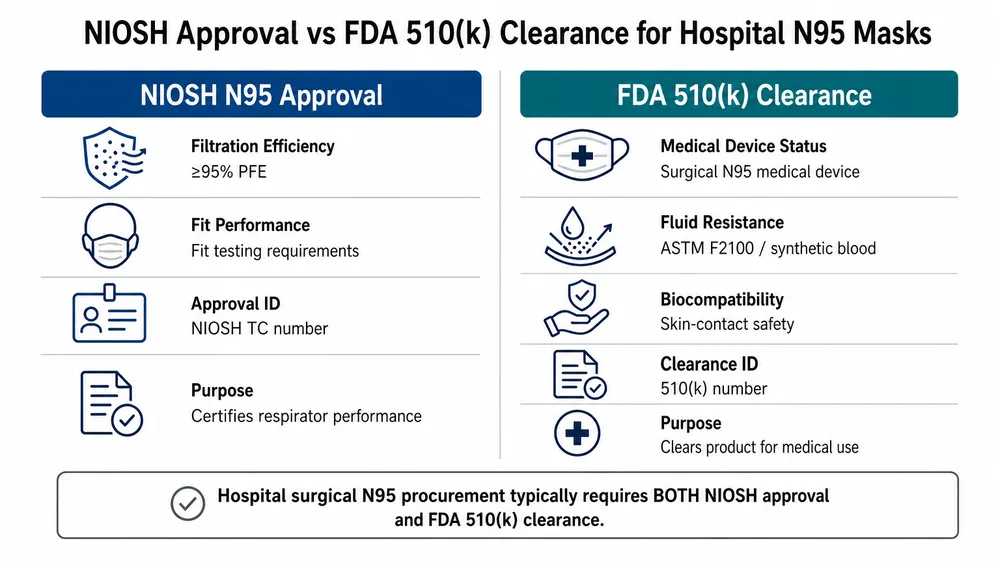
NIOSH approval and FDA 510(k) clearance are not the same thing. Confusing them is how hospital supply chains get exposed — and it happens more often than it should, especially when procurement teams are sourcing from overseas manufacturers for the first time.
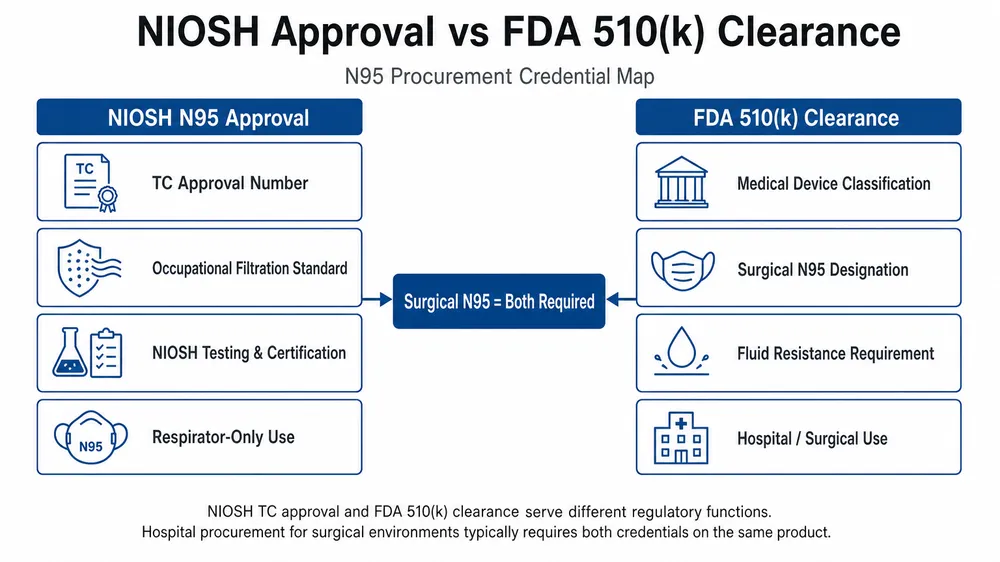
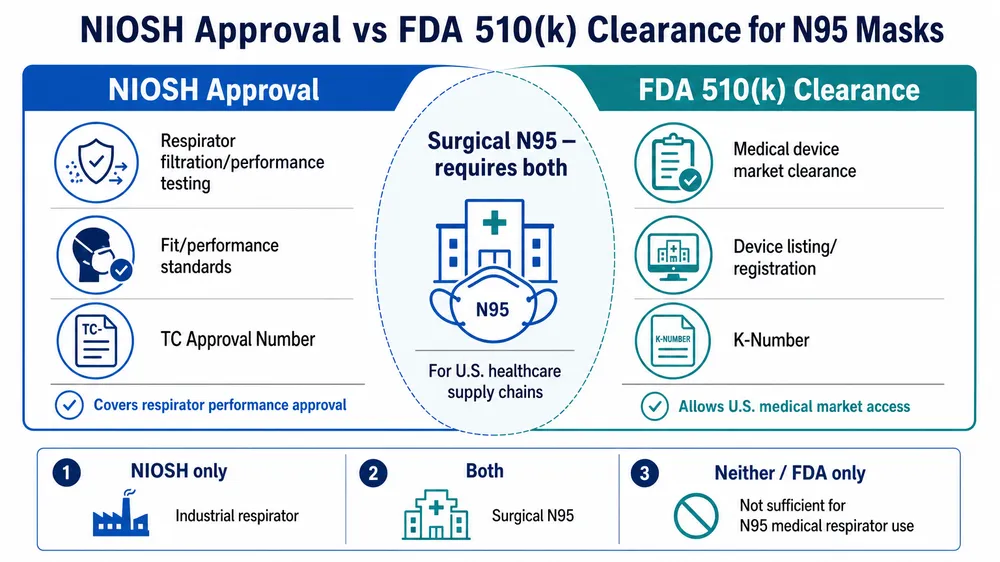
A NIOSH-approved N95 respirator meets the filtration performance standard. An FDA 510(k)-cleared surgical N95 meets the filtration standard and qualifies as a medical device under FDA jurisdiction. For hospital use — operating rooms, procedural areas, any setting where fluid resistance and sterile field integrity matter — you need both. Ordering a NIOSH-only N95 for clinical settings isn't just a compliance gap; it's a product category mismatch that your infection control team will catch, and your GPO contract may not cover.
This guide explains the distinction clearly, walks through what documentation your compliance team should require before placing an order, and shows you how to verify a supplier's 510(k) status before the purchase order goes out.

NIOSH Approval vs FDA 510(k): What Each Actually Covers
NIOSH approval is a performance certification. The National Institute for Occupational Safety and Health tests respirators against 42 CFR Part 84 — the standard that defines N95 filtration efficiency (≥95% particulate filtration against 0.3-micron NaCl aerosol), airflow resistance, and fit test compatibility. A NIOSH TC number on the packaging tells you the respirator passed that test. It says nothing about fluid resistance, biocompatibility, or medical device status.
FDA 510(k) clearance is a market authorization. Under 21 CFR Part 878, a surgical N95 respirator is classified as a Class II medical device (product code MSH). To obtain 510(k) clearance, a manufacturer must demonstrate substantial equivalence to a predicate device — which means submitting performance data covering filtration efficiency, fluid resistance (ASTM F1862), flammability (16 CFR 1610), biocompatibility (ISO 10993), and in some cases cytotoxicity. The FDA reviews the submission and issues a clearance letter with a K-number.
The practical difference for hospital procurement:
| Requirement | NIOSH N95 | FDA 510(k) Surgical N95 |
|---|---|---|
| Filtration efficiency ≥95% | Yes | Yes |
| Fit test compatible | Yes | Yes |
| Fluid resistance (ASTM F1862) | No | Yes |
| Biocompatibility testing | No | Yes |
| FDA medical device classification | No | Yes (Class II) |
| Required for OR/procedural use | No | Yes |
| Required for general industrial use | Yes | Not required |
The table above is the one your compliance team needs to have in front of them when evaluating supplier claims. A supplier who says "NIOSH approved" and "FDA registered" without a 510(k) K-number is describing two different things — and neither one alone qualifies the product for hospital clinical use.
(One thing we see regularly: suppliers listing "FDA registered" on their product sheets when they mean their facility is registered with the FDA as a device establishment — not that the product itself has 510(k) clearance. Facility registration and product clearance are separate. Always ask for the K-number.)
What Hospital-Grade N95 Masks Must Demonstrate for 510(k) Clearance
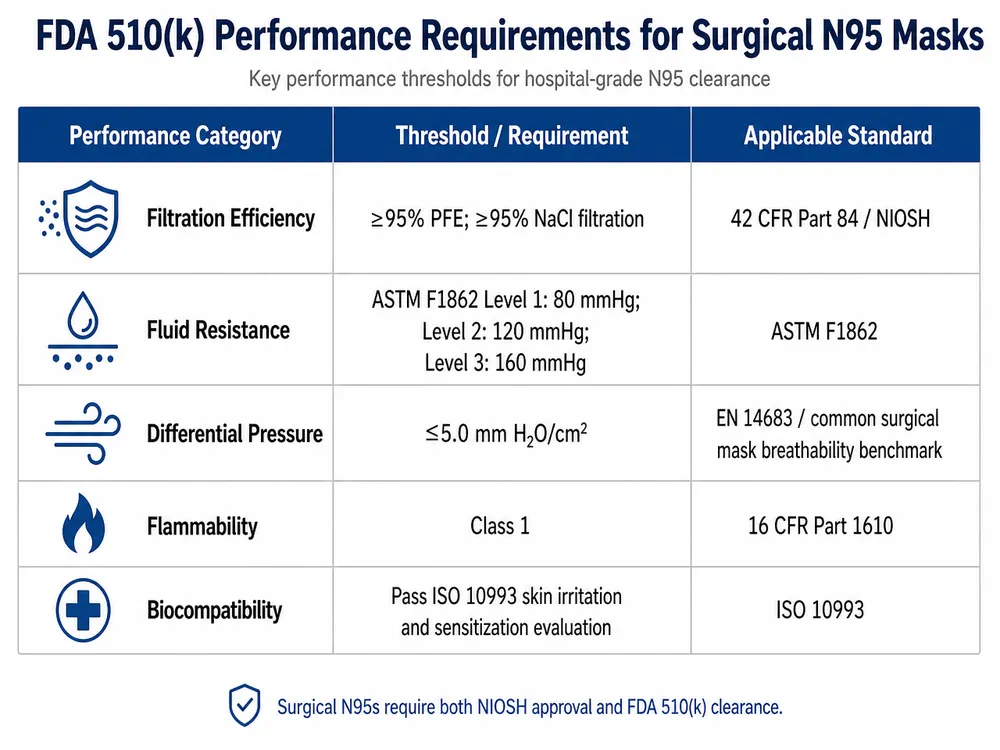
The performance requirements for a 510(k)-cleared surgical N95 are more demanding than most buyers realize. Here's what the submission must cover:
Filtration efficiency: ≥95% PFE against 0.1-micron latex sphere aerosol (ASTM F2101) and ≥95% against NaCl aerosol per NIOSH 42 CFR Part 84. Both tests must pass — the NIOSH test alone is not sufficient for the 510(k) submission.
Fluid resistance: Synthetic blood penetration resistance at 80 mmHg minimum (ASTM F1862 Level 1), with higher levels (120 mmHg for Level 2, 160 mmHg for Level 3) required for higher-splash-risk environments. Most hospital GPO contracts specify Level 3 for OR use.
Differential pressure (breathability): Delta-P ≤5.0 mm H₂O/cm² per MIL-M-36954C. This is the breathability test — a mask that passes filtration but fails Delta-P is too restrictive for extended clinical wear.
Flammability: Class 1 per 16 CFR 1610 — the mask material must not support combustion.
Biocompatibility: ISO 10993 cytotoxicity testing. This is the one that catches manufacturers who use substandard adhesives or nose wire coatings — materials that pass filtration tests but cause skin sensitization in clinical use.
The filtration layer is where most of this performance lives. Meltblown nonwoven fabric — the middle layer in an N95 — determines BFE, PFE, and Delta-P simultaneously. We produce our own meltblown fabric in-house, which means we set the fiber diameter, basis weight, and electrostatic charge level to hit the spec we're targeting. When a batch is tested, we know exactly what's in it because we made the material. Suppliers who buy meltblown from outside are dependent on their fabric supplier's consistency — and that consistency is what gets tested when your compliance team runs an audit.
How to Verify a Supplier's 510(k) Registration Before Ordering
The FDA maintains a public database of all 510(k) clearances at accessdata.fda.gov. Before placing any order for hospital-grade N95 masks, your compliance team should run this check directly — not rely on the supplier's word.
Step 1: Get the K-number from the supplier. A legitimate 510(k)-cleared product will have a K-number (format: K followed by six digits, e.g., K123456) on the product labeling and in the supplier's documentation. If the supplier cannot provide a K-number, the product does not have 510(k) clearance.
Step 2: Search the FDA 510(k) database. Go to accessdata.fda.gov/scripts/cdrh/cfdocs/cfpmn/pmn.cfm and search by the K-number or by the applicant name. The database entry will show the device name, applicant, clearance date, product code, and the decision letter.
Step 3: Verify the device description matches what you're ordering. The 510(k) clearance is specific to the device as described in the submission. Check that the product name, intended use, and device classification in the database match the product you're purchasing. A clearance for a 3-ply surgical mask does not cover an N95 respirator.
Step 4: Check the labeling. FDA regulations require that the 510(k) K-number appear on the product labeling. If the packaging doesn't show the K-number, the product is either not cleared or the labeling is non-compliant — both are problems for hospital procurement.
Step 5: Confirm the applicant name. The name on the 510(k) clearance should match the manufacturer you're sourcing from. If a distributor is claiming clearance that belongs to a different entity, that's a red flag worth investigating before the order goes out.
This five-step check takes about ten minutes and eliminates the most common compliance exposure in overseas N95 procurement. We've walked several US hospital importers through this process — the ones who do it before ordering never have the conversation about why their shipment is being held at the port.
Pre-Order Documentation Checklist for Hospital Compliance Teams
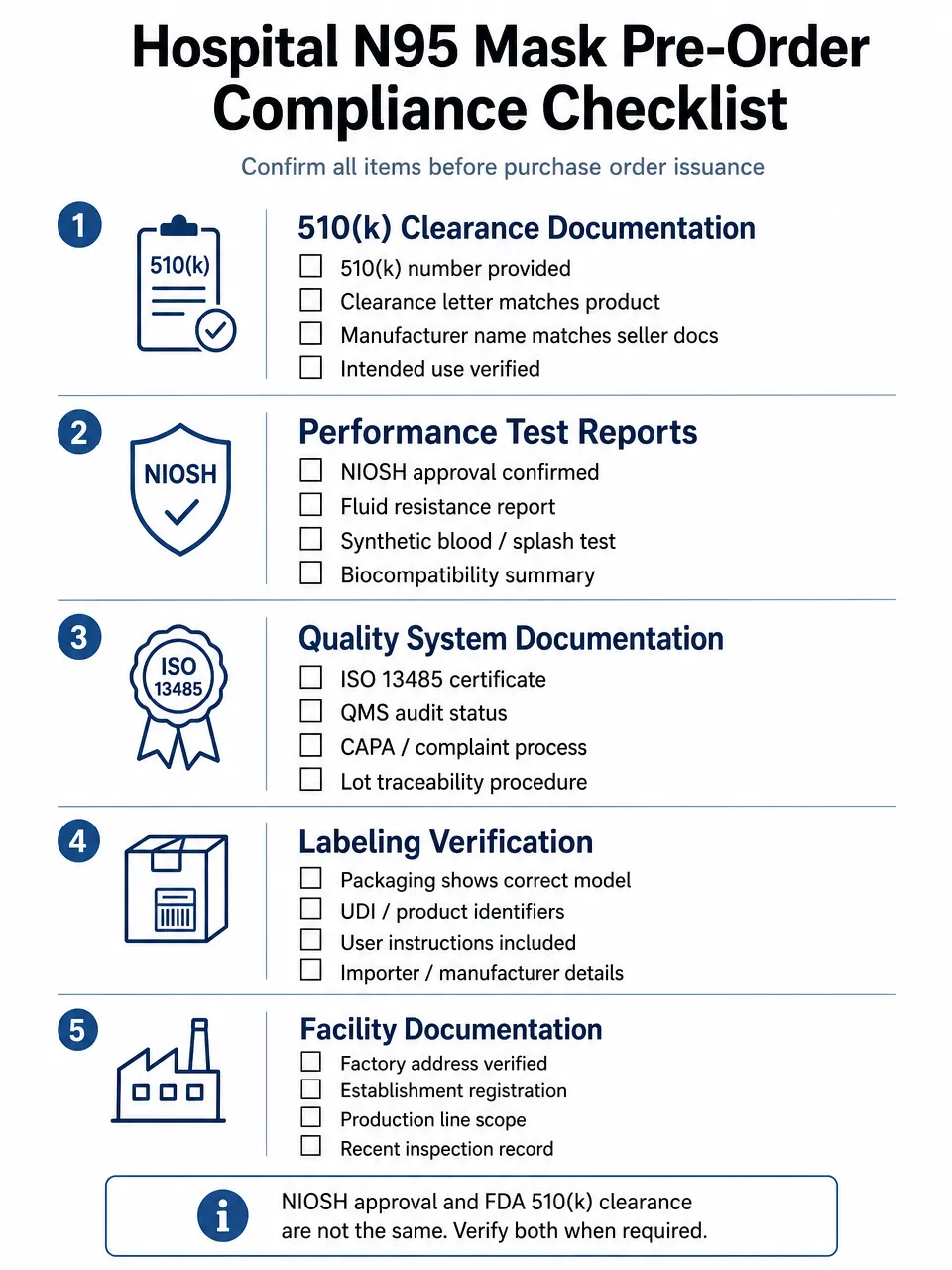
Before any hospital-grade N95 order is confirmed, your compliance team should have the following documents in hand. This is the standard package we provide with every order — and if a supplier can't produce all of it, that's the answer you need before you commit.
510(k) Clearance Documentation
- FDA 510(k) K-number (on product labeling and in writing from supplier)
- Copy of FDA 510(k) clearance letter or database confirmation
- Confirmation that the cleared device description matches the product being ordered
Performance Test Reports
- BFE test report (≥95%, ASTM F2101 or equivalent)
- PFE test report (≥95%, ASTM F2101 or equivalent)
- Delta-P test report (≤5.0 mm H₂O/cm², MIL-M-36954C or equivalent)
- Fluid resistance test report (ASTM F1862, specify Level 1/2/3)
- Flammability test report (16 CFR 1610 Class 1)
- Biocompatibility test report (ISO 10993 cytotoxicity)
Quality System Documentation
- ISO 13485:2016 certificate (medical device quality management system)
- Certificate of Conformity (CoC) for the specific order/batch
- Batch/lot number traceability documentation
Labeling Verification
- Confirmation that product labeling includes: K-number, NIOSH TC number, manufacturer name and address, lot number, expiration date, and intended use statement
- Sample label or packaging artwork for review before shipment
Facility Documentation (for institutional procurement audits)
- FDA device establishment registration number
- Cleanroom classification documentation (ISO 8 / Class 100,000 minimum for medical mask production)
(A note on the CoC: some suppliers issue a generic certificate that covers their entire product line rather than the specific batch you ordered. For hospital procurement, the CoC should reference your purchase order number and the specific lot numbers being shipped. Generic certificates don't hold up in a compliance audit.)
What a Compliant Supplier Documentation Package Looks Like — and What to Reject
The documentation package is where you find out whether a supplier actually has what they claim. Here's what a complete, audit-ready package from a legitimate 510(k)-registered manufacturer looks like in practice.
The test reports should come from accredited third-party laboratories — not just internal QC records. ASTM F2101 BFE and PFE reports from labs like Nelson Labs, SGS, or equivalent ISO 17025-accredited facilities carry weight in a compliance review. Internal test data is useful for ongoing production monitoring, but it doesn't substitute for third-party certification in a hospital procurement audit. We run in-house BFE, PFE, and Delta-P testing on every production batch as a quality gate — but the certification documentation we ship with orders comes from third-party labs.
The ISO 13485 certificate should be current (check the expiration date) and issued by an accredited certification body. ISO 13485 is the medical device quality management standard — it's what separates a factory that has documented risk management, design controls, and traceability from one that has a quality manual on a shelf. Our ISO 13485:2016 certification covers our full production scope including N95 respirators.
The 510(k) clearance letter is a public document — you can pull it from the FDA database yourself. But having the supplier provide it directly, along with confirmation that the product you're ordering matches the cleared device description, closes the loop on the most common documentation gap we see in hospital procurement reviews.
What to reject:
- Test reports without accredited lab identification or ISO 17025 accreditation number
- CoC that references a product category rather than a specific batch or lot
- "FDA registered" claims without a K-number — facility registration is not product clearance
- ISO certificates that are expired or issued by non-accredited bodies
- Labeling that omits the K-number, NIOSH TC number, or lot number
- Suppliers who can't provide the full package before order confirmation — not after
The last point matters. Some suppliers will promise documentation "with the shipment." For hospital procurement, that's too late. If the documentation doesn't exist before the order is placed, it may not exist at all.
Why Meltblown Production Control Matters for Hospital Supply Contracts
Hospital supply contracts run across multiple order cycles. The compliance documentation you verify before the first order needs to hold up on the fifth order — same specs, same test results, same labeling. That consistency depends on the filtration layer.
Meltblown nonwoven fabric is the component that determines BFE and PFE performance. It's also the component with the most variability in the supply chain. Fiber diameter, basis weight, and electrostatic charge level all affect filtration efficiency — and all three can shift between production runs if the manufacturer is buying meltblown from an outside supplier who changes their process or raw material source.
We brought meltblown production in-house specifically because of this variability problem. Our meltblown line produces the filtration layer to our own spec — fiber diameter and basis weight are set to hit ≥95% BFE and PFE consistently, and electrostatic charge is applied and verified before the fabric goes into mask production. When we test a batch and it passes, we know why it passed. When a batch fails internal testing (it happens — that's what the QC gate is for), we can trace the failure to a specific production parameter and correct it before the next run.
For hospital buyers running multi-year supply contracts, this matters commercially. Spec drift between orders creates re-qualification work, compliance documentation gaps, and in the worst case, product that passes the first audit and fails the second. Controlling the filtration layer at source is how we prevent that from happening across your order history.
Our Class 100,000 (ISO 8) cleanroom manufacturing environment is the other facility requirement that hospital procurement audits check. Particle counts are monitored continuously, and access is controlled. This isn't a marketing claim — it's a documented facility specification that we can provide in writing for your institutional procurement review.
Sourcing Hospital N95 Masks from China: The Compliance Exposure Points
Sourcing from Chinese manufacturers is standard practice for hospital N95 procurement — the manufacturing capacity is here, the certification infrastructure exists, and the cost structure works for institutional volumes. The compliance exposure isn't in the geography; it's in the documentation gaps that show up when buyers don't know what to ask for.
The most common exposure points we see:
KN95 vs N95 confusion: KN95 is a Chinese standard (GB 2626-2019). It is not equivalent to NIOSH N95 for US hospital use, and it does not qualify for FDA 510(k) clearance as a surgical N95. Some suppliers list both on the same product sheet in a way that implies equivalence. They are not equivalent. If your hospital requires NIOSH-approved N95 respirators, the product must carry a NIOSH TC number — not a GB 2626 certification.
Facility registration vs product clearance: Chinese manufacturers are required to register their facilities with the FDA as device establishments if they export medical devices to the US. That registration number is real and verifiable. It does not mean their products have 510(k) clearance. The two are separate, and conflating them is the most common documentation misrepresentation we see in this category.
Expired or out-of-scope certifications: ISO 13485 certificates expire and must be renewed through surveillance audits. A certificate issued in 2020 that hasn't been renewed is not current. Similarly, a 510(k) clearance for one product configuration doesn't automatically cover a modified version — if the manufacturer changed the nose wire, ear-loop attachment method, or filtration layer spec after clearance, the original K-number may not cover the current product.
Test reports from non-accredited labs: China has accredited testing laboratories that produce internationally recognized results. It also has labs that produce reports that look official but aren't. For hospital procurement, specify that test reports must come from ISO 17025-accredited laboratories. The accreditation number should be on the report.
We've been exporting to US healthcare buyers since our early years, and the documentation requirements have gotten more rigorous, not less, since 2020. The buyers who have the smoothest import experience are the ones who treat the documentation checklist as a pre-order requirement, not a post-shipment formality.
Verifying Compliance Across Your N95 Supply Chain
For hospital systems managing multiple suppliers or running competitive bid processes, the documentation checklist above becomes a supplier qualification matrix. Every supplier in your N95 category should be able to produce the same package — and the ones who can't are telling you something important about their compliance posture.
A few practical notes from the manufacturer side:
The 510(k) K-number is the fastest single check. Pull it from the FDA database before you do anything else. If it's there and the device description matches, you have the foundation. If it's not there, the conversation is over.
NIOSH TC numbers are also publicly verifiable. The NIOSH Certified Equipment List (CEL) at cdc.gov/niosh/npptl/topics/respirators/cel/ lists every approved respirator by TC number, manufacturer, and model. Cross-reference the TC number on the packaging against the CEL entry — the manufacturer name and model should match exactly.
For ongoing supply contracts, build a documentation renewal schedule into your supplier management process. ISO 13485 certificates typically run three-year cycles with annual surveillance audits. 510(k) clearances don't expire, but they can become non-applicable if the product changes. Ask your supplier to notify you of any changes to the cleared device configuration — that's a standard request and a legitimate one.
Our Hospital N95 Medical Mask product page has the current specification sheet, including the 510(k) K-number, NIOSH TC number, and available test report summary. If you're building a supplier qualification file, that's the starting point.
For the full documentation package — clearance letter, test reports, ISO 13485 certificate, and CoC template — contact us directly before your order is placed. We prepare the compliance package as part of the order process, not as an afterthought. If you're ready to move forward, submit an RFQ with your required grade, quantity, and any specific labeling or documentation requirements, and we'll confirm the full package with your quote.
FAQ: Hospital N95 Procurement Compliance
Does a NIOSH-approved N95 qualify for hospital use without FDA 510(k) clearance?
For general healthcare worker protection in non-procedural settings, a NIOSH-approved N95 may be acceptable depending on your facility's infection control policy. For use in operating rooms, procedural areas, or any setting where fluid splash is a risk, FDA 510(k) clearance as a surgical N95 is required. The fluid resistance testing (ASTM F1862) that's part of the 510(k) submission is what qualifies the product for those environments — NIOSH approval doesn't cover it.
What's the difference between a surgical N95 and a standard N95 respirator?
Both filter ≥95% of airborne particles. A surgical N95 additionally meets fluid resistance requirements (ASTM F1862), passes biocompatibility testing (ISO 10993), and is cleared by the FDA as a Class II medical device. The surgical designation is what makes it appropriate for clinical environments where the wearer may be exposed to blood or body fluid splatter.
How do I verify that a Chinese manufacturer's 510(k) clearance is current and applicable to the product I'm ordering?
Search the FDA 510(k) database at accessdata.fda.gov using the K-number the supplier provides. Confirm that the applicant name matches the manufacturer, the device description matches the product you're ordering, and the clearance date is on record. Then check the product labeling — the K-number must appear on the packaging. If any of these don't align, ask the supplier to explain the discrepancy before placing the order.
What ISO certification should a hospital N95 supplier hold?
ISO 13485:2016 is the medical device quality management standard and is the baseline requirement for hospital-grade N95 procurement. ISO 9001 alone is not sufficient — it doesn't cover the medical device-specific requirements for risk management, design controls, and traceability. Verify that the ISO 13485 certificate is current (check the expiration date) and issued by an accredited certification body.
Can a supplier's 510(k) clearance cover multiple N95 product configurations?
A 510(k) clearance is specific to the device as described in the submission. If a manufacturer offers multiple N95 models (different sizes, different ear-loop configurations, cup vs. fold-flat), each configuration may require its own clearance or may be covered under a single clearance if the variations were included in the original submission. Ask the supplier to confirm which specific product configurations are covered by the K-number they provide.
What's the minimum documentation package for a hospital GPO compliance audit?
At minimum: the 510(k) K-number with FDA database confirmation, current ISO 13485 certificate, third-party BFE/PFE/Delta-P test reports from an ISO 17025-accredited lab, fluid resistance test report (ASTM F1862), and a batch-specific Certificate of Conformity. Some GPO contracts also require facility audit reports or cleanroom classification documentation. Check your specific contract requirements — the list above covers the standard baseline.
For N95 Medical Masks sourced with full compliance documentation, or to discuss your hospital procurement requirements before placing an order, the documentation package is ready when you are.