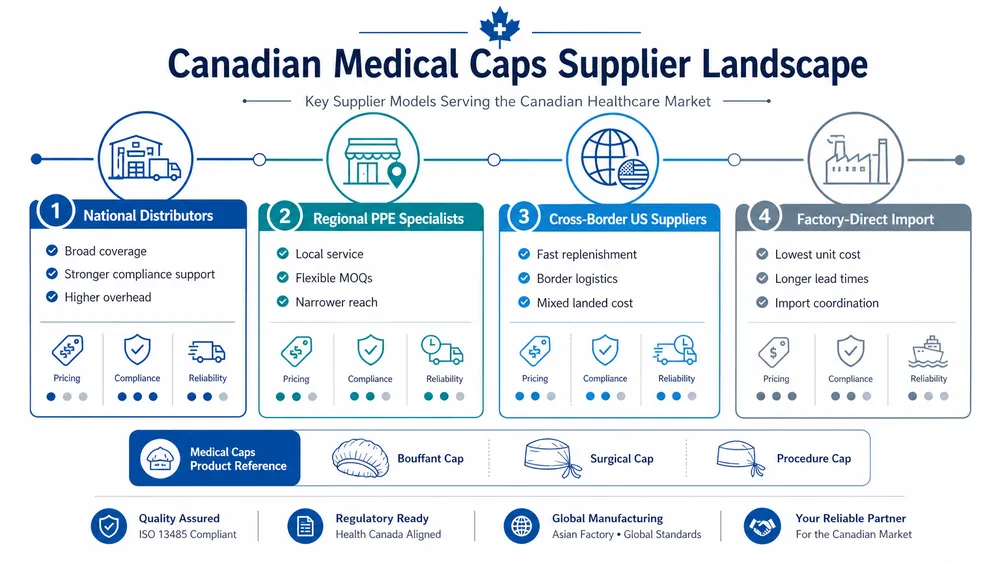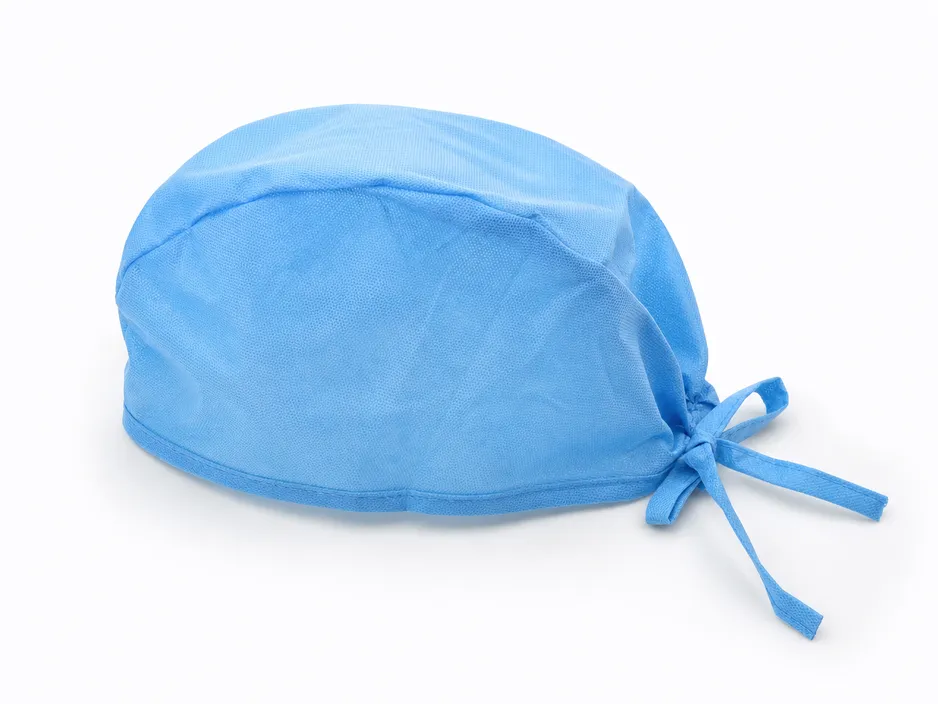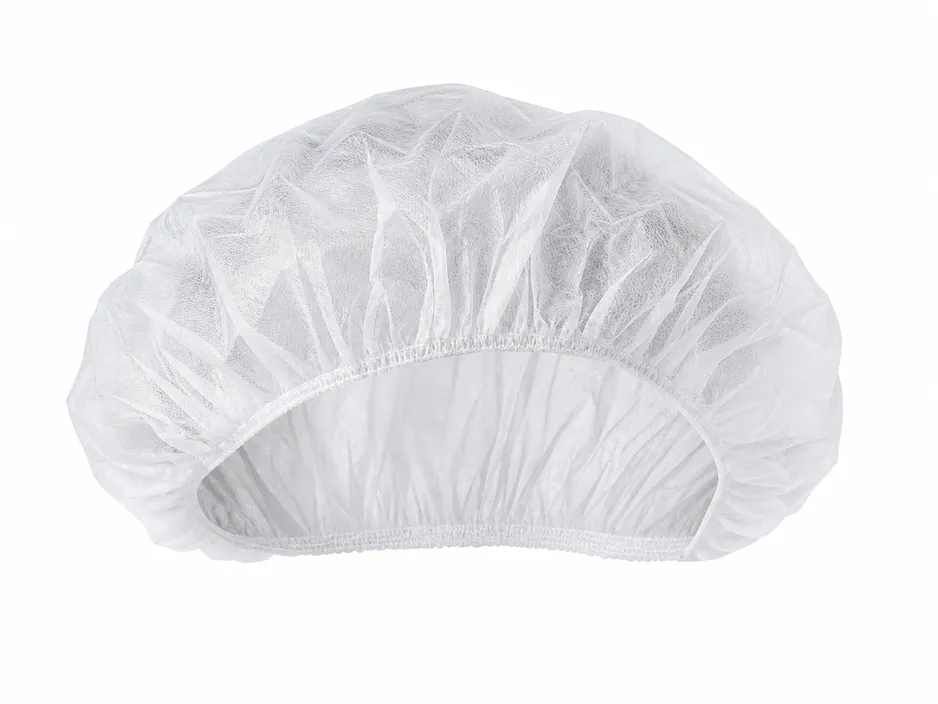
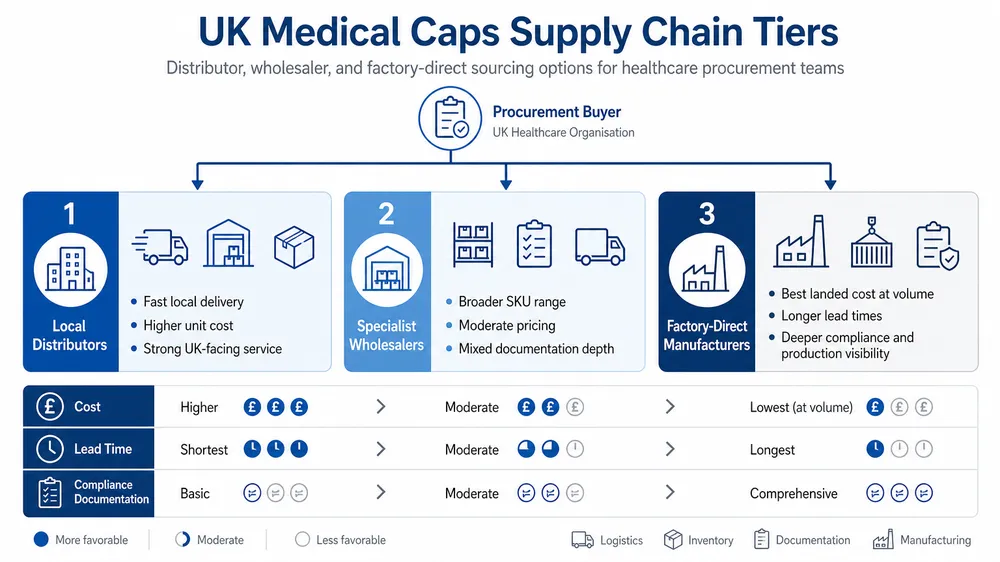
The UK medical caps market looks straightforward until you start placing real orders. You have a handful of well-known distributors, a longer tail of PPE resellers, and — if you know where to look — a direct path to the factories that supply all of them. The difference between those three tiers is not just price. It's batch consistency, documentation depth, and how much of your procurement budget disappears into the distribution chain before a single cap reaches your facility.
This guide covers 10 real suppliers serving the UK market, explains what each supplier model is actually good for, and gives you a framework for deciding when local stock makes sense and when factory-direct import starts to pay for itself.

Why UK Procurement Teams Are Re-Evaluating Their Medical Caps Supply Chain
Post-Brexit regulatory changes shifted the compliance landscape in ways that still catch buyers off guard. CE marking under EU MDR is currently accepted in Great Britain under transitional arrangements, but UKCA marking is the long-term direction — and not every supplier in your current roster has mapped out their UKCA pathway. If you're running NHS framework contracts or supplying private clinic networks, that gap is a procurement audit risk, not just a paperwork inconvenience.
The supply disruptions of 2020–2022 also changed how procurement teams think about single-source dependency. Buyers who relied on one UK distributor for their entire bouffant cap volume learned the hard way that distributor stock depth is only as reliable as the upstream factory relationship. Several distributors were themselves caught short because they had no direct factory access — they were buying from intermediaries who were buying from factories.
NHS cost pressures add another layer. The NHS Supply Chain framework has pushed harder on unit cost benchmarking, and procurement teams are increasingly asked to justify why they're paying distributor-tier pricing on high-volume consumables when factory-direct alternatives exist with equivalent certification. (We've seen this question come up more frequently from NHS trust procurement leads in the last two years — it's a real conversation, not a theoretical one.)
The result: more procurement teams are running dual-source strategies — local stock for urgent replenishment, factory-direct for planned volume orders. Getting that balance right starts with understanding who the real players are.
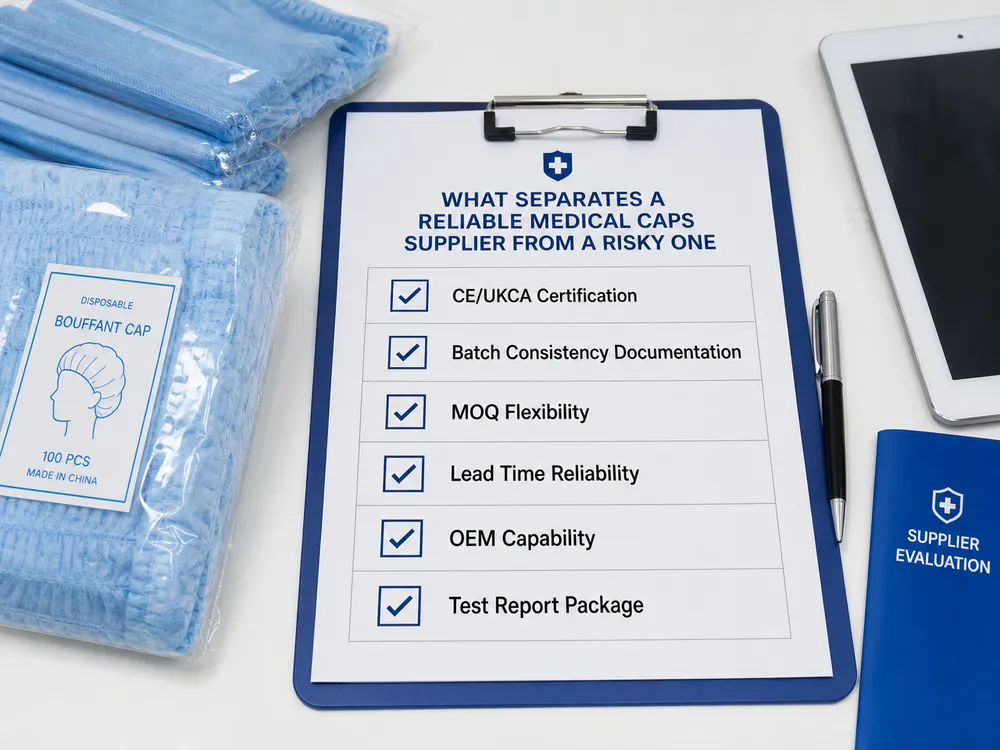
What Separates a Reliable Medical Caps Supplier from a Risky One
Before the list, the criteria. A cap is a simple product, but the sourcing decision is not. Here's what actually matters when you're evaluating suppliers for repeat institutional volume:
CE or UKCA certification status — not just a claim, but a verifiable certificate with a notified body number. For CE MDR, the notified body must be EU-recognised. For UKCA, the approved body must be UK-registered. Ask for the certificate, not just the logo.
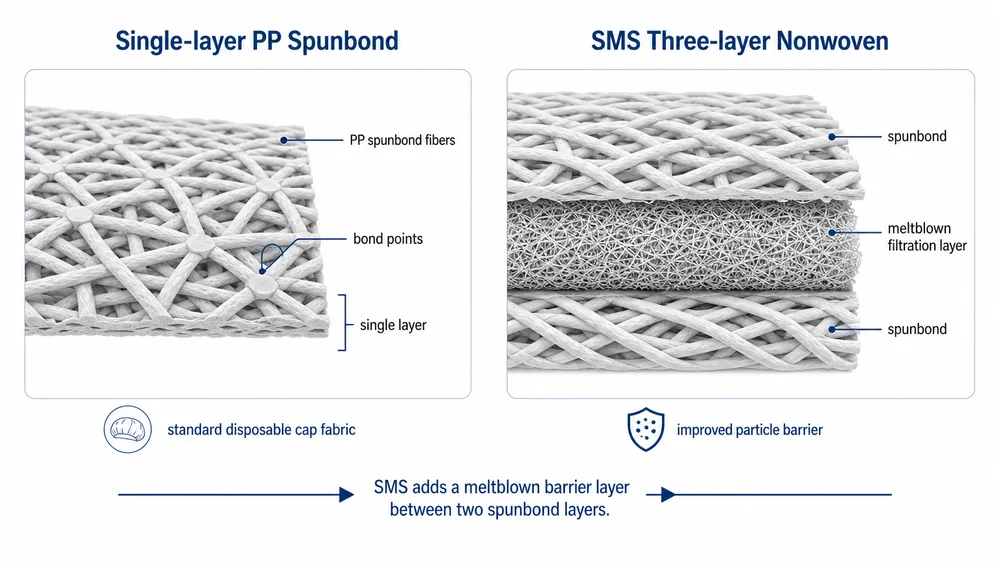
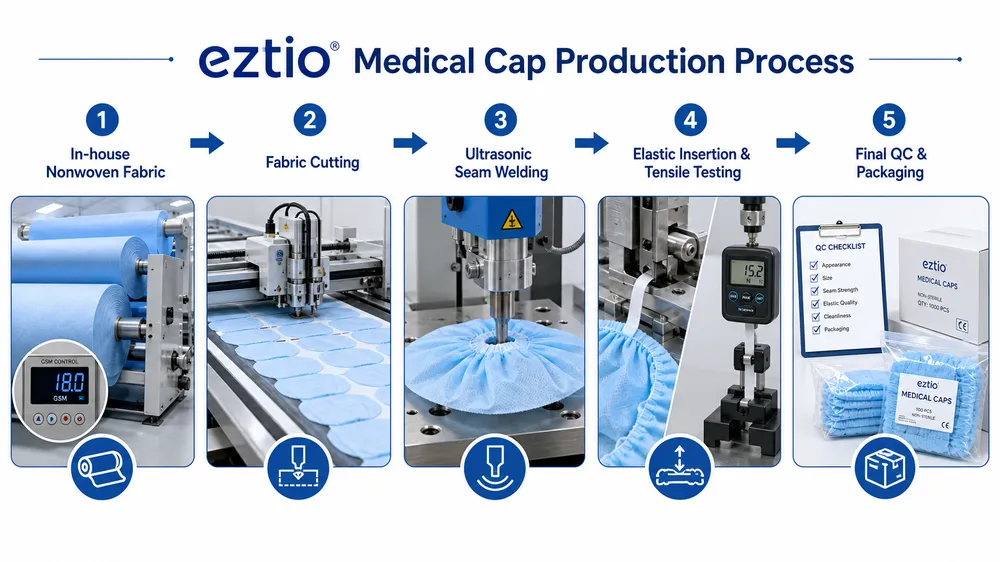
Batch consistency documentation — this is where distributors and manufacturers diverge sharply. A distributor may source from multiple upstream factories across different orders, meaning your 21 GSM bouffant cap in January may not be the same fabric spec as your March reorder. A manufacturer with in-house nonwoven production controls the GSM, elastic tensile strength, and seam integrity from raw material to finished product.
MOQ and lead time structure — local distributors typically offer low MOQ with fast delivery from UK stock. Factory-direct suppliers require higher MOQ (typically 50,000–100,000 pieces) but offer significantly lower per-unit cost on planned orders. The right answer depends on your order cadence.
OEM and private-label capability — relevant if you're building a branded PPE line or supplying under a healthcare brand's own label. Most UK distributors cannot offer this. Factory-direct manufacturers can.
Documentation package — for NHS procurement and clinical compliance, you need more than a product datasheet. You need test reports (BFE, particle filtration, breathability), material safety data, and ideally a Declaration of Conformity that names the specific product SKU.
Top 10 Medical Caps Suppliers Serving the UK Market
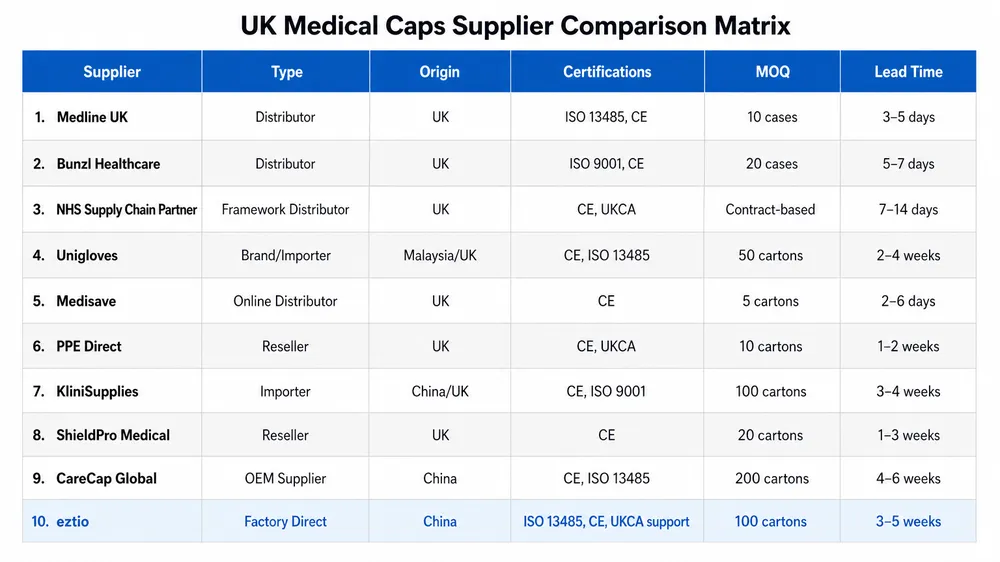
The suppliers below represent the realistic sourcing landscape for UK healthcare procurement teams in 2025. They span distributor, wholesaler, and manufacturer tiers — each with different strengths depending on your order profile.
1. Medline Industries (UK Operations)
Website: medline.com | Type: Global distributor / manufacturer hybrid | Origin: USA (UK distribution)
Medline is one of the largest healthcare product distributors operating in the UK market, supplying NHS trusts and private healthcare networks with a broad range of disposable PPE including bouffant caps, surgical caps, and procedure caps. Their UK operations provide local stock access with relatively fast replenishment cycles. Certification documentation is generally available, though buyers should verify the specific product SKU's compliance status rather than assuming blanket coverage across the range. MOQ for standard lines is low, making them practical for urgent or low-volume orders. Per-unit pricing reflects the full distribution margin.
2. Mölnlycke Health Care (UK)
Website: molnlycke.com | Type: Manufacturer / direct sales | Origin: Sweden (UK office)
Mölnlycke is a Swedish medical device manufacturer with a strong UK presence, particularly in surgical environments. Their surgical cap and head cover range is positioned at the clinical-grade end of the market, with robust CE MDR documentation and a reputation for consistent product quality across NHS surgical procurement. Their strength is in OR-specific applications where contamination control standards are highest. MOQ and pricing reflect a premium positioning — they are not the right choice for high-volume commodity procurement where unit cost is the primary driver, but for surgical suite supply where compliance documentation depth matters, they are a credible option.
3. Kimberly-Clark Professional (UK)
Website: kcprofessional.com | Type: Global manufacturer / distributor | Origin: USA (UK distribution)
Kimberly-Clark's professional healthcare division supplies disposable caps and head covers to UK healthcare and industrial buyers through a network of authorised distributors. Their KIMTECH and Halyard-branded products are well-recognised in NHS procurement frameworks. The distribution model means you're typically buying through a reseller rather than direct, which adds a margin layer. For buyers already running Kimberly-Clark contracts across other PPE categories, consolidating caps into the same supplier relationship is a practical convenience. For buyers optimising purely on unit cost, the distribution chain limits how far pricing can move.
4. Arco Limited
Website: arco.co.uk | Type: UK PPE distributor | Origin: UK (Hull)
Arco is one of the UK's largest safety and PPE distributors, with a healthcare product range that includes disposable medical caps. They hold NHS Supply Chain framework agreements and serve both NHS trusts and private sector healthcare buyers. Their strength is UK stock depth and fast delivery — next-day for most standard lines. For emergency replenishment or low-volume orders where speed matters more than unit cost, Arco is a practical choice. Their medical caps range is sourced from multiple upstream suppliers, so batch-to-batch consistency should be verified if you're running a protocol that specifies exact GSM or elastic tensile parameters.
5. Gompels Healthcare
Website: gompels.co.uk | Type: UK healthcare wholesaler | Origin: UK (Swindon)
Gompels is a UK-based healthcare and care sector wholesaler supplying care homes, clinics, and NHS-adjacent facilities with disposable PPE including bouffant caps and non-woven head covers. Their pricing is competitive within the UK wholesale tier, and their ordering platform is straightforward for repeat procurement. They serve a broad customer base across the care sector rather than specialising in acute clinical environments, which is reflected in their product range — practical and cost-effective for general clinical use, less suited for surgical-grade applications requiring deep compliance documentation.
6. Medisave UK
Website: medisave.co.uk | Type: UK medical supplies distributor | Origin: UK
Medisave is a UK medical supplies distributor serving GP practices, clinics, and healthcare professionals with a range of disposable PPE including medical caps. Their catalogue covers standard bouffant and surgical cap formats, and their ordering process is designed for smaller clinical buyers rather than large institutional procurement. For GP practices or small clinic networks running modest monthly volumes, Medisave offers a convenient single-source option. For NHS trust-level procurement or bulk institutional orders, their pricing and MOQ structure is less competitive than either specialist wholesalers or factory-direct alternatives.
7. Safepoint Medical
Website: safepointmedical.co.uk | Type: UK PPE and medical supplies distributor | Origin: UK
Safepoint Medical supplies disposable PPE and medical consumables to UK healthcare buyers, including a range of non-woven medical caps. They operate in the mid-market between large national distributors and specialist clinical suppliers, serving NHS trusts, private hospitals, and care sector buyers. Their product range includes standard bouffant caps and surgical head covers with CE documentation. For buyers looking for a UK-based supplier with a focused healthcare product range rather than a broad industrial PPE catalogue, Safepoint is worth evaluating.
8. Globus Group
Website: globusgroup.co.uk | Type: UK PPE manufacturer and distributor | Origin: UK (Manchester)
Globus Group is a UK-based PPE manufacturer and distributor with a healthcare product range that includes disposable head covers and medical caps. They manufacture some products in-house and distribute others, giving them a hybrid model that can offer more direct pricing on certain lines. Their UK manufacturing credentials are a differentiator for buyers with local-supply requirements or NHS procurement policies that favour UK-origin products. Product range depth in the medical caps category is narrower than the large global distributors, but their direct manufacturing capability on selected lines is worth noting for buyers who value supply chain transparency.
9. Robinson Healthcare
Website: robinsonhealthcare.com | Type: UK healthcare manufacturer and distributor | Origin: UK (Nottinghamshire)
Robinson Healthcare is a long-established UK healthcare products company with manufacturing and distribution operations. Their product range spans wound care, hygiene, and PPE, including disposable caps for clinical environments. As a UK manufacturer with NHS supply relationships, they offer a degree of supply chain visibility that pure distributors cannot match. Their medical caps range is positioned for standard clinical use rather than high-volume commodity procurement. For buyers who prioritise UK-origin supply and established NHS relationships, Robinson is a credible option in the mid-market.
10. eztio — Factory-Direct from Gaomi, Shandong
Website: eztio.com | Type: Dedicated medical cap and mask manufacturer | Origin: China (direct export)
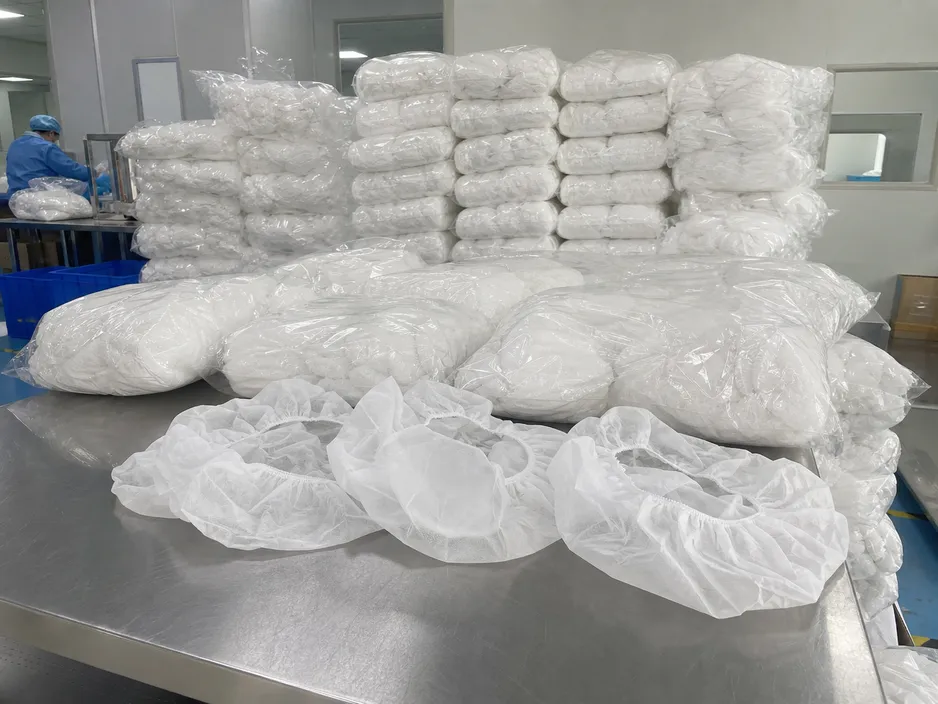
We make disposable medical caps — bouffant caps, surgical caps, and non-woven head covers — at our 12,000 m² facility in Gaomi, Shandong. We've been doing this since 2012, and medical-grade nonwoven products are the only thing we make. That focus matters when you're evaluating batch consistency: we control the nonwoven fabric production in-house, which means the 21 GSM specification on your first order is the same 21 GSM on your tenth.
Our certifications — ISO 13485:2016, CE under EU MDR, ISO 9001:2015, FDA 510(k) registration, and SGS — are maintained because our buyers need them to clear customs and pass procurement audits. The CE MDR certificate is currently accepted in Great Britain under transitional arrangements, giving you a compliant import path without waiting for UKCA transition timelines to resolve.
MOQ starts at 50,000 pieces for standard SKUs — accessible for mid-size procurement teams running a trial program before committing to framework volume. Full OEM and private-label capability means your branded packaging is handled at the factory, not by a separate supplier downstream.
Supplier Comparison: At a Glance
| Supplier | Type | Origin | Certifications | MOQ | Lead Time | OEM |
|---|---|---|---|---|---|---|
| Medline | Distributor/Mfr | USA/UK | CE, FDA | Low | 1–5 days (UK stock) | Limited |
| Mölnlycke | Manufacturer | Sweden/UK | CE MDR | Medium | 1–2 weeks | No |
| Kimberly-Clark | Distributor | USA/UK | CE, FDA | Low | 1–5 days (UK stock) | No |
| Arco | Distributor | UK | CE | Low | Next day | No |
| Gompels | Wholesaler | UK | CE | Low | 2–5 days | No |
| Medisave | Distributor | UK | CE | Low | 2–5 days | No |
| Safepoint Medical | Distributor | UK | CE | Low | 2–5 days | No |
| Globus Group | Mfr/Distributor | UK | CE | Medium | 3–7 days | Selected lines |
| Robinson Healthcare | Mfr/Distributor | UK | CE | Medium | 3–7 days | Limited |
| eztio | Manufacturer | China (direct) | ISO 13485, CE MDR, FDA 510(k), SGS | 50,000 pcs | 25–35 days | Full OEM |
The Real Cost of Distributor Convenience
Local distributors solve a real problem: speed. When a ward runs short on bouffant caps on a Tuesday afternoon, next-day delivery from Arco or Medline is worth the premium. Nobody is arguing otherwise.
The question is whether that convenience pricing makes sense across your entire annual volume — including the planned, forecastable portion of your procurement.
Here's the arithmetic that most procurement teams don't run explicitly. A UK distributor for commodity disposable caps typically operates on a 30–50% margin over their landed cost. That landed cost already includes the factory price, freight, import duty, and the distributor's own warehousing and logistics overhead. By the time the cap reaches your facility, you're paying for three or four layers of commercial margin on a product that costs pennies to manufacture.
For a trust running 500,000 bouffant caps per year — not an unusual volume for a mid-size NHS trust — the difference between distributor pricing and factory-direct pricing on a planned annual order can represent a meaningful budget line. The exact figure depends on your current contract pricing, but the structural gap is real and consistent across the market.
The trade-off is honest: factory-direct requires forward planning. You need a 25–35 day lead time buffer, a minimum order quantity that makes sense for your storage capacity, and a supplier whose documentation package can survive your compliance review. If those conditions are met, the economics shift decisively.
(We've had UK buyers come to us after running the numbers on their annual cap spend and realising they were paying distributor margin on a product they order every quarter without variation. The conversation usually starts with "we didn't realise factory-direct was this accessible.")
UK Regulatory Context: CE, UKCA, and What You Actually Need to Import Compliantly
This is the section most sourcing guides skip, and it's the one that creates the most procurement risk.
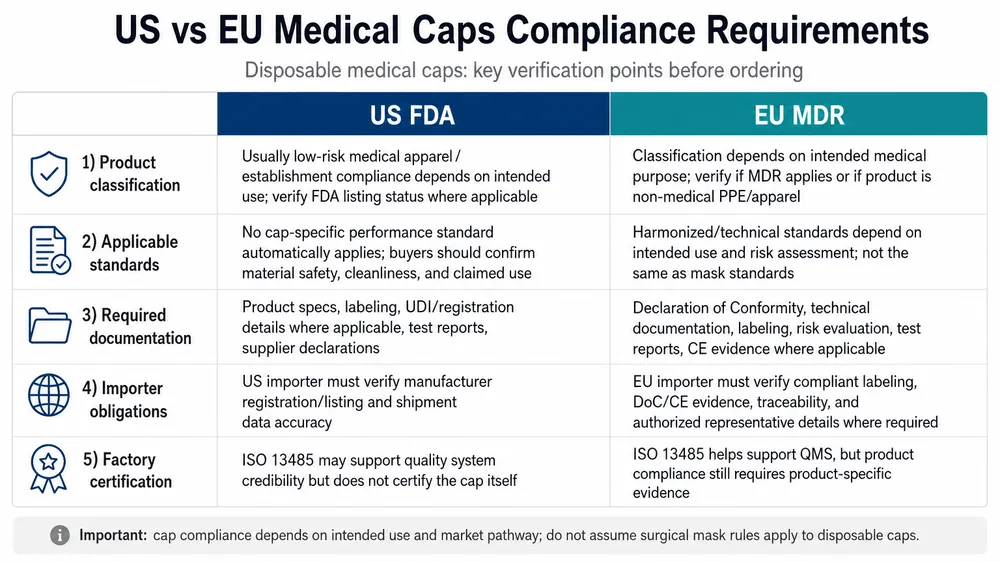
Post-Brexit, the UK operates its own conformity assessment framework — UKCA marking — which is separate from the EU's CE marking system. For medical devices including medical caps, the Medicines and Healthcare products Regulatory Agency (MHRA) governs compliance. The current position, as of 2025, is that CE marking under EU MDR continues to be accepted in Great Britain under transitional arrangements. The MHRA has extended these arrangements multiple times, and the practical reality is that CE MDR-certified products can be legally placed on the UK market today.
What this means for your sourcing decision: a supplier holding a valid CE MDR certificate from a recognised EU notified body gives you a compliant import path right now. You don't need to wait for a supplier to complete UKCA registration before placing an order — provided the CE MDR certificate is current and covers the specific product SKU you're ordering.
What to verify before importing:
- The CE certificate names the specific product (not just a product family)
- The notified body is EU-recognised (check the NANDO database)
- The Declaration of Conformity references the correct EU MDR regulation (2017/745)
- The product is correctly classified (most disposable medical caps are Class I medical devices)
For NHS procurement specifically, your trust's procurement policy may have additional requirements around supplier qualification, audit rights, or documentation format. Check your framework agreement terms before placing a first order with any new supplier.
Distributor vs. Factory-Direct: Which Sourcing Route Fits Your Situation
This isn't a binary choice. Most procurement teams running serious volume use both — and the split between them is a function of order type, not supplier loyalty.
Local distributor is the right answer when:
- You need delivery within 48 hours for urgent replenishment
- Your order volume is below 20,000 pieces and doesn't justify import logistics
- You're trialling a new cap format before committing to bulk volume
- Your compliance team needs a UK-registered supplier for framework qualification purposes
Factory-direct is the right answer when:
- You're placing planned quarterly or annual orders above 50,000 pieces
- You need consistent batch specs across multiple order cycles (same GSM, same elastic tensile, same seam construction)
- You're building a private-label or OEM cap program under your own brand
- Your current distributor pricing is under scrutiny and you need a cost benchmark
- You want direct access to test reports, material certifications, and production batch records — not just a product datasheet
The hybrid approach that works well for NHS trusts and larger private healthcare networks: maintain a local distributor relationship for emergency stock and low-volume orders, and run a direct factory relationship for your planned annual volume. The factory-direct portion covers the predictable demand; the local distributor covers the variance.
How to Verify a Medical Caps Supplier Before Placing a Bulk Order
The sourcing landscape for disposable medical caps includes a significant number of trading companies and intermediaries presenting themselves as manufacturers. Here's how to tell the difference and protect your procurement decision.
Request the ISO 13485 certificate directly — not a copy of a copy, but the current certificate with the issuing body's name and the certificate number. ISO 13485 is a quality management system standard for medical device manufacturers. A trading company can hold ISO 9001 but not ISO 13485, because 13485 requires manufacturing process controls that a pure trading operation cannot demonstrate.
Ask for the CE MDR Declaration of Conformity — this document names the manufacturer, the product, the applicable regulation, and the notified body. If the supplier cannot produce this document for the specific SKU you're ordering, the CE claim is not verifiable.
Request a production batch test report — not a generic product specification sheet, but an actual test report from a third-party lab (SGS, Intertek, Bureau Veritas) showing BFE (bacterial filtration efficiency), particle filtration, and breathability results for a recent production batch. The batch number on the test report should be traceable to a production record.
Ask about nonwoven fabric sourcing — this is the question that separates manufacturers from assemblers. A real manufacturer can tell you the GSM specification of their nonwoven fabric, the supplier or in-house production source, and the tensile strength of their elastic. A trading company typically cannot answer this question with specificity.
Red flags to watch for:
- CE certificate that covers a broad product family without naming specific SKUs
- Test reports dated more than 18 months ago with no recent retest
- Inability to provide a factory audit report or third-party inspection certificate
- MOQ that seems unusually low for a claimed manufacturer (sub-5,000 pieces for a factory claiming 100M+ annual capacity)
- No ISO 13485 — only ISO 9001
eztio as a Factory-Direct Alternative for UK Healthcare Procurement
We've been making disposable medical caps and bouffant medical caps since 2012. The factory is in Gaomi, Shandong — 12,000 m², 6 production lines, 150 people, 120 million pieces per year across our mask and cap lines.
The detail that matters most for batch consistency: we produce our own meltblown nonwoven fabric in-house. Most cap manufacturers — and all distributors — source nonwoven fabric from external suppliers, which means their fabric spec can shift between orders depending on what their supplier has available. We control that variable. The 21 GSM polypropylene nonwoven on your first order is the same material on your fifth order, because it comes off our own production line with our own GSM and tensile spec controls.
Our elastic specification is another area where we've invested more than the market standard. Elastic failure at scale — where caps lose fit after a few hours of wear — is almost always a tensile spec problem caught too late. We run tensile testing on every elastic batch before it goes into production. The spec is 18–22 N elongation at break for standard bouffant elastic, and we reject batches that fall outside that range. (This is the kind of detail that doesn't appear on a product datasheet but shows up in your clinical staff's feedback after six months of use.)
For UK buyers specifically: our CE MDR certificate covers our surgical medical cap and bouffant cap lines, and it's currently accepted in Great Britain under transitional arrangements. We can provide the full documentation package — CE certificate, Declaration of Conformity, ISO 13485 certificate, SGS test reports, and production batch records — in the format your compliance team needs.
OEM and private-label programs are fully supported. If you're building a branded cap line or supplying under a healthcare network's own label, we handle packaging design, print, and labelling at the factory. You don't need a separate packaging supplier.
MOQ is 50,000 pieces for standard SKUs — structured to be accessible for a trial program before you commit to framework volume. Most UK buyers start with a single SKU trial order, run it through their clinical evaluation process, and then move to a quarterly supply arrangement once the spec is confirmed.
Sourcing Decision Guide: Matching Your Order Profile to the Right Supplier
Use this framework to match your procurement situation to the right sourcing route.
Urgent replenishment (under 10,000 pieces, needed within 48 hours): Arco, Medline, or Gompels. Local stock, fast delivery, no import logistics. Pay the distributor premium — it's worth it for this use case.
Standard clinical procurement (10,000–50,000 pieces, 2–4 week lead time acceptable): Evaluate UK wholesalers and mid-tier distributors. Compare pricing across Gompels, Safepoint, and Robinson Healthcare. Request batch consistency documentation if you're running a protocol with specific GSM requirements.
High-volume planned procurement (50,000+ pieces, quarterly or annual orders): Factory-direct is worth the evaluation. Request quotes from eztio alongside your current distributor pricing. The per-unit cost difference on planned volume typically justifies the import logistics overhead within the first order cycle.
OEM or private-label program: Factory-direct only. UK distributors cannot offer this. Contact eztio with your brand specifications, target volume, and packaging requirements — we'll scope the program and provide a detailed quote.
Surgical-grade supply for OR environments: Mölnlycke and eztio are both credible options. Mölnlycke offers UK-local supply with premium positioning; eztio offers factory-direct pricing with equivalent CE MDR documentation. The right choice depends on your volume and whether the per-unit cost difference justifies the import lead time.
Frequently Asked Questions
What certifications should I require from a medical caps supplier for NHS procurement?
At minimum: CE marking under EU MDR (currently accepted in Great Britain under transitional arrangements) or UKCA marking, plus ISO 13485:2016 for the manufacturing quality management system. For surgical caps used in sterile field environments, also request EN 13795 compliance documentation. Ask for the actual certificate with the notified body number — not just a logo on a product page. If the supplier cannot produce a current, named certificate for the specific SKU you're ordering, the compliance claim is unverified.
What is the difference between a bouffant cap and a surgical cap for procurement purposes?
The distinction matters for both clinical application and compliance classification. A bouffant medical cap is a general-purpose head cover used in clinical, food service, and cleanroom environments — it provides basic hair containment and particulate control. A surgical medical cap is designed for use in surgical and sterile field environments, with tighter fit, higher filtration performance, and compliance with EN 13795 or equivalent surgical barrier standards. Specifying the wrong type for a surgical environment is a compliance gap, not just a product preference issue.
How do I verify that a Chinese medical caps manufacturer is a real manufacturer and not a trading company?
Three documents separate manufacturers from traders: ISO 13485:2016 certificate (requires manufacturing process controls that trading companies cannot demonstrate), a CE MDR Declaration of Conformity naming the manufacturer as the legal manufacturer, and a third-party production batch test report (SGS, Intertek, or Bureau Veritas) with a traceable batch number. Ask for all three before placing a bulk order. A real manufacturer can produce all three within 24 hours. A trading company typically cannot.
What MOQ is realistic for a factory-direct medical caps trial order from China?
50,000 pieces is the practical floor for most certified manufacturers — below that, the production setup cost and export documentation overhead doesn't make commercial sense for either party. At 50,000 pieces of standard bouffant caps, the per-unit cost advantage over UK distributor pricing is typically significant enough to cover the import logistics cost and still deliver a lower landed cost. If a supplier is offering factory-direct pricing at 5,000 or 10,000 pieces, verify their manufacturing credentials carefully — that MOQ profile is more consistent with a trading company than a production facility.
How does post-Brexit regulation affect importing medical caps from the EU or China into the UK?
Medical caps are classified as medical devices under UK MDR 2002 (as amended). CE marking under EU MDR is currently accepted in Great Britain under MHRA transitional arrangements — this has been extended and remains valid for placing products on the UK market. Products must be registered with the MHRA through a UK Responsible Person if the manufacturer is outside the UK. The UK Responsible Person requirement applies to all non-UK manufacturers placing medical devices on the GB market. Your supplier should be able to confirm whether they have a UK Responsible Person arrangement in place, or you can appoint one as part of your import process.
What lead time should I plan for factory-direct medical caps from China?
25–35 days from order confirmation to UK port arrival is a realistic planning figure for standard production runs. This covers production (typically 10–15 days for a 50,000-piece order), export documentation, and sea freight to a UK port. Add 3–5 days for customs clearance and inland delivery. For procurement teams running quarterly orders, a 45-day planning horizon from order placement to facility delivery is a conservative and reliable buffer.
The UK medical caps market has enough supplier options that you shouldn't be locked into a single sourcing route. Local distributors serve a real purpose for urgent and low-volume orders. For planned, repeat-volume procurement — especially above 50,000 pieces per order — the economics of factory-direct sourcing are worth running seriously.
If you're evaluating eztio as a factory-direct option, the practical next step is a quote comparison: send us your current cap specification (type, GSM if known, elastic configuration, packaging requirements), your annual volume estimate, and your required certifications. We'll return a detailed quote with full documentation — CE certificate, ISO 13485, test reports, and a sample offer — so you have a real cost benchmark against your current supplier pricing.
Request a quote with your cap type, volume, and certification requirements, and we'll respond within one business day.