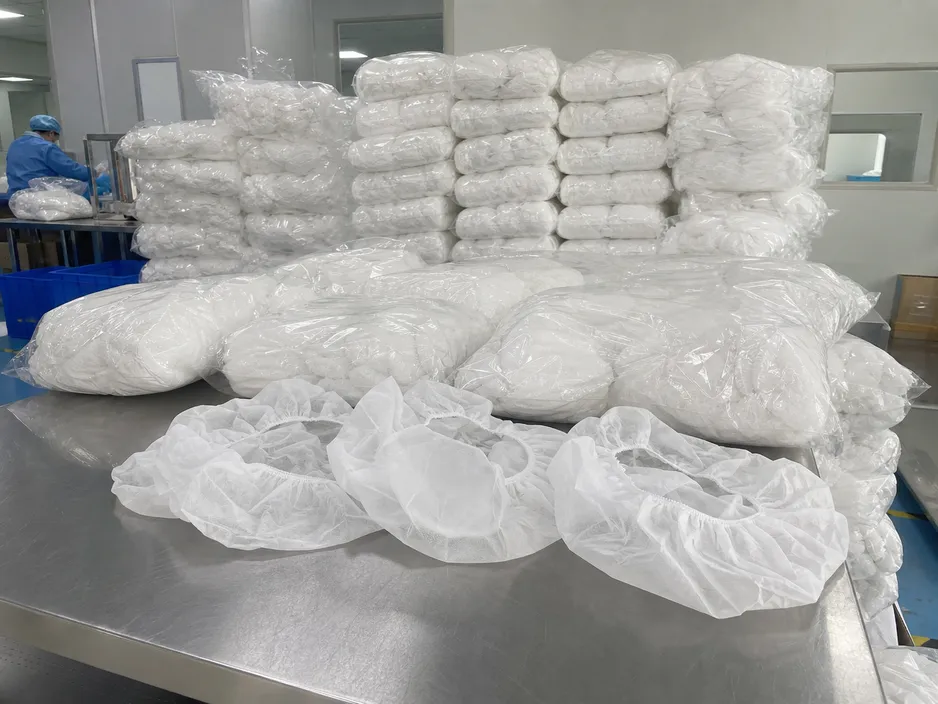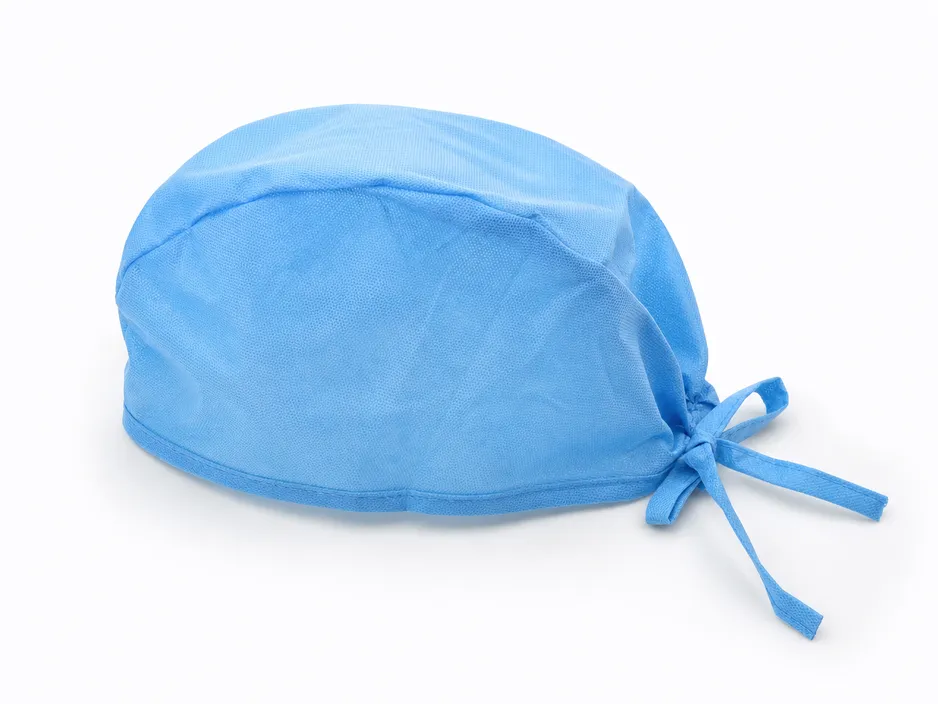
The US medical cap market runs on a familiar pattern: hospital systems and clinic groups buy through domestic distributors, distributors buy from manufacturers, and the margin stack compounds at every layer. That model works well when speed and account management matter more than unit economics. It works less well when you're managing a high-volume, recurring SKU like disposable bouffant caps or surgical tie-backs — products where the spec is stable, the compliance requirements are known, and the only variable is how much you're paying per thousand units.
This shortlist is built for buyers who are already sourcing caps domestically and want to understand the full landscape before their next contract cycle. The 10 suppliers below cover the range from large domestic distributors to factory-direct importers. The goal isn't to declare a winner — it's to give you enough sourcing intelligence to ask the right questions and make the right call for your volume and compliance situation.

How to Evaluate a Medical Cap Supplier: 5 Criteria That Protect Your Procurement
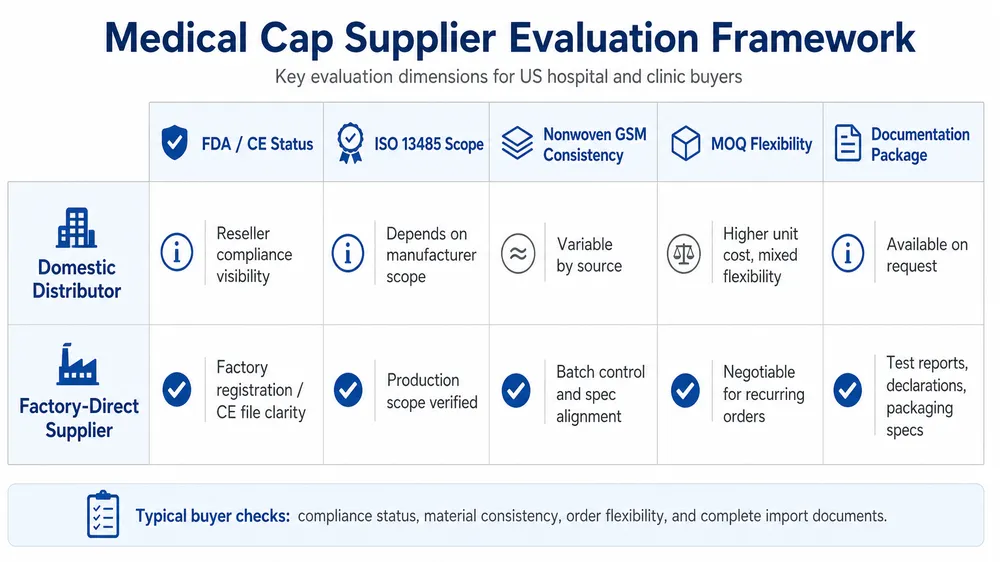
Before the list, the framework. Most buyers screen on price and lead time. The suppliers who cause problems later usually passed both of those screens. Here's what actually separates a reliable cap supplier from one that creates compliance headaches at the worst moment.
1. FDA and CE compliance status — and what it actually covers
FDA 510(k) clearance and CE marking under EU MDR are not interchangeable, and neither is automatic. A supplier can hold FDA clearance for surgical masks and have no clearance at all for caps — the 510(k) is device-specific. Before you assume a supplier's compliance stack covers your SKU, ask for the specific 510(k) number and verify it covers the cap product class (Class I or Class II, depending on intended use). CE under EU MDR is similarly scope-specific. (We've seen buyers discover mid-shipment that a supplier's CE certificate covered a different product line entirely — not a comfortable position when your customs broker is asking questions.)
2. ISO 13485 scope — does it actually cover caps?
ISO 13485 is a quality management system standard, not a product certification. A factory can be ISO 13485 certified for mask production and have caps completely outside the scope of their QMS. Ask for the certificate and read the scope statement. It should explicitly list the product categories covered. If caps aren't named, the certification doesn't protect you.
3. Nonwoven GSM specification and lot-to-lot consistency
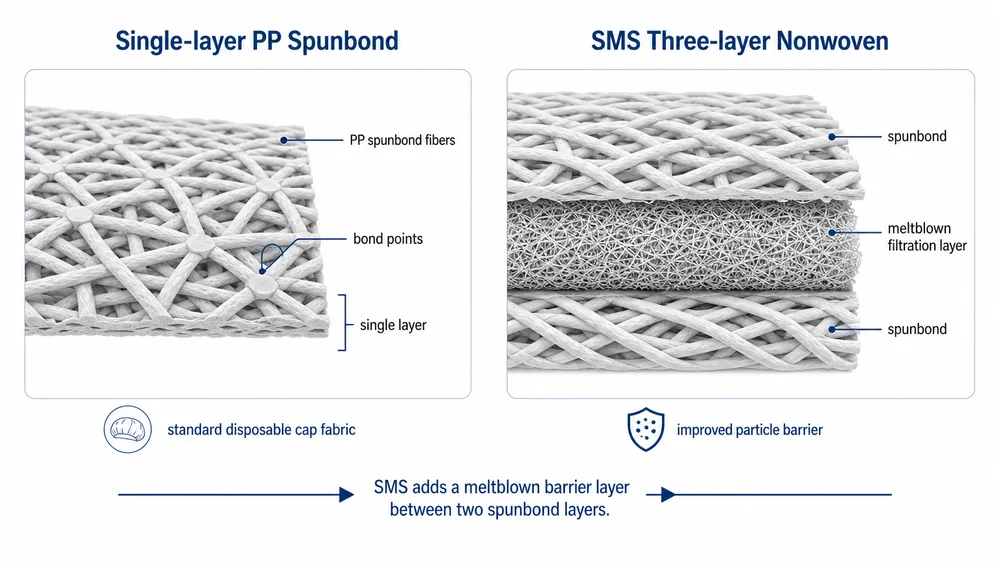
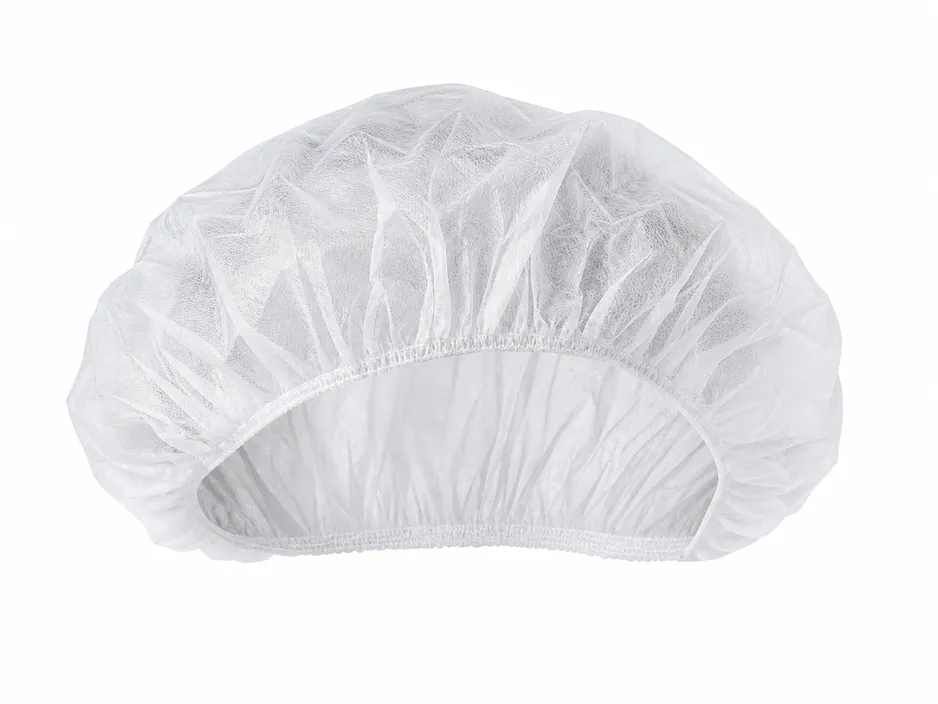
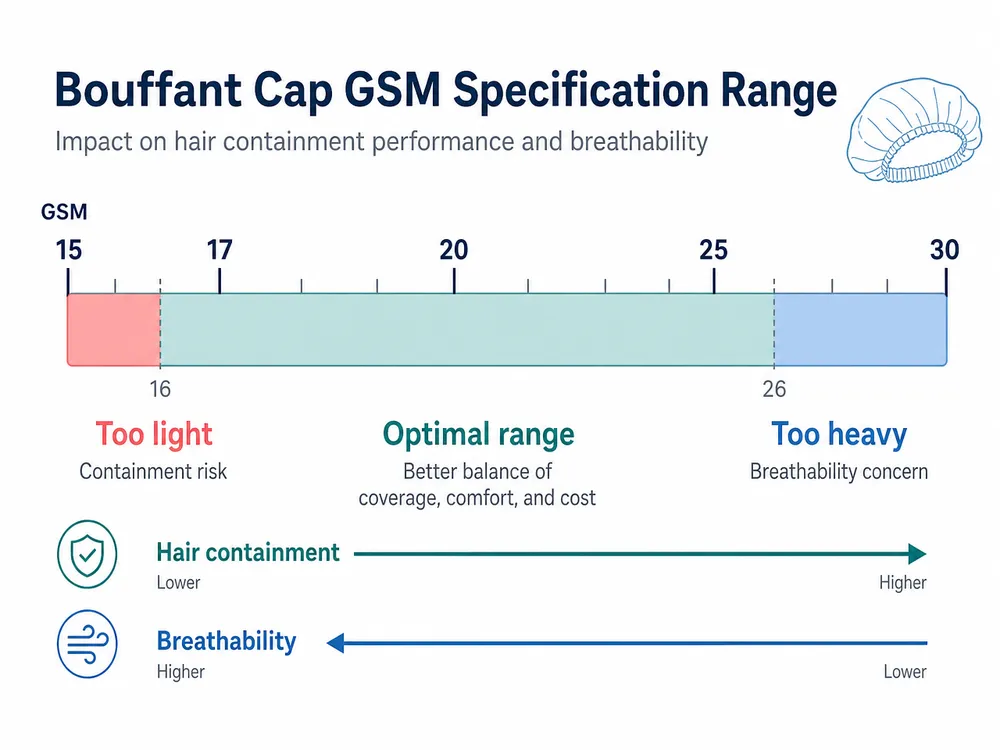
For bouffant caps, the nonwoven fabric weight — measured in grams per square meter (GSM) — determines hair containment performance, breathability, and durability through a shift. Standard bouffant caps run 17–25 GSM polypropylene spunbond. Below 17 GSM, you start seeing containment failures on high-volume hair. Above 25 GSM, breathability drops and staff compliance suffers. The spec matters, but lot-to-lot consistency matters more: a cap that passes your initial sample evaluation and then drifts 3 GSM in production is a supplier problem waiting to happen. Ask how the supplier controls fabric GSM across batches and whether they have incoming inspection records to show you.
4. MOQ structure and how it maps to your order cycle
Large domestic distributors often have no formal MOQ — they'll sell you a case of 100. Factory-direct suppliers typically start at 50,000–100,000 pieces per SKU. Neither is inherently better; it depends on your order cycle. If you're running a 200-bed hospital with monthly cap consumption of 30,000 units, a 50,000-piece MOQ from a factory-direct supplier covers roughly six weeks of inventory — manageable if your storage allows it. If you're a single-location clinic ordering 2,000 caps a month, factory-direct economics don't work until you aggregate across SKUs or facilities.
5. Export documentation package
For first-time importers or buyers switching from domestic to direct-import sourcing, the documentation package is where deals fall apart. You need: Certificate of Conformity (CoC), batch test reports (BFE/PFE for surgical caps, or particle filtration data for procedure caps), packing lists, and any market-specific declarations your customs broker requires. Ask for a sample documentation package before you commit to a supplier. A factory that can't produce clean documentation on request will not produce it faster under shipment pressure.
Top 10 Medical Caps Suppliers for US Hospital and Clinic Buyers
The list below is organized by supplier type: domestic distributors, specialty distributors, and factory-direct importers. Compliance status is noted where it's publicly verifiable. MOQ ranges reflect typical ordering patterns for each supplier model.
1. Medline Industries — medline.com
Type: Domestic distributor / manufacturer Compliance: FDA-registered, ISO 13485 MOQ: Case quantities (no formal minimum for standard SKUs)
Medline is the largest privately held medical supply company in the US and one of the most common cap suppliers for hospital systems. Their bouffant and surgical cap lines are stocked nationally, available through GPO contracts, and ship from domestic distribution centers — which means next-day or two-day delivery is realistic for most US locations. For urgent replenishment or small-volume orders, Medline is hard to beat on logistics.
The trade-off is unit economics. Medline's pricing reflects a full domestic distribution stack: warehousing, account management, and the margin layers between the factory and your loading dock. For a high-volume recurring SKU like bouffant caps, that stack adds up. Buyers on GPO contracts may have negotiated rates, but the baseline pricing is distributor-level, not factory-direct.
2. Cardinal Health — cardinalhealth.com
Type: Domestic distributor Compliance: FDA-registered products, ISO-compliant supply chain MOQ: Case quantities through standard distribution channels
Cardinal Health operates one of the largest medical supply distribution networks in the US, with direct relationships with most major hospital systems and IDNs. Their cap portfolio covers standard bouffant, surgical tie-back, and procedure cap configurations. Like Medline, Cardinal's value proposition is logistics reliability and account integration — EDI ordering, contract pricing through major GPOs, and a distribution footprint that covers virtually every US market.
For buyers managing complex hospital supply chains where cap procurement is one line item among thousands, Cardinal's integrated account management reduces administrative friction. The unit cost premium over factory-direct is real, but so is the operational convenience. Cardinal makes sense when procurement bandwidth is the constraint, not unit cost.
3. Halyard Health (Owens & Minor) — owens-minor.com
Type: Manufacturer / domestic distributor Compliance: FDA 510(k), ISO 13485 MOQ: Case quantities; volume pricing available for contract accounts
Halyard Health, now operating under the Owens & Minor umbrella, has a manufacturing heritage in surgical and procedural protective apparel. Their FLUIDSHIELD and standard surgical cap lines are used in OR environments across the US. Owens & Minor's distribution network handles the logistics side, while the Halyard brand carries the clinical credibility built over decades in surgical supply.
For OR-specific procurement — where surgical cap compliance documentation and sterile field compatibility matter — Halyard's product history and clinical validation data are genuine assets. The pricing reflects a branded, clinically positioned product rather than a commodity cap, which is appropriate for some procurement contexts and unnecessary overhead for others.
4. Dynarex Corporation — dynarex.com
Type: Domestic manufacturer / distributor Compliance: FDA-registered, ISO 9001 MOQ: Case quantities; volume pricing for larger accounts
Dynarex is a US-based manufacturer and distributor of disposable medical products, including a broad range of caps, gowns, and protective apparel. Their cap line covers bouffant caps in multiple sizes and colors, surgical caps, and beard covers. Dynarex sells through medical distributors and directly to healthcare facilities, with a product catalog that covers most standard clinical cap requirements.
Dynarex's positioning is value-oriented within the domestic market — their pricing is generally more competitive than the large national distributors, and their product range is broad enough to consolidate cap SKUs under a single supplier. ISO 9001 certification is in place; buyers requiring ISO 13485 documentation for their procurement audit trail should verify current certification scope directly with Dynarex.
5. Kimberly-Clark Professional — kcprofessional.com
Type: Manufacturer / brand Compliance: FDA-registered, ISO 13485 MOQ: Distributed through authorized dealers; volume minimums vary by channel
Kimberly-Clark's professional healthcare division produces surgical caps and protective headwear under the KIMTECH and KLEENGUARD brands. Their products are positioned for cleanroom, laboratory, and clinical environments where contamination control documentation is part of the procurement requirement. KC Professional products are distributed through authorized medical supply dealers rather than sold direct in most cases.
For buyers in pharmaceutical manufacturing, medical device production, or research environments — where cap compliance documentation needs to align with cleanroom protocols — KC Professional's product validation data and brand recognition carry weight. For standard hospital bouffant cap procurement, the brand premium may exceed the compliance benefit.
6. McKesson Medical-Surgical — mckesson.com
Type: Domestic distributor Compliance: Distributes FDA-registered products MOQ: Case quantities; contract pricing through GPO relationships
McKesson is one of the three largest healthcare distributors in the US and a common cap supplier for hospital systems, surgery centers, and clinic groups operating under GPO contracts. Their cap portfolio is sourced from multiple manufacturers and covers the standard bouffant, surgical, and procedure cap configurations used across clinical settings.
McKesson's value is in supply chain integration: EDI ordering, contract compliance tracking, and consolidated invoicing across a broad product portfolio. For buyers managing cap procurement as part of a larger McKesson supply relationship, the convenience of a single distributor relationship often outweighs the unit cost premium. For buyers evaluating caps as a standalone category, the economics look different.
7. Henry Schein — henryschein.com
Type: Specialty distributor (dental and medical) Compliance: Distributes FDA-registered products MOQ: Case quantities; no formal minimum for standard SKUs
Henry Schein is the dominant distributor for dental and ambulatory medical practices in the US, and their medical supply catalog includes disposable caps, gowns, and protective apparel. For clinic-scale buyers — dental offices, outpatient surgery centers, urgent care groups — Henry Schein's account management model and next-day delivery capability make them a practical cap supplier without the complexity of a hospital GPO contract.
The cap selection through Henry Schein is narrower than through the large hospital distributors, and pricing reflects the specialty distribution model. For small-to-mid-size clinic groups buying caps in case quantities, Henry Schein is a reliable option. For buyers at the volume threshold where factory-direct economics start to make sense (roughly 50,000+ units per order cycle), the comparison is worth running.
8. Prestige Ameritech — prestigeameritech.com
Type: US domestic manufacturer Compliance: FDA-registered, US-manufactured MOQ: Volume minimums apply; contact for current pricing
Prestige Ameritech is one of the few remaining large-scale domestic manufacturers of disposable medical protective products in the US, based in North Richland Hills, Texas. Their manufacturing footprint became nationally prominent during the pandemic-era supply disruption, and they have continued to position domestic manufacturing as a supply chain resilience argument for hospital procurement.
For buyers whose procurement policy explicitly requires US-manufactured product — whether for regulatory, contractual, or supply chain resilience reasons — Prestige Ameritech is a credible domestic manufacturing option. The unit cost premium over imported product is real and significant, but for buyers where domestic origin is a hard requirement, the comparison set is different.
9. Dukal Corporation — dukal.com
Type: Domestic distributor / private-label supplier Compliance: FDA-registered products, ISO 13485 MOQ: Case quantities; private-label programs available for larger volumes
Dukal is a US-based medical supply company with a broad disposable product catalog that includes caps, gowns, drapes, and wound care. Their cap line covers standard bouffant and surgical configurations, and they offer private-label programs for distributors and healthcare networks looking to build branded product lines without managing their own import supply chain.
Dukal's private-label capability is a differentiator within the domestic distributor category — it gives distributors and GPOs a path to branded cap programs without the complexity of direct factory sourcing. The economics of Dukal's private-label pricing still reflect a domestic intermediary margin, but the operational simplicity has value for buyers who aren't ready to manage direct import logistics.
10. eztio (Gaomi Eztio Medical Technology Co., Ltd.) — eztio.com
Type: Factory-direct manufacturer (China, export-certified) Compliance: FDA 510(k) Registered, CE (EU MDR), ISO 13485:2016, ISO 9001:2015, SGS MOQ: 50,000 pieces for standard SKUs; OEM/private-label available
eztio is a factory-direct option for US buyers who have moved past the evaluation phase and are ready to compare landed cost against their current distributor pricing. We've been manufacturing disposable medical nonwoven products since 2012 in Gaomi, Shandong — 12,000 square meters, 6 production lines, 150 people, 120 million pieces per year. The compliance stack — FDA 510(k), CE under EU MDR, ISO 13485:2016 — covers the regulatory requirements for US and EU market entry, and the scope covers caps specifically, not just masks.
The detail that matters most for hospital procurement audits is nonwoven consistency. We produce our own meltblown nonwoven fabric in-house, which means we control the fiber diameter, basis weight, and GSM spec at the source. When you order bouffant caps at a specified GSM, that spec holds across batches because we're not dependent on a third-party fabric supplier's production consistency. Lot-to-lot traceability runs through our QMS, and the documentation — CoC, batch test reports, packing lists — ships with every order.
The 50,000-piece MOQ is accessible for mid-size clinic groups and GPO trial orders. For hospital networks running monthly cap volumes above that threshold, the economics of direct import become straightforward: factory-direct pricing, full compliance documentation, and OEM packaging capability if you want your brand on the product.
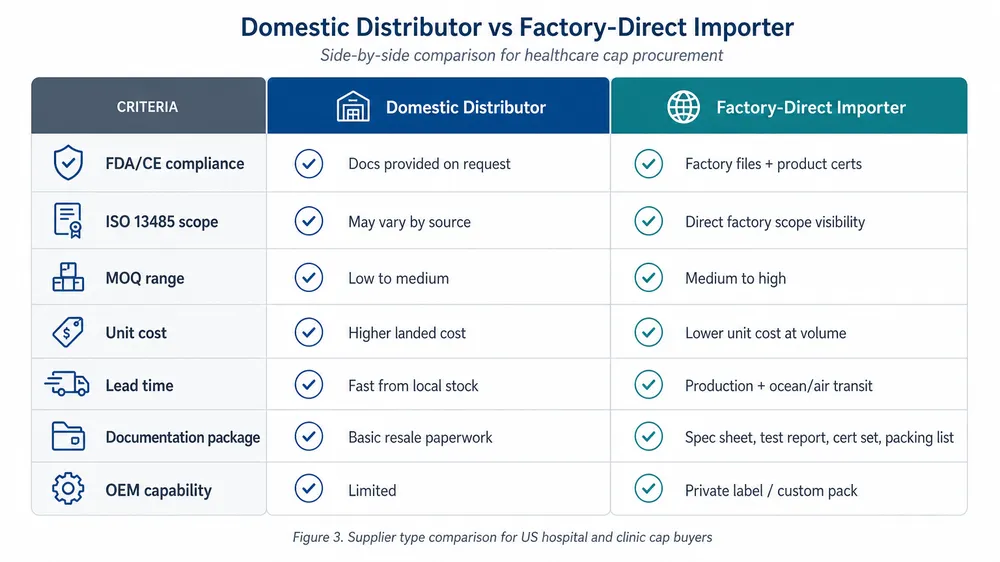
Domestic Distributor vs Factory-Direct Import: Where the Cost Difference Actually Lives
The unit price gap between a domestic distributor and a factory-direct supplier is real, but it's not the whole story. Here's where the cost difference actually accumulates — and where it doesn't.
Where factory-direct saves money:
The most visible saving is unit price. A standard 21 GSM bouffant cap from a domestic distributor typically runs $0.08–$0.14 per piece at volume pricing. Factory-direct pricing from a certified manufacturer runs $0.025–$0.05 per piece FOB, depending on GSM spec and order volume. On a 500,000-piece annual order, that gap is $25,000–$45,000 before freight and customs.
Freight and customs add back roughly $0.005–$0.012 per piece for a standard ocean shipment from China to a US port, depending on container utilization and current freight rates. Customs duty on disposable medical caps (HTS 6217.10 or 6506.10 depending on classification) runs 0–7% depending on material composition and country of origin. The net landed cost advantage for factory-direct typically runs 40–60% below domestic distributor pricing at comparable volume.
Where domestic distribution earns its premium:
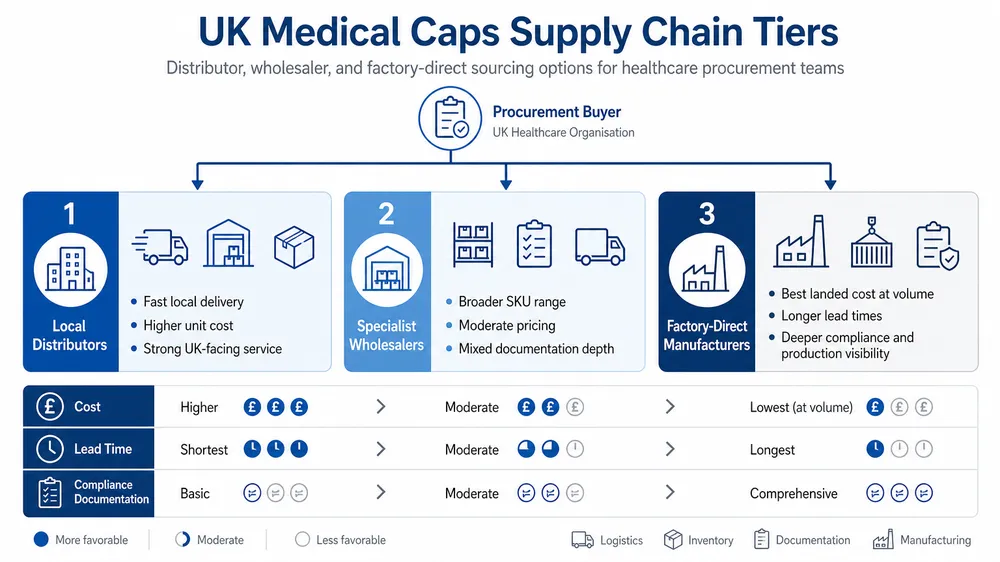
Domestic distributors earn their margin on speed and inventory risk. If your facility runs out of caps on a Tuesday and needs replenishment by Thursday, a domestic distributor with regional warehouse stock solves that problem. A factory in China cannot. For emergency replenishment, small fill-in orders, and situations where your procurement cycle is unpredictable, domestic distribution is the right answer — and the premium is justified.
The other genuine advantage is account integration. For hospital systems managing hundreds of SKUs through a single distributor relationship, the administrative cost of adding a direct import supplier for one SKU category may exceed the unit cost savings. That calculation changes when the SKU volume is large enough to justify the import management overhead.
The break-even logic:
Most buyers find that factory-direct economics make sense when three conditions align: annual volume above 200,000 pieces per SKU, a predictable order cycle that allows 4–6 weeks of lead time, and storage capacity for a 6–8 week inventory buffer. Below those thresholds, domestic distribution is usually the more practical choice even if the unit cost is higher.
What to Ask Before You Place a Bulk Cap Order
Whether you're evaluating a domestic distributor or a factory-direct supplier, these questions separate suppliers who can support a serious procurement relationship from those who can't.
Compliance documentation:
- Can you provide the specific FDA 510(k) number for this cap product, and does the clearance cover the intended use classification?
- Does your ISO 13485 certificate scope statement explicitly include disposable caps? Can I see the certificate?
- What CE marking standard applies to your surgical caps — EU MDR or the older MDD? (Post-2021, EU MDR is the current requirement.)
Material and specification control:
- What is the nonwoven GSM specification for this cap, and what is your acceptable tolerance range?
- How do you verify incoming fabric GSM on each lot? Do you have incoming inspection records available?
- What elastic tensile specification do you use for the cap band, and how is it tested?
Lot traceability and documentation:
- Can you provide batch test reports for BFE/PFE (for surgical caps) or particle filtration data (for procedure caps)?
- What is your lot traceability system — can you trace a defective cap back to the production batch and raw material lot?
- What documents ship with the order, and can I see a sample documentation package before I commit?
OEM and private-label:
- If I want my brand on the packaging, what is the minimum volume for a private-label run?
- Do you handle packaging design in-house, or do I need to supply print-ready artwork?
- What is the lead time difference between standard and private-label orders?
(These questions work equally well for domestic distributors and factory-direct suppliers. The difference is that a domestic distributor may not be able to answer the material specification questions directly — they'll need to go back to their manufacturer. A factory-direct supplier should be able to answer all of them without escalation.)
When Local Supply Is the Right Answer — and When It Isn't
This is worth saying plainly, because a credible sourcing guide should acknowledge both sides.
Local distribution is the right answer when:
- You need replenishment in under 72 hours
- Your order volume is below 50,000 pieces per cycle
- Your procurement system is already integrated with a distributor's EDI platform and the switching cost is real
- You're in a compliance audit cycle and need domestic supply chain documentation quickly
- Your facility doesn't have the storage capacity for a 6–8 week import buffer
Factory-direct import is worth evaluating when:
- Your annual cap volume exceeds 200,000 pieces across one or more SKUs
- Your order cycle is predictable enough to plan 4–6 weeks ahead
- You're building or refreshing a private-label cap program
- Your current distributor can't provide ISO 13485 scope documentation or batch-level test reports
- You've run the landed cost comparison and the gap is large enough to justify the import management overhead
The buyers who get the most value from factory-direct sourcing are typically mid-size hospital groups, surgery center networks, and healthcare distributors who are already managing some direct import relationships and understand the logistics. First-time importers can make it work, but the learning curve on documentation and customs clearance is real — factor that into your first-order timeline.
Sourcing the Right Medical Caps for Your Facility
The cap category looks simple from the outside — it's a disposable nonwoven product with a straightforward spec. In practice, the compliance documentation requirements, the nonwoven GSM consistency issues, and the MOQ economics make it a category where supplier selection has real downstream consequences.
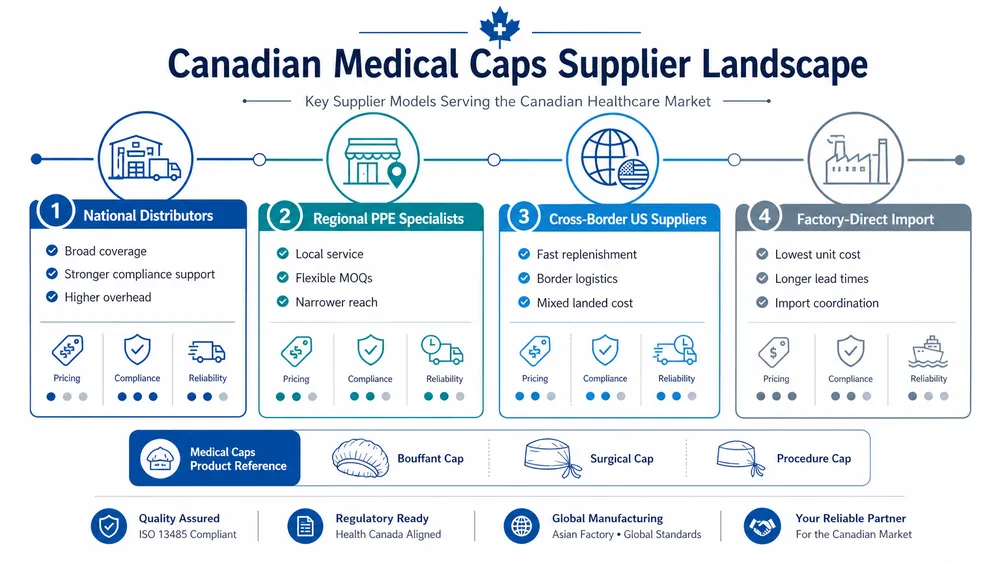
The 10 suppliers above cover the realistic sourcing landscape for US hospital and clinic buyers. The large domestic distributors — Medline, Cardinal Health, McKesson — offer logistics reliability and account integration that's genuinely valuable for complex procurement environments. Specialty distributors like Henry Schein and Dukal serve specific buyer segments well. Domestic manufacturers like Prestige Ameritech serve buyers with hard domestic-origin requirements.
For buyers at the volume threshold where factory-direct economics make sense, the compliance question is the first filter: does the supplier hold FDA 510(k) clearance and ISO 13485 certification with explicit scope coverage for caps? Most factory-direct options on Alibaba and similar platforms don't clear that bar. The ones that do — with verifiable certification documentation and a track record of US export — are a shorter list.
If you're evaluating bouffant caps or surgical caps for a direct import program, the Medical Caps Buying Guide covers the specification selection and compliance verification process in more detail. For volume inquiries and sample requests, the fastest path is a direct Request Quote with your cap type, GSM requirement, monthly volume, and any private-label or documentation needs specified upfront — that gives us enough to respond with a factory-direct quote and sample availability without a back-and-forth on basic parameters.