Most bulk-order problems with medical protective clothing don't start at the factory. They start at the RFQ stage, when buyers specify the wrong garment type, accept vague certification claims, or skip the documentation questions that customs will ask later. By the time the container arrives, the damage is done.
This guide is a working checklist — not a product catalog. It covers the evaluation steps that separate a reliable bulk supplier from one that looks fine on paper until your first shipment.
What "Medical Protective Clothing" Actually Covers — and Why the Distinction Matters for Your Order
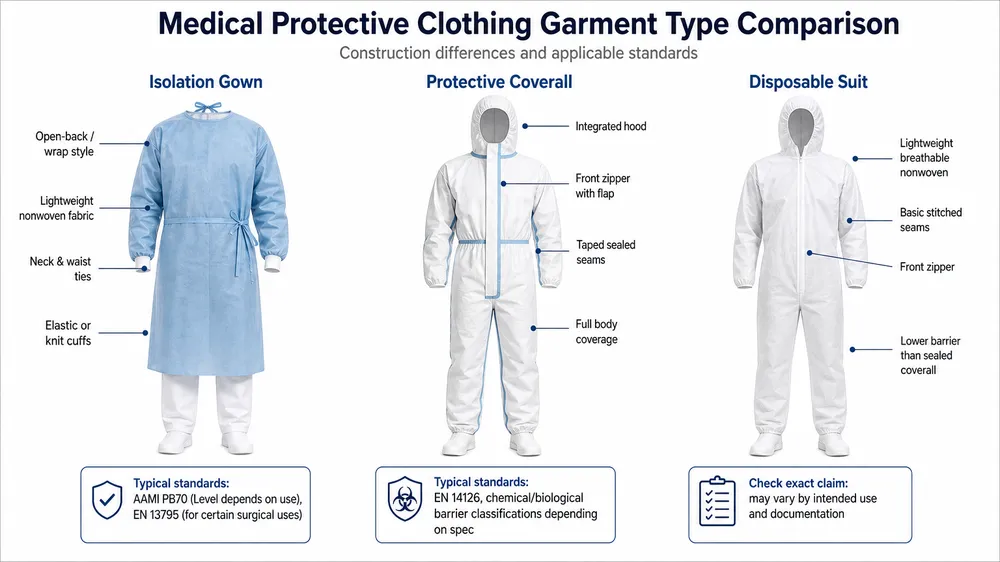
The term gets used loosely, and that looseness costs buyers money. For procurement purposes, Medical Protective Clothing breaks into three distinct product categories, each with different standards, different construction requirements, and different price points:
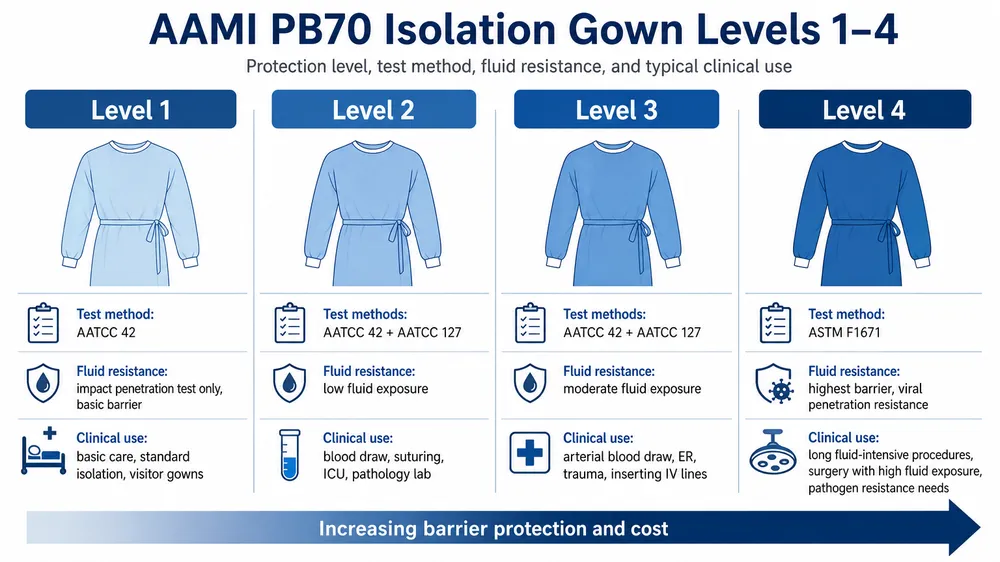
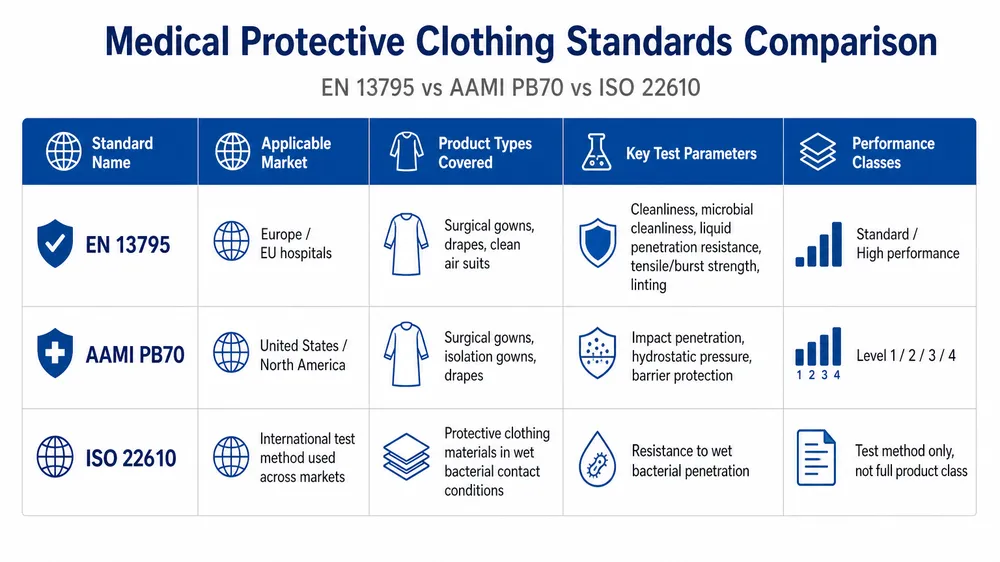
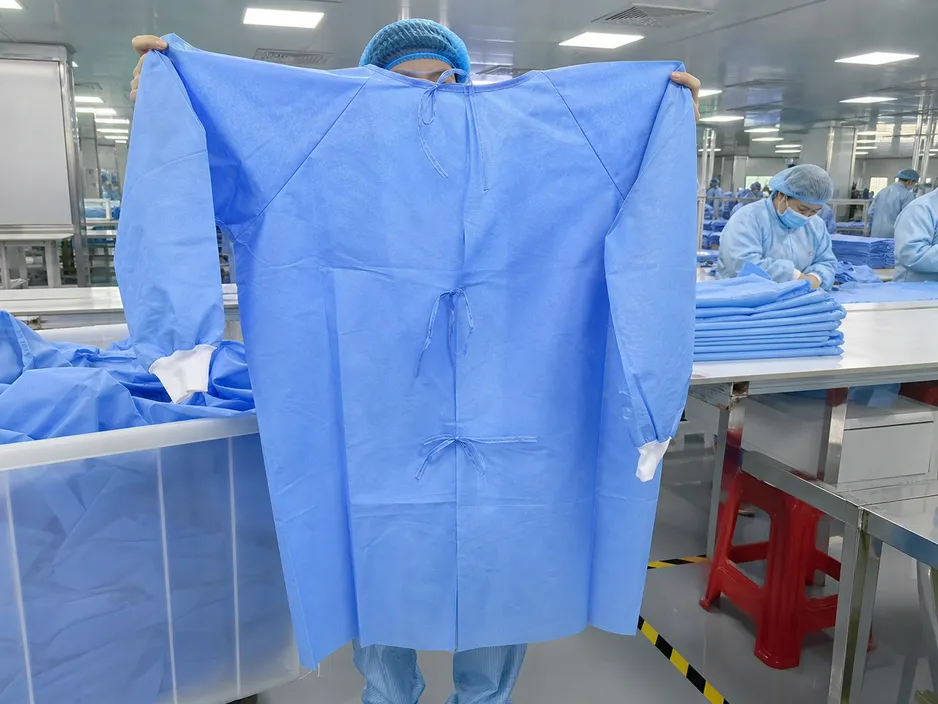
Isolation gowns — fluid-resistant, typically SMS or microporous film construction, used in clinical settings where splash and droplet exposure is the primary risk. Governed by AAMI PB70 (US) and EN 13795 (EU). Four AAMI levels, each with specific liquid barrier performance thresholds.
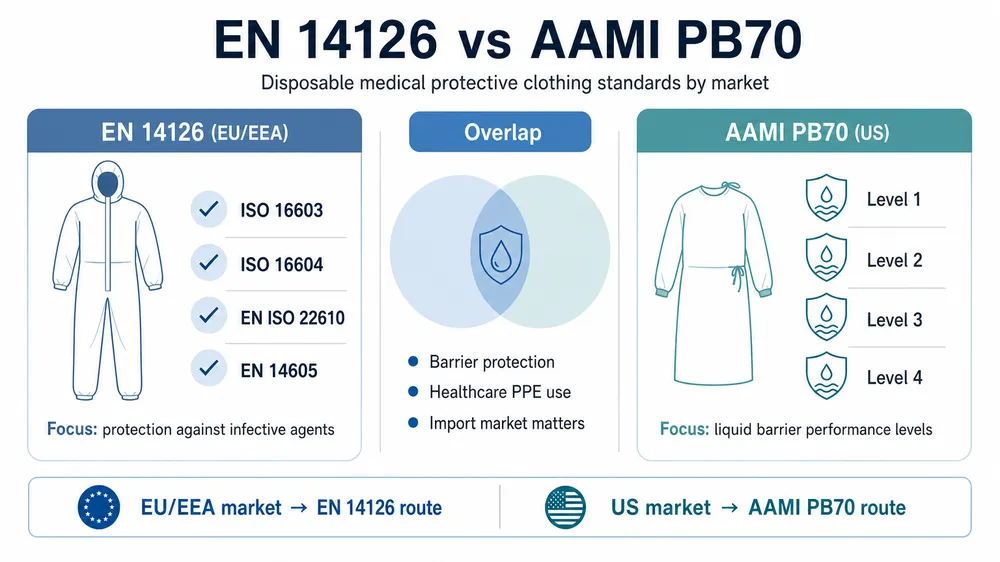
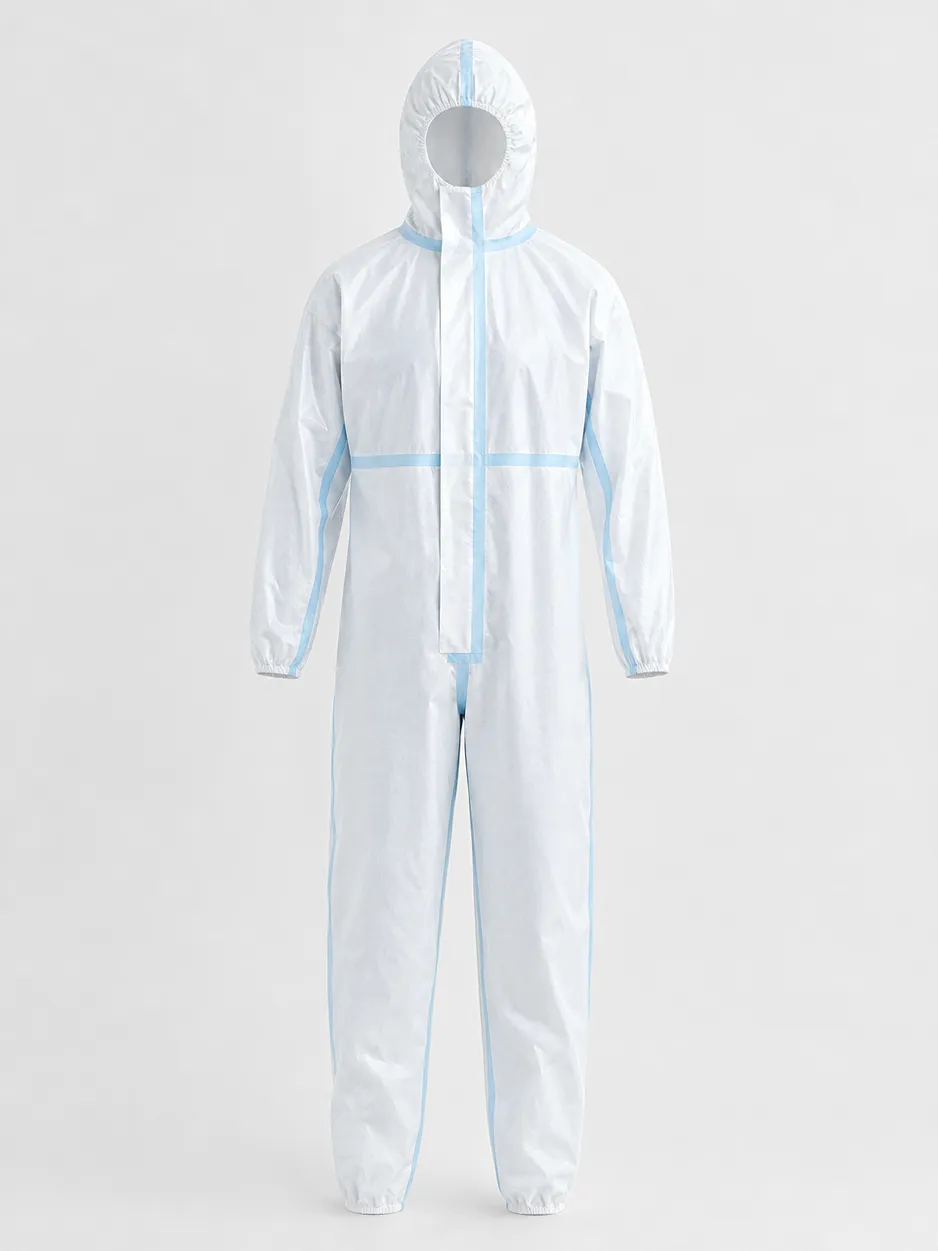
Disposable protective coveralls — full-body coverage including hood and boot covers, used in higher-risk environments: infectious disease wards, biohazard response, surgical suites. EN 14126 is the relevant standard for biological protection; Type 5/6 classifications under EN 13982 cover particulate protection. These are not the same standard, and a supplier who conflates them is a red flag.
Disposable protective suits — lighter-weight, often used in non-clinical settings (pharmaceutical manufacturing, cleanroom environments, food processing). Lower barrier requirements than medical coveralls, but still subject to facility-specific standards depending on the end market.
The procurement mistake we see most often: buyers specify "medical protective clothing" without locking down which category, then receive a quote for the cheapest option in the range. Get the garment type confirmed in writing before any pricing discussion.

Certification Checklist: What Each Standard Covers and Which Markets Require It
Certifications are not interchangeable. A CE mark under EU MDR does not satisfy FDA import requirements. An ISO 13485 certificate tells you about the quality management system, not the product performance. Buyers who treat these as equivalent end up with shipments held at customs or products that fail institutional procurement audits.
Here's the matrix that matters for bulk orders:
| Certification | What It Covers | Required For |
|---|---|---|
| ISO 13485:2016 | Quality management system for medical device manufacturing | Supplier qualification; required by most institutional buyers |
| CE (EU MDR) | Product conformity for EU market access | Selling into EU member states |
| FDA 510(k) Registration | US market clearance for medical devices | Importing into the United States |
| EN 14126:2003 | Biological protection performance for protective clothing | EU coveralls used in infectious disease environments |
| EN 13795 | Surgical gown and drape performance | EU surgical gowns |
| AAMI PB70 | Liquid barrier performance for gowns (Levels 1–4) | US hospital and clinical procurement |
| EN 13982 (Type 5/6) | Particulate protection for coveralls | EU industrial and cleanroom applications |
| SGS / Bureau Veritas | Third-party audit and test verification | Institutional tender requirements, additional buyer assurance |
A few things worth noting from export experience:
The EU MDR transition (fully in force since May 2021) tightened the documentation requirements significantly. Suppliers who were CE-marked under the old MDD directive are not automatically compliant under MDR. Ask specifically for the MDR-compliant technical file, not just the CE certificate.
FDA 510(k) registration applies to the manufacturer, not just the product. If a supplier claims FDA clearance, ask for the 510(k) number and verify it in the FDA database. This takes two minutes and eliminates a category of fraud that's more common than buyers expect.
ISO 13485 without CE or FDA clearance means the factory has a documented quality system — useful, but not sufficient for regulated market access on its own.
(We've walked first-time EU importers through the MDR documentation requirements more times than I can count. The importer-of-record obligations under MDR catch a lot of buyers off guard. Worth sorting out before you place the order, not after.)
Fabric and Construction Specs to Verify Before You Commit
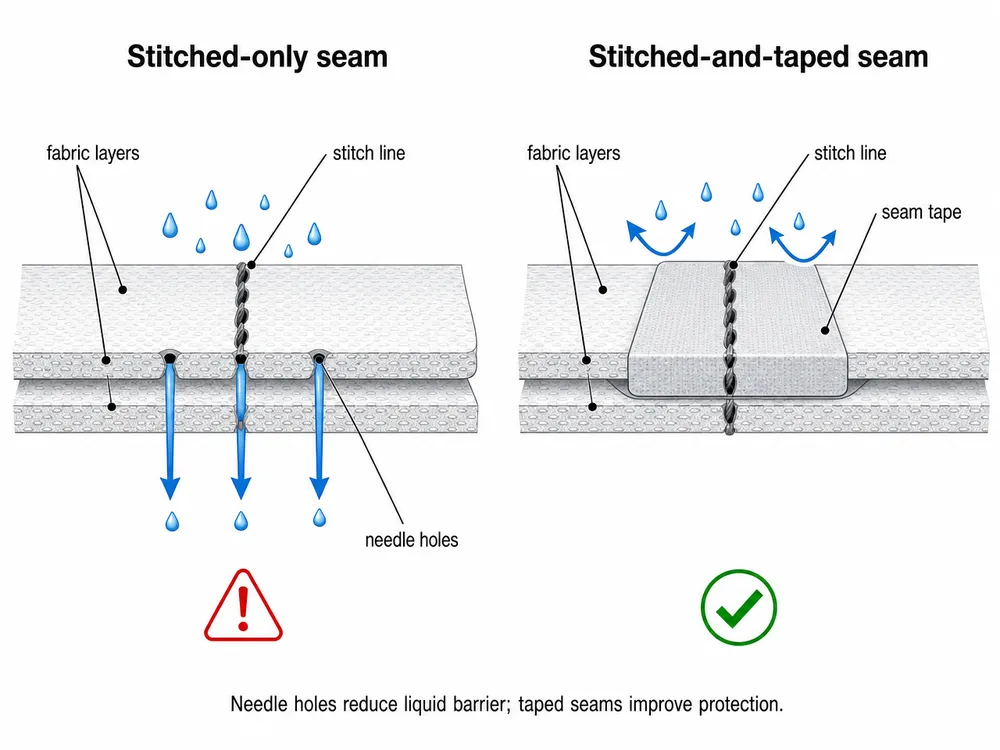
The seam is where most protective clothing fails — and it's the last thing buyers check before placing a bulk order. That's not an opinion; it's what we see when buyers send us competitor samples for comparison. The fabric spec looks fine. The seam construction is where the barrier breaks down.
Two fabric systems dominate medical protective clothing:
SMS (Spunbond-Meltblown-Spunbond) — three-layer nonwoven laminate. The meltblown middle layer provides the filtration and fluid barrier function. SMS is breathable, lightweight, and cost-effective for isolation gowns and lower-risk coveralls. The performance ceiling is real: SMS does not provide the same liquid penetration resistance as microporous film for high-risk applications.
Microporous film laminate — a breathable membrane bonded to a nonwoven substrate. Higher liquid penetration resistance, better chemical splash protection, used in EN 14126-rated coveralls for infectious disease environments. Heavier, less breathable, and more expensive than SMS. For buyers supplying hospital isolation wards or biohazard response teams, this is the correct material — SMS is not a substitute.
The spec questions to ask at RFQ stage:
- Fabric basis weight (gsm) — for SMS gowns, 35–60 gsm is typical; lighter than 35 gsm is a cost-cutting flag
- Seam construction — stitched only, or stitched and taped? Taped seams are required for EN 14126 compliance; stitched-only seams are not
- Seam tape width and adhesion standard — 20mm minimum tape width is standard for medical coveralls; ask for the peel strength spec
- Closure type — zipper with storm flap, or adhesive strip? Zipper closures with taped seams are the standard for high-protection coveralls
- BFE/PFE test results — if the garment incorporates a filtration layer, ask for the batch test report, not just the certificate
Factory Capability Questions That Separate Qualified Suppliers from Paper Certifications
ISO 13485 tells you the quality system exists. It doesn't tell you whether the factory can actually hold spec across a 50,000-unit order. These are the facility questions worth asking before you sign a purchase order.
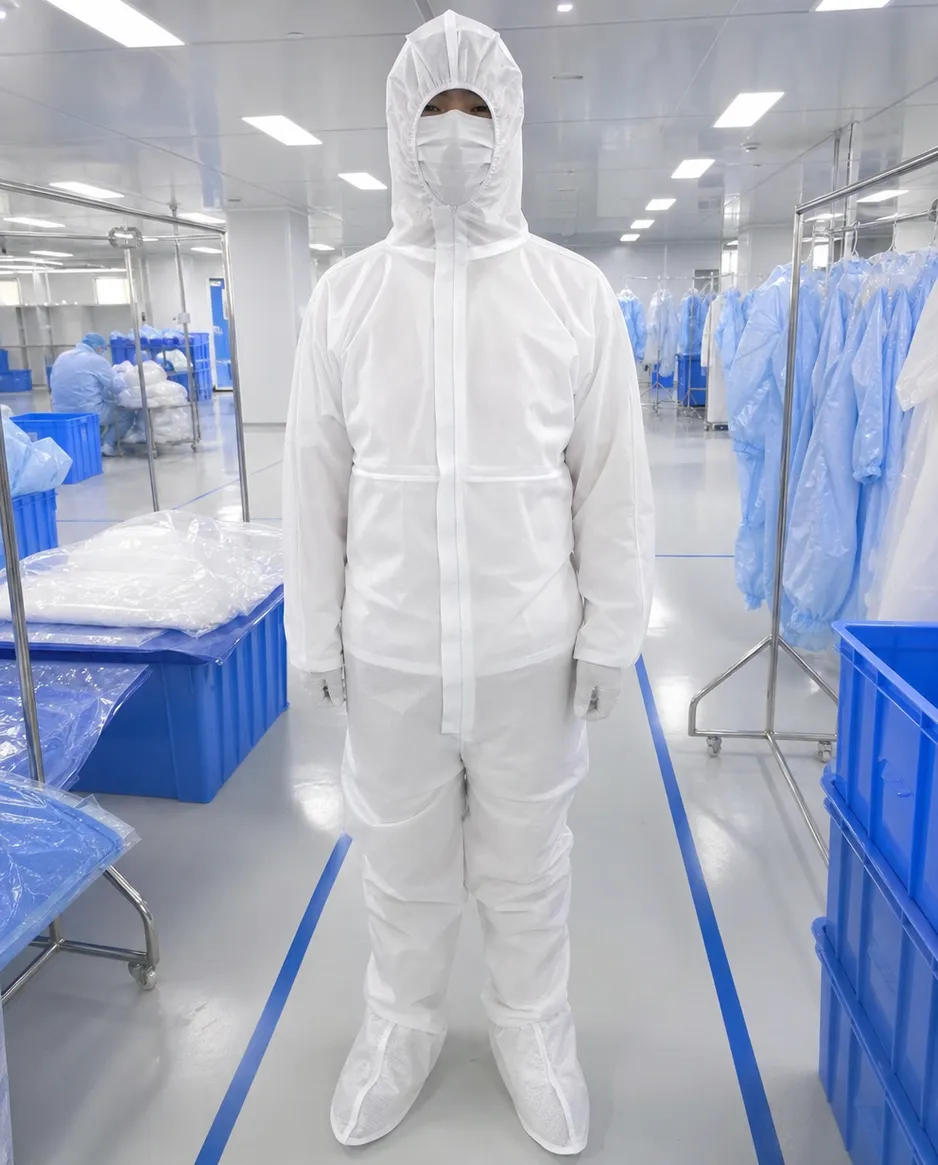
Cleanroom environment — Medical protective clothing production should run in a controlled environment. Class 100,000 (ISO 8) is the standard for medical device manufacturing. Ask for the cleanroom classification and how particle counts are monitored. A factory that can't answer this question specifically is not running a cleanroom — they're running a regular production floor with a sign on the door.
In-house filtration layer production — For garments that incorporate meltblown nonwoven (the filtration layer in SMS fabric), in-house production is a meaningful differentiator. Factories that buy meltblown from outside suppliers are dependent on that supplier's consistency. During supply disruptions — and we've seen several since 2020 — factories without their own meltblown capacity either stop shipping or substitute materials without telling buyers. In-house production means the spec is controlled at the source.
In-process QC checkpoints — Ask how defects are caught during production, not just at final inspection. A factory running ISO 13485 correctly stops the line when an out-of-spec condition is detected. A factory that sorts defects at the end of the run and ships the rest is not running ISO 13485 — they're using the certificate as a marketing document.
In-house testing equipment — For garments with barrier performance claims, the factory should have in-house testing capability: liquid penetration resistance (EN 20811 / AAMI PB70 method), seam strength, and for any filtration-rated product, BFE/PFE testing. In-house testing catches batch problems before they become shipment problems. Third-party lab reports are necessary for certification, but they're not a substitute for in-process testing.
Batch traceability — Can the factory trace a specific production batch back to the raw material lot? This is a basic ISO 13485 requirement, but many factories can't actually produce the traceability records when asked. Request a sample traceability record during supplier qualification — not after a quality incident.
We run our Disposable Medical Protective Clothing production through all of these checkpoints. The in-house meltblown production and the three-stage QC process (incoming, in-process, outgoing) are the two capabilities that most directly affect whether your order arrives to spec.
MOQ, Lead Time, and Batch Consistency: What to Confirm Before Signing
These three variables interact in ways that catch buyers off guard on first orders.
MOQ traps — Some factories quote low MOQs to win the order, then push back during production with minimum run requirements that don't match what was agreed. Get the MOQ confirmed in writing for the specific SKU, not for the product category. A factory that offers 10,000-piece MOQ on "isolation gowns" may require 50,000 pieces for the specific AAMI Level 3 gown with your packaging configuration.
Our standard MOQ for Medical Isolation Gowns and Medical Protective Coveralls starts at 50,000 pieces for standard SKUs. Custom configurations — modified seam construction, non-standard sizing, private-label packaging — typically require higher minimums because the line setup and material procurement change. We tell buyers this upfront.
Lead time realism — 15–25 days is a realistic lead time for standard SKUs from a factory with available line capacity. Quotes under 10 days for large orders (100,000+ pieces) should be questioned: either the factory has pre-made inventory sitting in a warehouse (spec consistency risk), or the lead time will slip once production starts. Ask specifically: is this lead time from order confirmation, or from receipt of payment? The difference can be a week.
Batch consistency across large orders — This is the failure mode that doesn't show up until the second or third shipment. A factory that passes your first-order inspection may drift on specs by the third batch if their raw material sourcing is inconsistent. Ask for the factory's raw material supplier list and whether they dual-source critical materials. For SMS fabric, ask whether the meltblown layer comes from a single supplier or multiple. Single-source dependency on a commodity material is a supply chain risk that lands on your customers, not the factory.
Documentation Checklist for Import Clearance
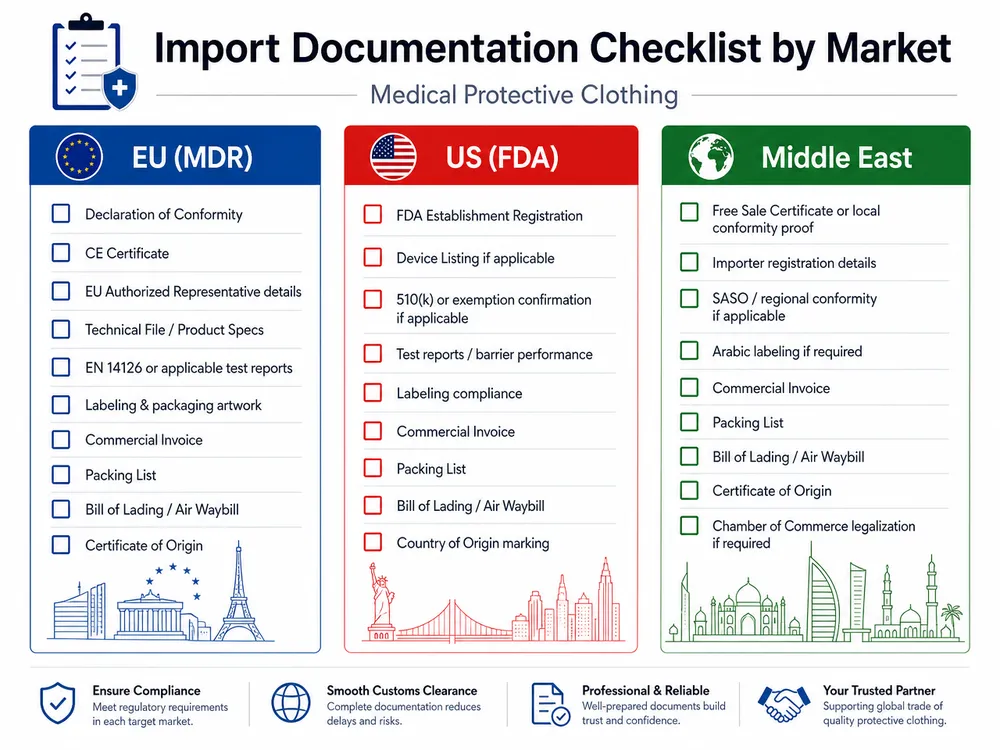
This is the section most buyers skip during supplier qualification and regret at customs. The documentation requirements vary by destination market, but the core package is consistent:
Standard export documentation (all markets):
- Certificate of Conformity (CoC) — product-specific, signed by the manufacturer
- Third-party test reports — from accredited labs, covering the performance standards claimed on the product
- Packing list — carton count, unit count, gross/net weight, dimensions
- Commercial invoice — with correct HS code for the product category
EU-specific (MDR compliance):
- EU Declaration of Conformity — references the specific MDR regulation and applicable harmonized standards
- CE certificate from a Notified Body (for Class I medical devices, self-declaration may apply — confirm with your importer of record)
- Technical file summary — not always required at customs, but institutional buyers and hospital procurement will ask for it
- Importer of Record designation — under EU MDR, the EU-based importer has legal responsibility for the product. This is not optional.
US-specific (FDA):
- FDA 510(k) registration number — verify in the FDA database before shipment
- FDA facility registration number — the manufacturing facility must be registered
- Customs entry documentation — HS code 6210 or 6211 depending on garment construction; misclassification causes delays
Middle East / Gulf states:
- SFDA (Saudi) or equivalent national authority registration may be required for hospital supply channels
- Halal certification is not typically required for medical protective clothing, but some institutional tenders specify it — confirm with your end buyer
A supplier who can't produce this documentation package before shipment is not ready for regulated market export. We prepare the full documentation set with every order — test reports, CoC, and market-specific declarations — because our buyers need it to clear customs, and a shipment held at the border is a problem for both sides.
Red Flags in Supplier Evaluation
These are the patterns that show up in supplier qualification and predict problems on bulk orders. None of them are definitive on their own, but two or more together is a serious signal.
No in-house testing capability — A factory that sends all performance testing to third-party labs has no way to catch batch problems before shipment. Third-party lab reports are necessary for certification; they're not a substitute for in-process quality control. Ask what testing equipment is on the production floor.
Vague or unverifiable certifications — "CE certified" without a certificate number, issuing body, and expiry date is not a certification. "FDA approved" is not a thing — FDA clears or registers; it doesn't approve. Ask for the specific certificate documents and verify them independently.
Inability to provide batch-level traceability — If a factory can't show you a sample traceability record linking a finished product batch to its raw material lot, they are not running ISO 13485 in practice. This is a basic requirement of the standard.
Single-source raw material dependency without disclosure — A factory that buys all its meltblown fabric from one supplier and doesn't mention it is carrying supply chain risk that transfers to your order. Ask directly.
Spec drift between sample and production — The most common complaint we hear from buyers who've had bad experiences elsewhere: the sample was perfect, the production run was different. This happens when factories use better materials for samples than for production. Request that the sample approval process include a material specification sign-off, not just a visual approval.
Unusually short lead times on large orders — As noted above, sub-10-day lead times on 100,000+ piece orders usually mean pre-made inventory. Pre-made inventory means you're buying product made to someone else's spec, not yours.
(One more: factories that can't tell you their cleanroom classification, or who describe their production environment as "clean" without a specific ISO class, are not running a cleanroom. This matters for hospital and institutional procurement, where facility standards are part of the supplier qualification criteria.)
How to Structure Your RFQ to Get Comparable Quotes
Most RFQs for medical protective clothing are too vague to generate useful quotes. Suppliers fill in the gaps with their cheapest option, and you end up comparing prices for different products.
A useful RFQ for bulk protective clothing should specify:
- Garment type — isolation gown, coverall, or disposable suit (not "protective clothing")
- Protection level — AAMI Level (1–4) for gowns, or EN 14126 biological protection class for coveralls
- Fabric system — SMS or microporous film, with basis weight range if known
- Seam construction — stitched only, or stitched and taped
- Sizing — size range and size ratio for the order (e.g., 30% M / 40% L / 30% XL)
- Destination market — determines which certifications are required
- Order volume — total pieces and whether this is a one-time order or a recurring program
- Packaging requirement — bulk clinical packaging or retail-ready, OEM labeling requirements
- Required documentation — list the specific documents you need for import clearance
Suppliers who can respond to this RFQ with specific answers — not "we can do whatever you need" — are the ones worth continuing the conversation with. Vague responses to specific questions are a qualification signal.
If you're ready to move forward, send us your RFQ with the garment type, protection level, target market, and estimated volume. We'll respond with specs, certifications, and a sample lead time.
Frequently Asked Questions
What is the minimum order quantity for medical protective clothing bulk orders?
For standard SKUs — isolation gowns and disposable coveralls in our existing configurations — our MOQ starts at 50,000 pieces. Custom configurations (modified seam construction, non-standard sizing, private-label packaging) typically require higher minimums because the line setup and material procurement change. We confirm the exact MOQ for your specific configuration before you commit.
What is the difference between EN 14126 and AAMI PB70 for protective clothing?
They cover different markets and different performance parameters. AAMI PB70 is the US standard for liquid barrier performance in healthcare gowns — it defines four protection levels based on liquid penetration resistance tests. EN 14126 is the EU standard for biological protection in protective clothing — it covers resistance to infective agents including bacteria, viruses, and contaminated liquids. A coverall rated to EN 14126 is not automatically AAMI-compliant, and vice versa. If you're supplying both US and EU markets, you need products tested and certified to both standards, or separate SKUs for each market.
How do I verify that a supplier's CE certification is valid under EU MDR (not the old MDD)?
Ask for the CE certificate document and check the regulation reference. MDR-compliant certificates reference Regulation (EU) 2017/745. Certificates referencing Directive 93/42/EEC (MDD) are no longer valid for new market placements since May 2021. Also check the issuing Notified Body number — you can verify it in the NANDO database. If the supplier can't produce an MDR-compliant certificate, they cannot legally place the product on the EU market.
What seam construction is required for EN 14126-rated coveralls?
EN 14126 requires that seams meet the same barrier performance as the fabric itself. In practice, this means taped seams — stitched-only seams leave needle holes that fail the liquid penetration resistance test. The seam tape must be applied with sufficient width (typically 20mm minimum) and adhesion strength to maintain integrity through the garment's rated use period. Ask for the seam tape specification and the seam strength test result, not just the overall EN 14126 certificate.
What documents do I need to import medical protective clothing into the EU?
At minimum: EU Declaration of Conformity, CE certificate from a Notified Body (or self-declaration for Class I devices), third-party test reports from an accredited lab, and a designated EU importer of record. Under EU MDR, the importer has legal responsibility for the product's compliance — this is not a paperwork formality. If you're importing for the first time, confirm the importer-of-record obligations with your customs broker or a regulatory consultant before placing the order.
Can SMS fabric meet EN 14126 biological protection requirements?
It depends on the specific EN 14126 performance class. EN 14126 has multiple test methods (ISO 16603 for blood-borne pathogens, ISO 16604 for viral penetration, etc.), and the required performance level varies by application. Standard SMS fabric typically does not meet the higher EN 14126 performance classes for viral penetration resistance — microporous film laminates are generally required for those applications. For lower-risk biological protection requirements, SMS may be sufficient. The answer depends on which EN 14126 performance class your end market requires, not on the fabric type alone.