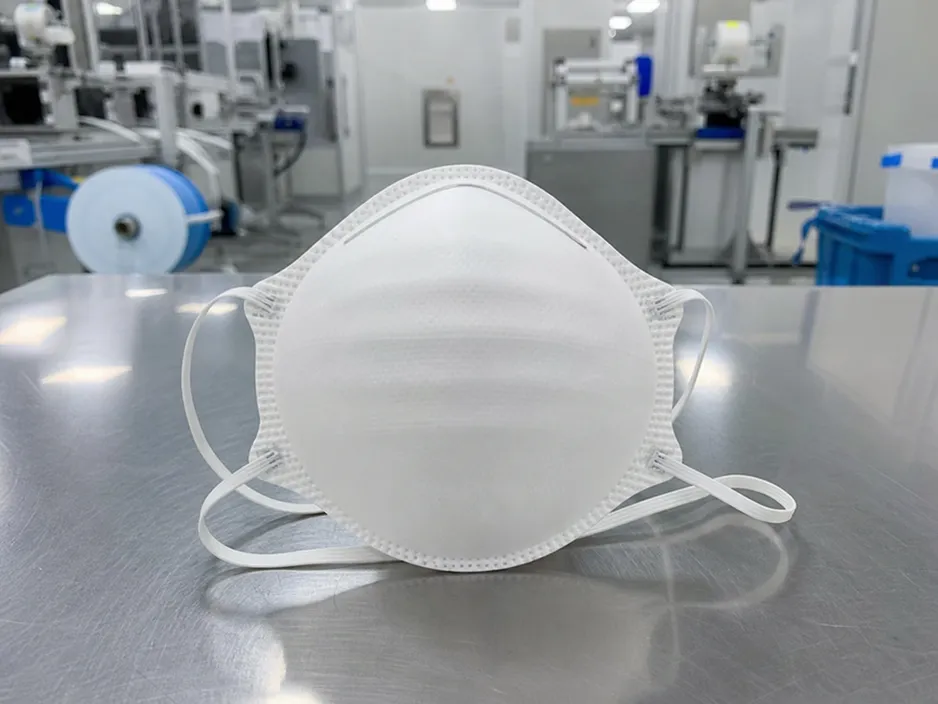
Most filtration disputes we see in sourcing don't start with a bad factory. They start with a buyer who ordered based on a number — "≥95% filtration" — without understanding what that number was actually measuring, under which test protocol, and whether the supplier's production process can reproduce it batch after batch.
PFE and BFE are not interchangeable. NIOSH N95 and ASTM Level 3 are not the same certification. And a supplier who quotes you "95% filtration" without specifying the test method is giving you a number that could mean almost anything. This article breaks down what the tests actually measure, how the major standards map to each other, and what to look for when you're evaluating a supplier's filtration claims.

What the 95% threshold actually measures — and what it doesn't
The "95%" in N95 refers specifically to particulate filtration efficiency tested under NIOSH 42 CFR Part 84. The test uses 0.3-micron NaCl aerosol particles at a flow rate of 85 L/min — conditions designed to find the most penetrating particle size for the filter media. A mask must block at least 95% of those particles to earn the N95 designation.
That's the PFE test. It measures how well the filtration layer stops non-oil-based aerosol particles.
BFE — Bacterial Filtration Efficiency — is a different test entirely. It uses a Staphylococcus aureus aerosol at a flow rate of 28.3 L/min and measures how many colony-forming units pass through the mask. BFE is the primary performance metric under ASTM F2100 (for surgical masks) and EN 14683 (for European medical face masks). A mask rated ASTM Level 3 must achieve ≥98% BFE. EN 14683 Type IIR requires ≥98% BFE as well.
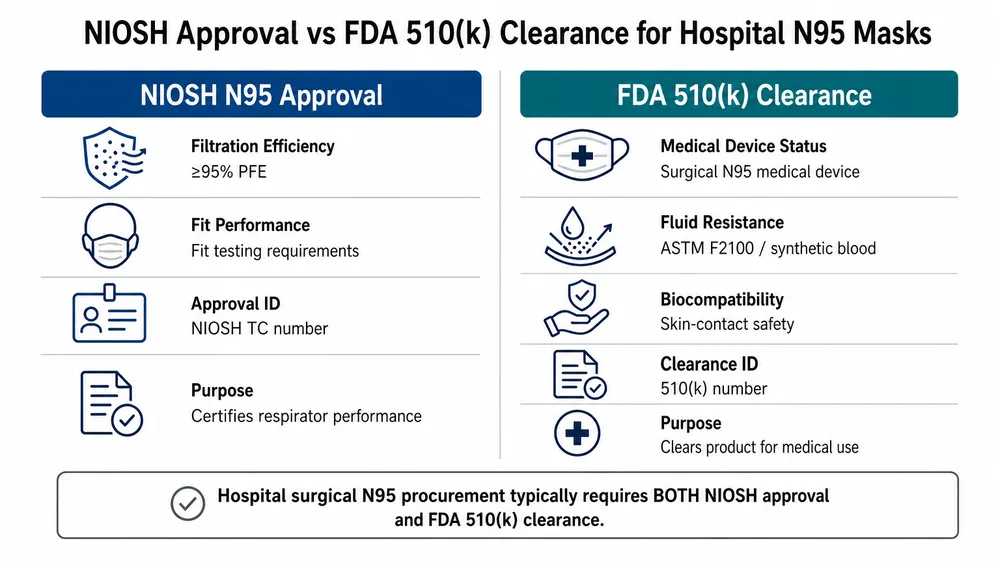
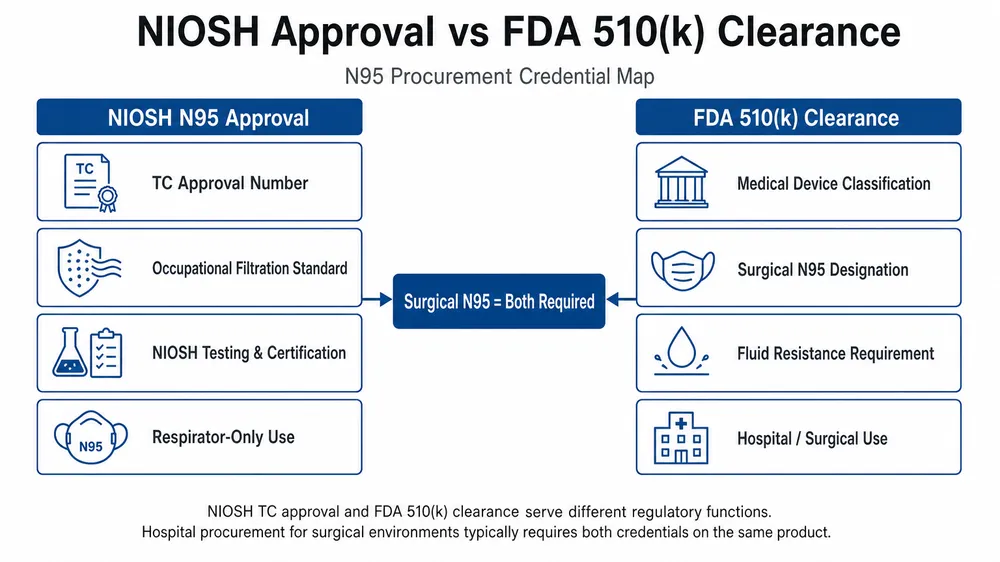
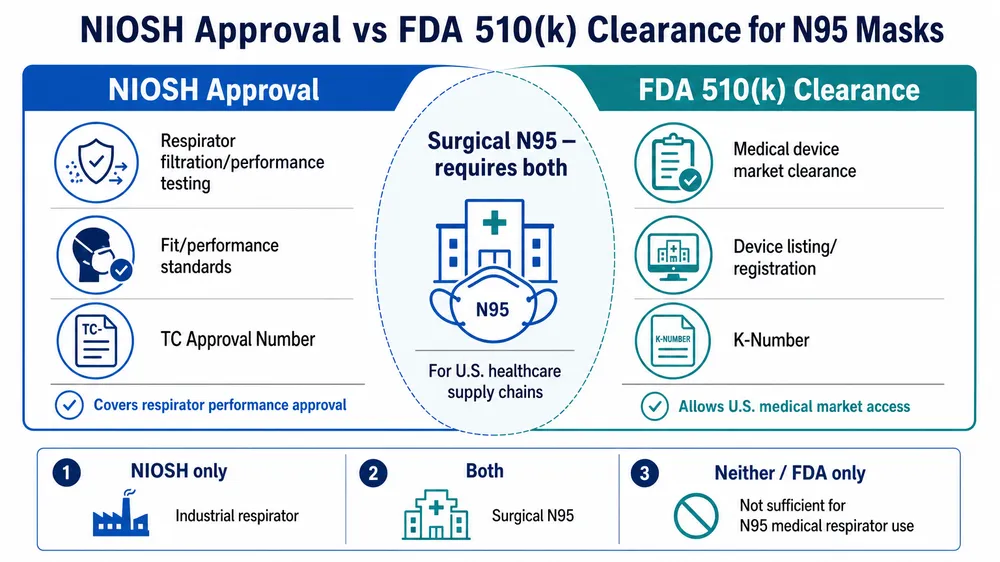
Here's where buyers get confused: an N95 respirator is tested for PFE under NIOSH protocols. A surgical mask is tested for BFE under ASTM or EN standards. A surgical N95 — the type used in operating rooms — must pass both, because it needs to protect the patient from the wearer (BFE) and protect the wearer from the environment (PFE). FDA 510(k) clearance for a surgical N95 requires meeting both NIOSH filtration requirements and ASTM F2100 Level 3 performance.
(We've had buyers come to us with spec sheets from other suppliers showing "≥99% BFE" on what was labeled as an N95. BFE alone doesn't make something an N95. NIOSH PFE testing under 42 CFR 84 is what does.)
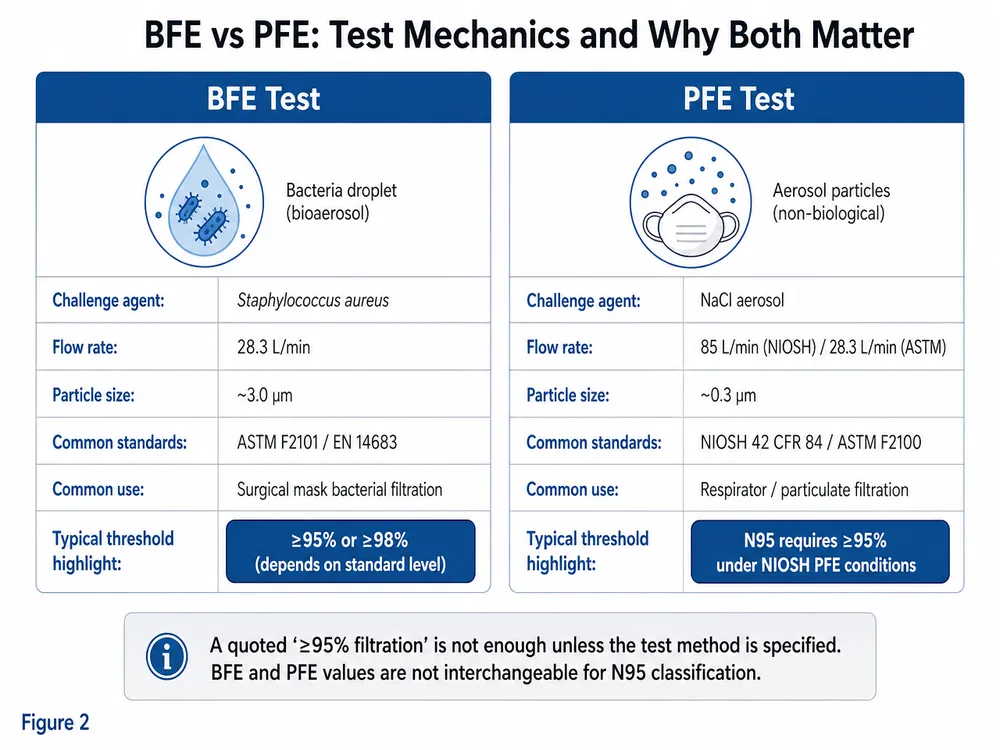
BFE vs PFE: the test mechanics and why both matter for N95 classification
Understanding the test mechanics helps you read supplier documentation without getting misled.
PFE testing (NIOSH 42 CFR 84 / ASTM F2100):
- Challenge agent: 0.3-micron NaCl aerosol (non-oil-based)
- Flow rate: 85 L/min (NIOSH) or 28.3 L/min (ASTM)
- Measurement: percentage of particles blocked by the filter media
- Threshold for N95: ≥95% at NIOSH flow rate
- Threshold for ASTM Level 3: ≥98% at ASTM flow rate
BFE testing (ASTM F2101 / EN 14683 Annex B):
- Challenge agent: Staphylococcus aureus aerosol, mean particle size ~3 microns
- Flow rate: 28.3 L/min
- Measurement: percentage reduction in colony-forming units
- Threshold for ASTM Level 1: ≥95% BFE
- Threshold for ASTM Level 2 and Level 3: ≥98% BFE
- Threshold for EN 14683 Type I: ≥95% BFE
- Threshold for EN 14683 Type II / IIR: ≥98% BFE
The particle sizes are different, the flow rates are different, and the challenge agents are different. A mask can pass BFE at ≥98% and still fail PFE at the NIOSH threshold — because the meltblown layer that handles sub-micron particle capture is doing different work than the layer that stops bacterial aerosols at 3 microns.
For N95 classification specifically, PFE is the governing test. BFE matters when the product is also positioned as a surgical mask or when your buyer's market requires ASTM or EN compliance alongside NIOSH certification.
How NIOSH 42 CFR 84, ASTM F2100, and EN 14683 define filtration requirements — and where N95 sits
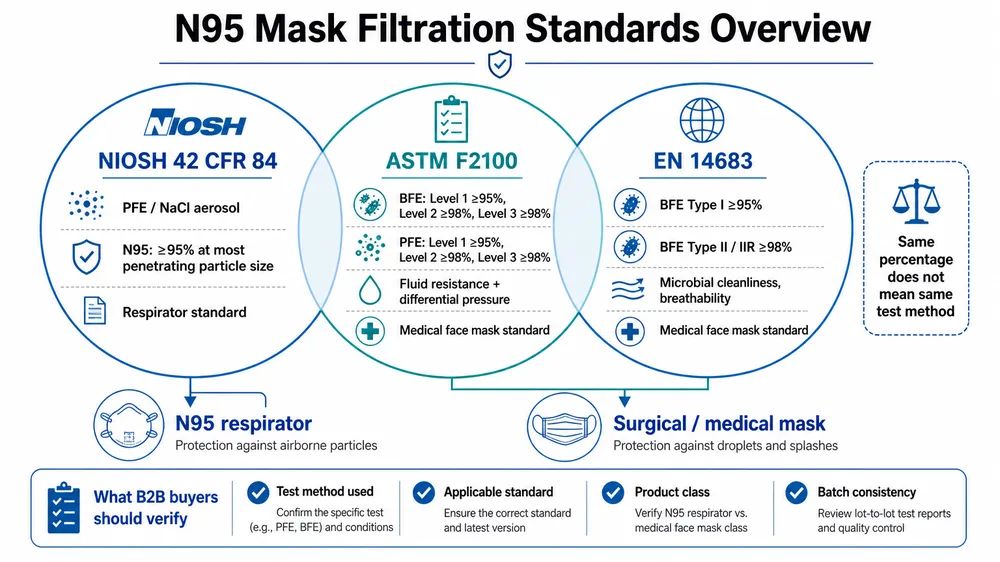
These three frameworks are not competing standards. They govern different product categories and different markets, but they overlap significantly for N95 and surgical N95 products. Here's how they map:
| Standard | Product Type | Primary Test | Minimum Filtration | Market |
|---|---|---|---|---|
| NIOSH 42 CFR 84 | N95 Respirator | PFE (NaCl, 0.3 µm) | ≥95% PFE | US (occupational) |
| ASTM F2100 Level 1 | Surgical Mask | BFE + PFE | ≥95% BFE, ≥95% PFE | US (medical) |
| ASTM F2100 Level 2 | Surgical Mask | BFE + PFE | ≥98% BFE, ≥98% PFE | US (medical) |
| ASTM F2100 Level 3 | Surgical Mask | BFE + PFE | ≥98% BFE, ≥98% PFE | US (medical) |
| EN 14683 Type I | Medical Face Mask | BFE | ≥95% BFE | EU |
| EN 14683 Type II | Medical Face Mask | BFE | ≥98% BFE | EU |
| EN 14683 Type IIR | Medical Face Mask | BFE + splash resistance | ≥98% BFE | EU (surgical) |
| FDA 510(k) Surgical N95 | Surgical N95 Respirator | PFE + BFE + Delta-P | ≥95% PFE (NIOSH) + ASTM L3 | US (surgical/medical) |
A few things worth noting in that table:
ASTM F2100 Level 3 and Level 2 have the same BFE and PFE thresholds (≥98%). The difference between them is Delta-P (breathability) and fluid resistance — Level 3 has stricter requirements on both. So a supplier claiming "Level 3" based on filtration numbers alone hasn't told you the full story.
EN 14683 Type I only requires BFE testing — no PFE requirement. A mask that meets EN 14683 Type I is not equivalent to an N95 and should not be sourced as one.
NIOSH N95 certification and FDA 510(k) clearance are separate processes. NIOSH certifies the respirator's filtration performance. FDA 510(k) clears it as a medical device for surgical use. A product can have one without the other. For hospital procurement in the US, you typically need both.
The meltblown layer: why filtration consistency is a supply chain problem, not just a spec problem
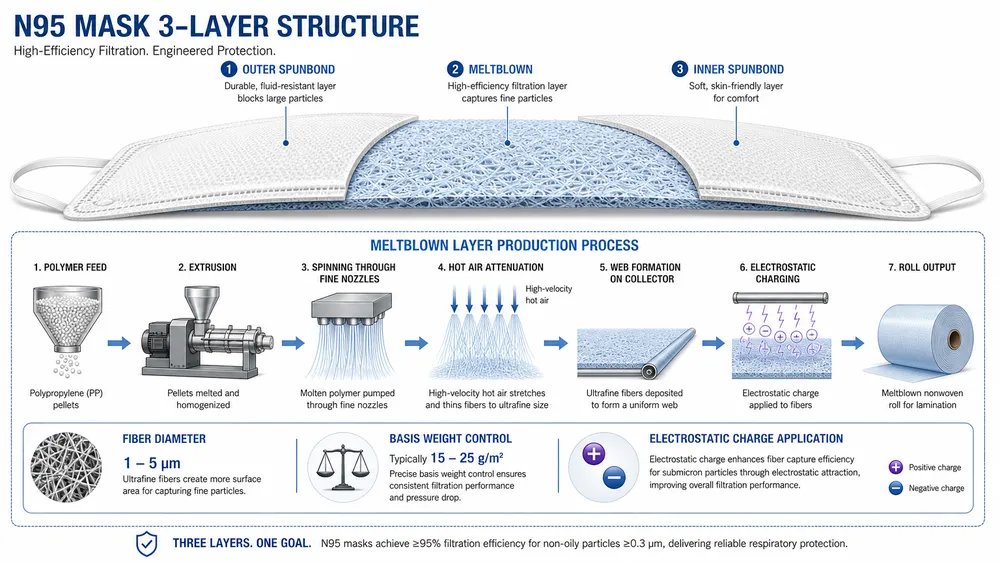
Every mask has three layers. The outer spunbond layer handles fluid resistance and structural integrity. The inner spunbond layer provides comfort. The middle meltblown layer does the filtration work.
Meltblown nonwoven fabric is produced by extruding polymer (typically polypropylene) through fine nozzles at high velocity, creating a web of ultra-fine fibers — typically 1–5 microns in diameter. The filtration performance comes from two mechanisms: mechanical interception of particles by the fiber web, and electrostatic attraction from the charge applied to the fabric during production.
The electrostatic charge is the variable that most buyers don't think about. A meltblown fabric that has lost its charge — through improper storage, humidity exposure, or age — will show significantly lower PFE than the same fabric freshly produced. We've tested rolls from external suppliers that arrived within spec on basis weight and fiber diameter but showed PFE degradation because the charge had dissipated in transit. That's a batch failure waiting to happen.
Most mask factories buy meltblown fabric from external suppliers. That means their filtration performance is only as consistent as their supplier's production run and storage conditions. When demand spikes — as it did in 2020 and again during subsequent respiratory illness seasons — meltblown supply tightens, prices rise, and quality variance increases. Factories that don't control their own meltblown supply either stop shipping or start accepting rolls that are marginal on spec.
We produce our own meltblown fabric in-house. That means we set the fiber diameter, basis weight, and electrostatic charge parameters ourselves, and we batch-test every roll before it enters the mask production line. When you order a mask rated at ≥95% PFE from us, the filtration layer was made in our facility under our process controls — not sourced from a spot market.
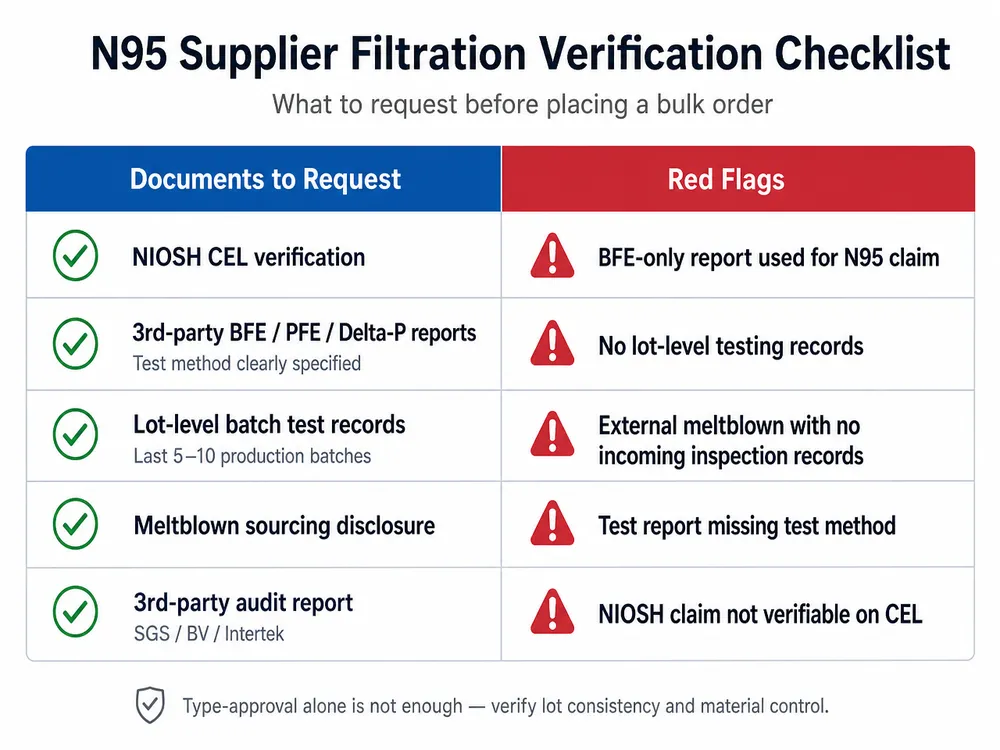
(The practical implication for your sourcing: ask any N95 supplier whether they produce their own meltblown or purchase it externally. If they purchase externally, ask for their incoming inspection records for meltblown lots. If they can't provide those, their filtration consistency is an open question.)
How to read a supplier's filtration test report — and what to ask for
A test report is only useful if you know what it's confirming. Here's what to look for when a supplier sends you filtration documentation.
Third-party lab certification vs. in-house test data
NIOSH certification is issued by NIOSH directly — it's not a third-party lab report. If a supplier shows you a "NIOSH test report" from a commercial lab, that's not NIOSH certification. Actual NIOSH-approved N95 respirators appear on the NIOSH Certified Equipment List (CEL), which is publicly searchable. Verify the product there before you rely on the certification claim.
For ASTM and EN compliance, third-party lab reports from accredited labs (Nelson Labs, SGS, Intertek, Bureau Veritas) are the standard documentation. The report should specify the test method (ASTM F2101 for BFE, ASTM F2299 for PFE), the challenge agent, the flow rate, and the result. A report that says "≥98% BFE" without specifying the test method is incomplete.
Lot-level vs. type-approval testing
Type-approval testing confirms that a specific product design meets the standard. It's done once (or periodically for recertification). Lot-level testing confirms that a specific production batch meets the standard. For B2B procurement, you want both: type approval tells you the product was designed to spec, lot-level testing tells you the batch you're receiving was produced to spec.
Ask your supplier: do you run BFE/PFE testing on every production batch, or only for initial certification? A supplier with in-house testing capability can provide batch-level test data. A supplier who only has type-approval documentation cannot tell you whether the specific lot you're receiving matches the certified design.
Delta-P: the breathability parameter that gets overlooked
Delta-P (differential pressure) measures airflow resistance — how hard it is to breathe through the mask. ASTM F2100 Level 3 requires Delta-P ≤5.0 mm H₂O/cm². NIOSH 42 CFR 84 has its own inhalation and exhalation resistance requirements. A mask with very high filtration efficiency but poor Delta-P is a compliance problem for healthcare settings where extended wear is required.
Always request Delta-P data alongside BFE and PFE. If a supplier's test report only shows filtration numbers, ask specifically for the breathability data.
Our in-house QC lab runs BFE, PFE, and Delta-P on every production batch before shipment. The batch test reports travel with the shipment documentation, so you have lot-specific performance data — not just the type-approval certificate — when your goods arrive.
Filtration spec consistency across batches: what to ask before placing a bulk order
A single test report proves one batch. Your sourcing risk is whether the next 50 batches perform the same way.
Spec consistency across production runs depends on three things: raw material consistency, process parameter control, and in-process testing. A factory that buys meltblown from multiple external suppliers, doesn't run in-process filtration checks, and only tests finished product at the outgoing stage has limited ability to catch batch-to-batch variance before it ships.
Before placing a bulk order with any N95 supplier, ask for:
- Meltblown sourcing disclosure: Do they produce in-house or purchase externally? If external, who are the approved suppliers and what are the incoming inspection criteria?
- Batch test records: Can they provide BFE/PFE/Delta-P results for the last 5–10 production batches? Look for consistency in the numbers, not just compliance with the threshold.
- Failure rate data: What percentage of batches fail internal QC? A factory that claims zero failures has either very low testing frequency or isn't being honest. A factory that can tell you their internal rejection rate and what happens to failed batches is running a real QC system.
- Third-party audit reports: SGS, Bureau Veritas, or equivalent. These confirm the QC system is operating as documented, not just that the product passed a one-time test.
For N95 Medical Masks specifically, the combination of NIOSH certification and FDA 510(k) registration means the product has been validated against two independent regulatory frameworks. That's a meaningful bar — it requires documented process controls, not just a passing test result.
N95 vs surgical mask filtration: where the specs diverge and why it matters for your market
The distinction matters commercially because the two product types serve different regulatory channels and different buyer segments.
| Parameter | N95 Respirator | Surgical Mask (ASTM L3) | Surgical N95 |
|---|---|---|---|
| Primary standard | NIOSH 42 CFR 84 | ASTM F2100 Level 3 | NIOSH + FDA 510(k) |
| Filtration test | PFE (NaCl, 0.3 µm) | BFE + PFE | PFE + BFE |
| Minimum filtration | ≥95% PFE | ≥98% BFE, ≥98% PFE | ≥95% PFE + ≥98% BFE |
| Fit requirement | Yes (NIOSH fit test) | No | Yes |
| Fluid resistance | Not required | Required (ASTM F1862) | Required |
| Typical buyer | Industrial, occupational health | Hospital, clinical | Hospital (OR/procedure) |
| US regulatory path | NIOSH certification | FDA 510(k) or 510(k) exempt | NIOSH + FDA 510(k) |
If you're supplying hospital procurement in the US, the distinction between a standard N95 and a surgical N95 affects which products can be used in surgical settings. Standard N95s are not cleared for use as surgical masks — they don't have the fluid resistance or BFE documentation that surgical settings require. Sourcing the wrong product type creates a compliance problem for your buyer downstream.
For industrial and occupational health distribution, a NIOSH-certified N95 without surgical clearance is the standard product. For healthcare distribution into surgical or procedural settings, you need the surgical N95 with FDA 510(k) clearance.
Our Disposable N95 Medical Mask and Hospital N95 Medical Mask lines are documented separately because the regulatory requirements and test documentation differ. If you're building a product line that spans both channels, we can walk you through which SKU fits which compliance path before you commit to a bulk order.
Frequently asked questions
What is the difference between BFE and PFE for N95 masks?
BFE (Bacterial Filtration Efficiency) measures how well a mask blocks bacterial aerosols at approximately 3 microns, using Staphylococcus aureus as the challenge agent. PFE (Particulate Filtration Efficiency) measures filtration of sub-micron particles — typically 0.3-micron NaCl aerosol — at higher flow rates. N95 classification is based on PFE under NIOSH 42 CFR 84. BFE is the primary metric for surgical masks under ASTM F2100 and EN 14683. A surgical N95 must pass both.
Does NIOSH N95 certification require BFE testing?
No. NIOSH 42 CFR 84 N95 certification requires PFE testing with NaCl aerosol at 0.3 microns and 85 L/min flow rate. BFE testing is not part of the NIOSH N95 certification protocol. BFE becomes relevant when the product is also classified as a surgical mask under ASTM F2100 or EN 14683, or when FDA 510(k) clearance as a surgical N95 is required.
How can I verify that an N95 supplier's filtration claims are accurate?
Start with the NIOSH Certified Equipment List (CEL) — it's publicly searchable and lists every NIOSH-approved respirator by manufacturer and model. For ASTM and EN compliance, request third-party lab test reports specifying the test method, challenge agent, and flow rate. Then ask for lot-level batch test records from recent production runs. A supplier who can only provide type-approval documentation but not batch-level data cannot confirm that the specific lot you're receiving matches the certified design.
What does Delta-P measure and why does it matter for N95 procurement?
Delta-P (differential pressure) measures airflow resistance — the pressure drop across the mask at a given flow rate. ASTM F2100 Level 3 requires Delta-P ≤5.0 mm H₂O/cm². High filtration efficiency with poor Delta-P creates compliance problems for healthcare settings requiring extended wear. Always request Delta-P data alongside BFE and PFE when evaluating N95 or surgical mask suppliers.
Why does meltblown fabric sourcing affect filtration consistency?
The meltblown layer provides the filtration performance. Its effectiveness depends on fiber diameter, basis weight, and electrostatic charge — all of which can vary between production runs and degrade with improper storage. Factories that purchase meltblown externally are dependent on their supplier's consistency and storage practices. Factories that produce meltblown in-house control these parameters directly and can run incoming inspection on every roll before it enters mask production.
What is the minimum order quantity for NIOSH-certified N95 masks from eztio?
Standard SKUs start at 50,000 pieces. For custom configurations or private-label programs, MOQ may be higher depending on the line setup requirements. If you're evaluating a new SKU for your market, we can discuss a sample run before committing to full production volume. Send your target spec and market to /rfq and we'll respond with the relevant documentation and pricing.