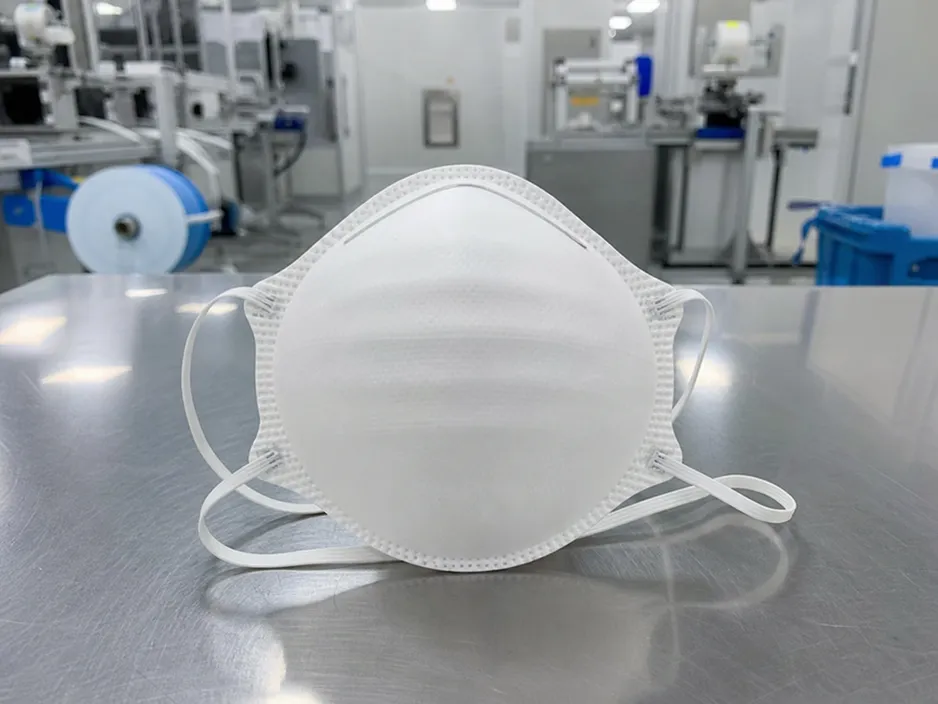
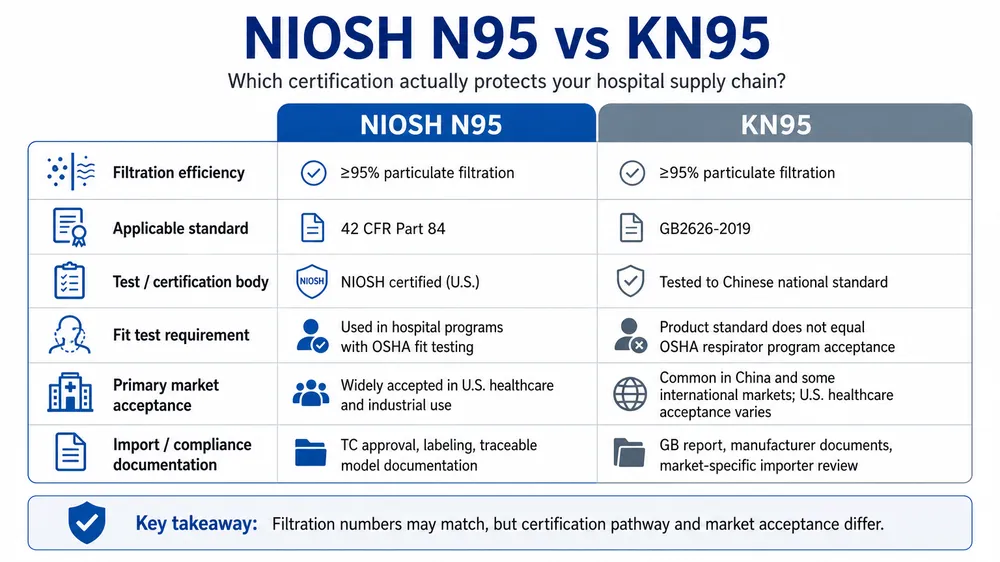
The filtration numbers look identical on paper. Both NIOSH N95 and KN95 claim ≥95% particulate filtration efficiency. Both use electrostatic meltblown media. Both are shaped to seal against the face. So when a hospital procurement team or a distributor building a healthcare supply program asks which one to specify, the answer isn't about filtration — it's about where the product is going, what documentation your customs broker needs, and whether your supplier can actually back the claim.
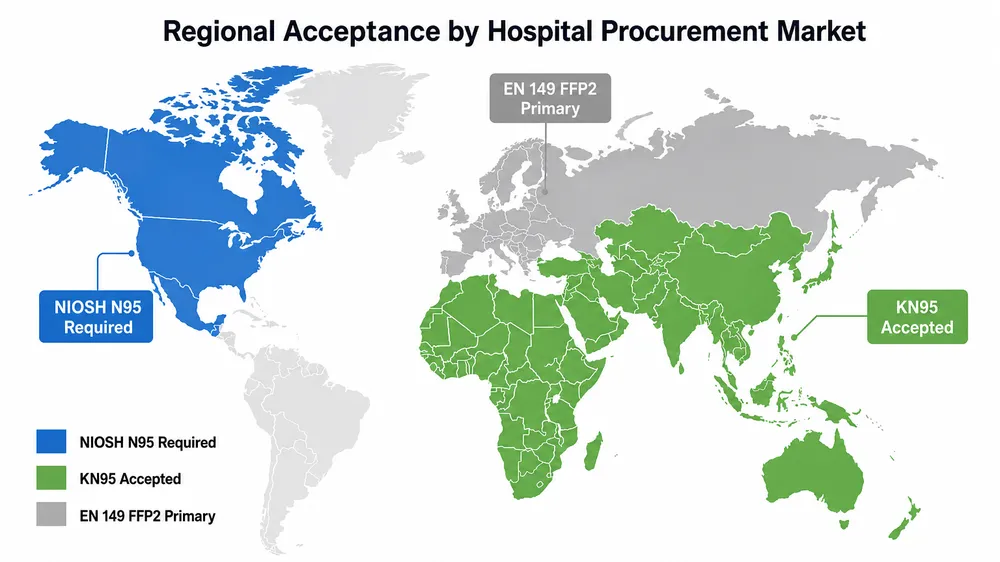
Here's the short version: for US hospital procurement, NIOSH N95 is the only certification that clears institutional audits and FDA import review without exception. KN95 is the correct specification for markets operating under Chinese GB2626-2019 or where institutional buyers accept it — primarily Southeast Asia, the Middle East, and parts of Africa. Confusing the two doesn't just create a compliance headache; it can strand a shipment at the border or fail a hospital procurement audit after the product is already in your warehouse.
The rest of this article explains why, what the documentation differences look like in practice, and what to require from a supplier in either case.

What NIOSH N95 Approval Actually Requires
NIOSH N95 is a product approval, not a self-declared standard. The National Institute for Occupational Safety and Health tests and approves each specific respirator model under 42 CFR Part 84. The manufacturer submits the product, NIOSH tests it, and if it passes, that specific model receives an approval number — TC-84A-XXXX. That number is tied to the exact design, materials, and manufacturing process submitted. Change the meltblown supplier, modify the nose wire geometry, or alter the ear-loop attachment method, and the approval technically no longer covers the modified product.
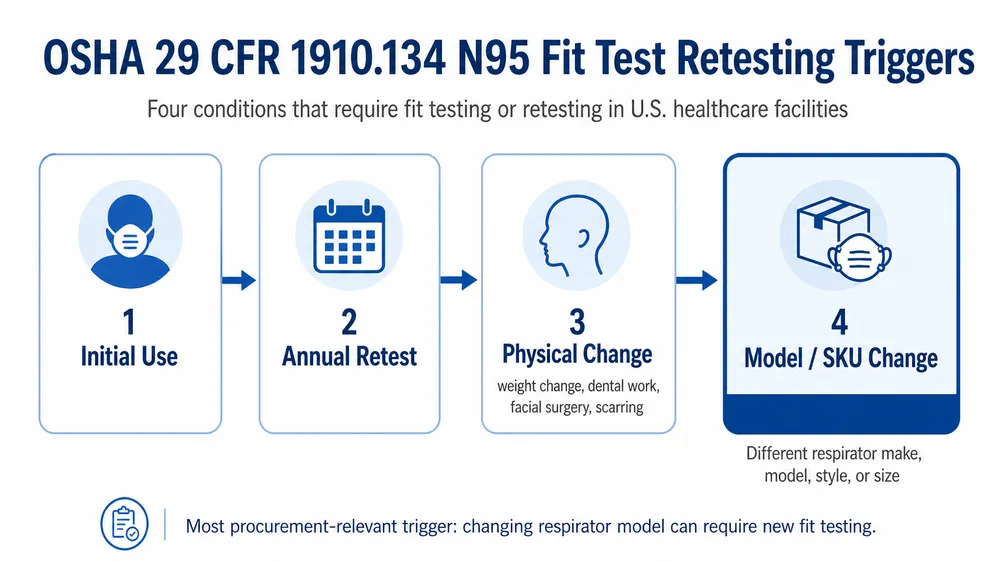
The filtration test uses NaCl aerosol at 85 L/min flow rate, which is a more demanding condition than the GB2626 test protocol. The fit test requirement for N95 is also more stringent: NIOSH requires quantitative or qualitative fit testing against a panel of human subjects as part of the approval process, and healthcare facilities using NIOSH-approved respirators are expected to conduct individual fit testing for their staff.
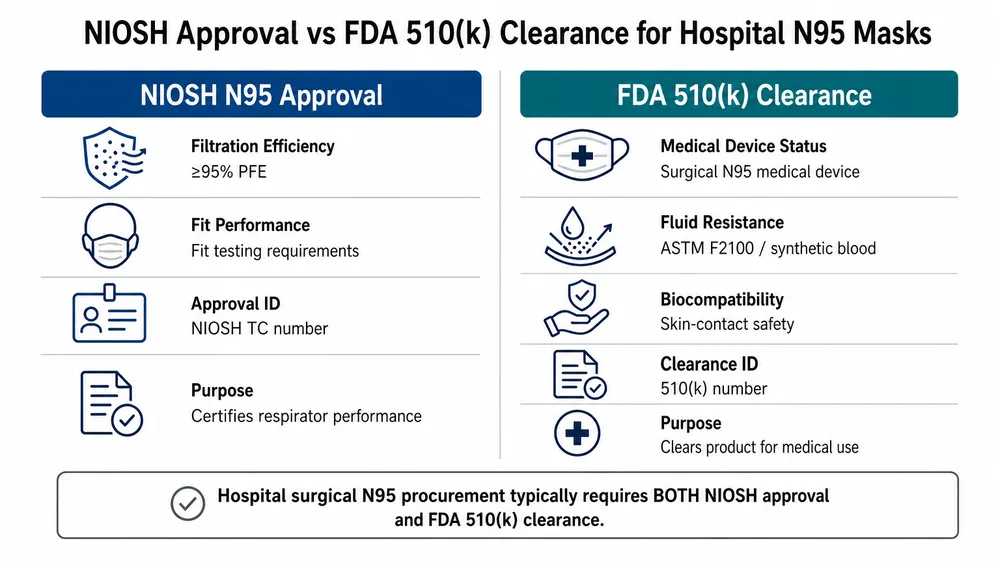
For US hospital procurement, the NIOSH approval number is the document that matters. Hospital compliance teams and GPO (Group Purchasing Organization) contracts typically require NIOSH-approved respirators by specification. FDA 510(k) clearance for surgical N95 respirators adds a second layer — it covers the mask's fluid resistance and flammability performance under 21 CFR Part 878, which is required for surgical environments where splash exposure is a risk. (These are two separate regulatory pathways. A NIOSH-approved N95 is not automatically FDA 510(k)-cleared for surgical use, and vice versa.)
What KN95 Certification Covers
KN95 is certified under China's GB2626-2019 standard, administered by the Standardization Administration of China. The filtration requirement is ≥95% PFE using NaCl aerosol — numerically identical to NIOSH N95. The fit test requirement under GB2626 uses a total inward leakage test with human subjects, but the protocol and acceptance criteria differ from NIOSH's approach.
The practical difference is that KN95 is a manufacturer-declared conformity to a Chinese national standard, with third-party testing required for certification. It is not a product-by-product approval by a government agency the way NIOSH N95 is. That distinction matters enormously for US import documentation — and it's the reason the FDA's Emergency Use Authorization for KN95 masks, which was issued during the COVID-19 pandemic to address N95 shortages, has since expired. As of 2023, the FDA EUA pathway that allowed KN95 masks to be used as N95 substitutes in US healthcare settings is no longer active.
KN95 is the correct and accepted standard in markets that recognize GB2626 or equivalent Chinese certification frameworks. For distributors supplying hospitals in Southeast Asia, the Middle East, and parts of Africa, KN95 with valid GB2626 certification and third-party test reports is typically sufficient for institutional procurement. The documentation package looks different — you're presenting GB2626 test reports and a certificate of conformity rather than a NIOSH TC number — but the product clears customs and passes procurement review in those markets without issue.
Head-to-Head: Certification Specification Matrix
| Dimension | NIOSH N95 | KN95 |
|---|---|---|
| Governing standard | 42 CFR Part 84 (US) | GB2626-2019 (China) |
| Filtration efficiency | ≥95% NaCl PFE | ≥95% NaCl PFE |
| Test flow rate | 85 L/min | 85 L/min |
| Fit test method | NIOSH-specified quantitative/qualitative | Total inward leakage (human subjects) |
| Approval mechanism | Government product approval (NIOSH TC number) | Third-party certification to national standard |
| Fluid resistance | Not required (separate FDA 510(k) for surgical N95) | Not required |
| US hospital acceptance | Required — no substitution | Not accepted (EUA expired 2023) |
| EU acceptance | Accepted; EN 149 FFP2 is the EU equivalent | Accepted in some markets; not equivalent to FFP2 |
| Primary markets | US, Canada | China, Southeast Asia, Middle East, Africa |
| Import documentation | NIOSH TC approval number + FDA 510(k) if surgical | GB2626 test report + certificate of conformity |
| Counterfeit risk | Lower (NIOSH database verifiable) | Higher (no central approval database) |
The Hidden Cost: Import Documentation Failures and Procurement Audit Exposure
The spec table above shows the performance numbers. This section is about what actually goes wrong when buyers get the certification wrong — and the costs are not small.
A US hospital distributor who sources KN95 masks and attempts to position them as N95-equivalent in a GPO contract is not just facing a product return. They're facing a compliance audit, potential contract termination, and in some cases FDA enforcement action for misbranding a medical device. We've seen this scenario play out with buyers who sourced during the EUA period and didn't update their procurement specs when the EUA expired. The product was physically identical to what they'd been buying — same filtration numbers, same construction — but the regulatory status had changed, and their hospital customers' compliance teams caught it.
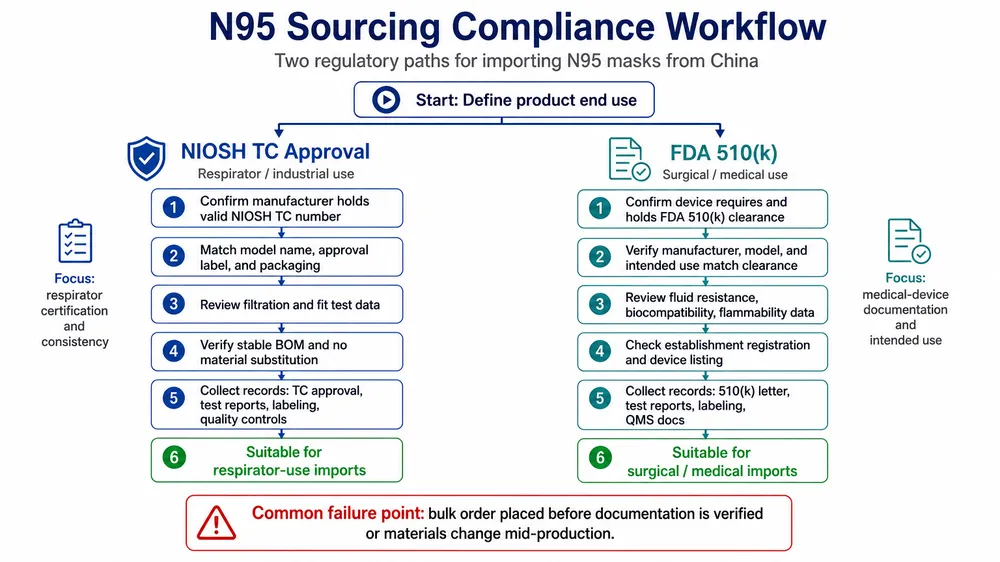
The import documentation failure is a different problem. NIOSH N95 masks imported into the US need to reference the NIOSH TC approval number on the packaging and in the import documentation. If the TC number doesn't match the NIOSH approval database — which is publicly searchable at cdc.gov/niosh/npptl — the shipment can be held at customs for review. Counterfeit N95 masks frequently carry fabricated TC numbers, and US Customs and Border Protection has been actively screening for this since 2020. A legitimate KN95 with valid GB2626 documentation won't have a TC number, because it's not a NIOSH-approved product — and that's fine for markets where KN95 is accepted, but it's the wrong document for a US hospital shipment.
For EU buyers, the equivalent framework is EN 149:2001+A1:2009, which defines FFP2 (≥94% filtration) and FFP3 (≥99% filtration) respirator classes. Neither NIOSH N95 nor KN95 is automatically equivalent to FFP2 under EU MDR — the product needs CE marking under the PPE Regulation (EU) 2016/425 with a notified body certificate. A supplier with CE (EU MDR) certification has gone through that process; a supplier with only GB2626 certification has not.
(This is the documentation gap that catches the most buyers off guard: a mask can have excellent filtration performance and still fail EU customs clearance if the CE technical file isn't in order. We've walked multiple European first-time importers through this.)
Supply Chain Risk: Verifying What You're Actually Buying
The counterfeit problem in the N95/KN95 category is real and well-documented. During the COVID-19 pandemic, the US government and multiple state health departments received shipments of masks labeled as NIOSH-approved N95 that failed filtration testing — some by significant margins. The problem hasn't disappeared; it's just less visible now that the emergency purchasing pressure has eased.
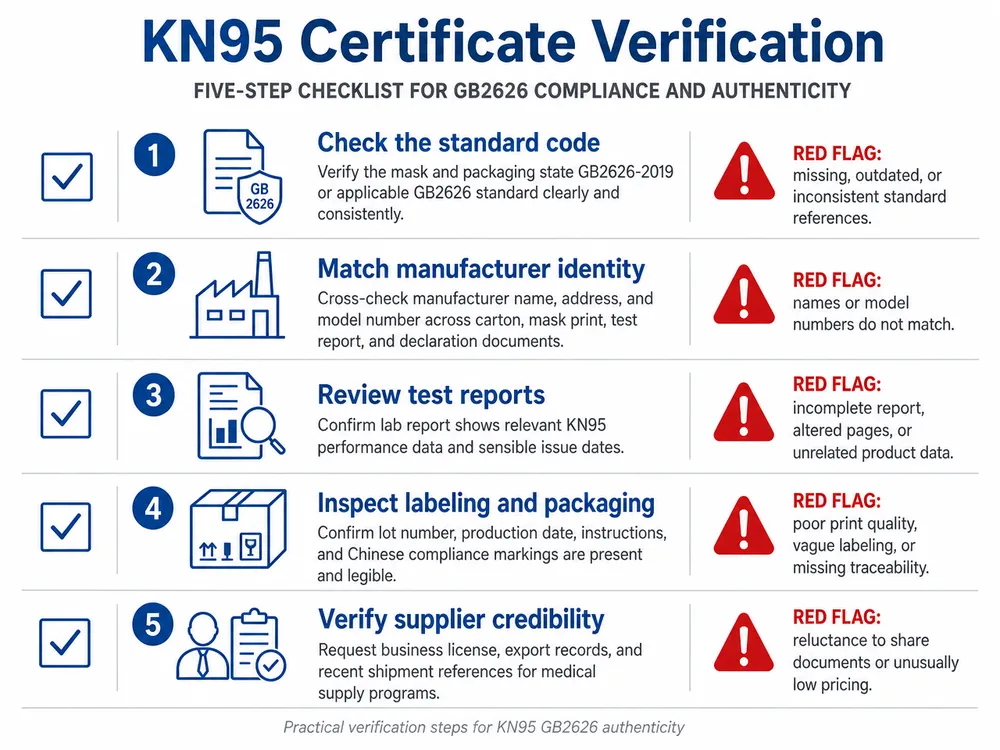
For NIOSH N95, verification is straightforward: the NIOSH TC approval number on the packaging should match an active listing in the NIOSH NPPTL respirator approval database. The database is public, searchable by TC number, and shows the approved manufacturer, model name, and approval status. If the TC number doesn't appear, or if it appears under a different manufacturer name than what's on the box, the product is not what it claims to be.
KN95 verification is harder because there's no equivalent central database. The GB2626 certification is issued by accredited Chinese testing laboratories, and the certificate should reference a specific test report number and testing body. The practical verification steps are: request the original GB2626 test report (not a summary), confirm the testing laboratory is CNAS-accredited, and cross-reference the product model name on the certificate against what's on the packaging. Discrepancies between the certificate model name and the physical product are a common indicator of certificate reuse — a legitimate certificate applied to a different, uncertified product.
The deeper supply chain protection is controlling the filtration layer. Meltblown nonwoven fabric is the component that determines whether a mask actually achieves ≥95% PFE. Factories that buy meltblown from outside suppliers are dependent on that supplier's consistency — and during periods of supply disruption, meltblown quality and availability vary significantly. We produce our own meltblown fabric in-house, which means the fiber diameter, basis weight, and electrostatic charge are set to our spec, not a commodity supplier's. Every production batch goes through in-house PFE testing before it leaves our QC lab. That's the difference between a filtration claim and a filtration guarantee.
Application Showdown: Which Certification Wins in Each Scenario
Scenario 1: US hospital system GPO contract
NIOSH N95 wins, no contest. GPO contracts for US hospital systems specify NIOSH-approved respirators by requirement, not by preference. The FDA EUA that allowed KN95 substitution expired in 2023. If your hospital customer's compliance team runs an audit — and they will — a KN95 in the N95 slot fails. Source NIOSH-approved product with a valid TC number, and if the application involves surgical environments, confirm the product also carries FDA 510(k) clearance for surgical N95 use.
Scenario 2: Southeast Asian hospital distributor building a regional supply program
KN95 with valid GB2626-2019 certification is the correct specification here. Most institutional procurement frameworks in Southeast Asia recognize GB2626 certification, and the landed cost advantage of KN95 over NIOSH N95 is meaningful at the volumes a regional distributor handles. The documentation package — GB2626 test report, certificate of conformity, and a manufacturer's declaration — is what your buyers' compliance teams will ask for. Verify the test report is from a CNAS-accredited lab and that the model name matches the physical product.
Scenario 3: Multi-market distributor supplying both US and non-US hospital accounts
This is where single-certification sourcing creates supply chain fragility. A distributor running US hospital accounts alongside Southeast Asian or Middle Eastern accounts needs a supplier who can deliver both NIOSH N95 and KN95-certified product with the correct documentation for each market — not a supplier who offers one and asks you to figure out the other. The operational risk of mixing up certification documentation across markets is significant: a KN95 shipment document accidentally attached to a US hospital order, or a NIOSH TC number cited on a GB2626 certificate, creates compliance exposure on both ends.
We supply both configurations from the same facility, with separate documentation packages for each market. Our FDA 510(k) registration covers US import requirements; our CE (EU MDR) certification covers European buyers; and our GB2626-certified KN95 line serves markets where that standard is the accepted framework. One supplier, correct documentation for each destination.
What to Require from a Supplier in Your RFQ
Whether you're specifying NIOSH N95 or KN95, the documentation requirements in your RFQ should be explicit. Vague language like "N95-equivalent" or "meets N95 standards" is not a specification — it's an invitation for substitution.
For NIOSH N95 orders, require:
- NIOSH TC approval number (verifiable in the NIOSH NPPTL database)
- FDA 510(k) clearance number if the application is surgical
- ISO 13485:2016 quality management system certificate
- In-house or third-party BFE/PFE test reports for the specific production batch
- Packaging that displays the TC number and NIOSH approval statement per 42 CFR Part 84 labeling requirements
For KN95 orders, require:
- GB2626-2019 test report from a CNAS-accredited testing laboratory
- Certificate of conformity with model name matching the physical product
- ISO 13485:2016 or equivalent QMS certificate
- In-house PFE test reports showing ≥95% filtration for the production batch
- Confirmation that the meltblown filtration layer spec is controlled — either in-house production or a documented approved supplier with batch testing
The last point on that KN95 list is the one most buyers skip. Asking for a GB2626 certificate is table stakes. Asking how the supplier controls the filtration layer spec across order cycles is the question that separates a reliable supply chain from one that passes the first order and drifts on the third.
(We get this question regularly from buyers who've had a bad experience with a previous supplier — usually a second or third order where the PFE numbers came back lower than the first. The answer is almost always that the previous supplier changed meltblown sources without notifying the buyer.)
Sourcing Decision Framework
The decision between NIOSH N95 and KN95 is not a filtration decision — the performance specs are comparable. It's a market access and documentation decision.
Specify NIOSH N95 when:
- The end destination is a US or Canadian hospital, clinic, or healthcare facility
- Your buyer's procurement contract references NIOSH approval by requirement
- The application involves surgical environments requiring FDA 510(k)-cleared surgical N95
- Your import documentation needs to reference a NIOSH TC number for customs clearance
Specify KN95 when:
- The end destination is in Southeast Asia, the Middle East, Africa, or other markets where GB2626 is the accepted standard
- Your buyer's institutional procurement framework accepts GB2626 certification
- You are building a cost-competitive supply program for markets where NIOSH approval is not required
- Your landed cost calculation makes KN95 the more viable margin structure
Require from any supplier in either case:
- In-house meltblown production or a documented, tested approved meltblown supplier
- Batch-level PFE test reports, not just a certification certificate
- ISO 13485:2016 QMS — this is the quality system standard for medical devices, and it's what ensures the spec you approved in the sample is the spec you receive in production
- A clear answer on how they handle meltblown supply disruptions — this is the single biggest supply chain risk in this product category
Our N95 Medical Masks product line covers both NIOSH N95 and KN95 configurations. Our certifications and compliance documentation is available for review before you place an order. If you're managing a multi-market supply program and need a supplier who can deliver the right documentation for each destination, send us your target markets, required certification standard, and order volume — we'll confirm which configuration fits your program and what the documentation package looks like for each market.
FAQ: N95 vs KN95 for Hospital and Institutional Procurement
Can US hospitals use KN95 masks instead of NIOSH N95?
No — not under current regulations. The FDA Emergency Use Authorization that permitted KN95 use as N95 substitutes in US healthcare settings expired in 2023. US hospital procurement contracts and GPO agreements require NIOSH-approved respirators. A KN95, regardless of its filtration performance, does not satisfy that requirement.
How do I verify a NIOSH N95 approval is legitimate?
Search the NIOSH NPPTL respirator approval database at cdc.gov/niosh/npptl using the TC approval number printed on the packaging. The database shows the approved manufacturer, model name, and current approval status. If the TC number doesn't appear, or appears under a different manufacturer name, the product is not NIOSH-approved.
What's the difference between NIOSH N95 and FDA 510(k) surgical N95?
These are two separate regulatory pathways. NIOSH N95 approval (42 CFR Part 84) certifies the respirator's particulate filtration and fit performance. FDA 510(k) clearance for surgical N95 (21 CFR Part 878) additionally certifies fluid resistance and flammability performance required for surgical environments. A mask can be NIOSH-approved without being FDA 510(k)-cleared for surgical use. For operating room and surgical suite applications, both are required.
What documentation should I request when sourcing KN95 from a Chinese manufacturer?
Request the original GB2626-2019 test report (not a summary), confirm the testing laboratory is CNAS-accredited, and verify the product model name on the certificate matches the physical product exactly. Also request batch-level PFE test reports for the specific production run — the certification certificate covers the product design, but batch testing confirms the actual production output meets spec.
Does eztio supply NIOSH-approved N95 masks?
We hold FDA 510(k) registration and produce masks that meet NIOSH N95 performance specifications. For buyers requiring NIOSH TC-approved product, we can discuss the specific approval pathway and documentation requirements for your order. Contact us with your target market, required certification, and volume — we'll confirm the correct configuration and documentation package.