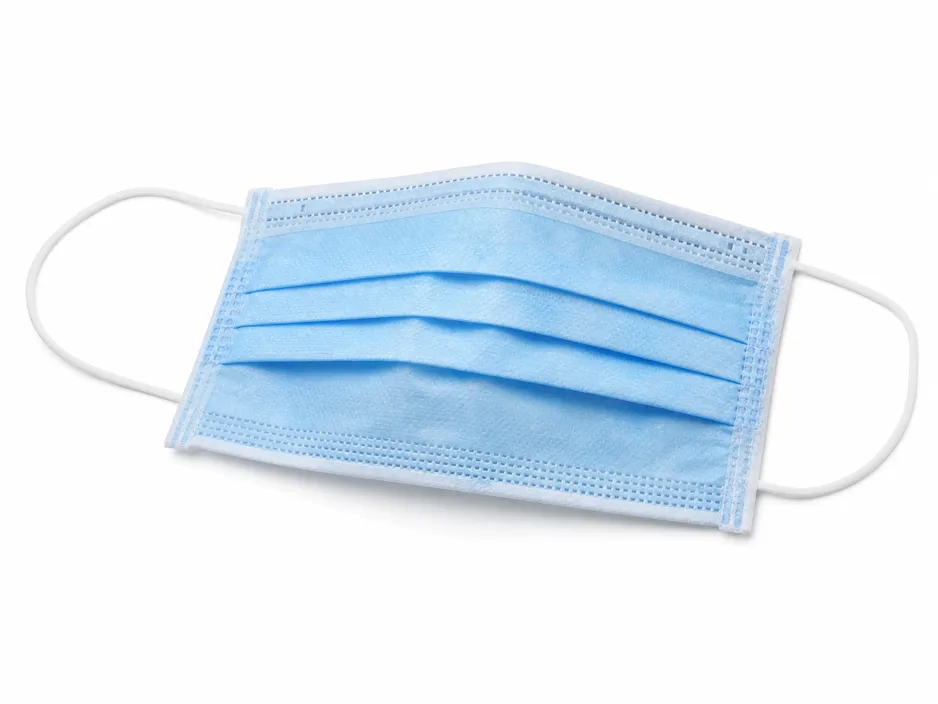
The most common sourcing mistake we see is buyers ordering Level 3 masks for every application because it sounds like the safest choice. It isn't — and it costs more than it needs to. Level 3 carries a higher Delta-P (airflow resistance), which means more breathing effort for the wearer. In a general ward setting where staff wear masks for eight-hour shifts, that matters. Ordering the wrong level doesn't just affect your unit cost; it affects compliance rates and, in some markets, your ability to pass hospital procurement review.
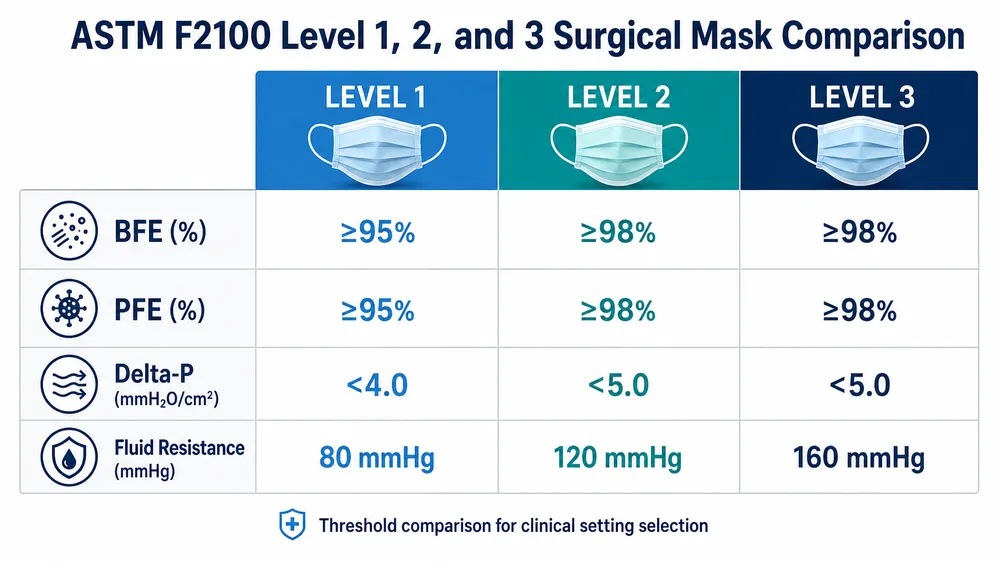
ASTM F2100 is the US standard that governs surgical mask performance. It defines three protection levels based on four measurable parameters: Bacterial Filtration Efficiency (BFE), Particulate Filtration Efficiency (PFE), differential pressure (Delta-P), and fluid resistance. Each level sets minimum thresholds for all four. The clinical setting determines which level you actually need — and getting that match right is the difference between a product that moves through procurement smoothly and one that gets flagged or returned.

The four parameters that define each level
Before the level comparison makes sense, the four parameters need to be clear — not as textbook definitions, but as the numbers your QC team will check on the test report.
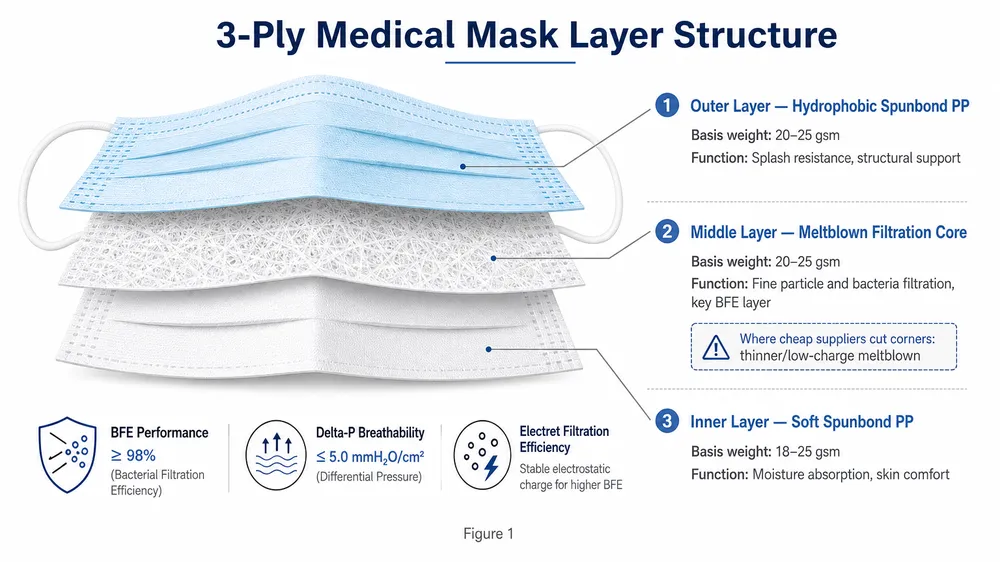
BFE (Bacterial Filtration Efficiency) measures how effectively the mask filters a standardized bacterial aerosol (Staphylococcus aureus at 3.0 ± 0.3 µm mean particle size). Reported as a percentage. The meltblown layer does this work.
PFE (Particulate Filtration Efficiency) measures filtration of 0.1 µm latex sphere particles — a finer challenge than BFE. This is the parameter that separates a mask that looks like it filters from one that actually does at the sub-micron level.
Delta-P (differential pressure) measures airflow resistance across the mask material, reported in mmH₂O/cm². Lower is better for breathability. This is the parameter that gets ignored until staff start pulling masks down mid-shift.
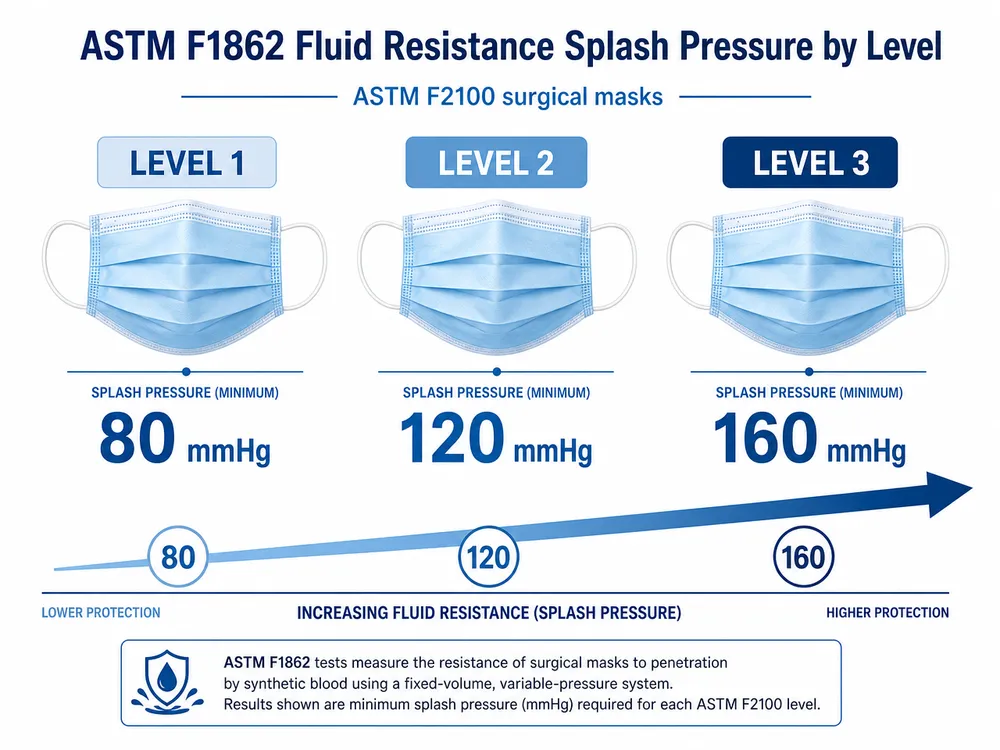
Fluid resistance (ASTM F1862) measures the mask's ability to resist penetration by a synthetic blood surrogate at a defined splash pressure, reported in mmHg. The three levels test at 80, 120, and 160 mmHg respectively — roughly corresponding to low, moderate, and high-velocity fluid exposure scenarios.
The full ASTM F2100 level comparison
| Parameter | Level 1 | Level 2 | Level 3 |
|---|---|---|---|
| BFE | ≥95% | ≥98% | ≥98% |
| PFE (0.1 µm) | ≥95% | ≥98% | ≥98% |
| Delta-P (mmH₂O/cm²) | <4.0 | <5.0 | <5.0 |
| Fluid resistance (mmHg) | ≥80 | ≥120 | ≥160 |
| Flammability | Class 1 | Class 1 | Class 1 |
A few things worth noting in this table. Level 2 and Level 3 share the same BFE and PFE minimums — the difference between them is entirely in fluid resistance. If your procurement decision is driven by filtration performance alone, Level 2 and Level 3 are equivalent. The 160 mmHg fluid resistance threshold on Level 3 is what you're paying for when you specify it, and it only matters in settings where high-velocity fluid splash is a real risk.
Delta-P is capped at <5.0 for both Level 2 and Level 3. In practice, a well-made Level 3 mask will often test at 4.0–4.8 mmH₂O/cm² — within spec, but noticeably stiffer than a Level 1 mask running at 2.5–3.5. Over a full shift, that difference is felt.
Level 1: exam rooms, general wards, and low-aerosol procedures
Level 1 is the right choice for settings where fluid splash risk is low and extended wear comfort matters. The ≥95% BFE threshold covers standard bacterial filtration requirements for non-surgical clinical contact. The 80 mmHg fluid resistance handles incidental splatter — a cough, a sneeze, minor wound irrigation — but not high-velocity blood exposure.
Where Level 1 fits:
- General ward patient care and routine examinations
- Outpatient clinic consultations
- Dental hygiene procedures without high-speed instrumentation
- Administrative and support staff in clinical environments
- Visitor and patient masking programs
The Delta-P advantage here is real. A Level 1 mask running at 2.5–3.0 mmH₂O/cm² is meaningfully more comfortable over a long shift than a Level 3 at 4.5. For buyers supplying hospital systems or large clinic networks, Level 1 is typically the volume SKU — it covers the majority of daily use cases at a lower unit cost and with better staff compliance.
(We see a lot of buyers default to Level 2 for everything because it feels like a safe middle ground. For general ward use, that's over-specification. Level 1 covers the clinical requirement and saves margin.)
Level 2: minor surgical procedures and moderate-risk outpatient settings
Level 2 raises BFE and PFE to ≥98% and fluid resistance to 120 mmHg. This is the appropriate level for procedures where there's a meaningful but not extreme risk of fluid exposure — minor surgical procedures, endoscopy, bronchoscopy, and outpatient OR settings where the surgical field is controlled.
Where Level 2 fits:
- Minor surgical procedures (laceration repair, biopsy, minor excisions)
- Endoscopy and bronchoscopy suites
- Outpatient OR settings with controlled fluid exposure
- Labor and delivery (non-emergency)
- Emergency department triage and treatment rooms
The 120 mmHg fluid resistance threshold handles moderate-velocity splash — the kind generated by standard surgical irrigation or controlled bleeding. It won't hold against arterial spray, but that's not what it's designed for.
For buyers supplying multi-department hospital systems, Level 2 is often the specification that covers the widest range of clinical settings without over-engineering. It's the level that passes most hospital procurement reviews for general surgical supply without requiring the Level 3 premium.
Level 3: high-aerosol OR environments, trauma, and oral surgery
Level 3 is the specification for settings where high-velocity fluid exposure is a documented risk. The 160 mmHg fluid resistance threshold is the defining characteristic — it's designed to resist arterial blood splash, high-pressure irrigation, and the fluid dynamics of procedures like oral surgery with high-speed instrumentation.
Where Level 3 fits:
- Cardiovascular and thoracic surgery
- Trauma surgery and emergency OR
- Oral and maxillofacial surgery with high-speed drills
- Orthopedic procedures with power irrigation
- Any procedure with documented high-velocity fluid exposure risk
The BFE and PFE specs are identical to Level 2 at ≥98%. You are not getting better filtration with Level 3 — you are getting higher fluid resistance. Specifying Level 3 for a general ward or exam room setting is paying for a capability that will never be tested in that environment.
One practical note on Delta-P: Level 3 masks are harder to breathe through than Level 1, and slightly harder than Level 2. For short-duration OR procedures, this is acceptable. For extended wear in non-surgical settings, it drives non-compliance. We've had buyers come back after their first order asking why staff were pulling masks down — the answer was usually that they'd specified Level 3 across the board.
How meltblown quality determines whether your order actually meets spec
The BFE and PFE numbers on a test report are only as reliable as the meltblown fabric that produced them. This is the part of the sourcing equation that most distributor-sourced content doesn't address, because most distributors don't manufacture the filtration layer.
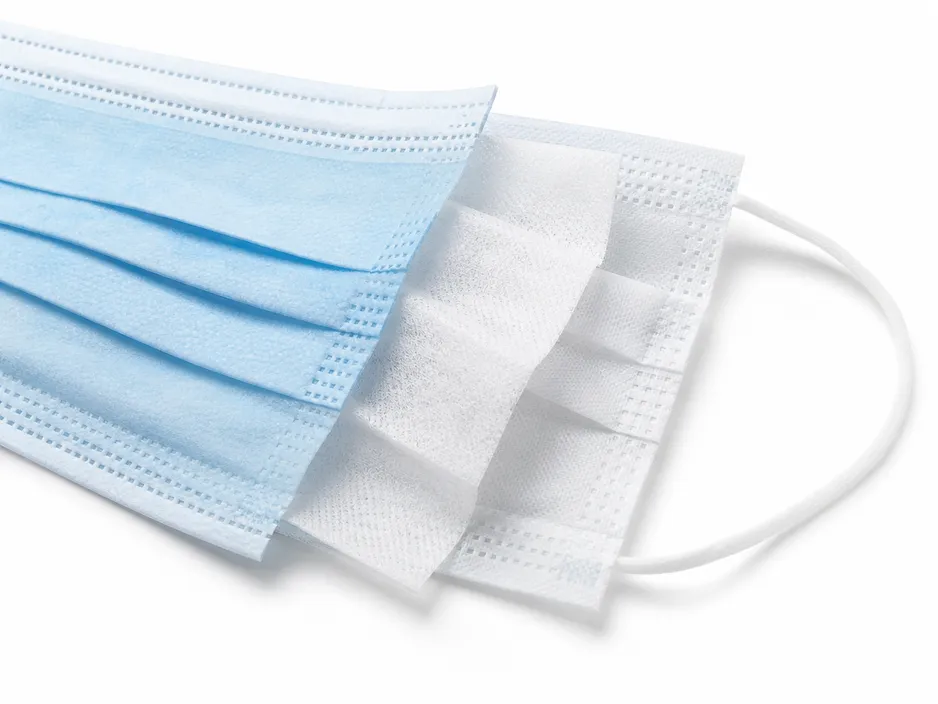
Meltblown nonwoven fabric is produced by extruding polymer through fine nozzles at high velocity, creating a web of sub-micron fibers. The filtration performance depends on fiber diameter, basis weight, and electrostatic charge — three variables that shift with production conditions. A roll of meltblown fabric that tests at ≥98% BFE on Monday can test at 91% on Friday if the extrusion temperature drifted or the charging process wasn't maintained. Fabric suppliers don't always catch this before the roll ships.
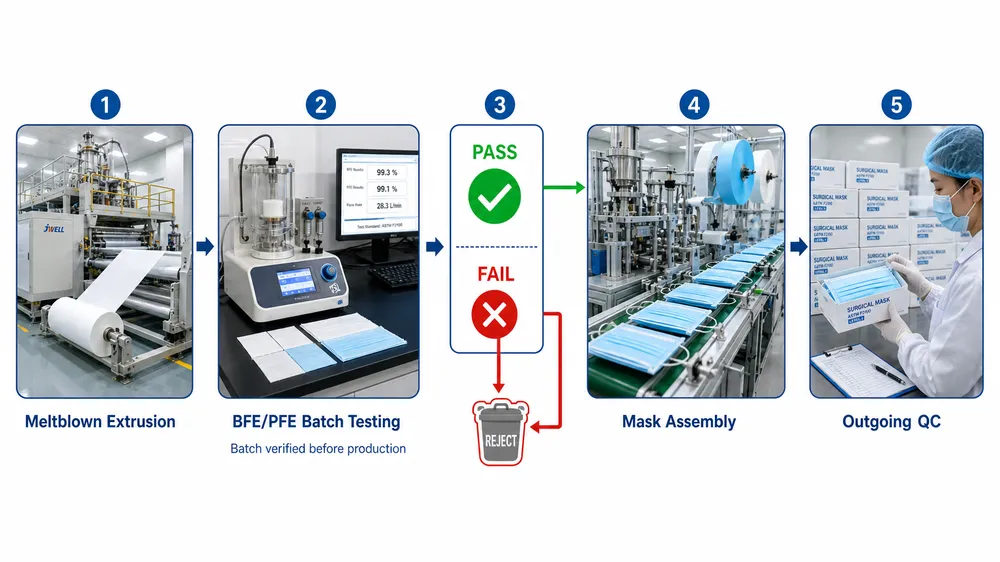
We produce our own meltblown fabric. That means we set the fiber diameter, basis weight, and charge level to match the filtration target for each ASTM level, and we test every production batch before it enters mask production. When you order a Level 2 or Level 3 mask from us, the ≥98% BFE isn't a claim from a fabric supplier's data sheet — it's a number we verified on our own equipment before the mask was made.
(The practical consequence: during the 2020–2021 supply disruptions, factories without in-house meltblown capacity were either stopped or shipping masks that didn't meet their stated BFE specs. We kept shipping because we controlled the input. That's the sourcing argument for vertical integration, and it applies to every order, not just during crises.)
Our in-house QC lab runs BFE, PFE, and Delta-P testing on every production batch. We test before the masks leave the production floor, not just when submitting for third-party certification. A batch that fails internal BFE testing gets pulled and investigated — it doesn't get shipped and hoped for. The third-party test reports that travel with your shipment reflect what we already confirmed internally.
For buyers sourcing across multiple ASTM levels — say, Level 1 for general ward and Level 3 for OR — this matters because the meltblown spec changes between levels. A factory buying meltblown from outside suppliers may be running the same fabric roll across both levels and adjusting the claim on the label. We adjust the actual material.
Delta-P and the breathability tradeoff your buyers will notice
Delta-P is the parameter that procurement teams often overlook until they get complaints from the field. It measures how much resistance the mask material creates against airflow — the higher the number, the harder the mask is to breathe through.
ASTM F2100 sets maximum Delta-P thresholds, not minimums. The standard says Level 1 must be below 4.0 mmH₂O/cm², and Levels 2 and 3 must be below 5.0. A mask that tests at 4.9 is technically compliant. Whether it's comfortable for eight hours of continuous wear is a different question.
In our production, we target Delta-P well below the maximum for each level. For Level 1, we typically run 2.5–3.2 mmH₂O/cm². For Level 2, 3.5–4.2. For Level 3, 4.0–4.8. These aren't marketing numbers — they're the ranges we see on our batch test reports, and they reflect the meltblown spec we're running for each level. A tighter fiber web gives better filtration but higher Delta-P; we tune the balance for each level's intended use case.
For buyers supplying hospital systems, Delta-P is worth specifying in your RFQ rather than accepting whatever the factory's standard production delivers. Ask for the batch test report range, not just the certification minimum. The difference between a Level 3 mask at 4.2 and one at 4.8 is real in extended wear, and it affects whether your downstream customers reorder.
Regulatory coverage across markets: FDA and CE on all three levels
If you're supplying both US and European markets, the certification stack matters as much as the performance spec. ASTM F2100 governs the US market. EN 14683 governs the EU. The two standards use different test methods and different classification systems — EN 14683 uses Type I, Type II, and Type IIR rather than Level 1, 2, 3 — but the performance requirements overlap substantially.
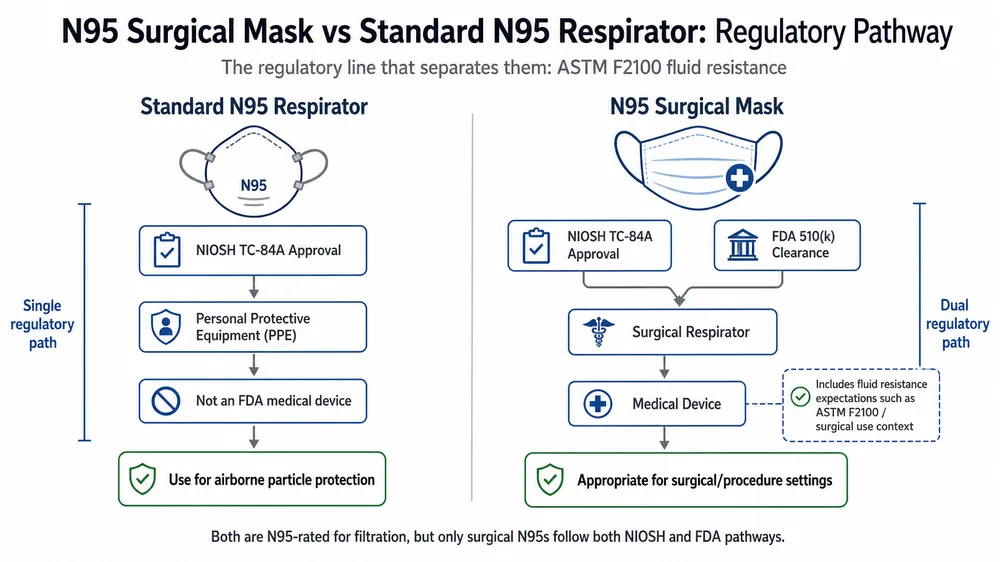
Our Surgical Medical Masks carry FDA 510(k) registration and CE marking under EU MDR across all three ASTM levels. For buyers supplying both markets from a single SKU program, this eliminates the compliance gap that comes from sourcing US-spec and EU-spec masks from different factories. One factory, one documentation package, both markets cleared.
The FDA 510(k) registration is particularly relevant for US hospital procurement. Many hospital GPO contracts require 510(k) clearance as a baseline qualification — it's not optional for institutional supply. CE under EU MDR (not the older MDD) is the current requirement for European market access; masks certified under the old MDD framework are no longer valid for new EU market entry.
For buyers building multi-market distribution programs, the compliance question is worth resolving at the sourcing stage, not after your first container arrives at customs. We can provide the full documentation package — 510(k) registration number, CE technical file summary, test reports by level — before you place an order.
Level selection checklist for procurement teams
Use this to self-qualify before specifying a level in your RFQ:
Specify Level 1 if:
- Primary use is general ward, exam room, or outpatient consultation
- Extended wear (6+ hours) is expected
- Fluid splash risk is incidental, not procedural
- Staff comfort and compliance are a priority
- You're building a high-volume general-use SKU
Specify Level 2 if:
- Use includes minor surgical procedures or controlled OR settings
- Moderate fluid exposure is possible but not high-velocity
- You need a single SKU that covers both clinical and light surgical use
- Your hospital procurement review requires ≥98% BFE
Specify Level 3 if:
- Use includes cardiovascular, trauma, oral surgery, or orthopedic OR
- High-velocity fluid exposure (arterial, high-pressure irrigation) is documented
- Your OR protocol specifically requires 160 mmHg fluid resistance
- Procedure duration is short enough that Delta-P is not a compliance concern
If you're supplying a hospital system that uses all three settings, the practical approach is a two-SKU program: Level 1 for general ward and outpatient, Level 3 for high-risk OR. Level 2 fills the gap for facilities that want a single OR-capable SKU without the Level 3 premium.
(We've helped several US distributors structure exactly this kind of tiered program. The documentation is straightforward — separate 510(k) references by level, separate test reports, same factory. It simplifies your compliance file and gives your hospital buyers a clear specification matrix.)
Sourcing consistency across levels: what to verify before you commit
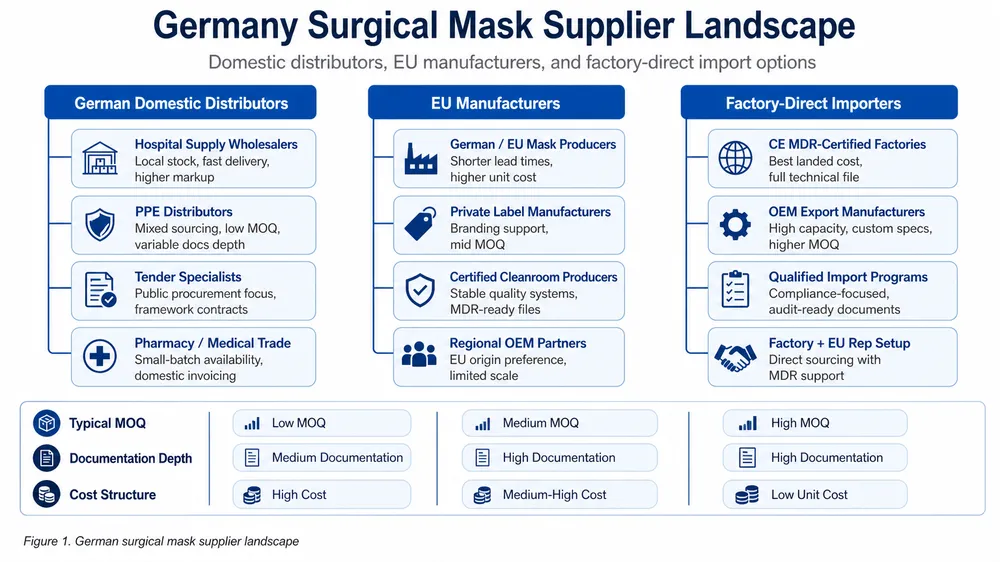
When you're sourcing across multiple ASTM levels from the same factory, the question to ask is whether the factory is actually running different meltblown specs for each level or just labeling the same material differently. This happens more than buyers realize, particularly with factories that buy meltblown from outside suppliers.
The verification is straightforward. Ask for:
- Batch BFE test reports for each level — not just the certification document, but actual production batch reports showing the test date, lot number, and result. A factory running consistent meltblown quality will have these readily available.
- Delta-P batch data alongside BFE — if the Delta-P values are identical across Level 1 and Level 3, the factory is likely running the same meltblown fabric for both. Different levels should show different Delta-P profiles.
- Meltblown fabric specification sheets — if the factory manufactures meltblown in-house, they should be able to provide the fiber diameter and basis weight spec for each level. If they buy from outside, ask for the supplier's material data sheet and the incoming inspection records.
- Third-party test reports by level — the certification documents should reference the specific level tested, not a generic "surgical mask" category.
For a deeper look at how ASTM F2100 specifications translate to product documentation, see our guide to disposable surgical mask ASTM specification. For the fluid resistance parameter specifically, fluid resistance ratings for surgical masks covers the ASTM F1862 test methodology and what the mmHg thresholds mean in clinical practice.
Our 50,000-piece MOQ on standard SKUs is designed for exactly this kind of verification process. You can trial a specific level — run it through your own QC, submit it to your hospital procurement review, confirm the Delta-P is acceptable for your end users — before committing to full program volumes. We'd rather you confirm the spec fits your market before you're managing a 500,000-piece inventory position.
Frequently asked questions
Can I use a Level 3 surgical mask in place of a Level 1 or Level 2 in all settings?
Technically yes — Level 3 meets or exceeds the performance minimums of the lower levels. But the Delta-P tradeoff is real. Level 3 masks are harder to breathe through, and in extended-wear settings like general wards, that drives non-compliance. Specifying Level 3 across the board also increases your unit cost without adding clinical value in low-risk settings. Match the level to the setting.
What is the difference between ASTM F2100 and EN 14683 for surgical masks?
ASTM F2100 is the US standard; EN 14683 is the EU standard. Both measure BFE and fluid resistance, but the test methods differ. EN 14683 uses Type I, Type II, and Type IIR classifications. Type IIR (splash-resistant) roughly corresponds to ASTM Level 2–3 in fluid resistance performance. A mask certified to both standards carries dual-market access, which matters if you're distributing in both the US and EU.
Does BFE rating change between production batches?
It can, if the meltblown fabric quality isn't controlled at the source. BFE is a function of the filtration layer — fiber diameter, basis weight, and electrostatic charge. If any of those variables drift between production runs, BFE drifts with them. This is why in-house meltblown production and per-batch BFE testing matter for sourcing reliability. A certification document from six months ago doesn't tell you what the current production batch is delivering.
What documents should I request when evaluating a surgical mask supplier for ASTM compliance?
At minimum: FDA 510(k) registration number (for US market), CE technical file or declaration of conformity (for EU), third-party BFE/PFE/Delta-P test reports by level, and ASTM F1862 fluid resistance test reports. For ongoing supply programs, ask for batch test reports from recent production runs — not just the certification documents. The batch reports tell you whether the factory is maintaining spec consistency across production, not just at the time of initial certification.
What MOQ is available for trialing a specific ASTM level before committing to full volumes?
Our standard MOQ is 50,000 pieces per SKU. For buyers evaluating a specific ASTM level for a new program, this is the minimum needed to run a meaningful trial — enough to submit for independent testing, distribute to end users for feedback, and confirm the Delta-P is acceptable for your target setting. Below 50,000 pieces, the production economics don't work for either side.
When you're ready to specify, Request Quote with the ASTM level, target market, and quantity — we'll confirm BFE/PFE test reports and lead time for your required level.