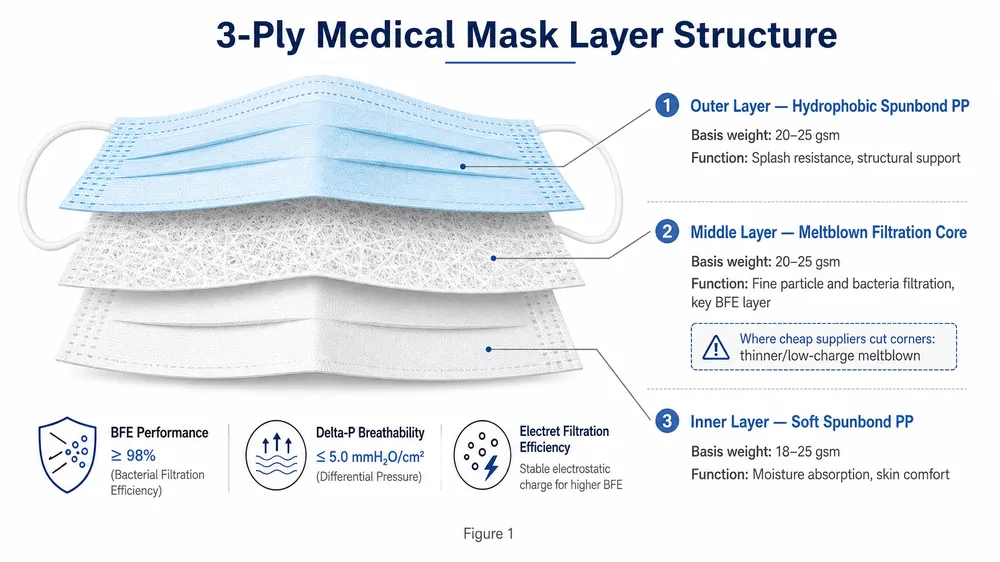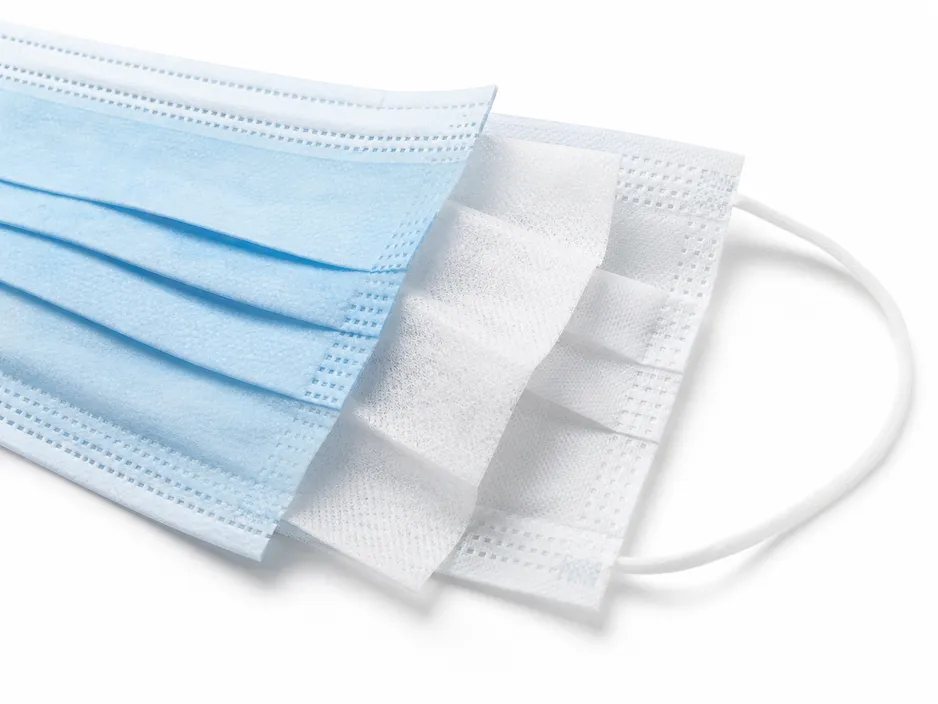
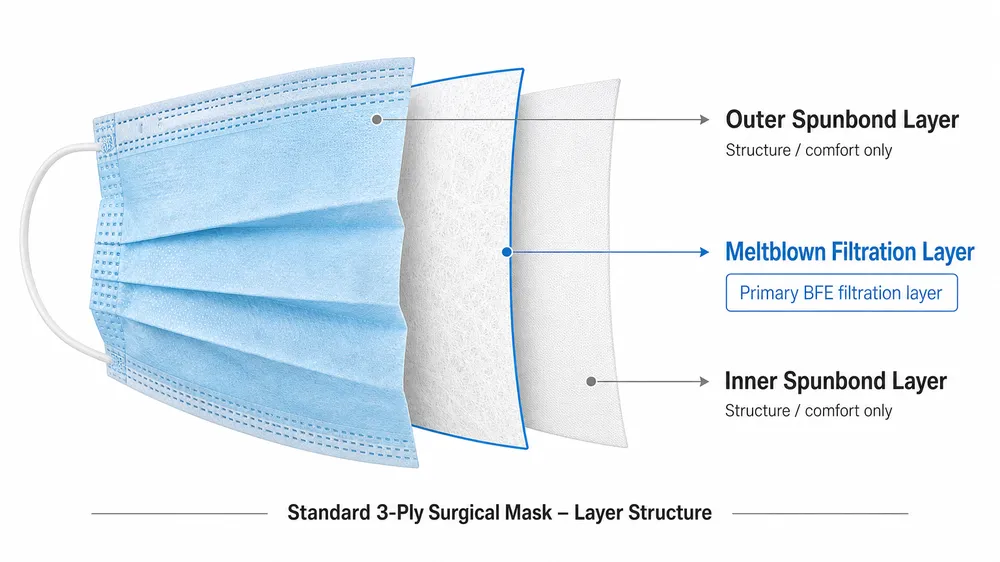
You can source a surgical mask with perfect ear-loop tensile strength, clean ultrasonic welds, and compliant packaging — and still fail BFE testing. The outer and inner spunbond layers don't filter. The nose wire doesn't filter. The ear loops definitely don't filter. The only layer in a 3-ply surgical mask that determines whether it meets ≥95% or ≥98% BFE is the meltblown middle layer, and most buyers have no visibility into how that layer was made or whether it will perform consistently across a bulk order.
This is where most BFE failures originate. Not from poor assembly. From meltblown substitution, batch variability, or a supplier who doesn't actually control the spec of the fabric going into their masks.

The three meltblown variables that control BFE outcomes
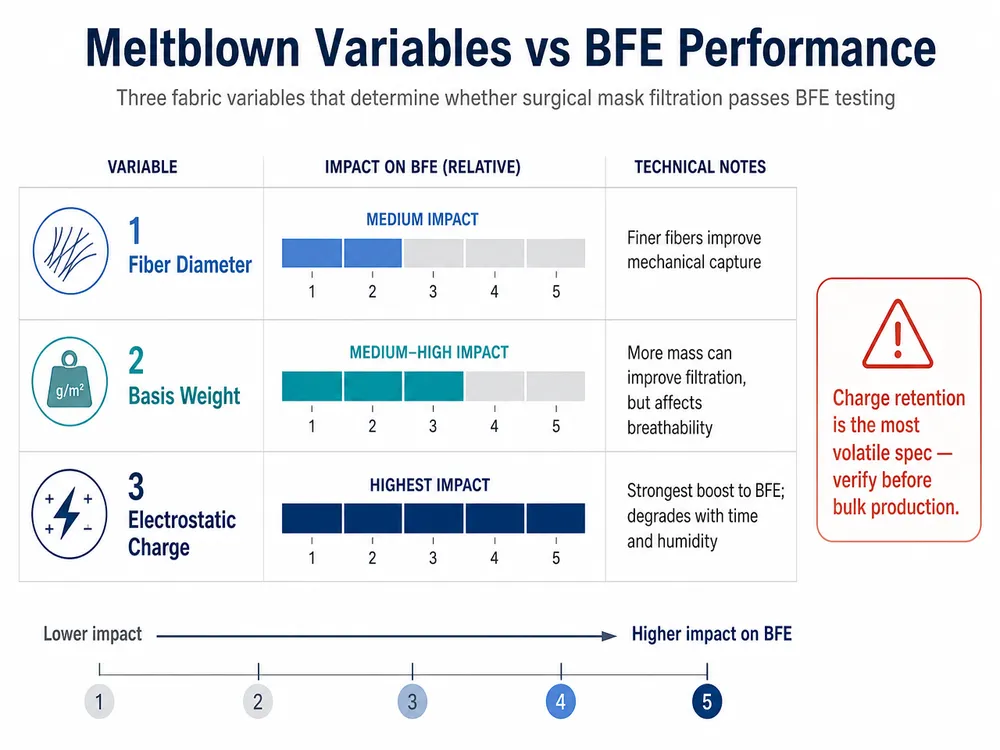
Meltblown fabric is produced by extruding polymer — typically polypropylene — through hundreds of fine nozzles under high-velocity hot air. The air attenuates the molten polymer into very fine fibers, which are collected on a moving belt to form a web. The filtration performance of that web depends on three variables: fiber diameter, basis weight, and electrostatic charge.
Fiber diameter is the most direct determinant of filtration efficiency. Finer fibers create a denser web with smaller interstitial gaps, which intercepts more particles. For surgical mask applications targeting ≥95% BFE under ASTM F2100 Level 1 or EN 14683 Type I, meltblown fiber diameters typically run in the 1–5 micron range. For ≥98% BFE (ASTM F2100 Level 2 or EN 14683 Type IIR), the fiber diameter needs to be tighter — generally toward the lower end of that range, with tighter process control to maintain consistency across the roll. A supplier who can't tell you the target fiber diameter for their meltblown is a supplier who doesn't control it.
Basis weight — measured in grams per square meter (gsm) — determines how much filtration material is present per unit area. Surgical mask meltblown typically runs between 20 and 40 gsm depending on the target BFE level. Higher basis weight generally improves filtration but increases Delta-P (breathing resistance). The trade-off matters: a mask that passes BFE at 40 gsm but fails Delta-P limits under ASTM F2100 or EN 14683 is still a non-compliant product. (We run our standard surgical mask meltblown at 25 gsm for Level 1 targets and 30–35 gsm for Level 2, with Delta-P verified on every batch before the fabric goes to the production line.)
Electrostatic charge is the variable most buyers don't ask about, and it's the one that causes the most unexpected failures. Meltblown fabric used in medical masks is electrostatically charged — the charge attracts and holds particles that would otherwise pass through the fiber web. This electrostatic effect can account for 20–30% of the filtration efficiency in a properly charged fabric. The problem: electrostatic charge degrades. It degrades faster in humid storage conditions, in contact with certain packaging materials, and simply over time. A roll of meltblown that tested at ≥98% BFE when it left the fabric supplier may test at ≥92% by the time it's been sitting in a warehouse for six months and then run through a production line.
This is why BFE testing on finished masks — not just on raw fabric — is the only reliable verification. And it's why the timing of that testing matters.
How third-party meltblown sourcing creates batch-to-batch BFE risk
Most surgical mask factories don't make their own meltblown. They buy it from nonwoven fabric suppliers, often on the spot market or through distributors. This is where bulk order BFE risk concentrates.
The core problem is that meltblown fabric is not a commodity with a fixed spec. Two rolls labeled "25 gsm surgical grade meltblown" from the same supplier can have meaningfully different fiber diameter distributions and charge levels depending on when they were produced, what production parameters were used, and how they were stored. A mask factory that buys meltblown from outside has limited ability to verify these variables — they can weigh the fabric, but they can't easily measure fiber diameter or charge level without specialized equipment.
What happens in practice: a factory qualifies their mask product using a specific meltblown batch, passes BFE testing, gets certified. Then they reorder meltblown from the same supplier, receive a different production lot, and run it without re-testing the finished mask. The masks look identical. The BFE may not be.
This is the mechanism behind most bulk order BFE failures we've seen in the market. The factory isn't deliberately substituting — they're just not controlling the variable that matters. From your side of the transaction, the masks arrive, you submit them for testing, and they fail. At that point you're looking at a rejected shipment, a delayed program, and a compliance gap you have to explain to your customer.
The risk compounds at scale. A 500,000-piece order likely spans multiple meltblown production lots. If the factory doesn't test finished masks from each lot — or doesn't have the in-house capability to do so — you have no way to know whether the BFE performance is consistent across the full order until it's too late.
For more on how BFE and Delta-P interact as compliance parameters, see our article on BFE and Delta-P performance trade-offs.
What in-house meltblown production means for spec consistency
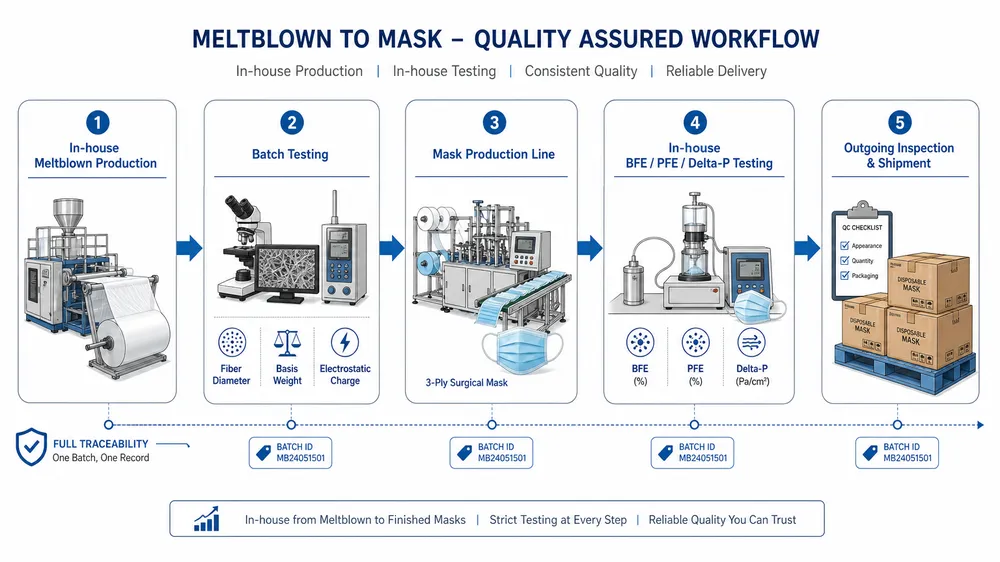
We brought meltblown production in-house specifically because of the problem described above. When you control the filtration layer, you control the one variable that determines whether the finished mask passes BFE testing.
Our meltblown line produces fabric to a defined internal spec for each mask SKU. The fiber diameter target, basis weight, and charge level are set parameters — not outcomes we discover after the fact. Every production run of meltblown fabric is batch-tested before it goes to the mask production line. If a meltblown batch doesn't meet the internal spec, it doesn't go into masks. It gets investigated, the process parameter is corrected, and a new batch is produced.
The traceability this creates matters beyond just quality control. Under ISO 13485, every component in a medical device needs to be traceable to its source lot. For meltblown fabric, that means we can tell you exactly which production batch of meltblown went into which lot of finished masks. If a question arises about a specific shipment — from your customer, from a regulatory body, from a procurement auditor — we can pull the meltblown batch record, the in-process test data, and the finished mask BFE result for that lot. That documentation chain is what survives a compliance review.
(We've had buyers ask us to provide meltblown batch records as part of their supplier qualification process. We can do that. Most factories that buy meltblown from outside can't — they don't have the records because they don't control the production.)
The in-house BFE/PFE/Delta-P lab is the other half of this. We test finished masks from every production batch before they reach outgoing inspection. The in-house test catches any meltblown performance issue before it becomes a shipment problem. Third-party certification testing confirms the result — but the in-house test is what gives us confidence before we ship.
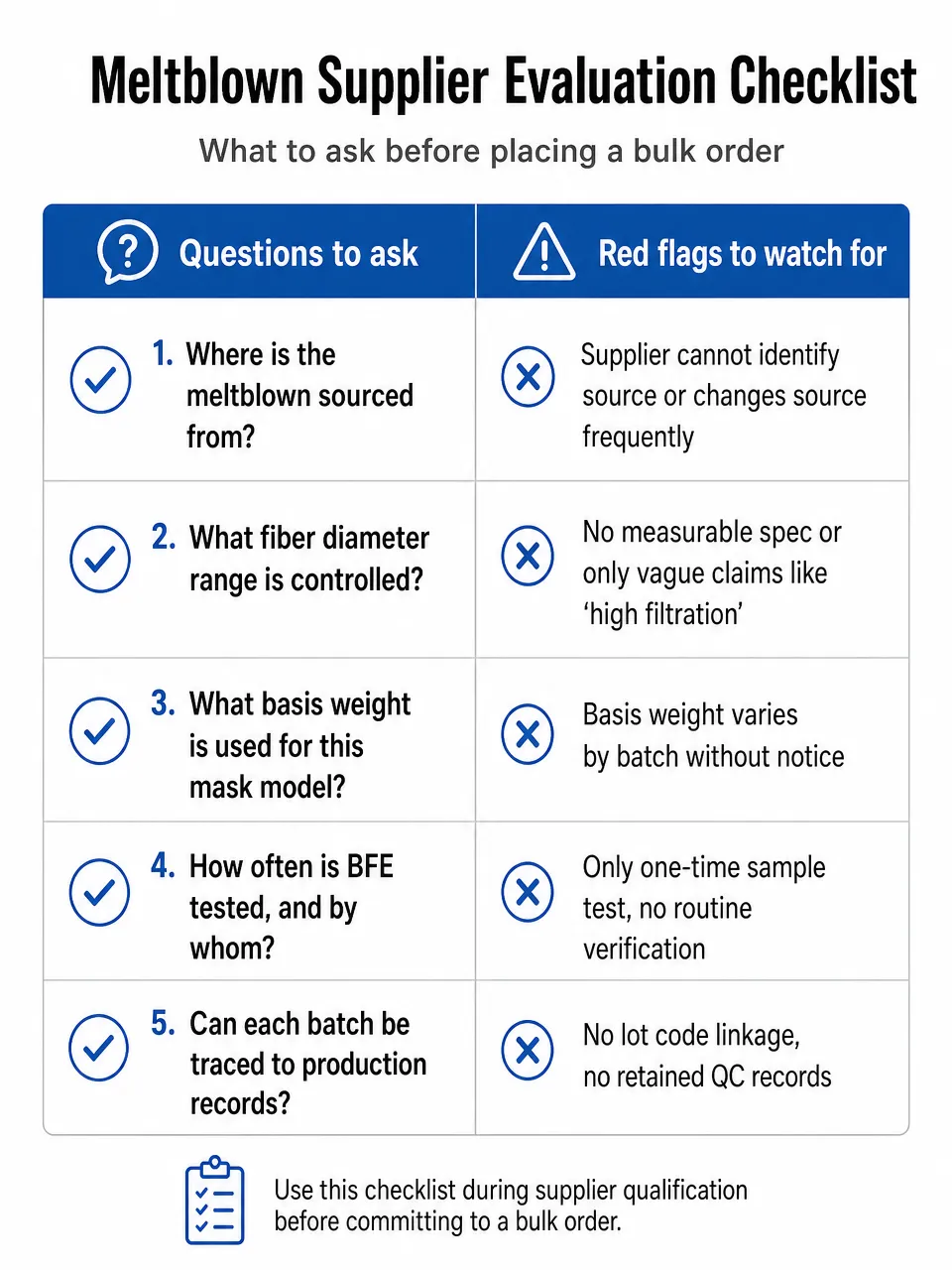
What to ask a supplier before placing a bulk order
The questions below are not difficult to answer if a supplier actually controls their meltblown. If they can't answer them, that's the information you need.
On meltblown sourcing:
- Do you manufacture meltblown fabric in-house, or do you purchase it from a third-party supplier?
- If purchased, can you provide the meltblown supplier's name and their fabric spec sheet for the grade used in this product?
- How many meltblown production lots typically go into a 500,000-piece order?
On meltblown specifications:
- What is the target fiber diameter range for the meltblown used in this mask?
- What is the basis weight (gsm) of the meltblown layer?
- Is the fabric electrostatically charged? What is the charge retention specification?
On testing and documentation:
- Do you test finished masks for BFE in-house, or only through third-party labs?
- At what point in production is BFE testing performed — per batch, per lot, or only at initial certification?
- Can you provide BFE test reports from the specific production lot that will ship with my order?
- Do you maintain meltblown batch records traceable to finished mask lots under ISO 13485?
A supplier who tests only at initial certification and then relies on that result for all subsequent production is not controlling BFE — they're assuming it. That assumption is where bulk order failures come from.
| Question | What a controlled answer looks like | Red flag |
|---|---|---|
| Meltblown source | "We produce in-house" or named supplier with spec sheet | "We use quality-certified fabric" |
| Fiber diameter | Specific range, e.g., "1–3 micron" | "Fine fiber, medical grade" |
| Basis weight | Specific gsm value | "Standard surgical grade" |
| BFE testing frequency | Per production batch | "We have CE/FDA certification" |
| Batch traceability | ISO 13485 batch records available | "We can provide test reports" |
How meltblown spec maps to ASTM F2100 and EN 14683 compliance thresholds
The BFE thresholds in the two major surgical mask standards are not interchangeable, and the meltblown spec required to meet them differs.
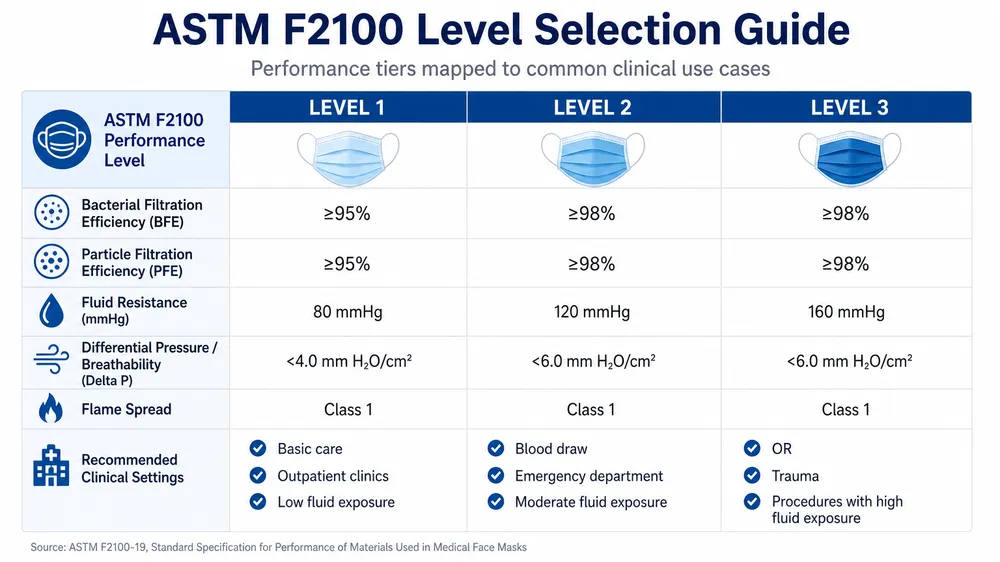
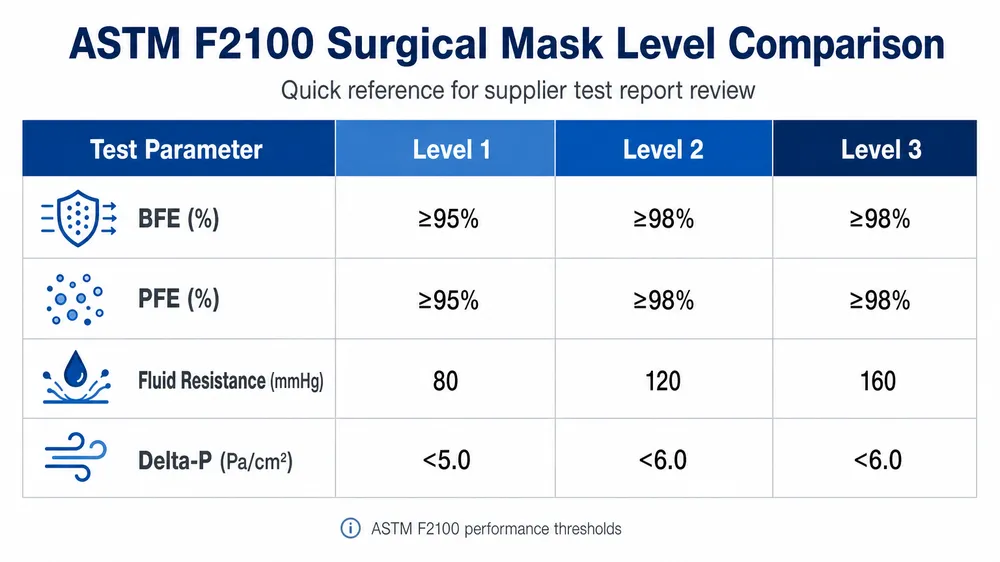
Under ASTM F2100 (the US standard), surgical masks are classified into three performance levels:
| Level | BFE | PFE | Delta-P (mm H₂O/cm²) | Fluid Resistance |
|---|---|---|---|---|
| Level 1 | ≥95% | ≥95% | <4.0 | 80 mmHg |
| Level 2 | ≥98% | ≥98% | <5.0 | 120 mmHg |
| Level 3 | ≥98% | ≥98% | <5.0 | 160 mmHg |
Under EN 14683 (the EU standard), the classification is:
| Type | BFE | Delta-P (Pa/cm²) | Splash resistance |
|---|---|---|---|
| Type I | ≥95% | ≤29.4 | Not required |
| Type II | ≥98% | ≤29.4 | Not required |
| Type IIR | ≥98% | ≤49.0 | Required (120 mmHg) |
The practical implication: a meltblown spec that reliably delivers ≥95% BFE will not reliably deliver ≥98% BFE. These are different fabric grades. A supplier who tells you their mask "can be certified to Level 1 or Level 2 depending on your requirement" without changing the meltblown spec is either confused about how BFE works or hoping you are.
The Delta-P constraint is the other side of this. Increasing basis weight to push BFE higher also increases breathing resistance. A mask that passes ≥98% BFE at 40 gsm meltblown may fail the Delta-P limit under ASTM F2100 Level 2 (<5.0 mm H₂O/cm²). Getting both parameters right simultaneously requires process control, not just heavier fabric.
For buyers sourcing into both the US and EU markets, the standard you're targeting determines the meltblown spec you need to specify. Don't assume a CE-certified mask automatically meets ASTM F2100 Level 2, or vice versa — the test methods and thresholds differ, and a mask can pass one while failing the other.
The sourcing decision: what in-house meltblown actually changes for your order
When you source Surgical Medical Masks from a factory with in-house meltblown production, the risk profile of your order changes in a specific way: the most common cause of BFE failure is removed from the equation.
You still need to verify that the factory's meltblown spec matches your target BFE level. You still need test reports from the production lot that ships with your order, not just from the initial certification run. And you still need to confirm that the factory's in-house testing is calibrated against the same test method as your target standard — ASTM F2100 and EN 14683 use different test organisms and challenge conditions, and a factory that only tests to one standard may not catch failures under the other.
What changes is the batch-to-batch variability problem. A factory that makes its own meltblown can hold the fiber diameter, basis weight, and charge level constant across your entire order. A factory that buys meltblown from outside cannot make that guarantee — they can only tell you what they received, not what they'll receive next time.
For buyers managing bulk sourcing without meltblown substitution, this distinction is the difference between a supplier who can commit to a BFE spec and one who can only commit to trying.
FAQ: meltblown quality and BFE testing
Can a surgical mask pass BFE testing with low-quality meltblown if the basis weight is high enough?
Sometimes, but not reliably. Increasing basis weight can compensate for coarser fiber diameter up to a point, but it also increases Delta-P. Past a certain basis weight, the mask fails breathability requirements even if BFE is adequate. The more common outcome with low-quality meltblown is inconsistent BFE — the mask passes some test samples and fails others, which is a compliance failure regardless of the average result.
How long does electrostatic charge last in meltblown fabric?
Under controlled storage conditions (low humidity, away from UV, in sealed packaging), charge retention in properly treated meltblown can remain adequate for 12–24 months. In practice, storage conditions vary, and charge degradation is accelerated by humidity above 60% RH. This is why BFE testing should be performed on finished masks from the production lot that will ship, not on fabric tested months earlier.
Does CE certification guarantee that a mask will pass ASTM F2100 testing?
No. EN 14683 and ASTM F2100 use different test organisms (Staphylococcus aureus at different concentrations), different flow rates, and different challenge conditions. A mask certified to EN 14683 Type IIR (≥98% BFE) has not been tested to ASTM F2100 methodology. If you're importing into the US market, you need ASTM F2100 test data, not EN 14683 data. We test to both standards in-house and can provide documentation for either market.
What documents should I request to verify meltblown quality before placing a bulk order?
At minimum: the meltblown fabric spec sheet (fiber diameter range, basis weight, charge specification), BFE test reports from the most recent production lot (not the initial certification run), and the factory's ISO 13485 certificate confirming their quality management system covers meltblown traceability. If the factory produces meltblown in-house, ask for their internal meltblown batch test records. If they purchase from outside, ask for the fabric supplier's mill test certificate for the specific lot used in your product.
Is there a meaningful BFE difference between 25 gsm and 30 gsm meltblown in a surgical mask?
Yes, typically 3–6 percentage points in BFE, depending on fiber diameter and charge level. Whether that difference matters depends on your target standard. For ≥95% BFE (ASTM Level 1 or EN Type I), 25 gsm with properly controlled fiber diameter and charge is generally sufficient. For ≥98% BFE (Level 2 or Type IIR), 30–35 gsm with tighter fiber diameter control is the more reliable path — and the Delta-P impact of the higher basis weight needs to be verified against the applicable standard's limit.
If you're sourcing surgical masks and want to confirm the meltblown spec and BFE documentation before committing to a bulk order, submit your requirements through our RFQ page with your target BFE level (≥95% or ≥98%), order volume, and destination market. We'll confirm the meltblown spec, provide test reports from a recent production lot, and give you a quote with the documentation your compliance team needs.