The Real Question Behind the Ply Count
Most buyers come to this comparison with the wrong frame. They assume more plies means better filtration — and sometimes that's true, but not always in the way they expect. The ply count is a structural description, not a performance guarantee. A 4-ply mask with a weak meltblown layer will underperform a well-made 3-ply mask every time.
Here's the actual decision you're making: whether your application requires the filtration ceiling and fluid resistance that a 4-ply configuration typically delivers, or whether a properly certified 3-ply mask already meets your tender spec, your regulatory requirement, and your end-customer's expectation — at a lower unit cost and with a simpler supply chain.
The quick verdict: 3-ply is the right call for general clinical use, standard distribution programs, and any tender that specifies EN 14683 Type II or ASTM F2100 Level 1. Move to 4-ply when your tender requires EN 14683 Type IIR, ASTM F2100 Level 2 or Level 3, or when your end-use environment involves fluid splash risk or elevated aerosol exposure. The rest of this article explains the structural and regulatory logic behind that verdict so you can match it to your specific requirement.

Layer Structure: What the Ply Count Actually Describes
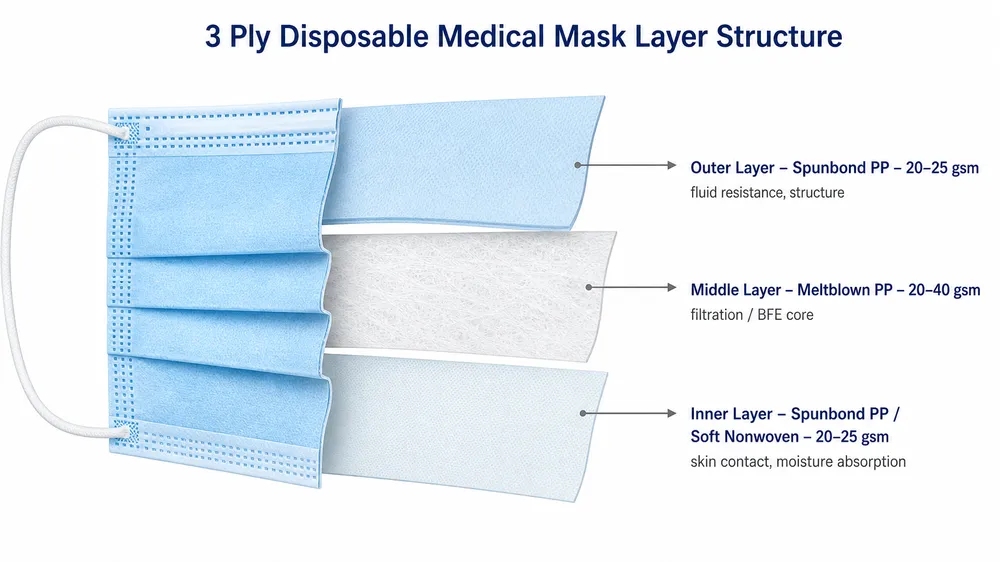
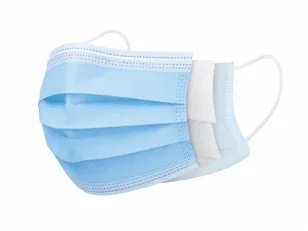
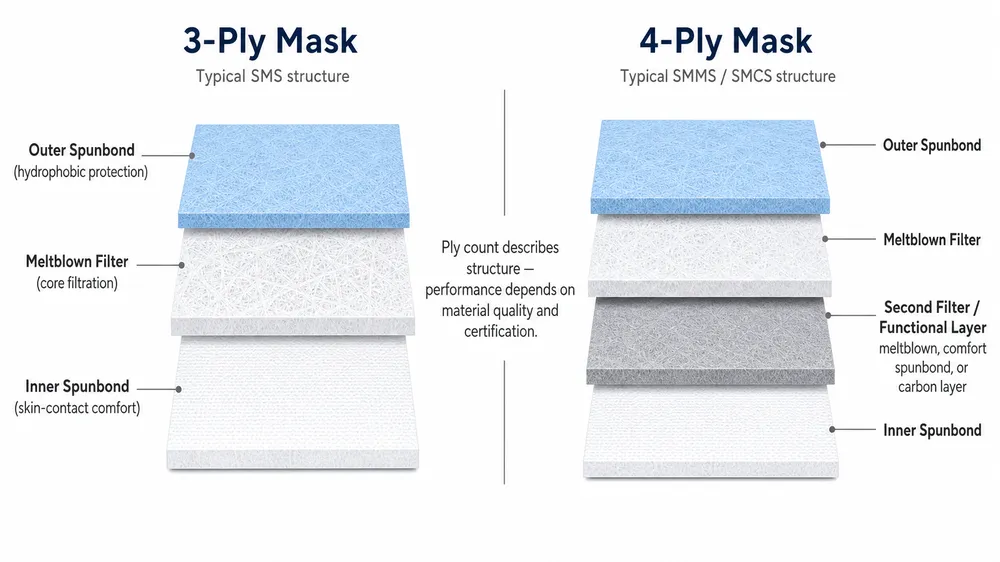
A standard 3-ply disposable medical mask runs an SMS configuration: spunbond outer layer, meltblown middle layer, spunbond inner layer. The outer spunbond provides structural integrity and fluid resistance. The inner spunbond sits against the face for comfort. The meltblown layer in the middle does the filtration work — it's the layer that determines your BFE and PFE numbers.
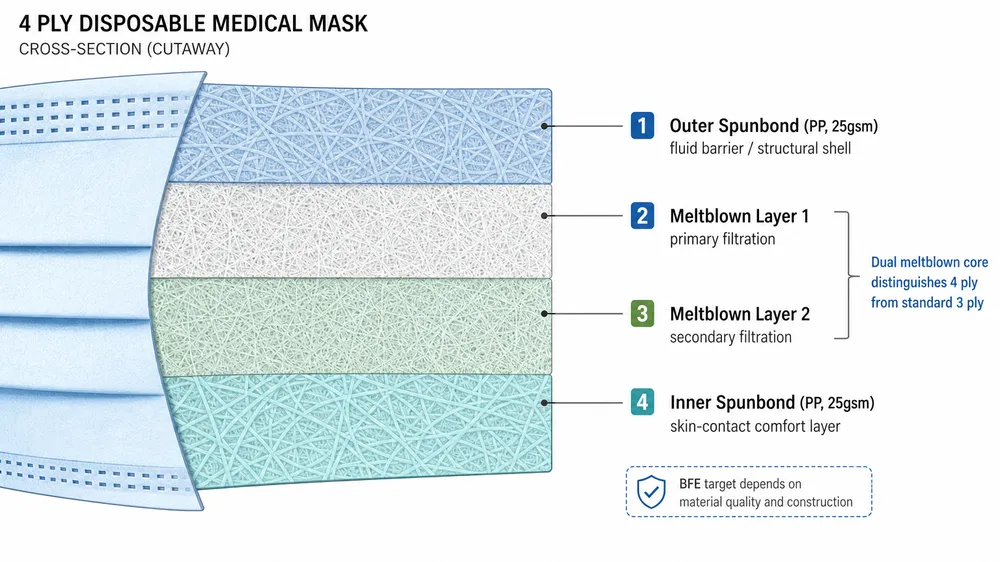
A 4-ply mask adds a fourth layer, and what that layer is determines everything about the mask's performance profile. Three common 4-ply configurations exist in the market:
- SMMS — two meltblown layers sandwiched between spunbond layers. This is the configuration that meaningfully improves filtration performance and fluid resistance. It's what you want when the spec requires it.
- SMCS — spunbond, meltblown, activated carbon, spunbond. The carbon layer adds odor filtration, which matters for certain clinical environments (surgical suites, wound care) but doesn't improve BFE or PFE.
- SMSS — spunbond, meltblown, spunbond, spunbond. The extra spunbond layer adds comfort and structural bulk but contributes nothing to filtration performance.
(We see a lot of buyers get burned by this distinction. A supplier quotes a "4-ply mask" and the buyer assumes they're getting SMMS filtration performance. They're not — they're getting an SMSS configuration with a comfort layer dressed up as a filtration upgrade. Always ask for the layer breakdown, not just the ply count.)
The filtration-relevant comparison is 3-ply SMS versus 4-ply SMMS. That's the configuration where the extra ply actually changes the performance ceiling, and that's the comparison this article is built around.
Filtration Performance and Regulatory Standards: Where the Specs Diverge
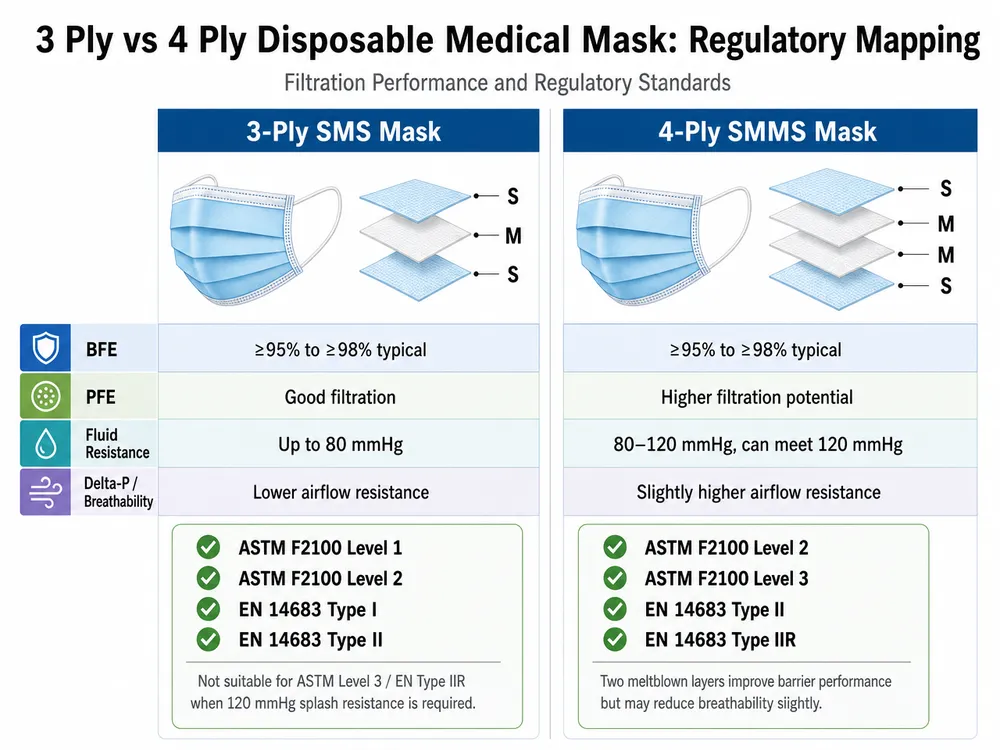
BFE and PFE numbers don't come from the ply count — they come from the meltblown layer's fiber diameter, basis weight, and electrostatic charge. But the SMMS configuration gives the mask a higher filtration ceiling because it runs two meltblown layers in series, which increases particle capture probability and allows the mask to meet more demanding regulatory thresholds.
Here's how the two configurations map to the standards your buyers operate under:
| Performance Parameter | 3-Ply (SMS) | 4-Ply (SMMS) |
|---|---|---|
| BFE (Bacterial Filtration Efficiency) | ≥95% (typical) | ≥98% (typical) |
| PFE (Particulate Filtration Efficiency) | ≥95% at 0.1μm | ≥98% at 0.1μm |
| Delta-P (Breathability) | ≤5.0 mmH₂O/cm² | ≤5.0–6.0 mmH₂O/cm² |
| Fluid Resistance (Synthetic Blood) | 80 mmHg (Type II) | 120 mmHg (Type IIR) |
| ASTM F2100 Level | Level 1 / Level 2 | Level 2 / Level 3 |
| EN 14683 Type | Type I / Type II | Type II / Type IIR |
The fluid resistance column is where the clinical decision usually gets made. EN 14683 Type IIR and ASTM F2100 Level 3 both require splash resistance at 120 mmHg — the threshold that covers arterial blood pressure scenarios in surgical environments. A 3-ply SMS mask typically tops out at 80 mmHg. If your tender spec calls for Type IIR or Level 3, the 3-ply configuration doesn't qualify regardless of its BFE number.
Delta-P is worth watching on the 4-ply side. Two meltblown layers increase airflow resistance, so breathability is slightly lower than a 3-ply mask. For most clinical applications this is within acceptable range, but for high-wear environments where staff are masked for 8+ hour shifts, it's a real consideration. We run Delta-P testing on every batch — the 4-ply masks we ship consistently come in at or below the ASTM F2100 Level 2 threshold, but the margin is tighter than on the 3-ply line.
The Hidden Cost in the Ply Upgrade Decision
The unit price difference between a 3-ply and 4-ply mask is real but not the number that should drive your decision. The downstream cost that buyers miss is the compliance documentation gap.
If you're running a distribution program that currently sources 3-ply masks certified to EN 14683 Type II, and a hospital tender comes in requiring Type IIR, you can't just swap in a 4-ply mask from a different supplier and assume the documentation transfers. You need a supplier whose 4-ply SKU carries the same regulatory clearances as the 3-ply SKU you've been running — FDA 510(k), CE under EU MDR, and the test reports that match the new performance tier.
We've seen buyers lose tender awards because they sourced the 4-ply mask from a factory that had the product but not the certification stack. The mask performed fine. The paperwork didn't survive the procurement audit.
Both our 3-ply and 4-ply configurations carry FDA 510(k) registration and CE (EU MDR) clearance, so upgrading between SKUs mid-program doesn't reset your compliance position. The certification continuity is built in — you're not starting a new regulatory process when you move from one configuration to the other.
The second hidden cost is meltblown quality variance. Most mask factories buy meltblown fabric from external suppliers. When supply is tight or the supplier changes their production parameters, the BFE number on the finished mask shifts — sometimes below spec. We produce our own meltblown fabric in-house, which means we set the fiber diameter, basis weight, and electrostatic charge to match the filtration target for each SKU. The BFE number on your test report reflects what's actually in the mask, not what the fabric supplier's spec sheet said last quarter.
Application Scenarios: Which Configuration Wins Where
General Ward and Outpatient Clinical Use
3-ply SMS, certified to EN 14683 Type II or ASTM F2100 Level 1/2. This is the workhorse configuration for general clinical environments — outpatient clinics, general wards, administrative healthcare settings, and non-surgical patient contact. BFE ≥95% covers the bacterial filtration requirement. Fluid resistance at 80 mmHg handles routine splash exposure. The lower Delta-P means staff can wear these comfortably through long shifts.
Winner: 3-ply. The 4-ply configuration adds cost and breathability resistance without adding clinical value in this environment.
Surgical and High-Fluid-Exposure Environments
4-ply SMMS, certified to EN 14683 Type IIR or ASTM F2100 Level 3. Surgical suites, procedure rooms, and any environment where arterial blood splash is a realistic exposure scenario require the 120 mmHg fluid resistance threshold. The 3-ply configuration doesn't reach it. This is not a performance preference — it's a regulatory requirement in most hospital procurement frameworks.
Winner: 4-ply. No alternative here if the tender spec calls for Type IIR or Level 3.
Distribution Programs and Retail Healthcare Channels
3-ply for standard retail and pharmacy distribution; 4-ply for hospital supply chain and institutional procurement. The split is driven by end-customer expectation and channel margin. Retail and pharmacy buyers are typically sourcing to EN 14683 Type I or Type II — the 3-ply configuration covers this at a unit cost that supports retail margin. Hospital and institutional buyers increasingly specify Type IIR or Level 2/3, which routes to the 4-ply SKU.
(This segment has been shifting toward 4-ply in the institutional channel over the past few years — worth building both SKUs into your product line if you're serving mixed channels.)
Winner: Depends on channel. Build both SKUs if your distribution program spans retail and institutional buyers.
Government and Institutional Tenders
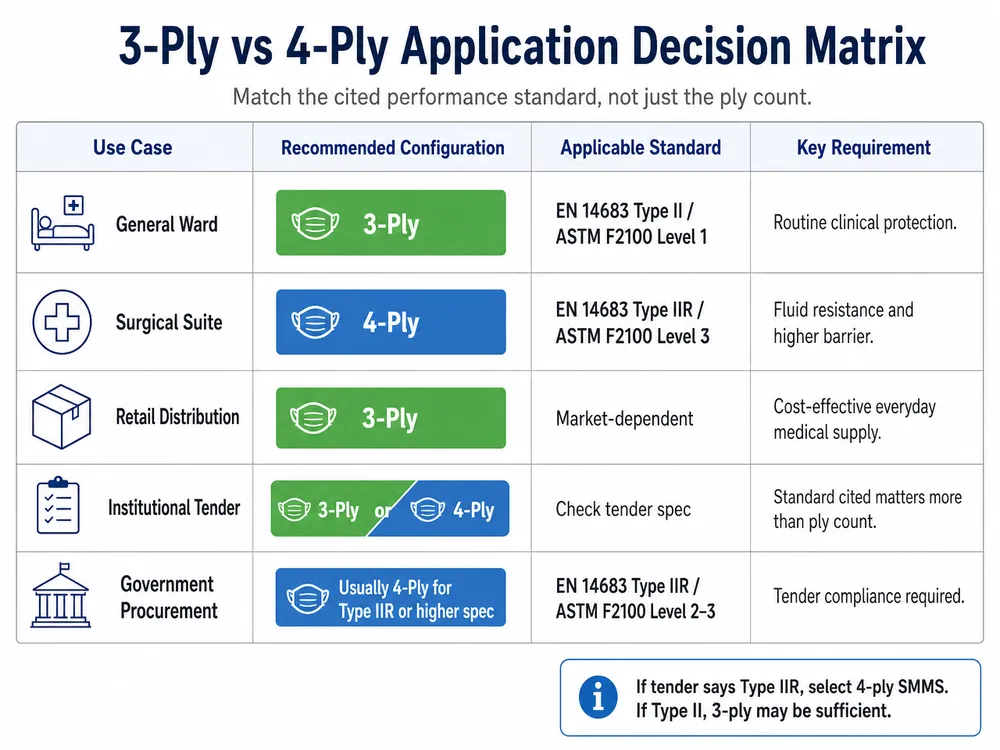
Read the tender spec before you source. Government tenders in the EU almost universally specify EN 14683 Type IIR for clinical-grade masks. US federal and state procurement often references ASTM F2100 Level 2 or Level 3. Middle East tenders vary — some reference EN 14683, others reference ASTM, and some specify both. The ply count in the tender document is usually a proxy for the performance standard, not the actual requirement. Match to the standard, not the number.
Winner: Whichever configuration satisfies the cited standard. If the tender says Type IIR, that's 4-ply SMMS. If it says Type II, 3-ply covers it.
Sourcing Considerations: MOQ, Lead Time, and Certification Documentation
The sourcing mechanics for 3-ply and 4-ply masks are more similar than buyers expect — at least when you're working with a factory that runs both configurations on certified lines.
MOQ: Our standard MOQ is 50,000 pieces for both 3-ply and 4-ply SKUs. This is intentional — it allows buyers to trial the 4-ply configuration without committing to a full container volume. A 50,000-piece trial order gives you enough product to run a procurement evaluation, submit samples for your own testing, and validate the documentation package before scaling up.
Lead time: Standard SKUs in both configurations run 15–25 days from order confirmation, depending on current line scheduling and order volume. Custom configurations — modified ear-loop length, non-standard nose wire, private-label packaging — add time for sample approval, typically 5–7 days before production starts.
Certification documentation: Both SKUs ship with the same documentation package: certificate of conformity, BFE/PFE/Delta-P test reports from our in-house lab plus third-party verification, FDA 510(k) registration documentation, CE technical file reference, and packing list. For EU imports, we include the EU MDR declaration of conformity. For US imports, the FDA 510(k) clearance number travels with the shipment. If your customs broker or compliance team needs additional documentation — SGS audit reports, ISO 13485 certificate, specific test method references — we prepare those on request.
Private-label programs: OEM packaging is available on both SKUs. Standard private-label work — your brand on our existing product configuration — runs on the same MOQ and lead time as standard orders. If you need a modified configuration (different filtration spec, custom ear-loop, non-standard packaging format), that goes through our ODM process with a sample approval run before full production.
How We Control Filtration Quality Across Both Configurations
The meltblown layer is the variable that determines whether a mask's BFE number is real or aspirational. Most factories in this industry buy meltblown fabric from external suppliers — which means their filtration performance is only as consistent as their supplier's last production run.
We produce our own meltblown nonwoven fabric in-house. That's not a marketing point — it's the operational mechanism that makes our BFE and PFE specs reliable across batches. We set the fiber diameter, the basis weight, and the electrostatic charge level ourselves, and we adjust those parameters when we're targeting different filtration thresholds. The 3-ply line and the 4-ply line draw from meltblown fabric we produced and tested before it entered the mask production process.
Our in-house QC lab runs BFE, PFE, and Delta-P testing on every production batch — not on a sampling schedule, on every batch. A batch that fails internal BFE testing gets pulled before it reaches outgoing inspection. We don't ship product and hope the third-party test report comes back clean. The in-house test is the first gate, and it runs before the product moves anywhere.
The production environment matters too. Our core mask production runs in a Class 100,000 (ISO 8) cleanroom — continuous particle monitoring, controlled access, HVAC systems maintained to specification. For medical devices, this is the facility standard that hospital procurement audits look for. It's also the environment that prevents the kind of contamination events that generate product recalls.
(One thing we've learned from running both configurations on the same lines: the 4-ply SMMS configuration is more sensitive to meltblown layer consistency than the 3-ply SMS. Two meltblown layers in series amplify any variance in the fabric — if one layer is slightly off-spec, the combined filtration performance shifts more than it would in a single-layer configuration. In-house meltblown production is what makes the 4-ply spec reliable. Factories buying meltblown externally have less control over this.)
Head-to-Head Sourcing Comparison
| Dimension | 3-Ply Disposable Medical Mask | 4-Ply Disposable Medical Mask |
|---|---|---|
| Layer configuration | SMS (spunbond / meltblown / spunbond) | SMMS (spunbond / meltblown / meltblown / spunbond) |
| BFE performance | ≥95% | ≥98% |
| PFE performance | ≥95% at 0.1μm | ≥98% at 0.1μm |
| Fluid resistance | 80 mmHg | 120 mmHg |
| Delta-P (breathability) | Lower — better for long-wear | Slightly higher — within ASTM Level 2 |
| EN 14683 compliance | Type I / Type II | Type II / Type IIR |
| ASTM F2100 compliance | Level 1 / Level 2 | Level 2 / Level 3 |
| FDA 510(k) registered | Yes | Yes |
| CE (EU MDR) cleared | Yes | Yes |
| Standard MOQ | 50,000 pieces | 50,000 pieces |
| Lead time (standard SKU) | 15–25 days | 15–25 days |
| OEM/ODM packaging | Available | Available |
| Unit cost | Lower | Higher |
| Best fit | General clinical, retail distribution, standard tenders | Surgical environments, institutional tenders, Type IIR / Level 3 specs |
Matching Your Requirement to the Right SKU
The decision comes down to three questions:
1. What does your tender or procurement spec actually cite? Pull the standard reference — EN 14683 Type, ASTM F2100 Level, or equivalent. If it says Type IIR or Level 3, you need 4-ply SMMS. If it says Type II or Level 1/2, 3-ply covers it.
2. What is the end-use environment? Surgical and high-fluid-exposure environments require the 120 mmHg fluid resistance threshold. General clinical and distribution use doesn't. Match the configuration to the exposure risk, not to a general preference for "better."
3. What does your distribution channel require? Retail and pharmacy channels typically source to Type I or Type II. Hospital and institutional supply chains increasingly specify Type IIR. If you're serving both, build both SKUs into your program — the MOQ and lead time are the same, and having both configurations under one supplier relationship simplifies your compliance documentation.
If you're sourcing for a specific tender and the spec language is ambiguous, send us the tender document. We've worked through procurement specs across North America, Europe, the Middle East, and Southeast Asia — we can tell you which configuration satisfies the cited standard and prepare the documentation package your compliance team needs.
Both our 3 Ply Disposable Medical Mask and 4 Ply Disposable Medical Mask carry FDA 510(k) and CE (EU MDR) clearance, with in-house BFE/PFE/Delta-P test reports available for every batch. Browse the full Disposable Medical Masks range or Request a Quote with your target standard, end-use environment, and volume — we'll match you to the right configuration and send back a complete documentation preview with the quote.
Frequently Asked Questions
Does a 4-ply mask always have better filtration than a 3-ply mask?
Not automatically. The filtration performance depends on the meltblown layer quality and configuration, not the ply count alone. A 4-ply SMMS mask — two meltblown layers — will outperform a 3-ply SMS mask on BFE and fluid resistance. But a 4-ply SMSS mask (extra spunbond comfort layer instead of a second meltblown) offers no filtration advantage over a well-made 3-ply. Always ask for the layer breakdown and the test report, not just the ply count.
Which ply configuration meets EN 14683 Type IIR?
EN 14683 Type IIR requires ≥98% BFE and 120 mmHg synthetic blood penetration resistance. A standard 3-ply SMS mask typically meets Type II (≥98% BFE, 80 mmHg fluid resistance) but not Type IIR. The 4-ply SMMS configuration is the standard path to Type IIR compliance. If your tender cites Type IIR, specify 4-ply SMMS and request the EN 14683 test report from your supplier.
What is the MOQ for a 4-ply disposable mask bulk order?
Our standard MOQ for the 4-ply configuration is 50,000 pieces — the same as our 3-ply SKU. This allows buyers to trial the 4-ply configuration or run a procurement evaluation without committing to full container volumes. Custom configurations and private-label programs may require higher minimums depending on the modification scope.
How do I verify that a supplier's BFE claim is accurate?
Request the batch-level test report, not just the product certification. The certification tells you the product was tested once during the approval process. The batch test report tells you what the specific production run you're buying actually measured. Ask whether the supplier tests in-house or relies entirely on third-party labs — in-house testing means problems are caught before shipment, not after. Also ask whether the supplier produces their own meltblown fabric or buys it externally, since external meltblown supply is the most common source of BFE variance between batches.
Can I source both 3-ply and 4-ply configurations from the same supplier under one FDA 510(k) registration?
Yes, if the supplier holds separate 510(k) clearances for each configuration — or if both configurations are covered under the same device listing. At eztio, both our 3-ply and 4-ply SKUs carry independent FDA 510(k) registration and CE (EU MDR) clearance, so you can run both configurations under a single supplier relationship without managing separate regulatory files.