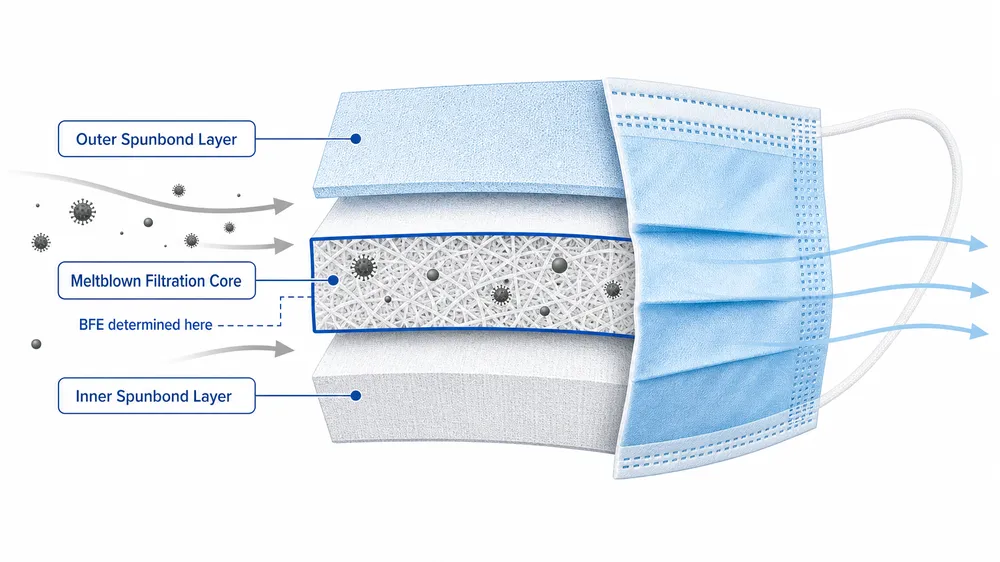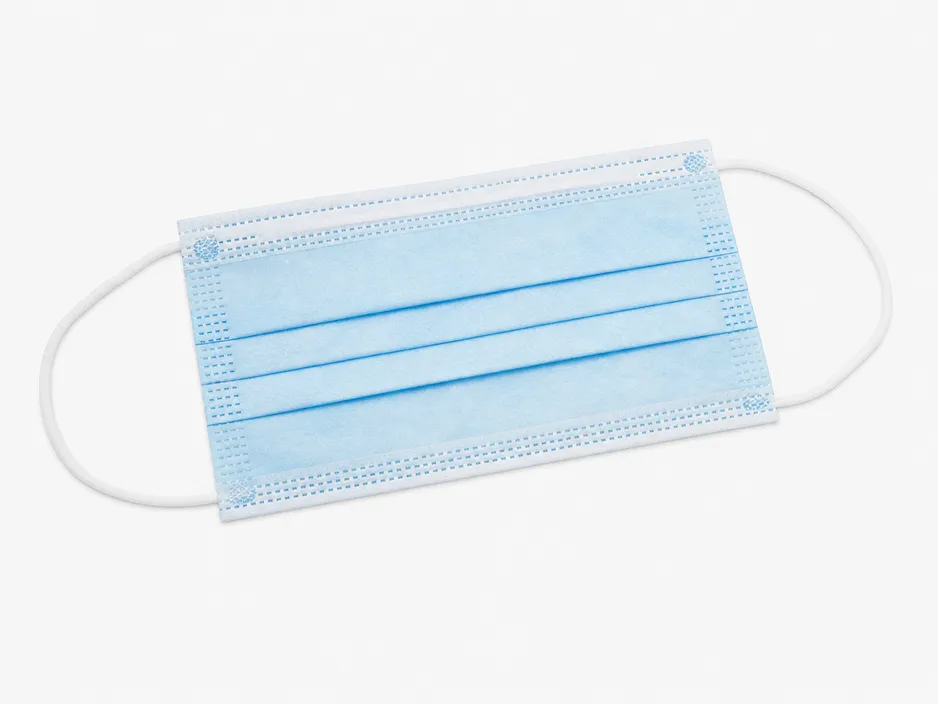
Most of the confusion we see around 4-ply masks comes from buyers who were told the layer count is the spec. It isn't. The layer count is the construction. The spec is BFE — and BFE is determined by what's inside those layers, not how many there are.
That distinction matters when you're sourcing at volume. A 4-ply mask with a weak meltblown layer will underperform a well-built 3-ply. A 4-ply with dual meltblown and a proper electrostatic charge will hit ≥99% BFE and hold it across batches. The question isn't "how many plies?" — it's "what does the 4th layer actually contribute, and does that contribution justify the price difference for your specific procurement context?"
This article answers that directly.

What the Four Layers Are and What Each One Does
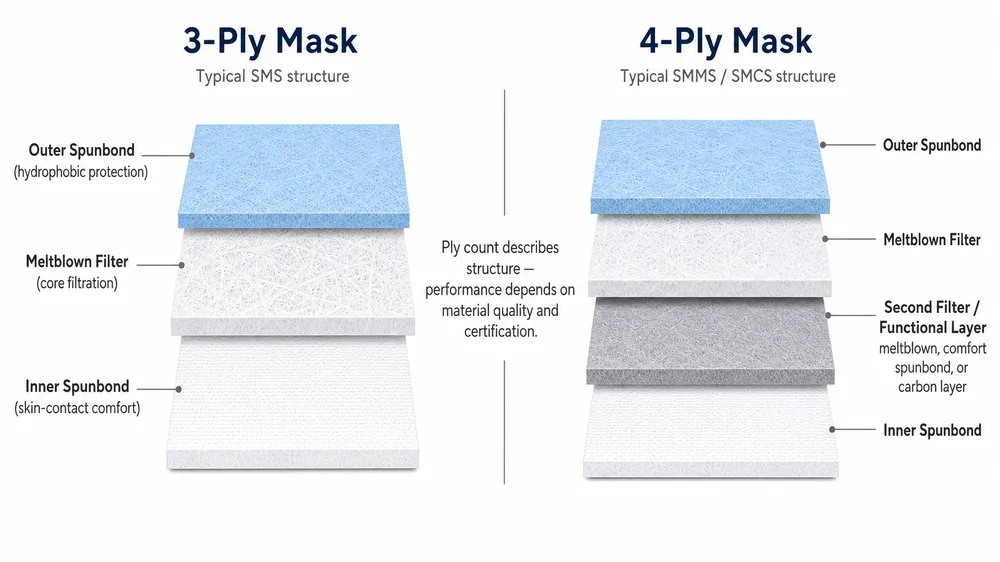
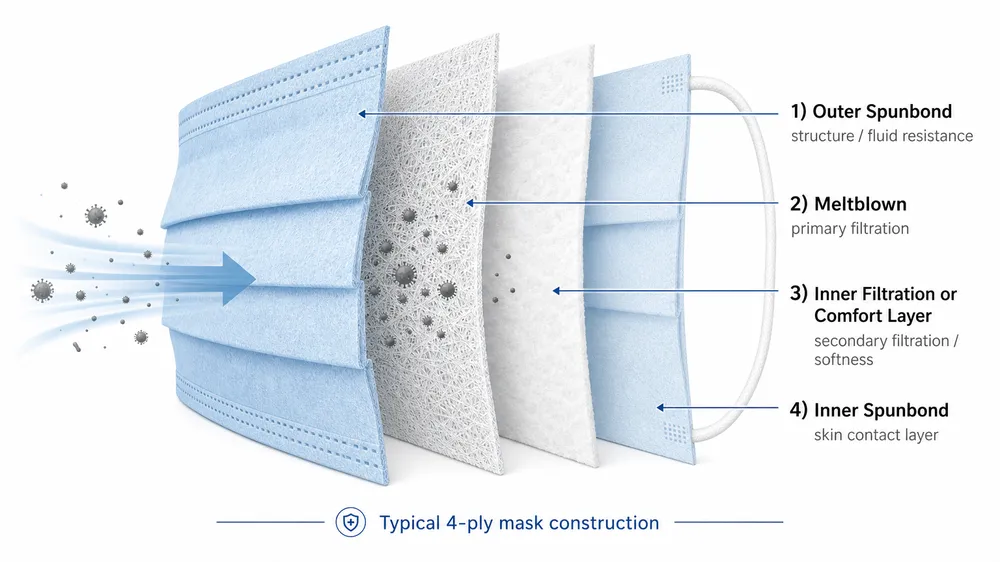
A standard 3-ply medical mask runs: outer spunbond / meltblown / inner spunbond. The outer layer handles fluid resistance and structural shape. The inner layer sits against the face. The meltblown in the middle does the filtration work.
When you add a 4th layer, you have a choice to make — and that choice determines whether you're buying a genuinely higher-performing mask or just a heavier one.
Configuration A: Dual meltblown (SMS + M) Outer spunbond / meltblown / meltblown / inner spunbond. Two filtration layers stacked. This is the construction that actually moves the BFE needle — from the ≥95% range typical of a standard 3-ply up toward ≥99%. The second meltblown layer catches particles that pass through the first, and if both layers carry electrostatic charge, the combined effect is additive.
Configuration B: Single meltblown + comfort layer (SMMS) Outer spunbond / meltblown / soft nonwoven / inner spunbond. The 4th layer here is a comfort layer — softer against the face, better for extended wear. Filtration performance stays roughly equivalent to a well-built 3-ply. The commercial case for this configuration is wearer compliance in clinical settings where staff wear masks for 6-8 hour shifts.
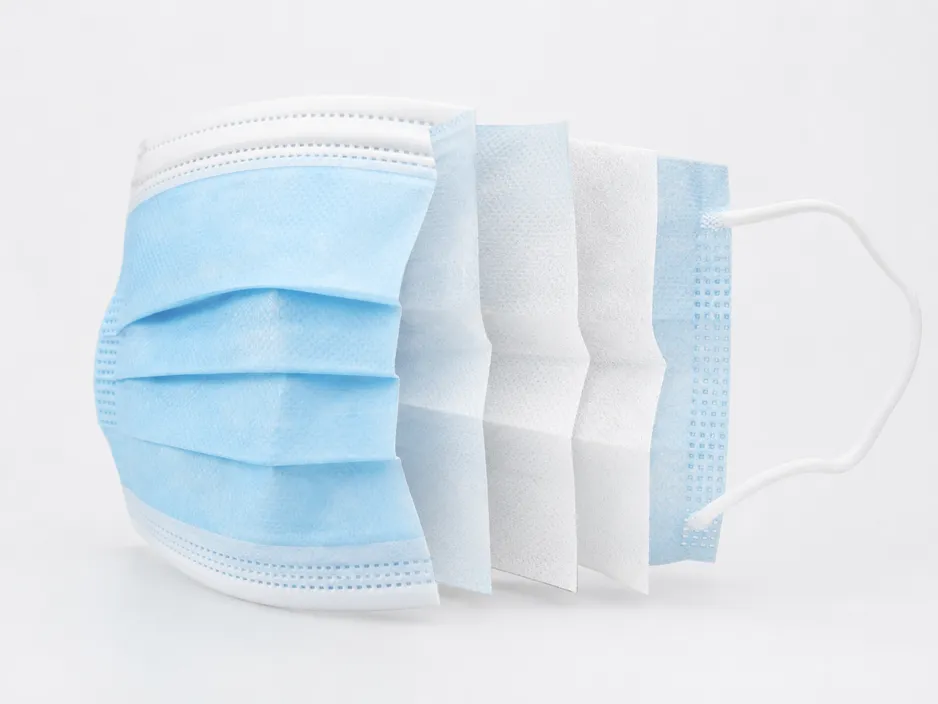
We run both configurations. The dual-meltblown version is what buyers specify when they need ≥99% BFE for surgical or high-aerosol environments. The comfort-layer version is what hospital procurement teams often prefer for general ward use where extended wear is the primary concern. (The two configurations look identical from the outside, which is exactly why you need to ask the right question at RFQ stage — not "is it 4-ply?" but "what is the 4th layer?")
BFE and PFE: What Numbers a 4-Ply Mask Should Actually Hit
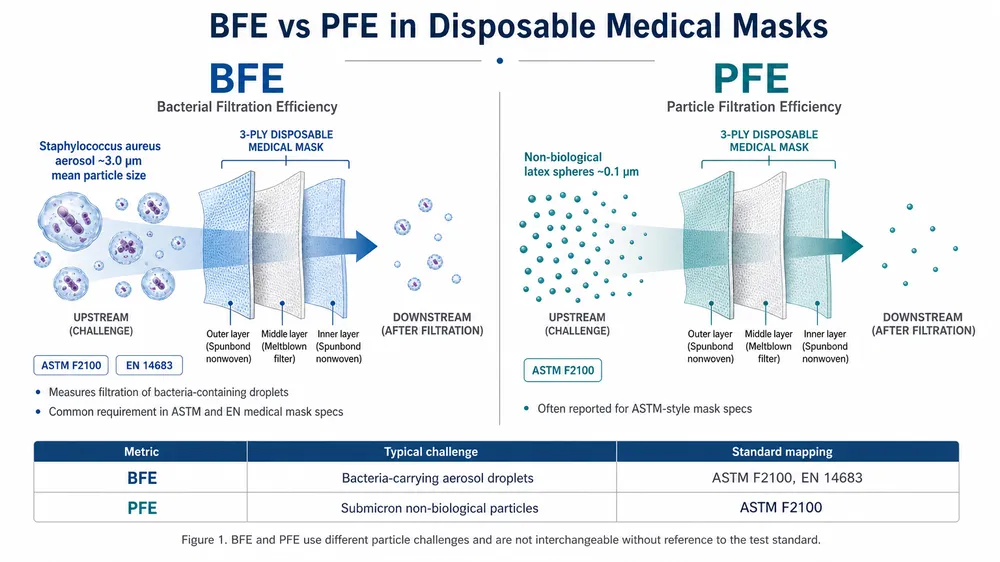
BFE (Bacterial Filtration Efficiency) and PFE (Particulate Filtration Efficiency) are the two performance parameters that determine whether a mask meets the standards your buyers operate under. Layer count doesn't appear on a test report. These numbers do.
| Construction | Typical BFE | Typical PFE | Applicable Standard |
|---|---|---|---|
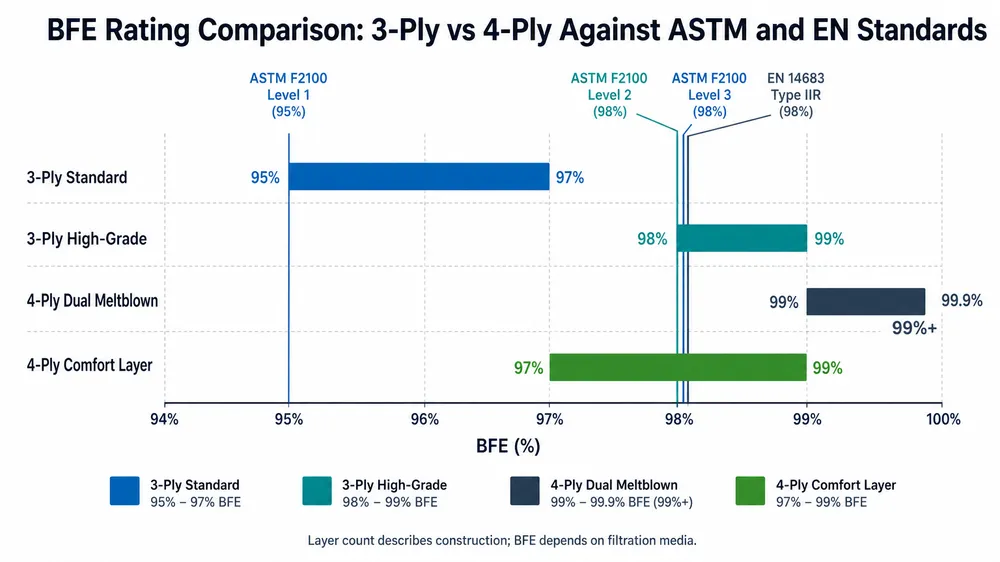
| 3-ply standard | ≥95% | ≥95% | ASTM F2100 Level 1, EN 14683 Type I |
| 3-ply high-grade | ≥98% | ≥98% | ASTM F2100 Level 2, EN 14683 Type II |
| 4-ply dual meltblown | ≥99% | ≥99% | ASTM F2100 Level 3, EN 14683 Type IIR |
| 4-ply comfort layer | ≥98% | ≥95% | ASTM F2100 Level 2, EN 14683 Type II |
A few things worth noting in that table. First, ASTM F2100 Level 3 and EN 14683 Type IIR are the two standards most commonly required by hospital procurement tenders in the US and EU respectively. Both require ≥98% BFE minimum — and in practice, most hospital procurement specs push for ≥99% to build in margin. A dual-meltblown 4-ply is the most reliable construction for hitting that threshold consistently across batches.
Second, EN 14683 Type IIR adds a splash resistance requirement (≥120 mmHg) that Type II does not. The "R" designation matters for surgical environments where fluid exposure is a real risk. A 4-ply mask with a reinforced outer spunbond layer can meet this requirement; a standard 3-ply typically cannot.
Third — and this is where sourcing decisions go wrong — a mask can be labeled "4-ply" and still only achieve ≥95% BFE if the meltblown quality is poor or the electrostatic charge has degraded. The ply count tells you nothing about the meltblown fiber diameter, basis weight, or charge retention. Those are the variables that actually determine filtration performance.
The Delta-P Trade-Off: Breathability Under a 4-Ply Construction
Delta-P — pressure differential — is the breathability measurement. It tells you how much resistance the mask creates against airflow. Lower Delta-P means easier breathing. Higher Delta-P means the mask is working harder to filter, but the wearer is working harder to breathe through it.
ASTM F2100 sets Delta-P thresholds by level:
- Level 1: < 5.0 mm H₂O/cm²
- Level 2: < 6.0 mm H₂O/cm²
- Level 3: < 6.0 mm H₂O/cm²
EN 14683 sets a single threshold: < 40 Pa/cm² (roughly equivalent to < 4.0 mm H₂O/cm²).
Adding a 4th layer increases Delta-P. That's physics — more material means more resistance. The question is how much, and whether the increase stays within the standard's acceptable range.
In our production, a well-built dual-meltblown 4-ply typically runs 4.5–5.5 mm H₂O/cm² — comfortably within ASTM Level 2/3 limits and within EN 14683 limits when the meltblown basis weight is managed correctly. The key variable is meltblown fiber diameter. Finer fibers filter better but restrict airflow more. Coarser fibers breathe easier but filter less. The balance point for a 4-ply mask targeting ≥99% BFE while staying under 6.0 mm H₂O/cm² is something we tune at the meltblown production stage — not something you can fix after the fabric is made.
This is where in-house meltblown production matters operationally. When we're developing a 4-ply SKU for a buyer targeting a specific BFE/Delta-P combination, we adjust the extrusion parameters directly. A factory buying meltblown from an outside supplier is working with whatever the supplier ships. If the batch runs slightly heavy on basis weight, Delta-P goes up and the mask may fail breathability testing. We catch that before it becomes your problem.
For extended clinical wear — 6-8 hour shifts — Delta-P is not a secondary concern. A mask that's technically within spec but sits at 5.8 mm H₂O/cm² will cause measurable fatigue over a full shift. Most of our hospital procurement buyers in Europe specify a Delta-P ceiling of 5.0 mm H₂O/cm² even when the standard allows 6.0, precisely because their end users are wearing these masks all day.
Which Regulatory Standards Actually Require or Benefit from 4-Ply Construction
Layer count is not a regulatory requirement in any major standard. What the standards require are performance thresholds — and 4-ply construction is one reliable way to meet the higher ones.
ASTM F2100 (US market)
Level 1 (≥95% BFE, < 5.0 mm H₂O/cm²): A standard 3-ply meets this. No case for 4-ply on performance grounds alone.
Level 2 (≥98% BFE, < 6.0 mm H₂O/cm²): A high-quality 3-ply can meet this. A 4-ply comfort-layer configuration also meets this. The choice comes down to whether your buyer needs the comfort layer for extended wear compliance.
Level 3 (≥98% BFE, ≥160 mmHg fluid resistance, < 6.0 mm H₂O/cm²): The fluid resistance requirement at Level 3 is where 4-ply construction earns its place. The reinforced outer layer in a 4-ply design handles the 160 mmHg splash resistance more reliably than a standard 3-ply outer spunbond. For surgical environments and high-aerosol procedures, Level 3 is the correct spec.
EN 14683 (EU market)
Type I (≥95% BFE): Standard 3-ply territory.
Type II (≥98% BFE): Achievable with a good 3-ply or a 4-ply comfort-layer configuration.
Type IIR (≥98% BFE + ≥120 mmHg splash resistance): This is the EU equivalent of ASTM Level 3. Hospital procurement tenders in Germany, France, the Netherlands, and the UK routinely specify Type IIR for surgical and procedural masks. A 4-ply construction with reinforced outer layer is the standard approach for meeting this spec reliably.
FDA 510(k) (US device clearance)
Our 4-ply masks carry FDA 510(k) registration alongside CE under EU MDR. For buyers supplying US hospital systems or government tenders, 510(k) clearance is often a hard requirement at the procurement audit stage — not just a nice-to-have. The combination of 510(k) + CE MDR means a single SKU can satisfy both US and EU institutional procurement requirements, which matters if you're building a product line for multiple markets.
When 4-Ply Is the Right Spec and When It Isn't
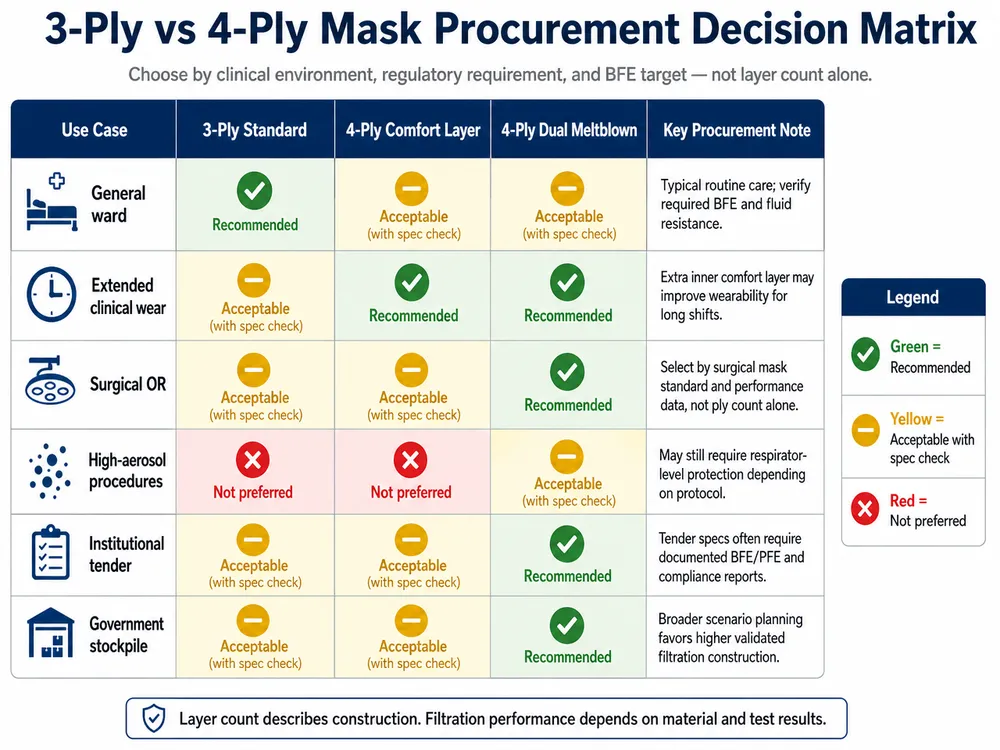
This is the decision most buyers actually need help with. The honest answer is that 4-ply is not always the right call — and over-specifying costs you margin without adding value.
| Use Case | Recommended Spec | Construction | Rationale |
|---|---|---|---|
| General ward, outpatient, low-risk clinical | ASTM Level 1 / EN Type I | 3-ply standard | ≥95% BFE is sufficient; Delta-P comfort matters more |
| Extended clinical wear (6-8 hr shifts) | ASTM Level 2 / EN Type II | 4-ply comfort layer | Comfort layer reduces fatigue; BFE stays ≥98% |
| Surgical procedures, OR environments | ASTM Level 3 / EN Type IIR | 4-ply dual meltblown | ≥99% BFE + fluid resistance required |
| High-aerosol procedures (intubation, bronchoscopy) | ASTM Level 3 / EN Type IIR | 4-ply dual meltblown | Maximum filtration; fluid splash risk present |
| Institutional tender (hospital procurement) | ASTM Level 2-3 / EN Type IIR | 4-ply dual meltblown | Tender specs typically require ≥98-99% BFE + splash resistance |
| Government/emergency stockpile | ASTM Level 2 / EN Type II | 3-ply or 4-ply comfort | Cost efficiency at volume; BFE ≥98% typically sufficient |
The cost premium for 4-ply dual meltblown over a standard 3-ply runs roughly 15–25% per unit at comparable order volumes, depending on meltblown basis weight and the specific BFE target. For surgical and institutional procurement, that premium is absorbed by the performance requirement — you don't have a choice. For general ward use or stockpile orders, it's often unnecessary spend.
Where buyers get this wrong is in blanket-specifying 4-ply across an entire order when only a portion of the volume actually needs it. If you're supplying a hospital system that uses Level 1 masks for general ward staff and Level 3 for surgical teams, those should be two separate SKUs at two separate price points — not a single 4-ply SKU applied to everything.
How Filtration Claims Get Verified — and Where They Fall Apart
This is the part of the sourcing process where most buyers are underprotected. A supplier can print "≥99% BFE" on a spec sheet and a box. That number is only meaningful if it comes from a test report that covers the actual production batch you're receiving — not a sample submitted for certification two years ago.
Here's what to request at RFQ stage for any 4-ply mask order:
Third-party test reports — BFE, PFE, and Delta-P test reports from an accredited lab (Nelson Labs, SGS, Intertek, or equivalent). The report should reference the specific product model and construction. Ask for the test date. A report from 2021 on a product that's been reformulated since doesn't tell you what you're getting today.
Batch-level QC documentation — In-house test data from the production batch corresponding to your order. This is different from the certification test report. It shows that the specific batch you're receiving was tested, not just that the product design was tested once.
Material traceability records — For meltblown specifically, ask whether the supplier manufactures their own meltblown or sources it externally. If they source externally, ask for the meltblown supplier's fabric spec sheet and incoming inspection records. Meltblown quality varies significantly between suppliers and even between batches from the same supplier.
ISO 13485 certificate — This is the quality management standard for medical device manufacturers. It requires documented incoming inspection, in-process controls, and batch traceability. A supplier without ISO 13485 is not operating under a system that guarantees the consistency you need for institutional procurement.
We run BFE, PFE, and Delta-P testing on every production batch in our in-house lab before the batch ships. The in-house results are the first gate — if a batch fails internal testing, it doesn't proceed to outgoing inspection. Third-party certification reports are submitted separately for regulatory documentation. The two serve different purposes: in-house testing catches production variation in real time; third-party certification establishes the regulatory baseline.
(One thing we've seen repeatedly: buyers who receive a single third-party test report and assume it covers all future production. It doesn't. Certification tests a product design. Batch testing verifies that each production run matches that design. Both are necessary.)
For buyers sourcing Disposable Medical Masks for institutional or hospital supply chains, the documentation package matters as much as the product itself. A shipment that arrives without proper test reports can be held at customs or rejected at the procurement audit stage — and that's a supply chain problem that lands on you, not the factory.
Sourcing a 4-Ply Mask: What to Confirm Before You Commit
Before placing a volume order on any 4-ply mask, run through this checklist:
Construction confirmation
- Is the 4th layer a second meltblown or a comfort layer?
- What is the meltblown basis weight (g/m²) for each meltblown layer?
- Is the meltblown manufactured in-house or sourced externally?
Performance verification
- What BFE and PFE does the product achieve on current batch testing?
- What is the typical Delta-P range for this SKU?
- Which standard does the product meet: ASTM F2100 Level 2 or Level 3? EN 14683 Type II or Type IIR?
Regulatory documentation
- Is the product FDA 510(k) registered? (Required for US hospital procurement)
- Does the product carry CE under EU MDR? (Required for EU market)
- Are current third-party test reports available (within 12 months)?
- Can the supplier provide batch-level QC data for your specific order?
Supply chain stability
- What is the supplier's meltblown sourcing situation? In-house or external?
- What is the lead time on a 4-ply SKU at your required volume?
- What is the MOQ for the specific configuration you need?
For our 4 Ply Disposable Medical Mask, the answers to all of the above are documented and available before you place an order. We manufacture our own meltblown, run batch-level BFE/PFE/Delta-P testing in-house, and carry both FDA 510(k) and CE MDR registration. MOQ on standard 4-ply SKUs starts at 50,000 pieces.
Frequently Asked Questions
Does a 4-ply mask always filter better than a 3-ply?
No. A 4-ply mask with a comfort layer as the 4th layer performs comparably to a high-quality 3-ply on BFE and PFE. The filtration improvement comes specifically from dual-meltblown construction, not from adding any 4th layer. If a supplier is marketing a 4-ply mask as higher-filtration without specifying that the 4th layer is meltblown, ask for the test report before assuming the performance claim is valid.
What BFE rating should I specify for hospital procurement?
For general ward and outpatient use, ≥95% BFE (ASTM Level 1 / EN Type I) is the standard baseline. For surgical environments and institutional tenders, ≥98% BFE (ASTM Level 2/3 / EN Type IIR) is the typical requirement. Most hospital procurement audits in the US and EU push toward ≥99% BFE for surgical masks to build in performance margin. If your tender spec says "surgical mask," assume Type IIR or ASTM Level 3 unless the document explicitly states otherwise.
How does the 4th layer affect Delta-P, and does that matter for my order?
Adding a 4th layer increases Delta-P by roughly 0.5–1.5 mm H₂O/cm² compared to a comparable 3-ply, depending on the layer type and meltblown basis weight. For most procurement contexts, this stays within ASTM and EN standard limits. It becomes a real concern for extended clinical wear — if your end users are wearing masks for 6+ hours, a Delta-P above 5.0 mm H₂O/cm² will cause measurable fatigue. Specify a Delta-P ceiling in your RFQ if extended wear is a factor.
Can a 4-ply mask meet both FDA 510(k) and CE MDR requirements simultaneously?
Yes, if the manufacturer holds both registrations for that specific product. This is commercially useful if you're supplying both US and EU markets from a single SKU — it eliminates the need to manage two separate product lines with different documentation. Not all manufacturers hold both; confirm at RFQ stage.
What's the typical cost premium for 4-ply dual meltblown over standard 3-ply?
At comparable order volumes, the premium runs roughly 15–25% per unit. The exact figure depends on meltblown basis weight, the BFE target, and order volume. For surgical and institutional procurement where ≥99% BFE is required, the premium is a specification cost, not a discretionary upgrade. For general ward use where ≥95% BFE is sufficient, the premium is unnecessary.
How do I verify that the meltblown in a 4-ply mask is actually performing to spec?
Request the BFE and PFE test report from an accredited third-party lab, and ask for batch-level QC data from the specific production run you're ordering. The test report establishes the product design's performance baseline; the batch data confirms that your specific order was produced to that baseline. If a supplier can only provide the certification report and not batch-level data, that's a gap in their QC system worth flagging before you commit to volume.
If you're evaluating 4-ply mask options for a specific procurement context — hospital tender, private-label program, or government supply — the most useful next step is to share your target BFE grade, destination market, and order volume. We can confirm the right construction, provide current test reports, and give you a per-unit price for the 4 Ply Disposable Medical Mask configuration that matches your spec. See the full 3 ply vs 4 ply disposable medical mask comparison if you're still working through which construction fits your market, or Request Quote with your specs and we'll respond with a matched recommendation.