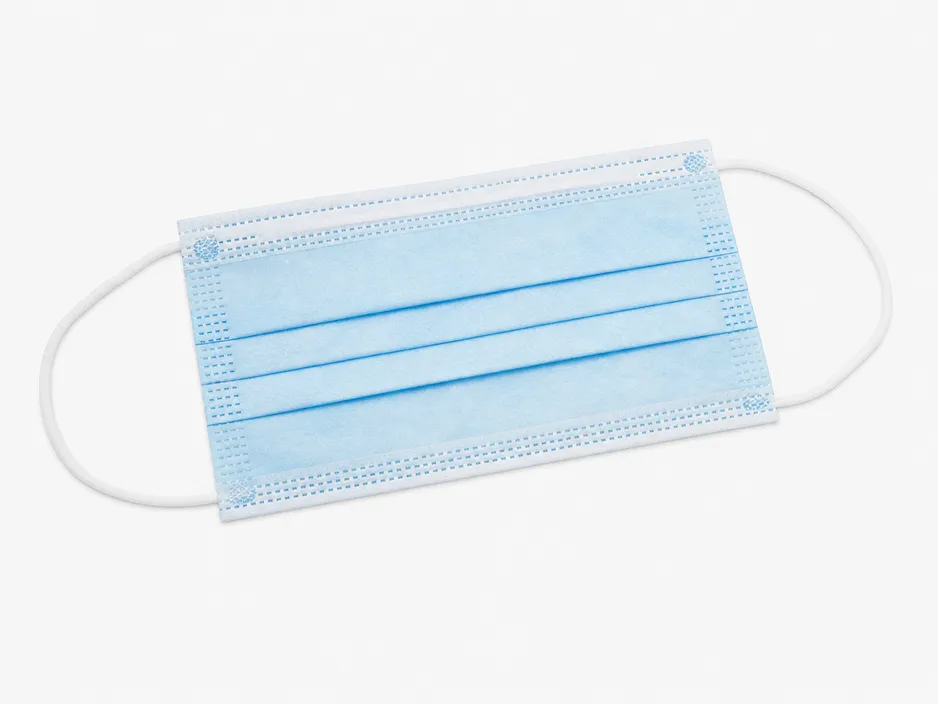
Most sourcing problems we see don't start with a bad product. They start with a documentation mismatch — a buyer specifying ASTM F2100 Level 2, a supplier quoting EN 14683 Type II, and both sides assuming those are the same thing. They're not. Close, but not the same. And that gap is exactly what gets shipments held at the border or rejected in a hospital procurement audit.
We hold both FDA 510(k) registration and CE certification under EU MDR. Our in-house QC lab runs BFE, PFE, and Delta-P testing against both ASTM and EN parameters on every production batch. So when we say we understand both frameworks, it's not a marketing claim — it's what we do every day on the production floor.
This article breaks down what each standard actually tests, how the levels map across frameworks, and what documentation your supplier should be able to hand you before you place an order.
What the Tests Actually Measure: BFE, PFE, and Delta-P
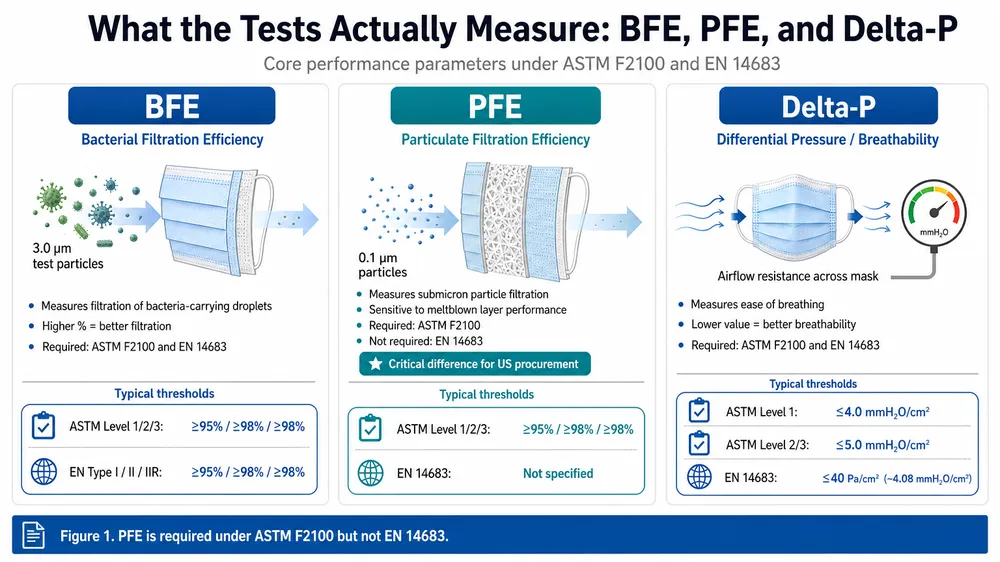
Before comparing ASTM and EN, you need to understand what the underlying test parameters mean. These three numbers appear on every compliant mask test report, and they're the ones that determine whether a mask passes or fails a procurement audit.
BFE — Bacterial Filtration Efficiency BFE measures how well the mask filters a bacterial aerosol (typically Staphylococcus aureus at a mean particle size of 3.0 µm). It's expressed as a percentage. A BFE of ≥98% means the mask filters out at least 98% of the bacterial challenge. Both ASTM F2100 and EN 14683 use BFE as a primary performance metric, though the test protocols differ slightly between the two standards.
PFE — Particulate Filtration Efficiency PFE measures filtration against sub-micron particles — typically 0.1 µm latex spheres. This is where the meltblown layer does its real work. ASTM F2100 requires PFE testing; EN 14683 does not. That's one of the most practically significant differences between the two frameworks. A mask can pass EN 14683 Type IIR without ever being tested for sub-micron particle filtration.
(We run PFE on every batch regardless of which standard the order is certified to. The meltblown layer is the heart of the mask — if it's underperforming, BFE alone won't catch it.)
Delta-P — Differential Pressure / Breathability Delta-P measures airflow resistance across the mask, expressed in mmH₂O/cm². Lower is better for the wearer. Both standards set maximum Delta-P thresholds, but the limits differ. ASTM F2100 Level 1 allows up to 4.0 mmH₂O/cm²; Level 2 and 3 allow up to 5.0 mmH₂O/cm². EN 14683 sets a maximum of 40 Pa/cm² (approximately 4.08 mmH₂O/cm²) for all types. In practice, a well-made 3-ply mask with quality meltblown typically lands between 2.5 and 3.5 mmH₂O/cm² — well within both standards.
Fluid Resistance (Splash Resistance) ASTM F2100 Level 2 and Level 3 require fluid resistance testing at 120 mmHg and 160 mmHg respectively. EN 14683 Type IIR requires splash resistance at 120 mmHg. Level 1 and EN Type I/II have no fluid resistance requirement. This matters for surgical environments where blood or fluid splash is a realistic risk.

ASTM F2100: The US Framework in Detail
ASTM F2100 is the standard that governs surgical mask performance in the United States. It's published by ASTM International and referenced by the FDA for 510(k) clearance of surgical masks. The standard defines three performance levels, each with progressively stricter requirements.
| Test Parameter | Level 1 | Level 2 | Level 3 |
|---|---|---|---|
| BFE (%) | ≥95% | ≥98% | ≥98% |
| PFE at 0.1 µm (%) | ≥95% | ≥98% | ≥98% |
| Delta-P (mmH₂O/cm²) | <4.0 | <5.0 | <5.0 |
| Fluid Resistance | Not required | 120 mmHg | 160 mmHg |
| Flammability | Class 1 | Class 1 | Class 1 |
Level 1 covers general medical use — outpatient clinics, dental offices, low-aerosol environments. The BFE threshold of ≥95% is lower than Levels 2 and 3, and there's no fluid resistance requirement.
Level 2 is the most commonly specified level for US hospital procurement. BFE and PFE both at ≥98%, fluid resistance at 120 mmHg. This is the level most US distributors default to when their hospital customers don't specify otherwise.
Level 3 is for high-fluid-exposure surgical environments — operating rooms, trauma settings. The 160 mmHg fluid resistance threshold is the key differentiator. The filtration numbers are the same as Level 2; it's the splash protection that changes.
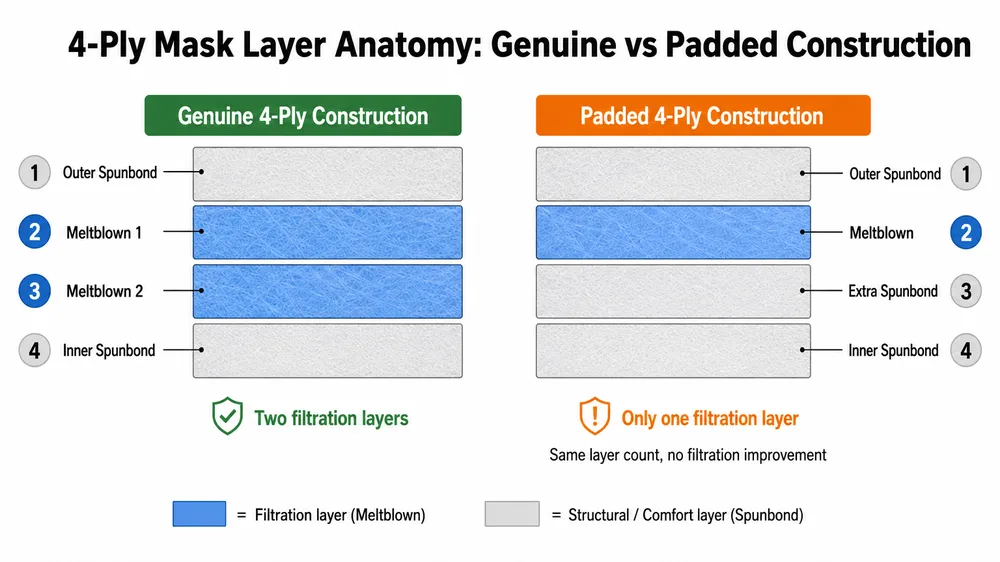
One thing worth noting: ASTM F2100 is a performance standard, not a design standard. It doesn't specify how many plies the mask must have or what materials to use. A 3-ply mask and a 4-ply mask can both achieve Level 2 certification — what matters is whether the finished product passes the tests. Our 3-ply disposable medical masks are certified to ASTM F2100 Level 2, and our 4-ply disposable medical masks are certified to Level 3.
EN 14683: The European Framework and How It Maps
EN 14683 is the European standard for medical face masks, published by the European Committee for Standardization (CEN). It defines three mask types, and the structure is simpler than ASTM F2100 — but the test scope is narrower.
| Test Parameter | Type I | Type II | Type IIR |
|---|---|---|---|
| BFE (%) | ≥95% | ≥98% | ≥98% |
| Delta-P (Pa/cm²) | <40 | <40 | <60 |
| Splash Resistance | Not required | Not required | 120 mmHg |
| PFE | Not required | Not required | Not required |
| Microbial Cleanliness | Required | Required | Required |
Type I is the lowest tier — intended for patients and general use, not for healthcare workers performing procedures. BFE ≥95%, no fluid resistance, no PFE requirement.
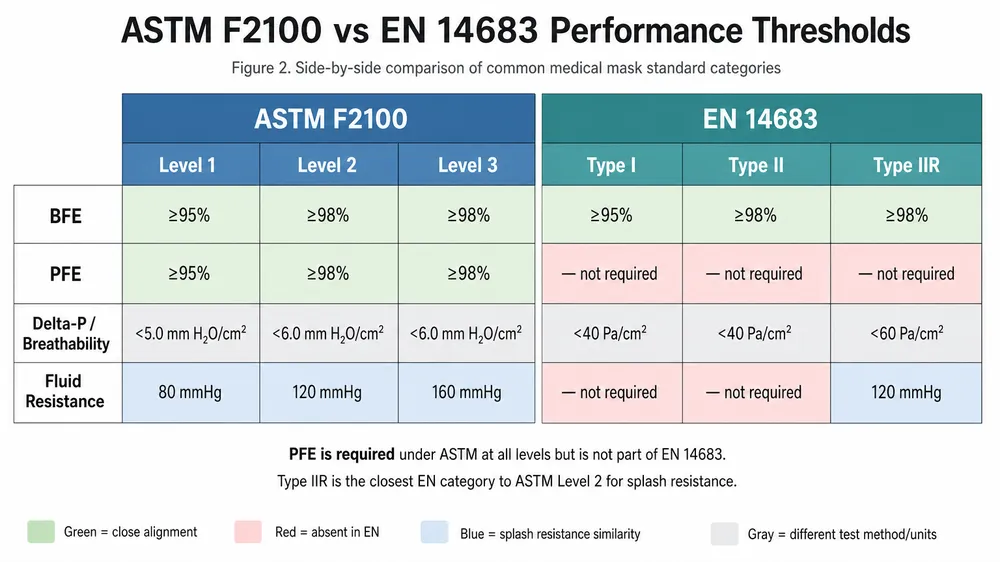
Type II is the standard clinical mask in European healthcare settings. BFE ≥98%, still no fluid resistance requirement. This is where the gap with ASTM Level 2 becomes visible: a Type II mask has never been tested for sub-micron particle filtration or fluid splash.
Type IIR adds splash resistance at 120 mmHg, making it the closest EN equivalent to ASTM F2100 Level 2. But even Type IIR doesn't require PFE testing.
The "R" in Type IIR stands for "Resistant" — specifically, splash resistant. It's a common point of confusion when buyers see both Type II and Type IIR on a supplier's product list and assume the difference is minor.
How ASTM F2100 and EN 14683 Levels Map to Each Other
This is the table most buyers need and almost no supplier provides clearly.
| ASTM F2100 | Closest EN 14683 Equivalent | Key Difference |
|---|---|---|
| Level 1 | Type I | ASTM requires PFE ≥95%; EN Type I does not |
| Level 2 | Type IIR | ASTM requires PFE ≥98%; EN Type IIR does not |
| Level 3 | No direct equivalent | EN 14683 has no 160 mmHg fluid resistance tier |
The practical takeaway: EN 14683 Type IIR is the closest European equivalent to ASTM F2100 Level 2, but it's not a substitute. If your buyer or end customer specifies ASTM F2100 Level 2, a Type IIR test report alone won't satisfy that requirement. You need an ASTM F2100 test report — specifically one that includes PFE results.
ASTM F2100 Level 3 has no EN equivalent at all. There is no EN 14683 type that requires 160 mmHg fluid resistance.
FDA 510(k) Clearance and Its Relationship to ASTM F2100
This is where a lot of import documentation problems originate.
The FDA classifies surgical masks as Class II medical devices. To legally market a surgical mask in the United States, a manufacturer must either obtain 510(k) clearance or qualify under an applicable exemption. The 510(k) process requires demonstrating that the device is substantially equivalent to a legally marketed predicate device.
For surgical masks, the FDA's guidance document references ASTM F2100 as the recognized performance standard. A 510(k)-cleared surgical mask will have test data on file demonstrating compliance with ASTM F2100 at a specific level. That level is part of the cleared device's intended use — a mask cleared as ASTM F2100 Level 2 cannot be relabeled or sold as Level 3 without a new submission.
What this means for procurement: when you source a surgical mask from a Chinese manufacturer for the US market, you need to confirm that the specific SKU you're ordering is covered by the manufacturer's 510(k) clearance. Not just that the manufacturer has a 510(k) number — that the specific product configuration (ply count, ear loop vs. tie-on, dimensions) is within the cleared device's scope.
We've seen buyers get caught by this. A factory has a 510(k) for their standard 3-ply ear-loop mask, and a buyer orders a custom tie-on version assuming the clearance transfers. It doesn't automatically. The cleared device description matters.
(Our 510(k) registration covers our standard 3-ply and 4-ply configurations. If you need a custom configuration for a private-label program, we'll confirm clearance scope before you commit to tooling.)
The Documentation Package a Compliant Shipment Should Include
This is the section most sourcing guides skip. Getting the product right is half the job — getting the paperwork right is the other half, and it's what determines whether your shipment clears customs and passes a procurement audit.
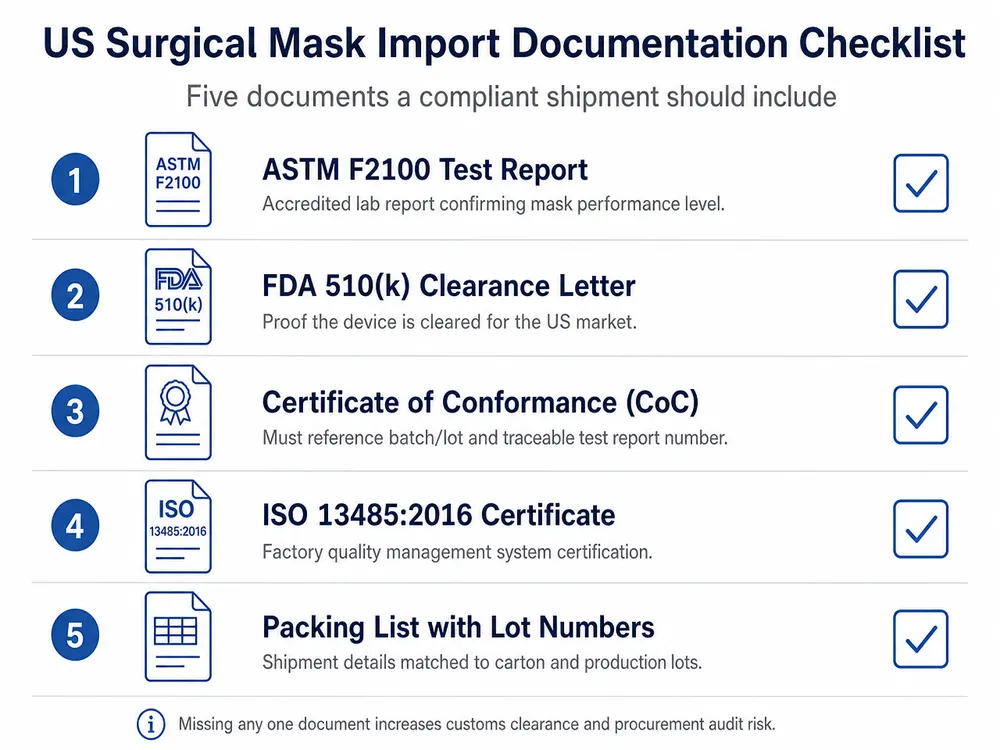
For a US-bound surgical mask shipment, the documentation package should include:
1. ASTM F2100 Test Report Issued by an accredited third-party laboratory (Nelson Labs, SGS, Intertek, or equivalent). The report must show results for all five parameters: BFE, PFE, Delta-P, fluid resistance (for Level 2/3), and flammability. Check that the test report covers the specific product configuration you're ordering — not a generic "3-ply mask" but the actual SKU with dimensions and construction details.
2. FDA 510(k) Clearance Letter or Registration Number The clearance letter confirms the device is legally marketable in the US. Cross-reference the cleared device description against your order specifications. The FDA's 510(k) database is publicly searchable — you can verify any clearance number before you pay a deposit.
3. Certificate of Conformance (CoC) The CoC is the manufacturer's written declaration that the specific production lot meets the stated standard and performance level. It should reference the test report number, the production batch, and the applicable standard (ASTM F2100 Level X). A CoC without a traceable test report number is not useful documentation.
4. ISO 13485:2016 Certificate ISO 13485 is the quality management system standard for medical device manufacturers. It doesn't certify the product — it certifies the factory's quality processes. A supplier without ISO 13485 is a sourcing risk, because there's no systematic QMS ensuring that production batches match the tested configuration.
5. Packing List with Lot Numbers Lot traceability is required for FDA-regulated medical devices. Each carton should be traceable to a production batch, which should be traceable to the test report. If a quality issue surfaces after delivery, lot numbers are how you isolate the affected inventory.
Common Documentation Mistakes When Mixing Standard Frameworks
We see these regularly when buyers come to us after a failed import or a rejected tender submission.
Substituting EN 14683 test reports for ASTM F2100 requirements A supplier provides a Type IIR test report when the buyer specified ASTM F2100 Level 2. The buyer assumes they're equivalent. The FDA and hospital procurement teams do not. If the purchase order says ASTM F2100 Level 2, the test report must say ASTM F2100 Level 2 — with PFE results included.
Using a 510(k) number that doesn't cover the ordered configuration The factory's 510(k) covers their standard ear-loop 3-ply mask. The buyer orders a tie-on version for a surgical tender. The clearance doesn't automatically extend. This is a common private-label trap — always request the cleared device description, not just the clearance number.
Accepting a CoC without a traceable test report Some suppliers issue a CoC that references "internal testing" or a test report number that doesn't match any third-party lab document. A CoC is only as good as the test report it references. If the test report isn't from an accredited lab, the CoC is a piece of paper.
Ordering to EN 14683 for a US hospital tender US hospital group purchasing organizations (GPOs) and government tenders typically specify ASTM F2100 by level. An EN 14683 certificate, even Type IIR, will not satisfy an ASTM F2100 specification in a US procurement context. The two standards are not interchangeable in US regulatory or procurement documents.
Misreading BFE as the only performance metric A supplier advertises "BFE ≥99%" and the buyer assumes the mask is high-performance. BFE alone doesn't tell you about PFE, Delta-P, or fluid resistance. We've seen masks with excellent BFE numbers and Delta-P values above 6.0 mmH₂O/cm² — technically failing ASTM F2100 on breathability while passing on filtration. Always request the full test report, not a summary spec sheet.
How We Test: In-House Lab Plus Third-Party Verification
Our QC lab runs BFE, PFE, and Delta-P testing on every production batch before shipment. We use a TSI 8130A automated filter tester for PFE and a bacterial challenge chamber for BFE — the same equipment configuration used by accredited third-party labs. This isn't a substitute for third-party certification, but it means we catch meltblown layer performance issues before a batch ships, not after it arrives at your warehouse.
The meltblown layer is where filtration performance lives. We produce our own meltblown nonwoven fabric in-house, which gives us direct control over fiber diameter, basis weight, and electrostatic charge — the three variables that determine BFE and PFE performance. When a supplier buys meltblown on the open market, they're accepting whatever quality the roll happens to be. We're not.
(BFE and PFE numbers only mean something if you know what went into the meltblown layer. That's not a philosophical point — it's why we test every batch rather than relying on the supplier's certificate for the raw material.)
For third-party certification, we work with SGS and accredited labs for ASTM F2100 testing and with EU-notified bodies for CE/EN 14683 certification. Our 510(k) registration is on file with the FDA. When you request our documentation package, you get the actual test reports — not summaries, not spec sheets.
Our Class 100,000 (ISO 8) cleanroom manufacturing environment is part of why our batch-to-batch consistency holds up. Particulate contamination during production affects meltblown performance. Running in a controlled environment isn't a marketing point — it's a QMS requirement under ISO 13485, and it's what keeps our test results reproducible across production runs.
Sourcing Decision Guide: Which Standard to Specify
The right answer depends on where your product is going and who's buying it.
US hospital and healthcare system procurement Specify ASTM F2100 Level 2 as your baseline. Most US hospital GPOs and IDNs require it. If the end use involves surgical procedures with fluid exposure risk, specify Level 3. Request the full ASTM F2100 test report (all five parameters) and confirm the supplier's 510(k) clearance covers your specific SKU configuration.
US distributor stocking for general medical/dental use ASTM F2100 Level 1 is sufficient for general clinical environments without fluid splash risk. Level 2 gives you more flexibility to sell into a wider range of accounts without re-specifying. Most distributors we work with default to Level 2 for this reason — the margin difference is small and the market access is broader.
US government and institutional tenders Government tenders (VA, DoD, state health departments) typically specify ASTM F2100 by level and require FDA 510(k) clearance. Some also require Buy American Act compliance or domestic content documentation — that's a separate conversation, but worth confirming before you submit a bid.
EU and international markets alongside US If you're distributing in both the US and EU, you need a supplier that holds both FDA 510(k) and CE certification. Sourcing from a factory with only one certification means you're managing two separate supply chains. We hold both, so your EU orders ship with EN 14683 documentation and your US orders ship with ASTM F2100 documentation — same factory, same production line, different certification packages.
Private-label programs If you're building a private-label healthcare brand, the certification must be in your brand name or you need a clear contractual arrangement with the manufacturer. A 510(k) clearance in the manufacturer's name doesn't automatically transfer to your label. Work through this before you invest in packaging.
For any of these scenarios, the starting point is the same: specify the standard and level in your purchase order, request the full documentation package before you pay a deposit, and verify the 510(k) clearance number against the FDA database. If a supplier can't provide a complete documentation package upfront, that's the answer you need.
You can browse our full range of certified Disposable Medical Masks or go straight to Request Quote with your standard, level, and volume — we'll confirm documentation scope and lead time in the same response.
Frequently Asked Questions
Is EN 14683 Type IIR accepted for US hospital procurement? Generally no. US hospital GPOs and government tenders specify ASTM F2100 by level. EN 14683 Type IIR is the closest European equivalent to ASTM F2100 Level 2, but it doesn't include PFE testing and is not recognized as equivalent in US procurement documents. If your buyer specifies ASTM F2100, you need an ASTM F2100 test report.
What's the difference between a 510(k)-cleared mask and an ASTM F2100-certified mask? These are two different things. ASTM F2100 certification means the mask has been tested and meets the performance thresholds for a specific level. FDA 510(k) clearance means the FDA has reviewed the device and determined it's substantially equivalent to a legally marketed predicate — which typically includes ASTM F2100 test data as supporting evidence. A mask can have ASTM F2100 test data without 510(k) clearance, but it cannot be legally marketed as a surgical mask in the US without clearance.
Can I use the same mask for both US and EU markets? The physical product can be identical. The documentation package differs. For the US, you need ASTM F2100 test reports and FDA 510(k) clearance. For the EU, you need EN 14683 test reports and CE certification under EU MDR. A manufacturer that holds both certifications can supply the same production batch with different documentation packages for each market.
What should I check on a Certificate of Conformance before accepting a shipment? Four things: the specific standard and level (e.g., ASTM F2100 Level 2, not just "ASTM F2100"), the production lot number, the reference to a third-party test report number, and the manufacturer's ISO 13485 certificate number. A CoC that doesn't reference a specific third-party test report is not adequate documentation for a regulated medical device.
Does a higher BFE percentage always mean a better mask? Not necessarily. BFE measures bacterial filtration at 3.0 µm — it doesn't tell you about sub-micron particle filtration (PFE) or breathability (Delta-P). A mask with BFE ≥99% but poor Delta-P performance may fail ASTM F2100 on breathability. Always evaluate the full test report across all parameters, not just the BFE headline number.
What's the minimum order quantity for ASTM F2100 Level 2 certified masks from eztio? Our standard MOQ is 50,000 pieces for certified SKUs. For private-label programs with custom packaging, MOQ and lead time depend on the configuration — send us your specs and we'll confirm.