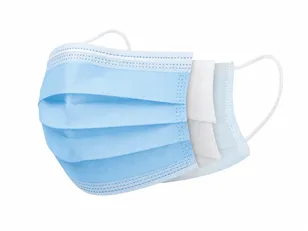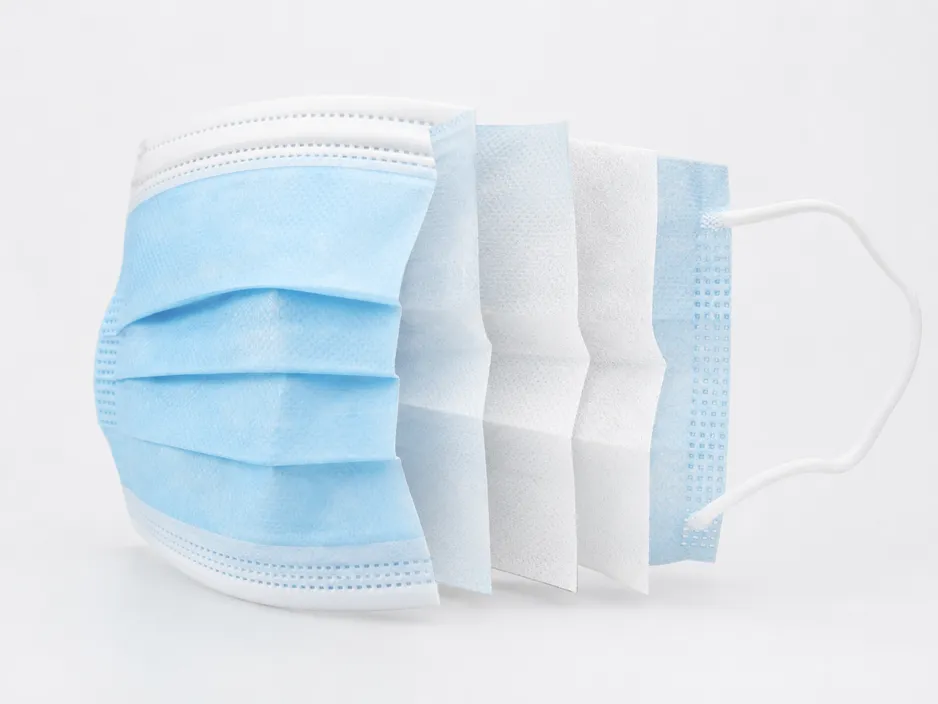
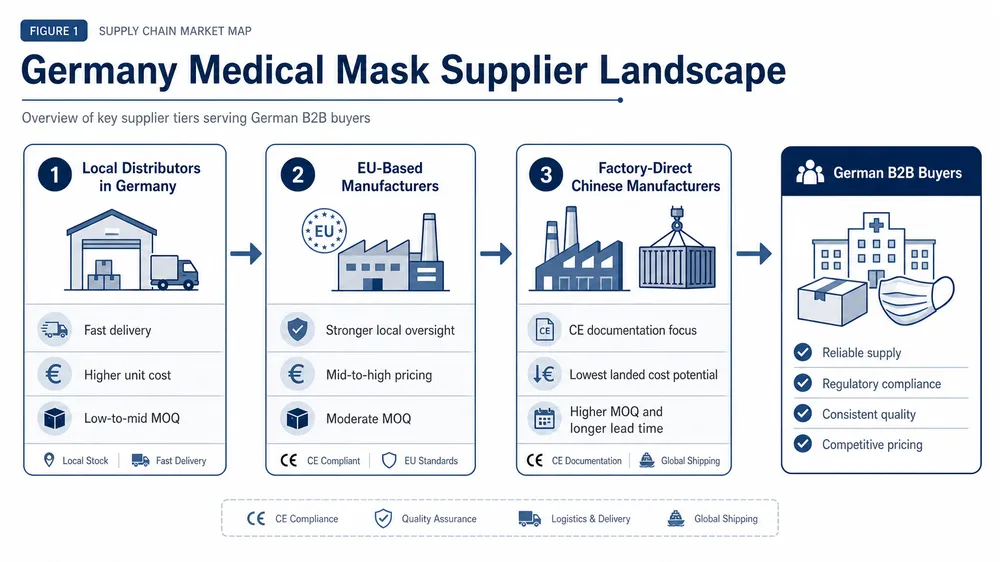
Germany's medical mask supply chain looks straightforward until you start pulling on the threads. You have large healthcare distributors, regional PPE wholesalers, and a long tail of importers who entered the market during 2020–2021 and never left. The certifications look similar on paper. The price differences are harder to explain. And since the EU MDR transition tightened documentation requirements in 2021, the compliance gap between suppliers who actually hold the paperwork and those who are still catching up has become a real sourcing risk.
This guide maps the supplier landscape honestly — who the serious players are, what model each one operates, and where the trade-offs land for buyers sourcing at volume. If you're screening local options and want to understand whether factory-direct import makes commercial sense for your situation, the cost and compliance comparison is in here too.

Why the German Market Is Harder to Source Than It Looks
The post-2021 EU MDR transition changed the compliance baseline for every mask importer operating in Germany. Under the old MDD framework, a CE mark on a surgical mask was relatively straightforward to obtain and maintain. Under EU MDR (Regulation 2017/745), the technical documentation requirements are substantially heavier — risk management files, clinical evaluation reports, post-market surveillance plans, and a notified body involvement for Class I sterile and Class IIR products.
What this means in practice: a supplier who was fully compliant in 2019 may be operating on a transitional basis today, with documentation that hasn't been updated to MDR standards. We've seen this pattern with European buyers who placed repeat orders with the same distributor for years, then ran into customs delays or hospital procurement rejections when the importer of record couldn't produce a current MDR technical file. The CE mark was still on the box. The underlying documentation wasn't current.
The second structural issue is margin layering. Germany's medical supply chain runs through several tiers — manufacturer, national distributor, regional wholesaler, end buyer. Each tier adds margin. For a commodity product like a 3-ply EN 14683 Type II mask, the price difference between a first-tier distributor and a fourth-tier reseller can be 40–60% on the same product. If you're buying to resell into hospital procurement, pharmacy chains, or institutional tenders, that margin compression is a direct hit to your bid competitiveness.
(We've had German buyers come to us after losing a tender bid by a few cents per unit. When we traced the cost back, the issue was always the same: too many hands between the factory and the buyer.)
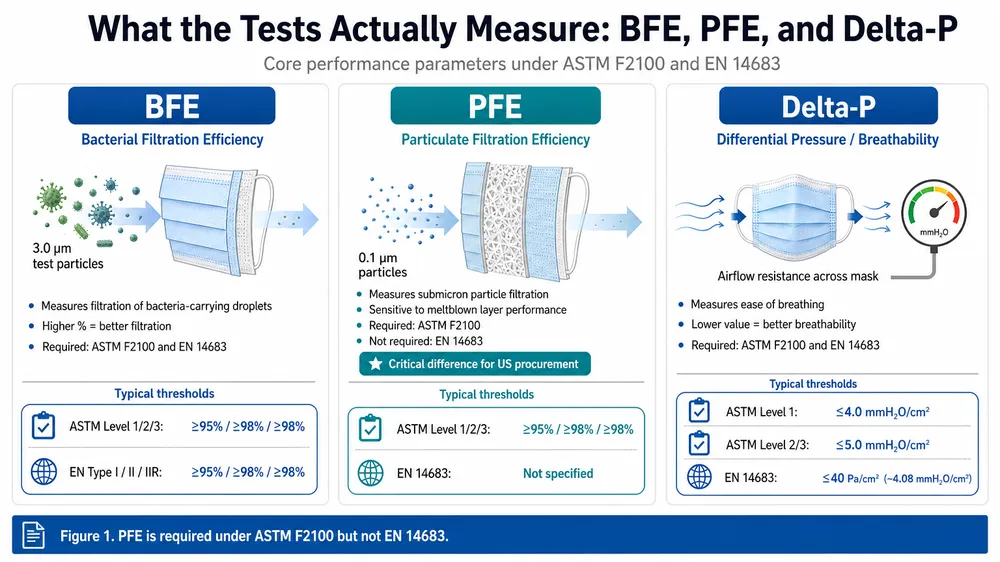
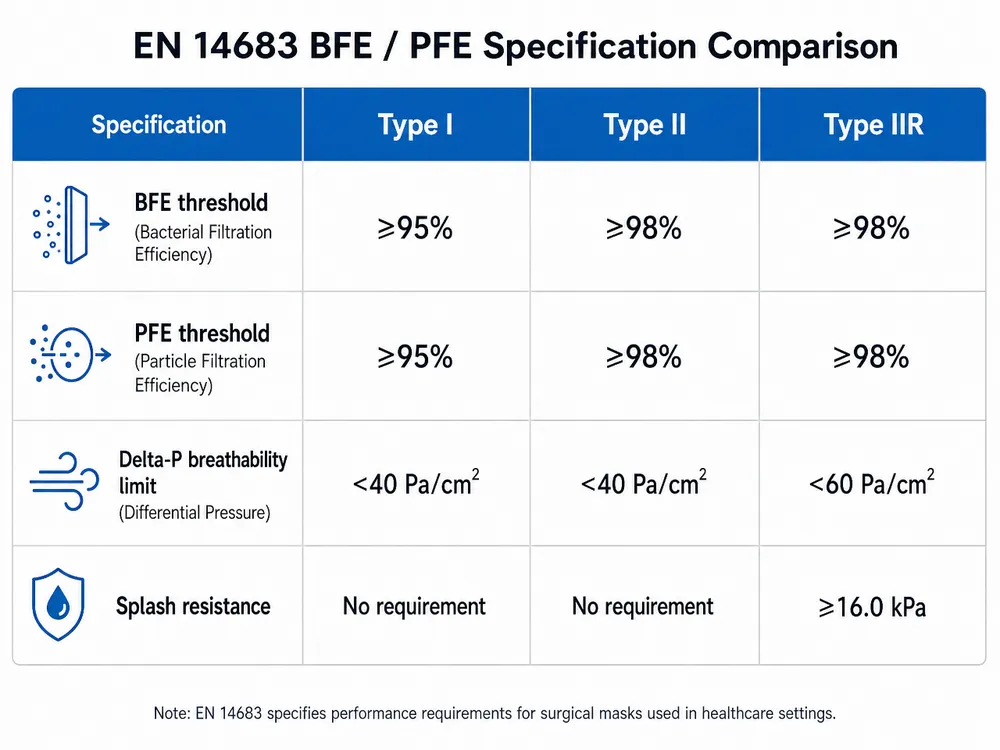
The third factor is specification opacity. EN 14683 defines three mask types — Type I, Type II, and Type IIR — with BFE thresholds of ≥95%, ≥98%, and ≥98% respectively, plus splash resistance for IIR. But the standard doesn't specify what goes into the filtration layer to achieve those numbers. A mask that barely clears 98% BFE on a fresh test report and one that consistently tests at 99.2% across production batches are both "Type II" on the label. The difference is in the meltblown fabric — its fiber diameter, basis weight, and electrostatic charge — and you can't see that from the certificate.
How to Evaluate a Disposable Medical Mask Supplier for the German Market
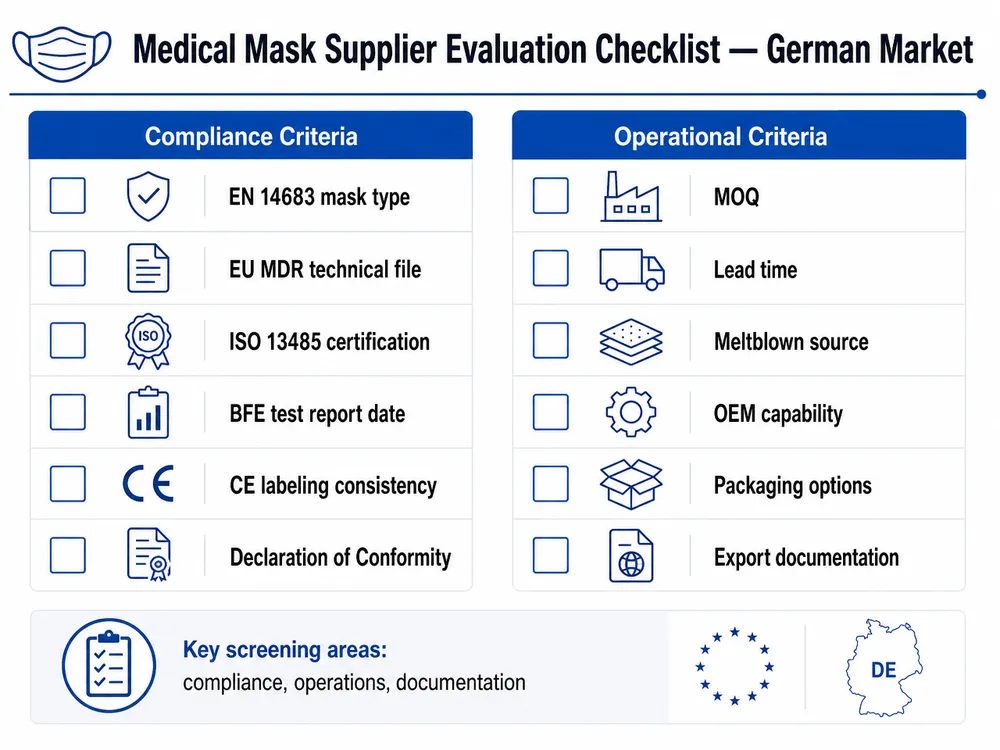
Before you look at any supplier list, the evaluation criteria matter more than the names. Here's the framework we use when buyers ask us to help them assess a sourcing option.
Certification stack — the non-negotiables:
- EN 14683:2019+AC:2019 — The European standard for medical face masks. Confirm the specific type (I, II, or IIR) and the notified body that issued the certificate. A self-declared CE mark without a notified body is not sufficient for surgical mask classification.
- EU MDR compliance — Ask for the current technical file reference and the Declaration of Conformity dated after May 2021. If the supplier can't produce this, the product is operating on transitional status.
- ISO 13485:2016 — Medical device quality management system. This is the process standard behind the product standard. A supplier with ISO 13485 has documented QC procedures, traceability, and corrective action processes. Without it, the CE mark is harder to trust.
- BFE/PFE test reports — Ask for the actual test report, not just the certificate. The report should show the test method (EN 14683 Annex B for BFE), the test date, the lot number tested, and the result. Reports older than 12 months on a product you're ordering today are a yellow flag.
Operational criteria:
| Criterion | What to Ask | Why It Matters |
|---|---|---|
| MOQ | Minimum order quantity per SKU | Determines whether you can test the market before committing |
| Lead time | Days from order confirmation to shipment | Affects your inventory planning and tender response windows |
| Documentation package | CoC, test reports, MDR technical file support | Required for EU import and hospital procurement audits |
| Meltblown source | In-house or third-party fabric | Controls BFE/PFE consistency across batches |
| OEM/ODM capability | Private label, custom packaging | Relevant if you're building a branded product line |
| Reorder reliability | Same spec, same supplier, same documentation | The hidden cost of switching suppliers mid-program |
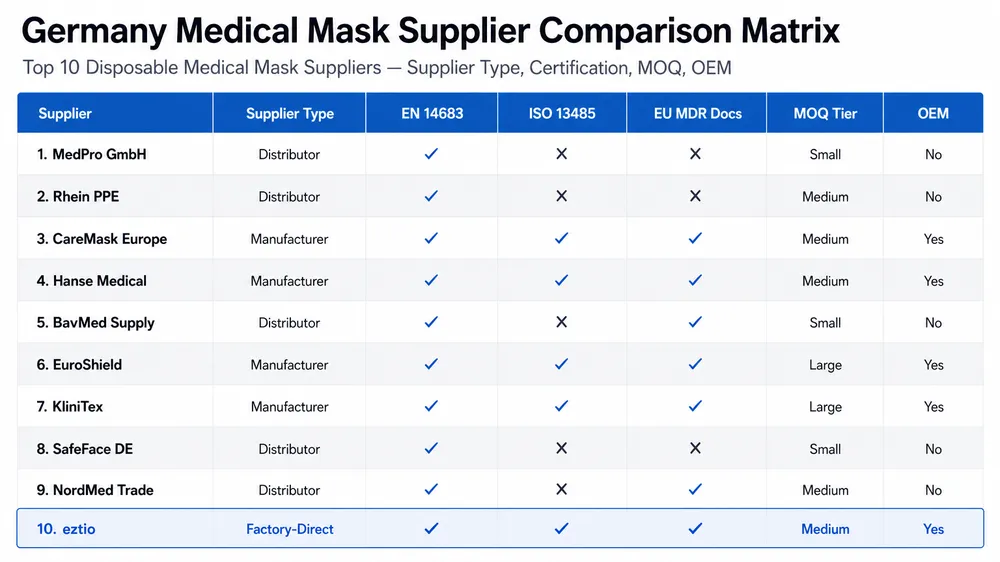
Top 10 Disposable Medical Mask Suppliers Serving Germany
The suppliers below represent the realistic sourcing landscape for German B2B buyers — from domestic healthcare distributors to EU-based manufacturers to factory-direct options. The list is organized by supplier type, not by a theatrical ranking score. Understanding what model each supplier operates tells you more than a number next to their name.
1. Paul Hartmann AG
Website: hartmann.info Supplier type: German healthcare manufacturer and distributor Headquarters: Heidenheim an der Brenz, Germany
Paul Hartmann is one of Germany's largest medical supply companies, with a product range spanning wound care, incontinence, and infection prevention — including surgical and procedure masks. Their masks are sold under the Hartmann brand through hospital procurement channels and medical wholesale networks across the DACH region. For buyers who need a domestic supplier with deep institutional relationships and local warehousing, Hartmann is the reference name in the German market.
Strengths: Established hospital procurement relationships, domestic warehousing, full EU MDR documentation, German-language compliance support. Considerations: Premium pricing reflects the brand and distribution infrastructure. MOQ and pricing are typically negotiated through their distribution network rather than direct factory pricing.
2. Mölnlycke Health Care (Germany)
Website: molnlycke.com Supplier type: Swedish medical device manufacturer, German market operations German office: Erkrath, Germany
Mölnlycke is a Swedish-headquartered medical device company with significant German market presence. Their surgical mask range — sold under the Barrier brand — covers Type II and Type IIR configurations and is widely specified in German hospital operating theatre procurement. Their products carry full EU MDR compliance and are distributed through major German medical wholesalers including Medline and regional distributors.
Strengths: Strong surgical mask credentials, OR-grade product range, full EU MDR technical files, established in German hospital procurement. Considerations: Primarily positioned for clinical/surgical use rather than general medical or institutional PPE. Pricing and MOQ are set for hospital procurement volumes.
3. Meditrade GmbH
Website: meditrade.de Supplier type: German medical device importer and distributor Headquarters: Kiefersfelden, Germany
Meditrade is a German-based medical device company that imports and distributes a broad range of disposable medical products, including EN 14683 Type II and Type IIR surgical masks. They supply pharmacies, medical practices, hospitals, and B2B wholesale buyers across Germany and the EU. Their product range includes both branded and private-label configurations.
Strengths: Broad product range, established German distribution network, pharmacy and medical practice supply experience, EU MDR-compliant product documentation. Considerations: As an importer-distributor, Meditrade sources from manufacturing partners rather than producing in-house. BFE/PFE consistency depends on their upstream supplier's production controls.
4. Ampri Medical GmbH
Website: ampri.de Supplier type: German medical disposables distributor Headquarters: Düsseldorf, Germany
Ampri Medical is a German distributor specializing in disposable medical products for dental, medical, and laboratory applications. Their mask range covers EN 14683 Type I, II, and IIR configurations, and they supply dental practices, medical offices, and B2B buyers through their German distribution network. Ampri is a practical option for buyers who need smaller-volume replenishment with short domestic lead times.
Strengths: Dental and medical practice supply expertise, domestic stock availability, short replenishment lead times, German-language customer service. Considerations: Distributor model — pricing includes distribution margin. Not positioned for large-volume tender procurement or private-label programs.
5. Foliodress (Lohmann & Rauscher)
Website: lohmann-rauscher.com Supplier type: German/Austrian medical device manufacturer and distributor Headquarters: Rengsdorf, Germany / Vienna, Austria
Lohmann & Rauscher is a major European medical device company with a dedicated surgical draping and mask line under the Foliodress brand. Their surgical masks are specified in German hospital operating theatre procurement and carry full EU MDR compliance. L&R has manufacturing operations in Europe and distributes through a direct sales force and medical wholesale network across the DACH region.
Strengths: European manufacturing base, strong OR and surgical mask credentials, full EU MDR documentation, established German hospital relationships. Considerations: Product range is oriented toward surgical and clinical applications. General-purpose medical mask procurement at commodity pricing is not their primary market.
6. Abena Deutschland GmbH
Website: abena.de Supplier type: Danish healthcare company, German subsidiary German office: Heide, Germany
Abena is a Danish healthcare company with a German subsidiary supplying hospitals, care homes, and institutional buyers across Germany. Their product range includes disposable medical masks alongside incontinence, wound care, and hygiene products. Abena supplies through direct sales and distribution partnerships, with a focus on care sector and institutional procurement.
Strengths: Care sector procurement experience, institutional supply relationships, domestic German operations, broad healthcare product range. Considerations: Masks are one product line within a broad healthcare portfolio — not a specialist mask supplier. Volume pricing and documentation depth may vary by product.
7. Unigloves Deutschland GmbH
Website: unigloves.de Supplier type: German PPE distributor (gloves and masks) Headquarters: Wiesbaden, Germany
Unigloves is primarily known as a glove supplier but carries a range of EN 14683-compliant disposable medical masks for the German B2B market. They supply dental practices, medical offices, and laboratory buyers through their German distribution network. Their mask range is positioned as a complement to their core glove product line.
Strengths: Established German B2B distribution, dental and laboratory supply experience, domestic stock availability. Considerations: Masks are a secondary product category. Buyers with significant mask volume requirements may find limited SKU depth and less competitive pricing compared to specialist mask suppliers.
8. Zarys International Group (EU Operations)
Website: zarys.eu Supplier type: Polish medical device manufacturer and EU distributor EU operations: Zabrze, Poland (EU-based manufacturing)
Zarys is a Polish medical device company with EU-based manufacturing and distribution across Central and Western Europe, including Germany. Their disposable mask range covers EN 14683 Type II and IIR configurations, and they supply hospital procurement, pharmacy chains, and B2B distributors across the EU. As an EU-based manufacturer, their products carry CE marking with EU MDR-compliant documentation.
Strengths: EU-based manufacturing, competitive pricing relative to Western European brands, EN 14683 compliance, distribution reach into Germany and DACH. Considerations: Less established in the German market compared to domestic brands. Buyers should verify current MDR technical file status and request recent BFE test reports.
9. Hygeco International (EU Distribution)
Website: hygeco.com Supplier type: French medical and mortuary supply company, EU distribution Headquarters: Montoire-sur-le-Loir, France
Hygeco is a French company specializing in medical and mortuary supply, with a product range that includes EN 14683-compliant disposable masks distributed across EU markets including Germany. They supply through medical wholesale channels and direct B2B accounts. Their mask range is positioned for medical practice and institutional use.
Strengths: EU-based operations, EN 14683-compliant product range, established EU distribution network. Considerations: Niche positioning in mortuary and medical supply — not a primary mask specialist. German market presence is through distribution partners rather than direct operations.
10. eztio — Factory-Direct CE/ISO 13485 Manufacturer
Website: eztio.com Supplier type: Chinese medical mask manufacturer, factory-direct export Headquarters: Gaomi, Shandong, China
eztio is a dedicated disposable medical mask manufacturer, not a distributor. We've been producing certified medical masks since 2012 — one product category, built around export compliance from the ground up. Our certification stack covers CE under EU MDR, ISO 13485:2016, FDA 510(k) registration, ISO 9001:2015, and SGS third-party verification. For German buyers, the CE (EU MDR) and ISO 13485 combination means the compliance work is already done — you're not asking a distributor to chase documentation from their upstream supplier.
The structural difference between eztio and the distributors above is vertical integration. We produce our own meltblown nonwoven fabric — the filtration layer that determines BFE and PFE performance. Most distributors in this list source from Chinese factories that buy meltblown from third-party suppliers. When that supply chain has a quality variation, the BFE number moves. We control that variable in-house, which is why our BFE test results are consistent across batches rather than varying by production run.
Certifications: CE (EU MDR), ISO 13485:2016, FDA 510(k), ISO 9001:2015, SGS MOQ: 50,000 pieces for standard SKUs Lead time: 15–25 days from order confirmation OEM/ODM: Available — private-label packaging, custom configurations
Factory-Direct vs. Local Distributor: What the Cost Structure Actually Looks Like
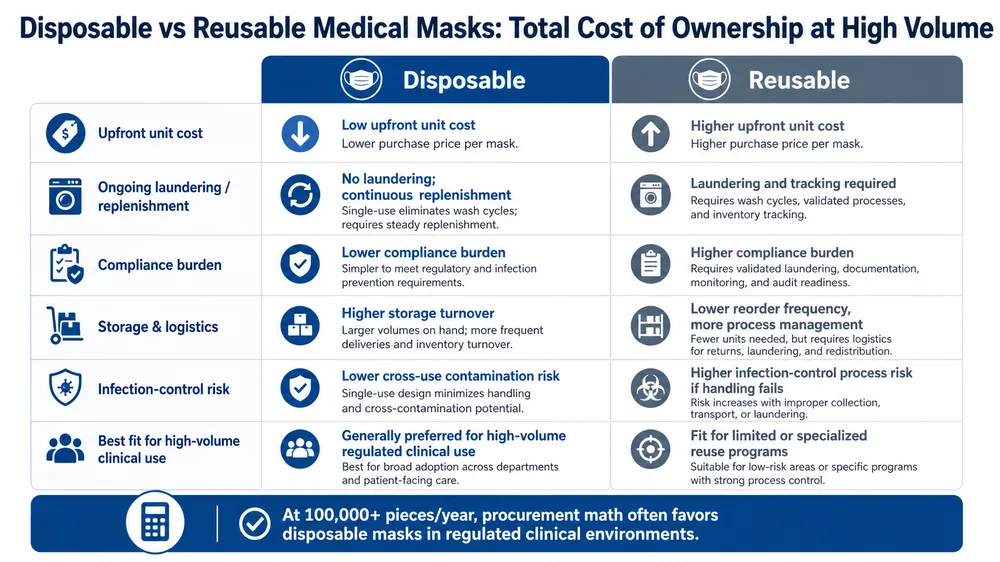
The price difference between a German distributor and a factory-direct manufacturer isn't just a margin question — it's a structural question about how many hands touch the product between the factory floor and your warehouse.
A typical German distribution chain for disposable medical masks runs: Chinese factory → Chinese trading company or export agent → European importer → German national distributor → regional wholesaler → end buyer. Each step adds 15–30% margin. By the time a mask that left a Chinese factory at €0.04–0.06 per piece reaches a German regional wholesaler, the price is often €0.12–0.18 per piece or higher, depending on the tier.
Factory-direct sourcing from a CE-certified manufacturer removes three to four of those steps. The landed cost calculation for a German importer buying directly from eztio looks like this:
| Cost Component | Typical Range |
|---|---|
| Ex-works unit price (EN 14683 Type II, 3-ply) | €0.045–0.065/piece |
| Ocean freight (40HQ, ~2M pieces) | €0.008–0.012/piece |
| Import duty (EU tariff, HS 6307.90) | ~12% on CIF value |
| Customs clearance and handling | €0.003–0.005/piece |
| Estimated landed cost | €0.065–0.095/piece |
Compare that to buying from a German distributor at €0.14–0.20/piece for the same EN 14683 Type II specification. On a 500,000-piece order, the difference is €22,500–€52,500 in gross margin — before you've sold a single unit.
(The import duty calculation is the part most first-time importers underestimate. HS 6307.90 carries a 12% EU MFN duty rate on CIF value. We include this in every landed cost estimate we send to European buyers so there are no surprises at customs.)
The trade-off is real: factory-direct sourcing requires you to manage the import process, hold more inventory, and plan further ahead. For urgent small orders — a few thousand pieces needed in 48 hours — a local distributor with domestic stock is the right answer. The economics of factory-direct only work when you're buying at volume and planning 4–8 weeks ahead.
EU MDR Documentation: The Compliance Gap That Catches German Importers
Since May 2021, the EU MDR has been the operative regulatory framework for medical devices sold in Germany and across the EU. For disposable surgical masks classified as Class I medical devices, the MDR requirements include:
- A current Declaration of Conformity referencing Regulation (EU) 2017/745
- A technical file covering device description, intended purpose, risk management (ISO 14971), clinical evaluation, and post-market surveillance plan
- For Class IIR (splash-resistant) masks: notified body involvement is required
The compliance gap we see most often: a supplier holds a CE certificate issued under the old MDD framework (93/42/EEC) and hasn't updated the technical file to MDR standards. The CE mark is technically still on the product, but the underlying documentation doesn't satisfy an MDR audit. German hospital procurement teams and institutional buyers are increasingly asking for MDR-specific documentation — not just the CE certificate.
When you source from eztio, the MDR technical file is current and available. We've been through the MDR transition with multiple European customers and have the documentation structure in place: Declaration of Conformity under 2017/745, ISO 13485-backed QMS documentation, EN 14683 test reports with current dates, and risk management files. If your importer of record or compliance team needs specific documents before the order ships, we prepare them as part of the standard export package — not as a special request.
(One thing worth knowing: if you're importing into Germany as an importer of record for the first time, you'll need to register as an EU importer under MDR Article 13. This is a one-time administrative step, not a product certification. We can walk you through what's required before you place the order.)
When Local Supply Is the Right Answer
Factory-direct sourcing isn't always the better choice. Here's where local German distributors have a genuine advantage:
Urgent small orders. If you need 5,000 masks delivered in 48 hours for an emergency procurement, a German distributor with domestic stock is the only realistic option. Factory-direct lead times of 15–25 days don't serve emergency replenishment.
Regulatory timing. If you're entering the German market for the first time and need to move quickly — a tender deadline, a contract start date — buying from an established local supplier while you set up your import process is a reasonable bridge strategy.
Low-volume ongoing supply. If your annual volume is under 100,000 pieces, the logistics overhead of managing a direct import relationship (freight booking, customs clearance, import documentation) may not be worth the unit cost savings. Local distributors absorb that overhead in exchange for their margin.
Relationship-dependent procurement. Some hospital and institutional procurement processes are built around approved supplier lists that take months to update. If your customer requires a specific local supplier, that constraint overrides the cost calculation.
The honest answer is that local supply and factory-direct import serve different procurement scenarios. The question is which scenario describes your actual buying pattern.
BFE and PFE: What the Numbers Mean for Your Sourcing Decision
EN 14683 sets the minimum BFE threshold at ≥95% for Type I and ≥98% for Type II and IIR. What the standard doesn't tell you is how much headroom a given supplier's product has above that threshold — or how consistent that performance is across production batches.
BFE and PFE numbers only mean something if you know what went into the meltblown layer. A mask that tests at 98.1% BFE on a single lot submitted for certification and a mask that consistently tests at 99.0–99.4% BFE across every production batch are both "Type II" on the label. The difference is in the meltblown fabric — specifically the fiber diameter, basis weight, and electrostatic charge level — and whether the manufacturer controls those parameters in-house or depends on a third-party fabric supplier to deliver consistent material.
We produce our own meltblown fabric. The fiber diameter target for our Type II masks runs at 1.0–2.0 microns, with a basis weight of 25 g/m² and electrostatic treatment applied inline during production. We test every production batch in-house before it goes to outgoing inspection — BFE, PFE, and Delta-P (breathability) — and we pull the batch if it doesn't clear our internal threshold, which is set above the EN 14683 minimum. The test reports that travel with your shipment reflect actual production lot results, not a single certification sample.
When you're evaluating any supplier on this list, ask for test reports from the last three production lots, not just the certification report. The variation between lots tells you more about production consistency than any single data point.
How to Start Sourcing from a Factory-Direct Manufacturer
If the cost and compliance comparison above fits your procurement situation, the process for starting a factory-direct relationship with eztio is straightforward.
Step 1: Define your specification. Confirm the EN 14683 type you need (Type II or Type IIR for most German medical applications), your annual volume estimate, and whether you need standard packaging or private-label. This determines MOQ applicability and whether OEM setup is required.
Step 2: Request samples and documentation. Before committing to a production order, request a sample set and the full documentation package — EN 14683 test report (current lot), Declaration of Conformity under EU MDR 2017/745, ISO 13485 certificate, and SGS audit report. Review the test report dates and lot numbers. If the documentation is current and the samples pass your internal review, you have the compliance foundation for your import process.
Step 3: Confirm landed cost. Send us your destination port (Hamburg, Bremen, or Rotterdam for most German buyers) and your target volume. We'll provide an ex-works price, estimated freight, and a landed cost calculation including EU import duty. This gives you the real number to compare against your current supplier pricing.
Step 4: Place a trial order. Most new buyers start with a 50,000–100,000 piece trial order — enough to validate production consistency, test the import process, and assess the product with your downstream customers before committing to larger volumes. We treat trial orders with the same production priority as repeat orders.
Step 5: Scale on confirmed performance. Once the trial order clears customs and passes your incoming inspection, the repeat order process is straightforward: same spec, same documentation package, same lead time. We don't change suppliers for the meltblown fabric between your orders — the spec you approved in the sample is the spec you receive in production.
For Disposable Medical Masks specifications, product range, and configuration options, the product category page has the full detail. For 3-ply disposable medical masks and 4-ply disposable medical masks, the individual product pages include spec sheets and configuration options.
When you're ready to compare pricing against your current supplier, Request a Quote with your required grade, annual volume, and any private-label requirements — we'll respond with pricing, lead time, and a sample offer within 24 hours.
Frequently Asked Questions
What EN 14683 mask type do most German hospital procurement contracts require?
Most German hospital procurement specifications call for Type IIR — the splash-resistant grade with ≥98% BFE and resistance to synthetic blood penetration at 120 mmHg. Type II (≥98% BFE, no splash resistance requirement) is widely used in medical practices, pharmacies, and non-surgical clinical settings. Type I (≥95% BFE) is generally limited to patient use and non-clinical applications. If you're bidding on hospital or surgical procurement, confirm the type specification in the tender documents — Type II and Type IIR are not interchangeable in most clinical procurement frameworks.
What documentation does a German importer of record need under EU MDR for surgical masks?
At minimum: a current Declaration of Conformity referencing Regulation (EU) 2017/745, a technical file covering device description, intended purpose, risk management documentation (ISO 14971), and clinical evaluation. For Class IIR products, notified body involvement is required. You'll also need EN 14683 test reports from a recognized test laboratory, an ISO 13485 certificate from your supplier, and a Certificate of Conformity per shipment. The importer of record must also register in EUDAMED (the EU medical device database) — this is a one-time registration, not a per-shipment requirement.
How do I verify that a supplier's BFE test report reflects actual production consistency, not just a certification sample?
Ask for test reports from the last three production lots, not just the certification report. Each report should show the lot number, production date, test date, test method (EN 14683 Annex B), and the actual result — not just "pass." If the results cluster tightly above the threshold (e.g., 99.0–99.4% for a Type II mask), the production process is consistent. If results vary widely or sit just above the minimum, the meltblown fabric supply is likely inconsistent. Also ask whether the supplier produces meltblown in-house or sources it externally — external sourcing introduces a variable the supplier doesn't control.
What is the minimum order quantity for factory-direct sourcing from China for the German market?
MOQ varies by manufacturer. At eztio, standard SKUs start at 50,000 pieces — a volume that fits a market-entry order or a trial procurement without requiring you to commit to a full container. Custom configurations (private-label packaging, modified specifications) typically require higher minimums to justify line setup and material procurement. For context, a 40HQ container holds approximately 1.5–2 million pieces of standard 3-ply masks depending on carton configuration — so a 50,000-piece order ships as a partial container or LCL shipment.
Is factory-direct sourcing from China compliant with EU MDR requirements for German importers?
Yes, provided the manufacturer holds current CE certification under EU MDR (Regulation 2017/745) and can supply the required technical documentation. The MDR does not restrict the geographic origin of medical devices — it regulates the documentation, quality system, and post-market surveillance requirements. A Chinese manufacturer with current CE (EU MDR) certification, ISO 13485, and a complete technical file is fully compliant for import into Germany. The importer of record in the EU carries the regulatory responsibility for ensuring the documentation is current and complete before placing the product on the market.