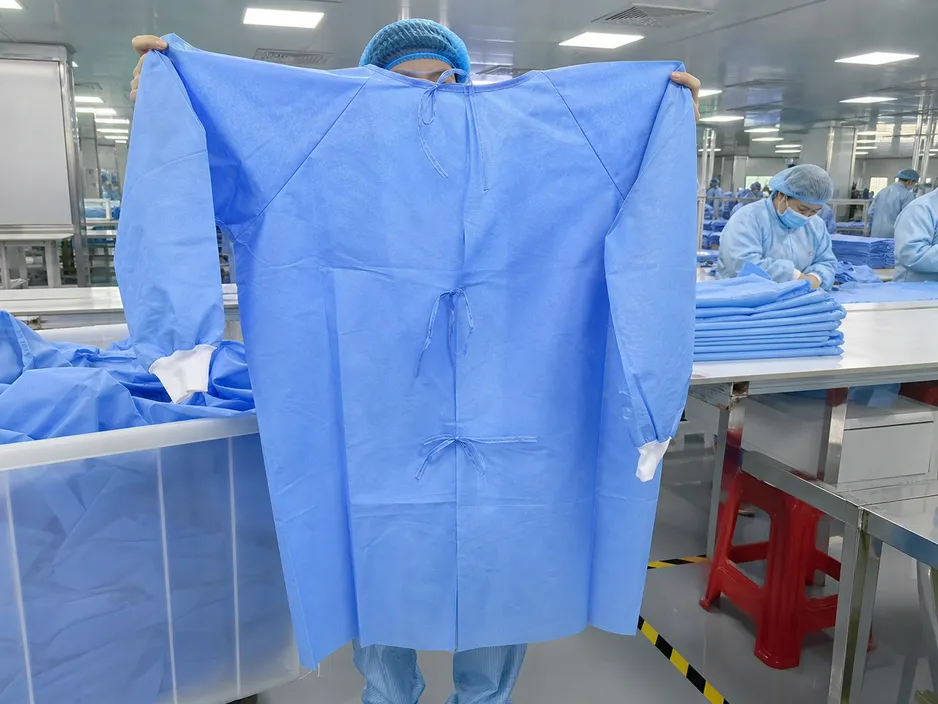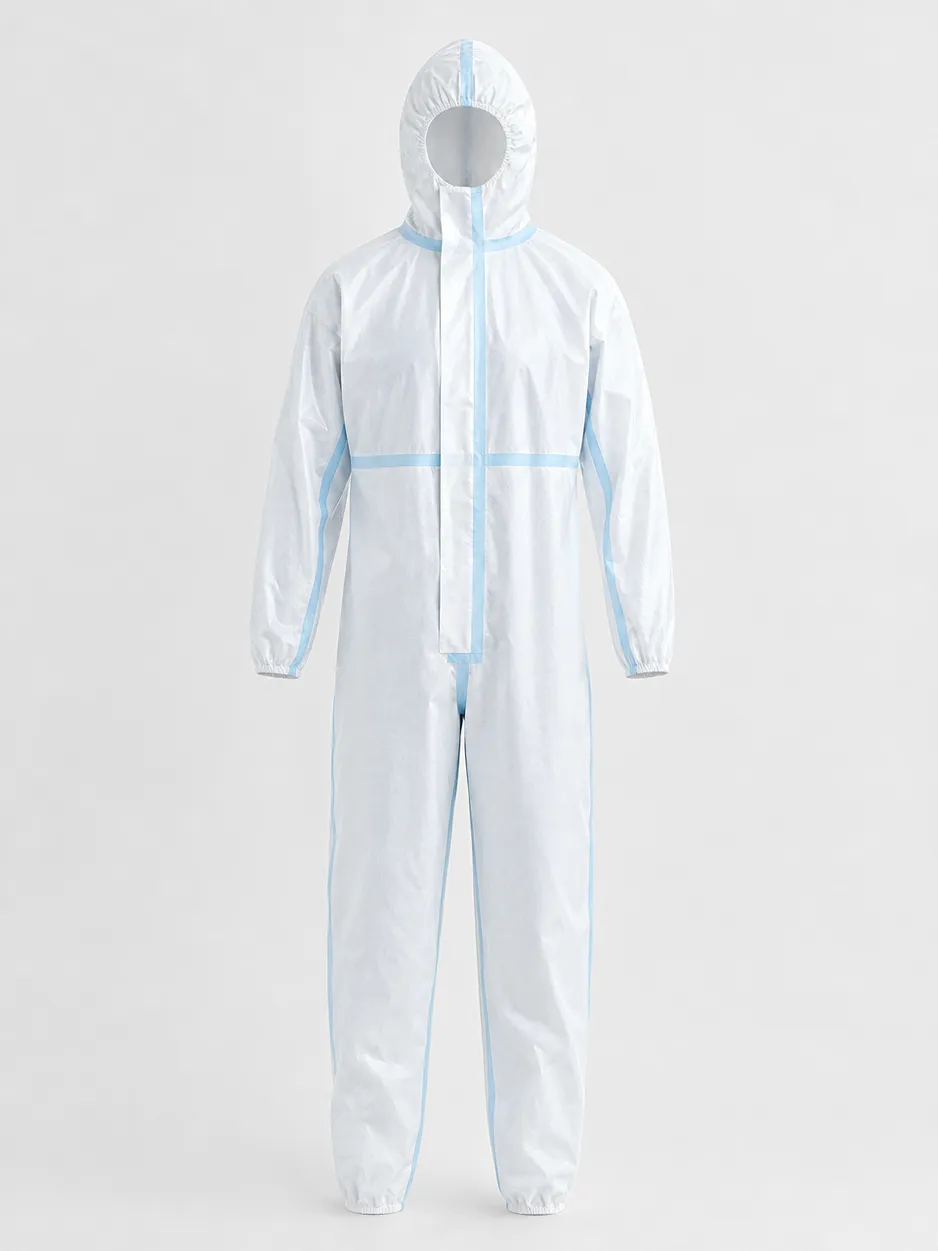
Most sourcing problems with disposable protective clothing don't start at the factory. They start at the spec sheet — or the absence of one. A buyer requests "EN 14126 compliant coveralls" without specifying protection type, fabric construction, or seam method, and the factory quotes whatever they run most often. The product arrives, clears customs, and then fails a hospital procurement audit because the seam construction doesn't meet the barrier requirement for the intended use.
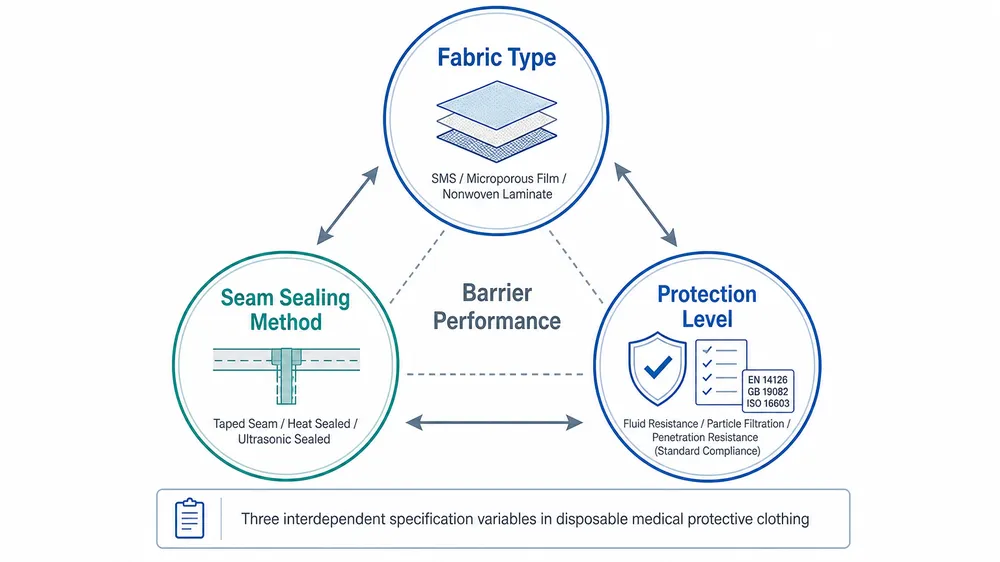
This guide maps the three variables that actually determine whether a disposable protective garment does its job: fabric type, seam sealing method, and protection level. We'll connect each to the standards that govern them and show you how the choices interact — because specifying one without the others leaves gaps that show up at the worst possible moment.

The Five Parameters That Define a Disposable Protective Clothing Specification
Before comparing fabric types or seam methods, it helps to know what a complete spec actually contains. When we review RFQs from new buyers, the most common problem isn't wrong specs — it's incomplete ones. Here are the five parameters that need to be defined before a factory can quote accurately:
1. Fabric type and basis weight. The nonwoven construction (SMS, SMMS, PE-laminated, microporous film) and the grams per square meter (gsm). These two together determine barrier performance, breathability, and cost. A 50 gsm SMS and a 60 gsm SMS are not the same product.
2. Seam construction method. Stitched, ultrasonically welded, or taped — and whether the seam is sealed or unsealed. This is the variable most buyers underspecify, and it's the one that determines whether the garment actually provides the barrier the fabric is rated for.
3. Protection level and applicable standard. EN 14126 Type 3 through Type 6 for European markets; AAMI PB70 Level 1 through Level 4 for US markets. These are not interchangeable, and the level determines which test methods apply.
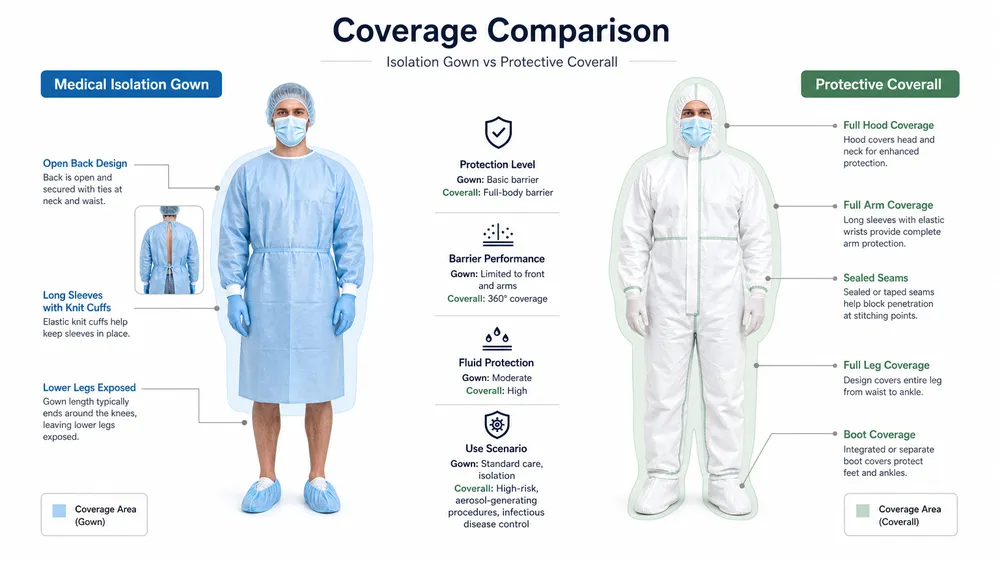
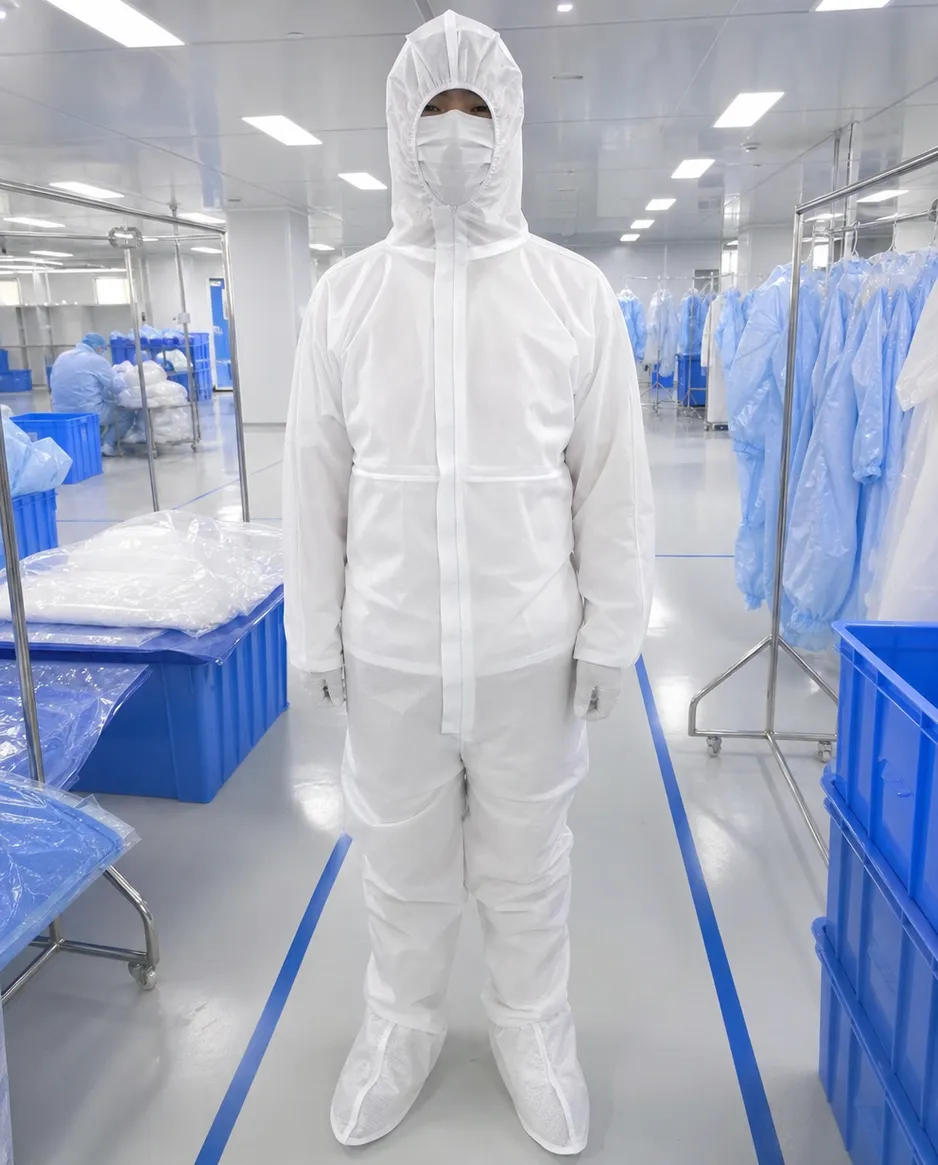
4. Garment configuration. Coverall vs. gown, hood attachment, boot covers, elastic vs. knit cuffs, zipper type and cover flap. These affect both protection performance and the certification scope.
5. Target market and certification requirements. CE marking under EU MDR, FDA 510(k) registration, or other market-specific clearances. The standard you're testing to must match the market you're selling into.
A spec sheet that covers all five is a workable RFQ. One that covers two or three is a starting point for a conversation, not a production order.
Fabric Types: What the Nonwoven Construction Actually Determines
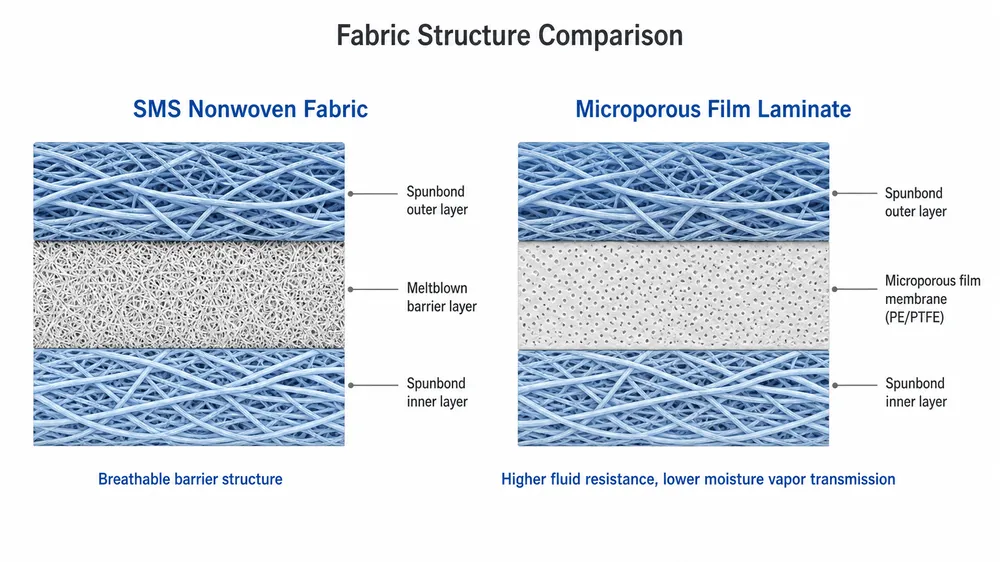
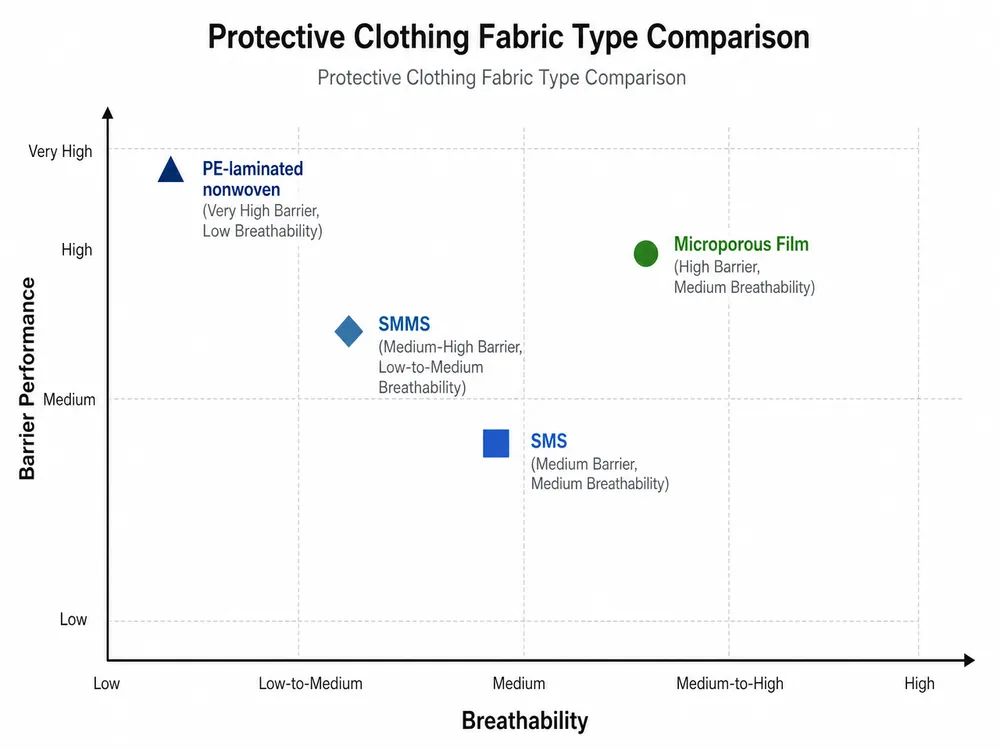
The fabric is where barrier performance starts. For disposable medical protective clothing, four nonwoven constructions cover most of the market:
| Fabric Type | Construction | Typical Basis Weight | Barrier Level | Breathability | Common Application |
|---|---|---|---|---|---|
| SMS | Spunbond-Meltblown-Spunbond | 35–60 gsm | Moderate | Good | Isolation gowns, low-risk coveralls |
| SMMS | Spunbond-Meltblown-Meltblown-Spunbond | 45–70 gsm | Moderate-High | Moderate | Surgical gowns, EN 14126 Type 5/6 coveralls |
| PE-laminated nonwoven | Nonwoven + polyethylene film | 50–80 gsm | High | Low | Fluid-resistant gowns, chemical splash protection |
| Microporous film | Nonwoven + microporous membrane | 60–90 gsm | Very High | Moderate | EN 14126 Type 3/4, high-risk infectious disease |
SMS and SMMS are the workhorses of the disposable protective clothing market. The meltblown layer is the barrier — it's the same filtration mechanism used in surgical masks, and the fiber diameter and basis weight of that layer determine how much liquid and particulate it stops. We produce our own meltblown nonwoven fabric, which means we control the fiber diameter and electrostatic charge rather than accepting whatever a fabric supplier ships. For protective clothing, that translates directly to consistent barrier test results across production batches.
The difference between SMS and SMMS matters when you're targeting higher protection levels. SMMS adds a second meltblown layer, which increases barrier performance without a proportional increase in basis weight. For EN 14126 Type 5 or Type 6 coveralls where you need to pass ISO 22610 (resistance to wet bacterial penetration) or ISO 16603 (resistance to blood-borne pathogens), SMMS typically performs more reliably than SMS at equivalent basis weights.
PE-laminated nonwoven trades breathability for barrier. The polyethylene film layer is essentially impermeable to liquids, which makes it the right choice for applications involving significant fluid exposure — surgical procedures, certain industrial cleaning environments, or any scenario where the garment will be saturated rather than splashed. The trade-off is that workers wearing PE-laminated garments in warm environments will notice the heat buildup. For short-duration, high-exposure tasks, that's acceptable. For extended wear, it's a real operational problem that affects compliance.
Microporous film sits between PE-laminated and SMMS in the breathability-barrier trade-off. The microporous membrane allows water vapor to pass while blocking liquid water and particles above a certain size. This is the construction used in the highest-protection disposable coveralls — EN 14126 Type 3 (liquid-tight) and Type 4 (spray-tight) garments almost always use microporous film or equivalent constructions. The cost is higher, and the lead time is longer because the material is more specialized.
(One thing worth knowing: basis weight alone doesn't tell you barrier performance. A 60 gsm SMS from a well-controlled meltblown process can outperform a 70 gsm SMS from a supplier with inconsistent fiber diameter. When you're evaluating fabric specs, ask for the hydrostatic head test result alongside the gsm figure.)
Seam Sealing: The Variable That Determines Whether the Fabric Spec Matters
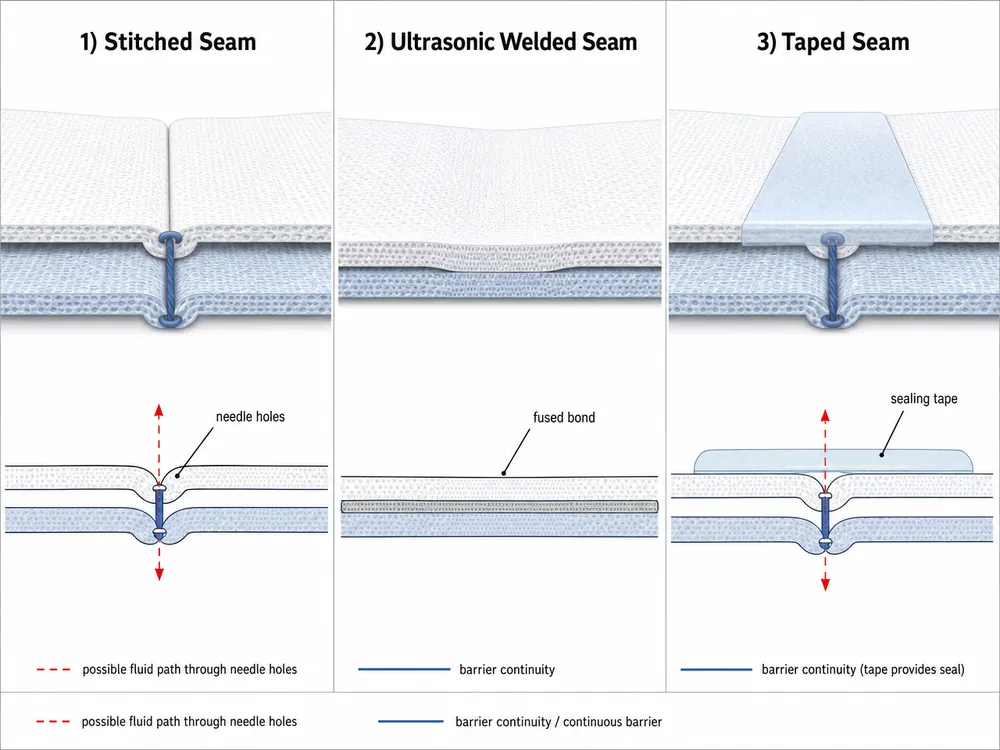
Here's the thing about seam sealing that most spec guides skip: a garment made from high-barrier microporous film with stitched-only seams does not provide the barrier performance the fabric is rated for. The seam is the weak point. Stitching creates needle holes. Those holes are pathways for liquid, particles, and microorganisms — exactly what the garment is supposed to stop.
This is the sourcing trap I see most often. A buyer specifies the fabric correctly, gets a competitive price, and doesn't notice that the seam construction is stitched rather than sealed. The garment passes a visual inspection. It may even pass some basic tests. But it won't pass the penetration resistance tests required for higher EN 14126 protection types, and it won't perform as expected in clinical use.
The three seam construction methods, and when each is appropriate:
| Seam Method | Construction | Barrier at Seam | Standard Requirement | Cost Impact |
|---|---|---|---|---|
| Stitched (unsealed) | Thread sewn, no sealing | Low — needle holes present | Acceptable for AAMI PB70 Level 1–2, EN 14126 Type 6 | Lowest |
| Ultrasonically welded | Heat-fused, no thread | Moderate-High — no needle holes | Required for EN 14126 Type 4–5, AAMI PB70 Level 3 | Moderate |
| Taped seam | Stitched + seam tape bonded over | High — tape covers needle holes | Required for EN 14126 Type 3, AAMI PB70 Level 4 | Highest |
Stitched seams are appropriate for low-risk applications: basic isolation gowns, visitor coveralls, environments where the primary concern is particulate rather than liquid penetration. AAMI PB70 Level 1 and Level 2 gowns can use stitched seams because the test methods at those levels don't require seam-level liquid barrier performance. EN 14126 Type 6 (limited splash protection) also permits stitched seams in most configurations.
Ultrasonically welded seams eliminate the needle hole problem by fusing the fabric layers together with heat and pressure rather than threading through them. The bond is continuous, which means the seam barrier performance approaches the fabric barrier performance. We use ultrasonic welding across our production lines — it's the same technology we use for mask ear-loop attachment, and the process parameters are controlled by machine settings rather than operator technique. For EN 14126 Type 4 and Type 5 coveralls, ultrasonic seams are the standard construction.
Taped seams add a seam tape layer bonded over a stitched or welded seam, creating a continuous barrier across the entire seam length. This is the construction required for the highest protection levels — EN 14126 Type 3 (liquid-tight) garments, AAMI PB70 Level 4 surgical gowns. The tape adds cost and production time, and it requires a separate bonding step. For buyers sourcing Type 3 coveralls for infectious disease response or high-risk surgical environments, taped seams are not optional — they're what the standard requires.
One practical note: when you receive a sample garment, turn it inside out and look at the seams before you test anything else. Stitched seams are immediately visible. Ultrasonic welds look like a continuous fused line with no thread. Taped seams have a visible tape strip. If the seam construction doesn't match what the spec sheet says, that's a compliance problem you've caught before production.
Protection Levels Decoded: EN 14126 and AAMI PB70
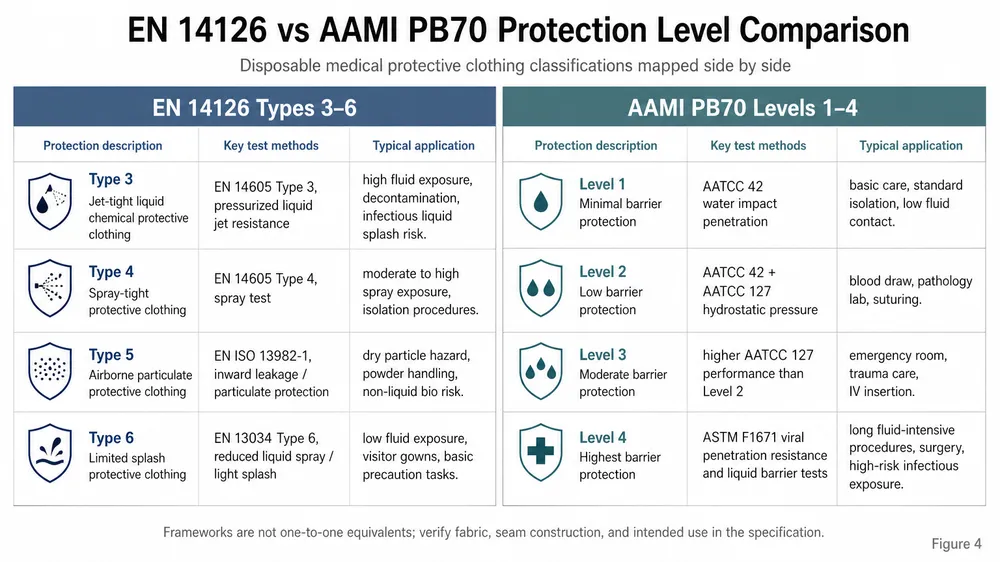
The two standards that govern most of the global market for disposable medical protective clothing are EN 14126 (European) and AAMI PB70 (US). They use different classification systems, test different performance parameters, and are not directly equivalent — though they overlap in intent.
EN 14126: Protection Against Infective Agents
EN 14126 is the European standard for protective clothing against infective agents. It defines performance requirements for resistance to penetration by blood and body fluids, and it references several test methods that determine which protection type a garment qualifies for.
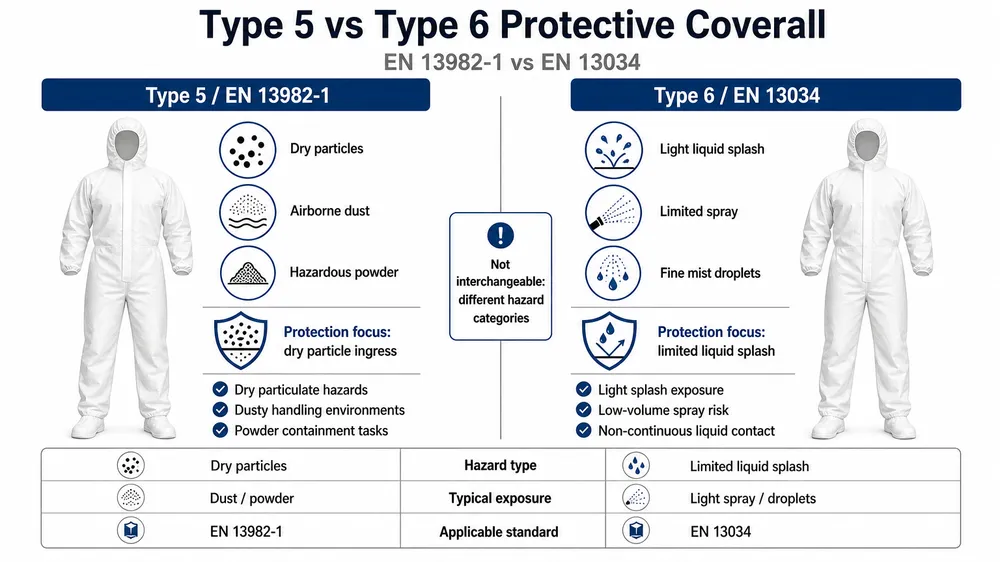
The protection types under EN 14126 run from Type 3 (liquid-tight) through Type 6 (limited splash), with Types 4, 5, and 6 being the most common in disposable medical protective clothing:
| EN 14126 Type | Protection Against | Key Test Methods | Typical Fabric | Seam Requirement |
|---|---|---|---|---|
| Type 3 | Liquid-tight (pressurized jets) | EN 14605 jet test, ISO 16603, ISO 16604 | Microporous film | Taped seams |
| Type 4 | Spray-tight (non-pressurized spray) | EN 14605 spray test, ISO 16603 | Microporous film or SMMS | Ultrasonic or taped |
| Type 5 | Airborne solid particles | ISO 13982-1 inward leakage | SMMS or SMS | Ultrasonic |
| Type 6 | Limited liquid splash | EN 13034 spray test | SMS | Stitched or ultrasonic |
The "B" suffix in EN 14126 designations (e.g., Type 4-B) indicates that the garment has also been tested against biological agents specifically — the standard's core purpose. A garment marked Type 4 without the B suffix has passed the physical barrier tests but has not been tested against infective agents under the biological test methods (ISO 16603, ISO 16604, ISO 22610).
For medical applications — hospital isolation, infectious disease response, surgical environments — you want the B designation. For industrial applications where the concern is chemical splash rather than biological agents, the non-B types may be sufficient. This distinction matters at customs and in procurement audits, and it's worth confirming with your supplier before production.
AAMI PB70: The US Framework
AAMI PB70 governs liquid barrier performance for protective apparel used in healthcare facilities in the US. It uses a four-level classification based on the ASTM F1670 (synthetic blood penetration) and ASTM F1671 (viral penetration) test methods:
| AAMI PB70 Level | Barrier Performance | Test Method | Typical Application |
|---|---|---|---|
| Level 1 | Minimal barrier | AATCC 42 water impact | Basic visitor gowns, low-risk procedures |
| Level 2 | Low barrier | AATCC 42 + AATCC 127 hydrostatic | General medical/surgical use |
| Level 3 | Moderate barrier | AATCC 42 + AATCC 127 + ASTM F1670 | Moderate fluid exposure, most surgical procedures |
| Level 4 | Highest barrier | ASTM F1670 + ASTM F1671 | High fluid exposure, blood-borne pathogen risk |
AAMI PB70 applies to the critical zones of a garment — the areas most likely to contact blood or body fluids — rather than the entire garment. A Level 4 surgical gown may have Level 4 fabric in the chest and sleeve areas and lower-level fabric elsewhere. This is different from EN 14126, which applies to the whole garment. When you're comparing a US-market gown to a European-market coverall, this zonal vs. whole-garment distinction affects how you interpret the protection level.
For buyers supplying both US and EU markets from the same product, dual certification is possible but requires testing under both standards. We've done this for several buyers — it adds to the certification cost and timeline, but it simplifies your SKU management if you're distributing across both markets.
How Fabric, Seam, and Protection Level Interact: The Sourcing Decision Matrix
These three variables don't operate independently. The protection level you're targeting determines which fabric constructions can achieve it, and the fabric construction determines which seam methods are technically feasible. Here's how they map together:
| Target Protection Level | Required Fabric | Required Seam | Certification Path |
|---|---|---|---|
| EN 14126 Type 6 / AAMI PB70 Level 1–2 | SMS 35–50 gsm | Stitched or ultrasonic | CE (basic), FDA registration |
| EN 14126 Type 5 / AAMI PB70 Level 2–3 | SMMS 45–60 gsm | Ultrasonic | CE (EN 14126), FDA 510(k) |
| EN 14126 Type 4 / AAMI PB70 Level 3 | SMMS or microporous 55–70 gsm | Ultrasonic or taped | CE (EN 14126 Type 4-B), FDA 510(k) |
| EN 14126 Type 3 / AAMI PB70 Level 4 | Microporous film 60–90 gsm | Taped seams | CE (EN 14126 Type 3-B), FDA 510(k) |
The cost implications follow the protection level. Moving from Type 6 to Type 4 roughly doubles the material cost and adds a seam processing step. Moving from Type 4 to Type 3 adds the taped seam cost and typically increases lead time because the tape bonding step is slower than ultrasonic welding. These are real numbers that affect your landed cost calculation, and they're worth understanding before you commit to a protection level in your product specification.
One thing we tell buyers who are new to this category: don't over-specify. A Type 3 coverall costs significantly more than a Type 5, and for most hospital isolation applications, Type 5 or Type 6 is the appropriate specification. Type 3 is designed for environments with pressurized liquid exposure — it's the right spec for certain surgical procedures and infectious disease response scenarios, not for general ward isolation. Buying Type 3 for a Type 5 application doesn't make the product safer; it makes it more expensive and potentially less comfortable, which affects compliance.
Reading a Supplier Spec Sheet: What to Verify and What Omissions Signal Risk
A spec sheet from a disposable protective clothing supplier should contain enough information to verify compliance before you place a production order. Here's what to look for — and what missing information tells you:
What should be present:
- Fabric type, construction, and basis weight (gsm) — not just "nonwoven" or "SMS"
- Seam construction method — stitched, ultrasonic, or taped, specified by garment zone
- Protection level and applicable standard — EN 14126 Type X-B or AAMI PB70 Level X
- Test report references — ISO 16603, ISO 16604, ISO 22610, ASTM F1670/F1671 as applicable
- Certification body and certificate number — CE notified body, FDA registration number
- Garment configuration details — hood, boot covers, zipper type, cuff construction
What omissions signal:
- "Meets EN 14126" without a type designation — the standard covers Types 3 through 6; this tells you nothing about the actual protection level
- Fabric listed as "SMS" without basis weight — basis weight is half the spec; without it, you can't evaluate barrier performance
- No seam construction detail — this is the most common gap, and it's the one that causes compliance failures
- Test reports from the fabric supplier rather than the finished garment — fabric test results don't account for seam performance or garment construction
- CE certificate without a notified body number — self-declared CE marking is not the same as third-party certified CE under EU MDR
When we send spec sheets to buyers, we include the test report references alongside the product parameters. ISO 13485:2016 requires us to maintain traceability between the product spec and the test data that supports it — so the documentation exists, and there's no reason not to share it. If a supplier can't provide test reports for the specific protection level they're claiming, that's a compliance gap, not a paperwork delay.
(We've seen spec sheets that list "EN 14126 Type 4-B" on the cover page and then reference only ISO 13982-1 — the Type 5 particulate test — in the test data section. The protection type and the test methods don't match. That's either a documentation error or a deliberate misrepresentation, and either way it's a problem you want to catch before your shipment arrives.)
Spec-to-RFQ: Translating Protection Requirements into a Workable Sourcing Brief
When you're ready to source Disposable Medical Protective Clothing, the spec parameters above translate directly into RFQ inputs. A well-structured RFQ for disposable protective clothing should specify:
1. Target market and applicable standard
- EU market: EN 14126 Type X-B (specify type)
- US market: AAMI PB70 Level X (specify level)
- Dual market: both standards, confirm dual certification is required
2. Fabric specification
- Construction type: SMS / SMMS / PE-laminated / microporous film
- Basis weight range: minimum and maximum gsm acceptable
- Color: white is standard; other colors typically require minimum order quantities
3. Seam construction
- Seam method: stitched / ultrasonic / taped
- Specify by zone if different seam methods are acceptable in different garment areas
4. Garment configuration
- Coverall or gown
- Hood: attached / separate / none
- Boot covers: integrated / separate / none
- Zipper: front zip with cover flap / back closure
- Cuffs: elastic / knit / thumb loop
5. Certification requirements
- CE marking: required / not required
- FDA registration: required / not required
- Test reports: specify which test methods you need documented
6. Commercial parameters
- Target quantity and order frequency
- Packaging: individual poly bag / bulk pack / retail-ready
- Private label: yes / no; if yes, artwork files and packaging spec
A complete RFQ brief like this gives a factory enough information to quote accurately on the first pass. It also makes it easier to compare quotes from multiple suppliers — when everyone is quoting the same spec, price differences reflect manufacturing efficiency and margin, not hidden spec differences.
For buyers building a Medical Protective Clothing product line across multiple protection levels, it's worth discussing the full range with your factory upfront. We can produce across EN 14126 Types 4 through 6 and AAMI PB70 Levels 1 through 4 from the same facility, which simplifies your supplier management and keeps certification documentation consistent across your SKU range.
How Spec Choices Affect MOQ, Lead Time, and Certification Cost
The protection level you choose has direct commercial implications beyond the unit price. Here's how the spec variables affect the sourcing economics:
MOQ. Standard SMS-based Type 6 or Level 1–2 garments typically have the lowest MOQ because the materials are widely available and the production process is straightforward. Our standard MOQ for these configurations starts at 50,000 pieces. Microporous film garments for Type 3 or Level 4 applications typically require higher minimums — the material is more expensive, the production process is slower, and the setup cost is higher. We'll confirm the specific MOQ when you provide the full spec.
Lead time. Standard configurations run 15–25 days from order confirmation. Taped seam garments add 5–7 days because the tape bonding step is a separate production pass. Custom fabric specifications — non-standard basis weights, custom colors, or modified constructions — add material procurement time, typically 10–15 days on top of the standard lead time.
Certification cost and timeline. CE marking under EU MDR requires third-party testing by a notified body. The testing scope depends on the protection type — Type 3 requires more test methods than Type 6, and the testing cost reflects that. For buyers who need a new certification (rather than using an existing certified product), budget 8–12 weeks for the full certification process. If you're using an existing certified product with OEM packaging, the timeline is much shorter — we can typically confirm certification coverage within a few days of reviewing your packaging spec.
The dual-certification question. If you're selling into both the US and EU markets, dual certification (FDA 510(k) + CE) is the cleanest approach. It adds to the upfront certification cost but eliminates the need to manage separate SKUs for each market. For buyers at sufficient volume, the SKU simplification is worth the certification investment.
Frequently Asked Questions
What is the difference between EN 14126 and EN 13795 for medical protective clothing?
EN 14126 covers protective clothing against infective agents — it's the standard for garments designed to protect the wearer from biological hazards. EN 13795 covers surgical gowns and drapes — it's focused on protecting the patient from contamination from the surgical team. The two standards address different protection directions and different test methods. A garment certified to EN 13795 is not automatically compliant with EN 14126, and vice versa. If you're sourcing for surgical environments, you may need both.
Can SMS fabric meet EN 14126 Type 4 requirements?
Standard SMS at typical basis weights (35–50 gsm) generally cannot meet EN 14126 Type 4 requirements because the single meltblown layer doesn't provide sufficient resistance to spray penetration under the EN 14605 test. SMMS at 55–70 gsm can meet Type 4 in some configurations, but microporous film is the more reliable construction for consistent Type 4 compliance. If a supplier is quoting Type 4 with standard SMS, ask for the test report — specifically the EN 14605 spray test result.
What seam construction is required for AAMI PB70 Level 4 surgical gowns?
AAMI PB70 Level 4 requires the critical zones of the garment to pass ASTM F1671 (viral penetration resistance). Stitched seams in critical zones will not pass this test because needle holes provide a penetration pathway. Taped seams over stitching, or fully bonded seam constructions, are required for Level 4 compliance in critical zones. The non-critical zones of the garment can use lower-barrier seam constructions.
How do I verify that a supplier's EN 14126 certification covers the specific protection type I need?
Ask for the CE certificate and the test report together. The CE certificate will reference the notified body and the standard, but it may not specify the protection type on the face of the certificate. The test report will show which test methods were performed and the results — cross-reference the test methods against the EN 14126 type requirements in the table above. If the test report doesn't include ISO 16603 or ISO 16604 results, the garment has not been tested for biological agent penetration, regardless of what the certificate says.
What is a realistic MOQ for custom-spec disposable protective coveralls from a Chinese manufacturer?
For standard configurations (SMS or SMMS, ultrasonic seams, EN 14126 Type 5 or Type 6), 50,000 pieces is a workable starting point with most certified manufacturers. For custom fabric specifications, non-standard colors, or taped seam constructions, expect minimum orders of 100,000–200,000 pieces depending on the factory's setup cost structure. If you need a lower quantity for market testing, discuss a trial order using the factory's standard certified spec with your OEM packaging — this is usually the fastest path to market without committing to a custom spec at volume.
Does the basis weight of the fabric affect the protection level certification?
Yes, indirectly. The certification is based on test results, not on the fabric spec itself — but the fabric spec determines whether the garment can achieve the test results. A garment certified to EN 14126 Type 5 was tested at a specific fabric construction and basis weight. If a supplier changes the fabric spec after certification (lighter basis weight, different meltblown quality), the certification no longer accurately represents the product's performance. This is why ISO 13485 requires change control — any material change to a certified product requires re-evaluation and potentially re-testing. Ask your supplier whether their certified products have undergone any material changes since the last certification audit.
Send your protection level requirement, target market, and volume to Request Quote — we'll confirm which certified configurations we can supply, the applicable test documentation, and MOQ against your project parameters.