The most common sourcing mistake we see isn't buying the wrong mask. It's buying the right mask with the wrong documentation — or the wrong level for the clinical setting, which amounts to the same problem when a hospital GPO audit comes back with a non-conformance.
ASTM F2100 is the US performance standard for surgical masks. It defines three protection levels, each with specific thresholds for bacterial filtration efficiency (BFE), particulate filtration efficiency (PFE), fluid resistance, and breathability (Delta-P). The level you specify determines what test reports your supplier must produce, what clinical settings the product is appropriate for, and whether your shipment clears FDA import review without a hold.
This guide covers the spec in the way a procurement team actually needs it: what each level requires, which settings call for which level, how to read a supplier's test documentation, and what manufacturing controls determine whether those specs hold across a full production run.

The ASTM F2100 spec breakdown: what each level actually requires
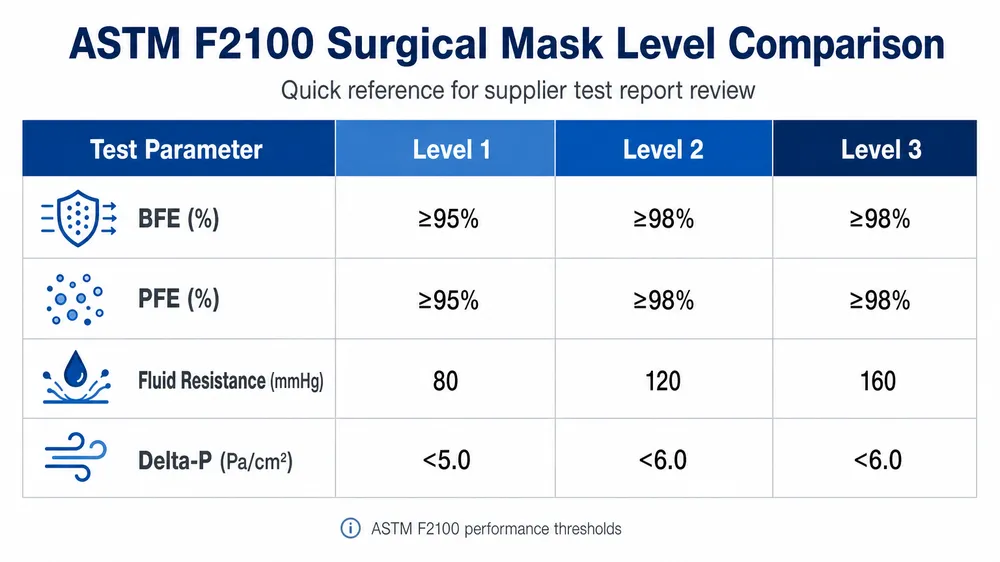
ASTM F2100 tests four performance parameters. Every level must pass all four — there's no partial compliance. Here's what the thresholds look like:
| Parameter | Level 1 | Level 2 | Level 3 |
|---|---|---|---|
| BFE (Bacterial Filtration Efficiency) | ≥95% | ≥98% | ≥98% |
| PFE (Particulate Filtration Efficiency, 0.1 µm) | ≥95% | ≥98% | ≥98% |
| Fluid Resistance (synthetic blood, mmHg) | 80 mmHg | 120 mmHg | 160 mmHg |
| Delta-P (breathability, Pa/cm²) | <4.0 | <5.0 | <5.0 |
| Flammability | Class 1 | Class 1 | Class 1 |
A few things worth noting in that table. BFE and PFE thresholds are identical for Level 2 and Level 3 — the difference between those two levels is entirely in fluid resistance. Level 3 is rated for 160 mmHg, which corresponds to high-velocity fluid splash scenarios in surgical environments. Level 2 handles moderate splash at 120 mmHg. Level 1 is rated for low-fluid-exposure settings at 80 mmHg.
Delta-P is the breathability parameter. Lower is better for the wearer. Level 1 has the tightest Delta-P ceiling at <4.0 Pa/cm², which means it must be more breathable than Level 2 or 3. This is intentional — Level 1 is designed for extended-wear, low-risk settings where comfort matters more than splash protection.
(One thing that trips up buyers: PFE tests at 0.1 µm particle size, which is smaller than most bacteria. A mask can pass BFE at ≥98% and still fail PFE if the meltblown layer isn't performing at the sub-micron level. We test both on every batch because they're measuring different things.)
Clinical setting mapping: which level belongs where
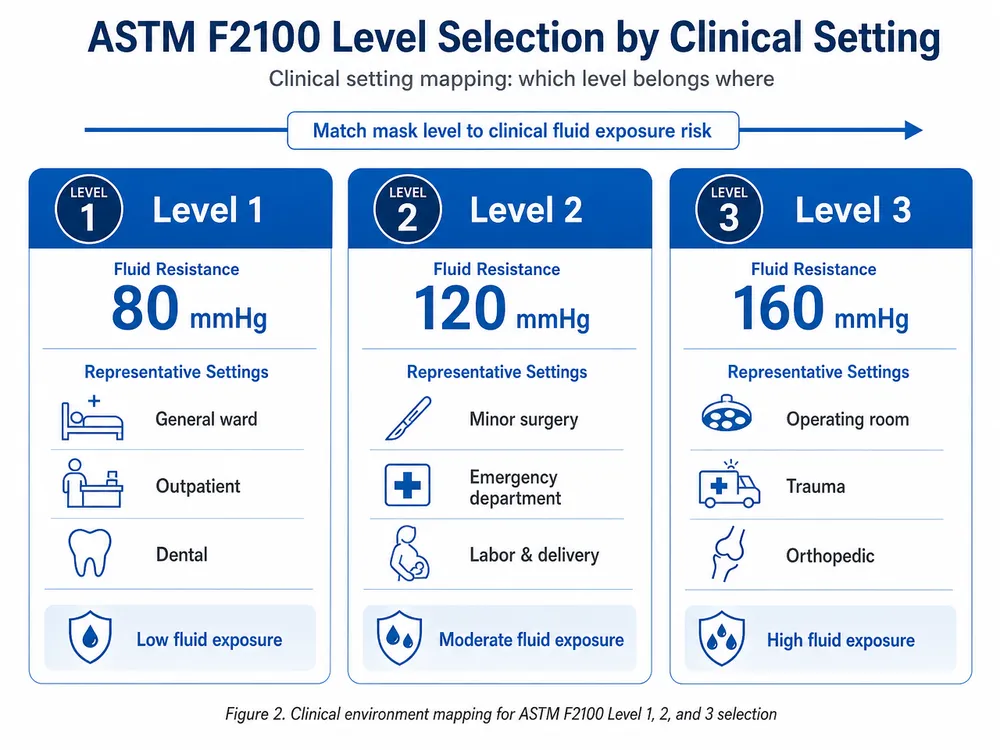
The level selection question comes down to two variables: expected fluid exposure and wear duration. Here's how that maps to clinical environments:
Level 1 — general ward, outpatient, and low-risk procedural settings. Dental exams, routine patient consultations, general ward nursing, and non-surgical clinical environments. Fluid exposure is minimal or incidental. The lower Delta-P ceiling makes Level 1 more comfortable for staff wearing masks for full shifts. For healthcare distributors supplying general clinical accounts, Level 1 covers the majority of volume.
Level 2 — moderate-risk procedural environments. Minor surgical procedures, emergency department work, labor and delivery, and settings where moderate fluid splash is possible but not routine. Level 2 is the most commonly specified level for hospital procurement programs that need a single SKU to cover a broad range of clinical departments. It's the practical middle ground.
Level 3 — high-splash surgical environments. Operating rooms, trauma surgery, orthopedic procedures, and any setting where high-velocity fluid exposure is expected. The 160 mmHg fluid resistance rating is the spec that matters here. Level 3 is not required for most clinical settings — specifying it across a full hospital system when Level 2 would suffice adds cost without adding protection where it's not needed.
The procurement risk in level selection runs in both directions. Under-specifying (using Level 1 in a surgical environment) creates clinical risk and compliance exposure. Over-specifying (mandating Level 3 across all departments) inflates unit cost and can create breathability issues for staff in extended-wear settings. The right answer is a tiered procurement approach: Level 1 for general clinical, Level 2 for procedural, Level 3 for OR.
For buyers building a hospital supply program or a distributor catalog, this tiered structure also gives you three distinct SKUs with clear clinical positioning — which is more defensible in a GPO bid than a single undifferentiated product.
How meltblown production determines whether your spec holds at scale
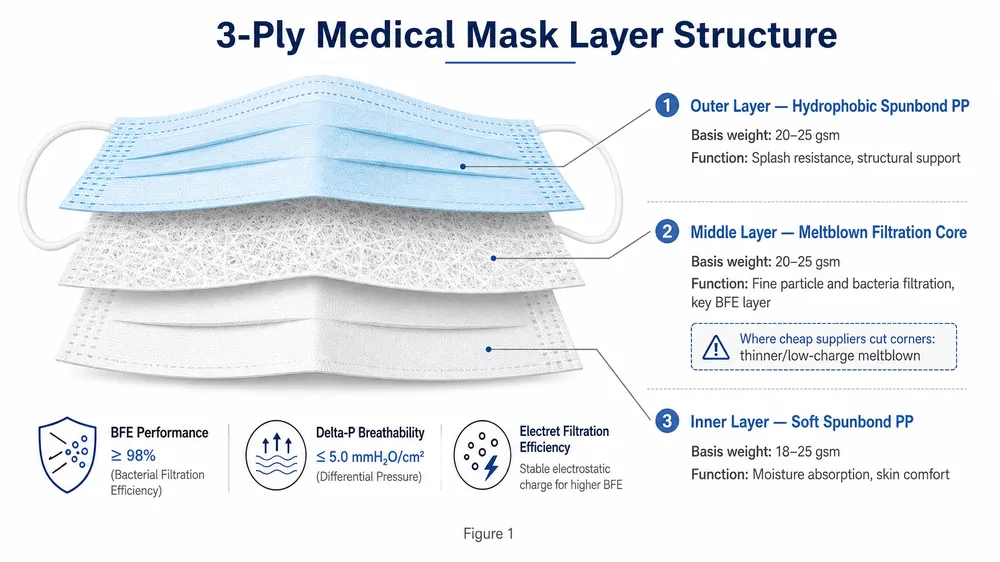
BFE and PFE performance in a surgical mask comes almost entirely from one component: the meltblown nonwoven filtration layer. The outer and inner spunbond layers provide structure and comfort. The meltblown layer does the filtration work.
Most mask factories buy meltblown fabric from external suppliers. That's a reasonable approach when supply is stable and the supplier's quality is consistent — but it means the factory's BFE performance is only as reliable as their last fabric delivery. We've seen what happens when that supply chain breaks: factories either stop production or substitute with off-spec material and hope the test reports from a previous batch still apply. Neither outcome is acceptable for a buyer with a hospital contract to fulfill.
We produce our own meltblown fabric. The fiber diameter, basis weight, and electrostatic charge level are set by our production parameters, not by a third-party supplier's process. When we target a ≥98% BFE spec for a Level 2 or Level 3 mask, we're controlling the variable that determines whether that spec is met — not hoping the incoming roll matches the certificate.
The practical implication for procurement: in-house meltblown production means spec consistency across your entire order, not just the first batch. A 500,000-piece order runs across multiple production batches. If the meltblown fabric is sourced externally, each batch is only as good as the fabric lot it was made from. Our batches are made from fabric we produced to the same parameters, so the BFE on batch 12 matches batch 1.
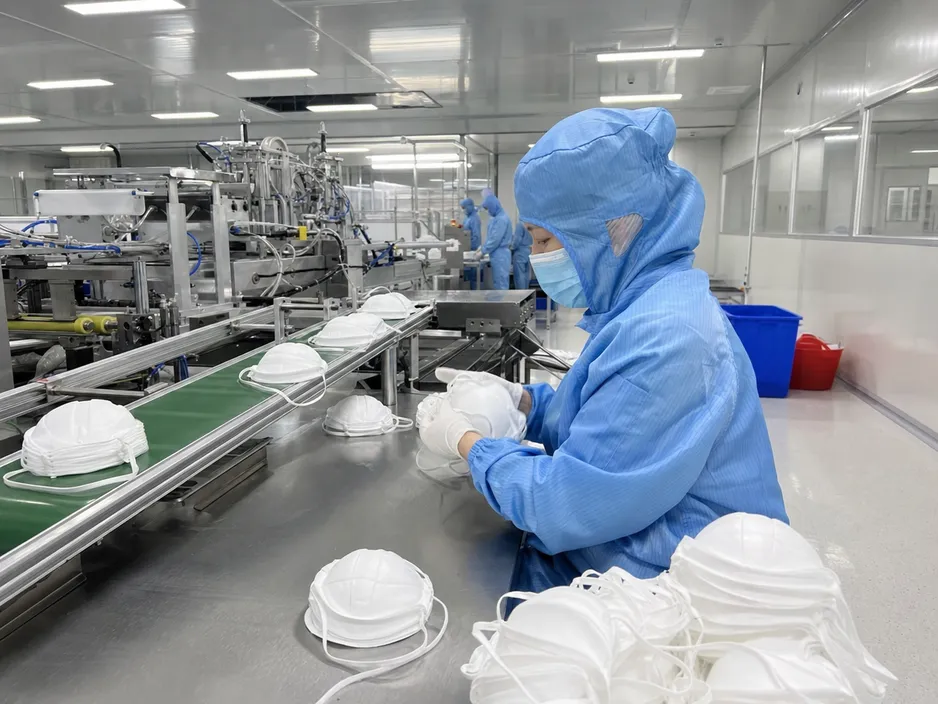
Our in-house QC lab runs BFE, PFE, and Delta-P testing on every production batch before the product moves to outgoing inspection. This isn't a substitute for third-party certification — it's the internal gate that catches problems before they become your problem. A batch that fails internal BFE testing gets pulled, the meltblown parameters get reviewed, and production doesn't resume until we understand why it failed. (We've had this happen. The cause was a calibration drift on the electrostatic charging unit. We caught it at the internal testing stage, not at the third-party lab, and not after the shipment left the factory.)
For buyers sourcing Disposable Surgical Medical Masks at scale, this is the manufacturing control that matters most. Ask any supplier you're evaluating whether they produce their own meltblown fabric. If they don't, ask how they verify incoming fabric quality and what their protocol is when a fabric lot fails BFE testing.
Reading supplier test reports: what valid ASTM F2100 documentation looks like
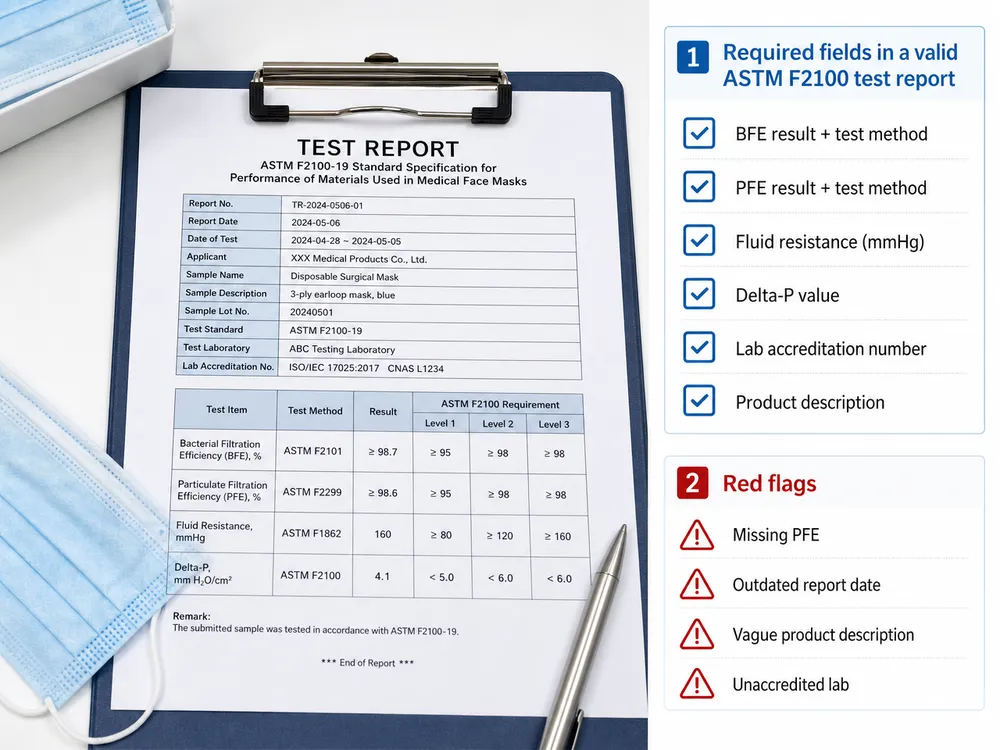
A supplier can claim ASTM F2100 compliance on a spec sheet. What you need is the test report that proves it. Here's what a valid report should contain and where the gaps usually appear.
What a complete ASTM F2100 test report includes:
- Test standard cited: ASTM F2100-19 (or current revision) — not a generic "meets ASTM standards" statement
- Level designation: Level 1, 2, or 3 explicitly stated
- BFE result with test method (ASTM F2101) and the actual percentage, not just "pass"
- PFE result with test method (MIL-M-36954C or equivalent) and actual percentage
- Fluid resistance result with test method (ASTM F1862) and pressure value in mmHg
- Delta-P result with test method (MIL-M-36954C) and value in Pa/cm²
- Flammability classification (ASTM D6413)
- Test laboratory name, accreditation number, and report date
- Product description matching the product you're ordering (mask model, lot number or production date range)
Red flags in supplier documentation:
A test report that shows only BFE and omits PFE is incomplete — some suppliers test only BFE because it's the more commonly cited parameter, but ASTM F2100 requires both. A report dated more than two years ago for a product that's been in continuous production should prompt a request for a current report — meltblown fabric quality can change between production runs, and an old report doesn't confirm current production performance.
Watch for reports where the product description is vague or doesn't match the specific SKU you're ordering. A test report for "3-ply surgical mask" without a model number or production specification is not product-specific documentation — it's a generic certificate that may or may not apply to what you're actually receiving.
The test laboratory should be accredited by a recognized body (A2LA, NVLAP, or equivalent). An in-house test report from the manufacturer alone is not sufficient for FDA import documentation or hospital procurement review — it needs to be backed by a third-party accredited lab report.
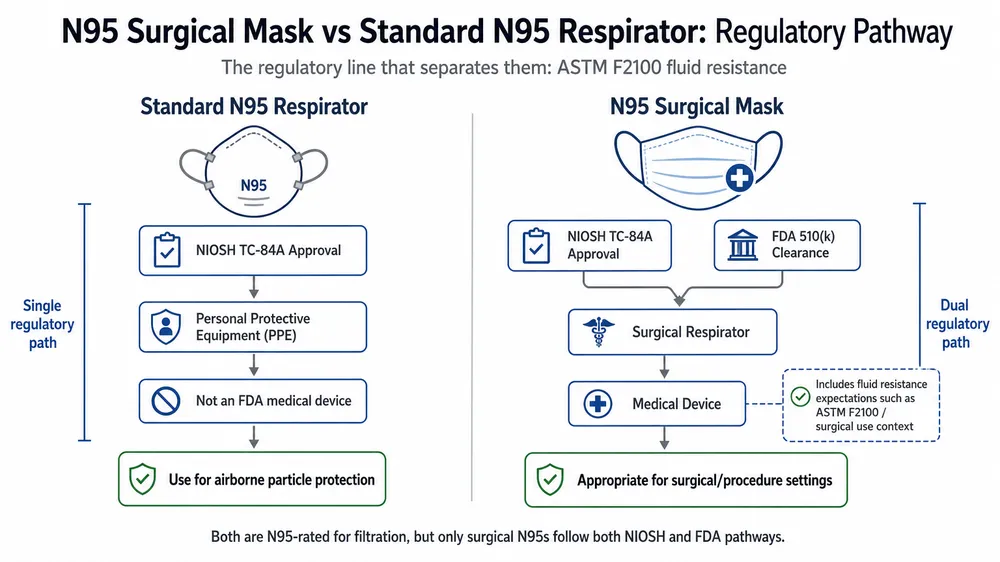
For buyers importing into the US, FDA 510(k) registration is the additional layer that confirms the product has been reviewed as a Class II medical device. Our Surgical Medical Masks carry FDA 510(k) registration, which means the regulatory review has already been completed — your import documentation doesn't require a new 510(k) submission.
ASTM F2100 vs EN 14683: what dual-market buyers need to know
If you're sourcing for both US and EU markets, you're working with two different standards. They're not interchangeable, and a mask that passes one doesn't automatically pass the other.
| Parameter | ASTM F2100 | EN 14683 |
|---|---|---|
| Levels | Level 1, 2, 3 | Type I, Type II, Type IIR |
| BFE threshold | ≥95% (L1), ≥98% (L2/L3) | ≥95% (Type I), ≥98% (Type II/IIR) |
| PFE | Required (≥95% or ≥98%) | Not required |
| Fluid resistance | Required (80/120/160 mmHg) | Required only for Type IIR (120 mmHg) |
| Delta-P | <4.0 or <5.0 Pa/cm² | <40 Pa/cm² (Type I/II), <60 Pa/cm² (Type IIR) |
| Regulatory framework | FDA 510(k) (Class II medical device) | CE marking under EU MDR |
The most significant structural difference: EN 14683 does not require PFE testing. ASTM F2100 does. A mask certified only to EN 14683 Type II has not been tested for sub-micron particulate filtration — it's been tested for bacterial filtration only. For US procurement, that's a gap in the documentation.
The fluid resistance comparison is also worth noting. EN 14683 Type IIR requires 120 mmHg — equivalent to ASTM F2100 Level 2. There's no EN 14683 equivalent to ASTM F2100 Level 3 (160 mmHg). If you're sourcing for a US surgical environment that requires Level 3, EN 14683 certification alone won't satisfy the specification.
Our products carry both FDA 510(k) registration and CE (EU MDR) clearance, so the documentation package covers both markets. For buyers managing dual-market distribution, this eliminates the compliance gap that comes from sourcing a product certified to one standard and trying to sell it into a market that requires the other.
(We've had buyers come to us after running into exactly this problem — a product certified to EN 14683 Type II that their US hospital customer rejected because it lacked PFE documentation. Getting the right certifications in place before you build your distribution program is considerably cheaper than retrofitting them after.)
The procurement checklist: documentation to request before placing a bulk order
Before committing to a bulk order of Surgical Medical Masks, here's the documentation set that should be in your hands:
Certification documents:
- ASTM F2100 test report from an accredited third-party laboratory (current, product-specific)
- FDA 510(k) registration number and clearance letter (for US import)
- CE certificate under EU MDR (for EU import)
- ISO 13485:2016 certificate (medical device quality management system)
Manufacturing verification:
- Factory audit report or ISO 13485 surveillance audit certificate
- Cleanroom classification documentation (for hospital procurement audits that require facility verification)
- In-house QC testing protocol — ask specifically whether the supplier tests BFE/PFE/Delta-P on every production batch or only on certification samples
Order-specific documentation (provided with shipment):
- Certificate of conformity referencing the specific order and lot numbers
- Batch test reports for the production lots in your shipment
- Packing list with carton count, piece count, and lot traceability
- Any market-specific declarations required by your customs broker
The question about in-house batch testing is worth asking directly. Some factories test only when submitting for certification renewal — which might be every one to two years. The test report on file may reflect production conditions from 18 months ago. A factory that tests every batch has current data; a factory that tests only for certification has historical data. For a hospital procurement program where spec consistency matters across multiple order cycles, that distinction is real.
MOQ for our standard ASTM F2100 SKUs starts at 50,000 pieces per level. For buyers building a tiered program across Level 1, 2, and 3, each level is treated as a separate SKU with its own MOQ. Lead time on standard SKUs runs 15–25 days from order confirmation. For private-label programs with custom packaging, add 7–10 days for artwork approval and packaging production.
Frequently asked questions
What is the difference between ASTM F2100 Level 2 and Level 3 for surgical masks?
The BFE and PFE thresholds are identical: ≥98% for both levels. The difference is fluid resistance. Level 2 is rated at 120 mmHg; Level 3 is rated at 160 mmHg. Level 3 is specified for high-velocity fluid splash environments — primarily operating rooms and trauma surgery. For most procedural settings outside the OR, Level 2 provides equivalent filtration performance at lower cost and with the same Delta-P ceiling.
Can a mask certified to EN 14683 Type II be used in place of ASTM F2100 Level 2 for US hospital procurement?
No. EN 14683 Type II does not require PFE testing, and US hospital procurement programs and FDA import documentation require ASTM F2100 compliance with both BFE and PFE results. A mask with only EN 14683 certification will typically fail a US hospital GPO compliance review. You need a product with a current ASTM F2100 test report from an accredited US lab.
How do I verify that a supplier's BFE test report applies to the product I'm actually ordering?
The test report should reference a specific product model, mask configuration, and production specification — not just a generic product category. Check that the mask description in the report matches the SKU you're ordering (layer count, ear-loop type, nose wire configuration). If the report is more than 12–18 months old, request a current report. Ask whether the supplier tests BFE on every production batch or only for certification renewal — the answer tells you whether the report reflects current production.
What does Delta-P measure and why does it matter for procurement?
Delta-P (pressure differential) measures airflow resistance through the mask — it's the breathability parameter. Lower Delta-P means easier breathing. ASTM F2100 sets a ceiling, not a target: Level 1 must be below 4.0 Pa/cm², Level 2 and 3 below 5.0 Pa/cm². For extended-wear clinical settings, a mask near the ceiling of its Delta-P limit will cause more wearer fatigue than one well below it. When comparing suppliers at the same BFE level, Delta-P is a useful secondary differentiator — ask for the actual measured value, not just "pass."
What is the minimum order quantity for ASTM F2100 certified surgical masks?
For standard SKUs, our MOQ is 50,000 pieces per level. This applies to Level 1, Level 2, and Level 3 separately. For buyers entering a new market or testing a new SKU, a 50,000-piece trial order is a practical starting point before committing to larger volumes. Custom configurations and private-label programs typically require higher minimums — we'll confirm the specific MOQ when you send your RFQ with the product specification.
Does in-house meltblown production actually affect BFE consistency across a large order?
Yes, and it's the most direct way to verify a supplier's spec reliability. Meltblown fabric is the filtration layer — BFE and PFE performance is determined almost entirely by the meltblown parameters (fiber diameter, basis weight, electrostatic charge). A factory that sources meltblown externally is dependent on their fabric supplier's consistency. A factory that produces its own meltblown controls those parameters directly. For a 500,000-piece order running across multiple production batches, the difference shows up in batch-to-batch BFE variation. Ask your supplier: do you produce your own meltblown fabric? If not, how do you verify incoming fabric quality?
For buyers ready to move from specification review to sourcing, the next step is straightforward. Send an Request Quote with your required ASTM level, annual volume estimate, and destination market. We'll respond with pricing, lead time, and the full certification documentation package — ASTM F2100 test reports, FDA 510(k) clearance, CE certificate, and ISO 13485 — for your compliance review before you commit to an order.
For a deeper look at how BFE and Delta-P interact in mask design and what the trade-offs look like at the manufacturing level, see our article on BFE and Delta-P performance trade-offs.