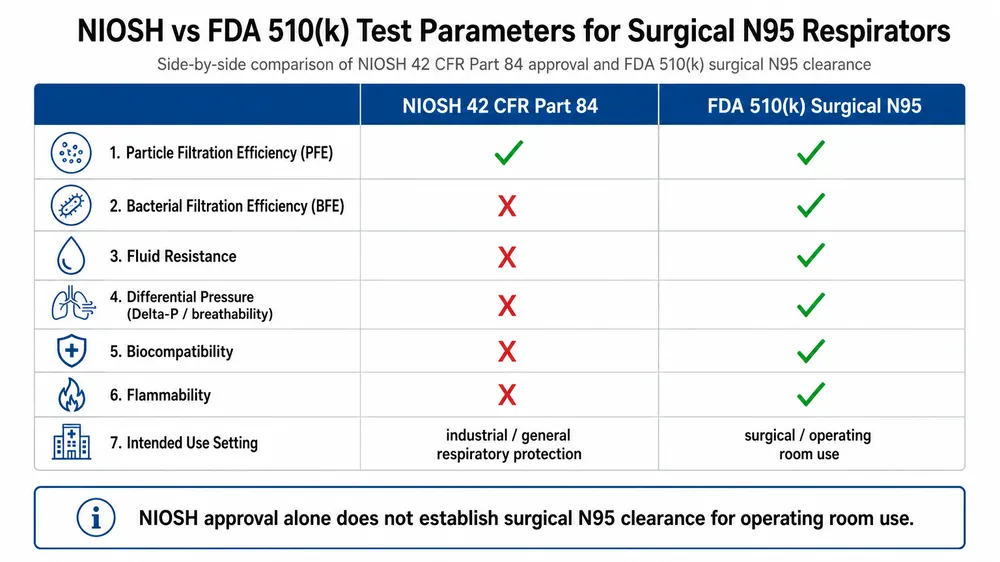
Most spec sheets list BFE and Delta-P as two separate numbers. They're not independent. They're two outputs of the same engineering decision — and if you don't understand the relationship between them, you'll either over-specify and pay for performance your end market doesn't need, or under-specify and end up with a compliance problem after the shipment lands.
This article explains how BFE and Delta-P interact, what the ASTM F2100 and EN 14683 thresholds actually require, and what to look for when you're verifying supplier claims on a 500,000-unit order.
What BFE and Delta-P actually measure
BFE — Bacterial Filtration Efficiency — measures what percentage of aerosolized bacteria the mask's filtration layer stops. The test method (ASTM F2101) uses a standardized aerosol of Staphylococcus aureus at a controlled flow rate. A mask rated ≥95% BFE stops at least 95 out of every 100 bacterial particles in that test. A mask rated ≥98% BFE stops 98 out of 100.
The number that matters for procurement is the minimum threshold, not the average. A supplier who reports "average BFE 99.2%" without specifying the minimum across the batch is giving you a marketing number, not a compliance number.
Delta-P — differential pressure, or pressure drop — measures the resistance the mask creates against airflow. The test (ASTM F2100 references ASTM F1862 for fluid resistance, but Delta-P is measured per EN ISO 9237 or equivalent) passes a controlled airflow through the mask material and measures the pressure difference across it. The result is reported in mmH₂O/cm² or Pa/cm². Lower Delta-P means less breathing resistance.
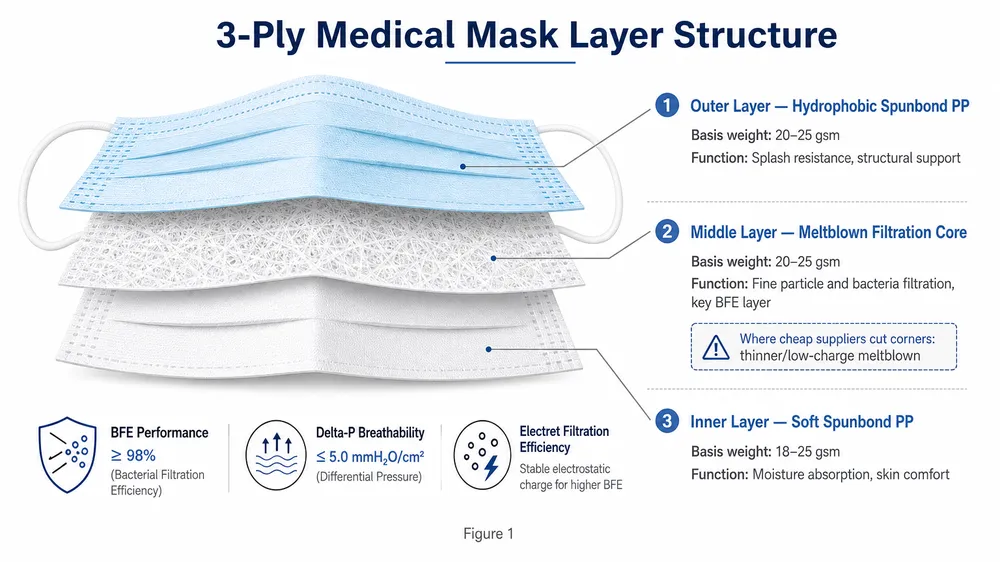
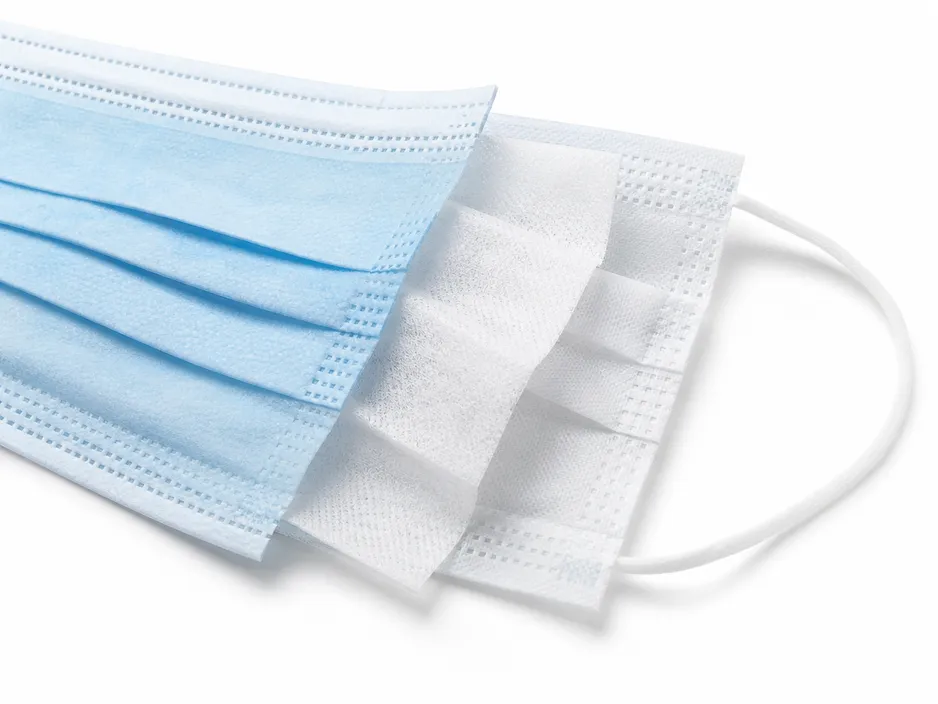
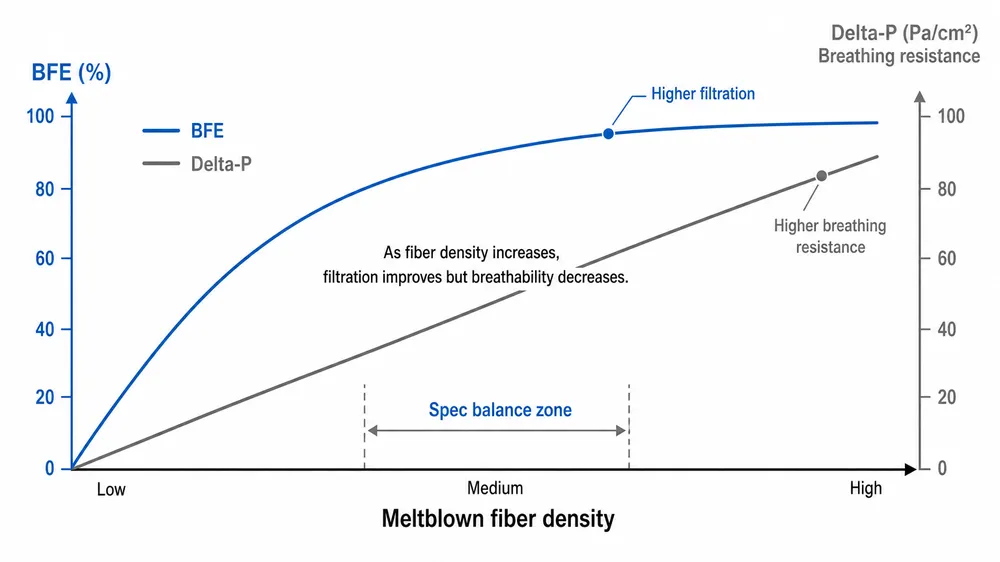
The engineering tension is direct: the meltblown layer that filters bacteria does so by creating a dense fiber matrix. Denser fiber matrix = higher BFE. Denser fiber matrix = higher Delta-P. You cannot raise one without putting upward pressure on the other. The question is how much Delta-P your end market will tolerate for the BFE level you need.

The standard tiers: ASTM F2100 and EN 14683 side by side
Two standards dominate global surgical mask procurement. Which one applies to your order depends on where the masks are being imported and used.
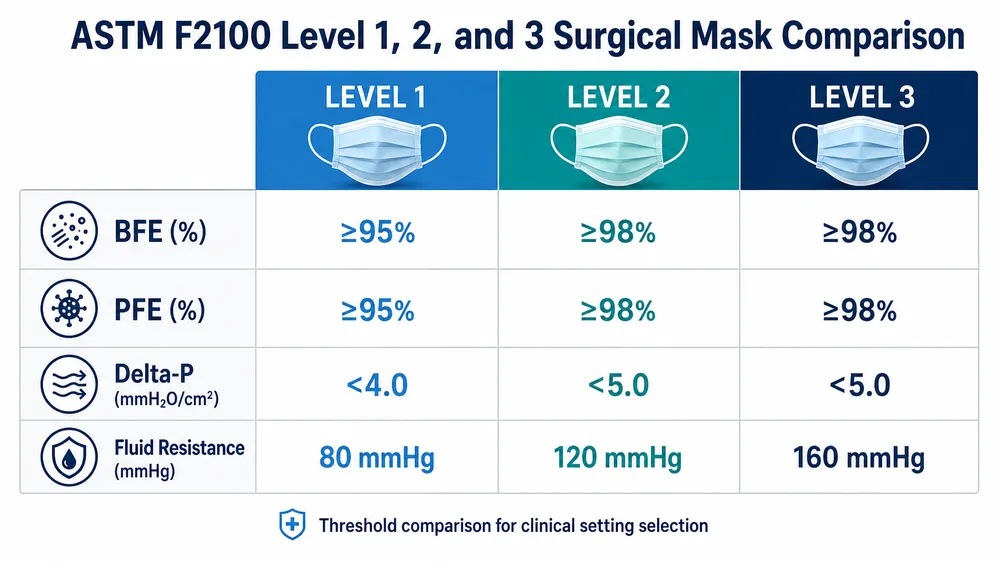
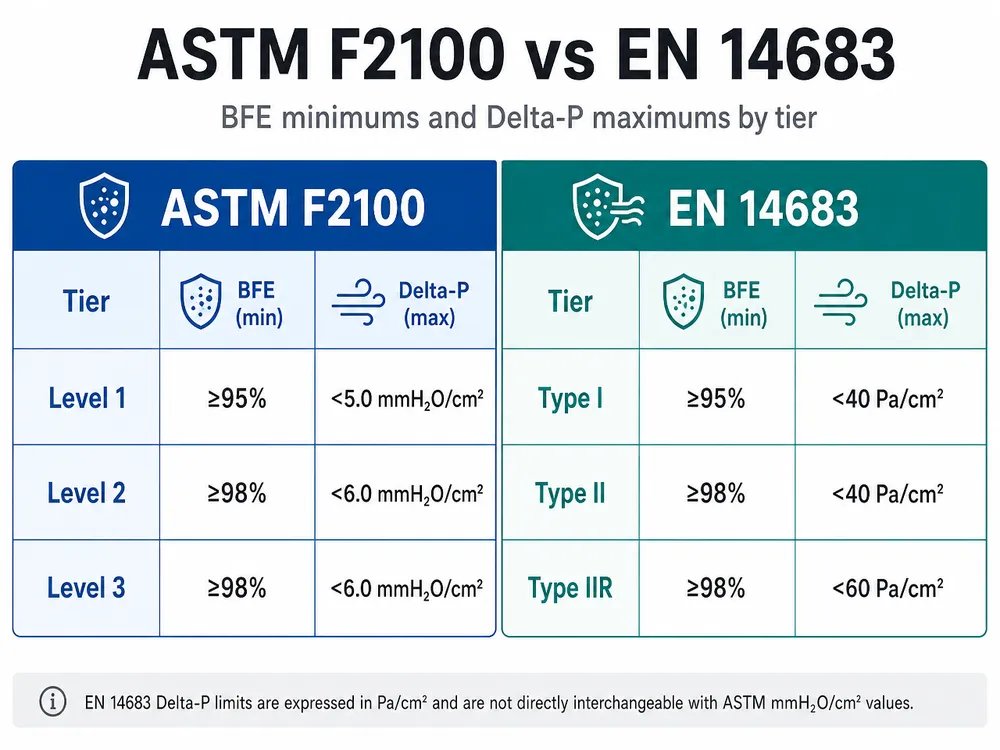
ASTM F2100 (US market, FDA-regulated) defines three performance levels. EN 14683 (EU/MDR market) defines three mask types. The BFE and Delta-P thresholds are different, and conflating them is a common sourcing error.
| Standard | Level/Type | BFE Minimum | Delta-P Maximum | Primary Market |
|---|---|---|---|---|
| ASTM F2100 | Level 1 | ≥95% | ≤4.0 mmH₂O/cm² | US — low-risk clinical, general use |
| ASTM F2100 | Level 2 | ≥98% | ≤5.0 mmH₂O/cm² | US — moderate fluid exposure |
| ASTM F2100 | Level 3 | ≥98% | ≤5.0 mmH₂O/cm² | US — high fluid exposure (splash risk) |
| EN 14683 | Type I | ≥95% | ≤29.4 Pa/cm² | EU — patient protection, non-surgical |
| EN 14683 | Type II | ≥98% | ≤29.4 Pa/cm² | EU — surgical, standard |
| EN 14683 | Type IIR | ≥98% | ≤29.4 Pa/cm² | EU — surgical, splash-resistant |
A few things worth noting in that table:
ASTM F2100 Level 2 and Level 3 share the same BFE and Delta-P thresholds. The difference between them is fluid resistance (splash protection), not filtration or breathability. If a supplier is quoting you "Level 3" as a premium filtration product, that's a misrepresentation — the filtration spec is identical to Level 2.
EN 14683 Delta-P is expressed in Pa/cm² rather than mmH₂O/cm². The conversion is approximately 1 mmH₂O/cm² = 9.81 Pa/cm², so the EN 14683 maximum of 29.4 Pa/cm² is roughly equivalent to 3.0 mmH₂O/cm² — tighter than ASTM F2100 Level 1's 4.0 mmH₂O/cm² limit. Masks produced to ASTM F2100 Level 1 spec may not automatically pass EN 14683 Delta-P requirements. This catches buyers off guard when they try to use US-spec product in EU tenders.
(We've had buyers come to us after a failed EU tender because their previous supplier's masks were ASTM-compliant but hadn't been tested to EN 14683. The BFE was fine. The Delta-P was the problem.)
How meltblown production controls both numbers simultaneously
This is where the sourcing decision gets real. BFE and Delta-P are not properties you select from a catalog — they are outputs of how the meltblown filtration layer is manufactured. Three variables in the meltblown extrusion process determine where your mask lands on the BFE/Delta-P curve:
Fiber diameter. Finer fibers create a denser, more tortuous path for particles, which raises BFE. They also increase resistance to airflow, which raises Delta-P. The relationship is not perfectly linear — there's a range where you can tune fiber diameter to gain BFE without a proportional Delta-P penalty — but you're always working within a physical constraint.
Basis weight. More fabric per unit area means more filtration material, which raises BFE. It also adds mass and density, which raises Delta-P. Basis weight is the bluntest instrument in the toolbox — it's easy to increase, but it moves both numbers together.
Electrostatic charge. This is where skilled meltblown production separates from commodity production. Electrostatic charging (corona treatment or triboelectric charging) allows the fibers to capture particles through electrostatic attraction rather than purely mechanical interception. A well-charged meltblown layer can achieve ≥98% BFE at a lower fiber density and basis weight than an uncharged layer — which means you can hit the BFE target with less Delta-P penalty.
The practical implication: a factory that buys meltblown fabric from a third-party supplier is accepting whatever fiber diameter, basis weight, and charge level that supplier produced. They have no direct control over the BFE/Delta-P balance. If the fabric supplier's process drifts between production runs — which happens — the mask factory's BFE and Delta-P numbers drift with it.
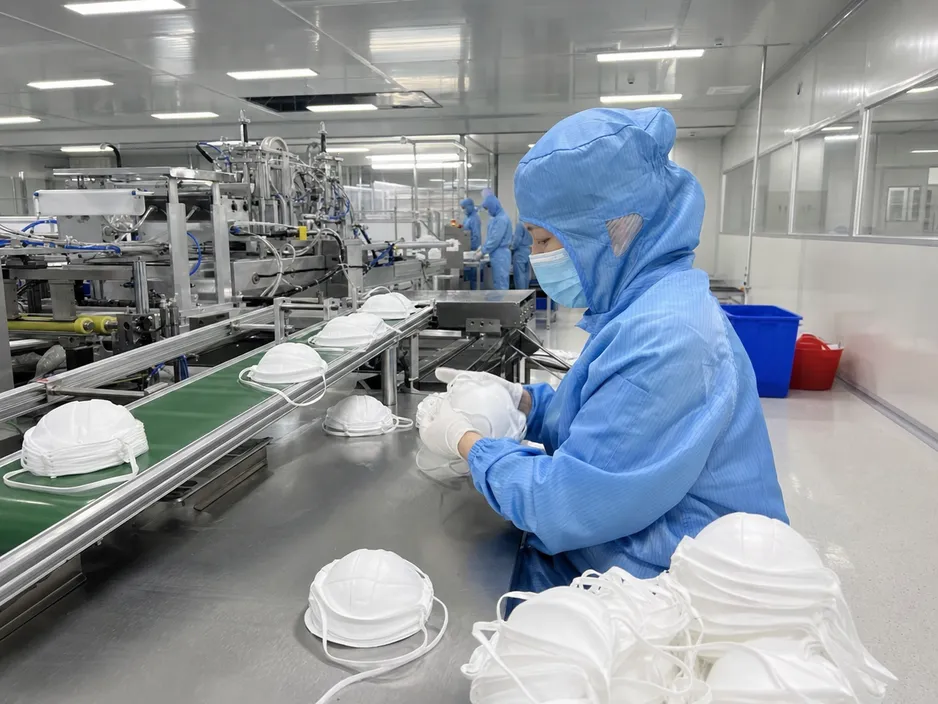
We produce our own meltblown fabric. That means we set the extrusion parameters, the charging parameters, and the basis weight for each production run. When we're producing to ASTM F2100 Level 2 spec, we're not hoping the fabric roll we received meets the spec — we're producing the fabric to the spec. The difference shows up in batch-to-batch consistency on large orders.
Spec consistency across 500k+ units: why fabric sourcing is the real risk
A single test report showing ≥98% BFE and Delta-P ≤5.0 mmH₂O/cm² tells you the mask passed on the day it was tested. It tells you nothing about whether the 200th production batch in your order will perform the same way.
For orders under 100,000 units, batch-to-batch variation is a manageable risk. For orders at 500,000 units and above — the scale where hospital procurement, government tenders, and large distributor programs operate — it becomes a material compliance risk. If batch 15 of your 20-batch order fails BFE testing at the destination country's customs lab, you have a shipment hold, a compliance incident, and a supply gap.
The root cause of BFE drift in large orders is almost always the meltblown layer. Specifically:
- Third-party meltblown suppliers change production parameters between rolls without notifying the mask factory
- Electrostatic charge degrades over time if fabric is stored improperly before use
- Basis weight variation within a roll (common in lower-grade meltblown) creates within-batch BFE variation
Our QC process addresses this at two points. First, every meltblown roll we produce is batch-tested before it enters the mask production line — basis weight, charge level, and a pre-production BFE check. Second, our in-house lab runs BFE, PFE, and Delta-P testing on every production batch of finished masks before they move to outgoing inspection. A batch that fails internal BFE testing gets pulled and investigated. It doesn't ship.
(The in-house testing step is the one most factories skip because it adds cost and time. We've kept it because the alternative — discovering a BFE failure at the destination lab — costs far more in both money and customer relationships.)
For buyers placing orders at scale, the question to ask any supplier is not "what is your BFE?" but "how do you control BFE consistency across the full production run?" The answer tells you whether you're dealing with a factory that understands the problem or one that's hoping the first test report covers the whole order.
What to verify before you place a bulk order
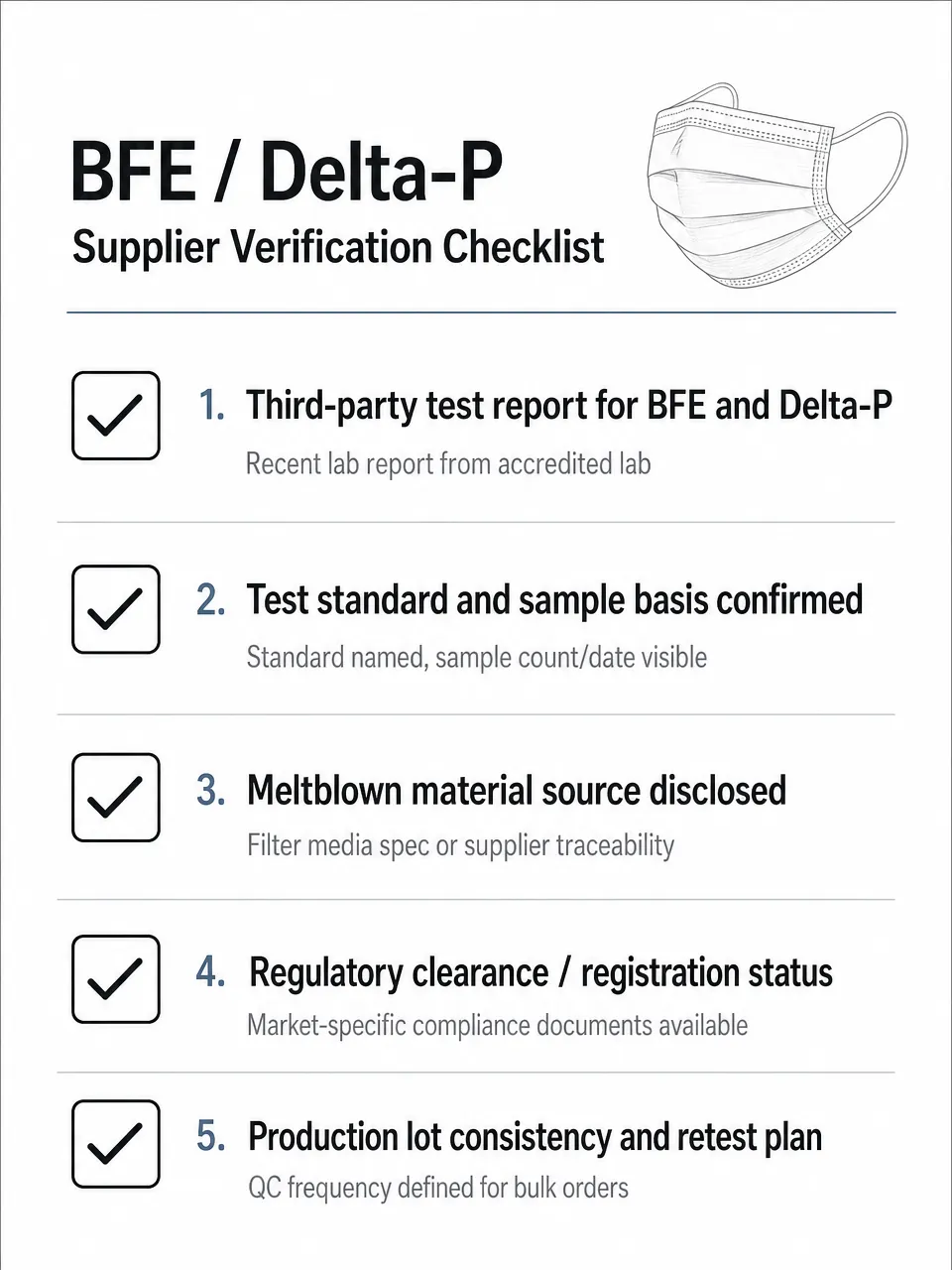
Test reports are necessary but not sufficient. Here's what to request and what to look for:
Third-party test reports, not just in-house data. BFE and Delta-P test reports should come from accredited labs — Nelson Labs, SGS, Intertek, or equivalent. The report should show the test method (ASTM F2101 for BFE, the relevant Delta-P method), the test date, the sample description, and the actual measured values, not just a pass/fail notation. If a supplier provides only a certificate without the underlying test data, ask for the full report.
Report age and sample traceability. A test report from three years ago on a different production batch is not evidence that your current order will meet spec. Ask when the report was issued and whether the sample tested matches the current production configuration (same meltblown source, same basis weight, same construction). For large orders, ask whether the supplier will provide batch-specific test reports with each shipment.
Delta-P units and test method. Confirm whether the Delta-P value on the report is in mmH₂O/cm² (ASTM) or Pa/cm² (EN). A supplier who reports "Delta-P: 3.5" without specifying units is giving you an ambiguous number. 3.5 mmH₂O/cm² passes ASTM F2100 Level 1. 3.5 Pa/cm² is a different value entirely.
Meltblown sourcing disclosure. Ask directly: does the factory produce its own meltblown fabric, or does it buy from a third-party supplier? If third-party, ask for the supplier's name and whether they have a consistent supply agreement. This is not a hostile question — it's standard due diligence for any order where spec consistency matters.
FDA 510(k) or CE (EU MDR) registration status. For US imports, FDA 510(k) clearance means the product has been reviewed against ASTM F2100 performance requirements. For EU imports, CE marking under MDR means the product has a technical file and a notified body review. These are not the same as a test report — they're regulatory clearances that cover the product's design and manufacturing process, not just a single batch. Our Disposable Surgical Medical Mask carries both, which means your import documentation is already in order for the US and EU markets.
Matching BFE/Delta-P spec to your end market
Not every market needs the same spec. Over-specifying costs margin. Under-specifying creates compliance risk. Here's how to think about it by end market:
Hospital and surgical procurement (US market). ASTM F2100 Level 2 or Level 3 is the standard requirement for surgical environments. Level 2 covers most OR and procedural settings. Level 3 adds splash resistance for high-fluid procedures. Both require ≥98% BFE and Delta-P ≤5.0 mmH₂O/cm². If your buyer is a hospital GPO or a surgical supply distributor, Level 2 is the baseline spec — anything below it won't pass procurement review.
Clinic and outpatient settings (US market). ASTM F2100 Level 1 (≥95% BFE, Delta-P ≤4.0 mmH₂O/cm²) is appropriate for non-surgical clinical environments where fluid splash risk is low. The lower Delta-P maximum actually makes Level 1 a more breathable mask than Level 2 — relevant for extended-wear settings like outpatient clinics where staff wear masks for full shifts.
EU surgical and healthcare procurement. EN 14683 Type II or Type IIR is the standard for surgical use. Type IIR adds splash resistance (same BFE and Delta-P thresholds as Type II, but with a fluid resistance test). For EU tenders, confirm whether the specification calls for Type II or Type IIR — the fluid resistance test is the differentiator, not BFE or Delta-P.
Institutional and non-clinical distribution (both markets). If your buyers are distributing to non-clinical institutional settings — corporate offices, schools, government facilities — the spec requirements are less stringent, but the regulatory labeling requirements still apply. A mask labeled as a surgical mask must meet the applicable standard regardless of where it's used. If you're distributing to non-clinical settings, confirm whether your buyers need a medical device designation or whether a non-medical mask spec is acceptable for their procurement requirements.
Private-label programs with custom spec targets. Some buyers need a specific BFE/Delta-P balance that doesn't map cleanly to a standard tier — for example, a private-label brand targeting extended-wear clinical use that wants ≥98% BFE with Delta-P closer to the Level 1 threshold. This is achievable through meltblown parameter tuning, but only if the factory controls its own meltblown production. We handle ODM projects with custom filtration targets through our product development process — the starting point is your target BFE, your Delta-P tolerance, and the applicable standard for your end market.
Red flags in supplier documentation
A few patterns we see regularly in the market that should prompt closer scrutiny:
A spec sheet showing ≥99% BFE with Delta-P well below the standard maximum sounds impressive. In practice, achieving very high BFE with very low Delta-P simultaneously requires either exceptional meltblown quality or a test methodology that doesn't reflect real-world performance. Ask for the full test report and confirm the test flow rate — some labs test at lower flow rates that produce better-looking numbers but don't reflect the ASTM F2101 standard conditions.
Suppliers who quote BFE without specifying the test standard (ASTM F2101 vs. EN 14683 Annex B) are giving you a number without context. The two test methods use different aerosol concentrations and flow rates, and the results are not directly comparable. Always confirm which test method produced the BFE number on the spec sheet.
A single test report covering multiple SKUs is a red flag. BFE and Delta-P are properties of a specific mask construction — a specific meltblown basis weight, a specific layer configuration. A report that covers "3-ply surgical masks" without specifying the exact construction tested may not apply to the specific product you're ordering.
For buyers sourcing from Surgical Medical Masks manufacturers in China, the documentation standard varies significantly. Factories with FDA 510(k) and CE (EU MDR) registration have been through a regulatory review process that requires documented production controls and traceability. Factories without these registrations may have test reports, but the underlying production process hasn't been reviewed against the same standard.
Specifying BFE and Delta-P in your RFQ
When you're ready to request quotes, the spec information that actually matters for a BFE/Delta-P discussion:
- Target standard: ASTM F2100 (specify Level 1, 2, or 3) or EN 14683 (specify Type I, II, or IIR)
- BFE minimum: state the threshold, not just the level name — "≥98% BFE per ASTM F2101"
- Delta-P maximum: state the value and units — "≤5.0 mmH₂O/cm²" or "≤29.4 Pa/cm²"
- Order volume: total pieces and expected batch frequency — this determines whether batch-specific test reports are practical
- Regulatory clearance required: FDA 510(k) for US imports, CE (EU MDR) for EU imports
- Meltblown sourcing preference: in-house vs. third-party, if spec consistency is a priority
The more specific your RFQ, the faster you'll identify which suppliers can actually meet your requirements versus which ones will confirm anything to get the inquiry moving.
If you're sourcing at 500,000 units or above and spec consistency across batches is a requirement, ask the supplier directly how they test BFE across the production run — not just on the first batch. The answer will tell you more about their production control than any spec sheet.
To discuss your BFE and Delta-P requirements against a specific standard and volume, submit an RFQ with your target spec, applicable standard, and order volume. We'll confirm spec match and provide a production-ready quote with the relevant test documentation.
FAQ
What is the difference between BFE and PFE in surgical masks?
BFE (Bacterial Filtration Efficiency) measures filtration of aerosolized bacteria using a biological aerosol test. PFE (Particulate Filtration Efficiency) measures filtration of non-biological particles, typically latex spheres at 0.1 micron. ASTM F2100 requires both for Level 2 and Level 3 masks — PFE ≥98% at 0.1 micron. EN 14683 does not require PFE. For surgical mask procurement, BFE is the primary compliance metric; PFE becomes relevant when the mask is also being evaluated for particulate protection.
Can a mask pass ASTM F2100 Level 2 but fail EN 14683 Type II?
Yes, and it happens more often than buyers expect. The BFE thresholds are the same (≥98%), but the Delta-P limits differ in units and test conditions. A mask with Delta-P of 4.5 mmH₂O/cm² passes ASTM F2100 Level 2 (maximum 5.0 mmH₂O/cm²) but converts to approximately 44 Pa/cm², which exceeds the EN 14683 maximum of 29.4 Pa/cm². If you're sourcing for both US and EU markets, confirm that the mask has been tested and certified to both standards separately.
How do I know if a supplier's BFE test report applies to the specific product I'm ordering?
The test report should identify the specific product by construction: number of layers, meltblown basis weight, and any relevant material specifications. If the report describes "3-ply surgical mask" without further detail, ask the supplier to confirm that the tested construction matches the product you're ordering. For large orders, request that the supplier provide batch-specific BFE and Delta-P test reports with each production run, not just a single pre-production certification.
What Delta-P value should I specify for extended-wear clinical use?
Lower Delta-P means less breathing resistance, which matters for staff wearing masks for full shifts. ASTM F2100 Level 1 has a tighter Delta-P maximum (≤4.0 mmH₂O/cm²) than Level 2 (≤5.0 mmH₂O/cm²), which makes Level 1 masks more breathable — but Level 1 only requires ≥95% BFE. If your end market requires ≥98% BFE for extended wear, you're looking for a mask that meets Level 2 BFE with Level 1-range Delta-P. That's achievable through meltblown parameter optimization, but it requires a factory with direct control over meltblown production.
Does in-house meltblown production guarantee better BFE consistency?
It's a necessary condition, not a sufficient one. A factory that produces its own meltblown has the ability to control fiber diameter, basis weight, and electrostatic charge — the variables that determine BFE and Delta-P. Whether they actually exercise that control depends on their QC process. The combination that matters is in-house meltblown production plus batch-level BFE testing on finished masks. Either one alone is less reliable than both together.