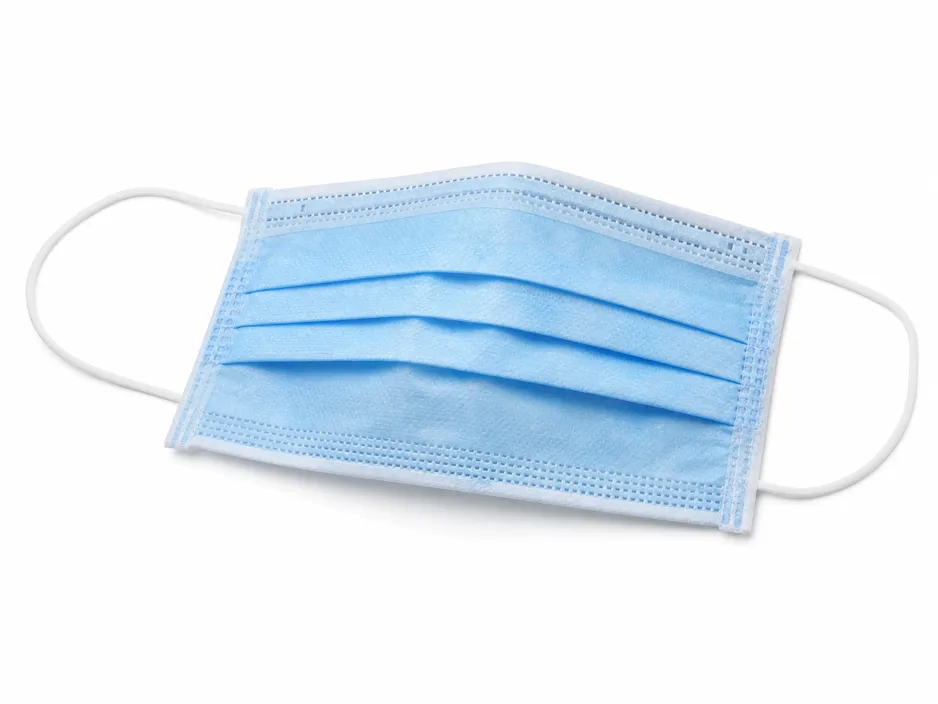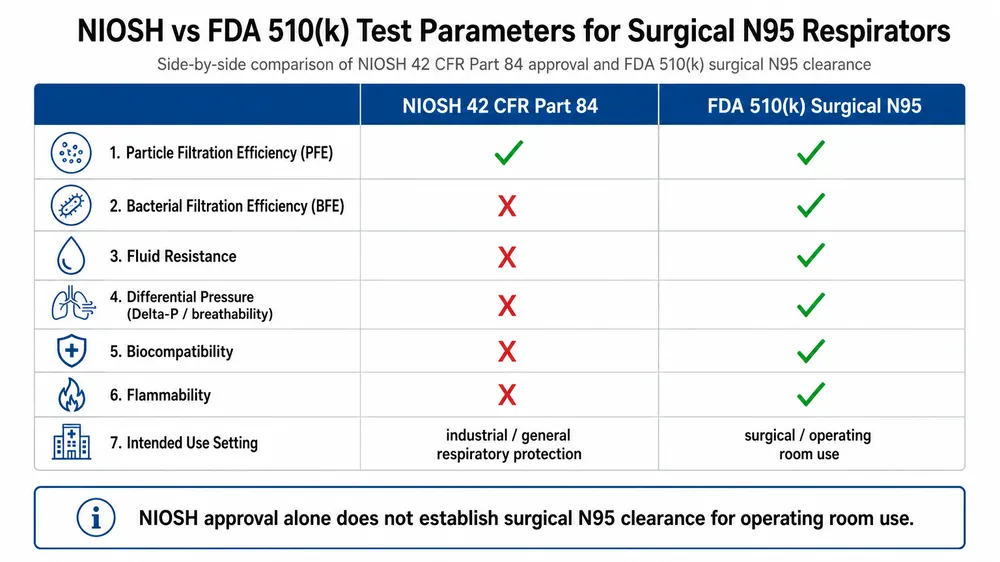
A NIOSH-approved N95 respirator is not automatically cleared for use in an operating room. That distinction costs procurement teams real money when they discover it after the order ships.
The confusion is understandable. Both credentials involve the word "N95." Both appear on legitimate products. But they cover different hazards, are issued by different regulatory bodies, and together — only together — satisfy the requirements for surgical use in a US hospital setting. If your procurement spec says "N95 for OR use" and your supplier sends you a NIOSH-only product, you have a compliance gap that no amount of documentation will close after the fact.
This article explains the regulatory logic behind dual certification, what each credential actually tests, and what documents you need to request from a supplier before you commit to an order.
Why one credential is never enough for the OR
The operating room presents two distinct hazards that a single regulatory framework doesn't cover simultaneously.
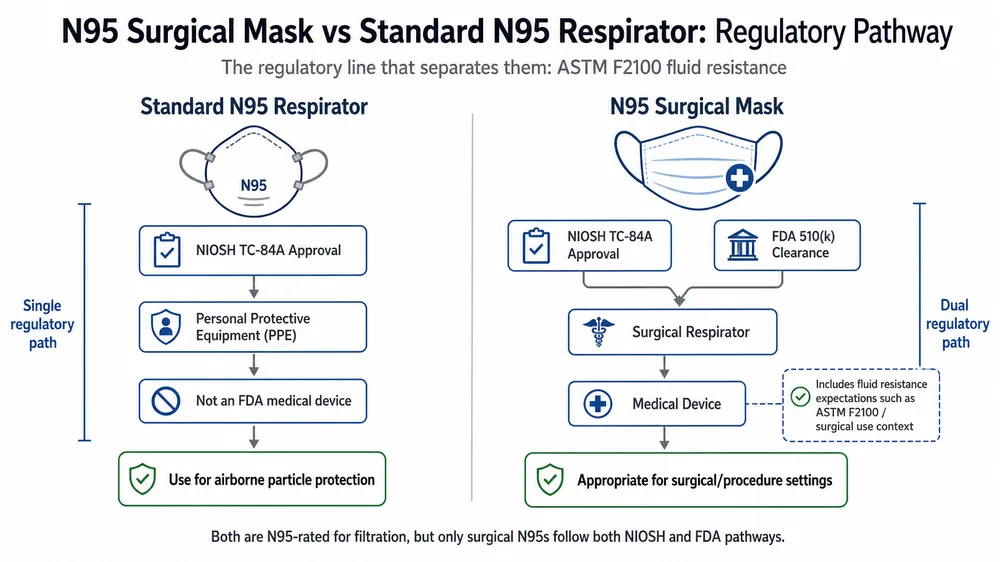
The first is airborne particulate — surgical smoke, aerosolized pathogens, fine particles generated during procedures. NIOSH addresses this. The second is fluid splash — blood, irrigation fluid, and other body fluids that can contact the mask surface during surgery. FDA 510(k) clearance addresses this, specifically through fluid resistance testing under ASTM F1862.
NIOSH is a division of the CDC. It tests and approves respirators under 42 CFR Part 84, which covers particulate filtration efficiency. An N95 designation from NIOSH means the mask filters at least 95% of airborne particles at 0.3 microns under controlled test conditions. That's the filtration credential.
FDA 510(k) clearance is a separate process entirely. It classifies the mask as a Class II medical device under 21 CFR 878.4040 and requires the manufacturer to demonstrate substantial equivalence to a predicate device. For a surgical N95, that demonstration includes fluid resistance testing (ASTM F1862 at 120 mmHg minimum), bacterial filtration efficiency (BFE ≥98%), and breathability (Delta-P ≤5.0 mm H₂O/cm²). These are the parameters that make a mask safe for surgical environments, not just industrial ones.
Neither credential substitutes for the other. A NIOSH-only N95 has no fluid resistance requirement. An FDA-cleared surgical mask without NIOSH approval has no particulate filtration standard. The OR requires both, which is why the product category exists: the surgical N95 respirator, carrying both a NIOSH approval number and an FDA 510(k) clearance number.
The test parameters behind each credential
Understanding what gets tested — and what doesn't — is the fastest way to see why the gap matters.
| Test parameter | NIOSH 42 CFR Part 84 | FDA 510(k) surgical N95 |
|---|---|---|
| Particulate filtration efficiency (PFE) | ≥95% at 0.3 µm | ≥95% |
| Bacterial filtration efficiency (BFE) | Not required | ≥98% |
| Fluid resistance (ASTM F1862) | Not required | ≥120 mmHg |
| Breathability / Delta-P | ≤35 mm H₂O at 85 L/min | ≤5.0 mm H₂O/cm² |
| Flammability | Required | Required |
| Biocompatibility | Not required | Required (ISO 10993) |
| Use setting | Industrial, healthcare (non-surgical) | Surgical / OR |
The Delta-P values look different because the test methods use different flow rates and units — but both measure breathability. The FDA surgical standard is more stringent on fluid resistance and biocompatibility because the device is classified as a medical device in contact with the patient care environment.
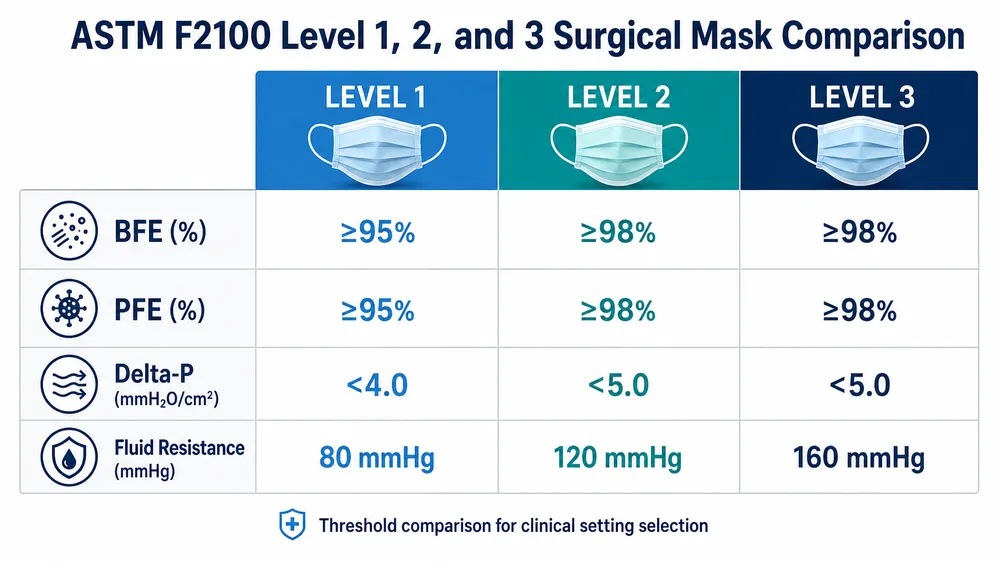
(One thing worth noting: the ASTM F2100 Level 3 standard, which covers surgical masks broadly, requires fluid resistance at 160 mmHg. Some hospital GPO specs reference F2100 Level 3 as the fluid resistance benchmark for surgical N95s. If your buyer's procurement spec cites F2100 Level 3, confirm the fluid resistance test result explicitly — 120 mmHg and 160 mmHg are not the same number.)

NIOSH-only N95 vs. dual-certified surgical N95: the sourcing difference
The product names overlap enough to cause real procurement errors. Here's the distinction that matters at the sourcing level.
| NIOSH-only N95 | Dual-certified surgical N95 | |
|---|---|---|
| Applicable standard | 42 CFR Part 84 | 42 CFR Part 84 + 21 CFR 878.4040 |
| Regulatory body | CDC/NIOSH | CDC/NIOSH + FDA |
| Fluid resistance tested | No | Yes (ASTM F1862, ≥120 mmHg) |
| BFE tested | No | Yes (≥98%) |
| Biocompatibility tested | No | Yes (ISO 10993) |
| Permitted in OR | No | Yes |
| Permitted in industrial settings | Yes | Yes |
| Documentation required | NIOSH approval number | NIOSH approval number + 510(k) clearance number + test reports |
The practical sourcing implication: a supplier who can show you a NIOSH approval number but cannot provide a 510(k) clearance number is selling you an industrial respirator. It may be a good industrial respirator. It is not a surgical N95.
We see this confusion most often when buyers are sourcing from suppliers who manufacture primarily for industrial PPE markets and have added "N95" to their medical product catalog without obtaining the FDA clearance. The NIOSH number is real. The surgical claim is not.
For buyers supplying Surgical Medical Masks into US hospital systems, the documentation gap will surface at the GPO compliance review stage — not at customs, but at the point where the hospital's infection control committee reviews the product before approving it for clinical use.
What procurement teams must verify before placing an order
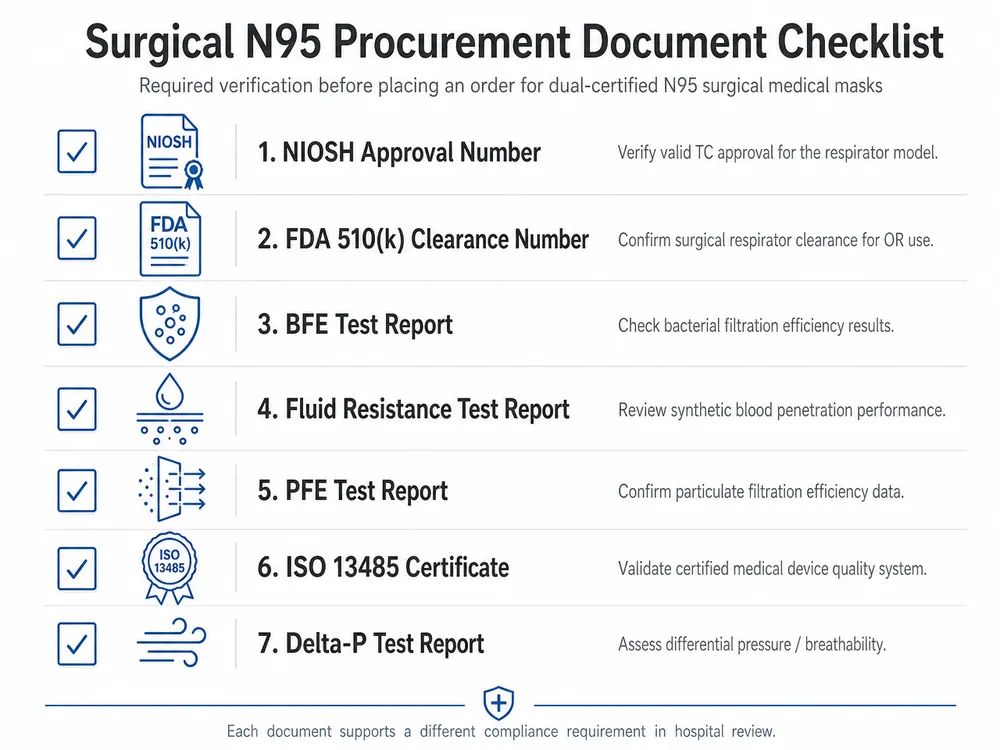
This is the part that most supplier content skips. Here's the document checklist that should accompany any sourcing decision for a surgical N95.
1. NIOSH approval number Every NIOSH-approved respirator has a unique approval number in the format TC-84A-XXXX. Verify it against the NIOSH Approved Respirators list on the CDC website. If the number isn't on that list, the product is not NIOSH-approved, regardless of what the packaging says.
2. FDA 510(k) clearance number Format: K followed by six digits (e.g., K123456). Verify it in the FDA 510(k) database. The database entry will show the device name, the applicant, and the clearance date. Confirm the device name matches what you're ordering.
3. BFE test report Request the third-party lab report showing BFE ≥98%. The report should identify the test standard (ASTM F2101 or equivalent), the test date, the lot or batch tested, and the lab name. In-house test reports from the manufacturer alone are not sufficient for hospital procurement review.
4. Fluid resistance test report ASTM F1862 test report showing the result at the relevant pressure level (120 mmHg minimum; 160 mmHg if your spec references ASTM F2100 Level 3). Same documentation requirements as BFE — third-party lab, test date, batch identification.
5. PFE test report Particulate filtration efficiency ≥95% at 0.3 µm. This is the NIOSH-equivalent performance parameter confirmed by the 510(k) submission, but request the test report separately so you have it for your own compliance file.
6. ISO 13485:2016 certificate This is the quality management system certificate for medical device manufacturing. Hospital GPO audits and institutional procurement reviews increasingly require it. It tells you the manufacturer's QMS has been audited by a notified body — not just that they claim to have a quality system.
7. Delta-P / breathability test report ≤5.0 mm H₂O/cm² under the FDA surgical standard. This matters for clinical acceptance — masks that fail breathability requirements get rejected by clinical staff regardless of filtration performance.
(A note on CE documentation: CE marking under EU MDR is a separate regulatory pathway and does not substitute for FDA 510(k) clearance in US procurement. We've had buyers present CE technical files to US hospital procurement teams and get rejected. The two systems are not interchangeable.)
Common sourcing mistakes that create compliance exposure
Three patterns come up repeatedly when buyers run into problems with surgical N95 procurement.
Accepting NIOSH approval as sufficient for OR use. The NIOSH number is real and verifiable, so it creates a false sense of compliance. The missing piece — FDA 510(k) clearance — doesn't show up until the product reaches clinical review. By then, the order is already in the warehouse.
Missing the fluid resistance data entirely. Fluid resistance is the parameter that most clearly separates a surgical N95 from an industrial N95, and it's the one most often absent from supplier documentation packages. Some suppliers will provide BFE and PFE data but have no ASTM F1862 test report because the product was never tested for fluid resistance. Ask for it specifically, not as part of a general "test reports" request.
Conflating CE marking with FDA clearance for US hospital supply. CE under EU MDR is a rigorous standard. It is not FDA clearance. US hospital procurement systems are built around FDA device classification, and a CE-only product will not pass a US GPO compliance review regardless of its European regulatory status.
Sourcing from suppliers who list "surgical N95" without a 510(k) number. If a supplier's product page or catalog lists a surgical N95 but cannot provide a 510(k) clearance number on request, the surgical designation is marketing language, not a regulatory classification. The product may perform well — but it cannot be documented as a surgical N95 for hospital procurement purposes.
How eztio's dual-certified N95 surgical mask meets the spec
Our N95 Surgical Medical Mask carries both NIOSH approval and FDA 510(k) registration. That's the baseline. What matters for sourcing confidence is how we maintain the spec across production batches.
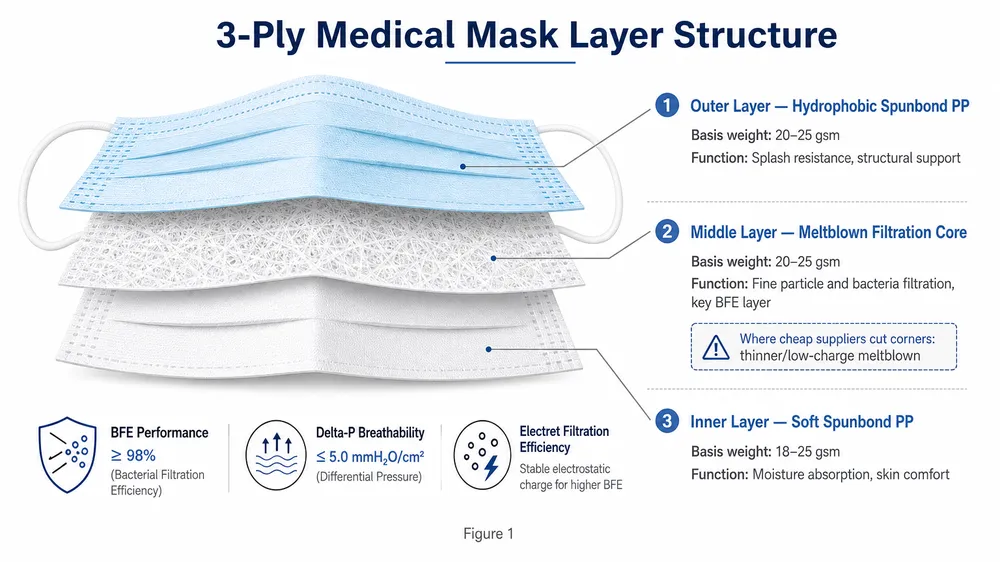
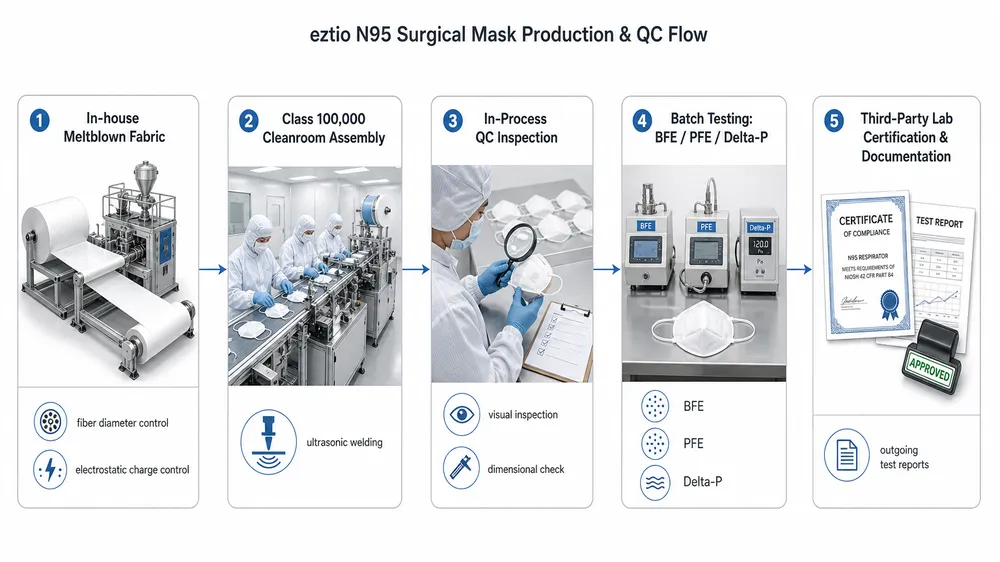
The filtration layer is the variable that determines whether an N95 actually performs at ≥95% PFE. Most mask factories buy meltblown nonwoven fabric from outside suppliers — which means their filtration performance depends on a third party's consistency. We produce our own meltblown fabric in-house. We set the fiber diameter, basis weight, and electrostatic charge level to match the filtration target. When we say ≥95% PFE, we're not relying on a fabric supplier's certificate of conformity. We're controlling the parameter at the source.
Our Class 100,000 (ISO 8) cleanroom manufacturing environment satisfies the facility standards referenced in surgical device procurement specs. Particle counts are monitored continuously. Access is controlled. This isn't a cleanroom designation we maintain for marketing purposes — it's a requirement for producing a product that passes FDA medical device facility standards.
The ISO 13485:2016 QMS is the documentation backbone that hospital and GPO procurement audits require. It covers design controls, risk management, traceability, and corrective action processes. When your procurement team or a hospital compliance committee asks for a supplier audit package, ISO 13485 is what makes that package credible. We've been through multiple surveillance audit cycles and can provide current certificate documentation.
For each production batch, our in-house QC lab runs BFE, PFE, and Delta-P testing before the batch ships. We then submit to third-party labs for the certification documentation that travels with your order. The in-house testing catches problems before they become shipment problems — a batch that fails internal BFE testing gets pulled and investigated, not shipped and sorted out later. (We've had batches fail internal testing. That's the point of running the test. The alternative is discovering the failure at your customer's receiving dock.)
The documentation package we provide with each order includes: NIOSH approval documentation, FDA 510(k) clearance number, third-party BFE/PFE/fluid resistance/Delta-P test reports, ISO 13485 certificate, and certificate of conformity. Everything your import documentation and hospital procurement review will require is prepared before the shipment leaves our facility.
You can review our full certifications documentation or go directly to our N95 Surgical Medical Mask product page for specifications.
Frequently asked questions
Can a NIOSH-approved N95 be used in surgery if the hospital approves it?
Hospitals can make internal policy decisions, but a NIOSH-only N95 cannot be documented as a surgical N95 under FDA device classification. For procurement purposes — GPO contracts, institutional supply agreements, and import documentation — the product must carry FDA 510(k) clearance to be classified as a surgical respirator. Some facilities use NIOSH-only N95s in non-surgical clinical settings, but that's a different use case from OR use.
Does ASTM F2100 Level 3 certification mean a mask is also a surgical N95?
No. ASTM F2100 Level 3 is a performance standard for surgical masks, not for respirators. A mask meeting F2100 Level 3 has high fluid resistance and BFE, but it has no particulate filtration requirement equivalent to N95. A surgical N95 must meet both the respirator standard (NIOSH 42 CFR Part 84) and the surgical device standard (FDA 510(k)). F2100 Level 3 is relevant as a fluid resistance benchmark within the 510(k) submission, but it doesn't replace either credential.
What's the minimum order quantity for a dual-certified surgical N95 from eztio?
Standard SKUs start at 50,000 pieces. For buyers entering a new market or running a trial program before a larger institutional tender, that's a workable entry point. If your volume requirement is significantly higher or you need custom packaging for a private-label program, send us an RFQ with your target quantity and delivery market and we'll confirm lead time and documentation package.
If a supplier has FDA 510(k) registration but not NIOSH approval, is the product a surgical N95?
No. FDA 510(k) clearance for a surgical N95 requires the manufacturer to demonstrate that the product meets NIOSH N95 filtration performance as part of the 510(k) submission. But the NIOSH approval number is a separate, independently issued credential. A product with 510(k) clearance but no NIOSH approval number is not a NIOSH-approved respirator and cannot be labeled or sold as one. Both numbers must be present and verifiable.
How do I verify a supplier's 510(k) clearance number?
Search the FDA 510(k) database at accessdata.fda.gov using the clearance number (format: K followed by six digits). The database entry will show the device name, the applicant company, the clearance date, and the predicate device. Confirm the device name matches the product you're ordering. If the number doesn't appear in the database, the clearance doesn't exist.