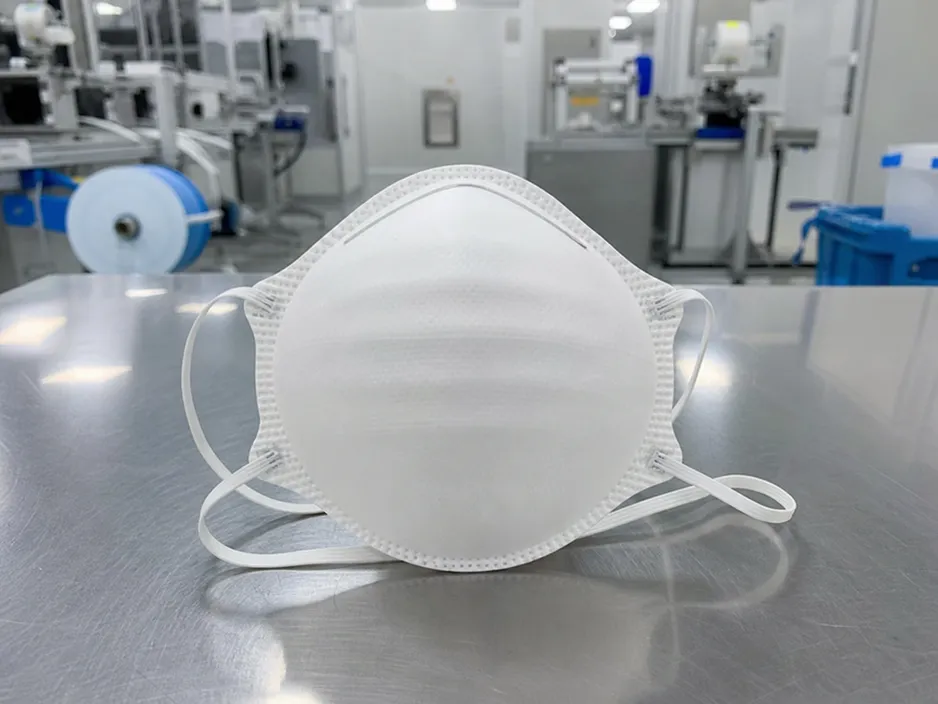
A hospital procurement team orders N95 respirators, the supplier provides NIOSH approval documentation, and the masks pass incoming inspection. Six months later, the infection control committee flags a compliance gap: the masks have no fluid resistance rating, and hospital policy requires ASTM F1862 compliance for any N95 used in splash-risk procedures. The order gets pulled from clinical use.
This happens more often than it should, and it's entirely avoidable. The confusion comes from a real regulatory gap: NIOSH approval and ASTM F1862 fluid resistance compliance are separate requirements, governed by separate agencies, and a mask can satisfy one without the other. If you're sourcing N95 Medical Masks for hospital environments, understanding where that line falls is the difference between a compliant order and a costly one.
What Fluid Resistance Actually Measures — and Why Filtration Alone Isn't Enough
An N95 respirator's filtration rating tells you how well the mask captures airborne particles. ASTM F1862 measures something different: whether the mask's outer surface resists penetration when struck by a high-velocity stream of synthetic blood.
These are two distinct failure modes. A mask with 99% BFE can still allow fluid to pass through the outer layer if the nonwoven fabric isn't engineered for splash resistance. In a surgical suite or trauma bay, that matters. Blood and body fluid splatter during procedures — sometimes at significant velocity — and a mask that filters aerosols but wicks fluid through to the wearer's face is not providing the protection the clinical environment requires.
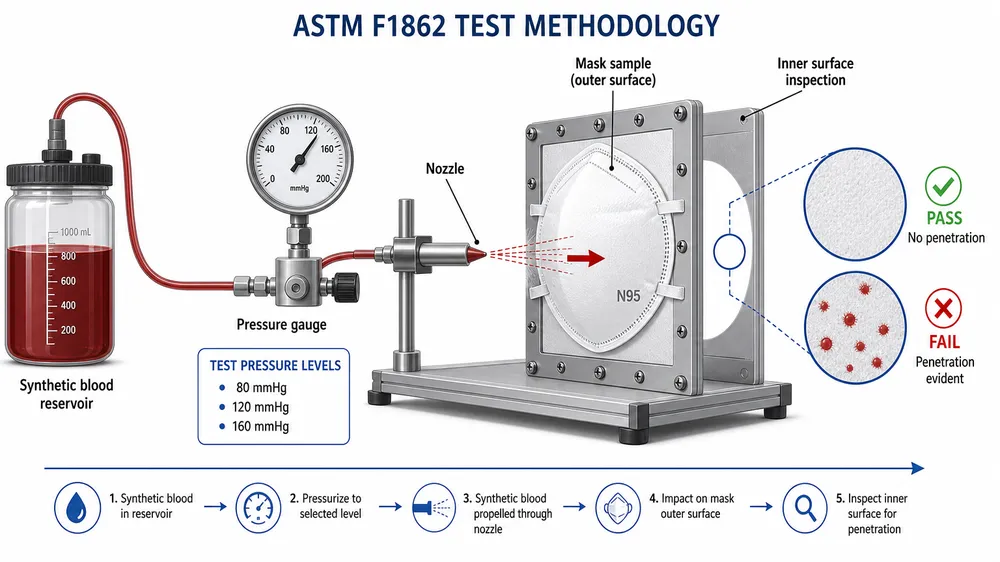
The ASTM F1862 test simulates this. A fixed volume of synthetic blood (calibrated to match human blood viscosity) is propelled at the mask's outer surface at a defined pressure. The mask passes if no synthetic blood penetrates to the inner surface. The test is run at three pressure levels, each corresponding to a different clinical exposure scenario.
(We run ASTM F1862 testing in-house before submitting to third-party labs. The failure mode we see most often in non-compliant masks isn't the outer layer — it's the seam areas and the nose wire channel, where the nonwoven layers are compressed or bonded. Those spots need specific attention during material selection and construction design.)

The Three ASTM F1862 Pressure Levels and Their Clinical Context
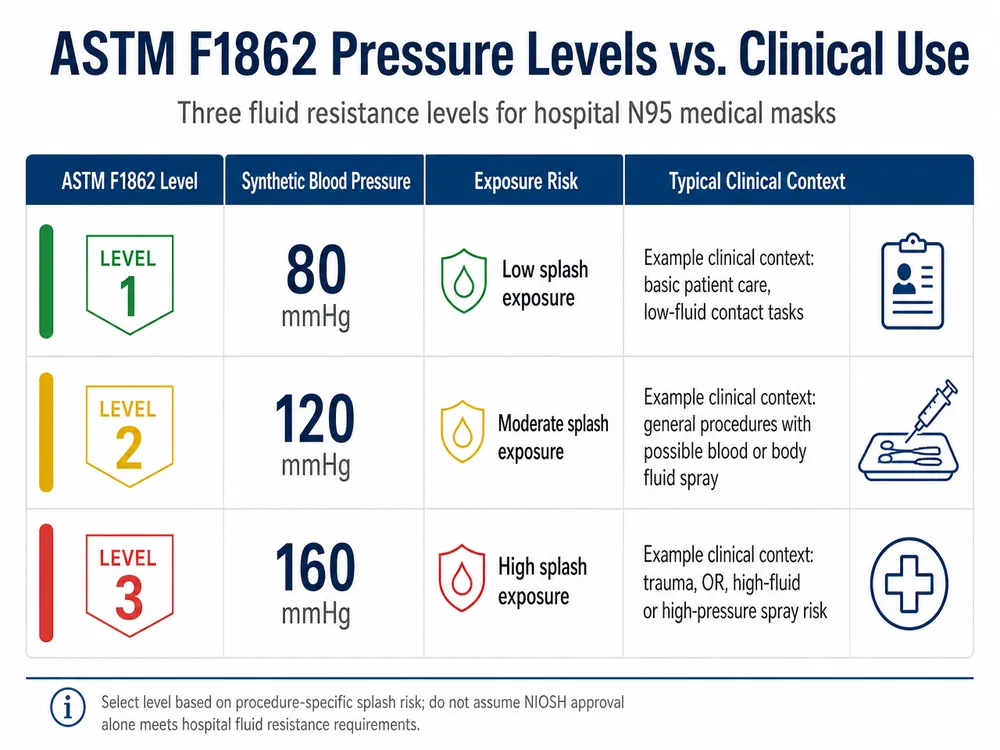
The standard defines three test pressures. Each maps to a different level of fluid exposure risk in clinical settings.
| ASTM F1862 Level | Test Pressure | Clinical Scenario |
|---|---|---|
| Level 1 | 80 mmHg | Low splash risk — routine patient care, general ward use, non-invasive procedures |
| Level 2 | 120 mmHg | Moderate splash risk — minor surgical procedures, emergency department, IV insertion |
| Level 3 | 160 mmHg | High splash risk — major surgery, trauma procedures, arterial line placement, high-pressure fluid exposure |
The 80 mmHg threshold approximates venous blood pressure. The 120 mmHg level corresponds roughly to normal systolic arterial pressure. The 160 mmHg level covers high-pressure arterial scenarios — the kind of fluid velocity you encounter during arterial access procedures or high-volume surgical bleeding.
For most hospital procurement decisions, the question isn't whether to require fluid resistance — it's which level the clinical environment demands. A general ward N95 program and a surgical suite N95 program have different requirements, and sourcing the same SKU for both is either over-specifying one application or under-protecting the other.
The practical procurement split we see most often: Level 1 for general clinical use and isolation precautions, Level 3 for OR and procedural environments. Level 2 sits in the middle and works for emergency departments where exposure risk is variable. Your infection control team should be driving that specification, not the supplier.
NIOSH N95 vs. Surgical N95: The Regulatory Split That Catches Buyers Off Guard
This is where most sourcing errors originate. NIOSH and the FDA regulate N95 respirators under different frameworks, and fluid resistance sits entirely on the FDA side.
NIOSH approval certifies that a respirator filters at least 95% of airborne particles at 0.3 microns under the 42 CFR Part 84 test protocol. NIOSH does not test or require fluid resistance. A NIOSH-approved N95 can have zero splash resistance and still carry a valid approval number.
FDA 510(k) clearance as a surgical mask or surgical respirator requires compliance with ASTM F2100 (for surgical masks) or the equivalent fluid resistance standard for surgical N95 respirators. This is where ASTM F1862 enters the picture. An N95 that carries both NIOSH approval and FDA 510(k) clearance as a surgical respirator has been tested for both filtration performance and fluid resistance — it's a dual-certified product.
The regulatory shorthand for this distinction:
| Designation | Governing Body | Fluid Resistance Required? |
|---|---|---|
| N95 Respirator | NIOSH (CDC) | No |
| Surgical Mask | FDA | Yes — ASTM F1862 |
| Surgical N95 Respirator | NIOSH + FDA | Yes — ASTM F1862 |
| KN95 | Chinese GB standard | No |
A standard NIOSH N95 is appropriate for airborne infection isolation — TB precautions, COVID-19 aerosol protection, respiratory isolation rooms. It is not the right product for splash-risk clinical procedures unless your hospital's infection control policy specifically permits it.
A Hospital N95 Medical Mask that carries both NIOSH approval and FDA 510(k) clearance as a surgical respirator covers both use cases. That dual certification is what hospital supply chains should be specifying for procedural environments — and it's what you need to verify before placing a bulk order.
What the ASTM F1862 Test Does Not Cover
Knowing the test's scope matters as much as knowing what it measures.
ASTM F1862 tests the mask's outer surface under a single, controlled fluid impact. It does not test:
- Fluid resistance after extended wear or repeated donning/doffing
- Resistance to chemical splashes or non-blood fluids (separate standards apply)
- Fluid resistance at the mask edges or seal perimeter
- Performance after the mask has been compressed, folded, or stored under pressure
The test is a pass/fail threshold at a defined pressure, not a continuous performance rating. A mask that passes Level 3 at 160 mmHg has demonstrated resistance under that specific test condition — it hasn't been certified for unlimited fluid exposure in any clinical scenario.
This matters for procurement because it means fluid resistance compliance is a minimum threshold, not a performance ceiling. For high-exposure surgical environments, the mask's construction quality, seal integrity, and material consistency across production batches are all factors that the ASTM F1862 number alone doesn't capture.
How to Verify Fluid Resistance Compliance When Sourcing from Overseas
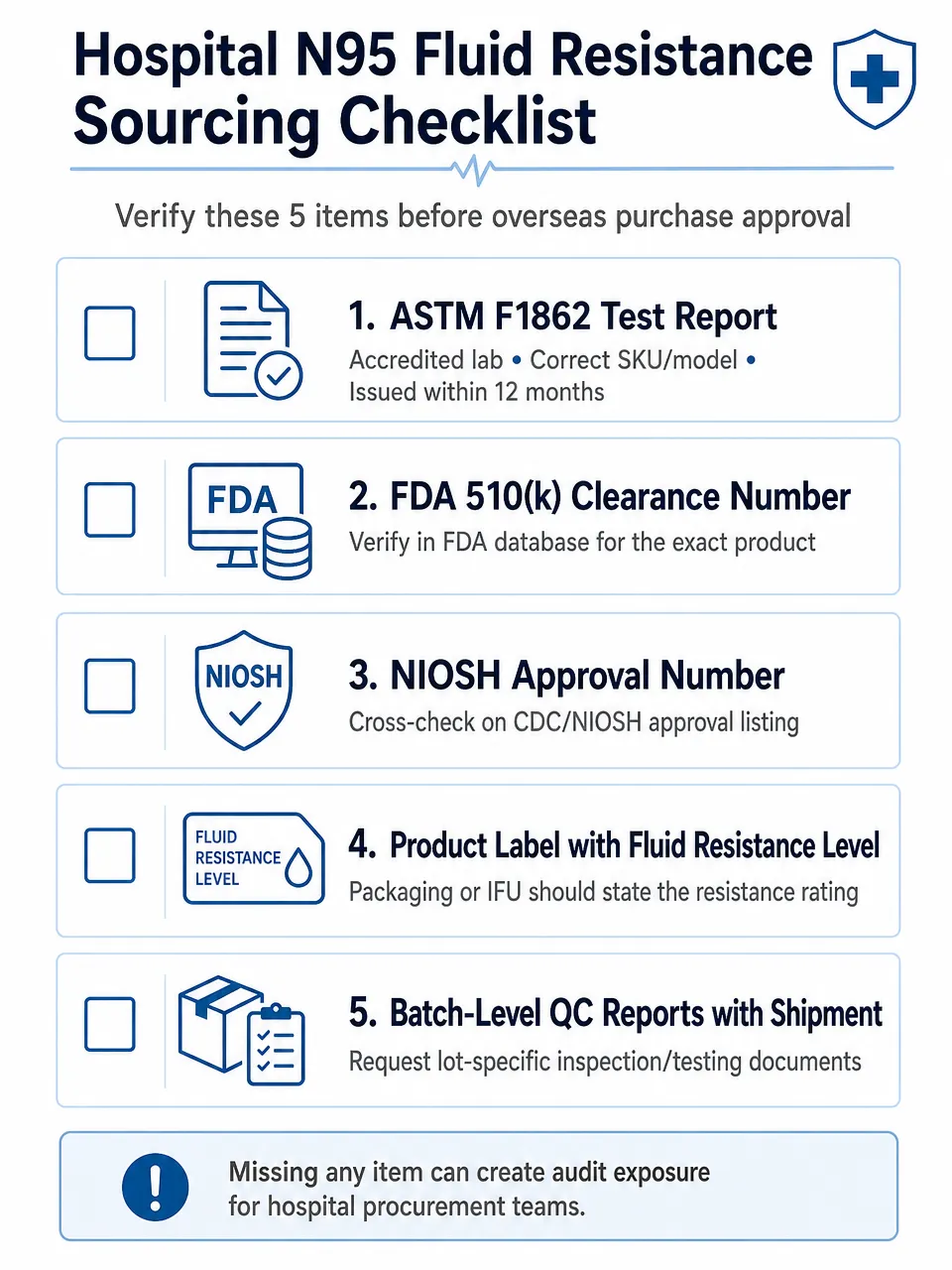
The documentation gap is where imported N95s most often fail hospital procurement audits. Here's what to request before committing to a bulk order.
1. ASTM F1862 test report from an accredited third-party lab
The report should specify the pressure level tested (80, 120, or 160 mmHg), the test date, the lab's accreditation body, and the specific product model tested. A test report for a different SKU or an older product version does not cover your current order. Ask for a report dated within the last 12 months on the exact product you're ordering.
2. FDA 510(k) clearance number
If the supplier claims surgical N95 designation, the product should have an FDA 510(k) clearance number you can verify directly on the FDA's 510(k) database. The clearance number is public record. If the supplier can't provide it, the surgical N95 claim is unverified.
3. NIOSH approval number
Separately, the NIOSH approval number should be verifiable on the CDC's NIOSH Approved Respirators database. NIOSH and FDA clearance are independent — both should be on file.
4. Product label and packaging confirmation
The fluid resistance level should appear on the product label or inner packaging. If it's not labeled, the product isn't marketed as fluid resistant regardless of what the test report says. Hospital procurement audits check labels, not just documentation files.
5. Batch-level test reports with shipment
A single certification test covers the product design. It doesn't guarantee that every production batch meets the same spec. Ask whether the supplier provides batch-level QC documentation — BFE, PFE, and fluid resistance data — with each shipment. This is the document that survives a compliance review when your hospital's infection control team audits the supply chain.
(We include batch-level test reports with every shipment as standard practice. It's not an add-on — it's part of the documentation package that travels with the order. Hospital procurement teams have told us this is the single most useful thing we do from a compliance standpoint.)
Why In-House Meltblown Production Changes the Fluid Resistance Equation
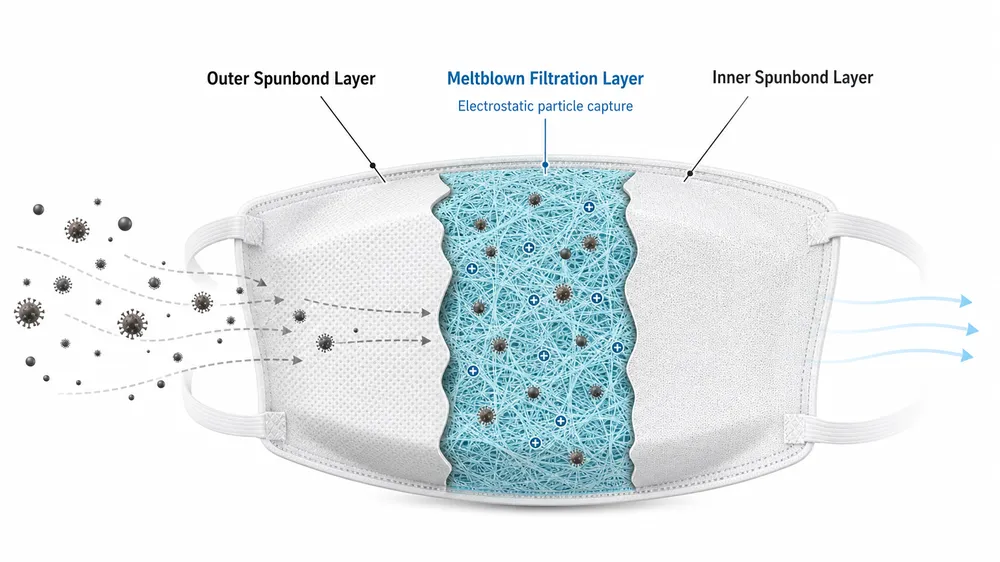
Most mask factories buy meltblown nonwoven fabric from external suppliers. That's a normal supply chain arrangement, but it creates a specific problem for fluid resistance compliance: the outer layer's fluid resistance performance depends on the fabric's construction, and if you're buying fabric from a third party, you're trusting their consistency batch to batch.
We produce our own meltblown layer. That means we control the fiber diameter, basis weight, and surface treatment parameters that determine both filtration efficiency and fluid resistance behavior. When we set a product to meet ASTM F1862 Level 3, we're specifying the meltblown parameters to achieve that — not hoping the fabric supplier shipped the right roll.
This matters for your sourcing decision in a specific way: BFE performance and fluid resistance are both functions of the meltblown layer's construction. A factory that controls its own meltblown production can guarantee both properties together. A factory sourcing meltblown externally can test the finished product, but they can't control the upstream variable that determines whether the test passes.
We've been running in-house meltblown production since we made the vertical integration decision around 2016. The consistency improvement in our BFE test results was measurable within the first production quarter. Fluid resistance compliance followed the same pattern — once we controlled the material, the test results stabilized.
Our FDA 510(k) registration and CE (EU MDR) certification cover both the US and EU fluid resistance documentation requirements from a single supplier. If you're distributing into both markets, that's one supplier relationship, one documentation package, and one audit trail — rather than managing separate suppliers for each regulatory environment.
Industrial N95 vs. Hospital N95: The Fluid Resistance Divide
One question that comes up regularly in sourcing conversations: can an industrial N95 be used in hospital settings?
The short answer is no, for splash-risk environments. The longer answer explains why.
Industrial N95 respirators are NIOSH-approved for occupational airborne hazard protection — construction dust, industrial aerosols, certain chemical vapors. They meet the same 95% filtration threshold as hospital N95s. What they don't have is ASTM F1862 fluid resistance testing, because industrial environments don't require it.
The performance gap isn't in filtration. It's in the mask's behavior when exposed to blood or body fluids. An industrial N95 may or may not resist fluid penetration — the manufacturer has no obligation to test or certify it for that property. Using it in a surgical or procedural environment means accepting an unknown fluid resistance performance, which is not an acceptable risk posture for hospital infection control.
| Property | Industrial N95 | Hospital/Surgical N95 |
|---|---|---|
| NIOSH Filtration (≥95% PFE) | Yes | Yes |
| ASTM F1862 Fluid Resistance | Not required | Required |
| FDA 510(k) Clearance | Not required | Required for surgical designation |
| Appropriate for OR/Procedural Use | No | Yes |
| Appropriate for Airborne Isolation | Yes | Yes |
The procurement implication: if your hospital uses a single N95 SKU across all clinical environments to simplify supply chain management, that SKU needs to be a surgical N95 with ASTM F1862 compliance. It costs more than an industrial N95, but it covers every clinical use case without creating a compliance gap in procedural areas.
Frequently Asked Questions
Does every N95 used in a hospital need ASTM F1862 fluid resistance compliance?
No. NIOSH-approved N95 respirators without fluid resistance are appropriate for airborne infection isolation — respiratory isolation rooms, TB precautions, aerosol-generating procedures where fluid splash is not a primary risk. ASTM F1862 compliance is required when the clinical environment involves blood or body fluid splash exposure: surgical suites, trauma bays, procedural areas, and emergency settings where fluid exposure is likely. Your hospital's infection control policy should define which environments require fluid-resistant N95s.
What is the difference between ASTM F1862 and ASTM F2100?
ASTM F2100 is the performance standard for surgical masks — it covers fluid resistance (using ASTM F1862 as the test method), bacterial filtration efficiency, differential pressure, and flammability. ASTM F1862 is the specific test method for fluid resistance that feeds into ASTM F2100. When a surgical N95 claims ASTM F2100 compliance, it has passed ASTM F1862 fluid resistance testing as part of that standard.
Can I verify a supplier's ASTM F1862 test report myself?
You can verify the testing laboratory's accreditation through the lab's accreditation body (NVLAP, A2LA, or equivalent). You can verify the FDA 510(k) clearance number directly on the FDA's 510(k) database at fda.gov. You can verify the NIOSH approval number on the CDC's NIOSH Approved Respirators database. The test report itself is a supplier-provided document — the verification comes from cross-referencing the lab accreditation and the regulatory clearance numbers, not from the report alone.
What fluid resistance level should I specify for a hospital-wide N95 program?
If you're running a single SKU across all clinical environments, specify Level 3 (160 mmHg). It covers every clinical scenario including high-pressure surgical environments, and it doesn't create a compliance gap if masks are used outside their intended area. If you're running separate SKUs by department, Level 1 is sufficient for general ward and isolation use; Level 3 for OR and procedural areas. The cost difference between levels is real but modest — the compliance risk of under-specifying is larger.
Does fluid resistance degrade over time or with storage?
ASTM F1862 tests the mask at the time of manufacture. Fluid resistance can degrade with improper storage — high humidity, UV exposure, or compression can affect the outer layer's performance. Standard medical mask storage conditions (cool, dry, away from direct light) maintain fluid resistance through the product's stated shelf life, typically 3-5 years. Masks stored outside these conditions should be retested before use in high-exposure environments.
What documentation should travel with a hospital N95 shipment for compliance purposes?
At minimum: the ASTM F1862 test report (specifying level and test date), the FDA 510(k) clearance certificate, the NIOSH approval certificate, a certificate of conformity, and batch-level BFE/PFE test data for the specific production lot. Some hospital procurement systems also require the ISO 13485 quality management certificate from the manufacturer. If you're importing into the EU, the CE technical file and EU MDR declaration of conformity are required separately.
For sourcing inquiries on hospital N95 medical masks with ASTM F1862 fluid resistance compliance, visit our Hospital N95 Medical Mask product page or Request Quote with your required pressure level, order quantity, and destination market.