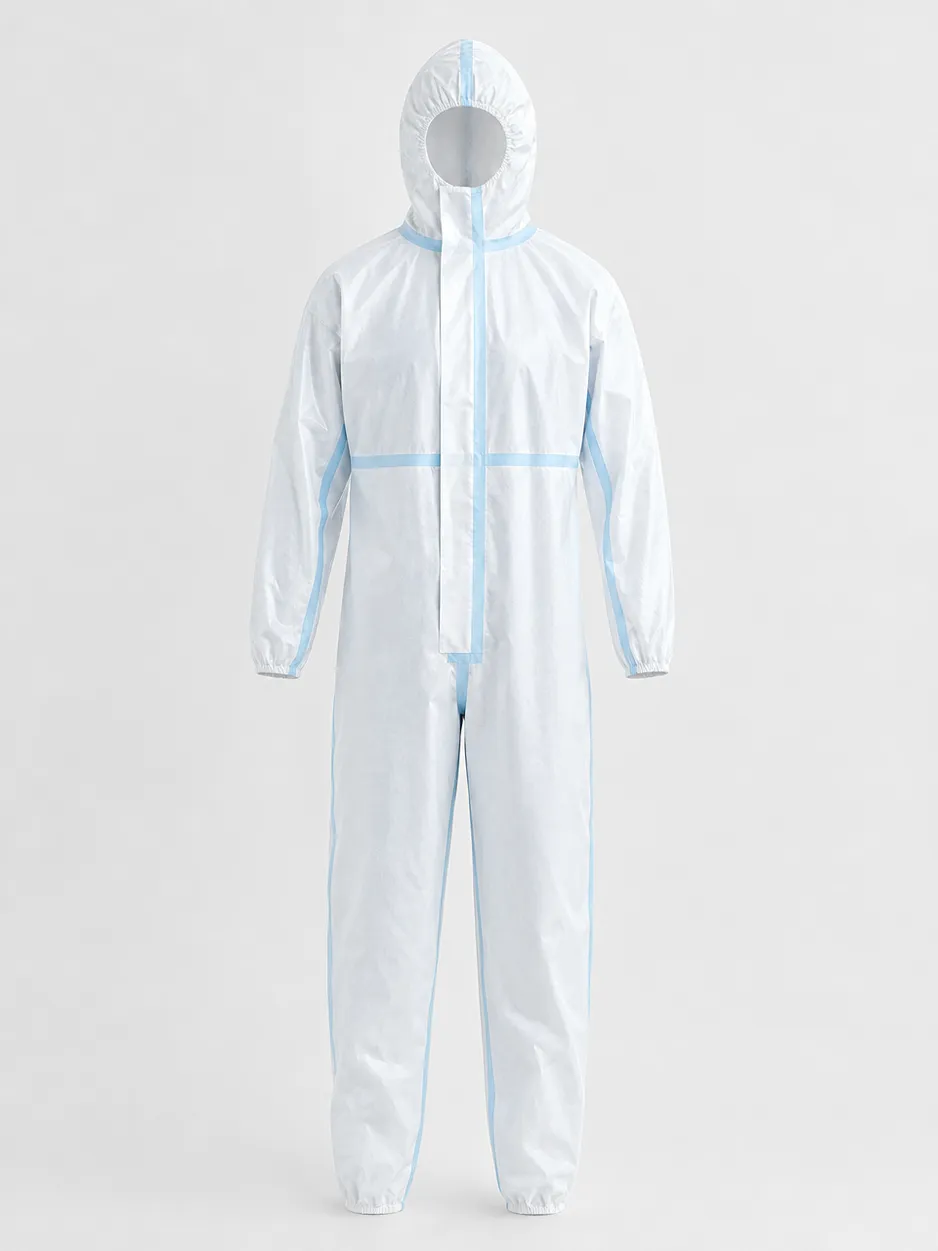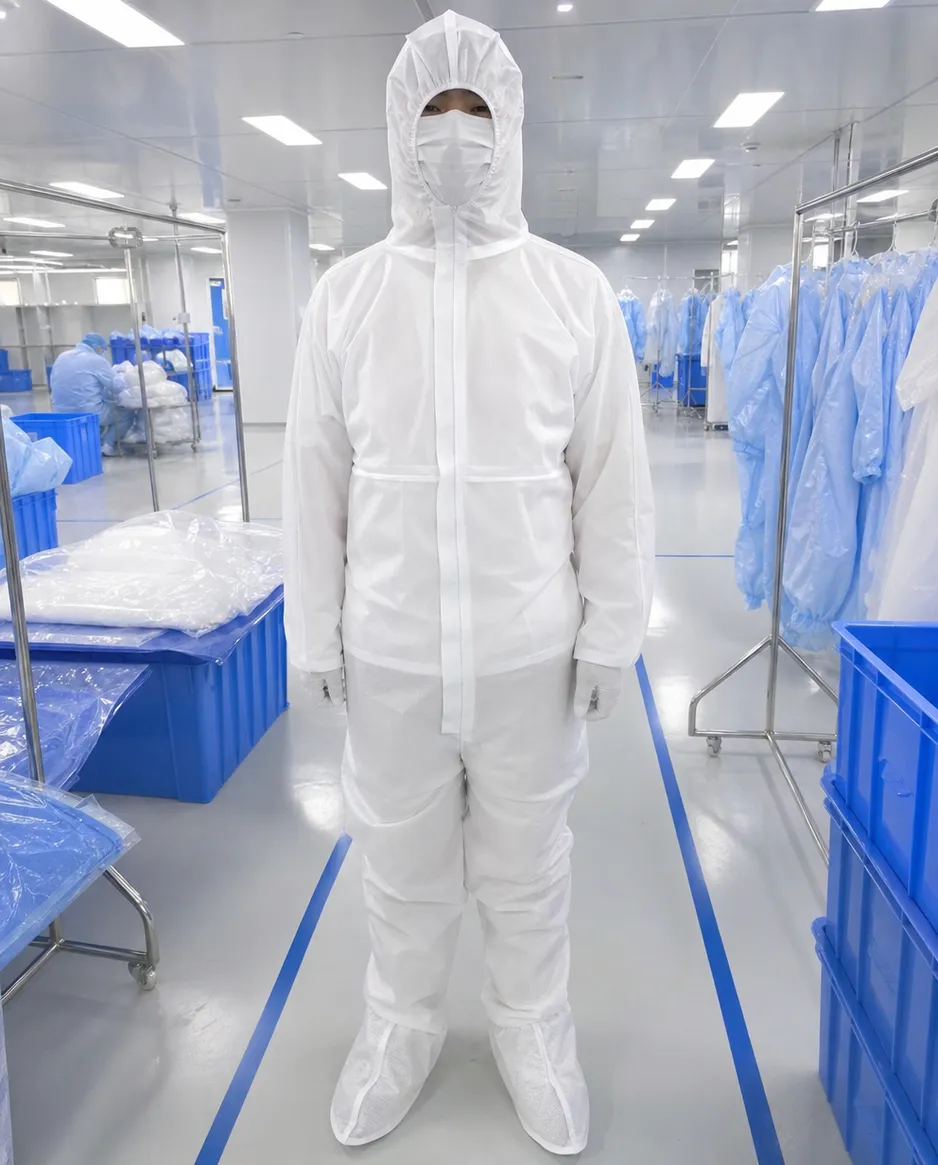
US healthcare procurement teams screening protective clothing suppliers right now are dealing with a specific problem: the market looks well-supplied on the surface, but the compliance documentation behind most listings is thinner than it appears. AAMI PB70 levels get cited without supporting test reports. FDA registration numbers appear on spec sheets but don't match the actual product configuration being quoted. And the pricing from domestic distributors — which looks straightforward — often obscures a 30–50% markup over what the same certified product costs at the factory gate.
This shortlist is built for buyers who are past the discovery phase and into the screening phase. You already know the major names. What you need is a clear picture of what each supplier model actually delivers — and where the gaps are.
We've organized this as a sourcing intelligence guide, not a theatrical ranking. The 10 suppliers below represent the realistic landscape for US buyers: domestic distributors with deep inventory, specialty manufacturers with niche compliance depth, and one factory-direct option with the certifications to compete on documentation, not just price.

What US Procurement Teams Actually Need to Verify Before Shortlisting
Before the supplier list, the criteria. Most sourcing failures in this category happen because buyers shortlist on brand recognition and price, then discover compliance gaps after samples arrive — or worse, after a shipment clears customs and fails a facility audit.
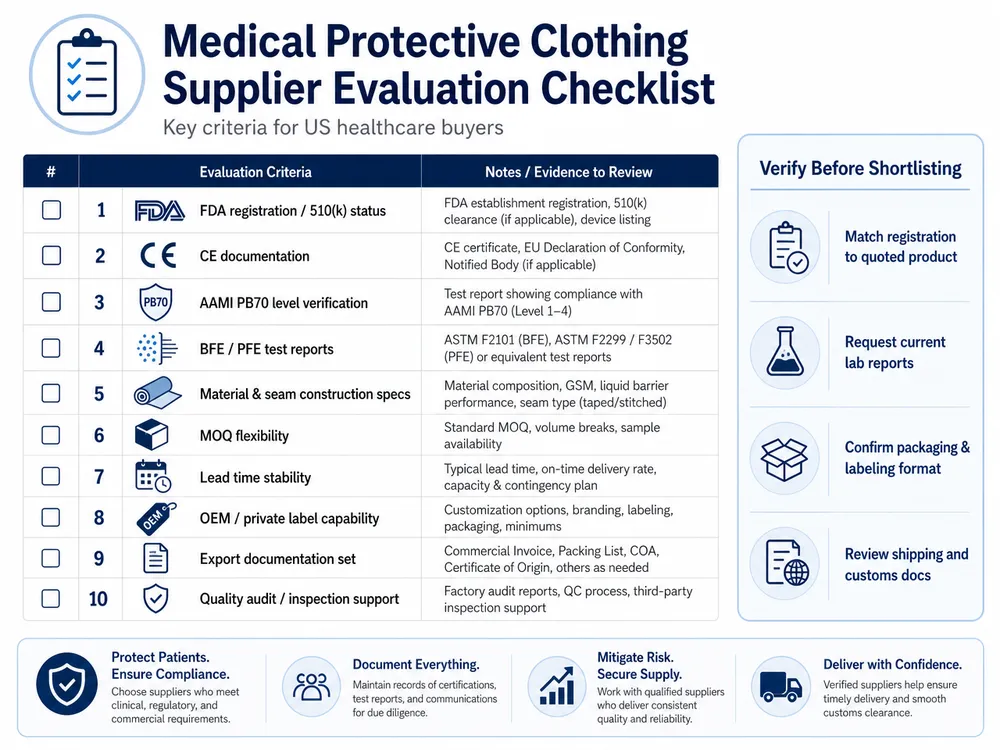
The evaluation framework that actually protects you:
FDA Registration Status — For medical protective clothing sold into US healthcare settings, FDA registration is the baseline. Specifically, look for FDA 510(k) clearance on the product type you're buying (isolation gowns, surgical gowns, coveralls). A supplier can be FDA-registered as a facility without having 510(k) clearance on the specific product. Verify the 510(k) number against the FDA device database, not just the supplier's spec sheet.
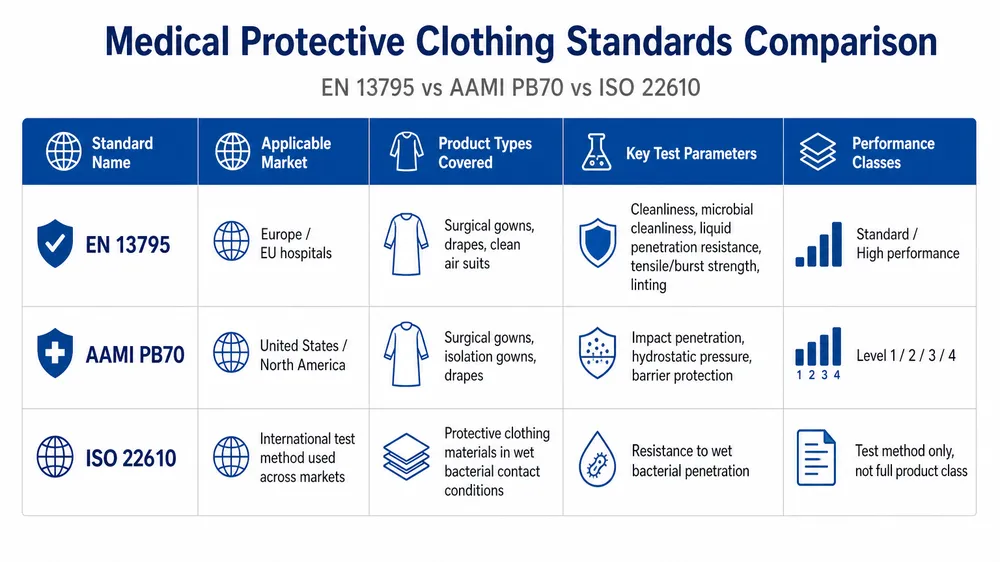
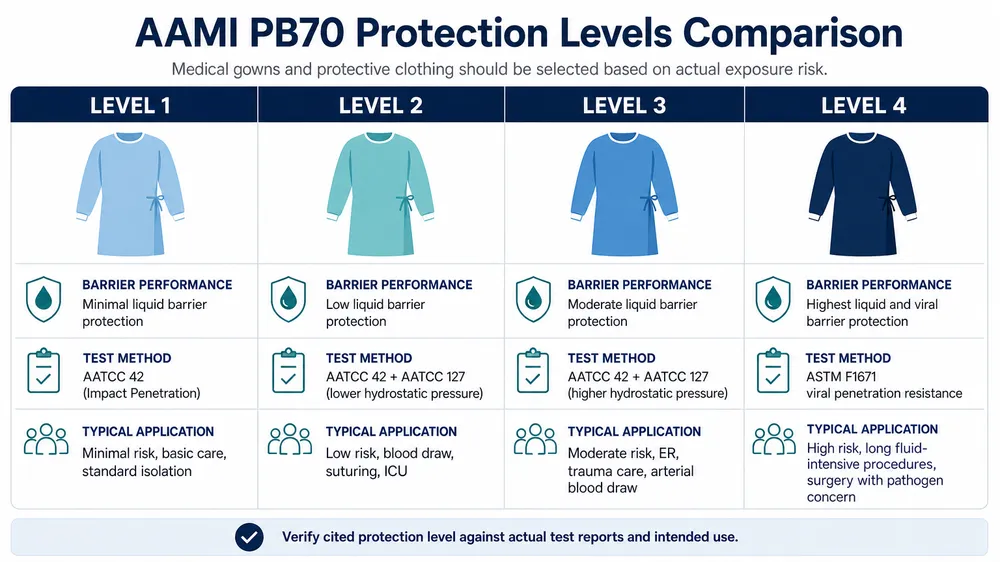
AAMI PB70 Level Compliance — The AAMI PB70 standard defines four barrier protection levels for liquid barrier performance. Level 1 covers minimal risk; Level 4 covers the highest fluid exposure risk. Most hospital procurement specs will call out a specific level. Get the test report, not just the claim — the test report will show the actual hydrostatic pressure resistance and impact penetration results that determine the level rating.
ISO 13485:2016 Certification — This is the medical device quality management standard. A supplier with ISO 13485 has documented risk management, design controls, and traceability built into their production system. A supplier with only ISO 9001 has a general quality system — useful, but not the same discipline. For hospital and institutional procurement, ISO 13485 is increasingly a hard requirement.
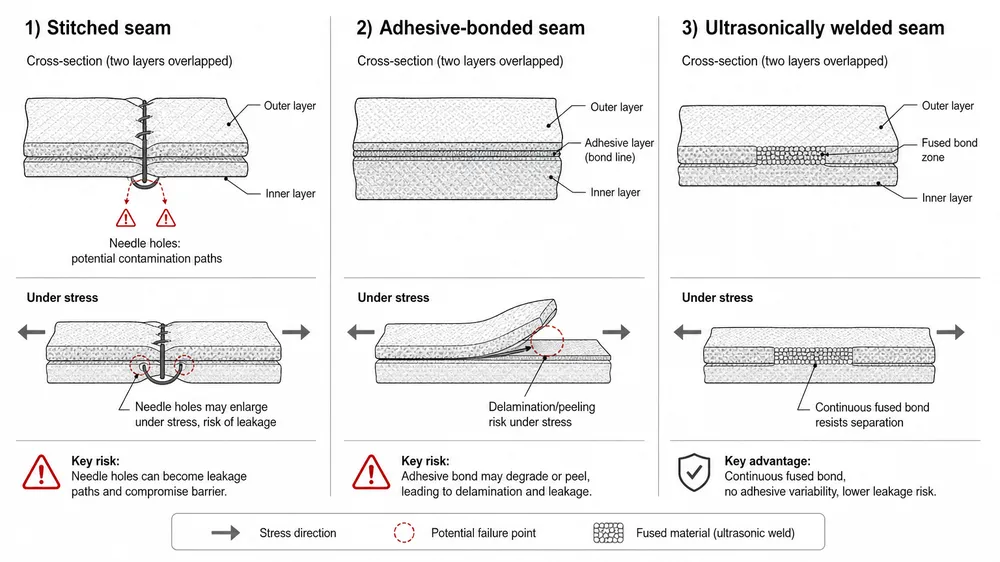
Seam Construction and Barrier Integrity — This is the detail most buyers miss. (David Fang's signature observation: the seam is where most protective clothing fails, and it's the last thing buyers check before placing a bulk order.) Ask specifically whether seams are sewn-only, sewn-and-taped, or ultrasonically welded. For AAMI Level 3 and Level 4 applications, taped or welded seams are required. A supplier quoting Level 3 gowns with sewn-only seams is either misrepresenting the product or hasn't tested it properly.
MOQ and Trial Order Flexibility — Domestic distributors typically have no MOQ on catalog items. Factory-direct suppliers will have minimums — the question is whether those minimums are workable for your procurement cycle. A 50,000-piece MOQ on a standard SKU is manageable for most institutional buyers; a 500,000-piece minimum is not a trial order, it's a commitment.
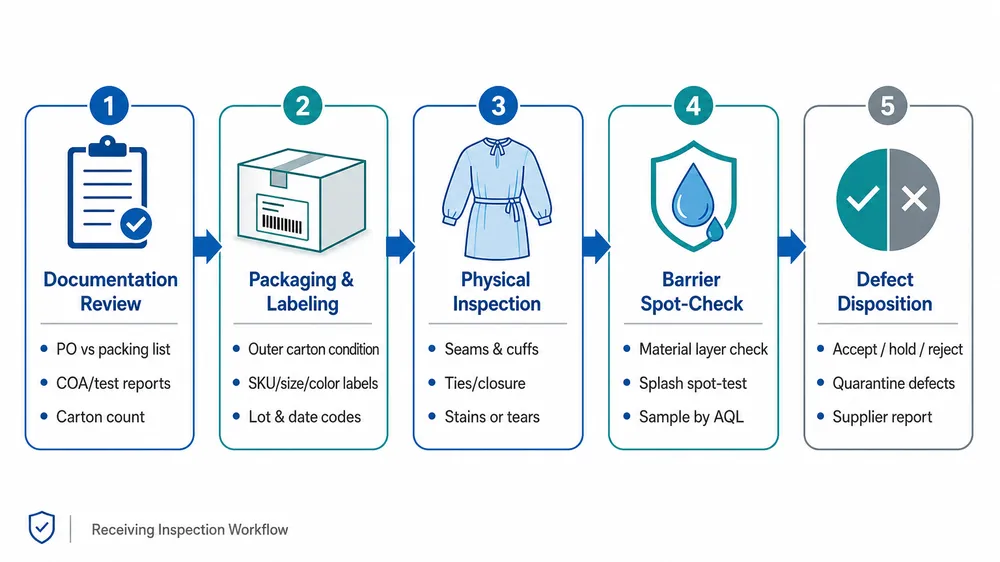
Export Documentation Package — For factory-direct imports, the documentation package determines whether your shipment clears customs cleanly. You need: Certificate of Conformity, test reports from an accredited lab, packing list, and any market-specific declarations. Ask for a sample documentation package before you place an order — a factory that can't produce a clean sample package will not produce a clean shipment package.
The 10 Suppliers: A Realistic Sourcing Landscape
These 10 companies represent the actual market structure US buyers are navigating. The first seven are domestic suppliers — distributors, specialty manufacturers, and integrated healthcare supply companies. The last three include international manufacturers with verified US market credentials. We've kept descriptions conservative where detailed public information is limited.
1. Medline Industries — medline.com
Medline is the largest privately held manufacturer and distributor of medical supplies in the US. Their protective clothing range covers isolation gowns, surgical gowns, coveralls, and procedure packs across all AAMI PB70 levels. For US hospital systems, Medline's primary advantage is inventory depth and GPO contract coverage — if your facility is on a Group Purchasing Organization contract, Medline is likely already an approved vendor.
The trade-off: Medline operates as a distributor-manufacturer hybrid. Some products are manufactured in their own facilities; others are sourced and private-labeled. For buyers who need to trace a specific product back to a single manufacturing facility for compliance documentation, the supply chain can be less transparent than a direct factory relationship. Pricing reflects the full distribution infrastructure.
2. Cardinal Health — cardinalhealth.com
Cardinal Health is one of the largest healthcare supply chain companies in the US, with a protective clothing portfolio that spans disposable gowns, coveralls, and procedure drapes. Their At-A-Glance and Convertors product lines are widely stocked across hospital systems and surgery centers.
Cardinal Health's strength is logistics: national distribution centers, EDI ordering integration, and the ability to support emergency replenishment on short notice. For procurement teams managing just-in-time inventory, that infrastructure has real value. The cost structure reflects it — Cardinal Health pricing is distributor pricing, not factory pricing. For high-volume repeat procurement, the per-unit cost premium over factory-direct sourcing is significant.
3. Owens & Minor (Halyard Health) — owens-minor.com
Owens & Minor acquired Halyard Health's medical products division and continues to market protective clothing under the Halyard brand. Their AERO CHROME and MicroCool lines are well-established in surgical settings, with documented AAMI PB70 Level 4 performance for high-fluid-exposure procedures.
The Halyard brand carries genuine technical credibility in the surgical gown segment — the MicroCool fabric technology has a documented performance history in US operating rooms. For buyers sourcing specifically for surgical applications where Level 4 barrier performance is required, Halyard products are a defensible specification. The pricing is premium, and the MOQ structure is distributor-standard (no minimum on catalog items, but pricing tiers favor high-volume commitments).
4. Kimberly-Clark Professional — kcprofessional.com
Kimberly-Clark's professional division supplies protective clothing primarily to industrial and healthcare settings. Their KLEENGUARD line covers disposable coveralls, gowns, and protective apparel with a range of barrier performance levels. In healthcare, their products appear most frequently in non-surgical clinical settings and procedural areas rather than high-risk surgical environments.
Kimberly-Clark's distribution network is broad, and their products are available through most major healthcare distributors. For buyers sourcing protective clothing across both clinical and non-clinical facility areas, the ability to consolidate under one supplier has operational value. The product range skews toward lighter barrier protection (Levels 1–2) for most catalog items.
5. Ansell Healthcare — ansell.com
Ansell is an Australian-headquartered company with significant US market presence in protective clothing, gloves, and barrier apparel. Their MICROGARD and ALPHATEC lines cover chemical and biological protective coveralls, with certifications spanning EN 14126 (biological protection), EN 13034 (chemical splash), and NFPA standards.
For buyers sourcing protective clothing for biosafety, laboratory, or hazmat applications — rather than standard clinical isolation — Ansell's certification depth is relevant. Their products are distributed through US safety and industrial supply channels. For standard medical isolation gown procurement, Ansell is not the primary choice; their strength is in higher-specification protective apparel where chemical or biological barrier performance beyond AAMI PB70 is required.
6. Precept Medical Products — precept.com
Precept is a US-based manufacturer and distributor focused specifically on medical protective clothing — isolation gowns, surgical gowns, and procedure drapes. Unlike the large integrated supply companies, Precept's entire business is in this product category, which means their product development and compliance documentation tend to be more focused.
Their isolation gown range covers AAMI PB70 Levels 1–4, and they supply directly to hospitals, surgery centers, and long-term care facilities. For buyers who want a supplier whose core competency is protective clothing rather than a line item in a broader catalog, Precept is worth evaluating. MOQ and pricing are distributor-tier; they do not operate as a factory-direct source.
7. Encompass Group — encompassgroup.com
Encompass Group is a US-based manufacturer of healthcare textiles and disposable protective clothing, supplying hospitals, long-term care facilities, and outpatient settings. Their disposable gown and protective apparel lines are manufactured and distributed domestically, with a focus on the institutional healthcare market.
Encompass's positioning is mid-market: not the lowest price, but with domestic manufacturing credentials that matter for buyers whose procurement policies favor US-made products or who need shorter lead times than international sourcing allows. For facilities with "Buy American" procurement requirements or state-level sourcing mandates, Encompass is a relevant option.
8. Protective Industrial Products (PIP) — pipglobal.com
PIP is a US-headquartered distributor and private-label supplier of personal protective equipment, including disposable coveralls and protective clothing for both industrial and healthcare applications. Their healthcare-adjacent protective clothing range includes disposable coveralls and isolation gowns sourced from manufacturing partners in Asia and distributed through US safety and industrial channels.
PIP's strength is breadth of SKU and distribution reach. For buyers sourcing protective clothing alongside other PPE categories (gloves, eye protection, respiratory), PIP's consolidated catalog has operational convenience. Their protective clothing products are not primarily positioned for high-acuity clinical settings — the documentation depth for hospital procurement audits is lighter than dedicated medical device manufacturers.
9. DuPont Personal Protection — safespec.dupont.com
DuPont's Personal Protection division manufactures Tyvek and Tychem protective coveralls, which are widely used in healthcare, pharmaceutical, and industrial settings. Tyvek coveralls are a standard specification in many US hospital infection control programs, particularly for isolation and decontamination applications.
DuPont's manufacturing credentials are strong — Tyvek is a proprietary material with documented barrier performance, and the product line has a long compliance history in US healthcare. The limitation for standard medical protective clothing procurement is product range: DuPont's portfolio is coverall-focused, and their pricing reflects the premium material technology. For buyers needing isolation gowns or surgical gowns alongside coveralls, DuPont is a partial solution.
10. eztio (Gaomi Eztio Medical Technology Co., Ltd.) — eztio.com
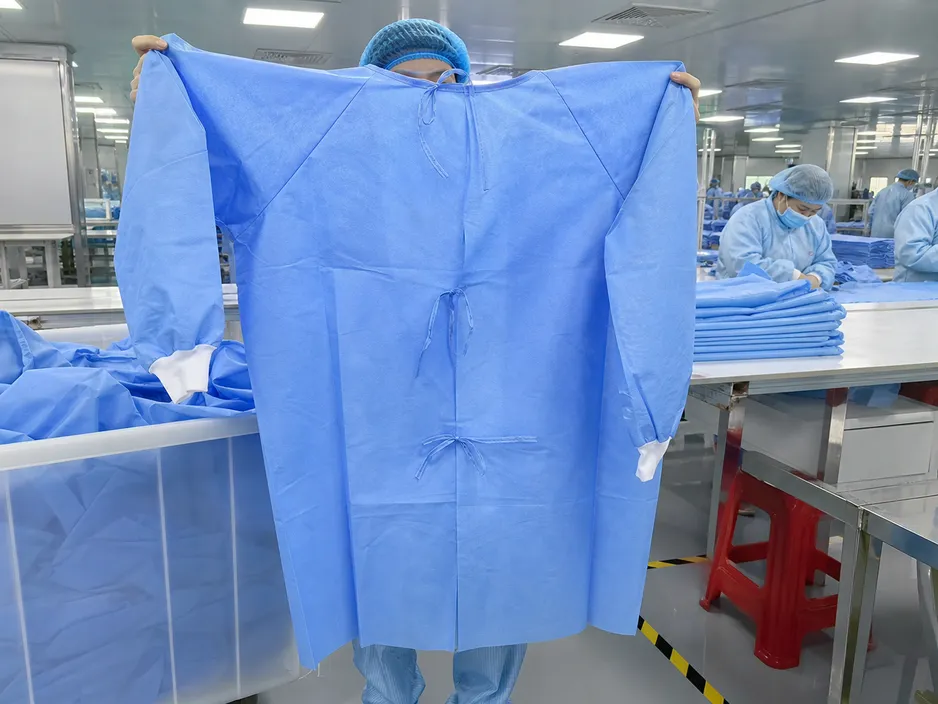
eztio is a factory-direct manufacturer based in Gaomi, Shandong, China, with FDA 510(k) registration, CE (EU MDR) clearance, and ISO 13485:2016 certification. We produce Medical Protective Clothing — isolation gowns, protective coveralls, and disposable protective apparel — in a Class 100,000 (ISO 8) cleanroom facility with 6 fully automated production lines.
The reason eztio belongs on a US buyer's shortlist is not price alone. It's the combination of verifiable regulatory credentials, in-house material control, and documentation capability that most factory-direct options in this category don't offer together. We'll cover this in detail in the section below.
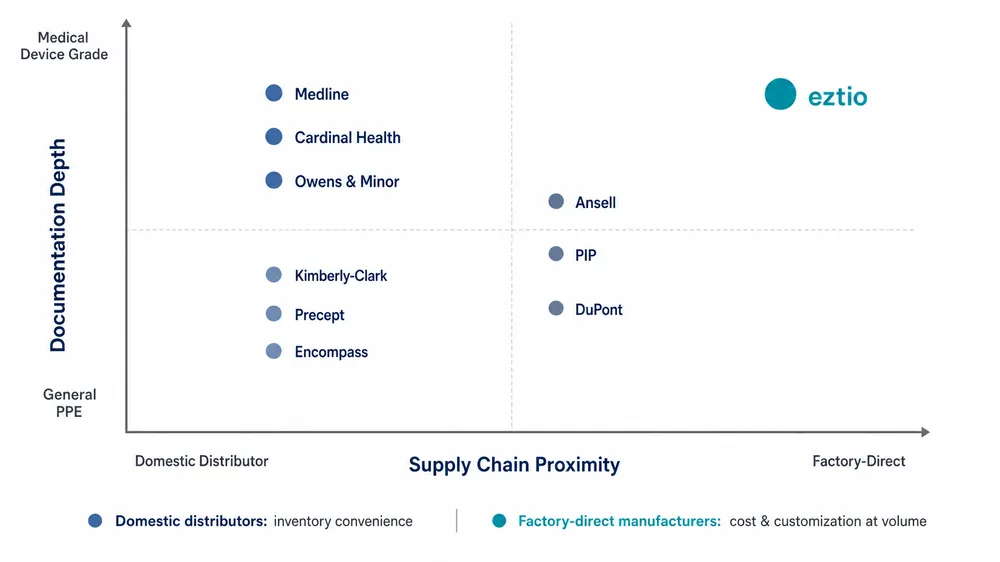
Factory-Direct vs. Domestic Distributor: What the Cost Structure Actually Looks Like
The pricing difference between domestic distributor and factory-direct sourcing is real, but it's not the whole story. Understanding where the cost goes — and where the risk sits — is what makes the trade-off decision defensible.
The domestic distributor model bundles several things into the unit price: warehousing, inventory carrying cost, sales infrastructure, and the convenience of net-30 terms with no import complexity. For urgent orders, small replenishment quantities, or facilities that can't absorb the lead time of international shipping, that bundle has genuine value. A hospital that needs 500 isolation gowns by Thursday is not a factory-direct buyer — they're a distributor customer, and that's the right answer for their situation.
The factory-direct model strips out the distribution layer. At 50,000 pieces and above, the landed cost difference on a standard AAMI Level 2 isolation gown typically runs 25–40% below domestic distributor pricing, depending on the specific product and current freight rates. That gap widens on higher-specification products (Level 3, Level 4) where the domestic distributor margin is larger. (We've seen buyers running 200,000-piece annual programs save enough on landed cost to fund a full private-label packaging program — the economics shift significantly at that volume.)
The variables that determine whether factory-direct makes sense for your procurement cycle:
| Factor | Domestic Distributor | Factory-Direct |
|---|---|---|
| Lead time | 1–5 business days | 20–35 days (sea freight) |
| MOQ | No minimum (catalog) | 50,000 pieces (standard SKU) |
| Unit cost at volume | Distributor-tier pricing | Factory-gate pricing |
| Documentation | Standard CoC | Full test reports + CoC + market declarations |
| Customization | Limited (catalog SKUs) | OEM/ODM available |
| Emergency replenishment | Yes | No |
| Compliance traceability | Distributor-managed | Direct factory relationship |
The honest answer: most institutional buyers running predictable annual volumes above 100,000 pieces should be running a hybrid model — factory-direct for planned procurement, domestic distributor for emergency buffer stock. The buyers who are paying distributor pricing on 100% of their volume are leaving margin on the table.
One documentation point that doesn't get enough attention: factory-direct sourcing from a certified manufacturer often produces better compliance documentation than domestic distributor sourcing, because you're getting the test reports directly from the production facility rather than a distributor's CoC that references a manufacturer you've never audited. For procurement teams that need to pass facility compliance audits, the traceability of a direct factory relationship is an asset, not a liability.
ISO 13485 vs. AAMI PB70: Why Both Matter and What Each Actually Covers
This is a compliance distinction that creates real procurement errors when it's misunderstood.
AAMI PB70 is a product performance standard. It defines the barrier protection levels for liquid resistance in medical gowns and protective clothing. When a product is rated AAMI PB70 Level 3, it means the fabric and construction have passed specific hydrostatic pressure and spray impact tests. AAMI PB70 tells you what the product does.
ISO 13485 is a quality management system standard. It defines how a manufacturer controls their production process, documents risk, manages design changes, and maintains traceability. ISO 13485 tells you how the product is made and whether the manufacturing system is capable of producing consistent results across batches.
You need both. A product with AAMI PB70 test reports but no ISO 13485 manufacturing system behind it may have passed the test on the specific batch submitted for certification — but there's no systematic guarantee that the next production run will perform the same way. A manufacturer with ISO 13485 but no AAMI PB70 test reports hasn't demonstrated that their product meets the barrier performance standard your facility requires.
(We see this gap most often with smaller Chinese factories that have ISO 9001 but not ISO 13485. The quality system exists, but it's not calibrated to medical device requirements. The difference shows up in batch-to-batch consistency — particularly in seam integrity and fabric basis weight uniformity.)
For US hospital procurement, the practical requirement is: ISO 13485 manufacturing system + AAMI PB70 product test reports + FDA 510(k) registration for the specific product type. All three. Not two out of three.
Why eztio Belongs on Your Factory-Direct Shortlist
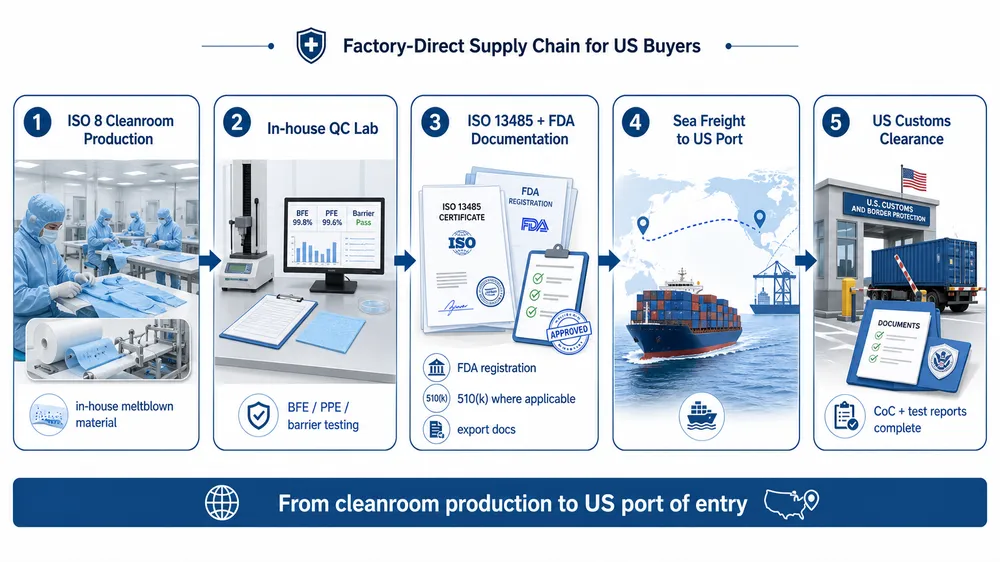
We're a mask manufacturer by origin — that's where eztio started in 2012. The protective clothing line came later, built on the same manufacturing infrastructure: Class 100,000 (ISO 8) cleanroom, ISO 13485:2016 quality system, and the same in-house material control that we apply to mask production.
The specific capabilities that matter for US buyers evaluating us as a factory-direct source:
FDA 510(k) + CE (EU MDR) dual clearance. Both registrations are maintained on our protective clothing products, not just our masks. For US import, the 510(k) registration means your customs documentation is clean from the first shipment. For buyers who also supply European markets, the CE (EU MDR) clearance means you're not managing two separate compliance tracks with two separate factories. We've handled FDA import documentation for multiple US customers and can walk your customs broker through the package before you place the order.
In-house meltblown nonwoven production. This matters for protective clothing the same way it matters for masks: the filtration and barrier layer is the performance-critical component, and most factories source it externally. We produce our own nonwoven materials, which means we control the fiber diameter, basis weight, and barrier properties at the source. When we quote a product at AAMI PB70 Level 3, the barrier performance is built into the material specification we're running — not dependent on a fabric supplier's batch consistency. (We've had buyers ask us to match a competitor's spec after a supply disruption. Because we control the material, we can adjust the production parameters to hit a specific hydrostatic pressure target. A factory buying fabric externally can't do that.)
Seam construction for barrier-critical applications. Our Medical Isolation Gown and Medical Protective Coverall lines use ultrasonic welding and heat-sealed seam tape on barrier-critical seam locations. Sewn seams are the standard in lower-cost production; sealed seams are what AAMI Level 3 and Level 4 applications actually require. We don't offer sewn-seam construction on products rated above Level 2 — the seam integrity test results don't support it, and we won't ship a product that can't pass the test it's rated for.
50,000-piece MOQ on standard SKUs. For a US buyer running a market-entry program or a trial order before committing to annual volume, 50,000 pieces is a workable number. It's enough to run a meaningful clinical evaluation across multiple facilities without requiring a full-year inventory commitment. Custom configurations — modified sizing, private-label packaging, non-standard barrier levels — typically require higher minimums, and we'll tell you that upfront.
Complete export documentation package. Every shipment includes: Certificate of Conformity, third-party test reports (BFE, PFE, barrier performance per AAMI PB70), packing list, and any market-specific declarations your customs broker or compliance team needs. We've shipped to US buyers enough times to know what FDA import records require, and we prepare the documentation package before the shipment leaves the factory — not after your customs broker asks for it.
Our Disposable Medical Protective Clothing range covers the standard SKUs most US institutional buyers need: isolation gowns in AAMI Levels 1–3, disposable coveralls, and procedure-specific configurations. OEM and private-label programs are handled in-house — artwork, packaging format, and label compliance for your target market.
Which Sourcing Route Fits Your Procurement Situation
The right answer depends on your order profile, not on which supplier has the best marketing.
Use a domestic distributor when:
- You need product within 1–5 business days
- Your order quantity is below 10,000 pieces
- You're managing emergency replenishment or unexpected demand spikes
- Your facility has a GPO contract that covers the product category
- Your procurement policy requires domestic sourcing
Use factory-direct sourcing when:
- Your annual volume is above 100,000 pieces and you're buying on a planned procurement cycle
- You need OEM or private-label packaging for your brand or distribution program
- You want direct traceability to the manufacturing facility for compliance audits
- You're building a new product line and need MOQ flexibility for market testing
- Your current distributor pricing is compressing margin on a product you're reselling or distributing
The hybrid model most institutional buyers should be running: Factory-direct for 70–80% of planned annual volume (lower unit cost, better documentation, OEM capability), domestic distributor for 20–30% emergency buffer (speed, no MOQ, immediate availability). The buyers who run 100% through distributors are paying for convenience they don't always need. The buyers who run 100% factory-direct are exposed on emergency replenishment.
If you're currently sourcing 100% through domestic distributors and your annual volume is above 100,000 pieces, the landed cost comparison on a factory-direct trial order is worth running. The documentation package from a certified factory-direct manufacturer will typically be more complete than what you're currently receiving through the distribution chain — and the unit economics at volume are not close.
Frequently Asked Questions
What AAMI PB70 level do most US hospitals require for standard isolation gowns?
Most US hospital isolation gown specifications call for AAMI PB70 Level 2 or Level 3. Level 2 covers low-risk patient care and general isolation; Level 3 covers moderate-risk procedures with potential for fluid exposure. Level 4 is specified for high-risk surgical procedures and situations with significant fluid exposure risk. The most common procurement error is defaulting to Level 1 for cost reasons in settings that actually require Level 2 — the barrier performance difference is significant, and the liability exposure if a Level 1 gown fails in a Level 2 application is not worth the unit cost savings.
What's the difference between ISO 13485 and FDA 510(k) for protective clothing?
ISO 13485 is a manufacturing quality system standard — it governs how a factory manages production, documentation, and risk. FDA 510(k) is a product clearance — it means the specific product has been reviewed by the FDA and cleared for sale as a medical device in the US market. A factory can have ISO 13485 without having 510(k) clearance on a specific product. For US hospital procurement, you need both: ISO 13485 on the manufacturing system and 510(k) clearance on the product you're buying. Verify the 510(k) number in the FDA's 510(k) database — the number on a spec sheet should match an active clearance for the product type and manufacturer.
Can factory-direct protective clothing from China pass US hospital procurement audits?
Yes, if the manufacturer has the right credentials. The audit criteria are the same regardless of where the product is manufactured: ISO 13485 quality system, FDA 510(k) clearance, AAMI PB70 test reports from an accredited lab, and a complete documentation package. A certified Chinese manufacturer with all four can produce documentation that passes a US hospital compliance audit. A domestic distributor selling product from an uncertified factory cannot. The geography of manufacturing is less important than the certification stack and documentation quality.
What MOQ is realistic for a factory-direct trial order of medical protective clothing?
50,000 pieces on standard SKUs is a workable trial order size for most institutional buyers. At that quantity, you can run a meaningful clinical evaluation across multiple facilities and generate enough usage data to make a volume commitment decision. Below 50,000 pieces, the economics of factory-direct sourcing (freight, documentation, import handling) typically don't justify the complexity versus buying from a domestic distributor. Above 200,000 pieces, the landed cost savings are significant enough that most buyers should be running factory-direct as their primary procurement channel.
How do sewn seams vs. sealed seams affect AAMI PB70 compliance?
Seam construction is the most commonly overlooked variable in protective clothing procurement. Sewn seams — even with tight stitch counts — create needle holes that compromise barrier integrity under fluid pressure. For AAMI PB70 Level 3 and Level 4 applications, the seam must be sealed (taped or ultrasonically welded) to maintain barrier performance at the rated hydrostatic pressure. A product claiming Level 3 or Level 4 with sewn-only seams either hasn't been properly tested or is misrepresenting the protection level. Always ask for the seam construction specification alongside the AAMI level claim.