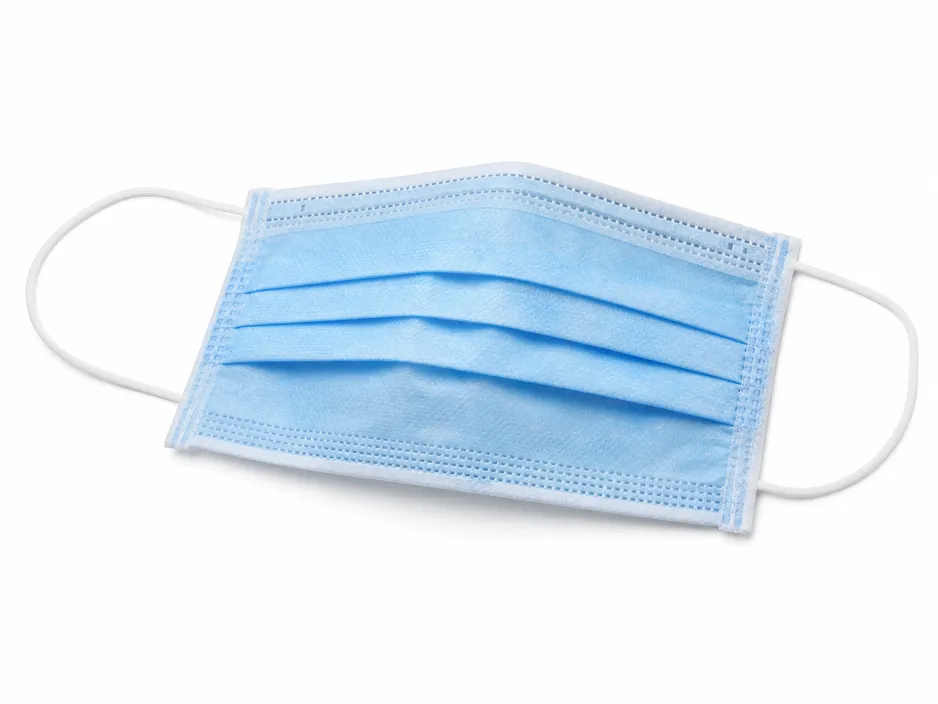
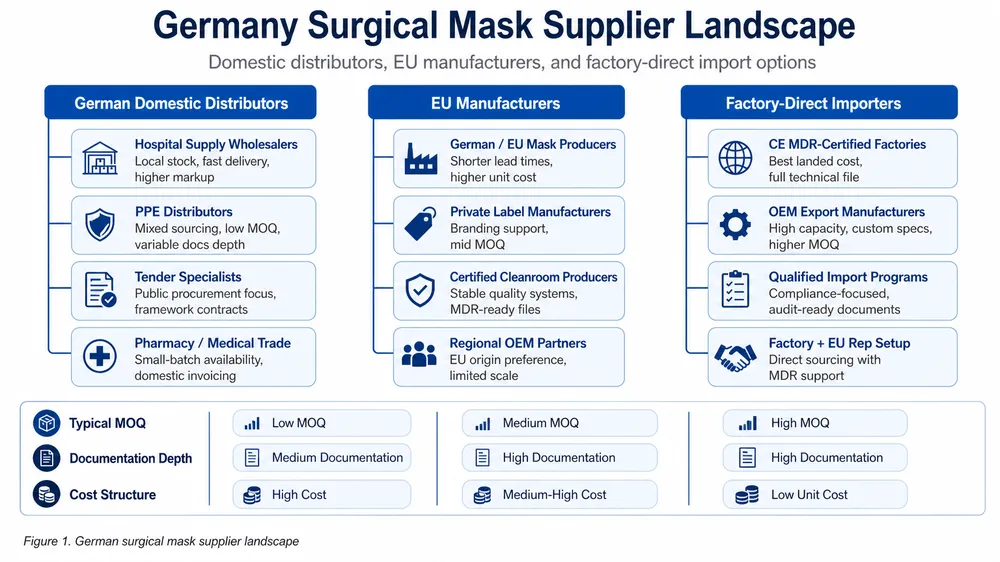
Germany runs one of the most compliance-demanding medical procurement environments in the EU. EN 14683 is the baseline, EU MDR documentation is non-negotiable for anything entering a hospital supply chain, and buyers who got burned by undocumented mask imports during 2020–2021 are now significantly more rigorous about what they accept. That's the context this list is built for.
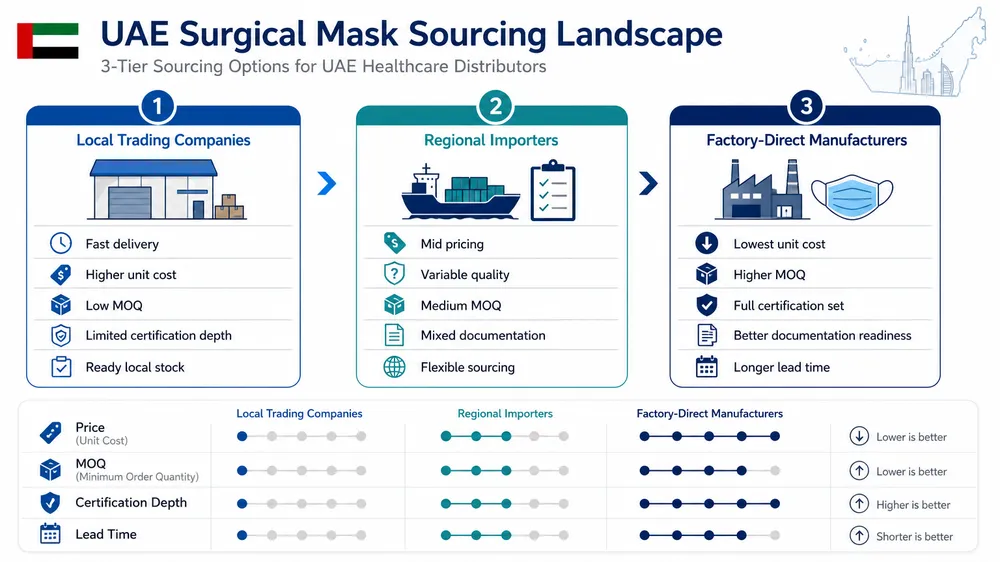
This isn't a ranked popularity contest. It's a sourcing landscape map — domestic distributors, EU-based manufacturers, and one factory-direct alternative — with honest notes on what each supplier model is actually good for and where the trade-offs land. The goal is to help you shortlist faster and ask better questions before you commit to a supplier relationship.

What German Buyers Actually Need from a Surgical Mask Supplier
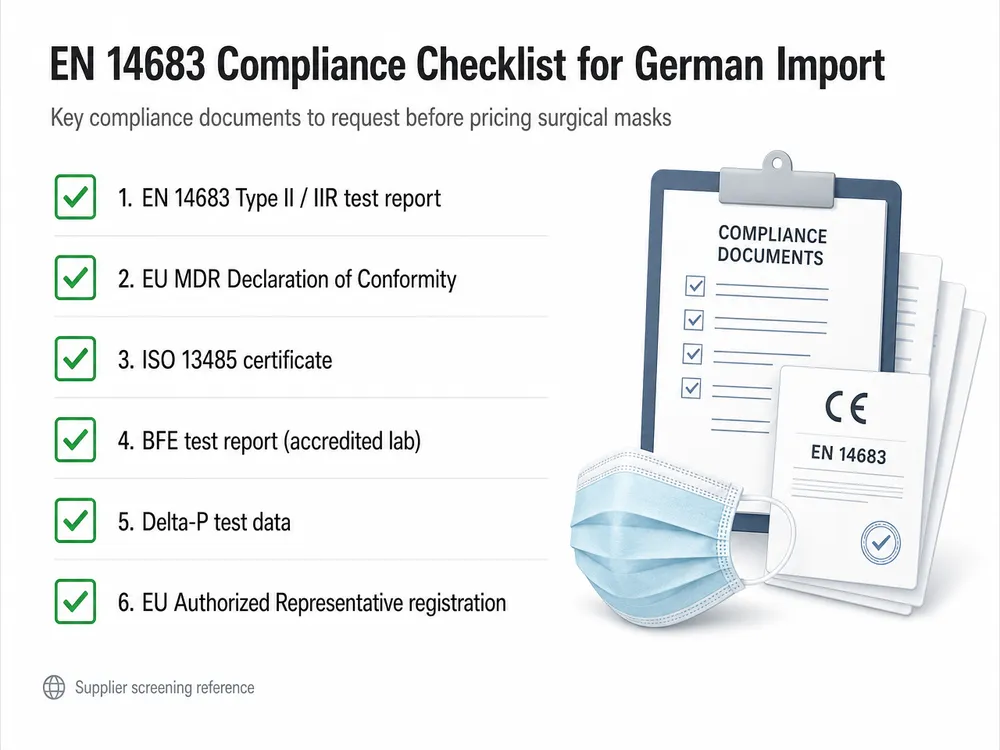
Before the list, the evaluation framework. German procurement teams — whether buying for hospital networks, pharmacy chains, or institutional resale — are working against a specific compliance checklist. If a supplier can't satisfy these criteria, the conversation ends before pricing even comes up.
EN 14683 Type II or Type IIR compliance is the floor. Type II requires ≥98% BFE; Type IIR adds splash resistance (≥120 mmHg fluid resistance). Most clinical settings in Germany specify Type IIR. If you're supplying pharmacy retail or non-clinical institutional buyers, Type II may be sufficient — but verify the end-use before you commit to a spec.
CE marking under EU MDR (Regulation 2017/745) is mandatory for surgical masks sold as medical devices in Germany. This is not the same as the old MDD CE mark. Post-2021, surgical masks require a valid EU MDR Declaration of Conformity, a technical file maintained by the manufacturer, and a registered EU Authorized Representative if the manufacturer is outside the EU. Suppliers who can only produce an MDD-era CE certificate are not compliant for current German market entry.
ISO 13485:2016 is the quality management standard behind the MDR technical file. It's not legally required as a standalone certification, but any serious manufacturer maintaining MDR compliance will have it — and any German hospital procurement audit will ask for it. Treat its absence as a yellow flag.
BFE test reports from an accredited laboratory — not just a certificate, but the actual test report showing the test method (EN 14683 Annex B), the test organism (Staphylococcus aureus), the particle size, and the result. We've seen suppliers provide certificates that reference tests they can't produce the underlying data for. Ask for the full report.
Delta-P (breathability) and fluid resistance test data round out the performance picture. Delta-P above 40 Pa/cm² on a Type IIR mask is a comfort problem for extended clinical wear — worth checking if your buyers are supplying surgical teams rather than general ward staff.
(One thing we've learned from working with German distributors: the documentation review often takes longer than the product evaluation. Build that into your timeline.)
The 10 Suppliers: German Market Landscape
1. Paul Hartmann AG
Website: hartmann.info | Type: German manufacturer and distributor
Hartmann is the anchor name in German hospital supply. Their Foliodress surgical mask line covers Type I, Type II, and Type IIR configurations and is stocked through their direct sales network and major medical distributors across Germany. For hospital procurement teams buying on framework contracts, Hartmann is often the default — the documentation is in order, the supply chain is domestic, and the account management is German-speaking.
The trade-off is cost and flexibility. Hartmann operates at scale for institutional buyers, which means their pricing reflects a full-service distribution model. MOQ for direct supply is typically aligned to hospital contract volumes. If you're a smaller distributor or a private-label buyer, you're likely buying through a sub-distributor, which adds another margin layer.
2. Mölnlycke Health Care
Website: molnlycke.com | Type: Swedish EU manufacturer, strong German distribution
Mölnlycke's Barrier surgical mask range is well-established in German OR settings. Their products carry EN 14683 Type IIR compliance and are positioned at the premium end of the clinical market — the brand is associated with surgical draping and gowning systems, so the mask sits in a broader OR supply relationship. German hospital procurement teams buying Mölnlycke gowns often extend that relationship to masks.
For buyers outside the hospital OR segment, Mölnlycke is less relevant. Their distribution model is built around surgical suite procurement, not general medical supply or pharmacy channels.
3. Lohmann & Rauscher (L&R)
Website: lohmann-rauscher.com | Type: German/Austrian manufacturer and distributor
L&R is a significant player in German wound care and surgical supply. Their Sentinex surgical mask line covers standard clinical configurations with EN 14683 compliance. L&R has direct sales infrastructure in Germany and a strong presence in hospital and outpatient clinic supply chains.
Their strength is breadth — they supply a wide range of medical consumables, so buyers consolidating orders across product categories find L&R convenient. The mask range itself is solid but not differentiated on filtration performance; it's a reliable commodity product from a trusted German supplier.
4. Meditrade GmbH
Website: meditrade.de | Type: German medical disposables distributor
Meditrade is a German-based distributor of disposable medical products with surgical masks in their portfolio. They serve pharmacy chains, medical practices, and institutional buyers across Germany. Their product range includes both branded and private-label configurations.
As a distributor rather than a manufacturer, Meditrade's documentation depth depends on their upstream suppliers. Worth asking specifically about the manufacturer of record on their surgical mask SKUs and whether the CE MDR technical file is accessible — this is a standard question for any distributor-sourced product.
5. Dräger
Website: draeger.com | Type: German medical device manufacturer
Dräger is primarily known for anaesthesia, ventilation, and monitoring equipment, but their respiratory protection portfolio includes surgical and procedure masks. Their products carry the full German regulatory pedigree — CE MDR, ISO 13485, and the documentation infrastructure that comes with a major medical device manufacturer.
For buyers specifically in the respiratory protection or clinical procedure segment, Dräger is a credible option. For general surgical mask procurement at volume, their pricing and minimum order structure reflects a premium medical device positioning that may not be cost-competitive against dedicated mask manufacturers.
6. Uvex Safety Group
Website: uvex-safety.com | Type: German PPE and safety equipment manufacturer
Uvex manufactures a range of respiratory protection products including surgical-grade masks. Their German manufacturing heritage and PPE compliance infrastructure make them a natural fit for industrial healthcare and occupational health buyers. EN 14683 compliance is covered in their medical mask range.
The caveat: Uvex's core business is occupational safety, not clinical medical supply. Their surgical mask range is real and compliant, but the depth of clinical documentation and the breadth of SKU options is narrower than dedicated medical mask manufacturers. Suitable for occupational health procurement; less suited for hospital supply chain buyers who need deep clinical documentation.
7. Abena Group
Website: abena.de | Type: Danish manufacturer, strong German distribution
Abena is a Danish healthcare product manufacturer with established German distribution. Their disposable medical product range includes surgical masks with EN 14683 compliance. They supply nursing homes, outpatient clinics, and pharmacy chains across Germany through their German subsidiary.
Abena's positioning is mid-market — reliable compliance documentation, reasonable pricing, and a distribution model that works for buyers who need regular replenishment without large-volume commitments. Not a factory-direct option, but a credible EU-based supplier for buyers who prefer European sourcing.
8. Kimberly-Clark Professional
Website: kimberly-clark.com | Type: US multinational, EU distribution including Germany
Kimberly-Clark's Halyard surgical mask range is distributed across the EU including Germany. Their products carry EN 14683 compliance and the documentation infrastructure of a major multinational medical device company. For buyers already in a Kimberly-Clark supply relationship for other medical consumables, extending to surgical masks is straightforward.
The practical limitation for German buyers is that Kimberly-Clark operates through distribution partners in Germany rather than direct factory supply. Pricing reflects the multinational brand premium plus distribution margin. For high-volume buyers, the landed cost per unit is rarely competitive against factory-direct alternatives.
9. Noba Verbandmittel Danz GmbH & Co. KG
Website: noba.de | Type: German medical supply distributor
Noba is a German medical supply distributor serving pharmacies, medical practices, and care facilities. Their product range includes surgical masks sourced from multiple manufacturers. As a distributor, Noba provides the convenience of domestic stock, German-language account management, and consolidated ordering across product categories.
For buyers who need small quantities, fast replenishment, or consolidated invoicing across multiple product types, Noba and similar German distributors serve a real function. The trade-off is unit cost — distributor margin is built into every SKU, and the manufacturer of record on the mask may not be immediately transparent.
10. eztio — Factory-Direct CE MDR Certified Manufacturer
Website: eztio.com | Type: Chinese factory-direct manufacturer, CE (EU MDR) + ISO 13485 certified
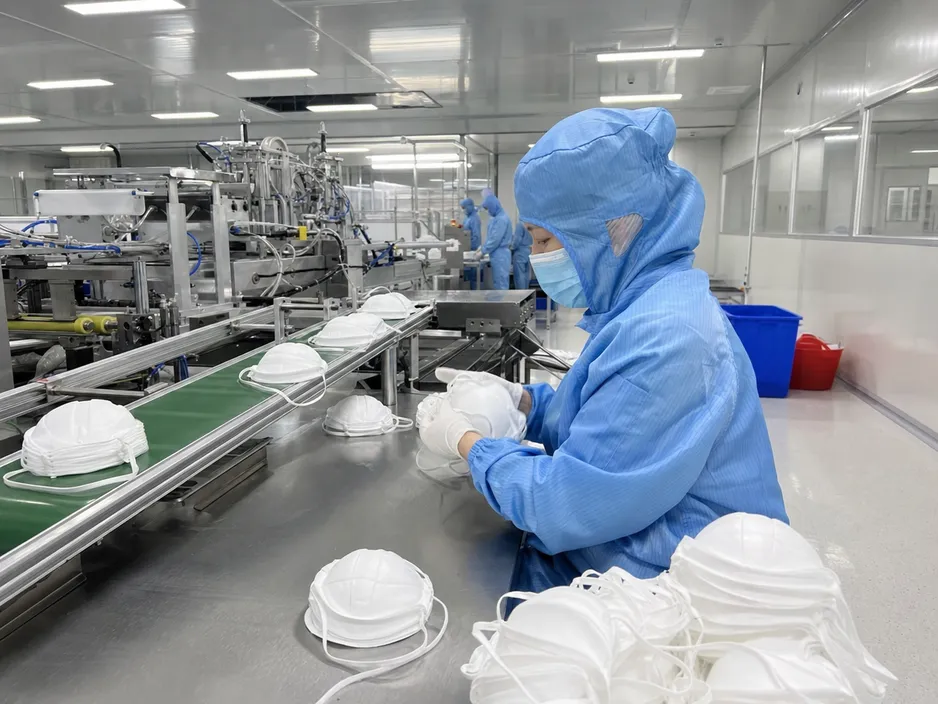
eztio is a different kind of entry on this list — not a German distributor or EU-based manufacturer, but a factory-direct option that clears the compliance bar for German market entry. We manufacture Surgical Medical Masks at our 12,000 m² facility in Gaomi, Shandong, with 6 fully automated production lines and 120 million pieces annual capacity.
The compliance stack is the starting point: CE under EU MDR, ISO 13485:2016, ISO 9001:2015, FDA 510(k) registration, and SGS. For German import, the CE MDR registration and ISO 13485 certificate are the documents your importer of record needs, and we maintain both with current surveillance audit records. Our EU Authorized Representative is in place, so the MDR importer pathway is already structured.
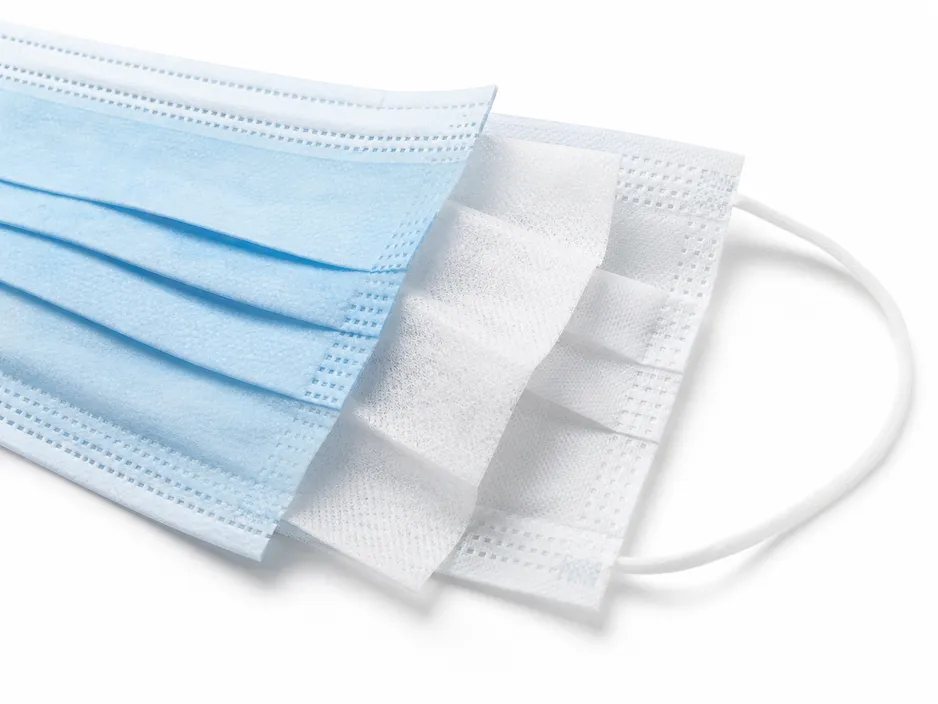
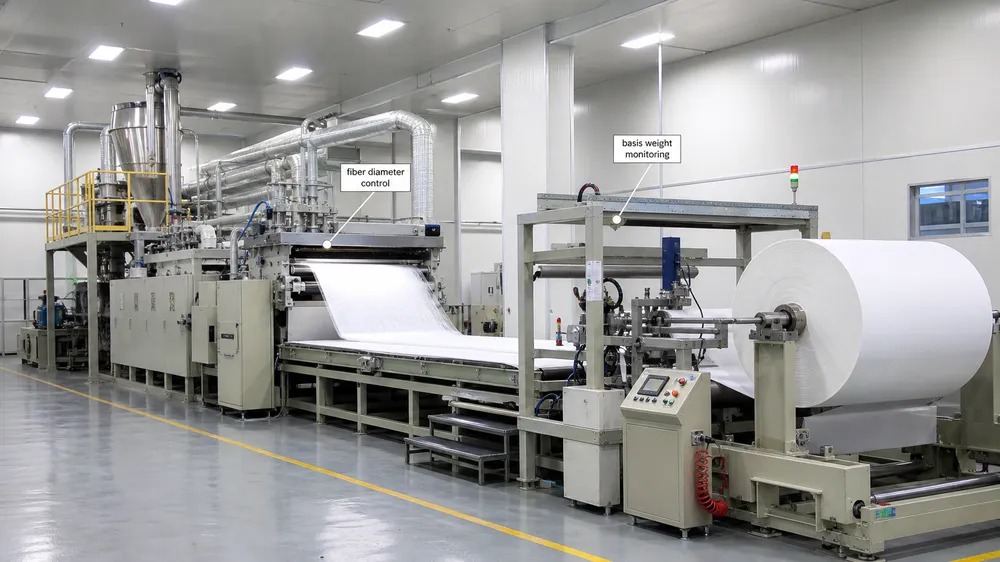
The differentiator that matters most for buyers evaluating filtration performance is in-house meltblown production. We manufacture the meltblown nonwoven layer — the filtration core — ourselves. That means when we quote a disposable surgical medical mask at ≥98% BFE (EN 14683 Type IIR), we're not relying on a fabric supplier's batch consistency. We set the fiber diameter, basis weight, and electrostatic charge level in our own production run, and we test every batch in our in-house BFE/PFE/Delta-P lab before it goes to outgoing inspection. (Most trading companies and even some manufacturers can't tell you who made their meltblown fabric or what the batch-to-batch BFE variance looks like. We can, because we made it.)
Our 3-ply medical mask line runs in a Class 100,000 (ISO 8) cleanroom with continuous particle monitoring — the facility standard that hospital procurement audits look for. MOQ starts at 50,000 pieces for standard SKUs, which is sized for market-entry orders and trial programs without forcing a volume commitment that doesn't match your current demand. OEM and private-label packaging is handled in-house.
For German buyers, the full export documentation package travels with every shipment: EN 14683 test reports from accredited third-party labs, Certificate of Conformity, EU MDR Declaration of Conformity, and any additional declarations your customs broker or compliance team needs. We've shipped to multiple European buyers post-2021 and understand what the MDR importer documentation review actually requires.
German Distributor vs. Factory-Direct: Where the Cost Difference Actually Lives
The pricing gap between a German distributor and a factory-direct manufacturer is real, but it's not uniform — it depends on order volume, documentation requirements, and how you're using the product downstream.
Here's how the cost structure typically breaks down on a 500,000-piece order of EN 14683 Type IIR surgical masks into Germany:
| Cost Component | German Distributor | Factory-Direct (eztio) |
|---|---|---|
| Unit product cost | Higher (includes distributor margin) | Lower (factory gate price) |
| Freight to Germany | Included or domestic | Sea freight + customs (est. €0.008–0.012/pc at volume) |
| Import duty (EU) | N/A (EU-sourced) | ~6.3% on CIF value |
| MDR documentation | Included | Provided by factory |
| Lead time | Days to weeks (from stock) | 15–25 days production + transit |
| MOQ flexibility | Often low (from stock) | 50,000 pieces minimum |
| Landed cost per unit | Higher at volume | Lower at volume |
The distributor model wins on speed and minimum quantity. If you need 10,000 masks by next week, a German distributor is the right answer. If you're placing a 500,000-piece order for a quarterly supply program, the factory-direct landed cost — even after freight and duty — is typically 25–40% lower than distributor pricing on the same EN 14683 Type IIR specification.
The documentation equation has shifted since EU MDR came into full effect. Pre-2021, some buyers assumed factory-direct sourcing meant documentation risk. The reality now is that a CE MDR-registered factory with a maintained technical file and an EU Authorized Representative in place carries the same regulatory standing as a European distributor sourcing from the same factory. The question is whether the factory can produce the documentation — not where the factory is located.
How to Verify a Supplier's CE MDR Status Before You Order
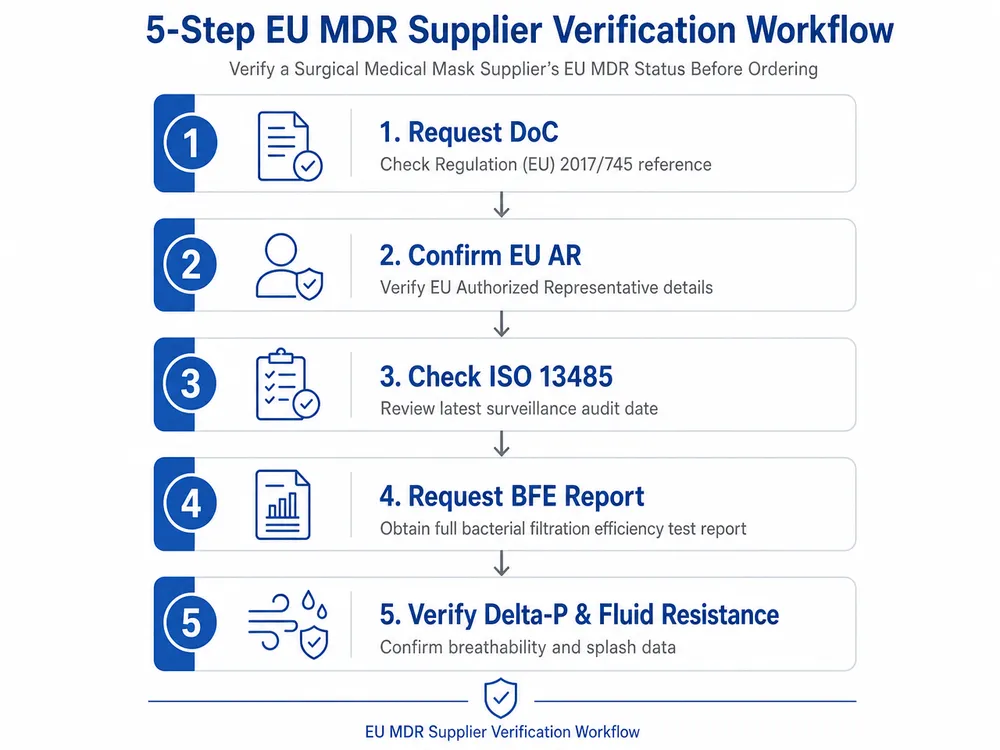
This is where a lot of buyers lose time. A CE mark on a product label is not the same as a valid EU MDR registration. Here's the verification sequence:
Step 1 — Request the EU MDR Declaration of Conformity (DoC). The DoC must reference Regulation (EU) 2017/745, not the old MDD (93/42/EEC). If the DoC references MDD, the product is not MDR-compliant for current German market entry.
Step 2 — Confirm the EU Authorized Representative. For manufacturers outside the EU, the MDR requires a registered EU Authorized Representative (Article 11). The DoC must name this representative. Verify the representative is real and currently active — this is a searchable registration.
Step 3 — Request the ISO 13485 certificate with current surveillance audit date. ISO 13485 certificates have a 3-year validity with annual surveillance audits. A certificate issued in 2020 with no surveillance audit record is a yellow flag.
Step 4 — Request the BFE test report, not just the certificate. The test report should show: test method (EN 14683 Annex B), test organism (Staphylococcus aureus at 28.3 L/min), particle size (3.0 ± 0.3 μm), and the actual BFE result (≥98% for Type II/IIR). A certificate that says "≥98% BFE" without the underlying test data is not sufficient for a German hospital procurement audit.
Step 5 — Check Delta-P and fluid resistance for Type IIR. Type IIR requires ≤40 Pa/cm² Delta-P and ≥120 mmHg fluid resistance. Both should appear in the test report. If a supplier is quoting Type IIR but can only produce a Type II test report, that's a compliance gap.
(We've had buyers come to us after a failed procurement audit because their previous supplier's documentation didn't hold up to this level of review. The documentation review is not bureaucratic box-ticking — it's the mechanism that protects your import license and your customer relationships.)
When Local Supply Is the Right Answer
Factory-direct sourcing makes economic sense at repeat volume. It doesn't make sense in every situation, and a credible sourcing guide should say so.
Buy from a German distributor when:
- You need delivery within days, not weeks
- Your order is below 50,000 pieces
- You're responding to an emergency or unplanned demand spike
- Your buyer requires a German or EU-based supplier of record for contractual reasons
- You're testing a new product category and need small quantities to validate demand
Consider factory-direct when:
- You're placing orders of 100,000 pieces or more on a recurring basis
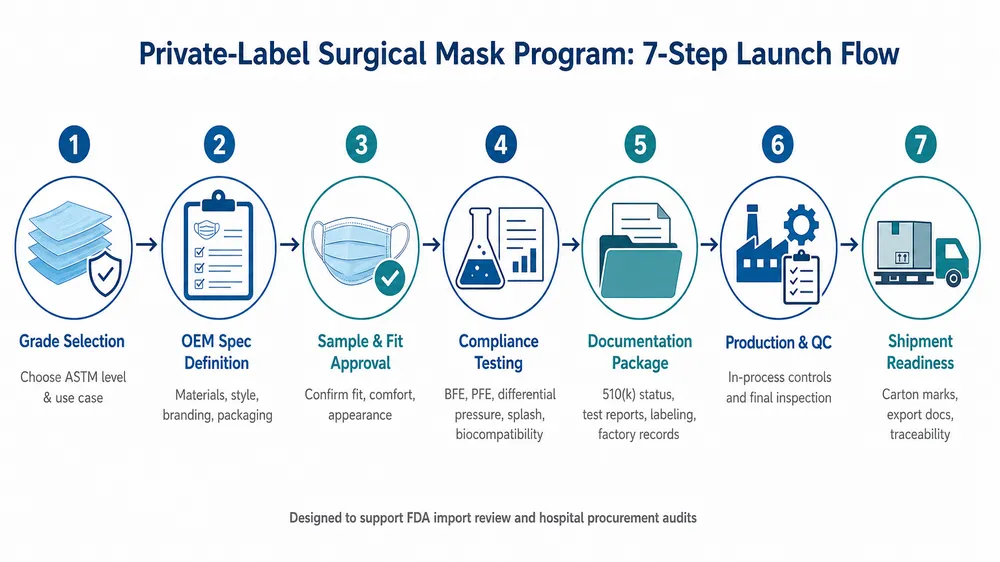
- You're building a private-label surgical mask program and need OEM packaging
- Your current distributor pricing is compressing your margin on resale
- You need a specific EN 14683 configuration (Type II vs. Type IIR, ear-loop vs. tie-on) that isn't stocked locally
- You want direct access to the manufacturer's QC documentation for your own compliance records
The honest version of this trade-off: local distributors provide convenience at a cost. That cost is manageable when your volumes are low or your urgency is high. At sustained volume — quarterly orders of 500,000 pieces or more — the distributor margin layer becomes a structural cost that factory-direct sourcing eliminates.
Sourcing Route Decision Guide
| Scenario | Recommended Route |
|---|---|
| Emergency restock, <50k pieces, needed within 1 week | German distributor (Hartmann, L&R, Meditrade, Noba) |
| Quarterly supply program, 200k–1M pieces, Type IIR | Factory-direct (verify CE MDR + ISO 13485 + BFE test reports) |
| Private-label surgical mask program, OEM packaging | Factory-direct manufacturer with in-house packaging capability |
| Hospital framework contract, German supplier of record required | German manufacturer or EU-based manufacturer (Hartmann, L&R, Mölnlycke) |
| Market entry, 50k–100k pieces, testing new SKU | Factory-direct with 50k MOQ, request samples first |
| Compliance-sensitive procurement, full MDR documentation required | Factory-direct with maintained MDR technical file and EU Authorized Representative |
Frequently Asked Questions
What EN 14683 type do most German hospitals specify for surgical masks?
Type IIR is the standard specification for surgical and procedural use in German clinical settings. Type IIR adds splash resistance (≥120 mmHg fluid resistance) to the ≥98% BFE requirement of Type II. General ward and non-surgical clinical environments sometimes accept Type II, but if you're supplying OR or procedure room settings, specify Type IIR and verify the fluid resistance test data.
What's the difference between an MDD CE mark and an EU MDR CE mark on a surgical mask?
The EU Medical Device Regulation (2017/745) replaced the Medical Device Directive (93/42/EEC) with a transition deadline of May 2021. Surgical masks sold as medical devices in Germany after that date must carry CE marking under MDR, not MDD. The Declaration of Conformity must reference Regulation (EU) 2017/745. An MDD-era CE mark is no longer valid for new market placements — if a supplier's DoC references 93/42/EEC, the product is not compliant for current German import.
What import duty applies to surgical masks imported into Germany from China?
Surgical masks (HS code 6307.90 or 9020.00 depending on classification) imported into Germany from China are subject to EU customs duty, typically in the range of 6.3–12% on CIF value depending on the specific HS classification. Your customs broker will confirm the applicable rate for your specific product. Factor this into your landed cost calculation alongside sea freight, insurance, and local delivery.
How do I verify that a Chinese mask manufacturer has a valid EU Authorized Representative?
The EU Authorized Representative must be named in the manufacturer's EU MDR Declaration of Conformity. You can cross-reference the representative's registration through the EUDAMED database (ec.europa.eu/tools/eudamed) once it is fully operational, or request the representative's registration documentation directly from the manufacturer. A legitimate EU Authorized Representative will have a formal mandate agreement with the manufacturer and will be able to confirm their registration status.
What MOQ is realistic for a first factory-direct order of EN 14683 Type IIR masks?
50,000 pieces is a workable entry point for factory-direct sourcing from a manufacturer like eztio. At that volume, you're covering the production line setup cost without committing to a full container. For context, a 40HQ container holds approximately 3–4 million pieces of standard 3-ply surgical masks depending on packaging configuration — so a 50,000-piece trial order ships as a partial container or LCL shipment. Most buyers in the German market who are evaluating factory-direct sourcing start with a 50,000–100,000 piece trial order to validate documentation, spec consistency, and logistics before scaling to quarterly supply programs.
If you're evaluating factory-direct sourcing for your next EN 14683 Type II or Type IIR order, the practical next step is a documentation review before pricing. Send us your grade requirement, target annual volume, and any private-label or packaging specifications — we'll respond with current pricing, lead time, and a sample documentation package including our CE MDR Declaration of Conformity, ISO 13485 certificate, and EN 14683 BFE test reports. Request Quote