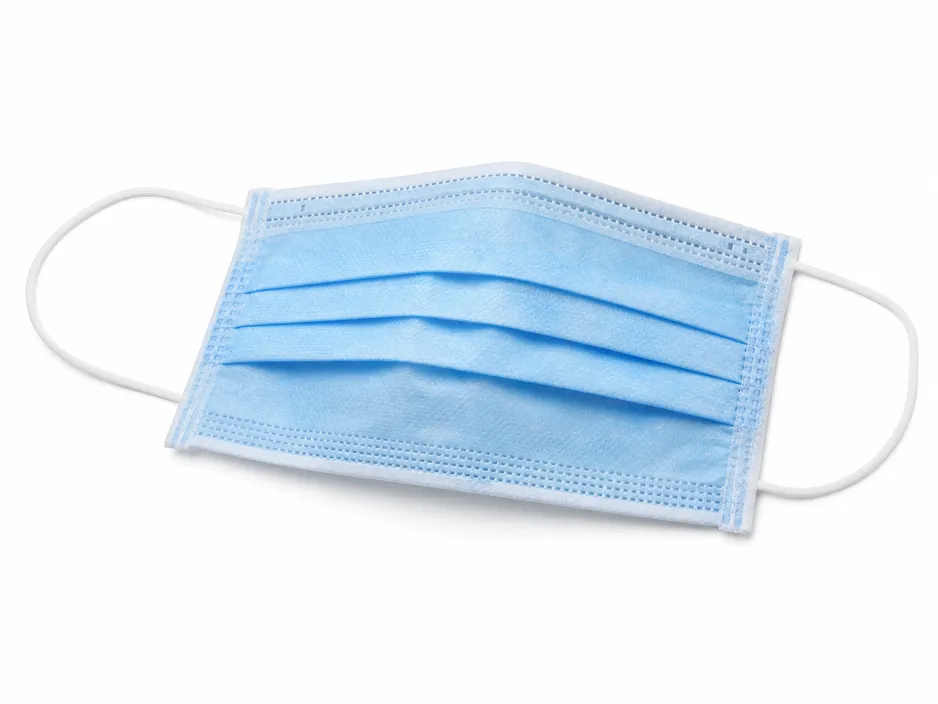
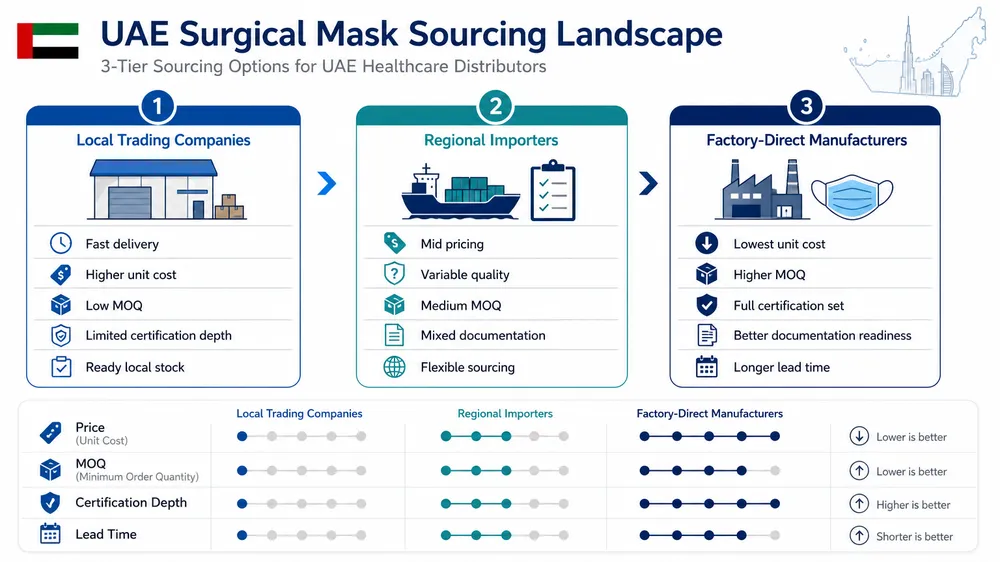
The UAE healthcare distribution market runs on two parallel sourcing tracks, and most buyers end up on the wrong one for their volume. Local trading companies offer speed and familiar communication — real advantages when you need 5,000 boxes by Thursday. But when you're building a recurring supply program for hospital tenders, clinic chains, or institutional procurement, the economics of that convenience start to compress your margin in ways that compound over time.
This guide maps the current supplier landscape for Surgical Medical Masks in the UAE and GCC region — who the real players are, what sourcing model each represents, and where the certification and MOQ trade-offs actually land. The goal is not to hand you a ranked list and call it research. The goal is to help you understand what you're looking at when you evaluate a supplier, so the decision you make is based on the right variables.

What UAE Distributors Actually Need from a Surgical Mask Supplier
Before the supplier list, the evaluation framework. The UAE healthcare market has specific documentation requirements that most supplier comparison content ignores entirely — and that gap is where procurement problems start.
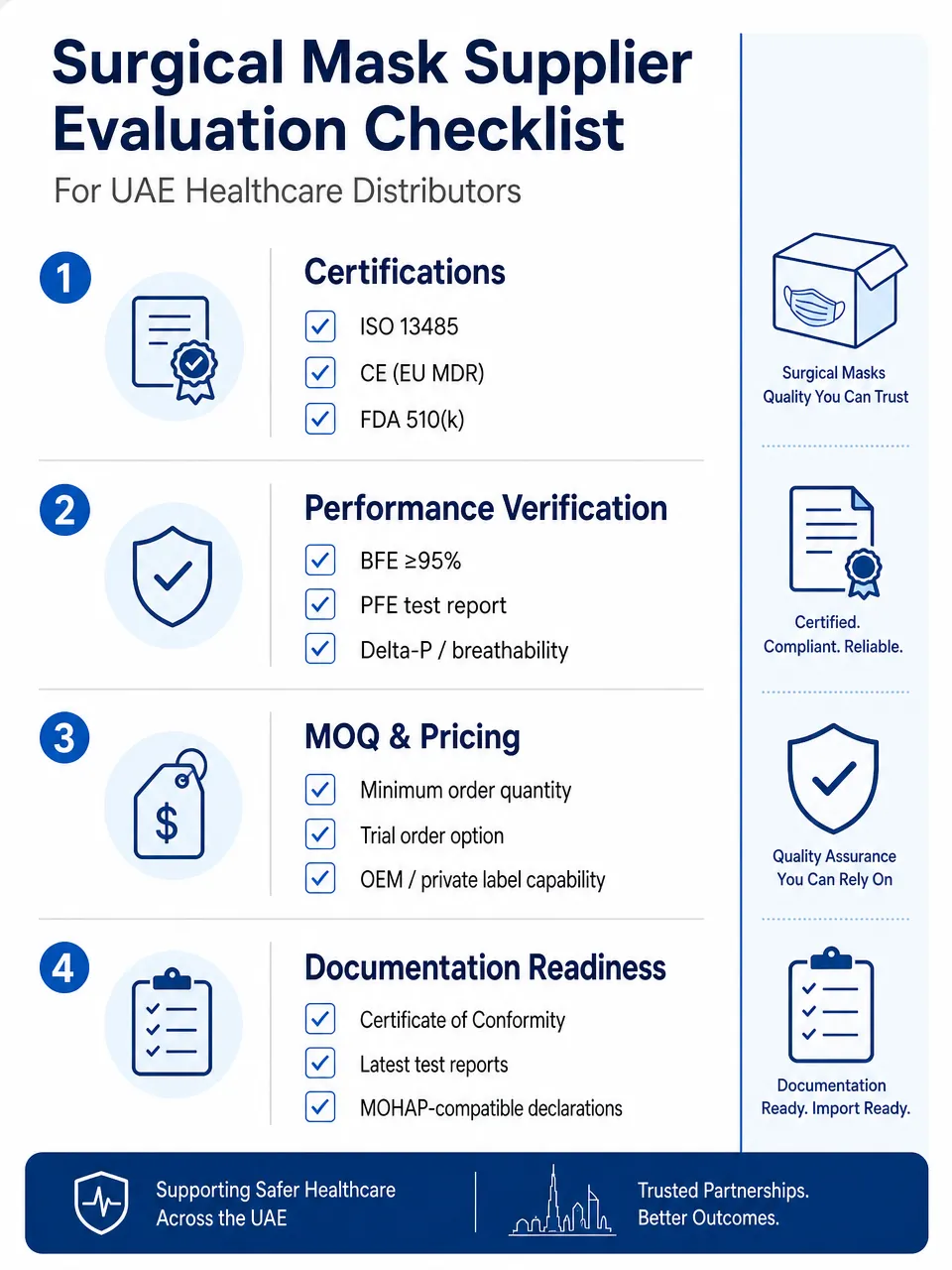
MOHAP and SFDA registration is the first filter. The UAE Ministry of Health and Prevention (MOHAP) requires that medical devices, including surgical masks, be registered or notified before distribution. Masks sold into UAE institutional channels — hospitals, clinics, government health authorities — need to be traceable to a manufacturer with recognized international certification. CE (EU MDR) and FDA 510(k) registration are the two most widely accepted frameworks for establishing that baseline. A supplier who can't produce current CE technical documentation or FDA registration records is a sourcing risk, regardless of how competitive their unit price looks.
BFE and PFE test reports are the second filter, and this is where a lot of UAE buyers get burned. Bacterial Filtration Efficiency (BFE) and Particulate Filtration Efficiency (PFE) are the performance parameters that determine whether a surgical mask actually does what it claims. The problem: test reports can be old, can apply to a different product configuration than what you're actually receiving, or can come from a batch that was specifically prepared for testing rather than representative of production. When I'm evaluating a new supplier, I ask for the test report date, the lot number it was run on, and whether the meltblown fabric used in that test batch is the same source as current production. Most trading companies can't answer that last question.
MOQ structure matters more for UAE distributors than it does in most markets, because the UAE healthcare channel is fragmented — you're often supplying multiple small-to-mid-size clinic groups, pharmacies, and institutional buyers simultaneously rather than one large hospital system. A supplier with a 500,000-piece minimum forces you to carry inventory risk that doesn't match your actual order flow. The right MOQ for a market-entry or trial program is in the 50,000–100,000 piece range.
Lead time and documentation readiness close the evaluation. Standard lead time from a verified factory runs 15–25 days. The documentation package — Certificate of Conformity, BFE/PFE/Delta-P test reports, packing list, and any MOHAP-specific declarations — should be prepared as a standard deliverable, not assembled on request after you've already placed the order.
The 10 Suppliers Worth Knowing in This Market
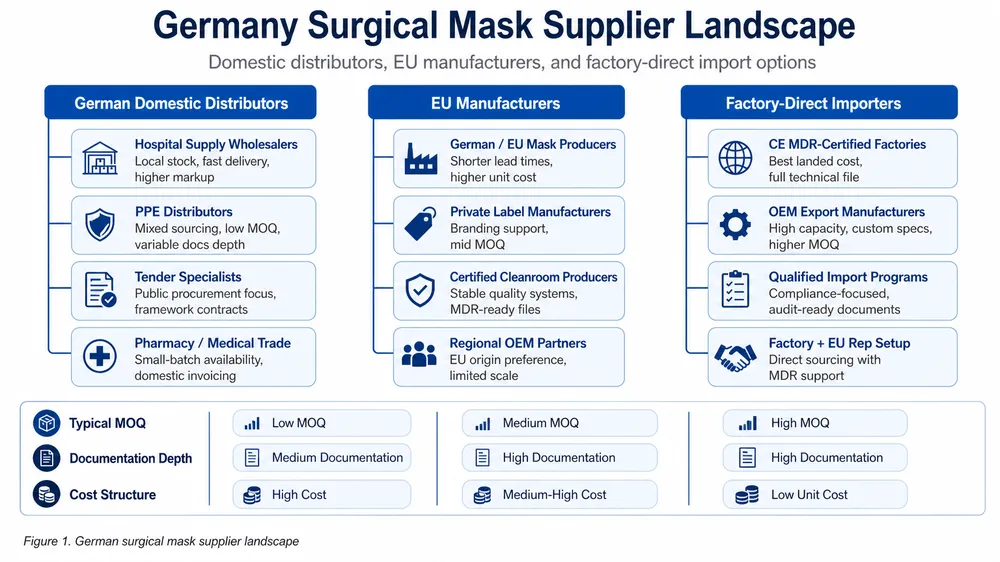
The companies below represent the realistic sourcing landscape for UAE healthcare distributors — a mix of UAE-based distributors, GCC-active trading companies, and verified export manufacturers. I've organized them by supplier model rather than a fake performance ranking, because the model tells you more about what you're actually getting than any score I could assign.
1. Medline Industries (medline.com)
Medline is one of the largest privately held medical supply companies in the world, with active distribution into the Middle East through regional partners. Their surgical mask range covers ASTM Level 1, 2, and 3 configurations, and their institutional procurement documentation is well-established. For UAE hospital tenders requiring a globally recognized brand name on the product, Medline's distribution network is a credible option. MOQs through regional distributors tend to be higher, and unit pricing reflects the brand premium. Supplier model: global manufacturer with regional distribution.
2. Kimberly-Clark Professional / Halyard Health (halayard.com / kimberly-clark.com)
Halyard Health (now part of Owens & Minor) produces the FLUIDSHIELD surgical mask line, which has strong recognition in UAE hospital procurement. Their ASTM Level 3 fluid-resistant masks are specified in a number of GCC institutional tenders. Regional availability is through authorized distributors; direct factory pricing is not accessible at typical distributor volumes. Supplier model: global brand, distributor-dependent pricing.
3. Mölnlycke Health Care (molnlycke.com)
The Swedish manufacturer is well-positioned in UAE surgical and procedural mask procurement, particularly for operating room applications. Their Barrier surgical mask range carries CE marking under EU MDR and is recognized by UAE hospital procurement committees. Mölnlycke sells through regional healthcare distributors rather than direct to smaller buyers. MOQ and pricing are set at the distributor level. Supplier model: premium European manufacturer, institutional channel focus.
4. Winner Medical (winner-medical.com)
Winner Medical is a Shenzhen-based manufacturer with ISO 13485 certification, CE marking, and FDA registration across their surgical mask product lines. They export actively to the Middle East and have established relationships with UAE healthcare distributors. Their product range includes standard 3-ply surgical masks and higher-protection configurations. Winner Medical operates at scale — annual capacity in the hundreds of millions of pieces — and their documentation package is generally export-ready. MOQ for direct orders typically starts in the 100,000–500,000 piece range depending on SKU. Supplier model: large-scale Chinese manufacturer, export-oriented.
5. Zhende Medical (zhende.com)
Zhende Medical, based in Shaoxing, Zhejiang, is one of China's larger listed medical consumables manufacturers. Their surgical mask lines carry ISO 13485, CE, and FDA certifications. Zhende has export history into the Middle East and their quality management infrastructure is auditable. For UAE distributors sourcing at volume, Zhende is a credible factory-direct option, though their MOQ structure and documentation responsiveness can vary by product line. Supplier model: large Chinese manufacturer, multi-product medical consumables.
6. Primacare Medical Supplies (primacare.ae)
Primacare is a UAE-based medical supplies distributor with a broad product range covering surgical masks, PPE, and clinical consumables. They stock locally and can fulfill smaller orders with short lead times — a genuine advantage for urgent replenishment needs. Their surgical mask range sources from multiple manufacturers, so certification depth varies by product. For buyers who need stock quickly and can't wait for a factory-direct shipment, Primacare represents the local convenience model. Supplier model: UAE-based distributor, local stock, mixed sourcing.
7. Gulf Medical (gulfmedical.ae)
Gulf Medical is a Dubai-based healthcare products distributor serving UAE and GCC institutional buyers. They carry surgical masks and PPE alongside a broader medical consumables catalog. Local warehousing means faster fulfillment for small-to-mid orders. As with most UAE distributors, their surgical mask range is sourced from third-party manufacturers, and the certification documentation available to end buyers depends on what the upstream supplier provides. Supplier model: UAE-based distributor, institutional channel focus.
8. Supermax Healthcare (supermax.com.my)
Supermax is a Malaysian manufacturer with significant export volume into the Middle East. Their surgical mask lines carry CE and ISO 13485 certification. Malaysia-origin masks have established acceptance in UAE healthcare procurement, and Supermax's documentation infrastructure is export-ready. Lead times to the UAE run longer than China-origin supply due to shipping routes, but their regulatory standing in the GCC is solid. Supplier model: Southeast Asian manufacturer, export-oriented.
9. Medicom (medicom.com)
AMD Medicom is a Canadian company with manufacturing operations in multiple countries, including China and France. Their surgical mask range is widely distributed in the Middle East through regional partners. Medicom's brand recognition in institutional procurement is strong, and their CE and ASTM documentation is current. Direct factory pricing is not accessible at typical distributor volumes — you're buying through a regional distribution layer. Supplier model: global brand, regional distributor pricing.
10. eztio — Gaomi Eztio Medical Technology Co., Ltd. (eztio.com)
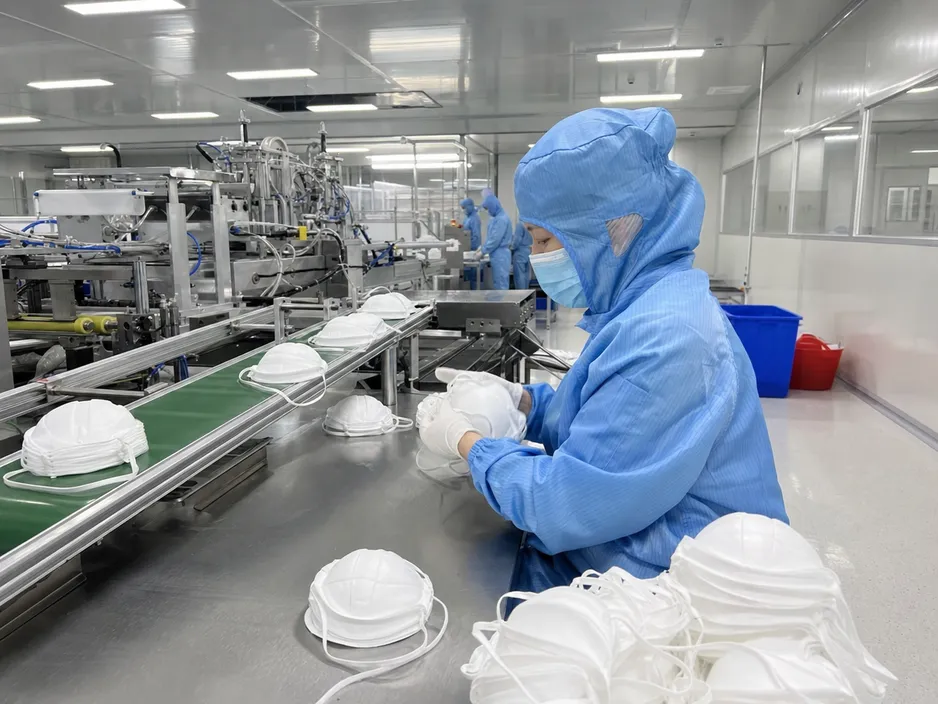
eztio is a dedicated surgical mask manufacturer based in Gaomi, Shandong, China. Founded in 2012, the factory runs 6 fully automated production lines in a Class 100,000 (ISO 8) cleanroom, with annual output capacity of 120 million pieces. Certifications cover ISO 13485:2016, ISO 9001:2015, CE (EU MDR), FDA 510(k) registration, and SGS. The factory produces meltblown nonwoven fabric in-house — the filtration layer that determines BFE and PFE performance — which means spec consistency is controlled at the source rather than dependent on a third-party fabric supplier. MOQ starts at 50,000 pieces for standard SKUs, with OEM and private-label packaging available. Full export documentation — Certificate of Conformity, BFE/PFE/Delta-P test reports, and MOHAP-compatible declarations — is prepared as a standard deliverable with every order. Supplier model: factory-direct manufacturer, full certification stack, UAE export documentation ready.
The Certification Gap That Costs UAE Distributors the Most
Most of the sourcing problems I see in the UAE market don't start with bad products. They start with incomplete documentation. A mask can perform perfectly and still fail a hospital procurement audit if the paperwork trail doesn't hold up.
Here's what the documentation gap looks like in practice: a UAE distributor sources from a trading company that sources from a factory. The trading company has a CE certificate — but it's issued to the trading company, not the manufacturer. When the hospital's procurement committee asks for the manufacturer's ISO 13485 certificate and the original BFE test report with the factory's name on it, the trading company can't produce them. The order gets rejected, or worse, it clears procurement and gets flagged during a later audit.
The documentation chain that actually survives UAE institutional procurement review looks like this:
| Document | What It Proves | Who Issues It |
|---|---|---|
| ISO 13485:2016 Certificate | Quality management system for medical device manufacturing | Accredited certification body (e.g., TÜV, BSI, SGS) |
| CE Certificate (EU MDR) | Conformity with EU medical device regulation | Notified Body |
| FDA 510(k) Registration | US market clearance for the device | FDA |
| BFE Test Report | Bacterial filtration efficiency ≥95% (or per spec) | Accredited third-party lab |
| PFE Test Report | Particulate filtration efficiency | Accredited third-party lab |
| Delta-P Test Report | Breathability / pressure differential | Accredited third-party lab |
| Certificate of Conformity | Batch-specific conformity declaration | Manufacturer |
| Packing List + Shipping Docs | Traceability for customs and import records | Manufacturer / freight forwarder |
Every document in that table should be issued by or traceable to the actual manufacturer — not a trading company, not a reseller. If any document in the chain has a different company name than the factory that made the product, you have a documentation gap.
(One thing I've seen catch first-time UAE importers off guard: MOHAP's product registration process requires the manufacturer's name and address to match the CE certificate exactly. A single-character discrepancy between the factory's registered name and the certificate name can trigger a registration hold. We prepare our documentation with this in mind — every document in the package uses the same legal entity name.)
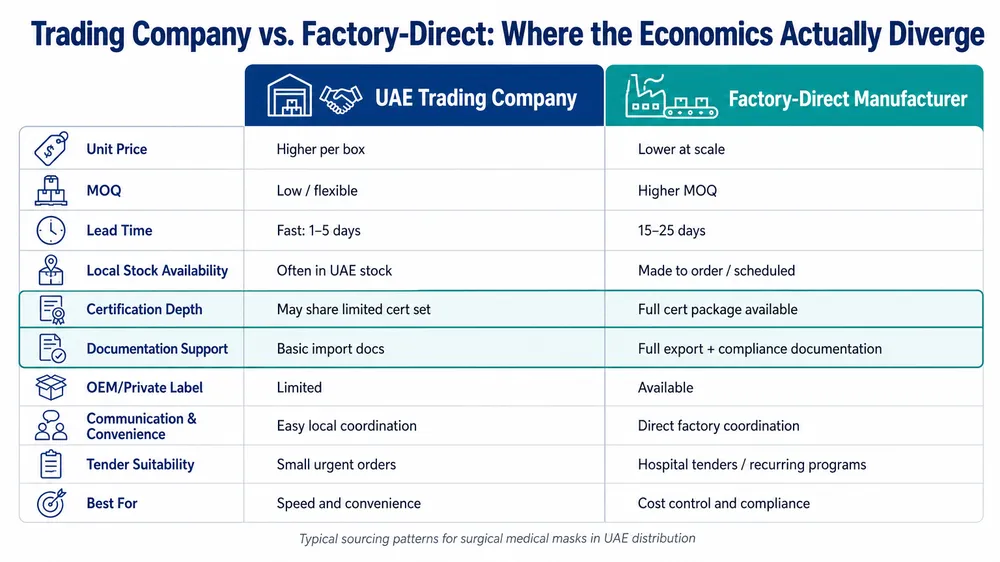
Trading Company vs. Factory-Direct: Where the Economics Actually Diverge
Local UAE trading companies serve a real purpose. If you need 10,000 masks delivered to a Dubai clinic by next week, a local distributor with warehouse stock is the right answer. No factory-direct shipment from China competes with that.
The trade-off becomes visible when you move to repeat volume. Here's how the two models compare at the procurement level:
| Criteria | UAE Trading Company | Factory-Direct (e.g., eztio) |
|---|---|---|
| Unit price | Higher (distributor margin + import cost built in) | Lower (no intermediary margin) |
| MOQ | Often 10,000–50,000 pieces from stock | 50,000 pieces (standard SKUs) |
| Lead time | 1–5 days (from local stock) | 15–25 days (production + shipping) |
| Certification depth | Variable — depends on upstream supplier | Full stack: ISO 13485, CE, FDA 510(k), test reports |
| BFE spec consistency | Depends on trading company's sourcing discipline | Controlled at source (in-house meltblown) |
| OEM / private label | Rarely available | Available from 50,000 pieces |
| Documentation for MOHAP | Often incomplete (trading company certs, not factory certs) | Full manufacturer documentation package |
| Batch-to-batch consistency | Variable (trading company may switch suppliers) | Consistent (same production line, same meltblown source) |
The inflection point for most UAE distributors is somewhere around 100,000–200,000 pieces per order cycle. Below that threshold, local stock convenience often justifies the price premium. Above it, the unit cost difference and the documentation reliability of factory-direct sourcing start to matter more than the lead time advantage.
For hospital tender submissions specifically, the documentation column in that table is the deciding factor. Tenders that require manufacturer-issued ISO 13485 certificates and original lab test reports cannot be fulfilled by a trading company that doesn't have those documents.
BFE Verification: The One Check Most Buyers Skip
Meltblown quality is the one variable that determines whether a surgical mask order passes BFE testing — everything else is secondary. I've seen this play out enough times that it's worth explaining the mechanism clearly.
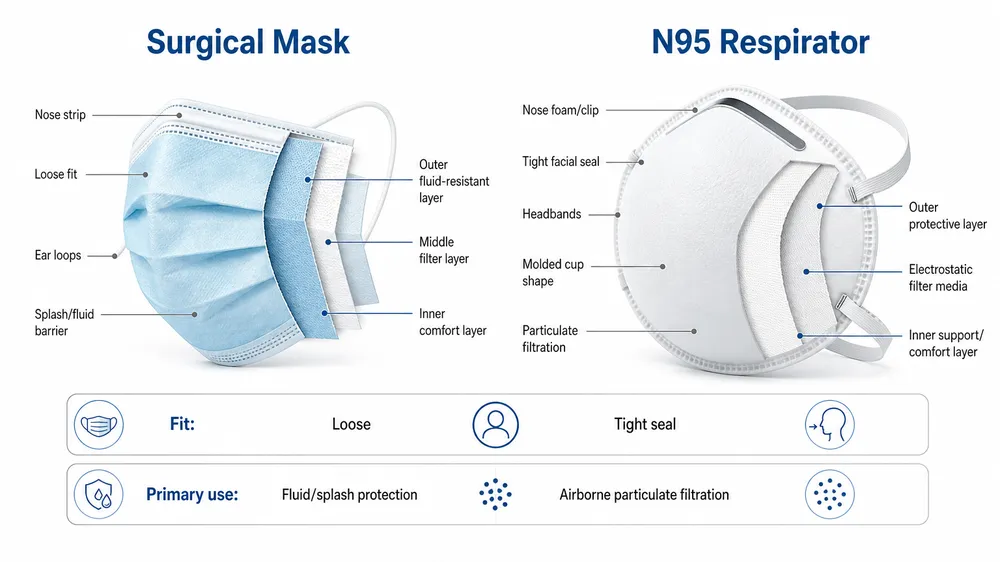
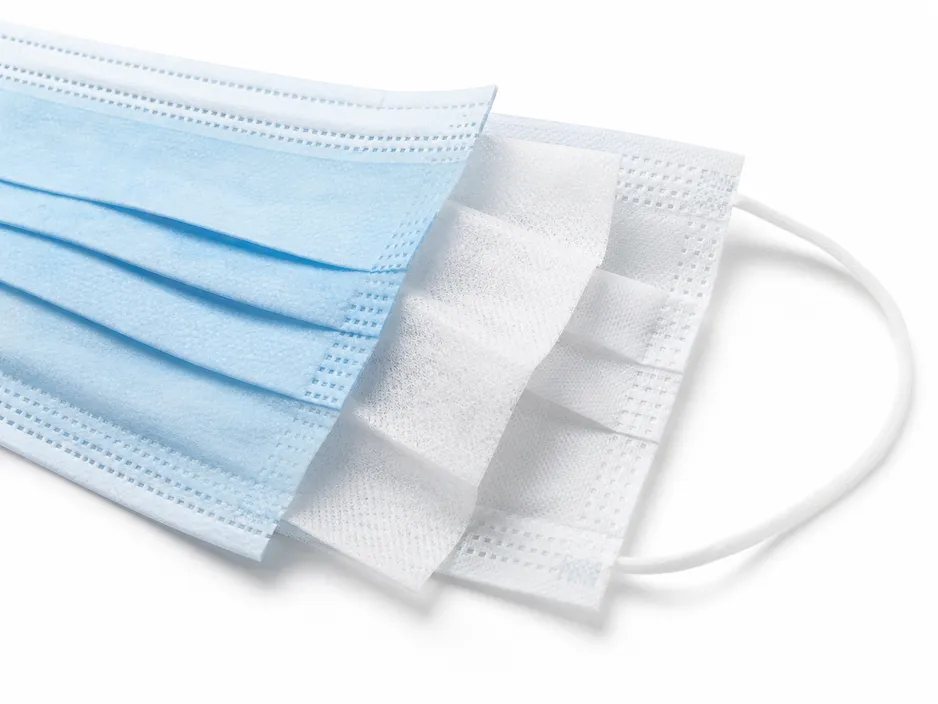
A surgical mask rated at ≥95% BFE gets that rating from the meltblown nonwoven layer in the middle of the three-ply construction. The outer and inner layers are spunbond — they provide structure and comfort, but they don't filter. The meltblown layer is where the filtration happens, and its performance depends on fiber diameter, basis weight, and electrostatic charge. All three of those parameters degrade if the meltblown fabric is stored improperly, produced inconsistently, or sourced from a supplier who doesn't control their extrusion process tightly.
The practical problem for buyers: you can't see meltblown quality by looking at a mask. A mask with degraded meltblown fabric looks identical to a mask with properly performing meltblown fabric. The only way to know is to test.
Before committing to a bulk order from any supplier, ask for:
- A current BFE test report — dated within the last 12 months, from an accredited lab (Nelson Labs, SGS, Intertek, or equivalent), with the manufacturer's name on the report.
- The meltblown fabric source — is it produced in-house or purchased from a third-party supplier? If purchased, who is the supplier and do they have their own quality documentation?
- Batch-to-batch consistency data — does the supplier test every production batch, or only the certification batch? In-house testing capability is the differentiator here.
At eztio, we produce meltblown fabric in-house and run BFE, PFE, and Delta-P testing on every production batch in our own QC lab before the product reaches outgoing inspection. The in-house testing catches problems before they become shipment problems. A batch that fails internal BFE testing gets pulled and investigated — it doesn't ship. Third-party lab reports are then generated from the outgoing batch for your documentation package.
(We switched to in-house meltblown production specifically because of the supply disruption period in 2020–2021, when factories without their own meltblown capacity were either stopping shipments or shipping masks that didn't meet BFE specs. We've maintained that vertical integration because it's the only way to guarantee spec consistency across your entire order, not just the certification sample.)
MOQ Reality for UAE Market Entry
The 50,000-piece MOQ question comes up in almost every first conversation with a UAE distributor. Here's the honest answer: 50,000 pieces is a reasonable market-entry volume for most UAE distribution scenarios, and it's significantly lower than what most large-scale Chinese manufacturers will accept for direct orders.
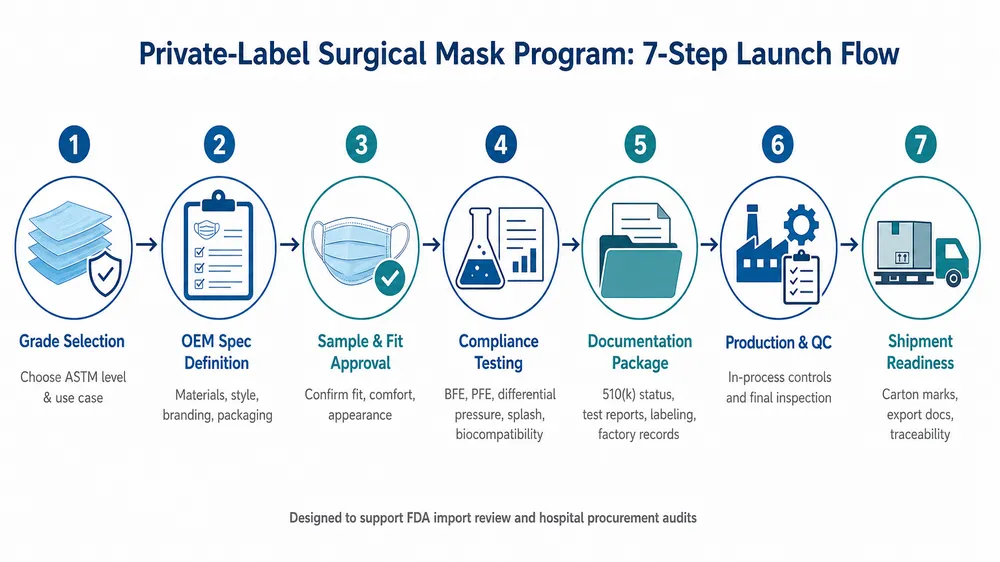
For context: a standard 3-ply surgical mask in individual polybag packaging, packed 50 pieces per box, 50 boxes per carton, fits approximately 1,000 cartons in a 20GP container. A 50,000-piece order is roughly 1,000 cartons — a manageable first shipment for a distributor testing a new SKU or building a private-label program.
The volume math for UAE institutional channels typically works like this:
- Clinic chain (10–20 locations): 500–2,000 boxes per month, or 25,000–100,000 pieces. A 50,000-piece order covers 1–4 months of supply.
- Hospital supply contract (mid-size facility): 5,000–20,000 boxes per month, or 250,000–1,000,000 pieces. Factory-direct economics are clearly favorable at this volume.
- Government or institutional tender: Typically 500,000+ pieces per award. Documentation requirements are strict; factory-direct with full certification stack is the only viable sourcing route.
For standard SKUs — our 3-ply surgical mask specifications — the 50,000-piece MOQ applies. OEM and private-label programs with custom packaging start at the same threshold for existing configurations; modified configurations or new packaging formats require a higher minimum to justify line setup, and we'll tell you that before you approve samples rather than after.
OEM and Private-Label: Building a Branded Mask Line for the UAE Market
The UAE healthcare distribution market has a growing segment of distributors who want to move beyond commodity reselling and build branded product lines. Private-label surgical masks are a practical entry point — the product is well-understood, the regulatory pathway is established, and the margin differential between a branded product and a commodity SKU is meaningful.
Our OEM and private-label mask programs handle the full scope: custom packaging design, private-label printing, modified mask configurations, and retail-ready or clinical bulk packaging depending on your downstream channel. For UAE distributors, the practical advantage is that the OEM program runs from the same factory that holds the CE and ISO 13485 certifications — your branded product carries the same regulatory standing as our standard product, because it's made on the same lines with the same materials.
The documentation for a private-label program includes the manufacturer's CE certificate (with your product listed), the BFE/PFE/Delta-P test reports, and a Certificate of Conformity that names both the manufacturer and the private-label brand. This is the documentation structure that UAE institutional procurement committees and MOHAP registration processes expect to see.
(One note on packaging lead time: custom packaging artwork typically adds 5–7 days to the first order cycle for print plate setup. Reorders run on the standard 15–25 day lead time once the artwork is approved and plates are in production.)
Which Sourcing Route Fits Your Situation
The honest answer is that both local and factory-direct sourcing have a place in a well-structured UAE distribution operation. The question is which one fits which order type.
Local UAE distributor is the right answer when:
- You need stock within 1–5 days for urgent replenishment
- Order volume is below 10,000–20,000 pieces and doesn't justify a direct shipment
- You're filling a gap in an existing supply program, not building a new one
- The buyer doesn't require manufacturer-issued certification documentation
Factory-direct from a verified manufacturer is the right answer when:
- You're building a recurring supply program at 50,000+ pieces per order cycle
- The buyer requires ISO 13485, CE, or FDA documentation traceable to the manufacturer
- You're submitting to a hospital tender or government procurement process
- You want OEM or private-label capability without adding a separate packaging supplier
- You're calculating landed cost over multiple order cycles and the unit price difference compounds
The hybrid approach that works for most established UAE distributors: maintain a local stock relationship for urgent small orders and emergency replenishment, and run a factory-direct program for your core recurring volume. The two models aren't mutually exclusive — they serve different order types.
For the recurring volume program, the certification documentation, BFE spec consistency, and MOQ flexibility of a factory-direct relationship with a verified manufacturer like eztio reduces the procurement risk that accumulates when you're sourcing through a trading company that may switch upstream suppliers between your orders.
Frequently Asked Questions
What certifications does a surgical mask need to clear UAE customs and pass MOHAP registration?
For UAE import and MOHAP product registration, the minimum documentation is a CE certificate (EU MDR) or equivalent international certification, the manufacturer's ISO 13485 certificate, and BFE/PFE test reports from an accredited third-party lab. The CE certificate and ISO 13485 certificate must be issued to the actual manufacturer — not a trading company or reseller. MOHAP's registration process cross-references the manufacturer name on the CE certificate against the product registration application, so the names must match exactly. FDA 510(k) registration is not required for UAE import but is accepted as additional evidence of regulatory standing and is often requested by hospital procurement committees.
How do I verify that a BFE test report is valid and applies to the product I'm actually receiving?
Check four things: (1) the test report date — it should be within the last 12–24 months; (2) the manufacturer's name on the report — it should match the factory you're ordering from, not a trading company; (3) the product description on the report — it should match the specific SKU you're ordering, including the meltblown fabric specification; (4) whether the supplier tests every production batch or only the certification batch. A supplier with in-house BFE testing capability can provide batch-specific test data, not just a single certification report. If a supplier can only produce one test report for all their products, that's a flag.
What is a realistic MOQ for a first surgical mask order from a Chinese factory?
For a verified manufacturer with export infrastructure, 50,000 pieces is a reasonable first-order MOQ for standard SKUs. Some large-scale manufacturers set minimums at 100,000–500,000 pieces, which creates inventory risk for distributors testing a new product or entering a new channel. At eztio, the 50,000-piece MOQ on standard SKUs is designed specifically for market-entry and trial orders — it's enough volume to run a meaningful market test without committing to a full container of a product you haven't sold yet.
What's the difference between EN 14683 Type IIR and ASTM F2100 Level 2 for UAE hospital procurement?
Both standards cover surgical masks with ≥98% BFE and fluid resistance requirements, and both are accepted in UAE institutional procurement. EN 14683 Type IIR is the European standard and is the basis for CE certification; ASTM F2100 Level 2 is the US standard and is the basis for FDA 510(k) registration. For UAE hospital tenders, CE-certified masks (EN 14683 Type IIR) are more commonly specified because the CE framework is more familiar to UAE procurement committees. ASTM Level 2 is accepted but may require additional documentation explaining the standard equivalence. If you're building a product line for both UAE and US distribution, a mask that meets both EN 14683 Type IIR and ASTM F2100 Level 2 covers both markets from a single SKU.
Can a UAE distributor request OEM packaging without a separate packaging supplier?
Yes — if the manufacturer has in-house OEM capability. At eztio, OEM and private-label packaging is handled entirely within our facility: custom artwork printing, packaging format selection (individual polybag, box of 50, clinical bulk), and retail-ready or institutional packaging configurations. The advantage for UAE distributors is that the branded product carries the same CE and ISO 13485 documentation as the standard product, because it's produced on the same lines. You don't need a separate packaging supplier, and you don't need to manage a second factory relationship for the packaging step.
The UAE surgical mask market rewards distributors who build their sourcing on documentation discipline and spec reliability — not just on whoever has stock available this week. The suppliers in this guide represent the realistic range of options, from local convenience to factory-direct economics. The right choice depends on your order volume, your buyers' documentation requirements, and whether you're building a one-time supply relationship or a recurring program.
For recurring volume at 50,000 pieces and above, with full certification documentation and OEM capability, Request Quote from eztio — specify your mask grade (EN 14683 Type IIR, ASTM F2100 Level 1/2/3, or equivalent), target quantity, and any MOHAP or institutional documentation requirements, and we'll prepare a complete sourcing proposal with the full documentation package.