The US surgical mask supply chain has been under pressure since 2020, and the pressure hasn't fully resolved. GPO contracts that looked stable pre-pandemic have been renegotiated, domestic production capacity has fluctuated, and the pricing gap between distributor-sourced masks and factory-direct imports has widened enough that procurement teams are actively re-evaluating their supplier mix. If you're screening suppliers right now — whether for a hospital system, a regional distributor, or a private-label program — the landscape is more complex than it was five years ago, and the compliance requirements are stricter.
This guide covers 10 real suppliers active in the US surgical mask market, explains the compliance criteria that should drive your evaluation, and addresses the pricing reality that most supplier listing pages won't touch.

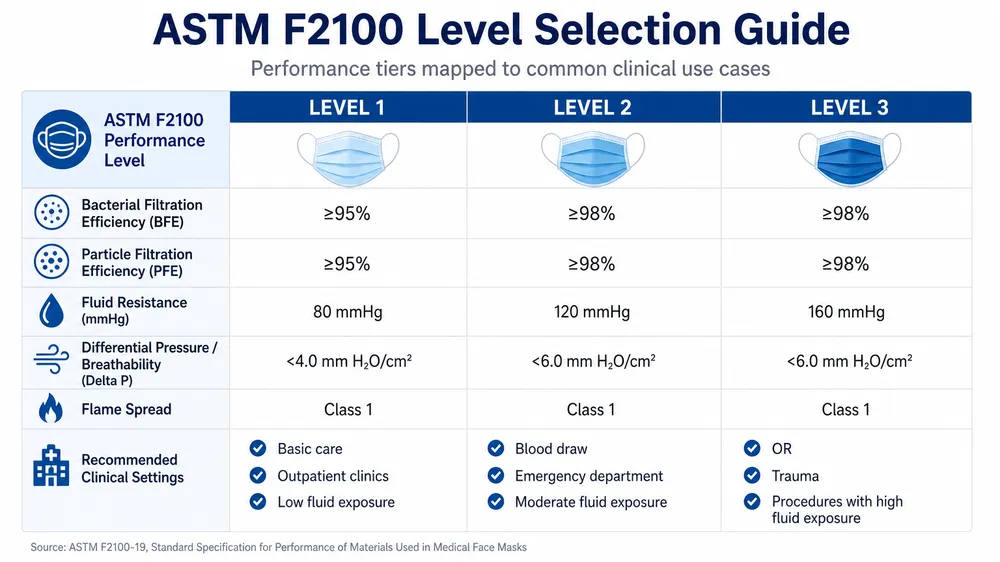
ASTM F2100 Level Selection: Match the Spec to the Clinical Setting Before You Call a Supplier
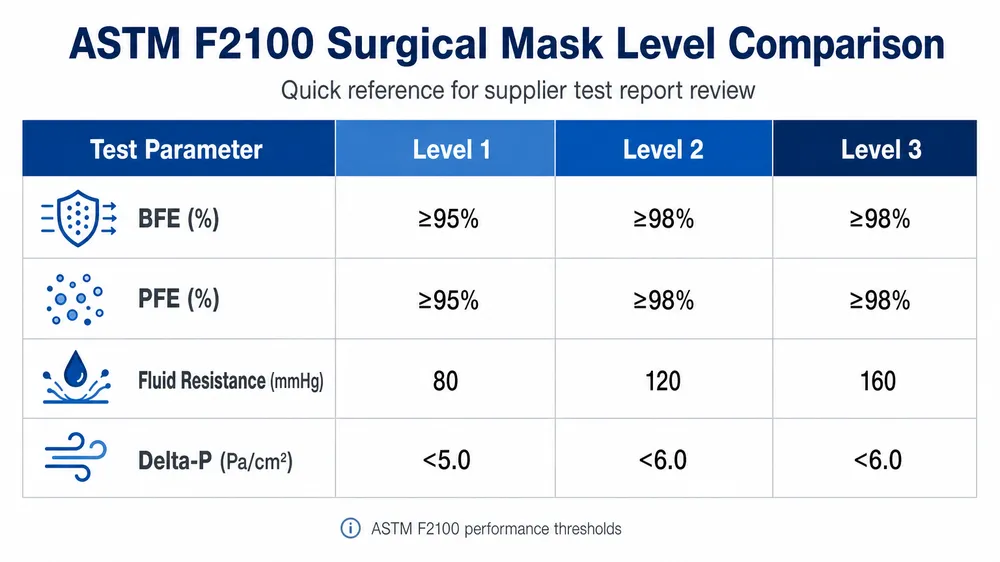
Before you evaluate a single supplier, you need to know which ASTM F2100 level your application requires. This is the decision that determines whether you're overpaying for protection you don't need — or under-specifying for a setting where fluid exposure is real.
| ASTM Level | BFE | Fluid Resistance | Delta-P (breathability) | Typical Clinical Use |
|---|---|---|---|---|
| Level 1 | ≥95% | 80 mmHg | <4.0 mm H₂O/cm² | General patient care, low-aerosol procedures |
| Level 2 | ≥98% | 120 mmHg | <5.0 mm H₂O/cm² | Moderate fluid exposure, minor surgical procedures |
| Level 3 | ≥98% | 160 mmHg | <5.0 mm H₂O/cm² | High fluid exposure, major surgical procedures |
The BFE difference between Level 1 and Level 2 is 3 percentage points. The fluid resistance difference is 40 mmHg. For most general ward and outpatient settings, Level 1 is the correct specification — and it costs less per unit. Where the level decision matters most is in OR and procedural settings where splash risk is real. Specifying Level 3 for a general ward is a budget problem, not a safety upgrade.
(One thing we see regularly: buyers who specify Level 2 or Level 3 across their entire facility because it's simpler to manage one SKU. That's a legitimate procurement decision, but it's worth knowing the unit cost premium you're paying for that simplicity — typically 15–25% over Level 1 pricing at comparable volumes.)
What to Verify Before Approving Any Surgical Mask Supplier
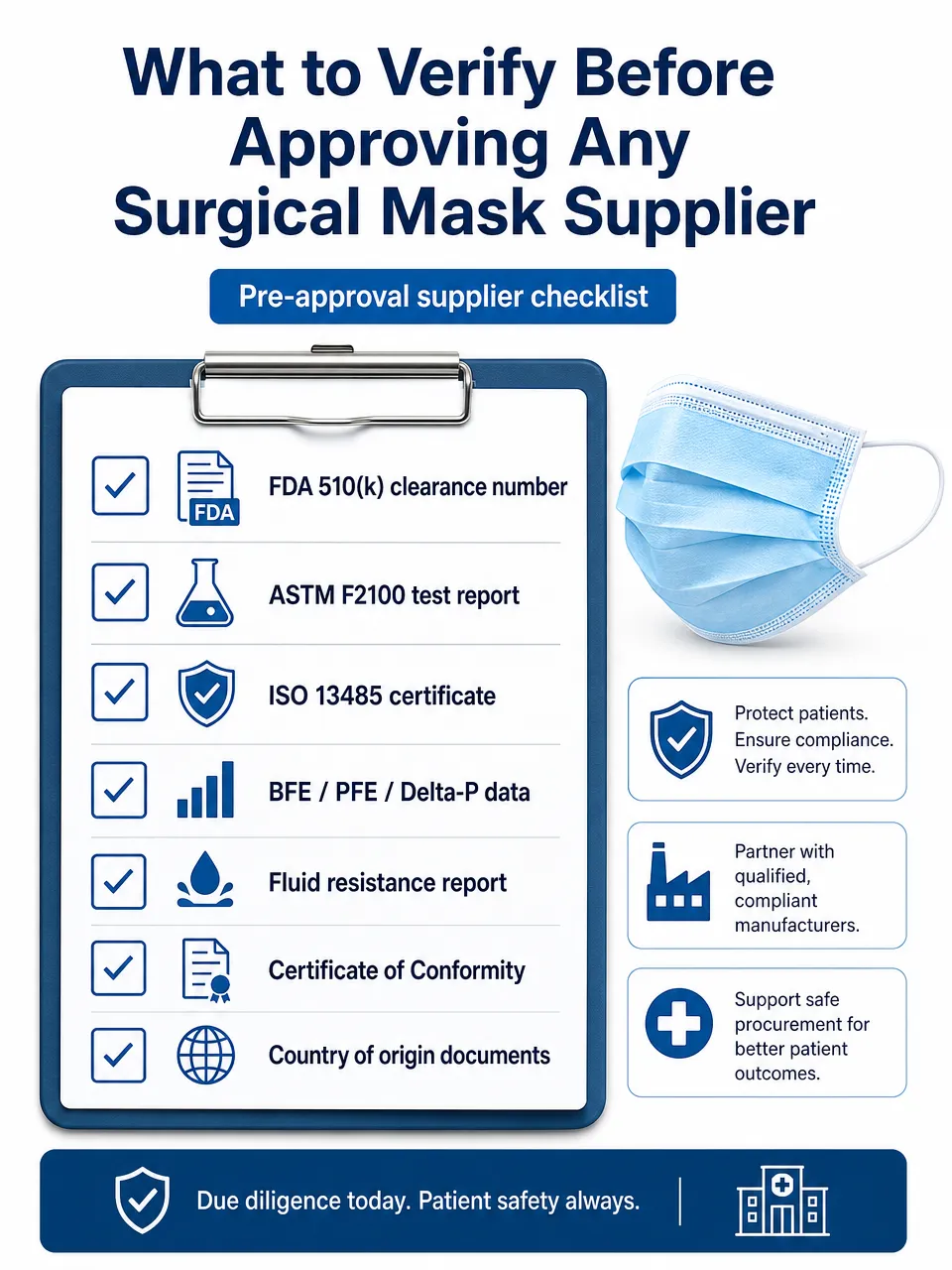
The compliance checklist below applies whether you're evaluating a domestic distributor or a factory-direct manufacturer. These are the documents and registrations that determine whether a mask can legally enter US healthcare channels and survive a GPO or hospital procurement audit.
FDA 510(k) Registration vs. 510(k)-Exempt — the distinction matters:
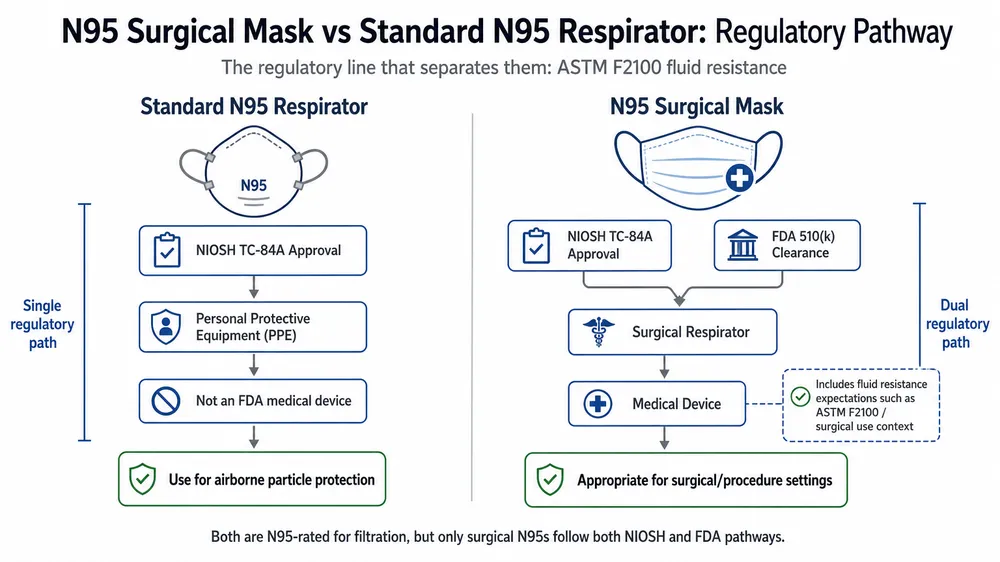
Most surgical masks sold in the US are Class II medical devices regulated under 21 CFR Part 878. A mask can reach the market through two routes: 510(k) clearance (the manufacturer submits a premarket notification and FDA reviews it) or 510(k)-exempt status (certain product types are exempt from the premarket notification requirement but still subject to general controls). Both are legal. The difference is the documentation trail.
For hospital and GPO procurement, FDA 510(k) registration is the stronger credential — it means the product has been reviewed against a predicate device and cleared. When a supplier says their mask is "FDA registered," ask specifically: is this a 510(k) clearance number, or is it a facility registration? These are different things. A facility can be FDA-registered without any of its products having 510(k) clearance.
The full compliance checklist:
- [ ] FDA 510(k) clearance number — verify on the FDA 510(k) database, not just the supplier's spec sheet
- [ ] ASTM F2100 test report — from an accredited third-party lab (Nelson Labs, SGS, Intertek), not self-declared
- [ ] ISO 13485:2016 certificate — medical device quality management system, current and in-scope for mask production
- [ ] BFE, PFE, and Delta-P test data — specific percentages and values, not just "meets ASTM F2100"
- [ ] Fluid resistance test report — ASTM F1862 splash resistance at the correct pressure for the claimed level
- [ ] Certificate of Conformity — batch-specific, not a generic template
- [ ] Country of origin documentation — relevant for tariff classification and import compliance
How We Evaluated These 10 Suppliers
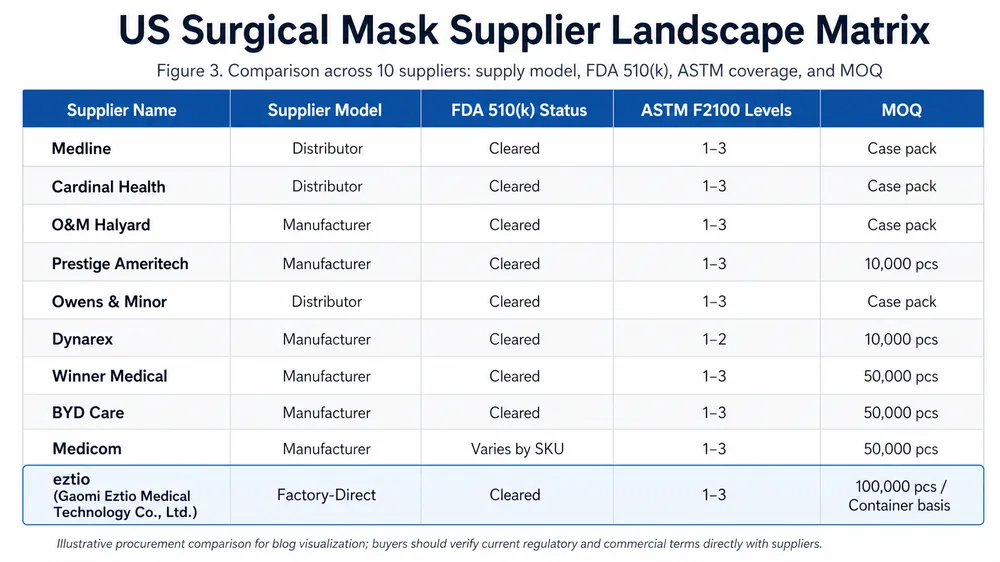
The 10 suppliers below represent the realistic sourcing landscape for US healthcare buyers — domestic distributors with national reach, specialty manufacturers, and one factory-direct option. They are not ranked by preference. They are grouped by supplier model, because the model determines what you're actually buying: inventory access and logistics convenience, or manufacturing control and cost structure.
Evaluation criteria used:
- Compliance credentials: FDA 510(k) status, ASTM F2100 level coverage, ISO 13485 scope
- Supply model: distributor, manufacturer, or trading company
- MOQ and volume flexibility: minimum order quantities and tiered pricing availability
- Documentation quality: test report availability, CoC practices, import documentation support
- OEM/private-label capability: relevant for distributors building branded programs
The 10 Surgical Medical Mask Suppliers for US Healthcare Buyers
1. Medline Industries — medline.com
Medline is the largest privately held medical products distributor in the US, with a product portfolio that spans surgical masks across all ASTM F2100 levels. Their surgical mask line includes both domestic and imported products, and their GPO contract coverage is extensive — most major US hospital systems have Medline on contract.
Supplier model: Distributor with some proprietary manufacturing Strengths: National distribution network, GPO contract access, broad SKU range, reliable replenishment for established accounts Limitations: Pricing reflects distributor margin structure; custom or private-label programs are not their core business; MOQ flexibility is limited for non-contract buyers Best fit: Hospital systems and IDNs already operating under GPO contracts where Medline is the contracted supplier
2. Cardinal Health — cardinalhealth.com
Cardinal Health operates as both a distributor and a manufacturer of medical products, including surgical masks under their own brand. Their at-Home and medical segments serve hospitals, surgery centers, and physician offices across the US. Cardinal's supply chain infrastructure is one of the most developed in the industry.
Supplier model: Distributor and proprietary manufacturer Strengths: Deep inventory, established hospital relationships, strong logistics infrastructure, compliance documentation for institutional procurement Limitations: Pricing is structured for contract accounts; spot buyers and smaller distributors face less favorable terms; limited flexibility outside standard SKUs Best fit: Large health systems, surgery centers, and institutional buyers with established Cardinal accounts
3. Owens & Minor (Halyard Health) — owens-minor.com
Owens & Minor acquired Halyard Health's S&IP (Surgical and Infection Prevention) business, which includes the Halyard-branded surgical mask line. Halyard masks have strong brand recognition in US OR settings, particularly for Level 2 and Level 3 surgical applications. The Halyard FLUIDSHIELD line is widely specified in hospital formularies.
Supplier model: Distributor and brand owner Strengths: Strong OR brand recognition, Level 2/3 product depth, established hospital formulary presence Limitations: Premium pricing relative to generic ASTM-compliant alternatives; less flexibility for buyers outside the Halyard brand ecosystem Best fit: OR procurement where Halyard is already on formulary; buyers who need Level 2/3 with strong brand documentation
4. Kimberly-Clark Professional — kcprofessional.com
Kimberly-Clark's professional division supplies surgical masks under the Kimberly-Clark brand to healthcare facilities. Their product range covers standard surgical masks and procedure masks, with distribution through major healthcare distributors. KC Professional is a recognized name in hospital infection control programs.
Supplier model: Manufacturer selling through distribution Strengths: Established brand, broad distribution access, consistent product quality Limitations: Not a direct-to-buyer manufacturer for most accounts; pricing includes distributor layer; limited OEM or private-label capability for third-party buyers Best fit: Facilities with existing KC Professional contracts or distributor relationships
5. Henry Schein Medical — henryschein.com
Henry Schein is a major healthcare distributor serving physician offices, dental practices, and ambulatory care settings. Their surgical and procedure mask offering spans multiple brands and price points, making them a common source for smaller healthcare facilities that don't have GPO access to the larger distributors.
Supplier model: Distributor Strengths: Broad product selection across price tiers, strong service for smaller facilities, established account management Limitations: Distributor pricing structure; no manufacturing capability; limited documentation depth for import compliance Best fit: Physician offices, dental practices, ambulatory surgery centers, and smaller facilities outside major GPO contracts
6. McKesson Medical-Surgical — mckesson.com
McKesson is one of the largest healthcare distributors in North America, with surgical mask inventory spanning their own Medi-Pak brand and third-party products. Their distribution reach covers hospitals, long-term care, and home health channels. McKesson's scale means consistent availability for high-volume accounts.
Supplier model: Distributor with proprietary brand Strengths: National scale, multi-channel distribution, consistent availability for contract accounts, Medi-Pak brand at competitive price points Limitations: Pricing and terms favor large contract accounts; smaller buyers face standard distributor markup; limited customization Best fit: Long-term care facilities, home health distributors, and hospital systems with McKesson distribution agreements
7. Prestige Ameritech — prestigeameritech.com
Prestige Ameritech is one of the few remaining domestic surgical mask manufacturers in the US, operating production facilities in Texas. They gained significant attention during the pandemic as a US-made alternative to imported masks. Their products carry FDA 510(k) clearance and are marketed specifically on the domestic manufacturing angle.
Supplier model: Domestic manufacturer Strengths: US-made production, FDA 510(k) clearance, strong compliance documentation, relevant for buyers with domestic sourcing requirements or Buy American provisions Limitations: Higher unit cost than imported alternatives at comparable ASTM levels; capacity constraints relative to the large distributors; limited OEM capability Best fit: Government procurement with domestic sourcing requirements, buyers where "Made in USA" is a procurement specification, facilities prioritizing supply chain resilience over unit cost
8. Dynarex Corporation — dynarex.com
Dynarex is a US-based medical products company that sources and distributes a broad range of disposable medical supplies, including surgical and procedure masks. Their mask line covers standard ASTM F2100 Level 1 and Level 2 products, distributed through medical supply dealers and distributors across the US.
Supplier model: Importer and distributor Strengths: Competitive pricing relative to the major distributors, broad dealer network, accessible for smaller buyers Limitations: Products are sourced from overseas manufacturers; documentation depth varies; less suitable for buyers requiring deep compliance documentation or OEM capability Best fit: Medical supply dealers, smaller distributors, and facilities looking for cost-competitive ASTM-compliant masks without GPO contract requirements
9. Moldex-Metric — moldex.com
Moldex-Metric is a US-based manufacturer primarily known for respiratory protection (N95 and N99 respirators), but their product line includes surgical masks and procedure masks. Their manufacturing is based in California, and their compliance documentation is strong — Moldex products are frequently specified in industrial and healthcare settings where documentation quality is a priority.
Supplier model: Domestic manufacturer Strengths: Strong compliance documentation, US manufacturing, well-regarded in respiratory protection; surgical mask line benefits from the same QC infrastructure Limitations: Core competency is respirators, not surgical masks; surgical mask SKU depth is narrower than dedicated mask distributors; pricing reflects US manufacturing cost structure Best fit: Buyers who already source Moldex respirators and want to consolidate suppliers; facilities where documentation quality is the primary criterion
10. eztio (Gaomi Eztio Medical Technology Co., Ltd.) — eztio.com
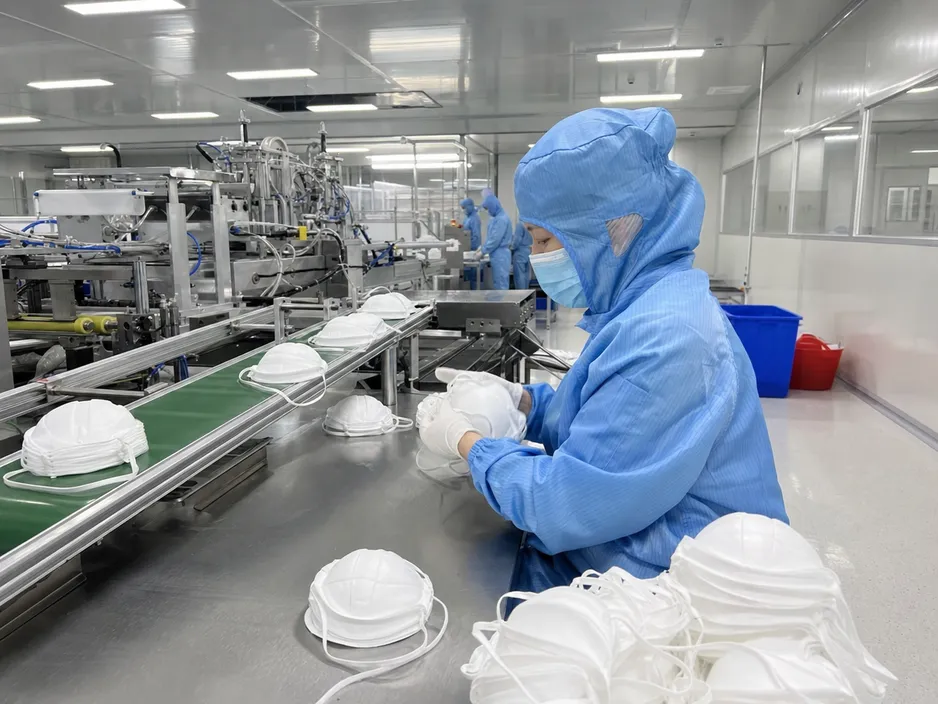
eztio is a factory-direct surgical mask manufacturer based in Gaomi, Shandong, China, operating since 2012. We hold FDA 510(k) registration, CE under EU MDR, ISO 13485:2016, and ISO 9001:2015. Our 12,000 m² facility runs 6 fully automated production lines in a Class 100,000 (ISO 8) cleanroom environment, with annual output capacity of 120 million pieces.
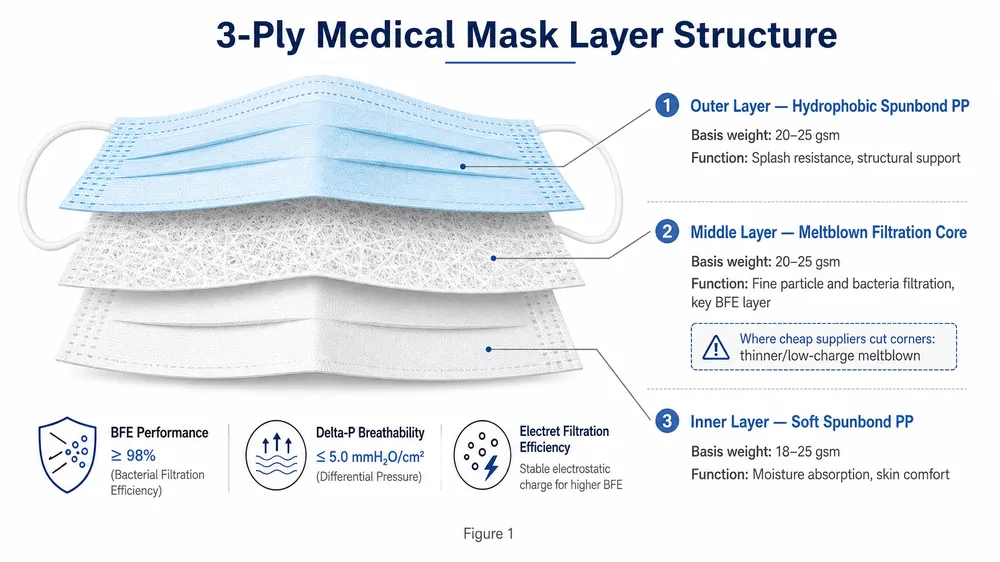
The detail that separates us from most of the supplier landscape — including most China-based factories — is in-house meltblown nonwoven production. Meltblown fabric is the filtration layer that determines BFE and PFE performance. We manufacture it ourselves, which means we set the fiber diameter, basis weight, and electrostatic charge to match the filtration spec we're targeting. When you order a mask rated at ≥98% BFE for ASTM F2100 Level 2, we're not relying on a third-party fabric supplier to ship the right roll. We know what's in the mask because we made the material. (This matters most during supply disruptions — factories without their own meltblown capacity either stop shipping or ship masks that don't meet spec. We've watched both happen to competitors.)
Our in-house QC lab runs BFE, PFE, and Delta-P testing on every production batch before third-party certification. The in-house testing catches problems before they become shipment problems. Outgoing inspection includes full performance testing plus visual inspection, packaging integrity, and label verification — the test reports from this stage travel with your shipment and support your FDA import documentation.
Supplier model: Factory-direct manufacturer FDA 510(k): Registered ASTM F2100: Level 1, Level 2, Level 3 ISO 13485:2016: Certified MOQ: 50,000 pieces for standard SKUs OEM/Private-label: Full capability, in-house Lead time: 15–25 days from order confirmation Best fit: US distributors, healthcare procurement teams, and private-label brands sourcing at repeat volume where unit cost, compliance documentation, and OEM capability all matter
The Pricing Reality: Distributor Markup vs. Factory-Direct Cost Structure
This is the section most supplier listing pages skip. Here's the honest version.
US surgical mask pricing runs through two fundamentally different cost structures, and the gap between them widens significantly at volume.
Domestic distributor pricing reflects the full supply chain: manufacturer margin, importer margin (if the product is sourced overseas), distributor margin, and logistics. For a standard ASTM F2100 Level 1 surgical mask, distributor pricing to healthcare facilities typically runs in the range of $0.08–$0.18 per piece depending on volume tier, contract status, and brand. Level 2 runs higher, Level 3 higher still. GPO contract pricing is at the lower end of that range for large systems; spot buyers pay more.
Factory-direct pricing from a certified manufacturer removes the distributor layer entirely. For the same ASTM F2100 Level 1 product from an FDA 510(k)-registered factory, FOB pricing typically runs $0.03–$0.06 per piece at 500,000+ piece volumes. Add ocean freight, customs duties (currently 7.5% for surgical masks under HTS 6307.90), and US inland logistics, and your landed cost is still materially below domestic distributor pricing at comparable volumes.
| Order Volume | Domestic Distributor (est.) | Factory-Direct Landed (est.) | Approximate Savings |
|---|---|---|---|
| 100,000 pcs | $0.12–0.18/pc | $0.07–0.10/pc | 30–45% |
| 500,000 pcs | $0.09–0.14/pc | $0.05–0.08/pc | 35–50% |
| 1,000,000+ pcs | $0.08–0.12/pc | $0.04–0.06/pc | 40–55% |
These are representative market ranges, not guaranteed quotes. Actual pricing depends on ASTM level, packaging configuration, and current freight rates.
The math changes when you factor in lead time and inventory risk. Domestic distributors can ship within days. Factory-direct orders run 15–25 days production plus ocean transit — typically 30–45 days total to a US port. For emergency replenishment or small fill-in orders, local distribution wins on speed. For planned procurement at repeat volume, the economics favor factory-direct.
When Local Distribution Is the Right Answer
A credible sourcing guide should say this plainly: domestic distributors are the right choice in specific scenarios, and pretending otherwise doesn't help you make a better decision.
Use domestic distribution when:
- You need product within 1–2 weeks and can't wait for ocean transit
- Your order volume is below 50,000 pieces — factory-direct MOQs don't make sense at that scale
- You're under a GPO contract that mandates specific suppliers
- You need emergency replenishment mid-contract cycle
- Your facility requires domestic sourcing under Buy American provisions
Factory-direct sourcing becomes financially smarter when:
- You're procuring at 100,000+ pieces per order on a recurring basis
- You're building a private-label surgical mask program and need OEM packaging
- Your current supplier has had quality consistency issues and you want direct factory QC visibility
- You're entering a new market segment and need a trial order at a manageable MOQ (50,000 pieces) before committing to volume
- You need full compliance documentation — FDA 510(k), ISO 13485, ASTM test reports — for a GPO or hospital procurement audit
The honest trade-off: factory-direct requires more procurement planning (longer lead times, larger minimum orders, more documentation management) but delivers better unit economics and more control over product specification at scale.
How to Vet a China-Based Surgical Mask Manufacturer
If you're evaluating factory-direct sourcing for the first time, the due diligence process is different from evaluating a domestic distributor. Here's what to verify before placing a bulk order.
Step 1: Verify FDA 510(k) registration independently
Go to the FDA's 510(k) database (accessdata.fda.gov) and search by company name or 510(k) number. A legitimate registration will show the applicant name, device name, clearance date, and product code. If a supplier claims FDA 510(k) clearance but can't provide a clearance number you can verify, that's a red flag.
Step 2: Request third-party test reports, not self-declared specs
ASTM F2100 compliance must be demonstrated through testing by an accredited laboratory — Nelson Labs, SGS, Intertek, or equivalent. The test report should show the specific BFE percentage, PFE percentage, Delta-P value, and fluid resistance result for the exact product you're ordering. A spec sheet that says "meets ASTM F2100 Level 2" without a lab report number is not sufficient documentation for hospital procurement.
Step 3: Confirm ISO 13485 scope covers mask production
ISO 13485 certificates have a defined scope. The scope statement must explicitly cover the manufacture of surgical masks or disposable medical masks. A certificate scoped to "nonwoven products" or "general medical supplies" is not equivalent.
Step 4: Ask about meltblown fabric sourcing
This is the question that separates serious manufacturers from assemblers. Ask directly: do you produce your own meltblown nonwoven fabric, or do you purchase it from a third-party supplier? Factories that buy meltblown from outside suppliers are dependent on that supplier's consistency for their BFE performance. During supply disruptions, that dependency becomes your problem.
Step 5: Request a sample documentation package before placing a bulk order
A factory that can't produce a complete documentation package — CoC, test reports, packing list format, FDA import records — before you place an order will not produce it reliably after. The documentation package is part of the product.
(We've had buyers come to us after a failed import — product held at customs because the documentation didn't match the FDA import records. Getting that right the first time is not complicated, but it requires a factory that has done it before and has the paperwork infrastructure in place.)
Sourcing Decision Framework: Which Route Fits Your Situation
| Scenario | Recommended Route | Rationale |
|---|---|---|
| Emergency replenishment, <2 weeks | Domestic distributor | Speed beats cost |
| GPO contract, mandated supplier | Domestic distributor | Contract compliance |
| Recurring order, 100K+ pcs/cycle | Factory-direct | Unit economics |
| Private-label program | Factory-direct | OEM capability, cost control |
| New supplier evaluation, trial order | Factory-direct (50K MOQ) | Test quality before committing volume |
| Buy American requirement | Domestic manufacturer (Prestige Ameritech, Moldex) | Domestic origin required |
| Hospital GPO audit, full documentation | Factory-direct (FDA 510(k) registered) | Documentation depth |
Frequently Asked Questions
What is the difference between FDA 510(k) clearance and FDA facility registration for surgical masks?
FDA facility registration means the manufacturing site is registered with the FDA — it's an administrative requirement for any facility that manufactures, processes, or distributes medical devices in the US. It does not mean the products have been reviewed or cleared. FDA 510(k) clearance is a product-level determination: the manufacturer submitted a premarket notification, FDA reviewed it against a predicate device, and issued a clearance letter. For hospital and GPO procurement, 510(k) clearance is the stronger credential. Always ask for the 510(k) number and verify it in the FDA database.
How do I select the correct ASTM F2100 level for my clinical setting?
Level 1 covers general patient care and low-aerosol procedures — most outpatient, general ward, and administrative settings. Level 2 is appropriate for moderate fluid exposure risk — minor surgical procedures, endoscopy, and similar settings. Level 3 is for high fluid exposure — major surgical procedures where splash risk is significant. The BFE performance difference between Level 1 and Level 2 is 3 percentage points (≥95% vs. ≥98%); the meaningful difference is fluid resistance (80 mmHg vs. 120 mmHg). Specify the level that matches the actual exposure risk in the setting, not the highest level available.
What MOQ is realistic for a factory-direct surgical mask order from China?
For a certified manufacturer with standard SKUs, 50,000 pieces is a workable trial order MOQ. Below that, the economics of ocean freight and documentation overhead don't make sense for either party. For custom configurations or OEM packaging, MOQ is typically higher — 100,000 to 200,000 pieces depending on the complexity of the customization. At 500,000+ pieces per order, factory-direct pricing delivers the most significant cost advantage over domestic distribution.
What documentation should I request before importing surgical masks from a China-based manufacturer?
At minimum: FDA 510(k) clearance number (verifiable in the FDA database), ASTM F2100 test report from an accredited third-party lab, ISO 13485:2016 certificate with scope covering mask production, Certificate of Conformity for the specific batch, and the factory's FDA facility registration number. For private-label programs, also request a sample of the packaging with your brand applied before approving the production run. Your customs broker will need the HTS classification (typically 6307.90 for surgical masks) and the country of origin documentation.
Can a China-based surgical mask manufacturer support a US private-label program?
Yes, provided the factory has OEM capability and the compliance documentation to support it. The key requirements: FDA 510(k) clearance on the base product, ISO 13485 quality system, and the ability to produce packaging with your brand that meets FDA labeling requirements for Class II medical devices. The labeling requirements include the device name, intended use, ASTM F2100 level, lot number, and manufacturer information. A factory that has done this before will have a label template and approval process in place — ask to see an example of a completed private-label package before committing to a program.
eztio as a Factory-Direct Alternative for US Healthcare Buyers
We've been manufacturing Surgical Medical Masks since 2012. The FDA 510(k) registration, ISO 13485:2016 certification, and CE under EU MDR are current and verifiable. Our 12,000 m² facility in Gaomi, Shandong runs 6 automated production lines in a Class 100,000 cleanroom, with 120 million pieces annual capacity.
The compliance documentation package we ship with every order — test reports, CoC, FDA import records — is designed to clear US customs and survive a hospital procurement audit without surprises. We've shipped to North American buyers across multiple order cycles, and the documentation infrastructure is built for repeat procurement, not one-time transactions.
For buyers evaluating a Disposable Surgical Medical Mask program or a 3 Ply Medical Mask private-label SKU, the 50,000-piece MOQ on standard configurations makes a trial order practical before you commit to volume. We'll send a sample documentation package — test reports, CoC template, FDA import record format — before you place an order, so you can verify the compliance infrastructure before the product ships.
If you're ready to compare specifications and pricing against your current supplier, Request a Quote with your target ASTM level, order volume, and any OEM or private-label requirements. We'll respond with pricing, lead time, and a sample documentation package within 48 hours.