Accepting a container of 3 Ply Disposable Medical Masks without verifying BFE performance is one of the more expensive mistakes a buyer can make. Not because the masks will obviously fail on arrival — they usually look fine. The problem surfaces later: an FDA import alert, a hospital procurement audit that pulls your product, or a distributor returning stock because the BFE certificate doesn't match the test method your end customer requires.
BFE numbers on a spec sheet are easy to print. What's harder to fake is a complete, traceable test report from an accredited lab, tied to a specific production batch, run under the correct standard for your target market. This guide walks through how to request that documentation, how to read it, and what to do when something doesn't add up.
What BFE actually measures — and why the meltblown layer is the whole story
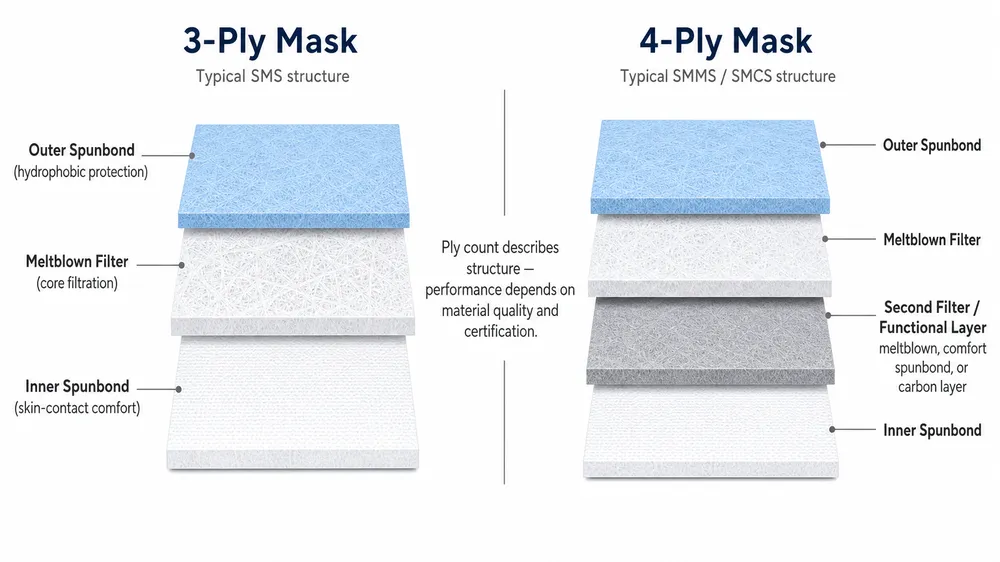
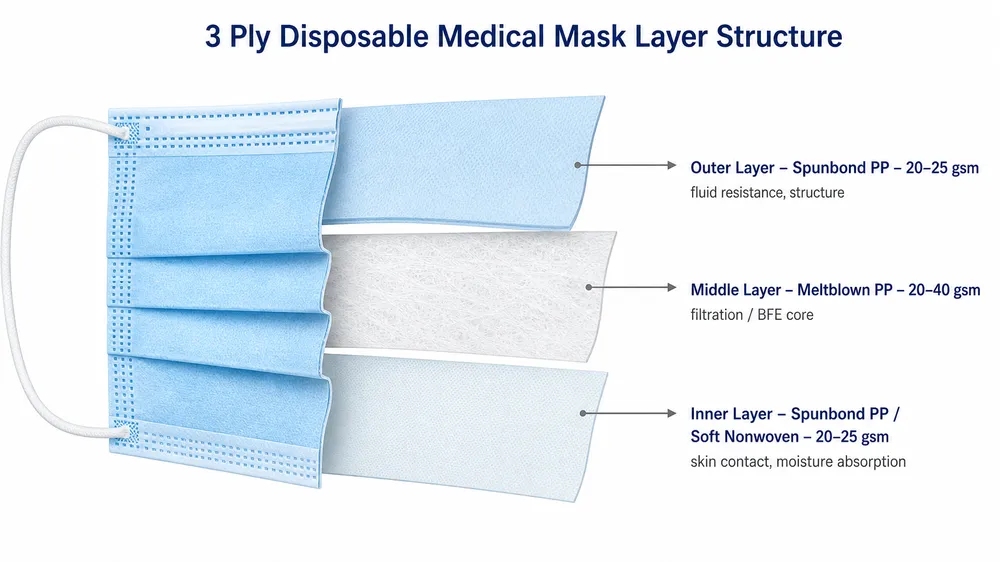
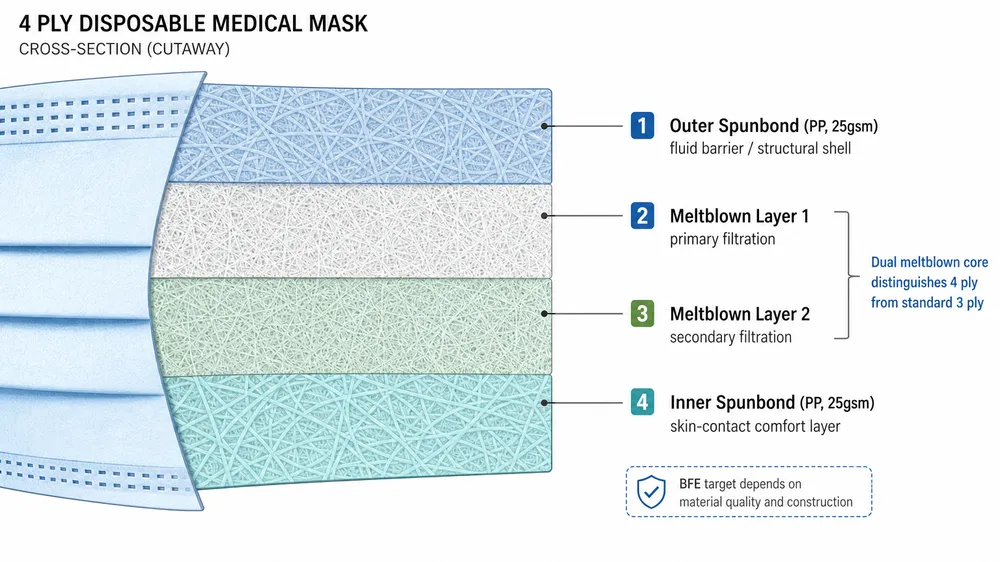
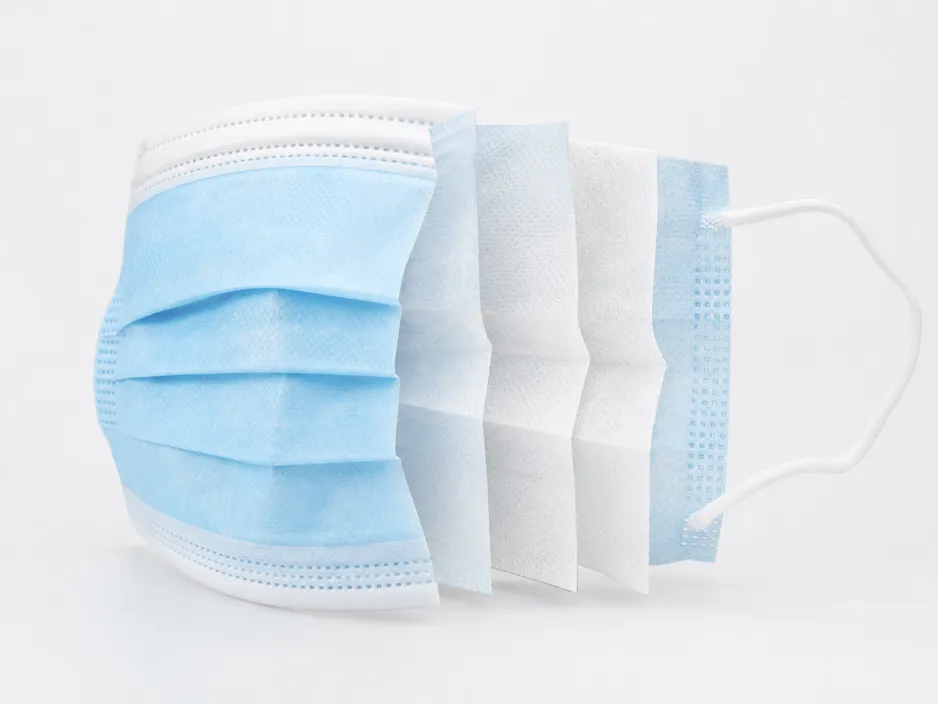
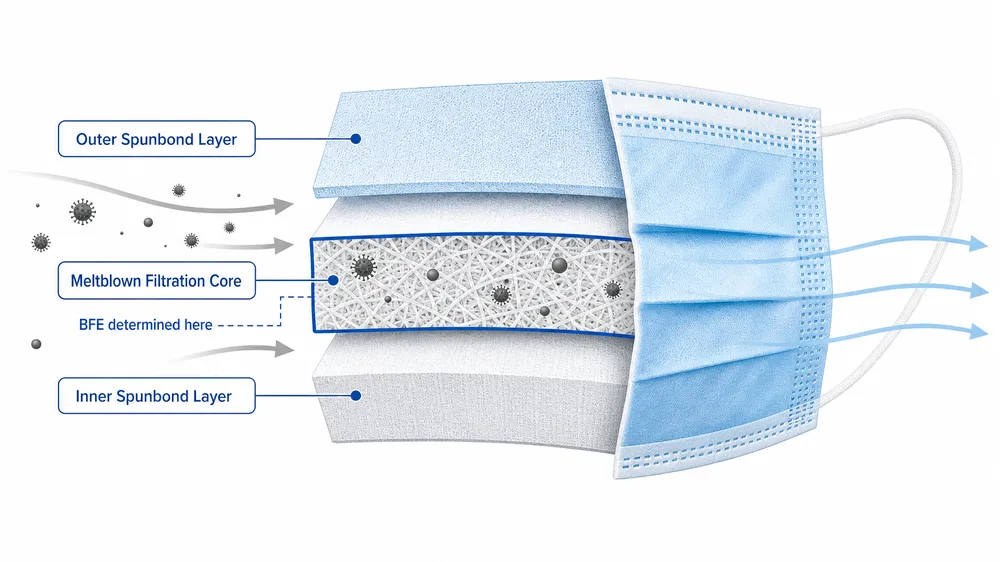
BFE stands for Bacterial Filtration Efficiency. It measures what percentage of aerosolized bacteria a mask filters out under controlled test conditions. For a standard 3-ply disposable medical mask, the three layers are a spunbond outer shell, a meltblown filtration core, and a spunbond inner facing. The outer and inner layers contribute almost nothing to filtration. The meltblown layer is the entire BFE story.
This matters for sourcing because meltblown nonwoven fabric is not a commodity. Fiber diameter, electrostatic charge density, and basis weight all affect filtration efficiency — and these properties vary between manufacturers, between production runs, and even between rolls from the same supplier. A mask factory that buys meltblown on the open market has limited visibility into what they're actually getting. We've seen incoming rolls that tested fine on the first batch and dropped 8-10 percentage points on the next delivery from the same supplier, with no visible difference in the fabric.
The practical implication: BFE consistency across batches is a function of meltblown supply chain control, not just final mask assembly. When you're evaluating a supplier's BFE claims, the first question isn't "what's your BFE number?" — it's "where does your meltblown come from and how do you verify it?"

BFE standards by market: what the numbers mean for your procurement spec
The two standards you'll encounter most often are ASTM F2101 (used in the US and many export markets) and EN 14683 (EU and markets that follow EU MDR). They are not interchangeable, and a test report under one does not satisfy the other.
ASTM F2101 tests BFE using Staphylococcus aureus at a flow rate of 28.3 L/min. The result is expressed as a percentage. Under ASTM F2100 (the full surgical mask standard), Level 1 requires ≥95% BFE, Level 2 requires ≥98%, and Level 3 requires ≥98%. The difference between Level 2 and Level 3 is not BFE — it's fluid resistance and PFE.
EN 14683 uses a similar bacterial aerosol challenge but defines two mask types: Type I (≥95% BFE) and Type II / Type IIR (≥98% BFE). Type IIR adds a splash resistance requirement. If your buyer is in Germany, France, or any EU member state, the test report needs to reference EN 14683 and the mask needs CE marking under EU MDR.
A few things buyers get wrong here:
- A BFE of 99% under ASTM F2101 does not automatically mean the mask meets EN 14683 Type II. The test organisms, challenge concentrations, and acceptance criteria differ enough that you need a separate test run under each standard.
- "BFE ≥95%" printed on a box is not a test result. It's a claim. The test report is the evidence.
- Some suppliers quote PFE (Particulate Filtration Efficiency) when asked for BFE. These are different tests. PFE uses latex microspheres, not bacteria. A high PFE does not guarantee a passing BFE, and vice versa.
If you're supplying into multiple markets, specify the standard in your purchase order. Don't assume the supplier knows which one you need.
How to request a BFE test report — and what to ask for
Most suppliers will send you a certificate of conformance or a one-page summary. That's not enough. What you need is the full test report from the testing laboratory, not a summary the supplier prepared themselves.
When you contact a supplier, ask for:
- The full lab test report — not a certificate, not a summary. The actual report from the testing lab, with the lab's letterhead, accreditation number, and authorized signature.
- The test standard referenced — ASTM F2101, EN 14683, or both. It should be stated explicitly in the report header.
- The sample description — the report should identify the mask model, lot number or batch reference, and the number of samples tested.
- The test date — BFE test reports have a shelf life for regulatory purposes. For FDA import documentation, reports older than 12 months may require re-testing depending on the product's 510(k) status.
- The lab's accreditation — the lab should be ISO 17025 accredited for the specific test method. Nelson Labs, SGS, Intertek, and Bureau Veritas are commonly accepted. An in-house test report from the factory itself is not a substitute for third-party lab testing.
(We run in-house BFE testing on every production batch as a process control check — but we still send samples to accredited third-party labs for the documentation that goes with your shipment. In-house testing catches problems early; third-party reports are what your customs broker and procurement auditor actually need.)
Reading a BFE test report field by field
Once you have the full report, here's what to check:
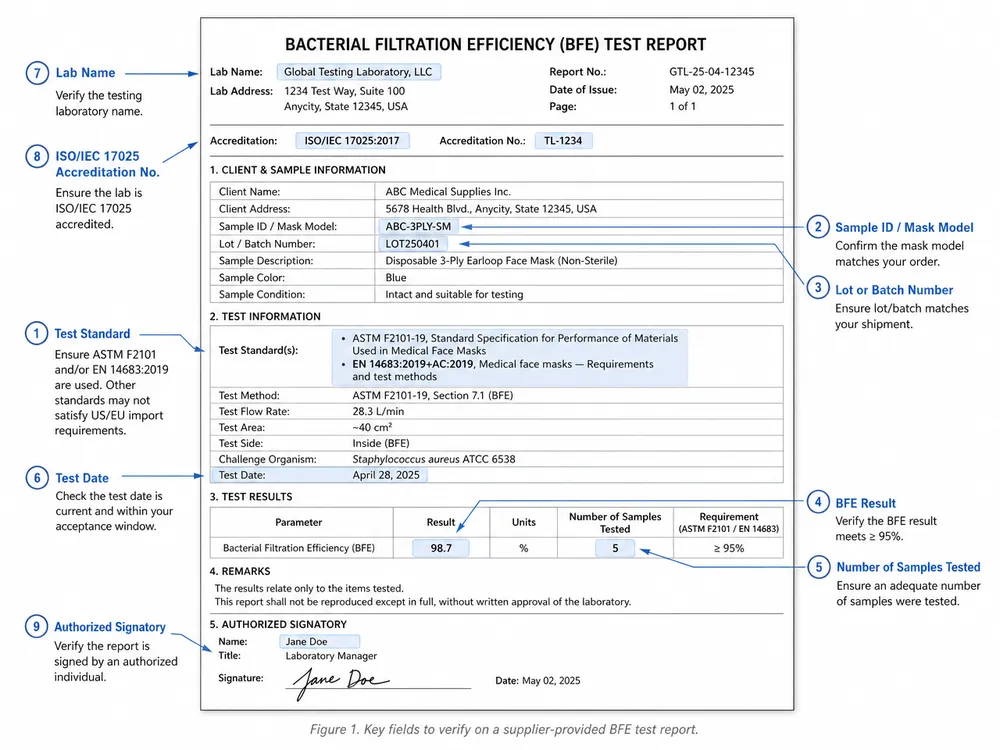
Test standard field: Should read "ASTM F2101" or "EN 14683:2019" (or the current revision). If it says "GB 19083" or another Chinese national standard, that report does not satisfy US or EU import requirements. GB 19083 is the Chinese medical mask standard — it has its own BFE requirements but is not accepted as equivalent by FDA or EU MDR.
Sample identification: The report should reference a specific mask model and ideally a lot or batch number. A report that says only "3-ply disposable mask" with no model number or batch reference cannot be tied to your specific shipment. This is a documentation gap that will cause problems in an FDA audit.
BFE result: The number itself — expressed as a percentage. For a medical-grade mask, you want ≥95% at minimum. If the supplier is claiming Level 2 or Type II performance, the result should be ≥98%. Check whether the report shows individual sample results or only a mean. Individual results matter — a mean of 98.2% that includes one sample at 94.1% is a failing result under most standards.
Number of samples: ASTM F2101 requires a minimum of 3 samples per test run. EN 14683 requires 5. If the report shows fewer, the test was not run to standard.
Test date and report date: These should be close together. A test date from 18 months ago with a report date from last week is a red flag — it may mean the supplier is reusing old test data on new production.
Lab accreditation: Look for an ISO/IEC 17025 accreditation number and the scope of accreditation. The scope should explicitly include ASTM F2101 or EN 14683 as a covered test method. If the lab is accredited for general microbiology but not specifically for mask filtration testing, the report may not be accepted by your regulatory authority.
Why batch-to-batch BFE consistency is harder than a single passing report
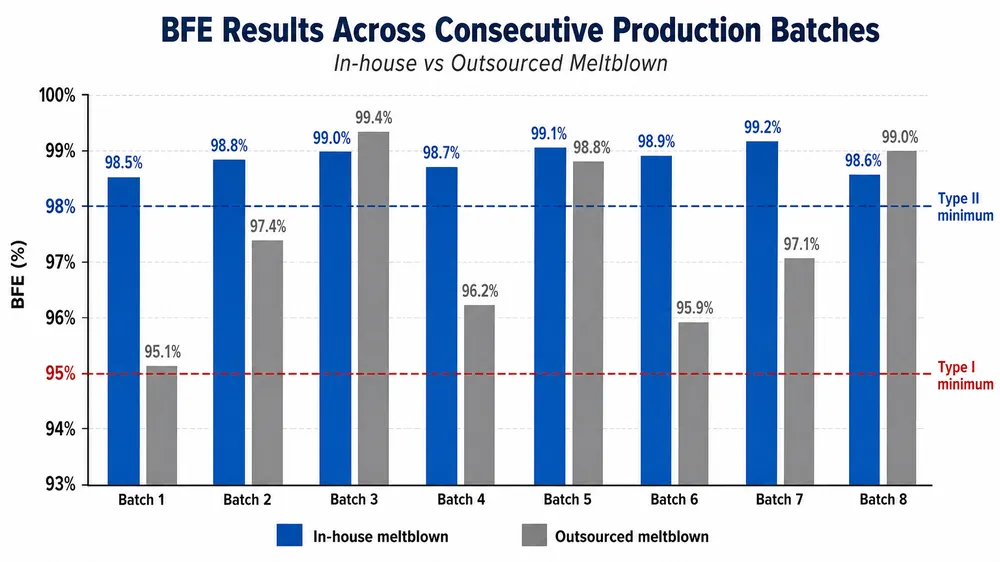
A single passing BFE report proves that one batch of masks, tested on one day, met the standard. It says nothing about the next shipment.
This is where meltblown sourcing becomes a commercial risk, not just a technical detail. Factories that buy meltblown from external suppliers are exposed to variability they can't fully control. The meltblown market tightened severely during 2020-2021, and many factories that entered the market during that period built supply chains around spot purchases from multiple fabric sources. Some of those supply chains never stabilized.
We produce our own meltblown nonwoven fabric, which means we control the fiber diameter, electrostatic treatment, and basis weight at the source. When a buyer asks us for BFE consistency data across 10 consecutive batches, we can pull that from our internal QC records. Most factories that outsource their meltblown can't do that — they can show you one test report, but they can't show you the batch-to-batch trend.
What to ask a supplier to assess their consistency:
- "Can you provide BFE test results from the last 5 production batches of this SKU?" A supplier with stable meltblown supply should have this data. If they can only provide one report, that's a signal.
- "What is your meltblown source, and do you have incoming inspection records for the fabric?" Incoming inspection for meltblown should include basis weight verification and ideally a quick BFE spot-check before the fabric goes to the production line.
- "What is your process if a production batch fails BFE testing?" The answer tells you whether they have a real QC system or just a testing protocol on paper.
Red flags in supplier BFE documentation
These are the patterns we see most often when buyers bring us documentation from other suppliers and ask us to review it:
The certificate is not a test report. A "Certificate of BFE ≥98%" signed by the factory's QC manager is a self-declaration, not a test result. It has no regulatory standing. The document you need is the lab's own report, not a factory-issued summary of it.
The test standard doesn't match the destination market. A report citing GB 19083 or an internal factory standard will not satisfy FDA or EU MDR requirements. This is common with factories that primarily serve the domestic Chinese market and are adapting their documentation for export.
The report covers a different product. Check the mask model number on the report against the model number on your purchase order. Some suppliers use a single test report for an entire product family. If the tested product has a different meltblown specification than what you're buying, the report doesn't apply.
The test date is more than 12 months old. For FDA 510(k)-registered products, performance data should be current. For non-510(k) products sold as general-use masks, older reports may be technically acceptable but are a signal that the supplier isn't running regular batch testing.
Individual sample results are missing. If the report shows only a mean BFE without individual sample data, ask for the full data table. A mean can pass while individual samples fail.
The lab is not ISO 17025 accredited for the specific test method. Some factories use in-house labs or small regional labs that are not accredited for ASTM F2101 or EN 14683. The report may look professional but won't hold up under regulatory review.
The report was issued before the production date of your order. If your order was produced in March and the test report is dated January, the report was not generated from your production batch. Ask for batch-specific documentation.
What to ask your supplier before placing a large order
Before committing to a significant volume, these questions separate suppliers with real QC infrastructure from those with documentation assembled for the sale:
- "Is your meltblown fabric produced in-house or sourced externally? If external, who is your supplier and do you have incoming inspection records?" This is the single most important question for BFE consistency.
- "Do you run BFE testing on every production batch, or only on periodic samples?" Batch-level testing is the standard for ISO 13485:2016 compliance. Periodic sampling is a cost-cutting measure that increases your risk.
- "Can you provide your ISO 13485 certificate and scope of certification?" ISO 13485 requires documented traceability on every production batch. A factory with a current ISO 13485 certificate has a QMS that supports the kind of batch-level documentation you need for hospital procurement and regulatory audits.
- "Are your masks FDA 510(k) registered or listed as Class II medical devices?" 510(k) registration means the mask's performance has been reviewed by FDA against ASTM F2100. It's not a guarantee of every shipment's quality, but it means the factory has gone through a rigorous documentation process and is subject to ongoing compliance obligations.
- "What is your process for handling a batch that fails BFE testing before shipment?" A factory with a real QC system will have a documented non-conformance procedure. If the answer is vague, that's informative.
- "Can you provide BFE test reports for the last three production batches of this SKU?" Trend data is more useful than a single passing report.
(We get asked these questions regularly, and we have documented answers for all of them. If a supplier hesitates or redirects, that's worth noting before you wire a deposit.)
Verifying documentation before the shipment leaves the factory
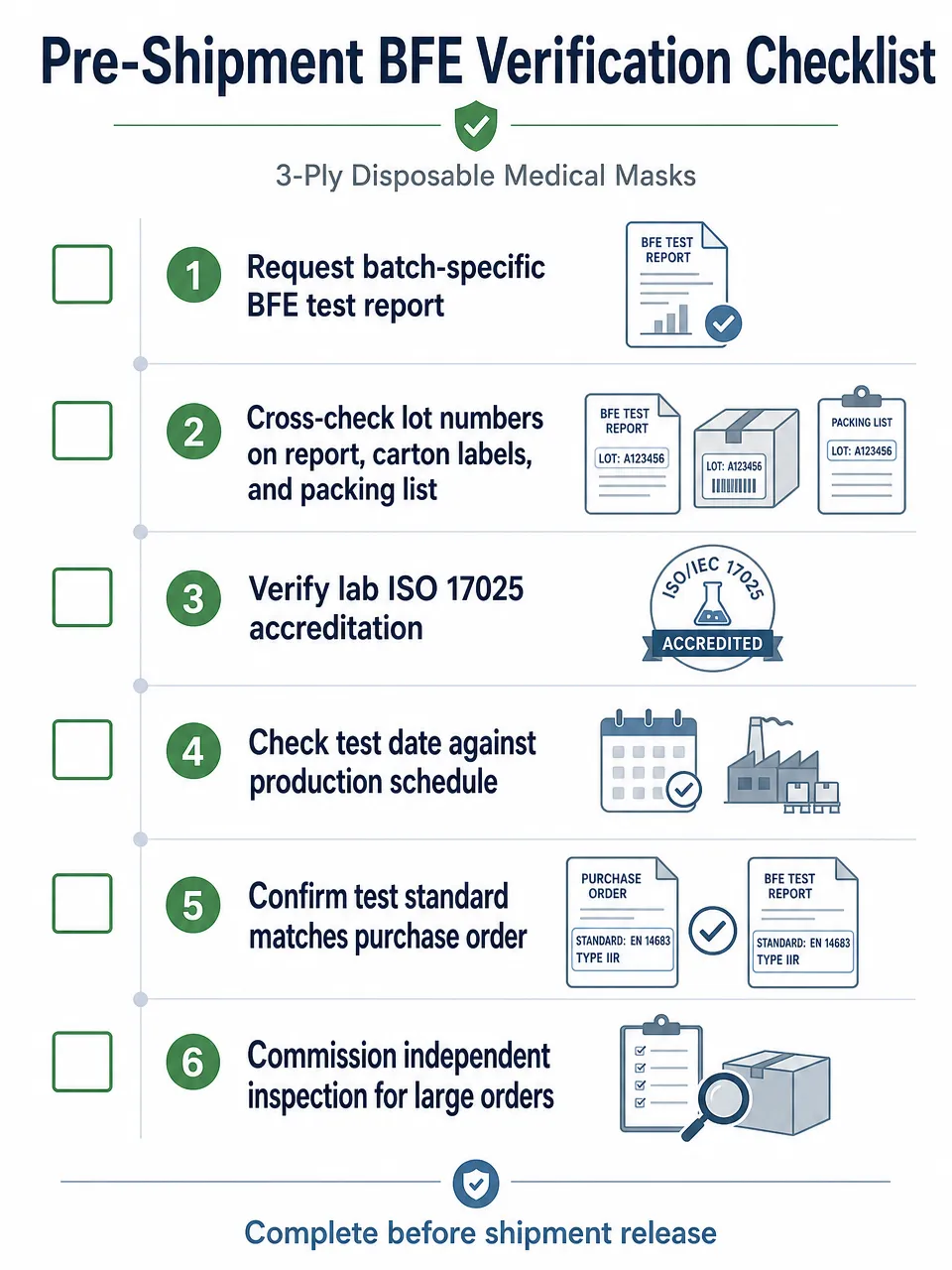
The most effective point to catch a BFE documentation problem is before the goods ship, not after they arrive at your warehouse or clear customs.
A practical pre-shipment verification process:
- Request the batch-specific BFE test report as a condition of final payment or before issuing the bill of lading release. The report should reference the production lot number that matches your shipment.
- Cross-check the lot number on the test report against the lot number on the carton labels and the packing list. These should match. If they don't, ask for an explanation in writing.
- Verify the lab accreditation by checking the lab's name against the ISO 17025 accreditation database for your region (ILAC-MRA member bodies maintain public directories). This takes five minutes and confirms the lab is real and currently accredited.
- Check the test date against your production schedule. If the test was run before your order was produced, it's not your batch's data.
- Confirm the test standard matches your purchase order specification. If your PO specifies ASTM F2100 Level 2 and the report references EN 14683 Type I, you have a mismatch.
- For large orders, consider commissioning an independent pre-shipment inspection that includes pulling samples for BFE testing at an accredited lab. The cost is typically a few hundred dollars and is recoverable many times over if it catches a non-conforming shipment.
How ISO 13485 and FDA 510(k) registration change the documentation picture
Not all Disposable Medical Masks are manufactured under the same quality system, and the documentation you can expect varies significantly depending on the supplier's certification status.
A factory operating under ISO 13485:2016 has a quality management system specifically designed for medical device manufacturing. The standard requires documented traceability on every production batch, defined non-conformance procedures, and regular management review of quality data. In practice, this means a compliant factory should be able to pull BFE records for any batch they've shipped in the last several years. The ISO 13485 certificate itself doesn't guarantee BFE performance — but it means the infrastructure for batch-level documentation exists.
FDA 510(k) registration goes further. A 510(k)-cleared surgical mask has been reviewed by FDA against ASTM F2100 performance requirements. The manufacturer has submitted test data, manufacturing process descriptions, and labeling for FDA review. Ongoing compliance requires maintaining the performance claims in the 510(k) submission. If a factory's masks are FDA 510(k) registered, you can look up the registration number in the FDA 510(k) database and verify the cleared indications and performance claims.
CE marking under EU MDR (Medical Device Regulation 2017/745) requires a notified body to review the technical file, which includes BFE test data under EN 14683. The CE certificate should identify the notified body by name and number — you can verify this against the NANDO database.
The practical takeaway: a supplier with ISO 13485, FDA 510(k), and CE under EU MDR has been through multiple layers of third-party review of their BFE documentation. That doesn't mean you skip verification — but it does mean the documentation infrastructure is more likely to be real and current.
Frequently asked questions
What BFE percentage should a 3-ply disposable medical mask have?
For medical-grade use, the minimum is ≥95% BFE (ASTM F2100 Level 1 / EN 14683 Type I). Most hospital procurement specs require ≥98% (Level 2 / Type II). If your end customer is a hospital or healthcare system, specify ≥98% in your purchase order and request the test report to confirm it. A mask labeled "medical grade" with only 95% BFE may not meet your buyer's procurement standard.
Can I accept a BFE certificate instead of a full test report?
For your own records and for regulatory compliance, no. A certificate of conformance is a supplier's self-declaration. The full lab report is the document that holds up under FDA import review, hospital procurement audit, or EU MDR compliance check. Always request the full report.
How often should a supplier re-test BFE?
Under ISO 13485, batch-level testing is the standard. At minimum, a supplier should be testing each production lot before shipment. If a supplier tests only quarterly or annually, their documentation cannot be tied to your specific shipment — which is a problem if you ever need to trace a quality issue.
What is the difference between BFE and PFE?
BFE (Bacterial Filtration Efficiency) uses an aerosolized bacterial challenge. PFE (Particulate Filtration Efficiency) uses latex microspheres at 0.1 micron. They measure different things. A mask can pass BFE and fail PFE, or vice versa. For surgical masks under ASTM F2100, both are required. Don't let a supplier substitute one for the other.
If a supplier's BFE report is from a Chinese lab, is it valid for US or EU import?
It depends on the lab's accreditation. Chinese labs that are ISO 17025 accredited and are members of the ILAC-MRA network can issue reports that are accepted internationally. The lab's accreditation scope must include ASTM F2101 or EN 14683 specifically. SGS China, Intertek China, and Bureau Veritas China are examples of labs with internationally recognized accreditation. An unknown regional lab with no ILAC-MRA membership is a different situation — that report may not be accepted by your customs authority or end customer.
If you're sourcing 3-ply disposable medical masks and need verified BFE documentation with every shipment, Request Quote with your grade, quantity, and destination market. We'll provide batch-specific test reports, certificates, and a factory quote.