A supplier quotes you "≥95% BFE." Another quotes "≥98% BFE + ≥98% PFE." A third sends a spec sheet with both numbers but no mention of which standard they're tested to. If you're building a procurement spec for hospital supply, institutional distribution, or a private-label program, these aren't interchangeable — and choosing the wrong one costs you either margin (over-specified) or compliance (under-specified).
This article breaks down what BFE and PFE actually measure, maps the numbers to the two standards your buyers are most likely to require (ASTM F2100 and EN 14683), and gives you a decision framework for matching the right grade to the right market.

What BFE and PFE Actually Measure
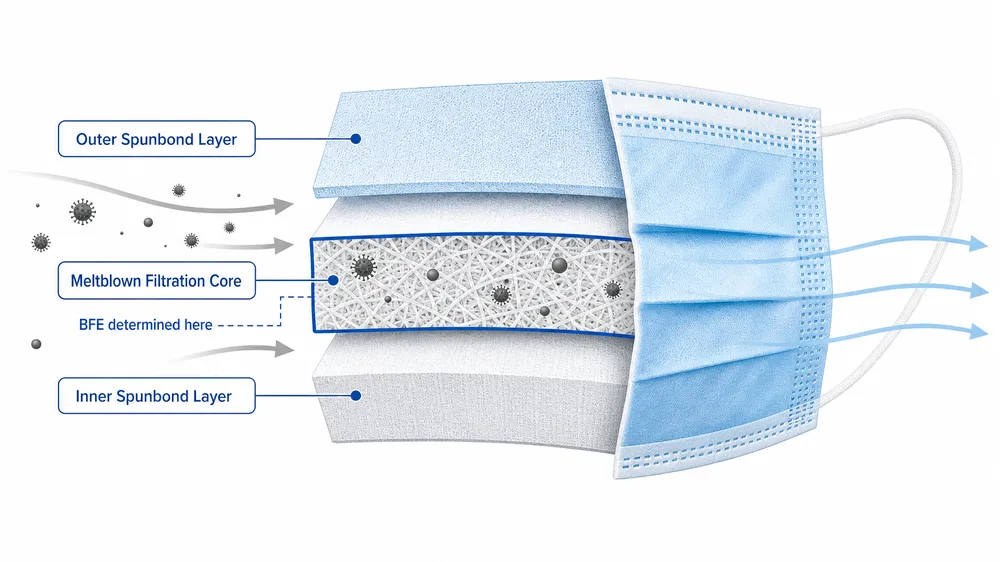
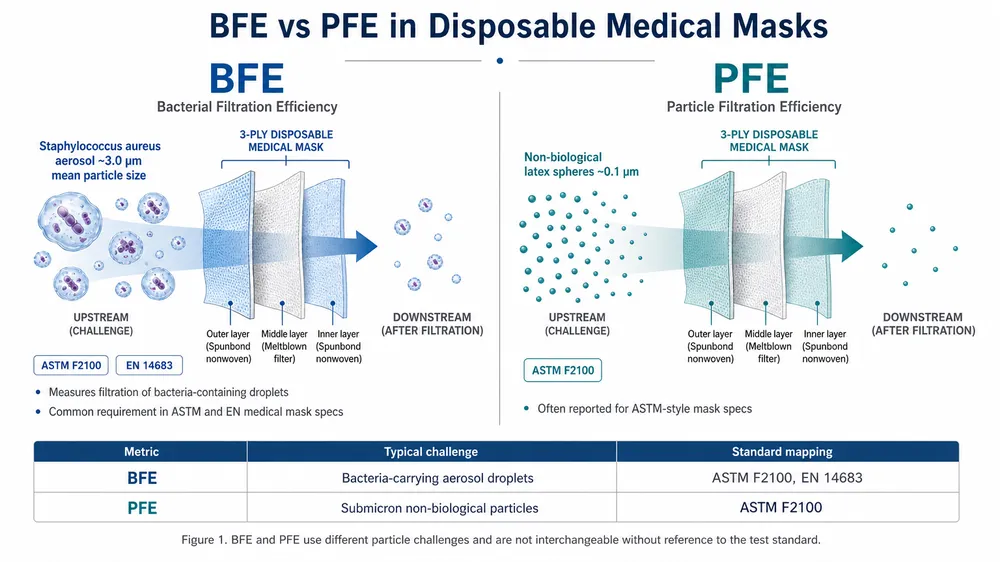
BFE — Bacterial Filtration Efficiency — measures how well the mask filters a standardized bacterial aerosol. The test uses Staphylococcus aureus at a mean particle size of 3.0 ± 0.3 µm, delivered at a flow rate of 28.3 L/min. Both ASTM F2100 and EN 14683 require BFE testing. The result is expressed as a percentage: a mask rated ≥95% BFE stops at least 95% of the bacterial aerosol challenge.
PFE — Particulate Filtration Efficiency — measures filtration against non-biological particles, specifically 0.1 µm polystyrene latex spheres. This is a harder test than BFE because the particles are smaller and don't behave like biological aerosols. ASTM F2100 requires PFE at all three levels. EN 14683 does not include a PFE requirement — it's a BFE-only standard.
That distinction matters for procurement. If your buyer is a US hospital operating under ASTM F2100, they need PFE on the spec sheet. If your buyer is an EU distributor sourcing to EN 14683, PFE is not a regulatory requirement — though some institutional buyers specify it anyway as an additional quality signal.
| Parameter | What it tests | Particle size | Standard |
|---|---|---|---|
| BFE | Bacterial aerosol filtration | ~3.0 µm (S. aureus) | ASTM F2100, EN 14683 |
| PFE | Particulate filtration | 0.1 µm latex spheres | ASTM F2100 only |
| Delta-P | Breathability (pressure differential) | N/A | ASTM F2100, EN 14683 |
Delta-P (differential pressure) is the third parameter in both standards. It measures airflow resistance — essentially, how hard the wearer has to breathe through the mask. A mask can pass BFE and PFE but fail Delta-P if the meltblown layer is too dense. We test all three on every batch because a mask that's uncomfortable to wear gets removed, which defeats the filtration entirely.
Standard-by-Standard Thresholds: ASTM F2100 vs EN 14683
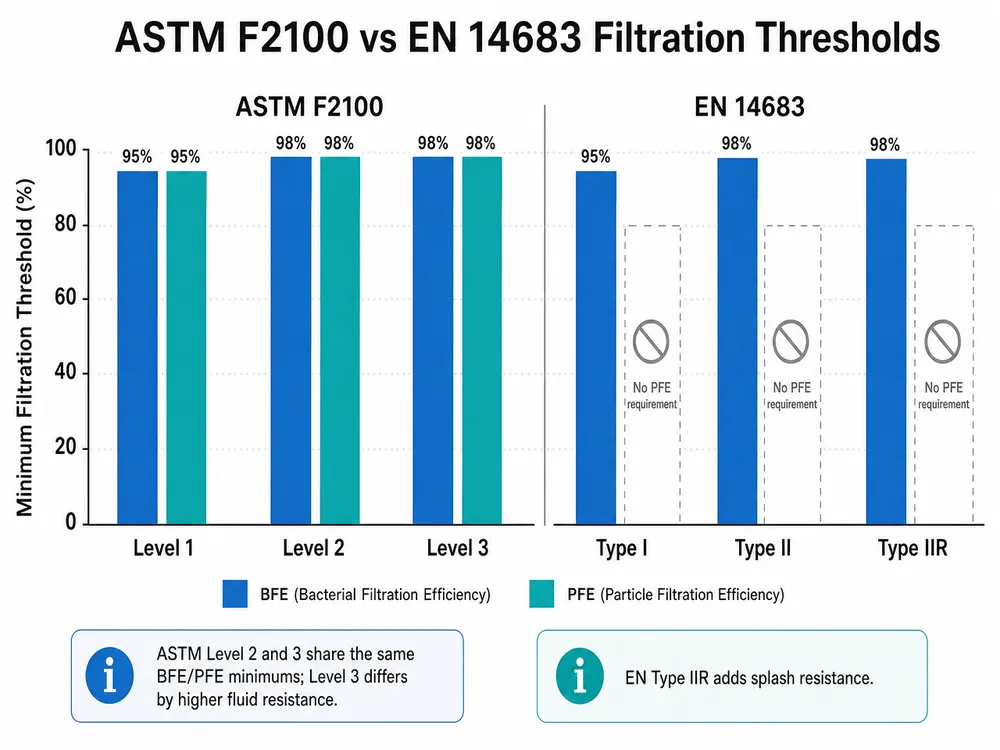
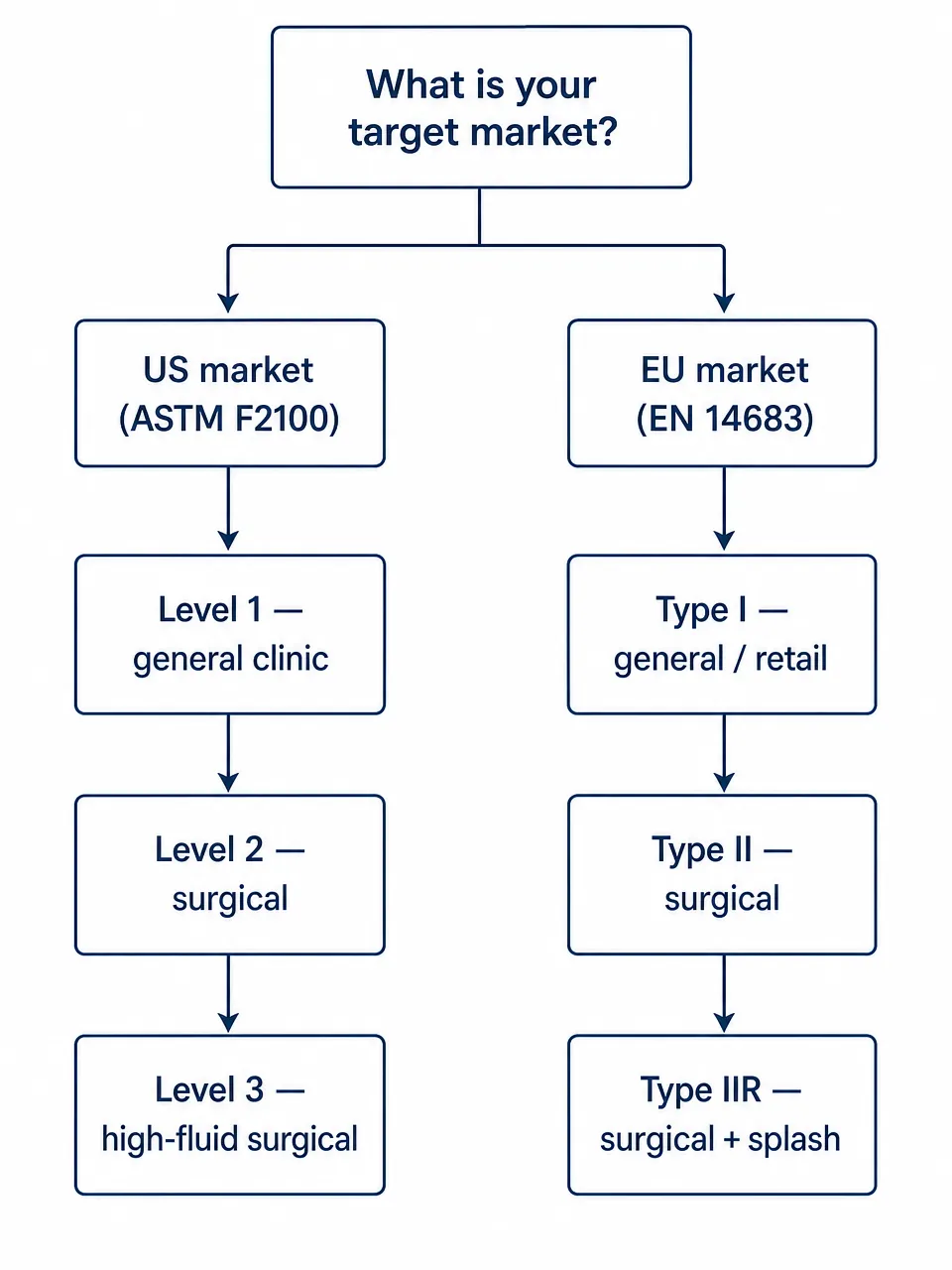
The two standards use different classification systems. ASTM F2100 has three levels (Level 1, 2, 3) based on fluid resistance and filtration performance. EN 14683 has three types (Type I, II, IIR) where IIR adds a splash resistance requirement.
| Standard | Grade | BFE minimum | PFE minimum | Delta-P max | Fluid resistance |
|---|---|---|---|---|---|
| ASTM F2100 | Level 1 | ≥95% | ≥95% | ≤4.0 mmH₂O/cm² | 80 mmHg |
| ASTM F2100 | Level 2 | ≥98% | ≥98% | ≤5.0 mmH₂O/cm² | 120 mmHg |
| ASTM F2100 | Level 3 | ≥98% | ≥98% | ≤5.0 mmH₂O/cm² | 160 mmHg |
| EN 14683 | Type I | ≥95% | — | ≤40 Pa/cm² | — |
| EN 14683 | Type II | ≥98% | — | ≤40 Pa/cm² | — |
| EN 14683 | Type IIR | ≥98% | — | ≤60 Pa/cm² | 120 mmHg |
A few things worth noting in this table. First, ASTM Level 2 and Level 3 have the same BFE and PFE minimums — the difference is fluid resistance (120 mmHg vs 160 mmHg). If your buyer doesn't need Level 3 splash protection, Level 2 is the right spec and typically costs less. Second, EN 14683 Type I is the only grade that allows ≥95% BFE — Types II and IIR both require ≥98%. Third, the Delta-P units differ between standards (mmH₂O/cm² for ASTM, Pa/cm² for EN), so don't compare them directly without converting.
(One thing we see regularly: buyers sourcing for EU markets who specify "≥98% BFE" without specifying EN 14683 Type II or IIR. The BFE number is correct, but the spec sheet won't satisfy a hospital procurement audit that asks for the EN classification. Always specify the standard, not just the number.)
Why the Numbers Vary Between Suppliers
Two masks can both be labeled "≥98% BFE" and perform very differently in practice — not on the certification test, but across production batches over time. The reason is almost always the meltblown layer.
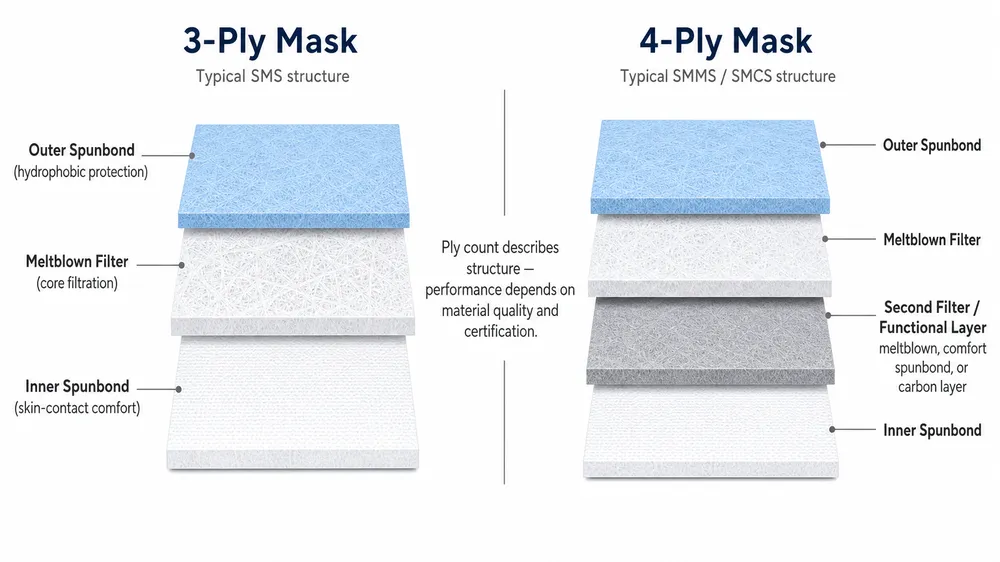
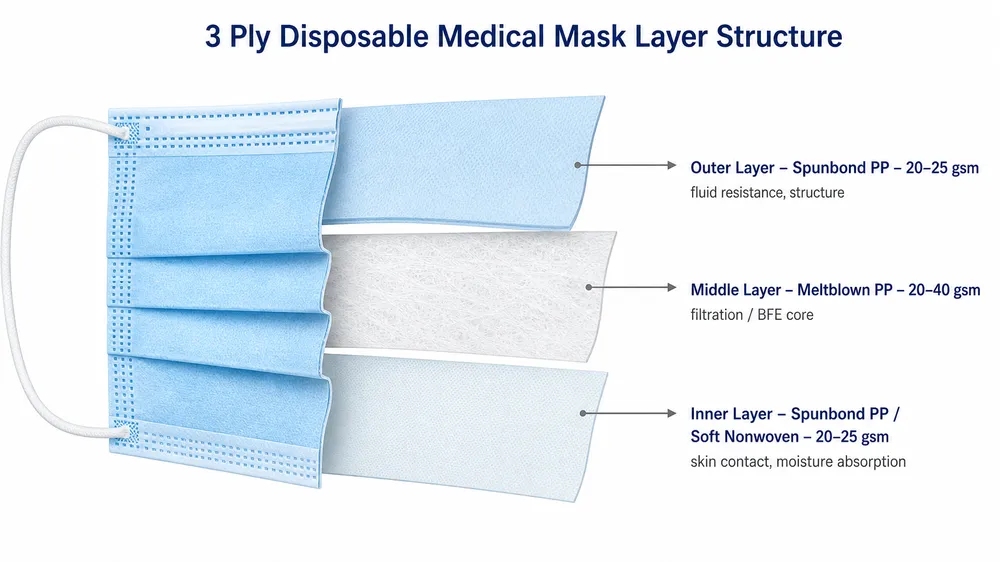
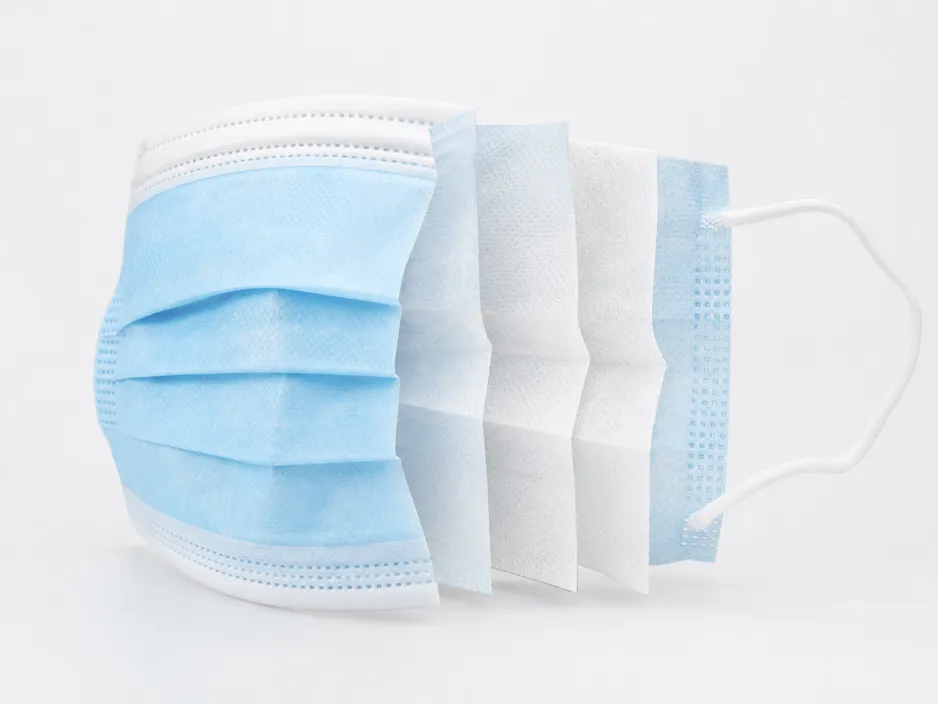
Meltblown nonwoven fabric is the middle layer in a 3-ply or 4-ply mask. It's produced by extruding polymer (typically polypropylene) through fine nozzles at high velocity, creating a web of microfibers that are then electrostatically charged. The electrostatic charge is what does most of the filtration work — it attracts and traps particles that would otherwise pass through the fiber matrix. The charge degrades over time and with exposure to humidity, which is why masks have shelf-life limits.
The problem for buyers is that most mask factories don't make their own meltblown fabric. They buy it from nonwoven fabric suppliers, and the quality of that fabric — fiber diameter consistency, basis weight uniformity, charge level — varies between suppliers and between production runs from the same supplier. A factory that passes its initial certification test with a good roll of meltblown may ship product six months later with a different roll that barely meets spec, or doesn't.
We produce our own meltblown fabric. That means we set the extrusion parameters, the basis weight, and the electrostatic treatment level ourselves, and we test every batch before it goes into mask production. When you order 500,000 pieces from us across two shipments, the meltblown going into the second shipment comes from the same controlled process as the first. The BFE number on the spec sheet isn't a snapshot from one good batch — it's the floor we hold to across production.
Our in-house QC lab runs BFE, PFE, and Delta-P on every production batch before third-party certification submission. If a batch fails internal testing, it gets pulled and investigated before it reaches outgoing inspection. The ISO 13485:2016 QMS means this process is documented and auditable — if you're running a supplier audit, you can review the batch test records, not just the final certificate.
Procurement Decision Guide: Which Grade to Specify
The right BFE/PFE grade depends on your end market and the regulatory framework your buyers operate under. Here's how we'd frame the decision:
US market (ASTM F2100):
- General clinic, dental, and outpatient settings: Level 1 (≥95% BFE/PFE) is typically sufficient and gives you the best margin on standard 3-ply product.
- Surgical and procedural environments with fluid exposure risk: Level 2 (≥98% BFE/PFE, 120 mmHg fluid resistance) is the standard hospital procurement spec.
- High-fluid-exposure surgical settings: Level 3 (≥98% BFE/PFE, 160 mmHg fluid resistance) — this is a narrower market segment, and the price premium is real. Don't over-specify if your buyers don't need it.
EU market (EN 14683):
- General healthcare and clinic use: Type I (≥95% BFE) covers most non-surgical applications.
- Surgical and procedural use: Type II (≥98% BFE) or Type IIR (≥98% BFE + splash resistance). If your EU buyers are hospital procurement teams, they'll typically require Type IIR.
- Retail and pharmacy distribution: Type I is usually sufficient, though some private-label programs specify Type II for positioning reasons.
Industrial and institutional distribution:
This is where the decision gets more nuanced. Industrial buyers — construction, food processing, general workplace safety — often don't need medical-grade certification at all. A mask with ≥95% BFE and a CE mark may be more than sufficient, and you're paying for regulatory overhead that doesn't add value in that channel. If you're building a product line that spans healthcare and industrial, it's worth separating the SKUs rather than trying to use one spec for both.
Private-label programs:
The spec you need depends entirely on where your private-label product will be sold and what claims you'll make on the packaging. If the packaging says "surgical mask" or "medical mask," you need the corresponding regulatory clearance — FDA 510(k) for the US, CE MDR for the EU. If the packaging makes no medical claims, you may be able to use a lower-cost non-medical SKU. We've set up both configurations for private-label buyers and can walk you through the documentation requirements before you commit to a spec.
What to Ask Your Supplier Before You Commit
A spec sheet with "≥98% BFE" printed on it is not the same as a supplier who can hold that spec across 10 production batches. Here's what to request during the RFQ stage:
Test reports, not just certificates. Ask for the actual test report from the third-party lab — not just the certificate of conformity. The report shows the test date, the specific product tested, the lot number, and the actual measured values (not just pass/fail). A certificate without a supporting test report is not auditable.
Which standard and which level. The test report should specify ASTM F2100 Level 1/2/3 or EN 14683 Type I/II/IIR explicitly. "Meets ASTM F2100" without a level designation is incomplete — Level 1 and Level 3 have very different fluid resistance requirements.
Batch-to-batch consistency data. Ask whether the supplier tests every production batch or only tests for certification. A supplier who only tests for the initial certificate has no data on whether subsequent batches hold the same spec. We test every batch in-house and can provide batch test records on request.
Meltblown sourcing. Ask directly: do you produce your own meltblown fabric, or do you buy it from a third-party supplier? If they buy it, ask whether they test incoming meltblown lots for BFE performance before production. Many don't. (We've seen situations where a factory's certification was valid but their current production was running on a different meltblown roll from a different supplier — and the BFE had dropped by 4-5 percentage points. The certificate was still technically current. The product wasn't.)
ISO 13485 certification. ISO 9001 is a general quality management standard. ISO 13485 is specific to medical devices and requires documented risk management, design controls, and traceability. For medical mask procurement, ISO 13485 is the relevant standard. Ask for the certificate and the scope statement — the scope should explicitly cover disposable medical mask production.
Our FDA 510(k) registration and CE (EU MDR) clearance mean the BFE and PFE ratings on our products are backed by regulatory-accepted test protocols, not just internal claims. The test reports are available upfront — you don't have to ask twice.
Reading a Mask Spec Sheet Without Getting Misled
A few patterns worth knowing when you're reviewing supplier documentation:
A spec sheet that lists BFE without specifying the test standard is incomplete. BFE tested to ASTM F2100 and BFE tested to EN 14683 use the same bacterial challenge, but the standards have different requirements for other parameters. The number alone doesn't tell you which regulatory framework the product was designed for.
"Meets EN 14683" without a type designation (I, II, or IIR) is similarly incomplete. Type I allows ≥95% BFE; Type II and IIR require ≥98%. If a supplier says "meets EN 14683" and the BFE is 95%, they're technically correct — but if your buyer needs Type II, you have a problem.
Watch for test reports dated more than two years ago on products being offered as current stock. Certifications have validity periods, and meltblown electrostatic charge degrades over time. A mask that passed BFE testing in 2022 may not hold the same performance in 2025 if it's been stored improperly.
PFE is sometimes listed on spec sheets for EN 14683 products as a marketing differentiator. That's fine — it's additional data. But don't confuse a supplier voluntarily listing PFE with PFE being a requirement of the EN standard. It isn't.
Matching Your Spec to Your Supply Chain
The BFE and PFE numbers on a spec sheet are the output of a manufacturing process. If you understand what drives those numbers — meltblown quality, electrostatic charge consistency, batch-to-batch process control — you can evaluate suppliers more accurately than by comparing certificates alone.
For Disposable Medical Masks sourced for regulated markets, the documentation chain matters as much as the product itself. A 3-ply disposable medical mask rated at ASTM F2100 Level 1 with a clean test report and auditable batch records is a more defensible procurement decision than a Level 2 mask with a certificate but no supporting data. Similarly, a 4-ply disposable medical mask with an additional meltblown layer can offer higher filtration headroom — useful if your buyers operate in higher-risk environments or want spec margin above the regulatory minimum.
The procurement spec you write today will be tested when your buyer's compliance team reviews it, when a shipment hits customs, or when a hospital procurement audit asks for documentation. Build it around the standard your market requires, the grade your application actually needs, and a supplier whose process controls can hold the spec across multiple order cycles — not just the first one.
If you're ready to confirm the right SKU for your target market and volume, Request a Quote with your required BFE/PFE grade, target market (US/EU/other), and order quantity. We'll confirm the matching product, provide test documentation upfront, and give you a specific lead time.
Frequently Asked Questions
What is the difference between BFE 95 and BFE 98 in disposable medical masks?
BFE 95 means the mask filters at least 95% of a standardized bacterial aerosol challenge. BFE 98 means at least 98%. The practical difference is which regulatory grade the mask qualifies for: ASTM F2100 Level 1 requires ≥95% BFE, while Levels 2 and 3 require ≥98%. EN 14683 Type I requires ≥95%; Types II and IIR require ≥98%. For general clinic and non-surgical use, BFE 95 is typically sufficient. For surgical environments or hospital procurement specs, BFE 98 is the standard requirement.
Does EN 14683 require PFE testing?
No. EN 14683 requires BFE and Delta-P testing only. PFE (Particulate Filtration Efficiency) is a requirement of ASTM F2100, not EN 14683. Some manufacturers voluntarily test and report PFE on EN 14683 products as an additional quality indicator, but it is not part of the EN classification system. If your target market is the EU and your buyer's procurement spec references PFE, confirm whether they're applying an ASTM requirement to an EN product — this is a common source of spec confusion.
How do I know if a supplier's BFE rating holds across production batches?
Ask for batch test records, not just the certification. A supplier who only tests for the initial certificate has no documented evidence that subsequent batches hold the same spec. The key variables are meltblown fabric quality and electrostatic charge consistency. Suppliers who produce their own meltblown fabric have more control over these variables than those who buy from third-party fabric suppliers. ISO 13485:2016 certification requires documented batch traceability — if a supplier holds ISO 13485, they should be able to provide batch-level test data on request.
What does Delta-P measure and why does it matter for procurement?
Delta-P (differential pressure) measures airflow resistance through the mask — essentially, how much effort is required to breathe through it. ASTM F2100 sets a maximum of 4.0 mmH₂O/cm² for Level 1 and 5.0 mmH₂O/cm² for Levels 2 and 3. EN 14683 sets a maximum of 40 Pa/cm² for Types I and II, and 60 Pa/cm² for Type IIR. A mask that fails Delta-P is too restrictive to wear comfortably for extended periods — which means it gets removed, defeating the filtration entirely. When reviewing spec sheets, check Delta-P alongside BFE and PFE. A mask with excellent filtration but poor breathability is a compliance problem waiting to happen in any extended-wear application.
Can the same mask be certified to both ASTM F2100 and EN 14683?
Yes, with some caveats. The BFE test method is similar enough between the two standards that a mask can often be tested to both. The main complication is fluid resistance: ASTM F2100 Level 2 and Level 3 have specific fluid resistance requirements (120 mmHg and 160 mmHg respectively) that EN 14683 Type IIR also requires (120 mmHg), but EN 14683 Types I and II have no fluid resistance requirement. A mask designed for ASTM Level 2 will typically also qualify for EN 14683 Type IIR. A mask designed only for EN 14683 Type II may not meet ASTM Level 2 fluid resistance. If you're sourcing for both US and EU markets, specify ASTM F2100 Level 2 as the primary standard — it's the more demanding spec and will cover EN 14683 Type IIR as well.