The most expensive sourcing mistake in this category isn't buying the wrong material. It's buying product certified to the wrong standard for your destination market — and discovering that at customs, or worse, during a procurement audit.
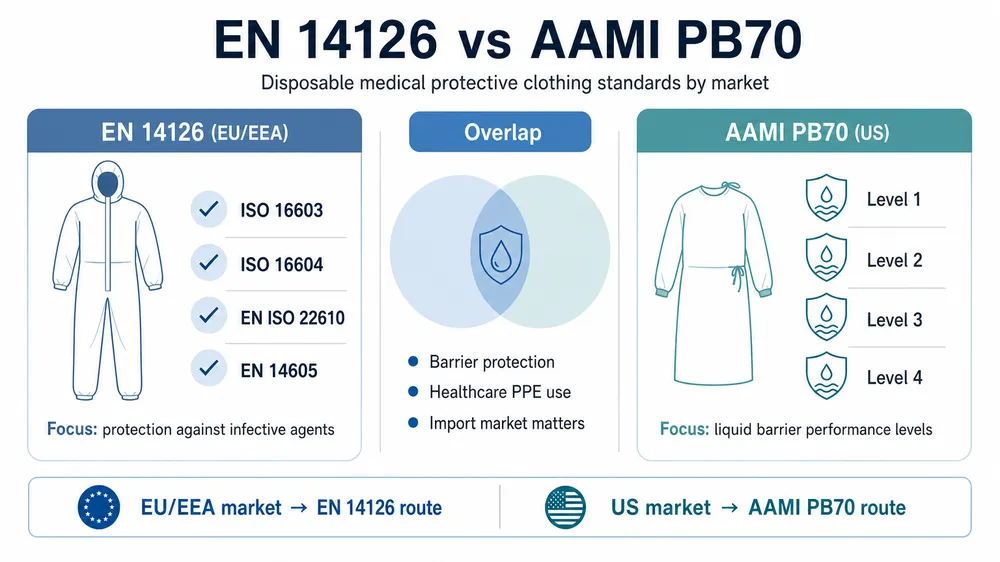
EN 14126 and AAMI PB70 are both legitimate frameworks for disposable medical protective clothing. They test different things, they're enforced by different regulatory bodies, and they're not interchangeable. A coverall with EN 14126 certification won't automatically satisfy a US hospital's AAMI PB70 Level 4 requirement. An AAMI PB70 Level 3 gown won't get you CE marking for the EU market. The overlap is real but partial, and the gaps are where orders get rejected.
This article breaks down both standards at the test-method level, maps them to their actual markets, and explains what documentation you should be requesting from any supplier before you commit to a production run.

What each standard actually covers
EN 14126 is a European standard for protective clothing against infective agents. The key word is "infective" — this standard is specifically designed to evaluate whether a garment prevents the penetration of biological hazards: blood, body fluids, and microorganisms. It's published by CEN (the European Committee for Standardization) and is the required framework for CE-marked protective clothing sold as a medical device in the EU and EEA under EU MDR.
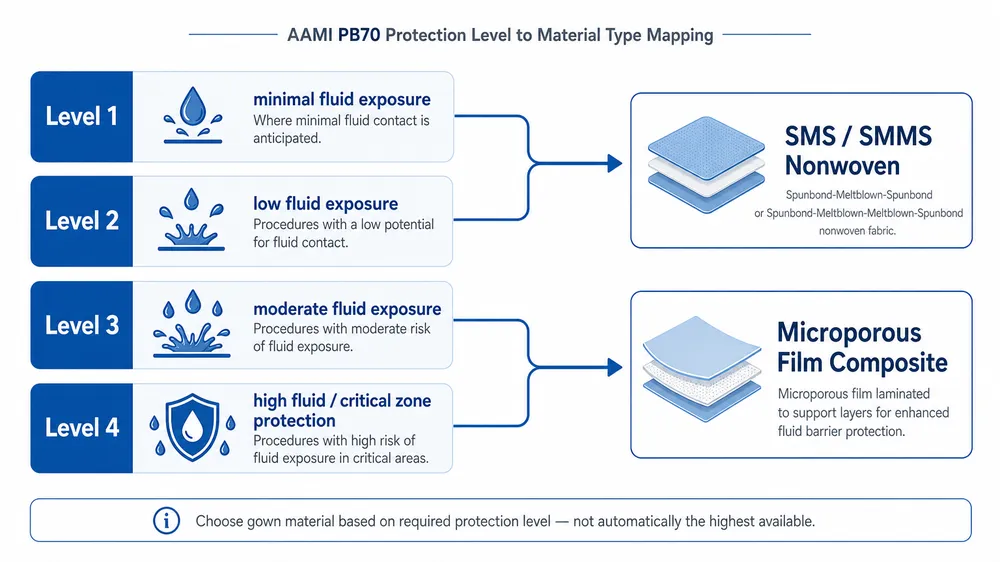
AAMI PB70 is an American standard published by the Association for the Advancement of Medical Instrumentation. It covers liquid barrier performance for protective apparel used in healthcare — surgical gowns, isolation gowns, and surgical drapes. The framework is a four-level classification based on liquid challenge intensity, from minimal splash exposure (Level 1) up to high-risk fluid exposure during surgical procedures (Level 4).
The conceptual difference matters for sourcing: EN 14126 is a pass/fail standard against specific biological challenge tests. AAMI PB70 is a tiered classification — a product can be Level 1, 2, 3, or 4, and the right level depends on the clinical application. Neither standard is inherently "stricter" than the other; they measure different things.
The test methods behind each standard
This is where most spec sheets get vague, and where you need to push suppliers for specifics.
EN 14126 sub-tests
EN 14126 doesn't run a single test. It references a battery of sub-tests, and a garment's classification depends on which sub-tests it passes and at what performance index:
| Sub-test | Standard | What it measures |
|---|---|---|
| Blood penetration resistance | ISO 16603 | Resistance to synthetic blood penetration under pressure |
| Viral penetration resistance | ISO 16604 | Resistance to penetration by blood-borne viruses (using bacteriophage Phi-X174 as surrogate) |
| Wet bacterial penetration | EN ISO 22610 | Resistance to wet bacterial penetration through the fabric |
| Liquid-tight / spray-tight seams | EN 14605 | Seam and closure integrity under liquid challenge |
| Contaminated liquid penetration | ISO 22611 | Resistance to aerosol penetration |
| Dust/particle penetration | ISO 22612 | Resistance to dry particulate penetration |
Each sub-test produces a performance index from 1 (lowest) to 6 (highest). The garment's EN 14126 classification is expressed as a combination of these indices — for example, a coverall might be rated Type 3-B (liquid-tight) or Type 4-B (spray-tight) with specific performance indices for each sub-test.
(One thing buyers often miss: the seam performance under EN 14605 is tested separately from the fabric. A garment can pass the fabric tests and fail at the seam. This is exactly the kind of gap that shows up in production when a manufacturer uses ultrasonic welding on the body panels but stitched seams at the cuffs.)
AAMI PB70 levels
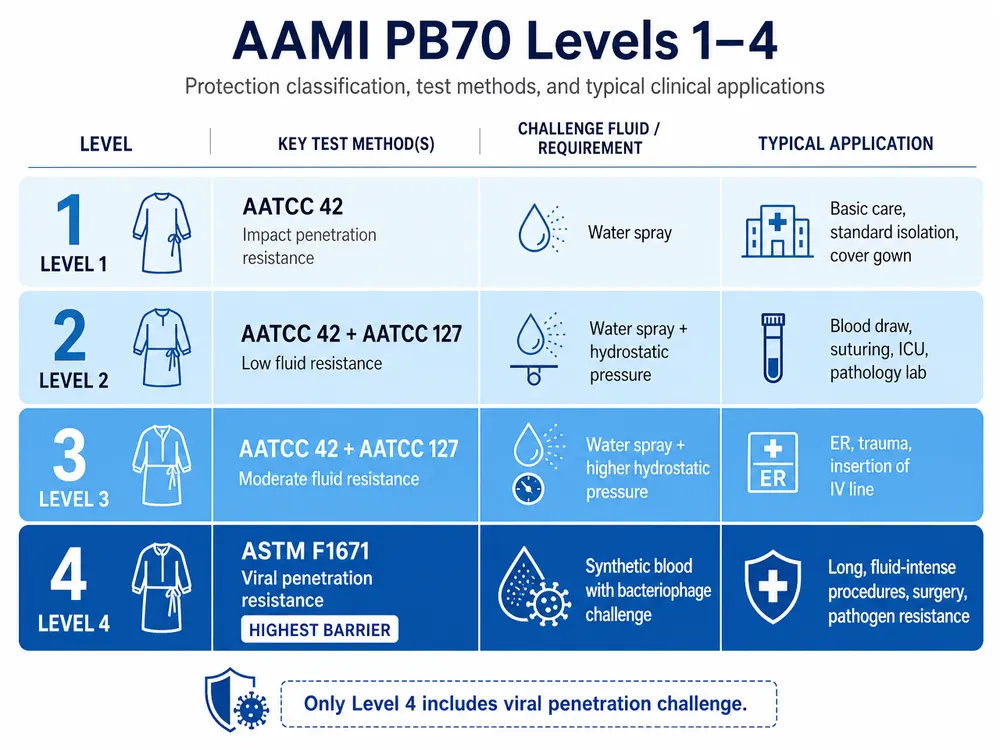
AAMI PB70 uses a simpler tiered structure, but the test methods behind each level are specific:
| Level | Primary test | Challenge fluid | Typical application |
|---|---|---|---|
| Level 1 | AATCC 42 (spray impact) | Water | Minimal fluid exposure, basic isolation |
| Level 2 | AATCC 42 + AATCC 127 (hydrostatic) | Water | Low-to-moderate fluid exposure |
| Level 3 | AATCC 42 + AATCC 127 (higher pressure) | Water | Moderate-to-heavy fluid exposure |
| Level 4 | ASTM F1671 | Synthetic blood / viral surrogate | High-risk procedures, bloodborne pathogen exposure |
Level 4 is the one that aligns most closely with EN 14126's viral penetration requirements — both use a viral surrogate challenge. Levels 1–3 are liquid barrier tests only, with no biological challenge component.
US hospital procurement typically specifies AAMI PB70 Level 3 or Level 4 for surgical and high-risk isolation applications. Level 1 and 2 are common for general ward use and visitor gowns.
Which standard governs your import market
The regulatory answer is straightforward. The sourcing answer is more nuanced.
EU and EEA markets: EN 14126 is mandatory for protective clothing classified as a medical device under EU MDR (Regulation 2017/745). Your supplier needs a CE certificate issued by a Notified Body — not a self-declaration. The technical file behind that certificate must include test reports from an accredited laboratory for the relevant EN 14126 sub-tests. If a supplier shows you a CE mark without a Notified Body number, that's a red flag.
US market: AAMI PB70 is the dominant framework for hospital and healthcare facility procurement. It's referenced in FDA guidance for surgical gowns (21 CFR Part 878) and is the standard most Group Purchasing Organizations (GPOs) and hospital systems specify in their procurement contracts. FDA 510(k) clearance for surgical gowns requires AAMI PB70 compliance documentation.
Middle East and Southeast Asia: These markets generally don't mandate a single standard. Saudi Arabia, UAE, and most Gulf states accept either EN 14126 or AAMI PB70 with supporting third-party test reports. Southeast Asian markets (Thailand, Vietnam, Indonesia) are similar — the key is having the test reports, not necessarily a specific regional certification. (We've shipped to both regions extensively, and the documentation that clears customs fastest is a full test report package from an accredited lab, regardless of which standard it references.)
Dual-market sourcing: If you're supplying both EU and US markets from the same SKU, the overlap between EN 14126 and AAMI PB70 Level 4 is real but not complete. A garment that passes ISO 16604 (viral penetration, EN 14126) will likely pass ASTM F1671 (AAMI PB70 Level 4) because both use a viral surrogate challenge — but the test protocols differ in pressure and exposure duration, so you need separate test reports for each standard. You can't use one to substitute for the other in regulatory submissions.
| Market | Required standard | Regulatory body | Key documentation |
|---|---|---|---|
| EU / EEA | EN 14126 + CE MDR | Notified Body | CE certificate, technical file, EN 14126 test reports |
| United States | AAMI PB70 (Level 3 or 4 for surgical) | FDA | 510(k) clearance, AAMI PB70 test reports |
| Gulf states | EN 14126 or AAMI PB70 | SFDA / local health authority | Third-party test reports, CoC |
| Southeast Asia | EN 14126 or AAMI PB70 | Local health ministry | Third-party test reports |
Coverall vs isolation gown: format implications under each standard
Both standards apply to different garment formats, but the format choice has real implications for which tests apply and how the product is classified.
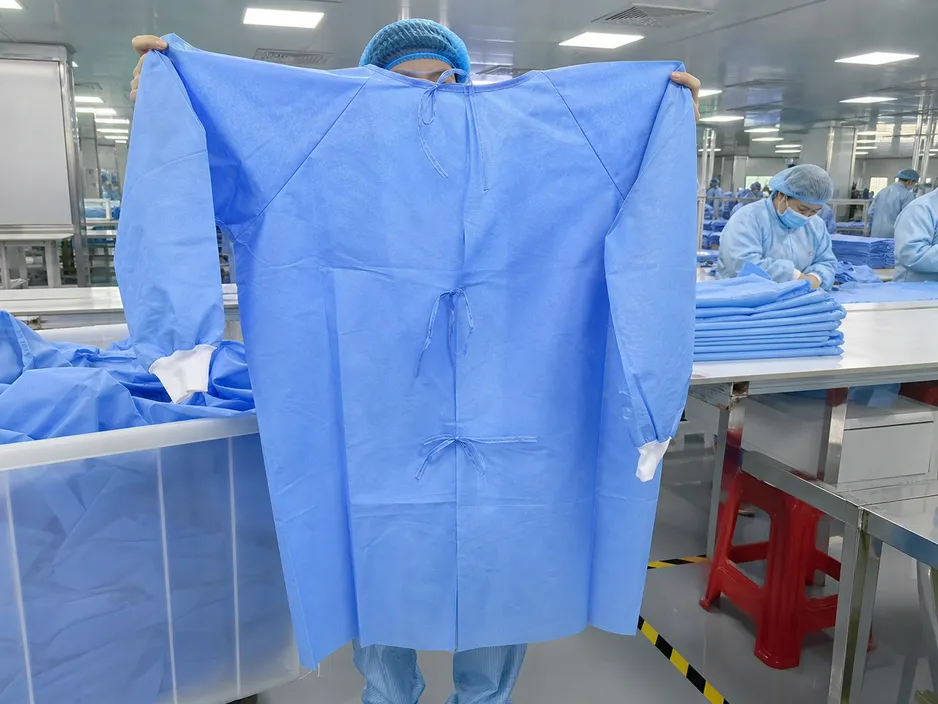
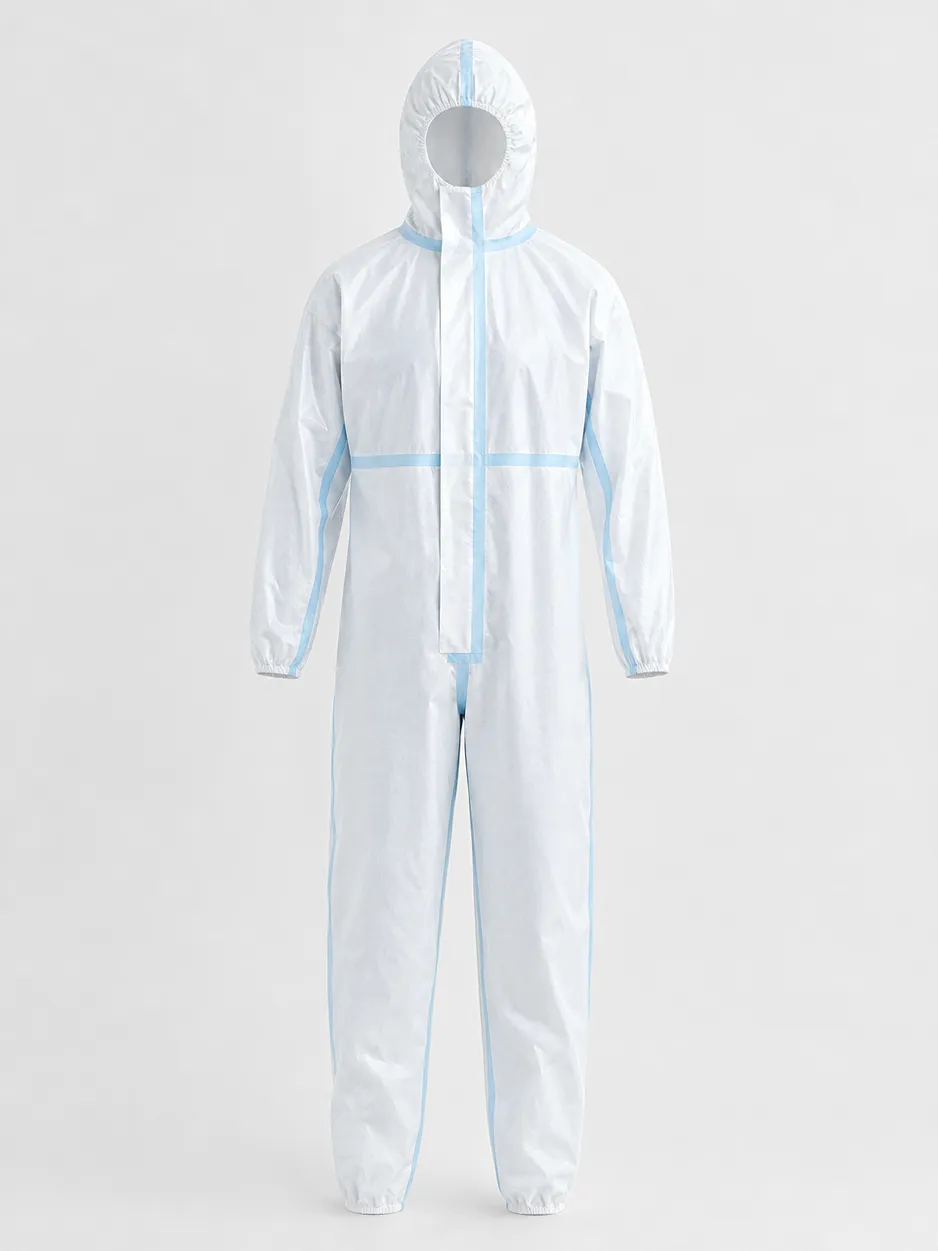
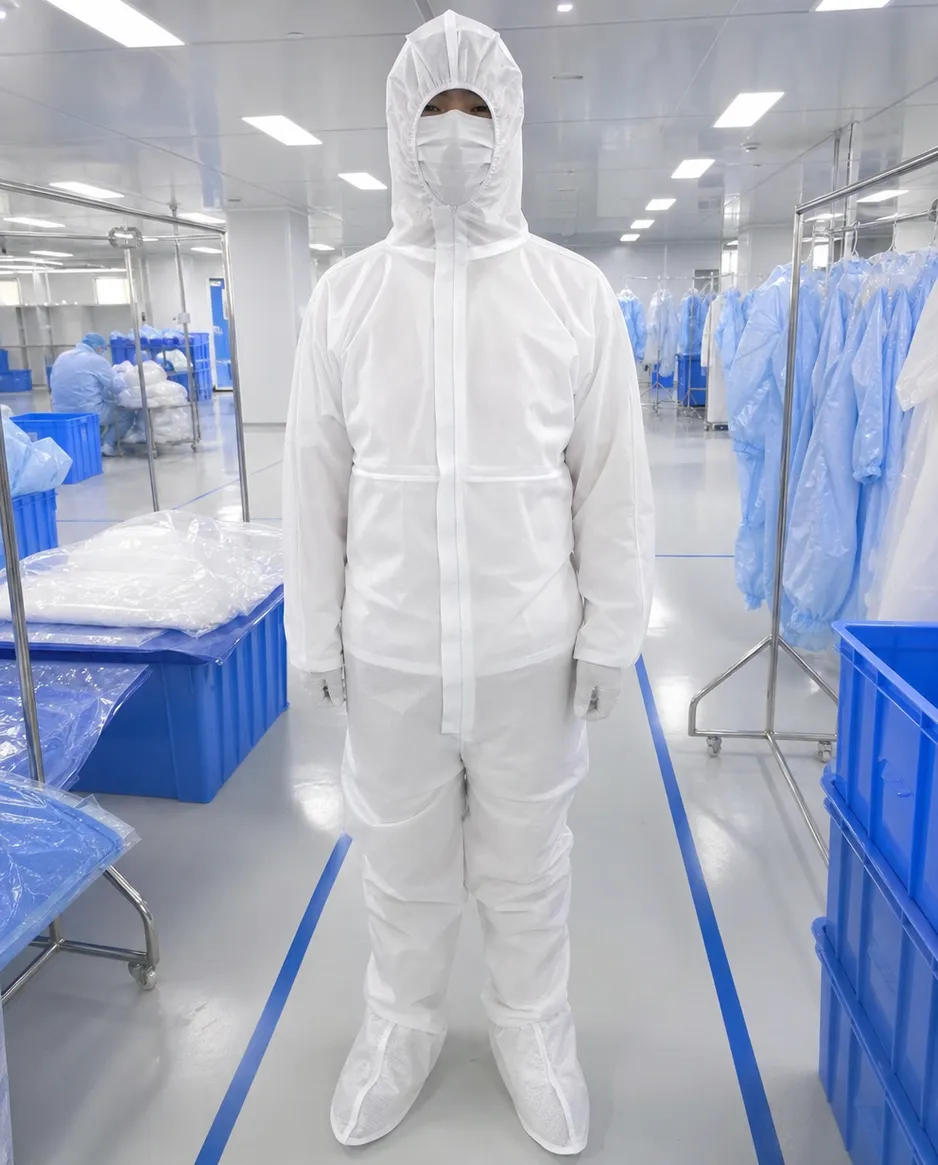
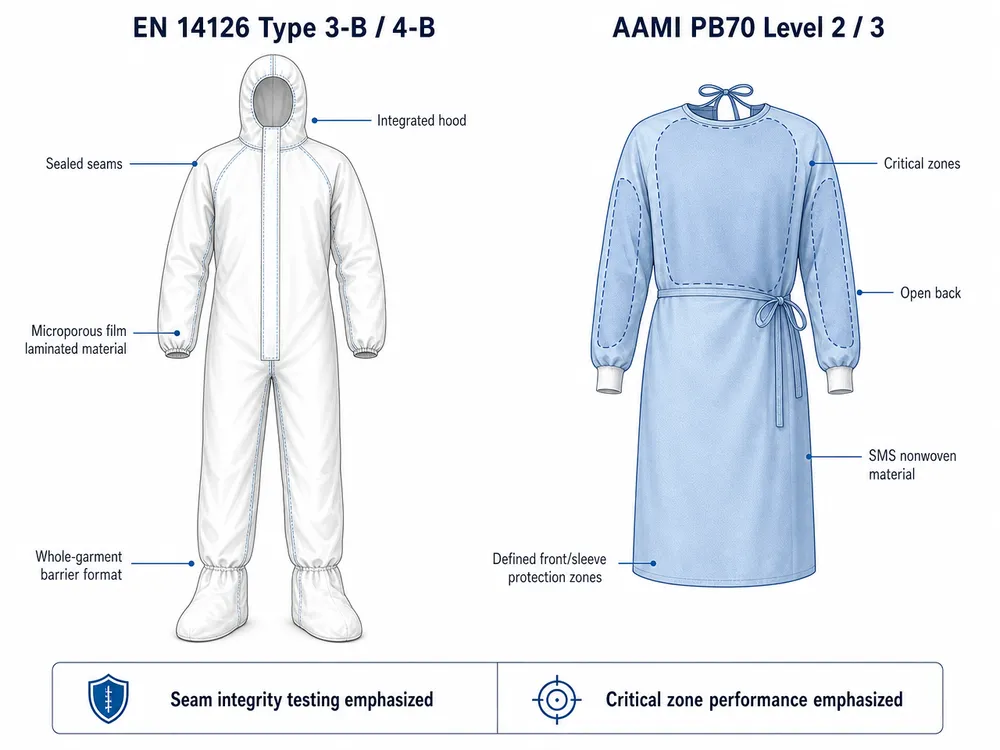
Under EN 14126, the garment type determines which EN 13982 or EN 14605 type classification applies. A full-body coverall with sealed seams and integrated hood is typically classified as Type 4-B (spray-tight) or Type 3-B (liquid-tight). An isolation gown — open-back, no hood, tied closure — will have a different type classification and may not meet the same seam integrity requirements. The standard doesn't prohibit gowns, but the test scope differs.
Under AAMI PB70, the standard explicitly covers both surgical gowns and isolation gowns, with different critical zone requirements for each. Surgical gowns have defined critical zones (sleeves, front body panel) that must meet the specified level. Isolation gowns have a simpler construction requirement. The level classification applies to the critical zone performance, not the entire garment.
For buyers sourcing for high-risk clinical environments — operating rooms, infectious disease wards, Ebola or hemorrhagic fever response — the coverall format under EN 14126 Type 3-B or 4-B is the appropriate specification. For general isolation and ward use in US hospitals, an AAMI PB70 Level 2 or Level 3 isolation gown is the standard procurement choice.
We produce both formats. The Medical Protective Coverall line is built for EN 14126 compliance with sealed seams and full-body coverage. The isolation gown line is configured for AAMI PB70 Level 2 and Level 3 requirements. The material selection differs between them — microporous film laminate for the coverall (better viral barrier, less breathable), SMS nonwoven for the gown (adequate liquid barrier for Levels 2–3, better comfort for extended wear).
(The SMS vs microporous film trade-off is one we discuss with almost every new buyer. SMS is cheaper and more comfortable. Microporous film performs better on viral penetration tests. For most isolation gown applications, SMS at the right basis weight is sufficient. For EN 14126 Type 3-B or 4-B coveralls, microporous film is the right call — the viral barrier performance difference is not marginal.)
What documentation to request — and what to watch for
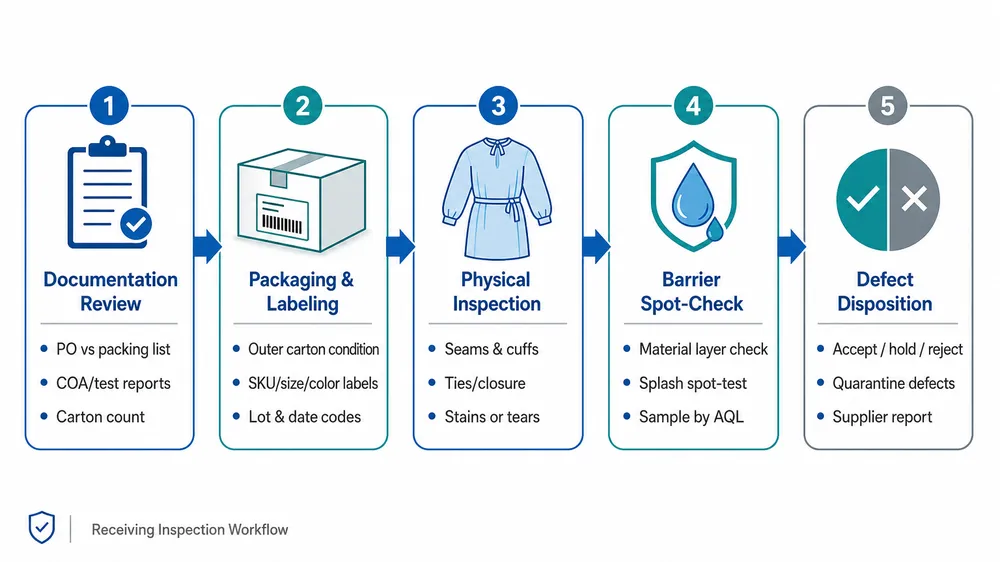
This is where sourcing decisions get made or broken. A supplier can claim EN 14126 compliance without having a valid Notified Body certificate. A supplier can claim AAMI PB70 Level 4 without having run ASTM F1671. Both happen more often than they should.
For EN 14126 compliance, request:
- CE certificate with Notified Body number (verify the NB number against the EU NANDO database)
- Technical file summary or Declaration of Conformity referencing EU MDR Annex IV
- Test reports from an accredited laboratory for each relevant sub-test (ISO 16603, ISO 16604, EN ISO 22610, EN 14605 as applicable)
- ISO 13485:2016 certificate — this is the QMS requirement behind EU MDR; without it, the CE certificate is suspect
- Batch-level test reports or CoC for your specific order
For AAMI PB70 compliance, request:
- FDA 510(k) clearance number (for surgical gowns — verify on the FDA 510(k) database)
- AAMI PB70 test reports from an accredited US laboratory (AATCC 42, AATCC 127, and ASTM F1671 for Level 4)
- ISO 13485:2016 certificate (required for FDA 510(k) QMS compliance)
- Lot-specific test reports or CoC
Red flags in supplier documentation:
- CE mark without a Notified Body number (self-declared CE is not valid for medical devices under EU MDR)
- Test reports from non-accredited labs or labs the supplier owns
- AAMI PB70 claims without ASTM F1671 test data for Level 4
- ISO 13485 certificates that are expired or issued by unrecognized certification bodies
- Seam performance data missing from EN 14126 documentation (fabric tests only, no seam test)
We hold ISO 13485:2016, CE under EU MDR, and FDA 510(k) registration. Our QC lab runs barrier performance testing in-house before third-party submission — the same infrastructure we use for mask BFE/PFE testing applies to protective clothing barrier evaluation. When you request documentation from us, you get the actual test reports, not a summary sheet.
Sourcing from one factory for both markets
The practical question for buyers supplying both EU and US markets is whether you can consolidate to a single supplier and get compliant product for both destinations.
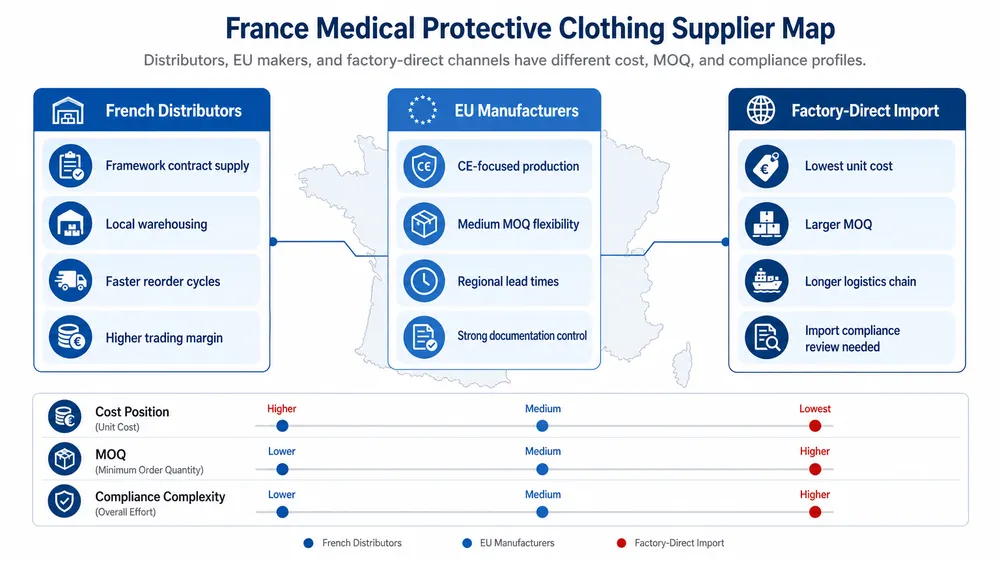
The answer is yes, but only if the factory holds both CE (EU MDR) and FDA 510(k) registration, and only if they can produce separate documentation packages for each standard. The product may be physically identical — same material, same construction — but the regulatory documentation is market-specific and cannot be shared.
We've been running this dual-market supply model since we built out our export compliance infrastructure. Our CE certification covers the EU MDR requirements for protective clothing. Our FDA 510(k) registration covers the US market. ISO 13485:2016 is the QMS backbone that both regulatory frameworks require from the manufacturer. OEM/ODM capability means we can customize labeling, packaging, and documentation per destination market — your EU shipment gets CE-compliant labeling and a Declaration of Conformity; your US shipment gets FDA-compliant labeling and 510(k) documentation.
The efficiency gain for your supply chain is real: one supplier relationship, one quality audit, one set of production specs, two compliant documentation packages. For buyers managing both EU and North American distribution, that consolidation reduces compliance overhead and eliminates the risk of spec drift between two separate supplier relationships.
If you're building a Medical Protective Clothing program that spans both markets, the sourcing decision starts with confirming that your supplier holds both certifications — not just one.
Frequently asked questions
Can a product certified to EN 14126 be sold in the US without AAMI PB70 testing?
No. EN 14126 certification satisfies EU MDR requirements but does not substitute for AAMI PB70 test data in US hospital procurement or FDA 510(k) submissions. The test methods overlap at the Level 4 / viral penetration level, but US buyers and the FDA require AAMI PB70-specific test reports (AATCC 42, AATCC 127, ASTM F1671). You need both sets of documentation for dual-market supply.
What is the difference between EN 14126 Type 3-B and Type 4-B?
Type 3-B is liquid-tight — the garment resists penetration by liquid jets under pressure (tested per EN 14605). Type 4-B is spray-tight — it resists penetration by liquid aerosols and sprays. Type 4-B is a lower liquid challenge than Type 3-B, but both include the "B" designation indicating biological (infective agent) barrier performance under EN 14126. For high-risk infectious disease applications, Type 3-B is the appropriate specification.
Does AAMI PB70 Level 4 require full-body coverall construction?
No. AAMI PB70 Level 4 applies to the critical zones of a surgical gown — the sleeves and front body panel — not the entire garment. A surgical gown can achieve Level 4 classification with the critical zones meeting ASTM F1671 requirements while the back panel meets a lower level. Full-body coverall construction is an EN 14126 format consideration, not an AAMI PB70 requirement.
What is the minimum documentation package for importing EN 14126 protective clothing into the EU?
At minimum: CE certificate with Notified Body number, Declaration of Conformity referencing EU MDR, EN 14126 test reports from an accredited laboratory, and ISO 13485:2016 certificate. Your EU importer of record will also need the technical file summary for their regulatory records. Since EU MDR came into full effect in 2021, customs authorities have become more rigorous about verifying Notified Body numbers — a self-declared CE mark will not clear EU customs for medical devices.
How do I verify that a supplier's EN 14126 test reports are legitimate?
Check the issuing laboratory's accreditation status. EU-recognized test labs for EN 14126 should be accredited under ISO/IEC 17025 and listed in the relevant national accreditation body's database (UKAS in the UK, DAkkS in Germany, COFRAC in France, etc.). The test report should include the lab's accreditation number and the specific test standard version. If the report doesn't reference an accreditation number, or if the lab isn't findable in a national accreditation database, treat it as unverified.
What MOQ applies to EN 14126 certified coveralls vs AAMI PB70 gowns?
Standard SKUs start at 50,000 pieces. Custom configurations — modified seam construction, different material specifications, or market-specific labeling — typically require higher minimums to justify line setup. We'll confirm the exact MOQ for your specific product configuration before you approve samples, not after.
For buyers ready to specify their destination market, required standard, and product format, the next step is a quote with full compliance documentation included. Request a quote with your target market (EU, US, or both), required standard (EN 14126 type classification or AAMI PB70 level), product format (coverall or isolation gown), and annual volume — and we'll respond with pricing, lead time, and the documentation package your market requires.