The ear loop is the component that fails most visibly — and most expensively. A mask that snaps at the weld point during clinical use, or loses its clamping force after two hours of wear, generates returns, complaints, and compliance questions that trace directly back to a spec decision made at the sourcing stage. Most buyers never ask about ear loop tensile strength until they have a problem. This article is for buyers who want to ask before the problem arrives.
The core procurement question is straightforward: what break force should the ear loop on a disposable medical mask achieve, and how do you verify it? The answer involves three layers — material type, weld-point bond strength, and elastic fatigue behavior — and each one has a different failure signature.
What the Ear Loop Elastic Actually Is: Material Types and Why They Matter
Not all ear loop elastic is the same material, and the differences affect both durability and comfort in ways that show up in your returns data.
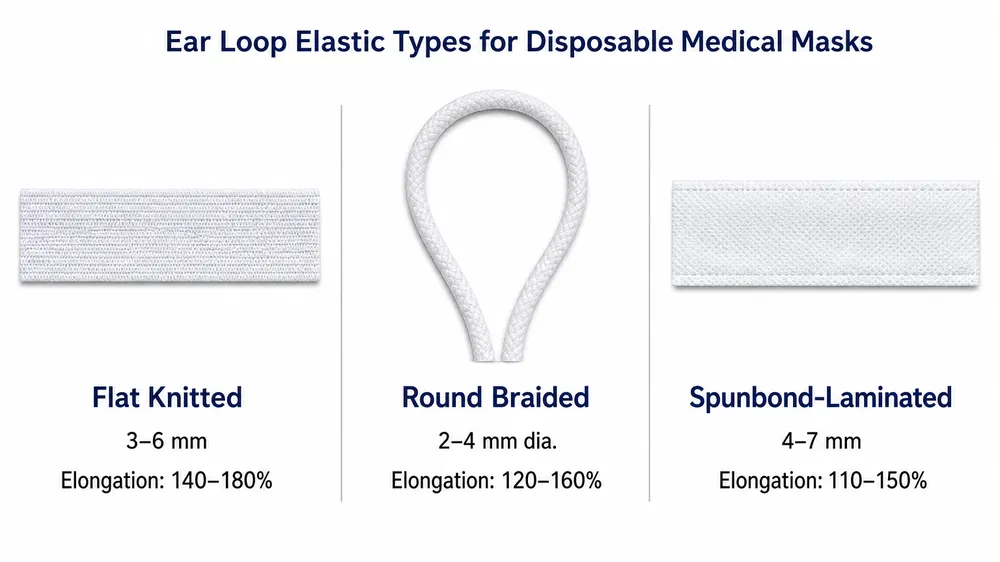
The three common constructions are:
| Type | Construction | Typical Width | Elongation at Break | Typical Break Force |
|---|---|---|---|---|
| Flat knitted elastic | Polyester/nylon knit, flat band | 3–6 mm | 150–250% | 15–30 N |
| Round braided elastic | Polyester/rubber core, braided sheath | 2–4 mm diameter | 100–180% | 10–20 N |
| Spunbond-laminated flat | Nonwoven laminate over elastic core | 4–7 mm | 80–130% | 10–18 N |
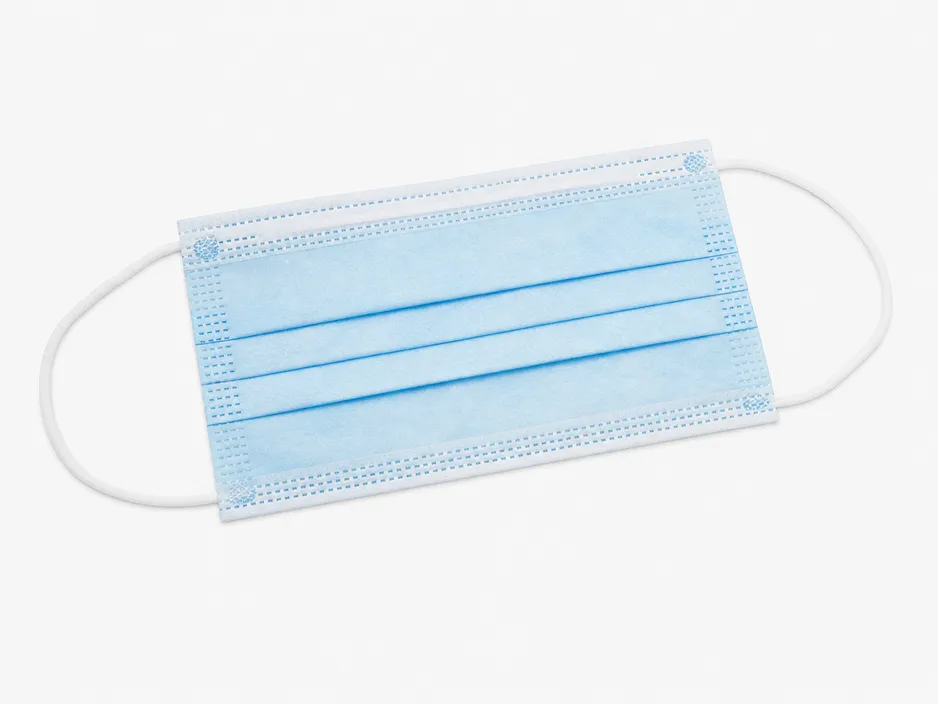
Flat knitted elastic is the most common construction in surgical and procedure masks. It has good elongation recovery, which means it returns to its original length after repeated stretch cycles without permanent deformation. Round braided elastic is softer against the skin but has a narrower elongation range — it's less forgiving if the ear loop is cut slightly long or short during production. Spunbond-laminated flat elastic is used in some premium configurations where a softer surface contact is specified, but the laminate layer can delaminate at the weld point under repeated stress if the ultrasonic weld parameters aren't dialed in correctly.
(We've run all three configurations at various points. For standard 3-ply surgical masks going into hospital procurement, flat knitted polyester is what we specify — the elongation recovery is more consistent across temperature and humidity ranges, which matters when masks are stored in warehouse conditions before use.)

Tensile Strength Specification: The Break Force Numbers That Actually Matter
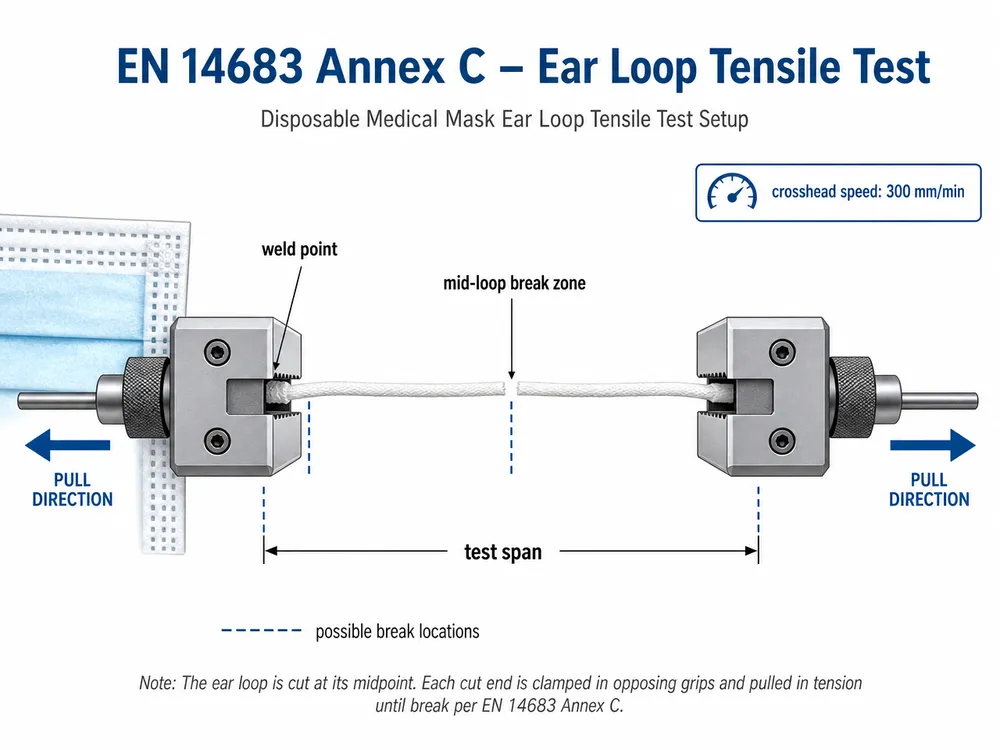
EN 14683:2019+AC:2019 Annex C sets the minimum ear loop attachment force at ≥10 N per loop. This is the threshold that appears in most European procurement specifications and CE technical files. ASTM F2100 does not specify an ear loop break force directly, but FDA-registered masks sold into US hospital procurement are routinely tested against the EN threshold or an equivalent internal spec because hospital GPOs increasingly require it.
The 10 N minimum is a floor, not a target. In practice, masks that test at 10–12 N are marginal — they pass the standard but leave little margin for production variation, storage degradation, or the mechanical stress of donning and doffing repeatedly. Masks with ear loop break force in the 18–25 N range have meaningful headroom.
Here's how to read a supplier's test report:
- Test method: The loop should be tested by cutting it at the midpoint and pulling each end in a tensile tester at a defined crosshead speed (typically 300 mm/min per EN 14683 Annex C). If the supplier's report doesn't specify the test method, the number is unverifiable.
- Where the break occurs: A break in the elastic body (mid-loop) is a different failure mode than a break at the weld point. Weld-point failures at forces below 15 N indicate a process control problem, not a material problem.
- Sample size: A report based on 5 samples is not statistically meaningful for a 500,000-piece order. Ask for the sample size and the standard deviation, not just the mean.
We test ear loop tensile strength at incoming inspection — before the elastic enters production — rather than only on finished masks. The reason is practical: if a lot of elastic is out of spec, catching it at incoming inspection means we pull the lot and reorder. Catching it on finished masks means we've already run production on defective material.
Comfort and Clamping Force: The Spec Your End Users Will Notice
Break force tells you whether the loop holds. Clamping force tells you whether the wearer can tolerate it for a full shift.
The relationship between elastic elongation and ear pressure is direct: a loop that's too short relative to the wearer's head circumference generates higher clamping force, which causes ear discomfort during extended wear. A loop that's too long provides insufficient clamping force and allows the mask to sag away from the face, compromising the seal.
For clinical masks worn for 4–8 hours continuously, the practical comfort threshold for clamping force is generally cited in the range of 0.5–1.5 N of sustained lateral force at the ear. This isn't a standardized test parameter in EN 14683 or ASTM F2100 — it's a design target that manufacturers control through loop length and elastic stiffness selection.
The variables that determine clamping force in production:
- Loop length: Typically 170–200 mm for adult masks. Shorter loops increase clamping force; longer loops reduce it.
- Elastic stiffness (force at 50% elongation): A stiffer elastic at the same loop length generates higher clamping force. This is the parameter that varies most between elastic lots from different suppliers.
- Elongation at wear: The actual elongation percentage when the loop is on an average adult head determines the operating point on the elastic's force-extension curve.
(One thing we've seen repeatedly: buyers specify loop length but not elastic stiffness. Two suppliers can both deliver 185 mm loops that pass the break force test, but if one uses a stiffer elastic, the clamping force at wear is noticeably higher. If your end users are reporting ear discomfort, loop length is usually the first thing buyers check — but elastic stiffness is often the actual cause.)
Failure Modes and Their Sourcing Implications
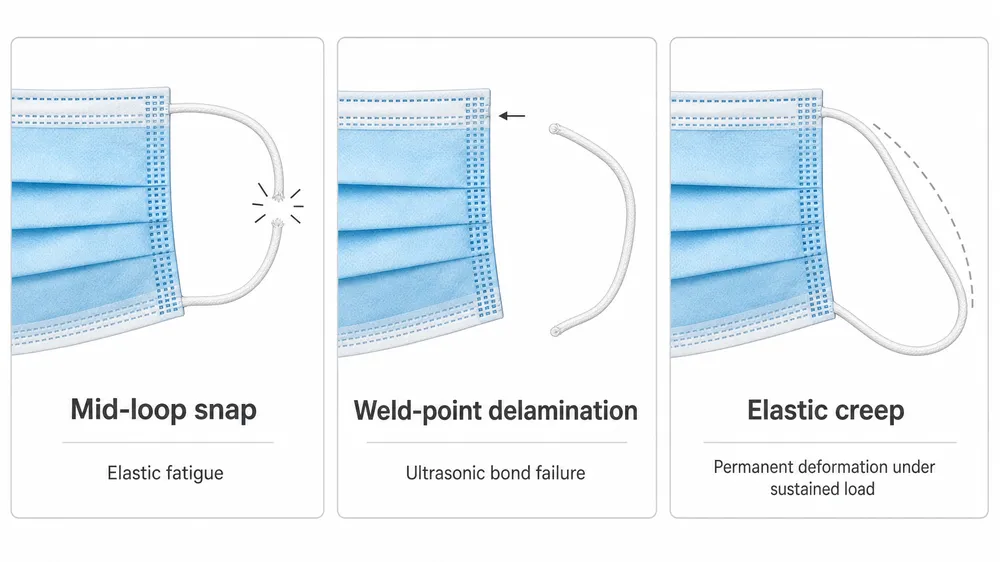
Three failure modes account for the majority of ear loop complaints in the field. Each has a different root cause and a different point of control in the supply chain.
Snap failure (elastic fatigue)
The loop breaks during normal use, typically after repeated donning and doffing cycles. Root cause is almost always elastic material quality — specifically, the rubber or elastane content and the knit construction. Low-grade elastic loses tensile strength after 20–30 flex cycles. Better-grade elastic maintains >80% of its initial break force after 100 cycles.
Sourcing implication: ask for cyclic fatigue test data, not just static break force. A loop that tests at 18 N on a new sample but drops to 9 N after 50 cycles is a field failure waiting to happen. This is especially relevant for masks sold into clinical settings where a single mask may be donned and doffed multiple times during a shift.
Weld-point delamination
The loop separates from the mask body at the ultrasonic weld point, often without the elastic itself breaking. This is the most common failure mode we see in masks from factories that don't control their ultrasonic welding parameters tightly.
Ultrasonic welding bonds the ear loop to the mask body by converting high-frequency vibration into localized heat at the interface. The bond strength depends on three parameters: amplitude, pressure, and weld time. If any of these drifts — and they do drift on machines that aren't regularly calibrated — the weld becomes either under-bonded (low peel strength) or over-bonded (brittle, prone to cracking under flex).
We run our ultrasonic welding lines with defined parameter windows and check weld-point peel strength at in-process inspection intervals. The target is that the weld-point break force exceeds the elastic body break force — meaning the loop should snap before the weld peels. If a sample fails at the weld point below the elastic body break force, the weld parameter is out of spec and the line stops.
Sourcing implication: when evaluating a supplier, ask specifically where the break occurs in their tensile test samples. A supplier whose samples consistently break at the weld point below 15 N has a process control problem that static break force numbers won't reveal.
Elastic creep (permanent deformation)
The loop doesn't break — it stretches out permanently over time, losing its clamping force. This is a material selection issue, not a weld issue. It's most common with elastic that has a high synthetic rubber content but low recovery characteristics, or with loops that are stored under tension (e.g., masks packed tightly in bulk bags where the loops are compressed for extended periods).
Sourcing implication: for masks with long shelf lives or those going into stockpile programs, ask about elastic recovery after sustained elongation. A simple test: stretch the loop to 150% of its natural length, hold for 24 hours, release, and measure the residual elongation. Good elastic recovers to within 5–10% of its original length. Poor elastic may show 20–30% permanent set.
How to Evaluate Ear Loop Spec During Supplier Qualification
The spec sheet a supplier sends you is a starting point, not a verification. Here's what to actually ask for and check.
At RFQ stage:
- Request the ear loop material specification: fiber content, construction type (flat knitted / round braided / laminated), and nominal width or diameter.
- Request the break force test report with sample size, test method, and break location noted.
- Ask whether tensile testing is performed on incoming elastic lots or only on finished masks. The answer tells you a lot about the factory's QC discipline.
- Ask for the elastic supplier's name or at least the country of origin. Elastic from established textile mills in Zhejiang or Fujian has a different quality baseline than unspecified domestic sourcing.
At sample evaluation stage:
- Test the break force yourself or through a third-party lab. Don't rely solely on the supplier's report for your first order.
- Perform a manual peel test on the weld point: grip the loop close to the weld and pull perpendicular to the mask body. The weld should resist cleanly; any peeling or delamination at low force is a red flag.
- Wear-test the sample for at least 4 hours. Ear discomfort that appears after 2 hours is a clamping force issue that won't show up in any lab test.
- Check loop length consistency across 10 samples. Variation of more than ±5 mm indicates a cutting or feeding process that isn't controlled.
Documentation to request before placing a production order:
- Incoming inspection records for the elastic lot used in your samples
- Ultrasonic weld parameter log (amplitude, pressure, weld time) for your mask configuration
- ISO 13485 lot traceability record linking the elastic lot to the finished mask batch
That last item matters if you're selling into hospital procurement or government tenders where your buyer may face a compliance audit. Under ISO 13485, every component lot used in a finished medical device batch must be traceable. A factory that can't produce this documentation isn't running a compliant QMS — regardless of what their certificate says.
eztio's Ear Loop QC Process: What We Control and Why
Our ear loop QC runs at three points: incoming inspection, in-process, and outgoing.
At incoming inspection, every elastic lot is tested for tensile strength before it enters the production floor. We pull samples from each incoming roll, run them through our tensile tester, and compare against our internal spec (minimum 18 N break force for standard surgical mask configurations, with break location in the elastic body, not at a pre-existing defect). Lots that don't meet spec are rejected and returned. This step is what separates a factory that controls its inputs from one that discovers problems after production.
In-process, our ultrasonic welding parameters are logged for each production run. Weld amplitude, pressure, and time are set to a defined window for each mask configuration, and the parameters are verified at the start of each shift and after any machine adjustment. We check weld-point peel strength at defined intervals — not just at the end of the run. If a weld-point failure appears during in-process inspection, the line stops and the parameter is corrected before production continues.
Under our ISO 13485:2016 QMS, each ear loop lot is documented with a lot number that links to the finished mask batch record. If you receive a shipment and need to trace the elastic lot — for a procurement audit, a regulatory inquiry, or a field complaint investigation — we can pull that record. (We've had buyers ask for this documentation during hospital tender qualification. Having it ready is the difference between passing the audit and scrambling to reconstruct records that don't exist.)
Our Ear Loop Disposable Medical Masks are produced under this QC framework, with test reports available for each production batch. If your procurement spec requires a specific break force threshold above the EN 14683 minimum, we can confirm compliance and provide the supporting test documentation with your sample order.
For buyers evaluating Disposable Medical Masks across multiple configurations, the ear loop spec is one of the parameters we discuss upfront — along with filtration performance and packaging requirements — so there are no surprises at the compliance review stage.
Frequently Asked Questions
What is the minimum ear loop break force required by EN 14683?
EN 14683:2019+AC:2019 Annex C specifies a minimum attachment force of ≥10 N per ear loop. This applies to both the elastic body and the weld-point attachment. In practice, masks targeting hospital procurement or government tenders are typically specified at 15–25 N to provide margin above the regulatory floor.
How do I tell whether an ear loop failure is a material problem or a weld problem?
Look at where the break occurs. If the elastic body snaps and the weld point remains intact, the issue is elastic material quality or fatigue. If the loop separates from the mask body at the weld point — especially at forces below the elastic body break force — the issue is ultrasonic weld parameter control. A supplier's tensile test report should note break location, not just break force. If it doesn't, ask.
Does ASTM F2100 specify ear loop tensile strength?
ASTM F2100 covers filtration performance (BFE, PFE), breathability (Delta-P), and fluid resistance — it does not set a specific ear loop break force requirement. For masks sold into US hospital procurement, ear loop tensile strength is typically evaluated against EN 14683 Annex C thresholds or buyer-specified internal standards. FDA 510(k) registration does not automatically require a specific ear loop break force, but hospital GPO contracts often do.
What loop length is standard for adult disposable medical masks?
Most adult surgical and procedure masks use ear loops in the 170–200 mm range (measured as the total loop circumference). The exact length is a design parameter that affects clamping force — shorter loops increase ear pressure, longer loops reduce it. If your end users report ear discomfort, loop length and elastic stiffness are the two variables to investigate first.
What documentation should I request to verify ear loop spec compliance?
At minimum: a tensile test report specifying test method, sample size, break force values, and break location. For ISO 13485-compliant suppliers, also request the incoming inspection record for the elastic lot and the lot traceability record linking that elastic lot to your finished mask batch. These documents are what survive a procurement audit — a spec sheet alone does not.
Can ear loop spec be customized for private-label programs?
Yes. Loop length, elastic type, and break force target can all be specified as part of an OEM program. If your target market has specific comfort requirements (pediatric masks, extended-wear clinical masks, masks for users with sensitive skin), those parameters can be built into the product spec before production. The constraint is MOQ — custom elastic configurations typically require a higher minimum to justify the material procurement and line setup. Request a quote with your target spec and we'll confirm feasibility and minimum volume.